
Low Voltage Structured Cabling: 10 Powerful Benefits in 2025
The Foundation of Modern Business Communication
Hey there! Let me tell you about something that might not sound exciting at first, but is absolutely crucial to how modern businesses function. Low voltage structured cabling is essentially the unsung hero behind your office walls – it’s an organized system of cables and hardware carrying electrical signals below 50 volts that forms the backbone of nearly all your business communications.
Unlike the standard electrical wiring powering your lights and computers, this specialized infrastructure supports everything that makes your business tick – data networks, voice systems, security cameras, video conferencing, and so much more.
Think of it as your building’s nervous system. Just as your nerves connect every part of your body to your brain, structured cabling connects all your technology to your network core. And just like a well-functioning nervous system, you probably don’t notice it until something goes wrong!
Here’s a quick reference to help you understand what we’re talking about:
| Aspect | Details |
|---|---|
| Definition | A standardized cabling infrastructure carrying less than 50V for data and communications |
| Primary Uses | Network connectivity, telephone systems, security cameras, AV systems, Wi-Fi |
| Key Benefits | Reliability, scalability, future-proofing, easy troubleshooting, reduced downtime |
| Cable Types | Cat5e (1 Gbps), Cat6 (10 Gbps), Cat6A (10 Gbps at longer distances), Fiber optic |
| Lifespan | 15-20 years when properly installed and certified |
| Components | Patch panels, racks, faceplates, cable runs, telecommunications rooms |
What makes low voltage structured cabling truly powerful is its organization. Rather than running individual cables directly between devices (creating the dreaded “spaghetti mess”), structured cabling follows a methodical approach with six standardized subsystems: entrance facilities, equipment rooms, backbone cabling, horizontal cabling, telecommunications rooms, and work areas.
When properly installed, this systematic approach can reduce network downtime by up to 50% and support multiple generations of hardware upgrades without requiring a complete overhaul. It provides consistent performance across all connected devices and makes troubleshooting infinitely easier when issues do arise.
I’m Corin Dolan, and I’ve spent over 30 years helping businesses transform their connectivity through properly engineered cable infrastructure. My team at AccuTech Communications has designed and implemented structured cabling systems across Massachusetts, New Hampshire, and Rhode Island, always balancing current needs with future scalability.
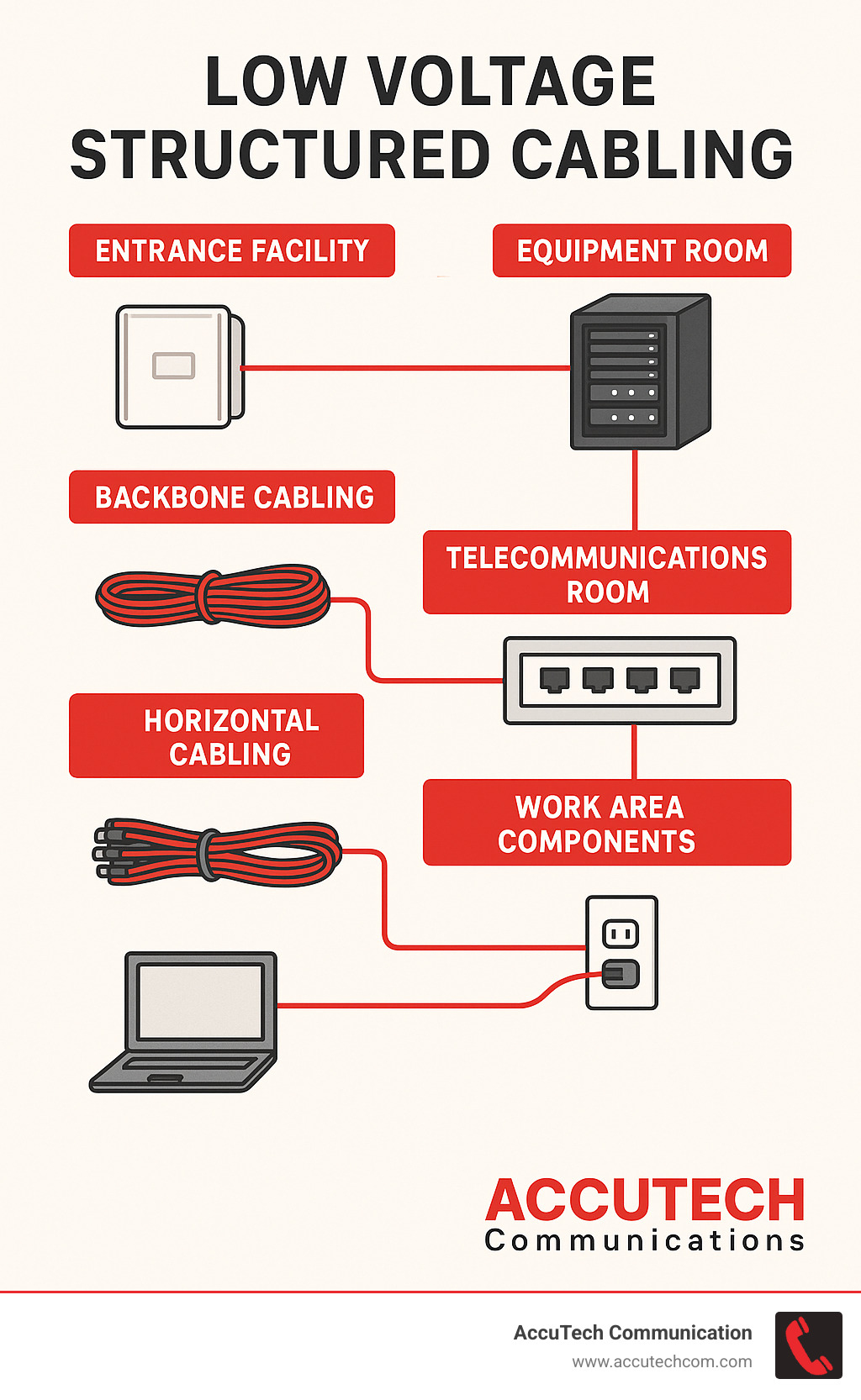
We’ve seen how a professional horizontal cabling structure can transform business operations. The right network data wiring isn’t just about connecting computers – it’s about creating a foundation that supports your business today while being ready for whatever technologies emerge tomorrow.
What Is Low Voltage Structured Cabling?
Low voltage structured cabling refers to any cabling system that transmits electrical signals below 50 volts. This threshold isn’t just a technical detail—it’s the dividing line that separates these systems from the standard electrical wiring powering your lights and appliances. But there’s so much more to understand about these vital systems that quietly power our connected world.
The “structured” part is what truly transforms this technology. Unlike the chaotic point-to-point wiring of yesteryear (where devices connected directly to each other with dedicated cables), structured cabling creates an organized infrastructure with central distribution points. This approach turns what could be a tangled nightmare into a methodical system that’s manageable, troubleshootable, and expandable.
I remember a network administrator in Worcester who told us, “Before our structured cabling upgrade, tracing a connection problem was like solving a puzzle blindfolded. Now it’s as simple as checking a label.” That’s the real-world impact of good design!
Definition & Core Principles
At its heart, low voltage structured cabling focuses on signal transmission rather than power delivery. While your electrical wiring delivers the juice to run devices, structured cabling transmits information between them. It’s a bit like comparing a water main (power) to a telephone line (signal)—both essential but serving completely different purposes.
The central distribution concept is what makes structured cabling truly shine. Instead of running direct cables between devices (creating a mess that multiplies with each new connection), all connections route through organized patch panels in telecommunications rooms. This creates a clean hierarchy:
- Horizontal cabling connects work areas to telecommunications rooms
- Backbone cabling links telecommunications rooms to each other
- Patch panels and cross-connects enable flexible connections
This thoughtful hierarchy delivers impressive longevity. While your computers and phones might need replacing every few years, a properly designed low voltage structured cabling system can serve your business for 15-20 years, spanning multiple generations of technology. That’s value you can count on!
Low Voltage vs. High Voltage Electrical Wiring
The differences between low voltage and high voltage wiring go far deeper than just the voltage levels:
| Characteristic | Low Voltage Structured Cabling | High Voltage Electrical Wiring |
|---|---|---|
| Voltage | Less than 50V | 120V-480V (typical in US) |
| Primary Purpose | Data and signal transmission | Power delivery |
| Safety Risk | Minimal shock hazard | Significant shock/fire hazard |
| Installation Requirements | BICSI certification recommended | Licensed electrician required |
| Regulatory Oversight | Less stringent, follows TIA/EIA standards | Strict NEC code compliance |
| Energy Efficiency | Very high (minimal power consumption) | Varies by application |
| Typical Applications | Networks, phones, AV, security | Lighting, appliances, HVAC |
The safety advantage cannot be overstated. Low voltage structured cabling poses minimal risk of serious electrical shock or fire, though proper installation remains important. This inherent safety is one reason why these systems can be more flexible in their deployment.
Energy efficiency is another wonderful benefit. These systems draw minimal power, resulting in lower operational costs over time—especially important in larger installations with hundreds or thousands of connection points. Who doesn’t love saving money while being more environmentally conscious?
How Low Voltage Structured Cabling Supports PoE
Power over Ethernet (PoE) represents one of the most exciting innovations in low voltage structured cabling. PoE allows both data and electrical power to travel over the same cable, eliminating the need for separate power outlets for many modern devices.
This capability has transformed how we deploy everything from IP security cameras and VoIP phones to wireless access points and smart lighting systems. Access control systems and digital signage have also benefited tremendously from this technology.
I recently worked with a Boston financial services firm that eliminated over 200 power outlets by switching to PoE-powered desk phones and security cameras. They saved thousands in electrical installation costs while creating a cleaner, more flexible workspace.
Modern PoE standards can deliver up to 90 watts of power—enough to run computers, displays, and even small appliances—all over standard network cabling. This convergence of power and data creates tremendous flexibility in office layouts and device placement. Want to put a phone, security camera, or wireless access point somewhere without a nearby outlet? With PoE, no problem!
Common Misconceptions About Low Voltage Structured Cabling
Despite its importance, several myths continue to circulate about low voltage structured cabling:
Myth 1: “Structured cabling is only for large enterprises.”
Reality: Businesses of all sizes benefit from structured cabling. Even a small office with 10-15 employees gains significant advantages in reliability, performance, and future flexibility. I’ve seen small medical practices completely transform their operations with properly designed systems.
Myth 2: “Wireless technology makes cabling obsolete.”
Reality: While wireless technology offers convenience, it simply cannot match the reliability, bandwidth, and low latency of a wired network. Even the most advanced wireless systems rely on a robust wired backbone. They’re complementary technologies, not replacements for each other.
Myth 3: “All cable categories are essentially the same.”
Reality: The performance differences between cable categories (Cat5e, Cat6, etc.) are substantial. Using the wrong category can throttle network throughput, reducing delivered bandwidth well below what you’re paying for. It’s like buying a sports car but putting economy tires on it!
Myth 4: “DIY installation saves money.”
Reality: The most expensive cable is always the one that needs to be installed twice. Professional installation prevents costly rework and performance issues that can plague DIY attempts. The peace of mind alone is worth the investment.
When properly designed and installed by certified professionals like our team at AccuTech Communications, low voltage structured cabling provides the reliable foundation that modern businesses need to thrive in an increasingly connected world.
Components & Subsystems of a Structured Cabling System
A complete low voltage structured cabling system is like a well-orchestrated symphony, with six distinct subsystems playing together to create perfect harmony in your network. Understanding these components helps you appreciate how the entire system works together to keep your business connected.
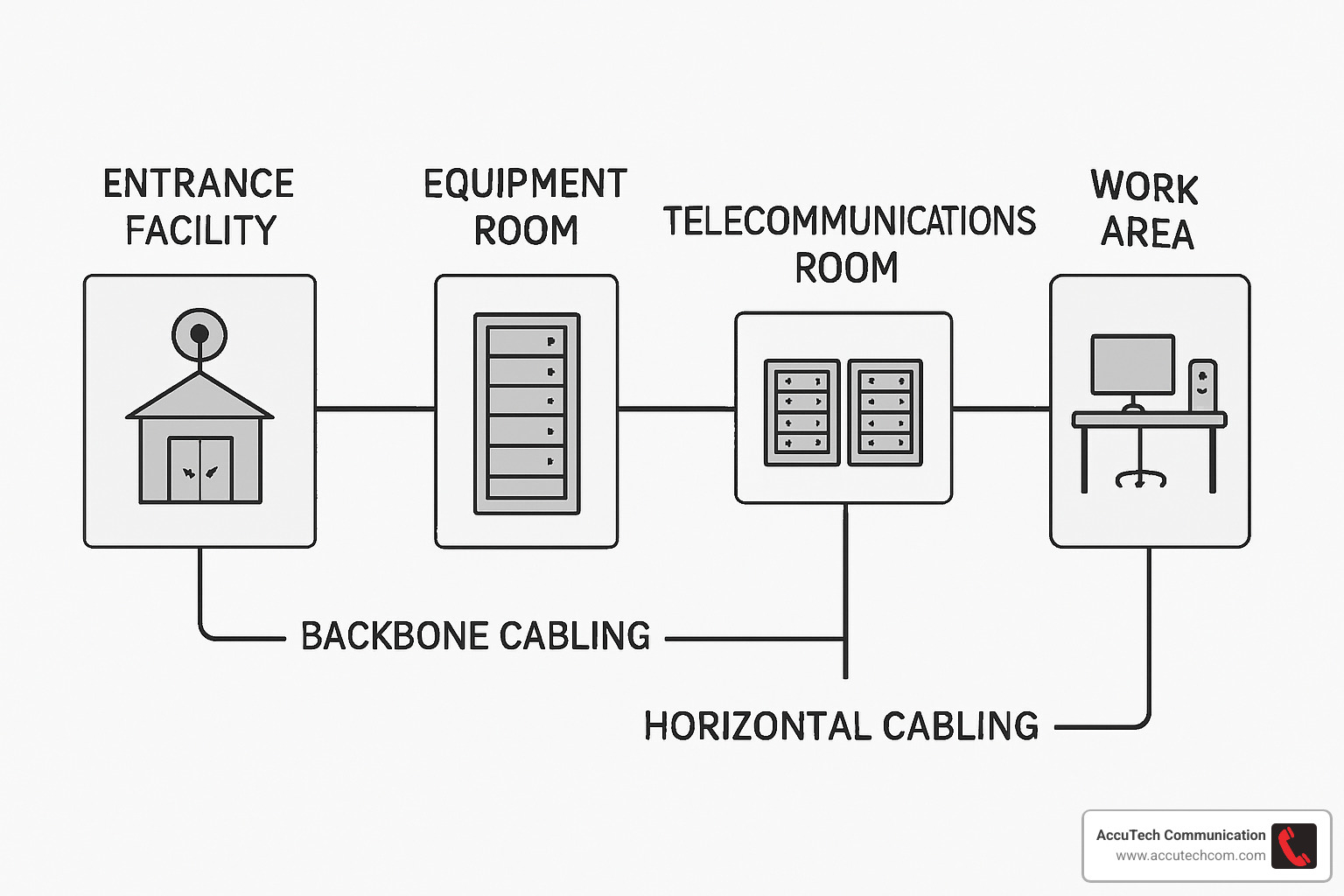
Entrance Facility & Demarcation Point
Think of the entrance facility as your building’s digital front door – it’s where external telecommunications services enter your property. This junction (often called the “demarc”) marks the dividing line between what belongs to your service provider and what belongs to you.
When we designed an entrance facility for a medical center in Woburn, we didn’t just focus on today’s needs. We built in capacity for three additional service providers and created diverse entry paths to ensure the facility would stay connected even if one path got damaged. Smart planning like this prevents headaches down the road.
Key elements here include surge protection devices to guard against lightning strikes, transition hardware to convert outdoor cables to indoor-friendly versions, and cross-connect hardware that helps distribute services throughout your building. This area requires thoughtful security planning – it’s essentially the gateway to your entire network.
Backbone & Horizontal Cabling Paths
If your network were a tree, the backbone cabling would be the trunk. Sometimes called vertical cabling, it connects your entrance facility, equipment rooms, and telecommunications rooms, carrying large amounts of aggregated traffic between these distribution points.
The backbone typically uses fiber optic cables for those high-bandwidth, long-distance runs. As one network manager told me after we completed their installation, “It’s like going from a country road to a superhighway.” Multi-pair copper cables often handle voice connections, while coaxial cables might distribute video signals.
Branching out from this backbone is the horizontal cabling – the pathways that extend from telecommunications rooms to individual work areas. These must follow strict guidelines, including a maximum copper cable length of 90 meters (about 295 feet). When we installed over 1,200 horizontal cable runs for a pharmaceutical research facility in Marlborough, each one was carefully labeled and tested to ensure their sensitive equipment would function flawlessly.
Telecommunications Rooms & Equipment Rooms
Telecommunications rooms are the neighborhood hubs of your network – they house the connection hardware linking your backbone to your horizontal cabling. These spaces need careful planning, with proper equipment racks, patch panels, and cable management systems that keep everything organized.
“A messy telecommunications room is like trying to find your car keys in a teenager’s bedroom,” as I often tell clients. Proper organization here makes troubleshooting infinitely easier when issues arise. These rooms also need adequate cooling, power, and physical security measures to protect your investment.
For larger facilities, equipment rooms serve as central connection points, housing servers, core network equipment, and primary distribution frames. These spaces demand even more rigorous environmental controls, typically including redundant power and cooling systems to prevent downtime.
Work Area & Patch Cords
The work area is where the rubber meets the road – or in this case, where your employees actually connect to the network. This subsystem includes the wall plates and modular outlets you see around your office, along with the patch cords that connect computers and phones to these outlets.
The beauty of this modular approach is the flexibility it offers. When a marketing agency in Boston needed to reconfigure their entire office layout, the low voltage structured cabling system we had installed allowed them to complete the move in a single weekend without modifying any permanent cabling. Employees simply unplugged from one location and plugged in at another.
This plug-and-play capability makes moves, adds, and changes remarkably simple – something every growing business appreciates. It’s one of the many ways a properly designed structured cabling system pays dividends long after installation.
At AccuTech Communications, we’ve been designing and installing these systems since 1993, creating organized, reliable infrastructures that grow with our clients’ needs. A thoughtfully planned system isn’t just about today’s connectivity – it’s about creating a foundation that will support your technology needs for years to come.
Cable Types & Performance Characteristics
The backbone of any low voltage structured cabling system is the cables themselves. Just like choosing the right vehicle for different journeys, selecting the appropriate cable type dramatically impacts your network’s performance, reliability, and longevity.
Copper Twisted-Pair Categories
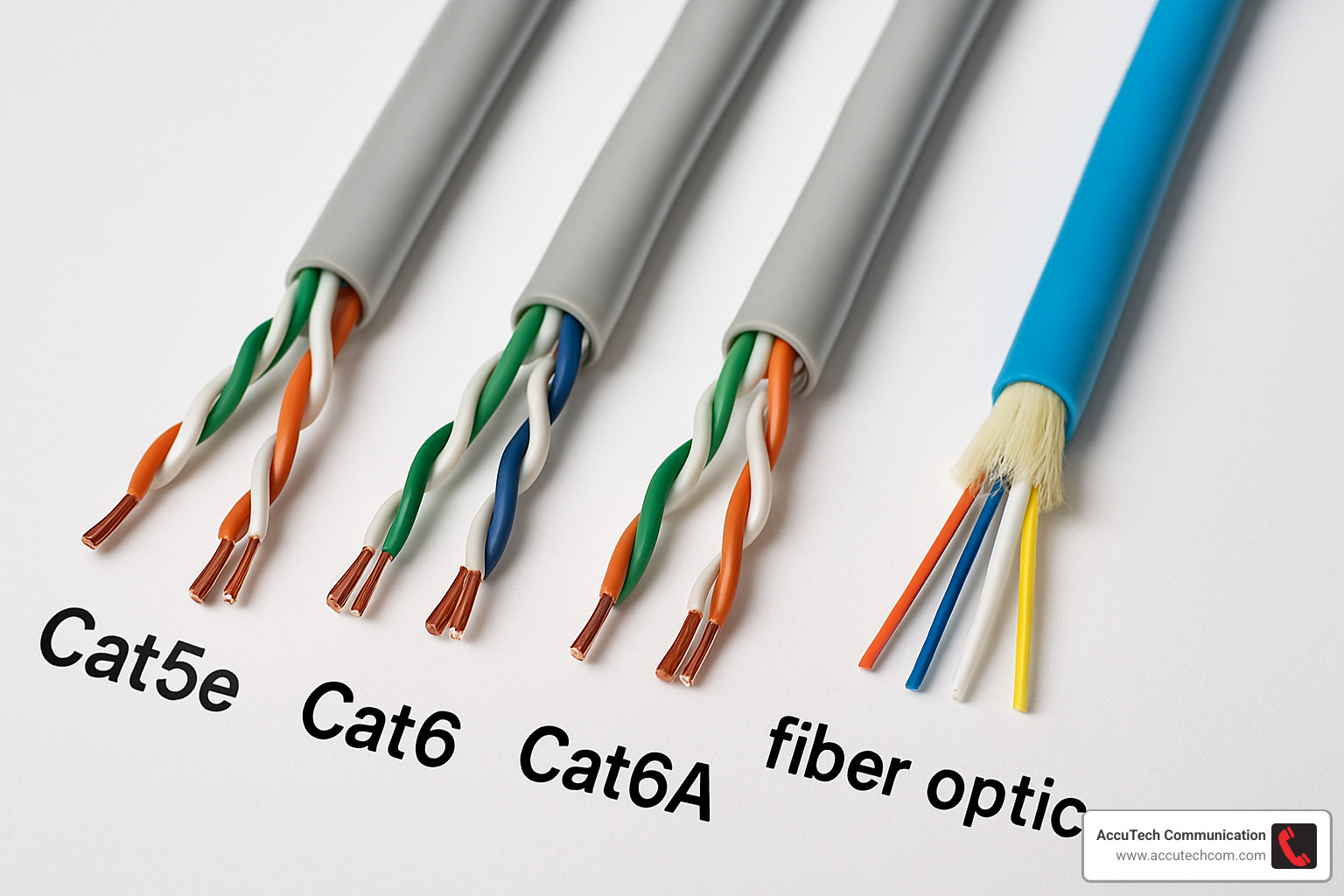
Twisted-pair copper cables remain the workhorses of most office networks. Think of the category (Cat) ratings as performance tiers, each offering different capabilities:
Cat5e (Improved Category 5) delivers reliable 1 Gigabit performance at an economical price point. With 350 MHz of bandwidth and support for runs up to 100 meters, it’s still perfectly adequate for many small businesses. I’ve seen Cat5e installations from the early 2000s that continue to serve basic office needs without issues.
Cat6 (Category 6) steps things up with 550 MHz bandwidth and support for 10 Gigabit speeds at distances up to 55 meters. This sweet-spot option offers excellent future-proofing without breaking the bank. When we upgraded a growing accounting firm in Framingham last year, we recommended Cat6 throughout their space, giving them room to grow without overspending.
Cat6A (Augmented Category 6) is the performance champion for most commercial applications. With 750 MHz bandwidth and full 10 Gigabit speeds at the maximum 100-meter distance, it also provides superior protection against alien crosstalk (signal interference between adjacent cables). Yes, the cables are slightly thicker, but that’s a small price to pay for the performance benefits.
Cat8 (Category 8) is the thoroughbred of copper cabling, delivering a whopping 2,000 MHz bandwidth and speeds up to 40 Gigabits per second. However, it’s limited to 30-meter runs and comes with a premium price tag. We typically only recommend Cat8 for specialized data center connections where every millisecond counts.
I remember a medical imaging center in Boston that insisted on Cat5e to save costs. Six months later, they called us back to upgrade everything to Cat6A because their new diagnostic equipment overwhelmed the network. The lesson? Balance initial costs against future needs – sometimes spending a bit more upfront saves a fortune later.
Fiber Optic Options
Fiber optic cables transmit data as pulses of light rather than electrical signals, offering tremendous advantages for certain applications:
Multimode Fiber serves as the workhorse for in-building fiber runs. Available in OM3, OM4, and OM5 grades, it supports speeds from 10 to 100 Gigabits with distance limits between 300-500 meters depending on the specific type. The aqua-colored jacket of OM3/OM4 fiber has become a familiar sight in modern telecom rooms.
Single-mode Fiber is the long-distance champion. Its narrower light path allows signals to travel for kilometers without degradation, making it perfect for campus connections or linking buildings across town. While the electronics cost more than multimode, the cable itself is actually less expensive – a fact that surprises many of our clients.
One of my favorite success stories involved a manufacturing facility in Worcester that struggled with network reliability on their production floor. The electromagnetic interference from their equipment constantly disrupted copper connections. We installed armored fiber optic cabling throughout the facility, completely immune to electromagnetic disturbance. Three years later, they haven’t experienced a single connectivity issue.
Coaxial & Specialty Low Voltage Cables
While twisted pair and fiber dominate modern networks, several specialty cables still play crucial roles in comprehensive low voltage structured cabling systems:
Coaxial Cable remains essential for certain applications. Traditional RG-6 or RG-11 cables distribute video signals, support legacy CCTV systems, and form the backbone of Distributed Antenna Systems (DAS) that improve cellular coverage inside buildings. Despite being an older technology, coax still offers unique benefits that newer cables can’t match for certain applications.
Speaker Wire connects audio systems throughout facilities, from background music to emergency announcement systems. The gauge (thickness) varies based on distance and power requirements, with specialized versions available for plenum spaces above drop ceilings.
Security and Sensor Cables form the nervous system of modern building automation. From access control door contacts to environmental monitors and fire alarm systems, these specialized cables often follow their own code requirements and installation standards.
I recall a historic hotel renovation in Providence where we integrated network cabling, video distribution, access control, and distributed audio throughout the property. By designing a unified pathway system with appropriate separations between different cable types, we prevented interference while maintaining the building’s historic character. The hotel manager later told us the invisible infrastructure was as important to guest experience as the visible renovations.
When planning your cable infrastructure, skimping on quality rarely pays off. As we tell our clients: cables are typically less than 10% of your total IT budget but can cause 90% of your connectivity headaches if you choose poorly. At AccuTech Communications, we help you select the right cable types for both current needs and future growth, ensuring your investment delivers maximum value for years to come.
Learn more about our approach to Low Voltage Cabling or explore how our ISO standards on structured cabling compliance ensures your installation meets global best practices.
Applications & Benefits for Businesses and Homes
Have you ever stopped to think about how much of your daily life depends on reliable connections? From the moment you check your email in the morning to setting your smart thermostat at night, low voltage structured cabling quietly powers the technologies we’ve come to rely on.
Let me walk you through how these humble cables are changing both workplaces and homes—and why they matter more than you might think.
Business Use Cases
When I visited a data center in Boston last month, I was struck by the beautiful organization of their cabling system. The technician smiled and said, “This isn’t just for looks—every cable here has a purpose.” He was right. In data centers, carefully managed Cat6A and fiber connections don’t just reduce visual clutter—they improve airflow cooling, prevent signal interference, and enable quick troubleshooting when seconds count.
Open offices present their own challenges. Remember the days of tripping over extension cords during office reconfigurations? Modern workplaces now use zone cabling with strategically placed consolidation points, making desk moves as simple as unplugging from one location and plugging into another. One marketing agency in Cambridge told me they completely redesigned their office layout in a weekend without calling a single technician—all thanks to their flexible structured cabling system.
Retail environments have unique needs too. When a shop in Providence installed a proper low voltage structured cabling system, they integrated their security cameras, digital signage, inventory tracking, and point-of-sale systems into one cohesive network. The owner told me, “Before, everything was on separate systems. Now it all works together, and my IT costs have dropped by almost 30%.”
For warehouses and manufacturing facilities, reliability is everything. These environments need ruggedized cabling that can withstand temperature fluctuations, dust, and sometimes even chemical exposure. We recently completed a warehouse project in Waltham with over 800 network connections, 120 security cameras, and 45 wireless access points—all supported by a single, integrated structured cabling system designed to grow with their business for the next decade.
Residential & Smart-Home Scenarios
“I never thought I’d need professional cabling in my house,” a homeowner in Sudbury told me recently. “Now I can’t imagine living without it.” His luxury home features over 60 low voltage connections supporting everything from automated shades to whole-home audio and comprehensive security—all managed through a central equipment room that rivals many small businesses.
The smart home revolution has brought commercial-grade connectivity needs right into our living rooms. Media distribution is no longer just about cable TV—it’s about supporting multiple 4K streams, video conferencing from any room, and whole-home audio systems that follow you from kitchen to patio.
Home security has evolved far beyond a simple alarm panel. Today’s systems incorporate multiple cameras, doorbell monitors, motion sensors, and environmental detectors—all requiring reliable connections. With low voltage structured cabling and Power over Ethernet, these devices can operate even during power outages when paired with backup systems.
Even climate control has gone high-tech. One homeowner in Newton told me his smart thermostats, automated blinds, and zone-controlled HVAC system save him hundreds on energy bills while keeping his historic home perfectly comfortable year-round. The key to making it all work seamlessly? You guessed it—properly installed structured cabling.
Key Benefits Explained
Why does all this matter? The benefits go far beyond just having working technology.
Reliability is perhaps the most important advantage. A properly installed system can operate for decades with minimal issues. When a manufacturing company in Worcester upgraded their haphazard network cabling to a structured system, their IT director told me, “We went from weekly connectivity problems to virtually none. I actually get to focus on improvements now instead of just putting out fires.”
Reduced downtime translates directly to better productivity and lower costs. Structured systems can cut network outages by up to 50% through quick identification and resolution of issues. The logical organization makes troubleshooting straightforward—no more tracing mystery cables through ceiling tiles or behind walls.
Future-proofing might be the most underappreciated benefit. Technology evolves rapidly, but a well-designed cabling infrastructure can support multiple generations of equipment. One financial services firm we worked with has upgraded their computers and network equipment three times in the past decade without touching their underlying cabling infrastructure.
There’s a reason professional IT managers prioritize quality cabling—they understand it’s an investment, not an expense. As one client put it after seeing the difference a professional installation made: “The most expensive cable is the one you have to install twice.”
Want to learn more about how structured cabling services can transform your business or home connectivity? Check out our Structured Cabling Services page for detailed information about our approach and solutions.
Design, Installation & Future-Proofing Best Practices
Creating an effective low voltage structured cabling system requires careful planning and execution. Following industry best practices ensures optimal performance, longevity, and return on investment.
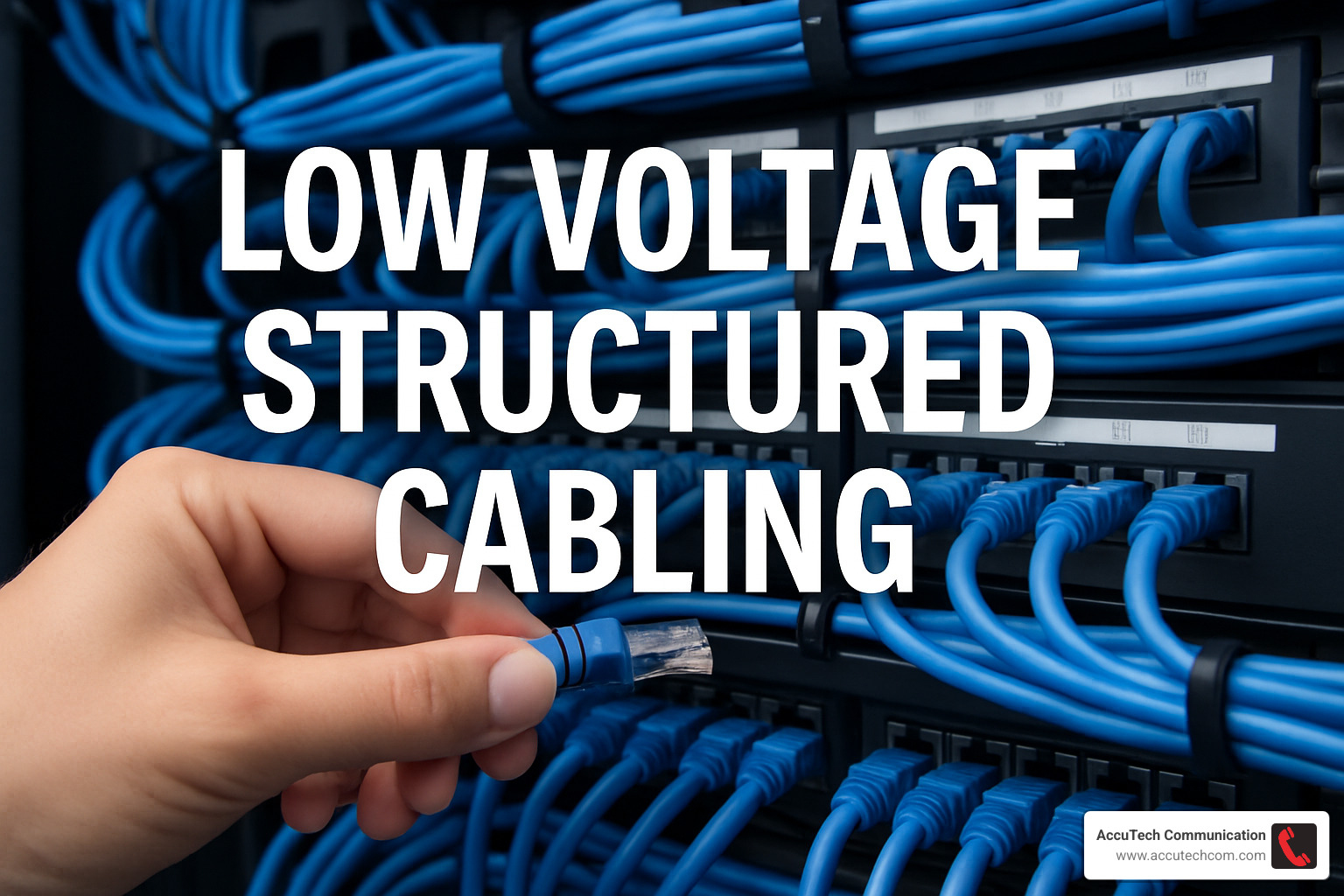
Following Industry Standards & Certifications
When I’m designing a cabling system for a client, I always start with the standards. They’re not just bureaucratic red tape – they’re the foundation of a system that will serve your business for decades.
ANSI/TIA-568 is the gold standard in North America. Think of it as the “building code” for telecommunications cabling. It defines everything from which cables to use to how far you can run them. I’ve seen how buildings wired to this standard in the 1990s are still supporting modern networks with minimal upgrades.
For our clients with international operations, ISO/IEC 11801 often comes into play. It’s compatible with TIA standards but includes some additional specifications, particularly for industrial environments. One manufacturing client with facilities in both Massachusetts and Europe appreciated our familiarity with both standards, ensuring consistent performance across all their locations.
At AccuTech, we’re proud that our team includes BICSI-certified Registered Communications Distribution Designers (RCDD). This isn’t just another acronym – it represents the highest level of expertise in structured cabling design. When an RCDD designs your system, you’re getting decades of industry knowledge applied to your specific needs.
Step-by-Step Installation Workflow
A quality installation is like baking a cake – skip a step or rush the process, and the results will disappoint. Our workflow has been refined over thousands of installations since 1993.
We start with planning and design, where we conduct a thorough site survey and needs assessment. I remember walking through an old mill building in Worcester that was being converted to offices – identifying pathway challenges early saved our client thousands in unexpected costs later. During this phase, we develop detailed CAD drawings that serve as the blueprint for the entire project.
During the rough-in phase, we build the infrastructure that will support your cables for decades. This includes installing pathways like conduit or cable trays, making necessary wall penetrations (with proper fire-stopping), and pulling cables with carefully monitored tension. As one of our technicians likes to say, “Treat each cable like it’s going to carry your paycheck – because someday it might!”
The termination and finish stage is where precision matters most. Each cable is terminated following manufacturer guidelines, with patch panels carefully organized and labeled. One Boston financial firm told me they could immediately tell the difference between our work and their previous installer’s – “It’s like comparing a custom suit to off-the-rack.”
We never consider a job complete without testing and certification. Every single link is tested with professional-grade equipment (we use Fluke testers), and you receive documentation proving your system meets or exceeds the standards. When we completed a system for a healthcare provider with over 1,200 connections, every single one passed certification testing the first time – that’s the AccuTech difference.
Finally, comprehensive documentation and handover ensures you understand exactly what was installed and how to manage it. Your package includes as-built drawings reflecting the actual installation, test results, warranty information, and training for your team.
Supporting Emerging Technologies
The structured cabling you install today will likely support several generations of technology. That’s why we design with the future in mind.
High-speed networking requirements continue to grow exponentially. While 1 Gigabit was once considered blazing fast, many of our clients now need 10 Gigabit to their desktops, with 40/100 Gigabit in their data centers. A properly designed Cat6A or fiber optic infrastructure can support these speeds, but only if installed with meticulous attention to detail. I’ve seen too many “budget” installations fail to deliver the rated performance because of poor installation practices.
Modern wireless systems actually increase the need for good cabling. It sounds counterintuitive, but Wi-Fi 6 and the upcoming Wi-Fi 7 require more access points with higher-capacity wired connections behind them. Plus, with Power over Ethernet (PoE++) now delivering up to 90 watts, your cabling infrastructure needs to handle both data and significant power delivery without overheating.
The rise of edge computing means processing is moving closer to end devices, creating mini data centers throughout your facility. One retail client in New Hampshire installed micro data centers in their telecommunications rooms to process in-store analytics locally, reducing latency and cloud costs. Their structured cabling system made this evolution seamless.
The explosion of IoT devices is perhaps the biggest challenge for modern networks. A manufacturing client went from 50 connected devices to over 500 in just three years as they implemented smart factory technologies. Because we had designed their cabling infrastructure with growth in mind, they accommodated this massive expansion without a major overhaul.
When to Upgrade or Expand
Even the best cabling system eventually needs updating. Here are the signs it might be time for an upgrade:
Physical changes to your workspace often necessitate cabling updates. When a marketing agency in Boston expanded to an additional floor, we extended their existing infrastructure while maintaining the same standards and documentation. The seamless integration made the expansion feel like it had been part of the original design.
Watch for performance limitations in your network. If users are complaining about slow file transfers or video conferences are freezing, your cabling might be the bottleneck. A law firm in Providence contacted us after noticing deteriorating application performance despite upgrading their servers. The culprit? Twenty-year-old Category 5 cabling that simply couldn’t handle modern demands.
Technology evolution can outpace your infrastructure. A healthcare provider implementing a new imaging system finded their legacy cabling couldn’t support the bandwidth requirements. Rather than just addressing that specific need, we helped them develop a phased upgrade plan that minimized disruption while creating a platform for their five-year technology roadmap.
New compliance and standards requirements might also drive upgrades. When insurance requirements changed for a financial services client, their outdated cabling represented both a fire risk and a potential coverage issue. Our upgrade not only brought them into compliance but also dramatically improved network performance – a win-win.
Your cabling infrastructure is an investment in your business’s future. As one of our long-time clients puts it: “I don’t think about our structured cabling system every day – and that’s exactly why it was worth doing right.”
Risks of Improper or DIY Cabling & How to Choose a Provider
When it comes to low voltage structured cabling, cutting corners can cost you dearly in the long run. I’ve seen businesses struggle with network issues for months before realizing their cabling was the culprit all along. It’s like building a house on a shaky foundation – everything that sits on top becomes vulnerable.
Warning Signs of a Poor Installation
You don’t need to be a cabling expert to spot the red flags of substandard work. Think of these warning signs as your early detection system before small issues grow into major problems.
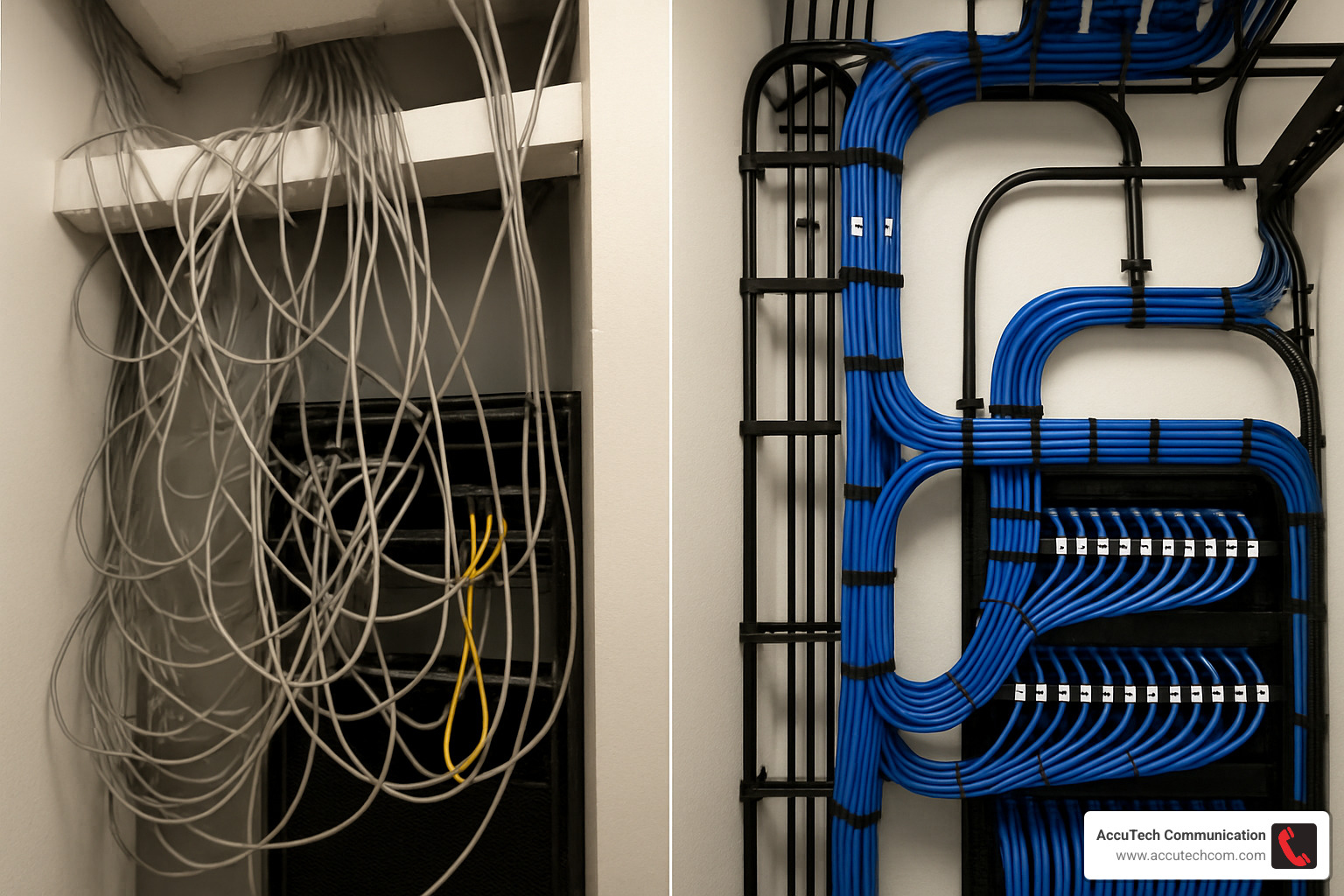
Physical problems are often the easiest to spot. Cables that are tied too tightly or kinked are practically begging for failure. When cables sag without proper support or bend at sharp angles (violating the minimum bend radius), they’re experiencing physical stress that will eventually compromise performance. And those missing fire-stops at wall penetrations? They’re not just code violations – they’re genuine safety hazards.
Organization issues might seem merely aesthetic, but they reveal much deeper problems. A telecommunications room without consistent labeling or proper cable management isn’t just messy – it’s a troubleshooting nightmare waiting to happen. When a network issue strikes (and it will), finding the right connection becomes like searching for a needle in a haystack.
I remember walking into a telecommunications closet at a law firm in Boston where the previous installer had left a tangled web of unlabeled cables. When they experienced network problems, their IT team spent countless billable hours just trying to identify which cable connected to which office. What could have been a 15-minute fix became a full-day ordeal.
Performance problems are the most frustrating consequences of poor installation. Mysterious disconnections, speeds far below what you’re paying for, and inconsistent performance across your network are often traced back to cabling issues. These problems typically worsen over time as cables degrade or become damaged.
A healthcare facility in Rhode Island called us after experiencing mysterious network outages. Our inspection revealed cables improperly installed above a hot water pipe, with heat damage causing intermittent failures. The entire installation required replacement—a costly consequence of improper initial work.
Selecting the Right Partner
Finding the right structured cabling partner isn’t just about getting quotes – it’s about finding a team you can trust with your organization’s nervous system. Here’s what truly matters when making this critical decision:
Credentials speak volumes. Look for technicians with BICSI certifications like RCDD (Registered Communications Distribution Designer), which represents the gold standard in the industry. Manufacturer certifications are equally important as they ensure your installer is properly trained on the specific systems they’re installing. Experience in your specific industry matters too – a hospital’s cabling needs differ dramatically from a warehouse’s requirements.
Design capabilities separate the professionals from the amateurs. A quality provider begins with thorough planning, including professional CAD documentation and a comprehensive needs assessment. They should ask questions about your future growth and technology roadmap, not just your current requirements. The best partners design with excess capacity built in, knowing that technology demands only increase over time.
Quality assurance should be baked into their process. Ask about their testing methodologies and equipment – names like Fluke Networks should come up in conversation. Every single cable run should be tested and certified, with documentation provided to you. This isn’t just paperwork – it’s your insurance policy and troubleshooting resource.
Support and warranty terms reveal their confidence in their own work. A quality installer stands behind their work with clear warranty terms covering both materials and labor. Response time commitments should be explicitly stated, and options for preventative maintenance show they’re interested in a long-term relationship, not just a one-time job.
At AccuTech Communications, we’ve built our reputation over 30 years by focusing on these fundamentals. Our BICSI-certified team approaches each project with the same care, whether it’s a small office or a multi-building campus. We serve businesses throughout Massachusetts, New Hampshire, and Rhode Island with a commitment to quality that has earned us clients who stay with us for decades.
Your low voltage structured cabling system is a long-term investment – typically lasting 15-20 years when properly installed. Choosing the right partner for this infrastructure is one of the most important technology decisions your organization will make. When you work with professional structured cabling installation contractors, you’re not just buying cables and hardware – you’re investing in peace of mind and future-proofing your operations.
Frequently Asked Questions About Low Voltage Structured Cabling
What lifespan can I expect from a structured cabling system?
When clients ask me about longevity, I’m always happy to share some good news. A properly designed and installed low voltage structured cabling system typically lasts 15-20 years—far outliving the 3-5 year lifecycle of the network equipment it connects.
Think of your cabling infrastructure like the foundation of a house. When built right, it supports multiple renovations and updates over decades. This impressive lifespan depends on several key factors: quality of the initial installation, strict adherence to industry standards, appropriate environmental conditions, physical protection of pathways, and selecting the right cable category for your applications.
I’ve seen this with many of our earliest installations from the 1990s. Those systems continue supporting modern applications with minimal upgrades, even as technology has evolved dramatically. It’s quite satisfying to visit a client after 15+ years and see our original infrastructure still performing flawlessly!
How far can I run Cat6 before performance drops?
Distance limitations are among the most common questions we receive, and for good reason—they can make or break your network performance.
For Category 6 cabling, the maximum recommended channel length is 100 meters (328 feet). This includes 90 meters of permanent link (the cable running from your wall outlet to the patch panel) plus 10 meters for patch cords on both ends.
Here’s where things get interesting: if you’re running 10 Gigabit Ethernet, standard Cat6 is actually limited to just 55 meters due to alien crosstalk concerns. For full 10 Gigabit capability at 100 meters, you’ll need to upgrade to Cat6A cabling.
Exceeding these distances isn’t just a theoretical concern—it causes real problems like packet loss, reduced speeds, frustrating intermittent connections, and failed certification tests. I remember a client in Portsmouth who insisted on stretching their Cat6 runs to reach a remote office area. Within weeks, they called us back to install fiber instead, after experiencing exactly these issues.
When you need to go the distance, fiber optic cabling becomes your best friend. Single-mode fiber can carry signals for kilometers rather than meters—perfect for campus environments or connecting separate buildings.
Does fiber always outperform copper?
While fiber optic cabling offers impressive technical advantages, copper twisted-pair cabling remains the most practical and cost-effective solution for many applications. It’s not always about maximum performance—it’s about the right performance for your specific needs.
Fiber shines with its virtually unlimited bandwidth potential, impressive distance capabilities, complete immunity to electromagnetic interference, slimmer cable diameter, and improved security (it’s extremely difficult to tap without detection).
Copper excels with lower equipment costs (switches, patch panels, etc.), simpler termination and testing procedures, native Power over Ethernet capability, more budget-friendly installation, and familiar technology that most technicians understand thoroughly.
In my experience, the smartest approach often combines both technologies. I recently worked with a medical imaging center in Boston that perfectly illustrates this hybrid strategy. We installed fiber to connect their equipment rooms where distance and bandwidth demands were highest, while using Cat6A for workstations and control areas. This balanced their performance needs with budget considerations while giving them room to grow.
The beauty of working with an experienced structured cabling partner is getting this kind of thoughtful, balanced approach rather than a one-size-fits-all solution. At AccuTech, we’ve been designing these hybrid systems since 1993, helping businesses across Massachusetts, New Hampshire, and Rhode Island build infrastructure that stands the test of time.
Conclusion
When I think about what makes modern businesses tick, low voltage structured cabling sits at the heart of it all. It’s not just a collection of wires behind your walls—it’s the lifeblood that keeps your communications flowing, your systems connected, and your business running smoothly day after day.
After helping hundreds of Massachusetts businesses with their connectivity needs, I’ve seen how the right cabling infrastructure transforms operations. A thoughtfully designed system delivers benefits that ripple throughout your entire organization:
Your team experiences fewer frustrating technology interruptions. Your IT staff spends less time troubleshooting mysterious connection problems. And when you need to grow or adapt your technology, you can do so without ripping out walls or disrupting operations.
Since we founded AccuTech Communications back in 1993, we’ve maintained a simple philosophy: build it right the first time. Our BICSI-certified technicians approach each project with meticulous attention to detail, whether we’re outfitting a small medical office in Woburn or designing a multi-building campus network in Worcester.
The technology landscape has changed dramatically over those three decades, but solid infrastructure principles remain constant. A properly installed low voltage structured cabling system still provides the most reliable foundation for whatever innovations the future brings—from increasingly bandwidth-hungry applications to the expanding universe of connected devices.
I’ve walked through too many facilities with tangled cable nightmares to count. The difference between those chaotic installations and our organized, standards-compliant approach isn’t just aesthetic—it directly impacts your bottom line through improved reliability, simplified maintenance, and extended infrastructure lifespan.
Whether you’re planning a new building, renovating your current space, or simply struggling with an aging network that can’t keep up with demands, investing in professional structured cabling pays dividends for years to come. It’s an investment in your organization’s future capabilities and daily operational efficiency.
We’re proud to serve businesses throughout Massachusetts, New Hampshire, and Rhode Island with the cabling expertise they deserve. From Metro-west Boston to Marlborough, Sudbury to Waltham, and beyond, our team brings the same commitment to quality and attention to detail to every project, regardless of size.
Ready to build a rock-solid foundation for your business technology? Let’s talk about how our structured cabling expertise can support your current needs while preparing you for future growth and innovation.
Learn more about our structured cabling services
