Multimode
A wider core that works with lower-cost optics. Built for shorter links inside a building or a data center.
- OM3 carries 10 Gb/s to about 300 meters, OM4 to about 400 meters (IEEE 802.3, 10GBASE-SR)
- Common for backbones within one building
Serving MA, NH & RI since 1993
Network cabling, fiber and business phone systems

Fiber optics · MA, NH & RI
Accutech Communications has handled fiber optic cabling installation, design and maintenance for businesses in Massachusetts, New Hampshire and Rhode Island since 1993. We run fiber where copper falls short: between floors, on outdoor runs to another building, into server rooms and over distances longer than an Ethernet run allows.
When to use fiber
Fiber carries data as light through strands of glass, so it reaches much farther than copper, is not affected by electrical interference and is far harder to tap.
Inside most offices, copper still runs to the desk. Fiber is used for the links that tie the network together: the backbone from the main closet to the closets on other floors, the run to another building, and the connections inside a server room where speed and density matter.
It is also the answer when copper cannot do the job. A copper Ethernet channel stops at 100 meters (ANSI/TIA-568), and copper picks up interference near motors, elevators and heavy electrical equipment; fiber is not affected by either.
Fiber types
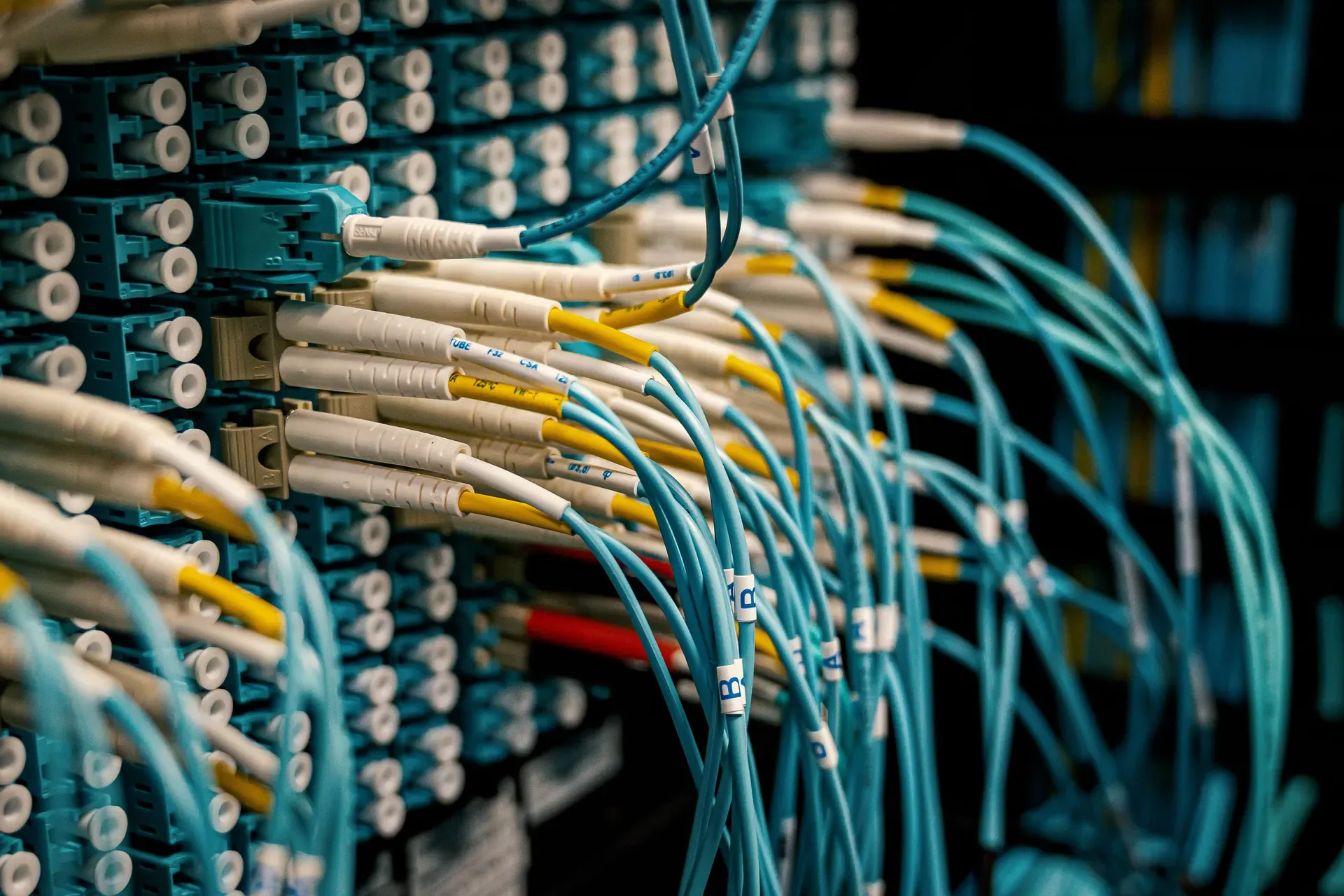
Single-mode fiber is the choice for long runs and links between buildings; multimode is the usual choice for shorter links inside one building. Choosing the cable type, connectors and components is part of the design.
A wider core that works with lower-cost optics. Built for shorter links inside a building or a data center.
A narrow core (OS2) that carries light much farther, measured in kilometers rather than hundreds of meters.
Cable assemblies built and tested at the factory, then installed and plugged in on site.
How a fiber job runs
A tight bend, a dirty connector or a poor termination shows up as signal loss, so fiber is planned step by step.
Where the equipment is, the distance between devices, and any obstacles along the route, indoors or outdoors.
The cable type, connectors and components for the link, and the pathway it will follow.
Fiber run through the building or outdoors, protected in innerduct where the route calls for it, then terminated at each end.
Each link tested to confirm it is working properly before handover.
Ongoing support, including testing and cleaning, so the system keeps performing.
Protecting the run
Fiber can be damaged by crushing, tight bends or pulling too hard, so we plan the pathway along with the cable.
In risers, above ceilings and underground, we run fiber in innerduct, which protects it and leaves room to add fiber later. In server rooms, fiber routing systems keep fiber separate from copper, and exposed runs can go in EMT conduit.
At each end, fiber is terminated with connectors that match the equipment. LC is the most common connector on switches and patch panels today; SC is common on older equipment; MPO connectors carry many fibers at once in pre-terminated data center cabling.
Planning fiber alongside new copper? The two are usually designed together as part of a structured cabling system.
From our clients
AccuTech took on a project which included Wireless Access Points with Cabling for those APs, Fiber runs from MDF to DMARC, IP Phone connectivity, MDF Cabling, IDF Cabling and More with the ease as if they were part of our company.
Yes, and that is the usual design. Copper (Cat 6 or Cat 6A) runs from the closet to each desk, and fiber carries the backbone between closets, any run over 100 meters and any route through heavy electrical interference. See network cabling installation for the copper side.
Single-mode has a narrow core and carries light for kilometers, so it is used between buildings and on long runs. Multimode has a wider core, works with lower-cost optics and suits shorter links inside a building or data center.
Usually LC, the most common connector on switches and patch panels. SC still appears on older equipment, and MPO is used for high-density pre-terminated cabling in data centers. The connectors are chosen in the design to match your equipment.
Yes. We run fiber through buildings and outdoors. For a link between buildings, single-mode is the usual choice; the site survey looks at the route, and the run is protected in innerduct where needed.
Yes. Each link is terminated and tested to confirm it is working properly before handover. Testing measures the end-to-end light loss on the link and checks it against the loss budget for that link.
Yes. Ongoing maintenance and support for fiber systems includes testing and cleaning, since a dirty connector is one of the most common causes of signal loss.
It depends on the length and route of each link, the fiber type and count, the connectors, and the pathway (open ceiling, riser, conduit or underground). We price from a site survey. Estimates are free: call 978-579-0006 or request one online.
Massachusetts, New Hampshire and Rhode Island. Our office is in Hopkinton, MA.
Request an estimate
Estimates are free. Call the office or send the details online.
Helpful to have ready