
Fiber Optic Network Cable: 10 Best Powerful Picks 2025
Why Fiber Optic Network Cables Are Your Infrastructure’s Best Friend
A fiber optic network cable is an assembly containing one or more optical fibers that transmit data as light pulses through glass strands, enabling speeds up to 100 Gbps and distances exceeding 100 kilometers without signal loss. Here’s what you need to know:
Key Fiber Optic Network Cable Types:
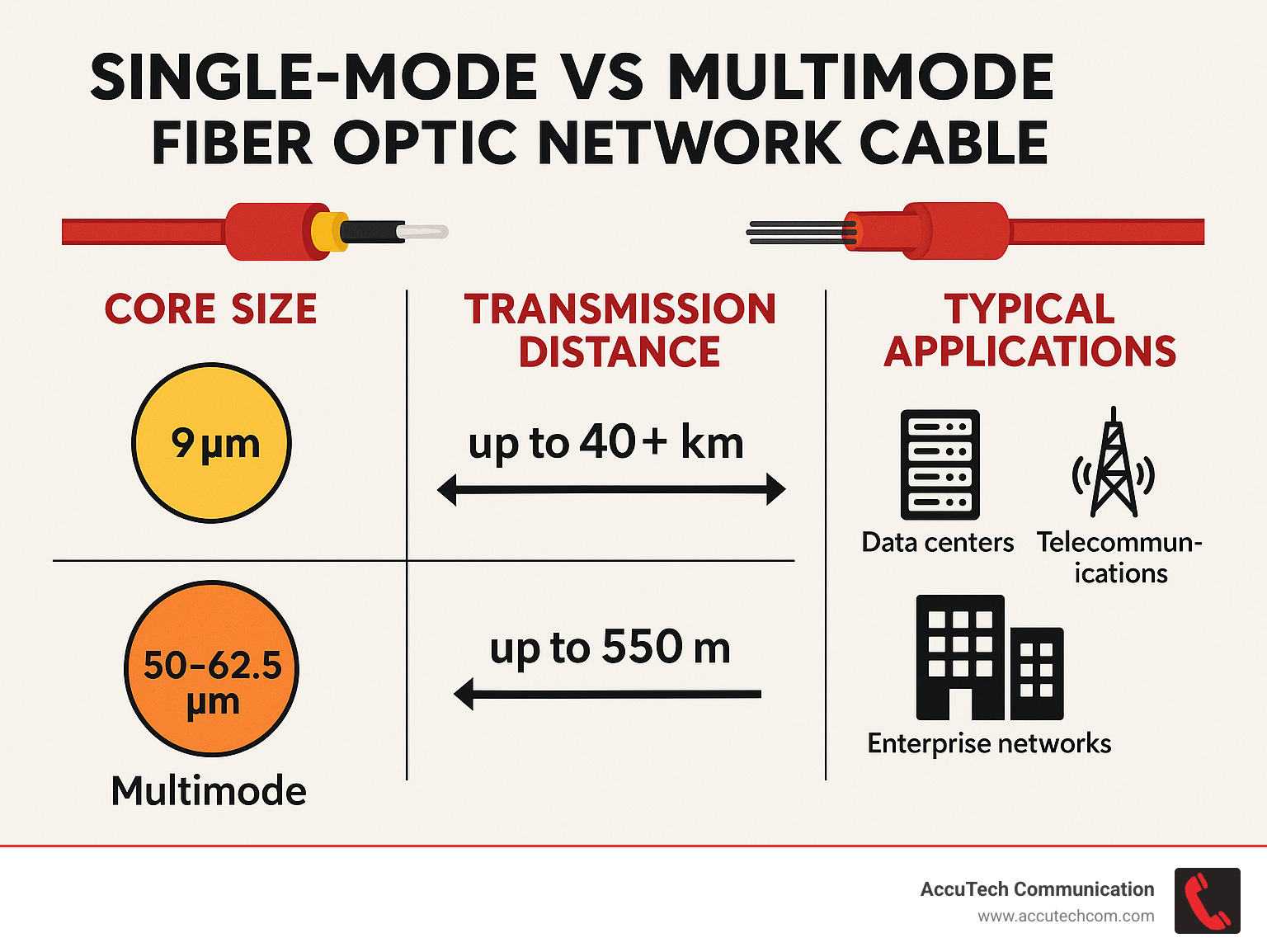
– Single-mode (SMF): 9 μm core, long-distance up to 40+ km, yellow jacket
– Multimode (MMF): 50-62.5 μm core, shorter distances up to 550m, orange/aqua jacket
– OM3/OM4: Laser-optimized for 10-40 Gbps data center links
– OS1/OS2: Single-mode for telecom and campus backbone
Common Applications:
– Data center interconnects
– Campus backbone cabling
– High-speed internet connections
– Medical and industrial networks
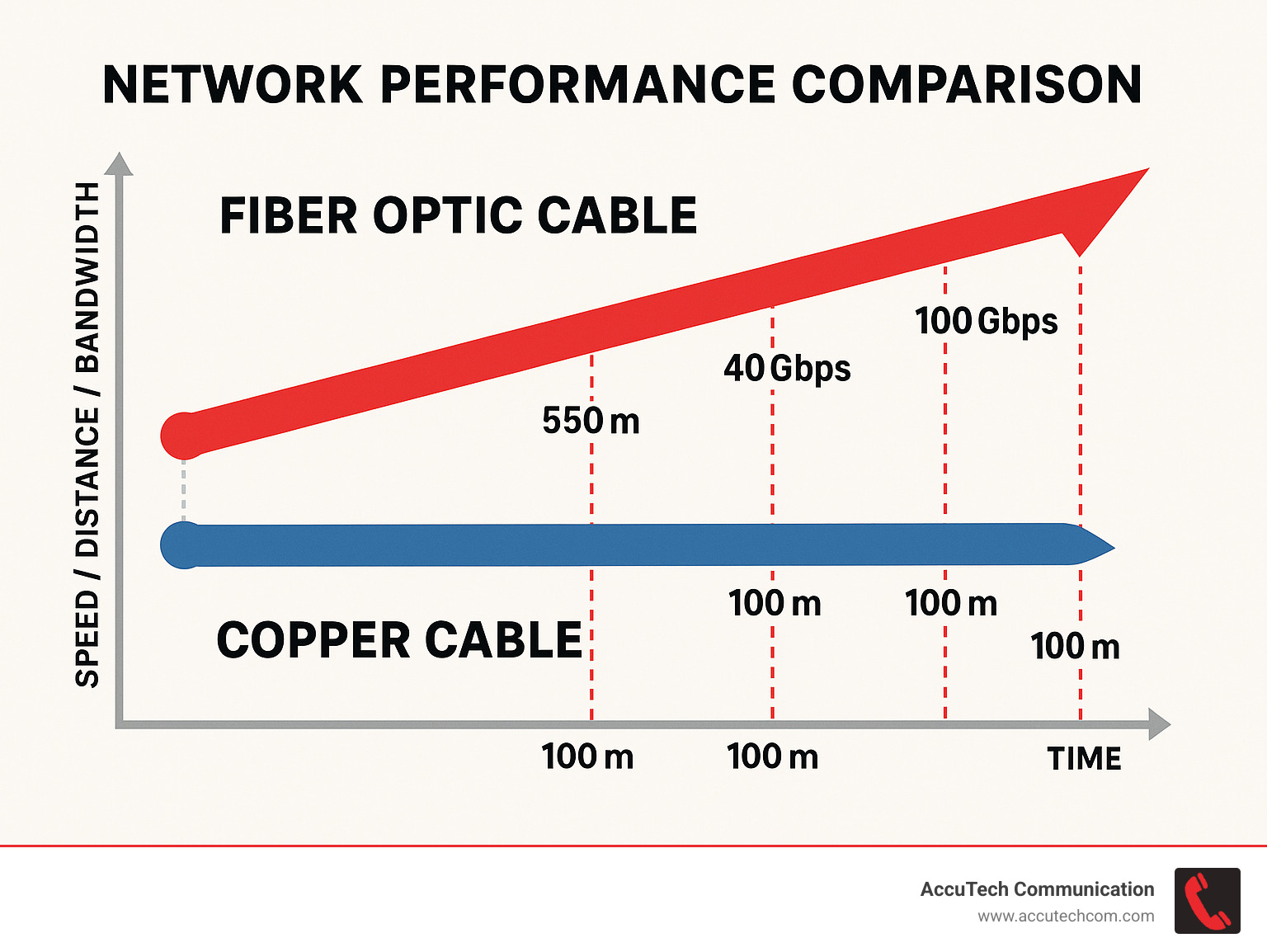
Think about it – copper cables max out at 100 meters and 40 Gbps, while fiber can push 800 Gbps over multiple kilometers. That’s like comparing a bicycle to a rocket ship.
The numbers don’t lie either. Fiber loses only 3% of its signal over 100 meters, while copper loses 94% over the same distance. Plus, fiber is immune to electromagnetic interference that can cripple copper networks in hospitals and manufacturing facilities.
I’m Corin Dolan, owner of AccuTech Communications, and I’ve been installing fiber optic network cable systems across Massachusetts, New Hampshire, and Rhode Island since 1993. My team has seen how the right fiber infrastructure transforms business operations, especially in healthcare and manufacturing where network reliability isn’t optional.
Simple fiber optic network cable glossary:
– Fiber Optic Technology
– fiber optic monitoring system
– fiber optic sensing technology
How Does a Fiber Optic Network Cable Work?
Ever wonder how your data travels at the speed of light? The secret behind every fiber optic network cable is total internal reflection. Light enters an ultra-pure glass core thinner than a human hair and bounces off the surrounding cladding layer, traveling at roughly 200,000 kilometers per second.
The light source makes all the difference. LEDs work for multimode applications – cheaper and great for shorter distances. Lasers create focused light for single-mode fiber, costing more but pushing data across cities.
Most fiber optic network cable systems operate at wavelengths of 850 nm, 1310 nm, or 1550 nm. Engineers chose these because glass is most transparent at these points.
Attenuation (signal loss) is where fiber crushes copper. Single-mode fiber loses only 0.35 dB per kilometer at 1310 nm and 0.25 dB per kilometer at 1550 nm. Compare that to copper’s dramatic drop after 100 meters.
The Scientific research on light propagation shows modern fiber can achieve petabit transmission rates – 1,000 times faster than gigabit internet.
Dispersion affects how light pulses spread over distance, while bandwidth determines data capacity. OM4 multimode supports 4,700 MHz·km compared to older OM1’s 200 MHz·km.
Fiber Optic Network Cable Anatomy 101
Every fiber optic network cable is built like a high-tech sandwich protecting that precious glass core.
The core (9 μm for single-mode or 50-62.5 μm for multimode) is surrounded by cladding at 125 μm that reflects light back using total internal reflection.
The primary coating (250 μm acrylate) protects against moisture and microbending. The buffer layer comes as tight-buffer (900 μm indoor) or loose-tube (outdoor) construction.
Strength members (Kevlar or fiberglass) prevent stretching during installation. The outer jacket varies – PVC for basic indoor, LSZH for plenum spaces, polyethylene for outdoor.
Color coding is critical: single-mode wears yellow, multimode OM1/OM2 in orange, OM3/OM4 in aqua, and OM5 in lime green.
Cable construction determines bend radius (typically 10x cable diameter) and maximum pulling tension. Get these wrong, and you’ll troubleshoot mysterious signal loss later.
Fiber Optic Network Cable Types & Specs You Must Know
Choosing the wrong fiber optic network cable is like buying a sports car for Boston traffic – expensive and underused. Understanding specs upfront saves headaches later.
Single-mode fiber uses a 9-micrometer core and pushes data incredible distances. Multimode fiber has a larger 50-62.5 micrometer core, trading distance for easier installation and lower equipment costs.
Single-mode standards are simple. OS1 fiber handles indoor runs up to 10 kilometers, while OS2 extends beyond 40 kilometers outdoors.
Multimode is more complex. OM1 and OM2 are older generations suitable for legacy networks. OM3 and OM4 are laser-optimized – OM3 supports 10 Gbps up to 300 meters, while OM4 extends to 550 meters and handles 100 Gbps over shorter distances.
OM5 multimode fiber (lime-green jacket) supports shortwave wavelength division multiplexing, running multiple data streams over different wavelengths.
| Cable Type | Core Size | 10 Gbps Reach | 40 Gbps Reach | 100 Gbps Reach |
|---|---|---|---|---|
| OM1 | 62.5 μm | 33 m | – | – |
| OM2 | 50 μm | 82 m | – | – |
| OM3 | 50 μm | 300 m | 100 m | – |
| OM4 | 50 μm | 550 m | 150 m | 150 m |
| OS1/OS2 | 9 μm | 10+ km | 10+ km | 10+ km |
Single-mode fiber loses only 0.35 dB per kilometer, while multimode typically loses 3 dB per kilometer. This explains why single-mode dominates long-distance applications.
Choosing the Right Fiber Optic Network Cable for Your Project
Picking the right fiber optic network cable means matching actual needs with smart future-proofing.
For 1 Gbps Ethernet, OM2 multimode works fine. Planning 10 Gbps? OM3 handles most data centers, but OM4 provides more flexibility.
For 40-100 Gbps, OM4 multimode works for shorter runs, while longer distances need single-mode OS2.
Environmental factors matter. Indoor plenum needs OFNP-rated cables. Riser applications require OFNR ratings. Outdoors needs polyethylene jackets with water-blocking.
LSZH jackets cost more but make sense in hospitals and schools for fire safety.
Your link budget determines if chosen fiber actually works. Every connector adds 0.3 dB loss, every splice 0.1 dB, plus cable attenuation. Always include a 3 dB safety margin.
Our advice: invest one grade higher than needed today. OM4 costs barely more than OM3 but supports ten times the bandwidth. The fiber optic cabling services we provide always include this future-proofing discussion.
Product Roundup: Best Fiber Optic Network Cables in 2025
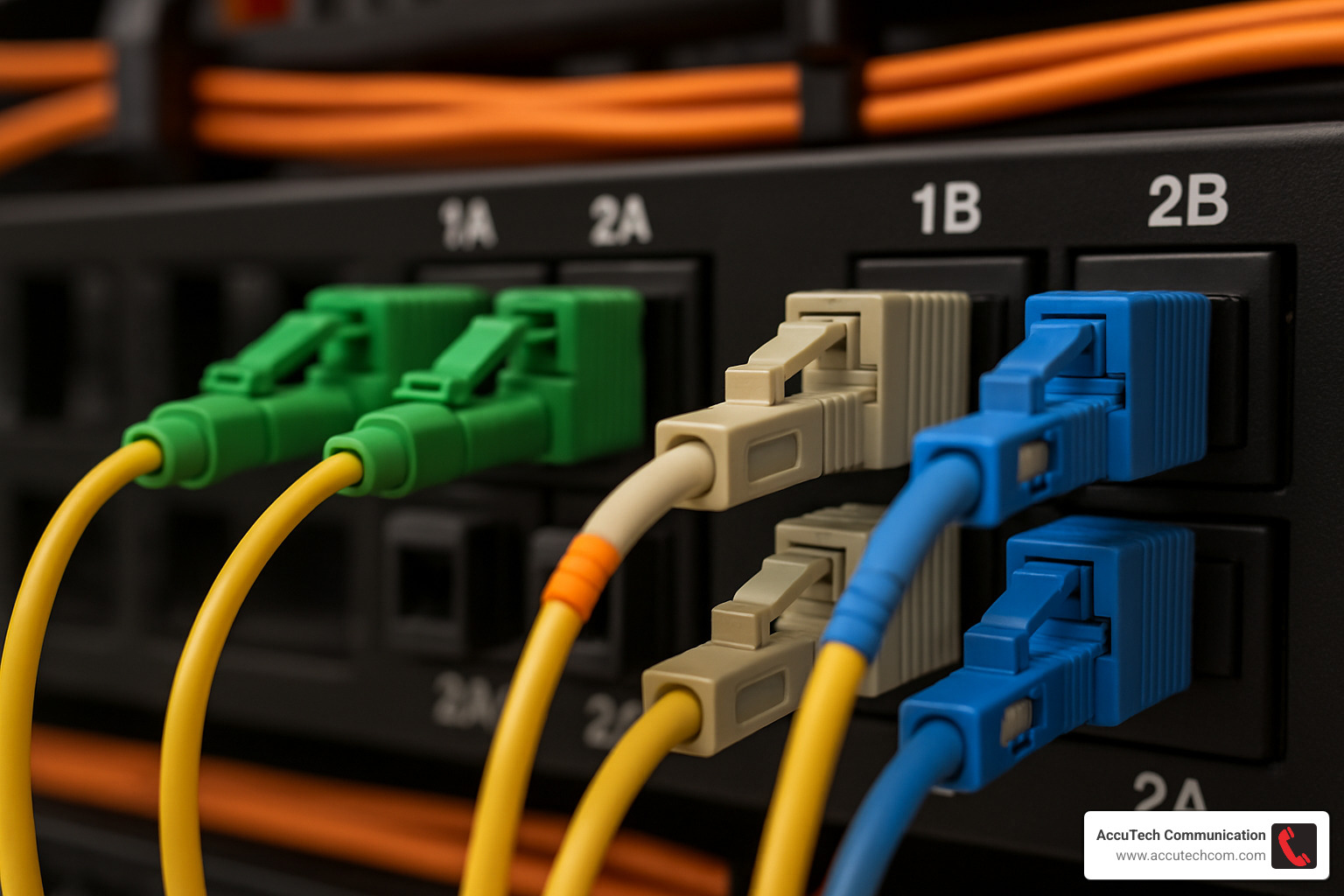
After installing fiber optic network cables across New England for over 30 years, I can tell you that not all fiber is created equal. The difference between good and great cables often comes down to manufacturing consistency.
We’ve measured insertion loss variations of 0.05 dB on premium cables versus 0.2 dB swings on budget options. That’s the difference between rock-solid 10 Gbps links and ones that drop packets during peak traffic.
Our testing covers insertion loss consistency, mechanical durability during installation, and long-term reliability in New England’s temperature swings. We follow ANSI/TIA-568 standards plus our own real-world stress tests.
Top-Rated Fiber Optic Network Cable — Single-Mode Picks
For campus connections or ISP equipment, single-mode fiber optic network cable with its 9/125 μm core carries signals for miles without breaking a sweat.
Our recommendation is OS2-grade single-mode cable with SC/APC connectors. The angled polish reduces back-reflection to -65 dB – critical for sensitive DWDM equipment. We consistently measure insertion loss under 0.15 dB, 50% better than industry standard.
The LSZH jacket is required in most commercial buildings with plenum circulation. These cables handle 10 Gbps over 10+ kilometers and push 1 Gbps beyond 40 kilometers.
Fiber Optic Network Cable — Multimode Marvels
Modern OM3 and OM4 cables are enterprise workhorses. The 50/125 μm core with laser-optimized design delivers impossible performance from a decade ago.
OM3 aqua-jacketed cables hit the sweet spot with 2000 MHz·km bandwidth, pushing 10 Gbps up to 300 meters. We use LC-LC duplex jumpers for compact, reliable patch panel management.
OM4 cables cost only 15% more than OM3, yet double your reach with 4700 MHz·km bandwidth. That means 10 Gbps extends to 550 meters and 100 Gbps up to 150 meters.
Fiber Optic Network Cable for Data-Center Runs
Data centers demand space efficiency and zero downtime. We’ve moved toward high-fiber-count ribbon cables and MPO/MTP trunk assemblies.
MPO/MTP connectors pack 12-48 fibers into thumb-sized connectors. These breakout cables reduce patch panel space by 75% compared to individual cables.
Active Optical Cables have built-in transceivers, using 30% less power and generating less heat. For 1-100 meter runs, they’re often the smartest choice.
Ribbon fiber technology for backbone runs cuts installation time by 80%. We’ve terminated 864-fiber cables in one day versus weeks with individual strands.
For comprehensive solutions, learn more through our fiber optic cabling services.
Installation & Handling Best Practices
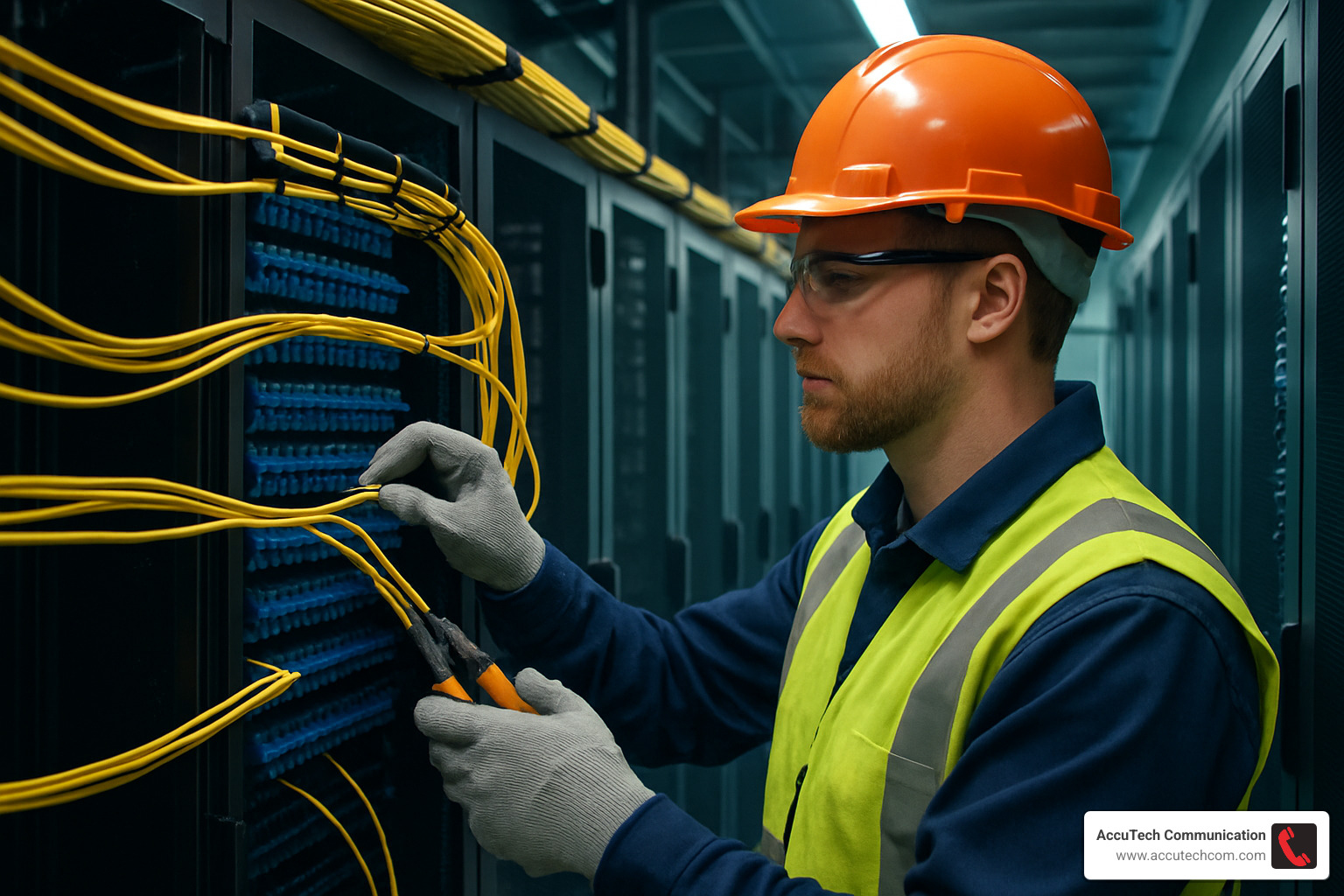
Installing fiber optic network cable properly requires respecting glass physics. After three decades across New England, I’ve learned that following critical rules determines whether networks last 20 years or fail in two.
Glass doesn’t bend like copper. Your fiber optic network cable has a minimum bend radius of 10 times the cable diameter – jumping to 15 times under pulling tension. Ignore this, and microbends kill your signal.
Maximum pulling tension varies by cable, but distribution cables typically handle up to 600 pounds. We use proper pulling grips on strength members – never pull fiber directly.
Temperature matters. Outdoor cables handle -40°C to +70°C, but indoor cables aren’t as forgiving. Survey actual pathways, not just drawings. Pull boxes need 6 times the cable diameter for smooth turns.
We use water-based pulling lubricant only. Petroleum-based lubricants attack cable jackets, causing failures years later.
Safety is critical. The Scientific research on eye safety shows single-mode lasers cause permanent retinal damage in milliseconds. Never look directly into fiber ends.
Class 1 systems using multimode LEDs are generally safe. Class 3R systems (most single-mode) pose direct viewing hazards requiring proper safety procedures.
Our protocol: connector dust caps stay on until final connection. Dry clean first, wet clean if needed. Every connector gets magnified inspection before connection, and everything gets labeled.
Fiber Optic Network Cable Termination & Testing Checklist
Physical Contact (PC) polish with 0-8 degree angles versus Angled Physical Contact (APC) at 8 degrees seems trivial but determines performance levels.
PC connectors give less than 0.6 dB insertion loss. Ultra Physical Contact (UPC) delivers less than 0.3 dB loss and over 50 dB return loss. APC connectors are the gold standard with 8-degree angles delivering over 60 dB return loss.
Acceptance testing: insertion loss ≤0.3 dB for patch cables and ≤0.75 dB for permanent links. Return loss >14 dB for multimode and >26 dB for single-mode.
OTDR testing from both directions using multiple wavelengths – 850/1300 nm for multimode, 1310/1550 nm for single-mode.
Documentation includes cable type, measured losses, return loss, complete routing, and clear pass/fail results. This prevents troubleshooting headaches months later.
Frequently Asked Questions about Fiber Optic Network Cables
What’s the difference between single-mode and multimode?
Core size makes all the difference. Single-mode fiber has a 9 μm core forcing light into a single path, eliminating distortion and enabling 100+ kilometer runs.
Multimode fiber has a 50-62.5 μm core allowing multiple light paths. It’s like comparing a laser pointer (single-mode) to a flashlight (multimode) – the laser travels far while the flashlight spreads quickly.
Single-mode costs more upfront needing precision lasers versus cheap LEDs, but carries 100 Gbps across entire campuses while multimode tops out at 550 meters.
We recommend single-mode for building connections and multimode for equipment rooms.
How far can a fiber optic network cable run without boosters?
Multimode reaches vary by generation. OM1 maxes at 33 meters for 10 Gbps, OM3 gets 300 meters, while OM4 stretches to 550 meters. For 100 Gbps, OM4 drops to 150 meters.
Single-mode fiber easily handles 10 kilometers at 10 Gbps and 40+ kilometers at slower speeds. We’ve installed single-mode links between Boston campuses that would require multiple copper amplifiers.
Every connector steals 0.3 dB and each splice adds 0.1 dB. Premium cables have lower attenuation translating to longer reaches.
Can I mix fiber and copper in the same network switch?
Absolutely. SFP and SFP+ modules let you convert switch ports between fiber and copper. Need 200-meter server connections? Use multimode SFP+. Desktop computers nearby? Use copper ports.
Media converters handle conversion when switches lack right port types. We install rack-mount chassis handling dozens of conversions.
Best strategy: fiber for backbone connections over 100 meters or between buildings, copper for desktops and short equipment jumpers.
Conclusion & Next Steps
The evidence is overwhelming: fiber optic network cables aren’t just the future – they’re today’s reality for serious businesses. While copper loses 94% signal over 100 meters, fiber loses only 3%. That’s the difference between networks that grow with your business versus ones that hold it back.
After three decades across New England, I’ve seen fiber transform operations. Hospitals went from network crashes to seamless 24/7 operations. Manufacturing plants eliminated production delays from network bottlenecks. Growing companies scaled from 50 to 500 employees without rewiring backbones.
Key decisions are simple: Choose single-mode for long distances and maximum future-proofing. Use OM4 multimode for data centers needing performance without single-mode costs. Proper installation prevents 90% of problems, and professional testing ensures 20+ year reliability.
Successful projects start with honest network assessments, plan for 5-10 year growth, and partner with certified installers understanding fiber isn’t DIY.
At AccuTech Communications, we’ve installed fiber optic network cable systems across Massachusetts, New Hampshire, and Rhode Island since 1993. Our certified technicians understand New England’s unique challenges – from freezing temperatures to historic building constraints making Boston installations an art form.
What sets us apart isn’t just 30+ years experience or comprehensive testing. It’s understanding your network infrastructure is the foundation everything builds on. When we design your fiber system, we’re thinking about your business five years from now.
Businesses investing in proper fiber optic network cable infrastructure see immediate reliability improvements and position themselves for future bandwidth demands. Whether connecting campus buildings, upgrading data centers, or replacing limiting copper backbones, fiber is the answer.
Ready to stop letting networks hold your business back? Let’s discuss how the right fiber infrastructure can transform your operations. For complete fiber optic solutions, visit our More info about fiber optic solutions page.
Your network’s future is fiber – and that future starts with a conversation.
