
How to install low voltage deck post lighting: Simple Guide 2025
Why Low Voltage Deck Post Lighting Transforms Your Outdoor Space
Learning how to install low voltage deck post lighting is a rewarding DIY project that adds safety and ambiance to your outdoor living space. Evening on the deck should be about relaxation, not the harsh glare of a floodlight. Low-voltage systems create subtle pools of light, improving your deck’s beauty without overwhelming the atmosphere.
Quick Installation Overview:
- Plan your layout – Map light locations and power sources
- Size your transformer – Calculate total wattage plus 25% capacity
- Prep the posts – Drill holes for wire routing (1-inch main, 1/2-inch intercept)
- Run low-voltage cable – Use 12-gauge wire for runs up to 50 feet
- Connect fixtures – Wire in parallel using waterproof connectors
- Test and secure – Verify operation before final mounting
Low-voltage systems operate at just 12 volts, making them significantly safer than standard household wiring. You won’t need underground conduit or junction boxes, just simple connections most homeowners can handle. The result is professional-looking lighting that highlights your deck’s features and provides essential safety for stairs and walkways.
I’m Corin Dolan, owner of AccuTech Communications, with over 30 years of experience in low-voltage installations across Massachusetts, New Hampshire, and Rhode Island. My expertise comes from designing and implementing countless residential and commercial lighting systems that prioritize both functionality and aesthetics.
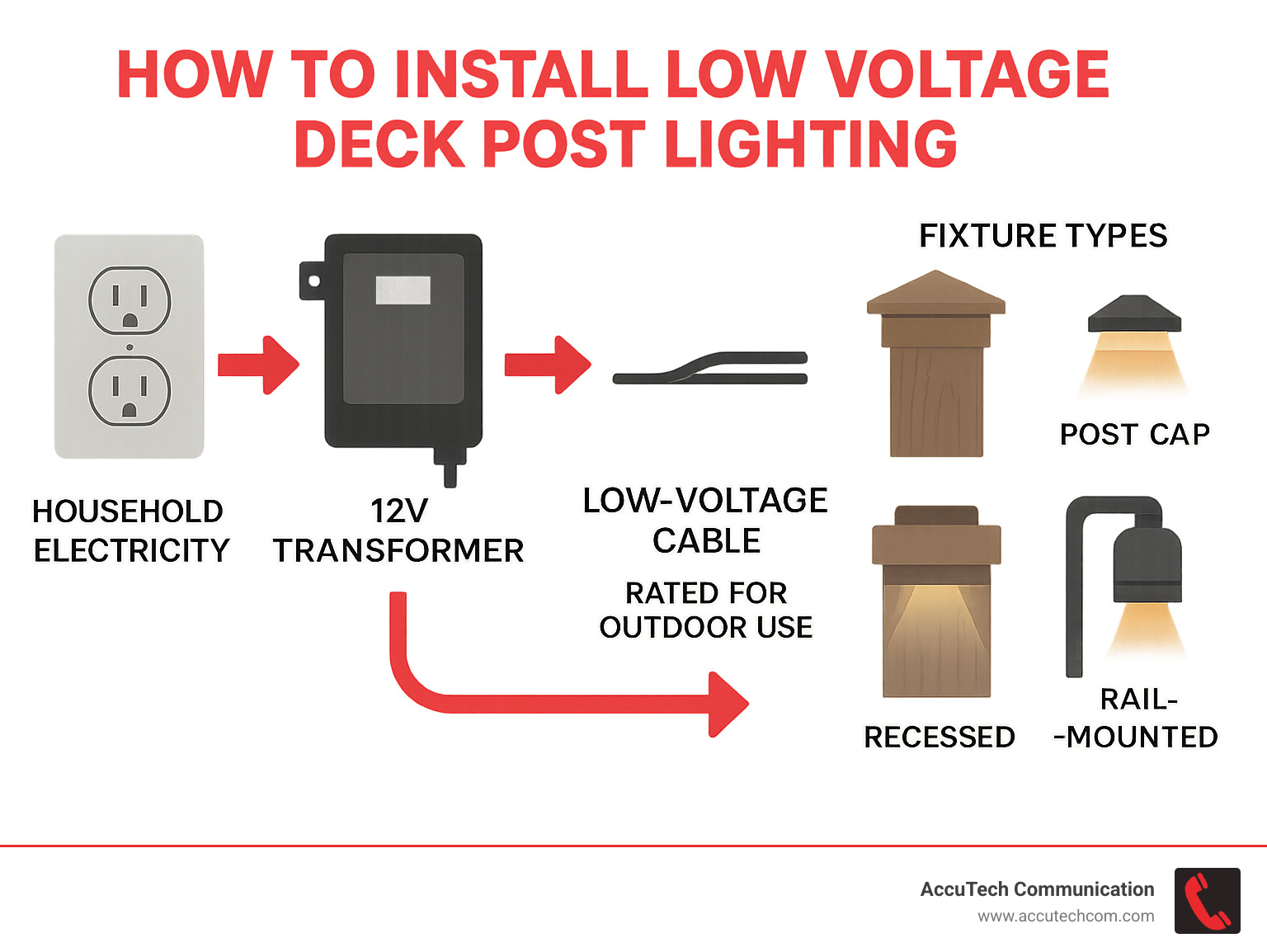
Terms related to how to install low voltage deck post lighting:
Planning Your Deck Post Lighting Project
Proper planning is the secret to mastering how to install low voltage deck post lighting. Start by observing your deck to identify focal points, such as seating areas or stairs that need safety lighting. These will guide your fixture placement.
Sketching a rough plan on graph paper is incredibly helpful. Mark your deck’s features, existing electrical outlets, and where you envision each light. This helps you determine how many fixtures you’ll need and where your transformer should be located.
Your power source location is crucial. The transformer must plug into a weather-protected, 120-volt GFCI outlet. An ideal spot is under an eave or in a covered area that’s accessible but shielded from rain.
When planning fixture spacing, aim for a gentle rhythm. For post cap lights, spacing them every four to six feet creates a balanced, subtle illumination that improves your deck’s natural beauty.
Finally, map your wire routing strategy. The best installations hide the wires completely. Plan to run cables under decking, through hollow posts, or behind structural elements. Spending extra time on this step ensures a clean, professional finish.
Essential Tools and Materials
Having the right tools makes the installation process smooth. Here’s what you’ll need for a successful how to install low voltage deck post lighting project:
- Drill and bits: A powerful drill with a 1/2-inch machine bit, a 1-inch forstner bit, and a wood auger bit will cover most needs. Always wear safety glasses.
- Wire strippers and waterproof wire connectors: These are essential for creating reliable, long-lasting connections. Heat-shrink tubing adds an extra layer of protection.
- Low-voltage outdoor cable: Ensure it is UV-protected and rated for outdoor use.
- Insulated staples: Use these to secure cables neatly. Do not drive them in too tightly.
- Shovel and Fish tape: A shovel helps pry up deck boards or bury cable, while fish tape is essential for threading wires through tight spaces.
- Deck light fixtures and a low-voltage transformer.
- Measuring tape, pencil, and safety gloves.
How to Select and Size the Correct Transformer
The transformer converts your home’s 110-volt power to a safe 12-volt low-voltage supply. This is what makes low-voltage lighting ideal for DIY projects.
First, choose between AC vs. DC transformers. Most modern LED lighting systems use 12-volt DC, while older incandescent lights use 12-volt AC. Check your fixture requirements to ensure compatibility.
Calculating total wattage is simple: multiply the number of lights by their individual wattage (e.g., 10 lights x 3 watts = 30 watts).
Crucially, never run a transformer at maximum capacity. Add 10-25% capacity for line loss and voltage drop. For our 30-watt example, you would need at least 37.5 watts of capacity, making a 40-watt or 60-watt transformer a good choice.
Overloading risks include premature failure and flickering or dim lights. Many transformers include timers and light sensors for automatic dusk-to-dawn operation.
For assistance, you can use an online Lighting Transformer Calculator to determine the correct size and prevent overloading.
Choosing and Routing Your Low-Voltage Wiring
Your wire choice is critical for performance. For most LED applications, 18/2 gauge wire is sufficient, while older incandescent systems may require 12/2 gauge wire. The “2” refers to the two conductors inside.
Circuit length determines the necessary wire gauge to prevent voltage drop, which can dim lights far from the transformer. Use 12-gauge for runs up to 50 feet, 10-gauge for 50-100 feet, and 8-gauge for longer runs.
Direct burial wire is essential for any underground sections, as it’s built to withstand moisture and temperature changes.
Hiding wires under deck structures creates a professional look. Run cables along joists or through hollow posts. The goal is to make wiring invisible yet accessible for future maintenance.
Secure cables with staples every two feet. Pro tip: don’t drive staples in completely. Leave slight slack for temperature changes to prevent wire damage.
For underground runs, bury cables 6 inches deep. In high-traffic areas, consider protecting wires from damage with conduit. You can learn more about conduit for electrical wire or how to install underground conduit for maximum protection.
Step-by-Step Guide: How to Install Low Voltage Deck Post Lighting
With planning complete and tools gathered, it’s time for the hands-on part of how to install low voltage deck post lighting. This process will transform your deck into a beautiful and safe evening sanctuary.
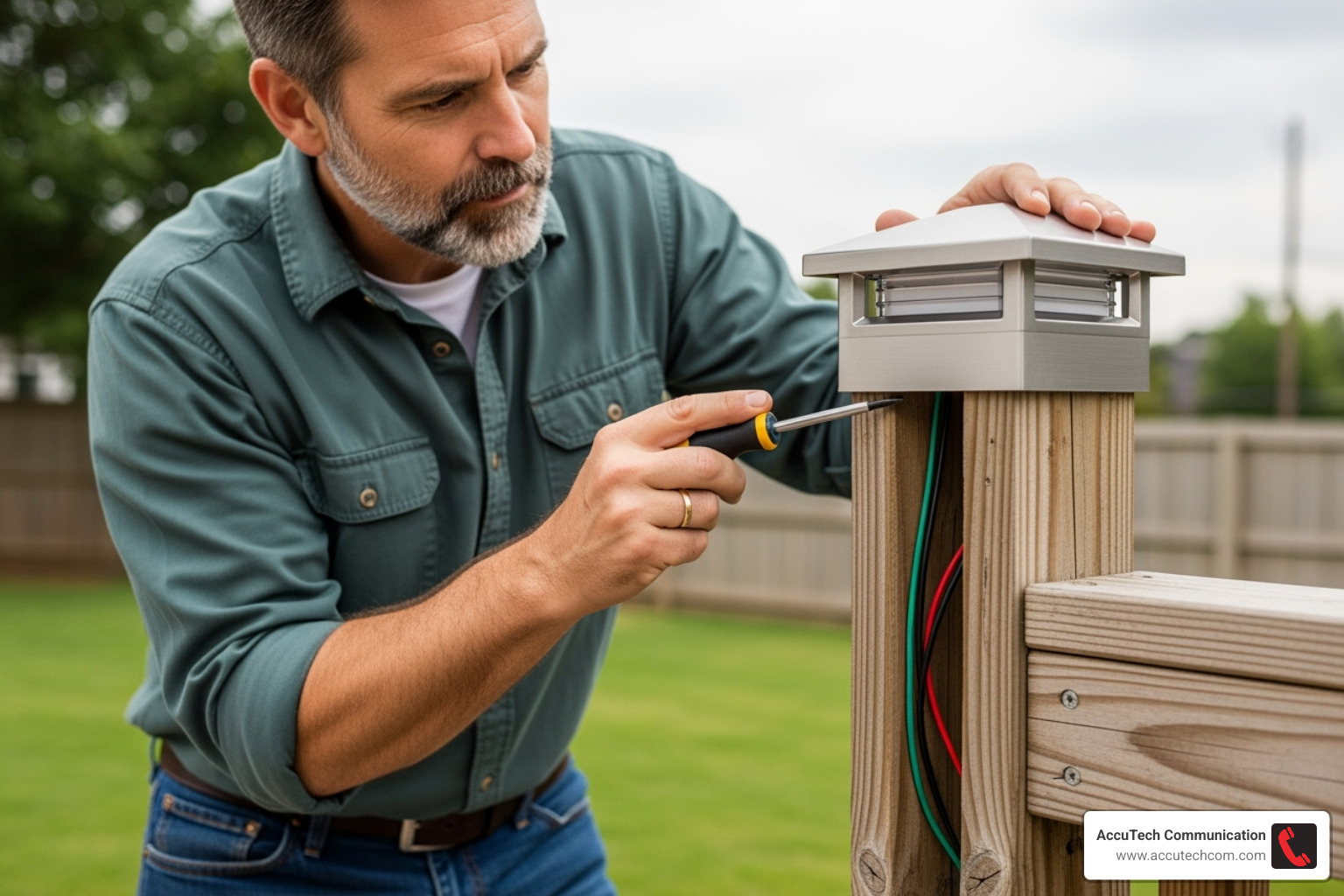
We’ll focus on hiding wires within the deck posts for a seamless, professional look. The beauty of low-voltage systems is that you can achieve these results without being a licensed electrician.
This guide covers common installation methods for post cap lights, recessed lights, and side-mount lights. Always consult your manufacturer’s manual, but these core techniques apply to most brands.
Prepping the Post: Drilling Techniques for Low Voltage Deck Post Lighting
For a professional look, run wiring through the deck post, not along its surface. The drilling technique depends on whether you have wood posts, metal posts, or composite post sleeves.
For Wood Posts, start by removing any existing post cap. Mark where your light will sit. For a post cap light, you’ll drill near the top. To create a hidden wire path, first drill a 1/2-inch wire entrance hole on the face of the post where the light will mount. Then, using a wood auger bit, drill down from the top of the post at an angle to connect with the entrance hole.
For larger lights, you can bore a 1-inch hole down the center of the post, then drill a 1/2-inch intercept hole from below the rail, angling up to meet it. This provides more room for connections while keeping everything concealed. Pro tip: You can lift a post slightly with a shovel to pull wire through the bottom for a completely hidden run.
Metal or Composite Posts are often hollow, which simplifies wire routing. Remove the top cap or slide up the sleeve, then use a fish tape or a straightened coat hanger to guide the wire up from the base. For side-mounted lights on a composite sleeve, you may need to drill a 1-inch hole for the fixture and a smaller 1/2-inch hole for wiring. Avoid drilling horizontally through posts, as this can compromise structural integrity.
Wiring and Connections: How to Install Low Voltage Deck Post Lighting Fixtures
With posts prepped, it’s time for electrical connections. This step is straightforward, but attention to detail is key for reliability.
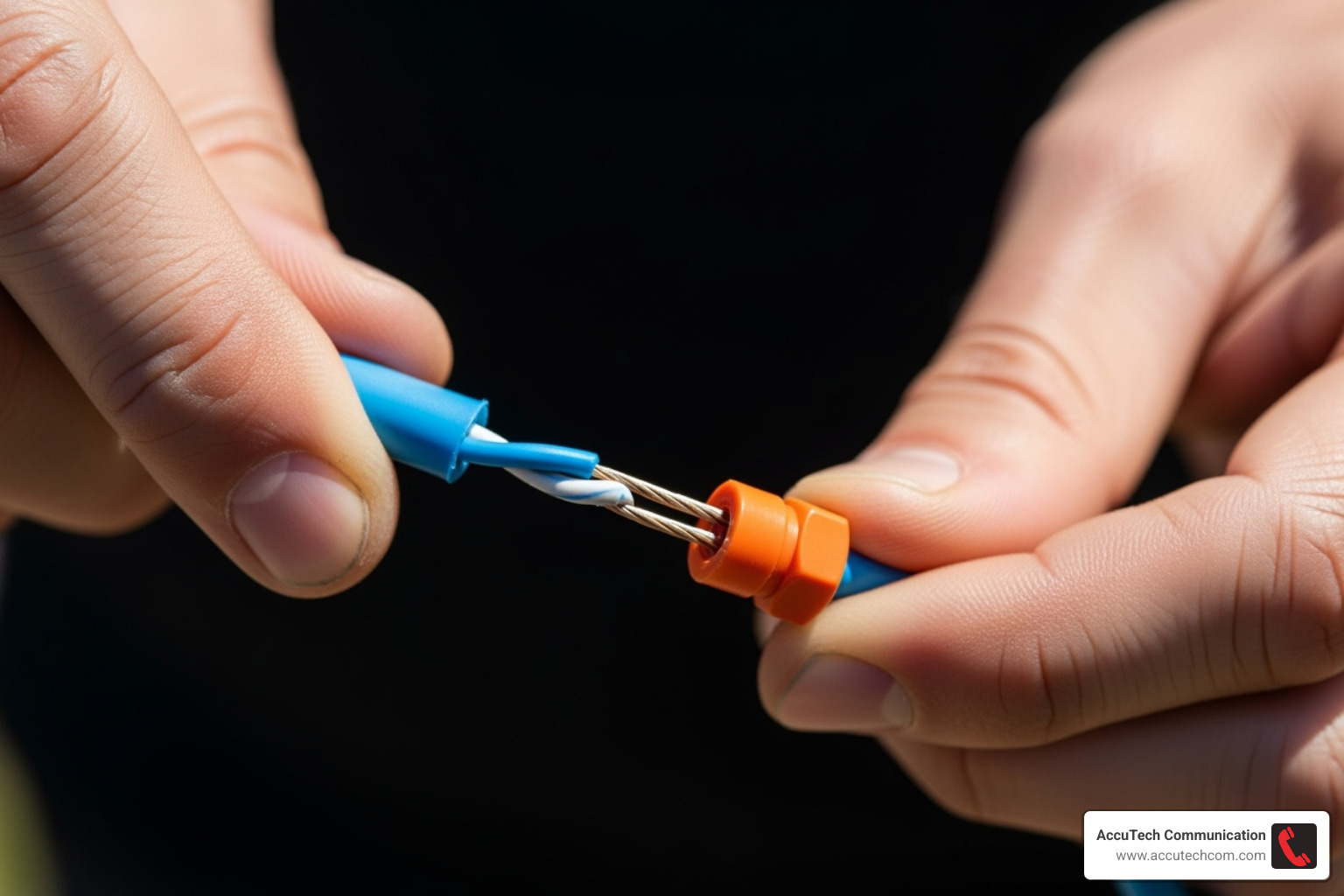
Strip about 3/4 inch of insulation from the fixture wires and the main circuit wire. Matching polarity is crucial. Low-voltage wires typically have a smooth side (positive) and a ribbed or lettered side (negative). Connect smooth to smooth and ribbed to ribbed consistently.
Twist the corresponding wires together firmly, then secure them with waterproof connectors. These gel-filled wire nuts create a tight seal that protects against moisture. For extra protection, wrap the connection with heat-shrink tubing. Never use electrical tape for weatherproofing; it deteriorates and fails.
Always leave about 6 inches of slack coiled inside the post. This makes future maintenance or fixture replacement much easier.
Parallel wiring is essential for LED lights, ensuring each light gets full voltage and the rest stay lit if one fails. Most systems are designed for this, with each fixture tapping into the main circuit cable.
Many modern systems offer plug-and-play connectors that use hubs or splitters, eliminating the need for wire stripping and nuts, which simplifies installation.
Mounting Different Types of Post Lights
With wiring complete, the final step is mounting the fixtures. This is where your careful preparation results in a clean, professional look.
Post cap lights are the most straightforward to install. Coil the excess wire into the hole at the top of the post and place the cap squarely on top. Secure it with the provided screws through the side or base. Some designs use silicone caulk, but ensure you can still access the wiring later.
Recessed lights sit flush for a sleek, integrated look. Push the fixture into your pre-drilled hole (typically 1-inch diameter). They often use spring clips or screws to hold them in place. With composite decking, ensure fixtures fit easily to allow for thermal expansion and contraction.
Side-mount lights offer placement versatility. Position the fixture on the post or railing according to your plan and secure it with screws, making sure the base plate doesn’t pinch the wire. Install any decorative covers for a finished look.
Once all lights are mounted, reattach any railings or decorative elements you removed. Now you’re ready to test your work.
Safety, Testing, and Maintenance
After you install low voltage deck post lighting, these final steps ensure your system works safely and beautifully for years. These details make all the difference in performance and longevity.
Safety comes first. Even with safer 12-volt systems, proper installation is key. Your transformer must plug into a GFCI-protected outdoor outlet. This is a critical federal safety code requirement to prevent electrical shock.
Always turn off power at the circuit breaker before making connections. Even low voltage can cause a shock. It’s also wise to check with your local building department for any specific guidelines, as requirements can vary.
If any low-voltage wires run underground, they must be buried at least 6 inches deep to protect them from accidental digging and environmental damage.
Testing your new lighting system is a satisfying final step. Plug in your transformer and walk around the deck to confirm every light turns on. Check for even brightness. Dim lights may indicate a voltage drop issue from a long wire run, incorrect wire gauge, or a loose connection, which is easiest to fix now.
If your transformer has a timer or photo-eye sensor, test these features to ensure they function as expected. Observe the overall lighting effect and adjust any fixture orientations to eliminate harsh glares or unwanted shadows.
Ongoing maintenance is simple but essential for performance. Regular cleaning of light lenses with a damp cloth will prevent dirt and pollen from dimming your lights.
Every few months, inspect your connections for corrosion or looseness and check for frayed wires. Address any issues immediately to prevent larger problems.
For fixtures with gaskets, ensure water seals remain intact to prevent water intrusion, which can damage the fixture. Replace any burned-out bulbs or damaged fixtures promptly to maintain safety and aesthetics.
With proper installation and basic maintenance, your low-voltage deck lighting will provide years of safe, beautiful illumination.
Frequently Asked Questions about Deck Post Lighting
Here are answers to common questions that arise when people learn how to install low voltage deck post lighting.
Can I connect my deck lighting to a timer or smart home system?
Yes, this is a popular feature of modern low-voltage systems. Many transformers have built-in timers and photo-eye sensors for automatic dusk-to-dawn operation.
For smart home integration, you have several options:
- Smart plugs: This is the simplest method. Plug your transformer into an outdoor-rated smart plug to control your lights with a smartphone app or a voice assistant like Alexa or Google Home.
- Wi-Fi enabled systems: Some systems include controllers that connect to your home’s router, offering app control, dimming, and even color changes with RGBW lights.
- Smart transformers: These high-end options have built-in smart capabilities for advanced control and system monitoring directly from an app.
What kind of maintenance does low-voltage deck lighting require?
Low-voltage lighting is low-maintenance, but a little regular care ensures long-term performance.
- Clean lenses regularly: Dust, pollen, and debris can dim the lights. Wipe them with a damp cloth every few months to keep them shining brightly.
- Check for loose connections: Seasonally inspect wire connections. Flickering lights often indicate a loose connection that needs to be secured.
- Inspect wires for damage: Look for any signs of wear, cuts, or damage from garden tools or animals. Address these issues early.
- Replace bulbs or fixtures as needed: Although LEDs have long lifespans, they can eventually fail. Replace non-functioning components promptly.
- Ensure water seals are intact: For fixtures with gaskets, check that seals are pliable and tight to prevent water damage.
How do I hide the wires for a clean installation?
Hiding wires is key to a professional-looking installation. Here are the best methods:
- Route under deck joists: Secure the low-voltage cable along the underside of joists with insulated staples. This keeps wires out of sight and protected.
- Run wire inside hollow post sleeves: If you have composite or vinyl posts, feed the wire up through the hollow center for a completely invisible installation.
- Create channels in wood posts: Use a router to create a discreet channel on the back or underside of a post. Recess the wire and cover the channel with a matching wood strip for an integrated look.
- Use insulated staples neatly: Even if wires are partially visible, securing them tightly and consistently every two feet makes them far less noticeable.
- Bury cable runs: For sections crossing open ground, bury the direct-burial cable at least 6 inches deep for concealment and protection.
Conclusion
Completing your how to install low voltage deck post lighting project is a satisfying DIY achievement that transforms your outdoor space. By following the step-by-step planning, drilling, and wiring techniques outlined above, you create a welcoming atmosphere that improves night-time safety and highlights the craftsmanship of your deck.
Low-voltage lighting makes your deck a true extension of your home, usable long into the evening for family and friends. You’ve also added value to your property. Quality outdoor lighting is a noticeable improvement for potential buyers, and energy-efficient LED fixtures ensure low operating costs for years.
Beyond the visual appeal, well-designed outdoor lighting encourages more time outdoors, extends your living space, and can even deter intruders by eliminating dark corners around your property. The modest power draw of LED fixtures—often less than three watts each—means you can enjoy these benefits without worrying about a spike in your electric bill.
While this is a rewarding DIY project, some homeowners prefer the peace of mind that comes with professional installation, especially for complex layouts or larger systems. Sometimes, you just want the job done right without sacrificing your weekend.
That’s where AccuTech Communications comes in. With over 30 years of experience serving Massachusetts, New Hampshire, and Rhode Island, our certified technicians handle complex low-voltage lighting installations, ensuring beautiful and reliable results. We understand the nuances of different materials and how to integrate controls seamlessly.
Whether you need help expanding a current system or want a professional installation from the start, we’re here to help create the outdoor lighting system of your dreams.
Learn more about professional low voltage installation services.
