
Why a Wired Connection is Essential for Professional Environments
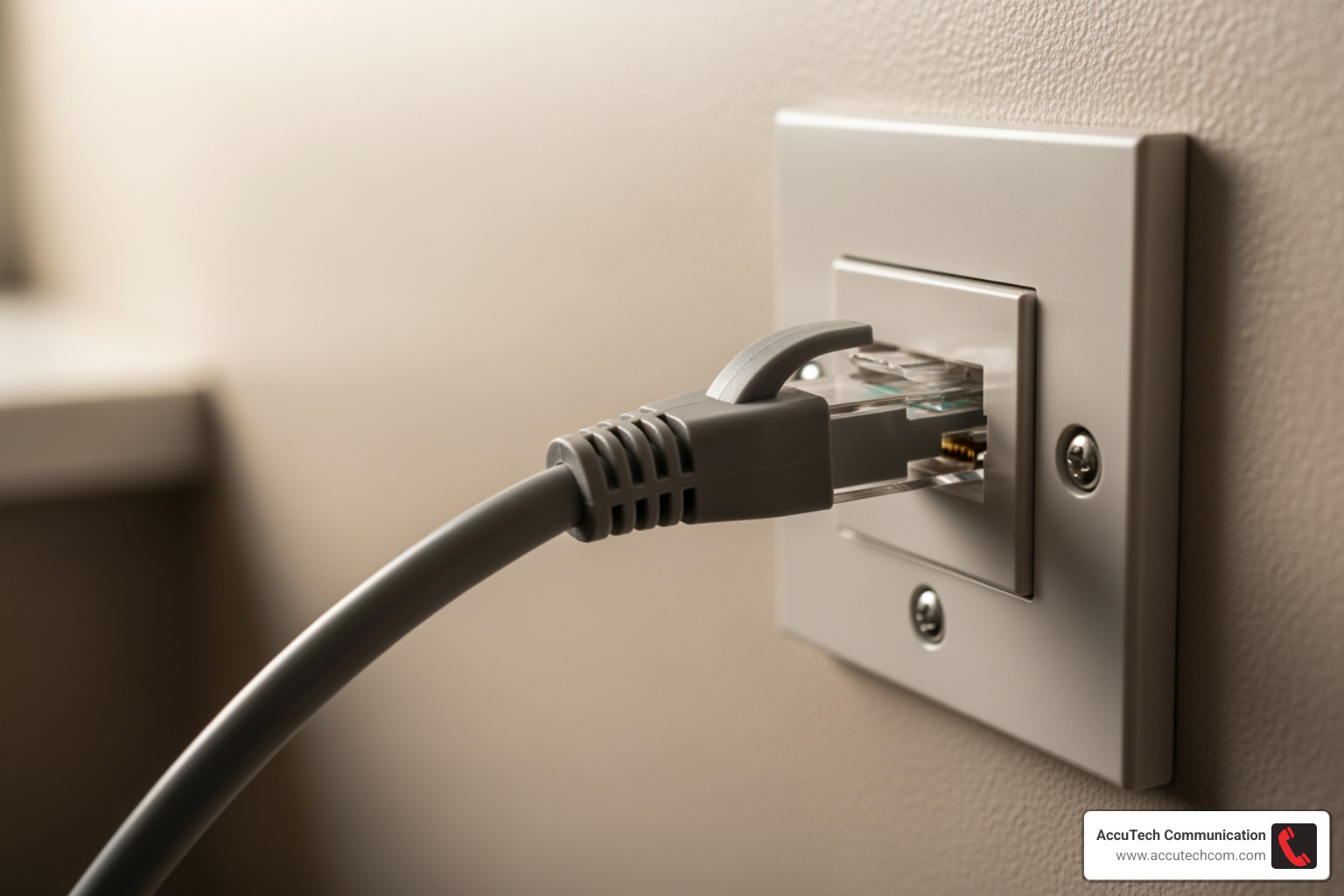
The best ethernet cable for commercial wiring depends on your specific performance requirements and future network plans. For most modern business environments, Cat6a is the recommended standard, supporting 10 Gbps speeds over the full 100-meter distance and accommodating Power over Ethernet (PoE) devices. Cat6 is suitable for smaller offices with moderate bandwidth needs, while Cat5e remains adequate only for very basic applications. Here’s a quick comparison:
| Cable Category | Maximum Speed | Bandwidth | Best For |
|---|---|---|---|
| Cat5e | 1 Gbps | 100 MHz | Basic office connectivity, VoIP phones |
| Cat6 | 10 Gbps (up to 55m) | 250 MHz | Small business networks, moderate data use |
| Cat6a | 10 Gbps (up to 100m) | 500 MHz | Recommended for most commercial installations |
| Cat8 | 40 Gbps | 2,000 MHz | Data centers, short-distance server connections |
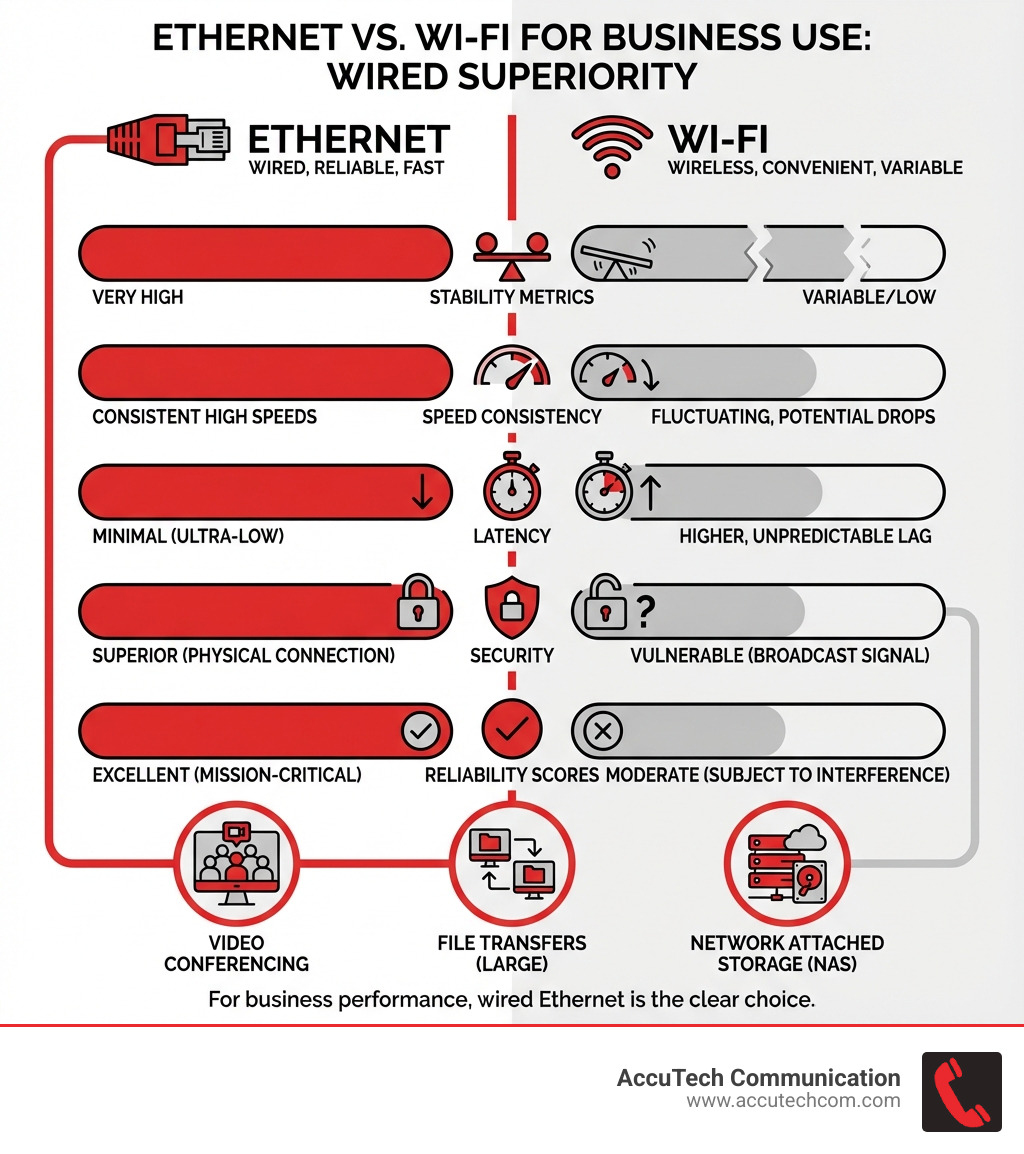
In today’s business world, a stable network connection isn’t just nice to have—it’s critical to your operations. While Wi-Fi has become ubiquitous, it simply cannot match the reliability, speed, and security of a properly installed wired Ethernet connection.
Wi-Fi connections are vulnerable to interference from walls, other devices, and congestion from neighboring networks. For mission-critical applications like video conferencing, large file transfers, cloud-based business systems, and real-time communications, a wired connection eliminates dropped packets, signal fade, and latency issues that can disrupt your workflow.
Ethernet provides a direct, stable link between your devices and network infrastructure. It guarantees consistent speeds, minimal latency, and superior security—essential for businesses in healthcare, finance, manufacturing, and any sector where downtime or data breaches carry serious consequences.
Choosing the right cable category for your structured cabling system is a decision that will impact your network performance for years to come. The differences between Cat5e, Cat6, Cat6a, and Cat8 cables aren’t just technical specifications—they directly affect your network’s speed, bandwidth capacity, and ability to support emerging technologies like PoE security cameras, wireless access points, and high-speed data transfers.
I’m Corin Dolan, owner of AccuTech Communications, and I’ve been helping businesses across Massachusetts, New Hampshire, and Rhode Island design and install reliable network infrastructure since 1993, including selecting and installing the best ethernet cable for office wiring in commercial settings to ensure optimal performance and long-term reliability. Let me walk you through what you need to know to make the right decision for your organization.
Relevant articles related to best ethernet cable for office wiring:
Decoding the Alphabet Soup: Ethernet Cable Categories Explained
When we talk about Ethernet cables, the “Cat” refers to “Category,” and the number indicates the cable’s performance specifications. Each category defines the cable’s maximum speed and bandwidth capabilities, along with its ability to resist interference. Understanding these categories is crucial for any business planning its network infrastructure.
Understanding Cable Categories (Cat5e, Cat6, Cat6a)
Let’s break down the most common categories we encounter in commercial wiring:
- Cat5e (Category 5e): This was once the workhorse of business networks, and it’s still found in many older installations. Cat5e is rated for speeds up to 1 Gigabit per second (Gbps) and has a bandwidth of 100 MHz. It’s sufficient for basic office connectivity, such as connecting desktop computers for general internet use, printers, and Voice over IP (VoIP) phones. However, for modern data-intensive tasks, it often acts as a bottleneck.
- Cat6 (Category 6): An upgrade from Cat5e, Cat6 cables can support speeds up to 10 Gbps. However, this 10 Gbps speed is typically limited to shorter distances, usually around 55 meters (180 feet). Beyond that, it defaults to 1 Gbps. Cat6 offers a bandwidth of 250 MHz. It’s a good choice for small business networks with moderate data usage, providing a solid performance boost over Cat5e.
- Cat6a (Category 6 Augmented): This is where most modern commercial structured cabling projects in Massachusetts, New Hampshire, and Rhode Island find their sweet spot. Cat6a is designed to support 10 Gbps speeds over the full 100-meter (328 feet) distance and boasts a bandwidth of 500 MHz. This makes it ideal for data-intensive applications, high-speed backbone connections, and future-proofing your network infrastructure. It’s robust enough to handle the demands of today’s business applications and those emerging in the near future.
For readers who want to dive deeper into how Ethernet standards have evolved over time, the overview of twisted pair Ethernet on Wikipedia provides additional technical background and history.
High-Performance Categories: Cat7 and Cat8
For specialized, high-demand environments, even higher categories exist:
- Cat7 (Category 7): Cat7 cables are designed for speeds up to 10 Gbps across 100 meters with a higher bandwidth of 600 MHz. A key difference with Cat7 is that it uses shielding around each twisted pair and an overall cable shield. However, Cat7 often uses proprietary GG45 connectors (or TERA connectors), which are not compatible with the standard RJ45 ports found on most network equipment. This limits its mainstream adoption for typical commercial wiring.
- Cat8 (Category 8): This is the fastest Ethernet cable category available today, supporting incredible speeds of up to 40 Gbps with a massive bandwidth of 2,000 MHz. However, Cat8’s 40 Gbps capability is limited to very short distances, typically 30 meters (98 feet). It’s primarily designed for high-bandwidth applications within data centers, connecting servers and network switches over short runs where extreme speed is paramount. For building-wide wiring, Cat8 is generally overkill and impractical due to its cost and distance limitations.
Does Your Cable Need to Be Faster Than Your Internet Plan?
This is a common question, and the answer is a resounding “yes” for businesses. While your Internet Service Provider (ISP) speed dictates how fast data flows in and out of your building, your Local Area Network (LAN) speed determines how quickly data moves within your internal network.
A new Ethernet cable won’t magically increase the speed of your internet plan. However, if your internal cabling is outdated (e.g., Cat5e with a 1 Gbps internet plan), it could be creating a bottleneck, preventing you from fully utilizing the speed you’re paying for.
More importantly, most business operations involve significant internal data transfers—think moving large files between workstations and servers, accessing data on a Network Attached Storage (NAS) device, or running internal applications. If your internal network is limited to 1 Gbps (due to older cabling), but you frequently transfer files larger than a few gigabytes, those transfers will be significantly slower than they could be.
We strongly advocate for future-proofing your network infrastructure. Pulling Cat6a cabling throughout your commercial space in Massachusetts, New Hampshire, or Rhode Island sets a 10-Gigabit baseline for the next decade. This ensures your internal network can handle high-speed demands today and adapt to faster technologies tomorrow, regardless of your current ISP speed. It allows for rapid internal file transfers, supports multiple PoE devices, and provides the headroom for future upgrades without costly re-cabling.
More info about our ethernet cable wiring services
Anatomy of a Cable: Physical Traits That Determine Performance
Beyond the category, the physical construction of an Ethernet cable plays a vital role in its performance, durability, and suitability for different commercial environments. Understanding these characteristics helps us choose the right cable for your specific needs.
Shielded (STP) vs. Unshielded (UTP)
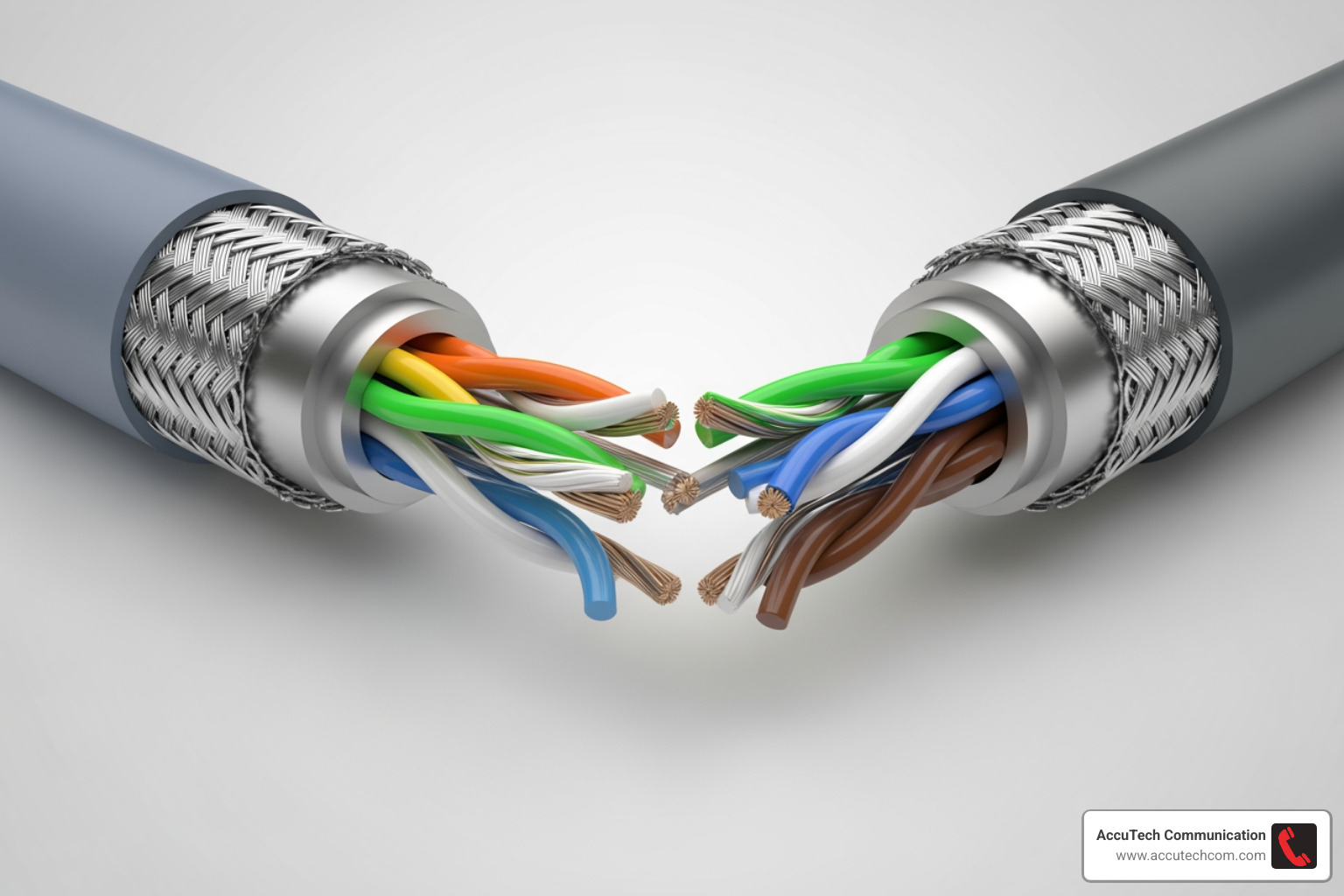
Ethernet cables transmit data using electrical signals. These signals can be affected by external electromagnetic interference (EMI) and internal crosstalk (signal leakage between adjacent wire pairs). This is where shielding comes into play:
- UTP (Unshielded Twisted Pair): As the name suggests, these cables have no metallic shielding. They rely solely on the twisting of wire pairs to cancel out interference. UTP cables are generally thinner, more flexible, and less expensive. For most general office environments with low EMI, UTP Cat5e or Cat6 cables are perfectly adequate.
- STP (Shielded Twisted Pair): These cables incorporate metallic shielding (foil, braid, or both) around individual wire pairs, the entire cable, or both. This shielding acts as a barrier against external EMI and reduces crosstalk. We recommend STP cables in environments with high electromagnetic noise, such as industrial settings near heavy machinery, fluorescent lighting, or high-voltage power lines. STP cables are also beneficial in high-density wiring scenarios, like crowded server racks, where crosstalk can become a significant issue. While STP cables are thicker, less flexible, and more costly, they provide superior signal integrity and reliability in challenging conditions. When using UTP cables, best practices suggest maintaining at least 8-12 inches of separation from AC power lines to minimize interference.
For additional background on how twisted pairs and shielding work to reduce interference, you can review the technical overview of twisted pair cabling on Wikipedia.
Solid Core vs. Stranded Cable
The type of conductor within the cable dictates its flexibility and ideal application:
- Solid Core Conductors: These cables use a single, solid copper wire for each conductor within the twisted pair. Solid core cables are designed for permanent installations, such as running through walls, ceilings, or conduit. They offer superior performance over longer distances and are more durable when terminated into wall jacks or patch panels. Their rigidity makes them less suitable for frequent bending. For any permanent structured cabling that runs inside the walls of your commercial building in Massachusetts, New Hampshire, or Rhode Island, solid core cable is the definitive choice.
- Stranded Conductors: These cables use multiple thinner strands of copper wire twisted together to form each conductor. Stranded cables are much more flexible and can withstand repeated bending without damage. This makes them ideal for patch cables—the shorter cables used to connect your devices (computers, printers, phones) to the wall outlets, or to connect equipment within a server rack.
Pure Copper vs. Copper-Clad Aluminum (CCA)
The material of the conductor is critically important for performance and safety:
- Pure Bare Copper: This is the industry standard for reliable Ethernet cabling. Pure copper offers excellent electrical conductivity, low resistance, and superior durability. It is essential for Power over Ethernet (PoE) applications, where power is delivered alongside data to devices like security cameras, VoIP phones, and wireless access points. Pure copper cables can dissipate heat effectively, preventing performance degradation and potential safety hazards.
- Copper-Clad Aluminum (CCA): CCA cables use an aluminum conductor with a thin coating of copper. While cheaper, CCA is inferior to pure copper in every critical aspect. It has higher electrical resistance, leading to greater signal loss over distance, reduced performance, and increased heat generation. Crucially, CCA cables are not suitable for PoE applications because they cannot safely and efficiently carry power. They are also more brittle and prone to breakage during installation or over time. For any professional installation, we strongly advise against using CCA cables. Always choose pure bare copper for optimal performance, reliability, and safety. High-grade forms of pure copper, such as oxygen-free copper, offer even better performance characteristics. You can read more general information about oxygen-free copper and its applications on Wikipedia.
Wire Gauge (AWG) and Gold-Plated Connectors
Two smaller, but still significant, details are the wire gauge and connector plating:
- American Wire Gauge (AWG): AWG is a standardized system that defines the thickness of the conductor wire. Counter-intuitively, a lower AWG number indicates a thicker wire. Thicker wires have less resistance and can carry signals more effectively over longer distances. For solid core cables used in permanent installations, you’ll typically find 23-24 AWG. Stranded patch cables often use thinner wires, around 24-26 AWG, to improve flexibility.
- Gold-Plated Connectors: The RJ45 connectors at the ends of Ethernet cables are often gold-plated. While this doesn’t directly increase speed, it offers significant benefits for long-term reliability. Gold is highly conductive and resistant to corrosion. Over time, non-gold-plated connectors can oxidize, leading to signal degradation and intermittent connectivity issues. For robust and stable connections in a business environment, especially those needing to perform reliably for years, look for connectors with at least 50-micron gold plating, which ensures optimal conductivity and corrosion resistance.
Planning Your Network: Choosing the Best Ethernet Cable for Commercial Wiring
Effective network planning is foundational to a successful business operation. Selecting the appropriate Ethernet cable is a critical component of this plan, ensuring your infrastructure can support current demands and future growth.

What is the best ethernet cable for commercial wiring in a professional setup?
For the vast majority of commercial wiring projects in Massachusetts, New Hampshire, and Rhode Island, we recommend Cat6a Ethernet cable. It strikes an optimal balance between performance, cost-effectiveness, and future-proofing.
With its ability to deliver 10 Gigabit Ethernet speeds over the full 100-meter distance and a robust 500 MHz bandwidth, Cat6a is perfectly suited for a wide range of business applications:
- High-Speed Workstations: Ensures fast data access and transfer for employees.
- Server Connections: Provides reliable, high-bandwidth links for internal servers and network storage.
- Power over Ethernet (PoE) Devices: Fully supports the power requirements for PoE devices like IP security cameras, VoIP phones, and wireless access points, which are increasingly common in modern offices.
- Future Scalability: Offers ample headroom for upcoming technologies and increased bandwidth demands without requiring a complete re-cabling effort.
While Cat8 cables offer even higher speeds, their extremely limited distance for those speeds (30 meters) makes them practical only for very specific, short-haul data center applications, not for general building-wide wiring. For businesses considering even higher bandwidth needs, such as between buildings or for specialized data center requirements, we would then explore fiber optic solutions. You can explore our fiber optic cabling solutions for those advanced needs.
Installation Tips for the best ethernet cable for commercial wiring
Proper installation is just as important as choosing the right cable category. Even the highest-quality cable will perform poorly if installed incorrectly.
- Cable Length Matters: Ethernet cables have specific maximum effective lengths. For Cat5e, Cat6, and Cat6a, the maximum recommended length for optimal performance is 100 meters (328 feet), including any patch cables. Exceeding this distance can lead to signal degradation and reduced speeds. Always measure your runs accurately, and it’s good practice to leave a small service loop (extra length) at termination points for future adjustments or repairs.
- Flat vs. Round Cables: While flat Ethernet cables can be aesthetically pleasing for short, visible runs along baseboards or under carpets in some settings, they generally offer less durability and protection than traditional round cables. For professional, permanent commercial installations where cables are run through walls, ceilings, or conduits, round cables are always preferred due to their robust construction and better protection for the twisted pairs.
- Wiring Standards (T568A vs. T568B): When terminating Ethernet cables into RJ45 connectors or wall jacks, two common wiring standards exist: T568A and T568B. Both are valid, but it’s crucial to consistently use one standard throughout your installation to avoid connectivity issues. In the United States, T568B is the most common wiring scheme for new commercial networks. We consistently adhere to T568B for our installations in Massachusetts, New Hampshire, and Rhode Island to ensure compatibility and ease of maintenance.
Outdoor and Riser-Rated Cabling
Not all Ethernet cables are created equal when it comes to environmental resilience:
- Outdoor Use: If you need to run Ethernet cable outside your building—perhaps to an outdoor access point, a detached office, or security cameras—you must use cables specifically designed for outdoor environments. These cables feature a UV-resistant jacket (often made of PE or PVC) to withstand sunlight, moisture, and extreme temperatures. For underground runs, direct burial cable is required, which has additional waterproofing to prevent moisture ingress. Standard indoor cables will quickly degrade and fail when exposed to the elements.
- Riser (CMR) and Plenum (CMP) Ratings: For internal wiring within multi-story commercial buildings, fire safety ratings are paramount and often mandated by local building codes in Massachusetts, New Hampshire, and Rhode Island.
- Riser-Rated (CMR) Cable: This cable has a fire-resistant jacket designed to prevent fire from spreading vertically between floors through risers or vertical shafts. It is suitable for vertical runs within walls.
- Plenum-Rated (CMP) Cable: This is the highest fire safety rating. Plenum cables are designed for use in air circulation spaces (plenums), such as drop ceilings or raised floors, where air is circulated for HVAC systems. These cables are made with materials that produce minimal smoke and are self-extinguishing, to prevent the spread of fire and toxic fumes through a building’s ventilation system. Always consult local building codes to ensure compliance for your specific installation.
Frequently Asked Questions about Ethernet Wiring
We often hear similar questions from our commercial clients in Massachusetts, New Hampshire, and Rhode Island. Here are some of the most common:
What are the benefits of using an Ethernet cable over Wi-Fi for a business office?
A wired Ethernet connection provides a more stable, secure, and faster connection with lower latency than Wi-Fi. This is critical for uninterrupted video calls, fast data transfers, and reliable access to business applications, eliminating issues like signal drops and interference common with wireless networks. For any business-critical task, Ethernet offers unparalleled reliability and performance.
Should I run solid or stranded ethernet cable in my walls?
For any permanent wiring that runs inside walls, ceilings, or between floors, you must use solid core cable. It is designed for long, straight runs and proper termination into wall jacks and patch panels. Solid core cables offer superior signal integrity over distance and are more robust for fixed installations. Stranded cable is too flexible, less durable for this purpose, and is intended only for shorter patch cords that connect your devices to the wall outlet. Using stranded cable for in-wall wiring can lead to poor performance and reliability issues.
Is it worth upgrading from Cat5e to Cat6 or Cat6a?
If your current network meets your needs and you have a 1 Gbps internet plan or less, Cat5e is often sufficient for basic connectivity. However, for any new installations, or if you are upgrading to a multi-gig internet plan, frequently transferring large files locally, utilizing numerous Power over Ethernet (PoE) devices, or want to future-proof your infrastructure for the next 5-10 years, installing Cat6a is the recommended professional standard. It provides the necessary bandwidth and speed for modern business demands and emerging technologies, making it a wise long-term investment. Upgrading from Cat5e to Cat6a significantly improves your network’s capabilities and longevity.
Conclusion: Building a Reliable Network Foundation
Choosing the best ethernet cable for your office wiring in your commercial space is a foundational decision that impacts your business’s efficiency, reliability, and future growth. We’ve seen that while various categories exist, Cat6a stands out as the optimal standard for most modern commercial installations in Massachusetts, New Hampshire, and Rhode Island. It effectively balances high performance (10 Gbps over 100 meters), robust bandwidth, and future-proofing capabilities, supporting everything from high-speed workstations to a growing array of PoE devices.
Beyond the category, understanding physical traits like shielding, conductor material (always pure copper!), wire gauge, and connector quality ensures your network performs reliably day in and day out. These details are not mere technicalities; they are critical to avoiding costly downtime and ensuring your business operations run smoothly.
A professionally designed and installed structured cabling system, utilizing the right materials and adhering to industry best practices, is the best investment you can make in your network infrastructure. Since 1993, AccuTech Communications has been providing certified, reliable service with a commitment to quality for businesses throughout Massachusetts, New Hampshire, and Rhode Island. We understand the unique needs of commercial environments and are dedicated to building network foundations that empower your business for years to come.
Contact us to discuss your network cabling installation needs
