
Why Your Business Needs a Robust Data Network Foundation
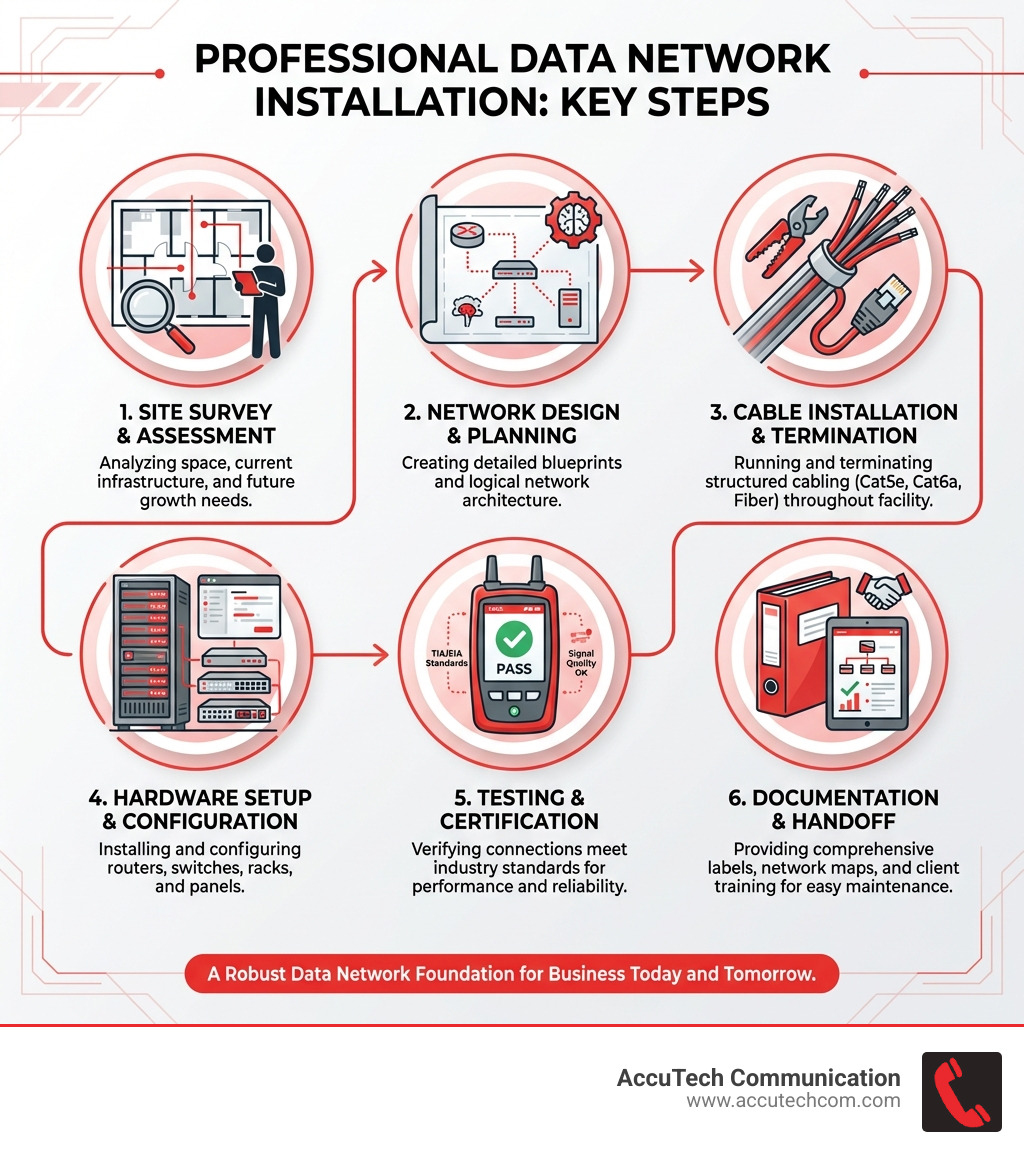
Data network installation is the setup of physical and logical infrastructure enabling business computers, phones, security systems, and other devices to communicate reliably. A professional commercial installation typically includes:
- Site survey and planning – Assessing your space, current needs, and future growth
- Structured cabling installation – Running Cat5e, Cat6, Cat6a, or fiber optic cables throughout your facility
- Hardware setup – Installing routers, switches, patch panels, and server racks
- Testing and certification – Verifying all connections meet industry standards (TIA/EIA)
- Documentation – Labeling and mapping your entire network for easy maintenance
Businesses across Massachusetts, New Hampshire, and Rhode Island rely on their networks daily for transactions, client communication, and cloud access. When the network fails, business operations halt.
A properly installed data network is not just about connecting devices. It’s about building a foundation that supports your business today and scales with you tomorrow. Whether you’re opening a new location, upgrading outdated infrastructure, or dealing with an unreliable system, the quality of your installation matters.
The global network cabling market was valued at $13.5 billion in 2022 and is projected to reach $23.8 billion by 2030, driven by demand for high-speed connectivity, IoT devices, and cloud computing. Businesses that invest in professional installation report 99% customer satisfaction across thousands of projects, with systems that deliver years of dependable service.
Poor installation leads to costly downtime, frustrating troubleshooting, and expensive repairs. Incorrect cabling, skipped testing, or low-quality materials create compounding problems that often require a complete reinstallation to fix.
This guide covers everything you need to know about commercial data network installation: planning, choosing hardware and cabling, the installation process, and avoiding common mistakes that compromise performance and safety.
I’m Corin Dolan, owner of AccuTech Communications. Since 1993, I’ve helped businesses across Massachusetts, New Hampshire, and Rhode Island design and install reliable data network infrastructure. From healthcare facilities to manufacturing plants, I’ve seen how the right data network installation transforms operations and supports long-term growth.
Data network installation terminology:
- cabling infrastructure solutions
- network cabling Boston
- voice data cabling
The Blueprint: Planning Your Commercial Data Network Installation
A commercial data network installation requires meticulous planning, just like a building’s blueprint. This phase ensures a reliable, efficient, and scalable network. Our process starts with a site survey to assess your facility, identify challenges, find optimal pathways for cabling and equipment, and check for sources of interference.
A thorough business needs assessment is critical. We identify network size, user count, applications, and data transfer rates to inform hardware and topology choices. We also work with you to create a realistic budget and a detailed project timeline, accounting for initial costs, maintenance, and future expansion.
Whether we’re working on new construction or retrofitting an existing building in Massachusetts, New Hampshire, or Rhode Island, the planning phase adapts. New construction offers the advantage of integrating cabling into the building’s design, while retrofitting often requires creative solutions to route cables around existing structures. Understanding the nuances between LAN and WAN, and the impact of network topology, further refines our blueprint.
Understanding Network Types and Topologies
The foundation of any robust data network installation lies in understanding the different network types and how their physical or logical arrangement—known as topology—impacts performance and reliability.
A Local Area Network (LAN) is typically confined to a smaller geographic area, such as a single office building or campus. We design LANs to connect devices within your immediate operational space, enabling rapid data transfer and resource sharing.
A Wide Area Network (WAN) spans larger regions, linking LANs across cities or states. WANs, often managed by telecom providers, connect your business locations in Massachusetts, New Hampshire, and Rhode Island. Understanding the LAN/WAN distinction is vital for a proper data network installation, as each has unique hardware, configuration, and cost requirements.
Network topology refers to the arrangement of different elements in a network. Common topologies include:
- Star Topology: This is one of the most common topologies in commercial settings. All devices connect to a central hub or switch. It’s easy to install and manage, and a failure in one cable only affects that single device. However, it may require more cabling, and a central hub failure can bring down the entire network segment.
- Mesh Topology: In a full mesh topology, every device is connected to every other device. This offers high reliability and redundancy, as data can take multiple paths. However, it is complex and expensive, making it less common for general business networks but valuable for critical connections.
- Bus Topology: All devices connect to a single central cable, or “bus.” This is simpler and requires less cable than a star, but a break in the main cable can disrupt the entire network.
The chosen topology significantly affects the network’s performance, reliability, and scalability. We carefully select the most appropriate topology based on your business needs, ensuring optimal data flow and fault tolerance.
Designing for the Future: Scalability and Structured Cabling
In today’s rapidly evolving digital landscape, a data network installation must be designed for the future, not just current demands. We prioritize future-proofing your network to accommodate technological advancements and growth. The increasing adoption of IoT devices and reliance on cloud computing mean your network must handle greater data volumes and higher speeds.
This is where structured cabling systems shine. This comprehensive infrastructure supports various hardware and organizes your network into a streamlined, manageable system. Its consistency allows for using the same cabling for voice, data, and video, which simplifies troubleshooting and system updates. This approach helps us quickly isolate network issues, reducing operational downtime.
The benefits of structured cabling extend beyond just neatness. It provides the foundation for robust networks, preventing costly overhauls as your business grows. Structured cabling systems are expected to see significant growth, reaching an estimated market value of $15.7 billion by 2028, highlighting their long-term value and return on investment (ROI). By designing a scalable, organized system, we ensure your network can adapt to more users, new devices, and higher bandwidth demands without compromising performance.
The Building Blocks: Essential Hardware and Cabling
A successful data network installation relies on carefully selected hardware and the right cabling. These building blocks form the physical backbone of your network, ensuring efficient data flow and reliable connectivity.
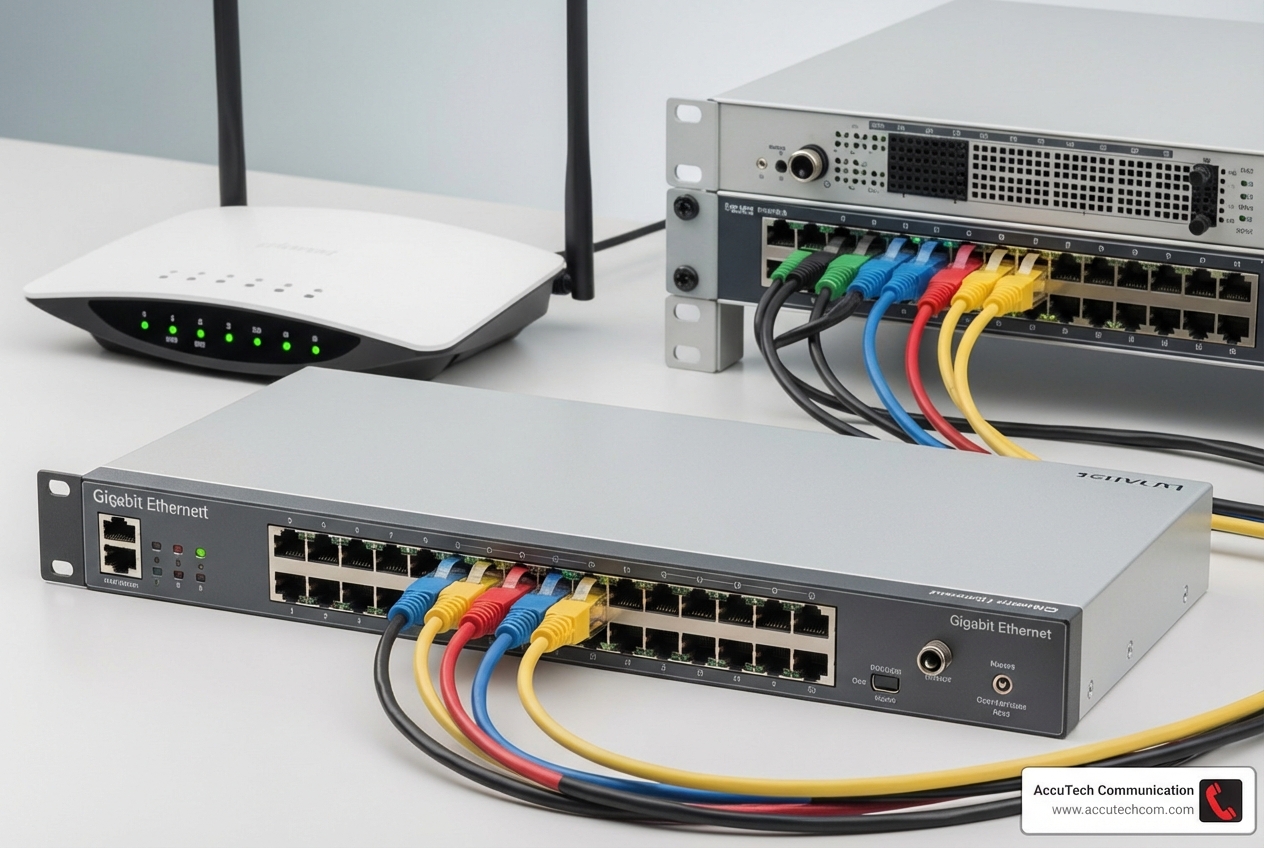
Here are the essential hardware components we typically integrate:
- Routers: Act as gateways, directing data packets between your internal network and external networks like the internet.
- Switches: Connect devices within a LAN, operating at the data link layer. They improve efficiency by learning device MAC addresses and forwarding data only to the intended recipient.
- Firewalls: A critical security system that monitors and controls network traffic based on security rules, acting as the first line of defense against cyber threats.
- Patch Panels: Provide a centralized, organized point for terminating and managing network cables, simplifying cable management and troubleshooting.
- Server Racks: For larger installations, we design and install computer rooms with server racks and customized power backup solutions to securely house your servers, switches, and other equipment.
- Network Interface Cards (NICs): Though often integrated, NICs are the fundamental components that allow devices to connect to a network.
Our technicians use professional-grade tools like punch-down tools, crimpers, and network testers to terminate and verify all connections.
Choosing the Right Network Cables
The type of cable we select for your data network installation is paramount to achieving desired speeds, distances, and overall performance. We work with various cable types, each suited for specific applications:
- Twisted Pair Cables: The most common type for commercial LANs, consisting of insulated copper wires twisted together to reduce electromagnetic interference.
- Cat5e: Supports speeds up to 1 Gigabit per second (Gbps) over 100 meters, with a 5-10 year lifespan. Ideal for basic office networks.
- Cat6: Supports 10 Gbps up to 55 meters (or 1 Gbps up to 100 meters). It has a 10-15 year lifespan and is suitable for modern business networks.
- Cat6a: An augmented version of Cat6, supporting 10 Gbps over the full 100-meter distance, with a 10-15 year lifespan. It is ideal for high-speed data transmission.
- Coaxial Cables: These copper wires have a shielded core, protecting the signal from interference. While less common now, they are valuable for specialized uses like video conferencing systems.
- Fiber Optic Cables: These use light pulses to transmit information through glass or plastic strands, offering superior bandwidth and distance. They are increasingly adopted for their speed, especially in data centers and telecommunication networks.
We carefully assess your bandwidth, distance, and environmental needs to recommend the optimal cable type for your commercial data network installation in Massachusetts, New Hampshire, or Rhode Island.
Comparing Common Network Cable Types
| Category | Max Speed | Max Distance | Common Application |
|---|---|---|---|
| Cat5e | 1 Gbps | 100 meters | Basic commercial LANs, VoIP, general office use |
| Cat6 | 10 Gbps | 55 meters | Modern commercial LANs, server-to-switch connections |
| Cat6a | 10 Gbps | 100 meters | High-speed commercial networks, data centers |
| Cat7 | 40 Gbps | 100 meters | High-performance networks, demanding applications |
| Cat8 | 40 Gbps | 30 meters | Server room/data center connectivity |
| Single-Mode Fiber | 100+ Gbps | 10+ kilometers | Long-distance backbone connections, WAN links |
| Multimode Fiber | 100 Gbps | 2 kilometers | Campus networks, building backbones, data centers |
The Execution: A Professional Data Network Installation Process
After planning and selecting hardware, the physical data network installation begins. This phase demands precision, adherence to best practices, and attention to detail to ensure a robust network.
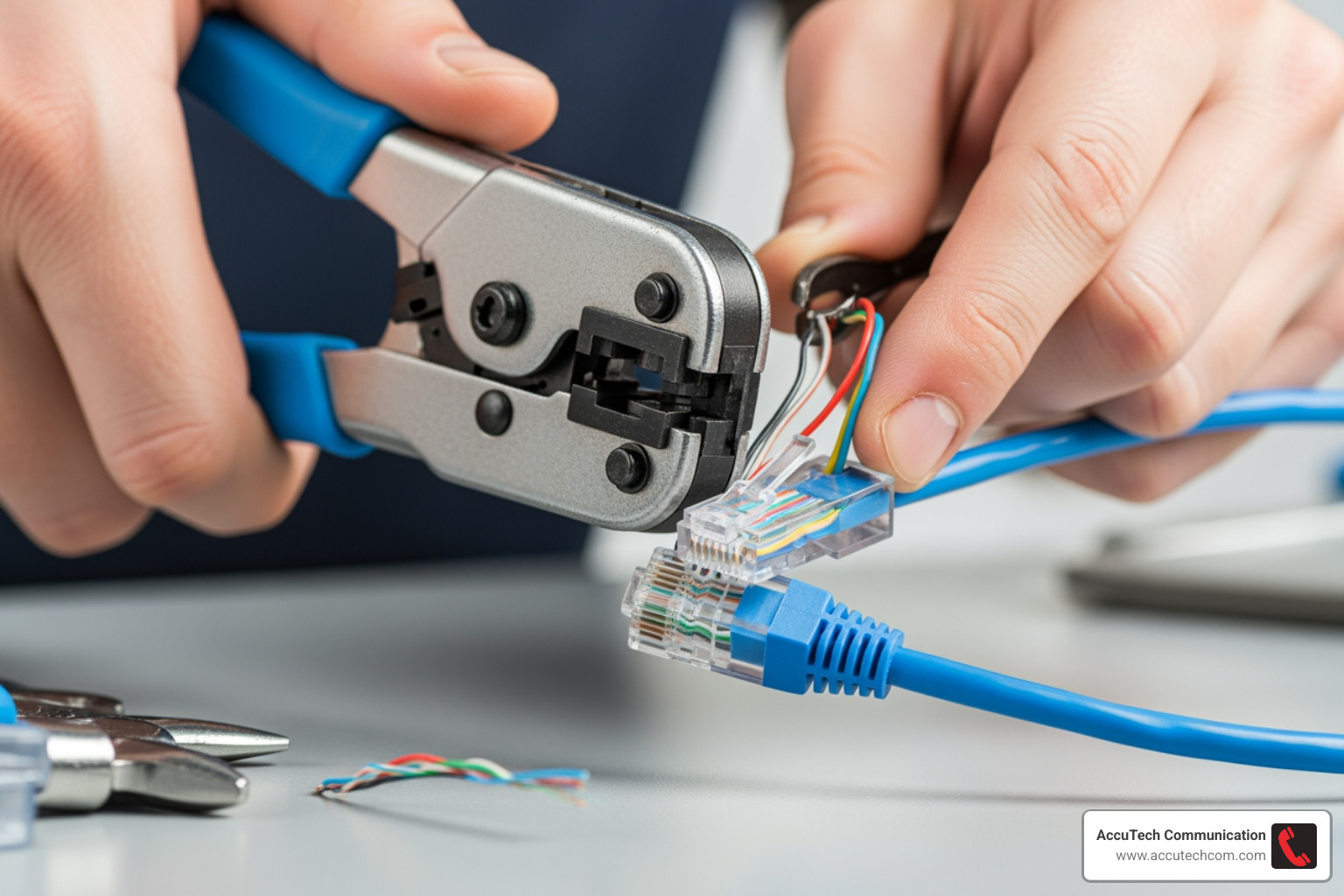
Our process typically involves:
- Cable Pulling and Routing: We carefully run network cables through walls, ceilings, and conduits, ensuring proper pathways that avoid interference and protect the cables, paying close attention to building structure.
- Terminating Connections: Cables are precisely terminated with appropriate connectors (e.g., RJ45 for copper, specialized connectors for fiber) at patch panels, wall plates, and equipment. We often use fusion splicing for strong, low-loss fiber connections.
- Systematic Labeling: Every cable is labeled at both ends with consistent naming conventions. This documentation is invaluable for future maintenance, troubleshooting, and upgrades.
- Cable Management Best Practices: We organize cables neatly in server racks and trays, avoiding tight bundling, allowing service loops for future access, and ensuring proper airflow.
- Rack and Stack Equipment: We install and organize all active network equipment, like switches and routers, within server racks, ensuring proper power, cooling, and connectivity.
Best Practices for a Flawless Installation
A professional data network installation adheres to industry best practices to guarantee optimal performance and longevity.
- Adhering to TIA/EIA Standards: We strictly follow TIA/EIA and BICSI standards to ensure quality and performance, including compliance with local building codes in Massachusetts, New Hampshire, and Rhode Island.
- Maintaining Proper Bend Radius: Cables, especially fiber optic, have a minimum bend radius. We route cables with gentle curves to prevent damage and signal loss.
- Avoiding Electromagnetic Interference (EMI): We minimize EMI by routing data cables away from power sources and crossing them at 90-degree angles when paths intersect.
- Creating Service Loops: We leave a small amount of slack, or “service loops,” at termination points for flexibility during future maintenance or equipment moves.
- Detailed Documentation: We create comprehensive documentation, including cable layouts, equipment locations, and test results. This is invaluable for future repairs, upgrades, and troubleshooting.
Common Mistakes to Avoid During a data network installation
We’ve learned to anticipate and avoid common pitfalls during data network installation:
- Exceeding Cable Length Limits: Standard Ethernet cables have a 100-meter limit. Exceeding this causes signal degradation. We plan cable runs carefully to stay within specifications.
- Poor Cable Management: Tangled, unorganized cables hinder airflow, complicate troubleshooting, and can lead to accidental damage or disconnections.
- Inadequate Testing: Skipping rigorous testing can lead to costly downtime later. Every cable must be tested and certified.
- Ignoring Building Codes: Non-compliance with local building codes can lead to safety hazards, fines, and expensive re-work.
- Using Low-Quality Materials: Low-quality components lead to poor performance, frequent failures, and a shorter network lifespan, costing more in the long run.
The Critical Role of Testing and Certification
After the physical installation, testing and certification are critical to ensure the network performs to industry standards. This step verifies our work quality and gives you documented assurance of your network’s capabilities.
We conduct a series of rigorous tests:
- Continuity Testing: Confirms each wire is properly connected without breaks.
- Wire Mapping: Verifies each wire pair is correctly terminated at both ends.
- Performance Testing: Using a network test tool, we measure parameters like signal loss and crosstalk to ensure the cable supports intended data speeds.
- Certification Reports: We generate detailed reports for each cable, confirming it meets or exceeds TIA/EIA standards. These are crucial for warranties and troubleshooting.
- OTDR Testing for Fiber: For fiber optic installations, Optical Time Domain Reflectometer (OTDR) testing measures the link’s integrity, pinpointing any breaks or poor splices.
This comprehensive process ensures your network is reliable, performs optimally, and is ready to support your business without interruption.
Safety, Costs, and Choosing Your Installer
A professional data network installation involves more than connecting wires; it includes critical safety and financial planning. When choosing a partner for your commercial network in Massachusetts, New Hampshire, or Rhode Island, these factors are paramount.
Safety First: Critical Considerations
Safety is non-negotiable in any commercial installation. Our teams adhere to the strictest safety protocols to protect personnel and your property.
- Electrical Hazards: We always disconnect power at the breaker before working near electrical wiring or cutting into walls to prevent accidental contact with live systems.
- Fire Safety Compliance: We integrate proper fire safety measures, using fire-rated cables (plenum or riser) in appropriate areas and sealing wall penetrations to maintain fire ratings.
- Maintaining Structural Integrity: We route cables carefully to avoid damaging existing electrical, gas, or plumbing systems and never compromise load-bearing structures.
Understanding the Costs of a professional data network installation
The cost of a professional data network installation varies with project complexity and scale. Understanding these factors helps in planning this crucial investment in your business’s future.
Factors affecting cost include:
- Building Size and Layout: Larger or more complex facilities require more labor and materials.
- Number of Connections (Data Drops): Each wired connection point adds to the overall cost.
- Type of Cabling: Fiber optic cabling is typically more expensive to install than copper alternatives like Cat6a.
- New Construction vs. Retrofit: Retrofitting existing buildings often requires more labor to route cables through finished spaces.
- Hardware Requirements: The quantity and type of routers, switches, and server racks influence the budget.
Industry averages suggest a basic commercial Cat5 installation could range from $1,000 to $3,000, while advanced fiber optic cabling with multiple connections might fall between $6,000 and $18,000. These are general estimates from publicly available internet data and do not reflect AccuTech Communications’ actual pricing or guarantees. We provide detailed, customized quotes for your specific project. A high-quality installation provides long-term value through reliability, reduced downtime, and scalability.
DIY vs. Professional Services: When to Call the Experts
For commercial businesses, professional data network installation is essential. While DIY may work for simple home setups, the complexity, scale, and performance demands of a business network require expert handling.
DIY Limitations for Commercial Settings:
- Lack of Expertise: Commercial networks require knowledge of cable types, topologies, and industry standards (TIA/EIA).
- Time and Resources: A DIY approach consumes internal resources and can lead to prolonged downtime.
- Risk of Errors: Incorrect installation can cause performance issues, security vulnerabilities, or safety hazards.
- No Warranty or Certification: Without professional certification, you lack proof that your network meets performance standards.
Benefits of Professional Service:
Partnering with professionals like AccuTech Communications ensures:
- Guaranteed Performance: We deliver infrastructure that meets industry standards for speed and reliability.
- Comprehensive Warranty and Compliance: Our installations include a warranty and comply with all local building codes.
- Expert Troubleshooting: Our experienced technicians can efficiently resolve any issues, minimizing business disruption.
- Efficient Project Completion: We execute projects with minimal disruption, often working off-hours.
- Proven Reliability: Professional installation achieves a 99% customer satisfaction rate, reflecting the peace of mind that comes with expert service.
Frequently Asked Questions about Data Network Installation
How long does a typical commercial network installation take?
The timeframe for a commercial data network installation varies significantly. A small office may take a few days, while a large, complex project could require several weeks. Key factors include project size, number of data drops, new construction vs. retrofit, and cabling type (e.g., fiber optics). We can also use phased installations to minimize business disruption.
How does installation differ between new construction and existing buildings?
Data network installation presents unique challenges and advantages depending on the building type.
- New Construction: This is the ideal scenario. We integrate cabling into the building’s design from the start, allowing for optimal routing, easy access, and seamless integration. This results in a cleaner, more efficient, and cost-effective installation.
- Existing Buildings (Retrofitting): Retrofitting requires careful planning to steer challenges like finished walls, existing infrastructure (plumbing, electrical), and older materials. A professional site survey is crucial to develop a strategic plan. For exposed cables, we can use EMT Piping Services for protection.
What are the main benefits of a structured cabling system?
A structured cabling system offers numerous benefits for commercial businesses:
- Simplicity and Organization: It creates a streamlined, manageable network infrastructure, reducing clutter and simplifying component identification.
- Scalability for Future Growth: It is designed for expansion, easily accommodating new technologies and increased bandwidth demands without a complete overhaul.
- Reduced Downtime and Faster Troubleshooting: The organized system makes it easier to isolate and resolve network issues, significantly reducing downtime.
- Cost-Effectiveness Over the System’s Lifespan: A well-designed system reduces long-term maintenance and upgrade costs, providing a stable, cost-effective foundation for years.
Conclusion: Building a Reliable Foundation for Your Business
A robust data network installation is a fundamental necessity in today’s business world. It’s the silent workhorse powering your operations, communication, and growth. Every step, from planning and hardware integration to meticulous installation and testing, contributes to a flawless network.
By understanding network types, selecting the right components, and adhering to industry best practices, you build a foundation for long-term performance. Skipping corners or attempting a DIY approach in a commercial setting leads to costly mistakes, downtime, and security risks.
For businesses in Massachusetts, New Hampshire, and Rhode Island, AccuTech Communications provides certified, expert installation services. We bring decades of experience to every project, ensuring your data network installation is optimized for your specific needs and future growth. Let us help you build a network that empowers your business.
Learn more about our professional Network Cabling Installation services
