
Why Professional Network Installation MA Matters for Your Business
Network installation MA is the foundation of reliable business connectivity across Massachusetts. Whether you’re upgrading outdated infrastructure or setting up a new location, professional network installation ensures seamless data transmission, reduced downtime, and compliance with industry standards like ANSI/TIA/EIA.
Key elements of professional network installation in Massachusetts include:
- Structured Cabling Systems – Cat5e, Cat6, Cat6a, and fiber optic cabling designed for scalability
- Hardware Integration – Routers, switches, firewalls, and wireless access points configured for optimal performance
- Testing & Certification – Comprehensive testing to TIA standards with documented as-built drawings
- Ongoing Support – Professional maintenance to prevent signal loss, network slowdowns, and security vulnerabilities
Modern businesses in healthcare, manufacturing, education, and retail depend on robust network infrastructure to support mission-critical operations. Outdated wiring installed over 10 years ago often can’t handle today’s bandwidth demands, leading to slow connections, dropped calls, and productivity losses. Professional installation eliminates these risks through proper design, certified technicians, and thorough testing.
The cost of poor network design goes beyond initial savings. DIY installations or inadequate cabling may save money upfront, but they frequently result in performance issues, costly troubleshooting, and premature replacement. Professional network installation MA services provide future-proof solutions that adapt as your business grows, whether you’re connecting multiple buildings with fiber optic backbones or optimizing a single office for high-speed data transfer.
I’m Corin Dolan, owner of AccuTech Communications, and I’ve been designing and installing commercial network infrastructure across Massachusetts, New Hampshire, and Rhode Island since 1993. With expertise in structured cabling, fiber optics, and business phone systems, I’ve helped organizations across healthcare, manufacturing, and education sectors build reliable, scalable networks that support their long-term success.
Simple network installation MA glossary:
The Strategic Value of Professional Network Installation MA
When we talk about network installation MA, we aren’t just talking about plugging in a few routers and running some wires behind a desk. We are talking about the central nervous system of your business. In cities like Boston, Worcester, and Waltham, the speed of business is breakneck. If your network stutters, your productivity stalls.
Professional installation provides a level of reliability that “good enough” setups simply can’t match. We’ve seen many businesses in Marlborough and Sudbury try to save a few pennies by handling their own wiring, only to find that their performance suffers over the long term. A professional setup by certified technicians ensures that your infrastructure is organized, labeled, and tested to meet the highest industry standards.
One of the biggest advantages of working with experts is the use of Certified Registered Communications Distribution Designers (RCDDs) and Telecommunications Layout Technicians (TLTs). These professionals don’t just “run wire”; they design an interconnected building system that supports multiple subsystems, from your VoIP phone lines to your high-end security cameras.
For more information on how we handle these complex projects, check out our guide on network cabling installation.
Optimizing Business Connectivity with Network Installation MA
In the commercial world, connectivity is about more than just “getting online.” It’s about data transmission efficiency. Have you ever noticed that your network seems to crawl during peak afternoon hours? Or perhaps you’ve experienced “signal loss” where data packets simply vanish into the ether?
These are often symptoms of poor cabling. Professional network installation MA focuses on preventing signal loss through high-quality materials and precise termination. When we install a system, we look at the latest industry insights to ensure we are using the most efficient pathways. By optimizing local Ethernet networks for data, video, and audio equipment, we help businesses in the Metro-West Boston area achieve the low-latency performance they need for modern applications like video conferencing and cloud-based ERP systems.
Core Components of Commercial Network Infrastructure
A robust network is built on several key physical layers. Think of it like a highway system: you need the road (cabling), the interchanges (switches), and the traffic lights (routers).
- Copper Cabling: This is the workhorse of the office. Category-rated, twisted-pair cabling like Cat6 and Cat6a provides the foundation for most workstations and PoE (Power over Ethernet) devices.
- Fiber Optic Cabling: When you need to transmit massive amounts of data over long distances—like connecting two separate buildings in a corporate campus—fiber is the answer. It uses pulses of light to deliver heavy bandwidth with zero interference. You can learn more about this in our section on fiber optic cabling installation.
- Racks and Enclosures: These are the “homes” for your active electronics. A clean, organized rack protects your equipment from physical damage and optimizes airflow to prevent overheating.
- Cable Management: Nobody likes a “spaghetti” closet. Proper pathways, raceways, and labeling ensure that if something goes wrong, a technician can find and fix the issue in minutes, not hours.
Essential Hardware for Business Networks
While the cables are the roads, the hardware manages the traffic.
- Routers: These connect your internal network to the outside world (the internet) and manage the flow of data between different networks.
- Switches: These act as the central hub for devices within your building, allowing computers, printers, and servers to talk to each other.
- Firewalls: Your first line of defense. They monitor incoming and outgoing traffic to block potential threats.
- Wireless Access Points (WAPs): These extend your network wirelessly, allowing for mobility throughout the office without sacrificing security.
For more professional networking insights, you can follow industry leaders on LinkedIn.
Comparing LAN and WAN for Massachusetts Businesses
Understanding the difference between a Local Area Network (LAN) and a Wide Area Network (WAN) is crucial for any MA business owner planning an expansion.
| Feature | LAN (Local Area Network) | WAN (Wide Area Network) |
|---|---|---|
| Geographic Reach | Limited to a single building or campus (e.g., an office in Woburn). | Spans large distances, connecting cities or even countries. |
| Data Speed | Typically very high (1Gbps to 10Gbps+). | Varies depending on service provider and distance. |
| Ownership | Owned and maintained by your business. | Often maintained by telecom companies or ISPs. |
| Typical Use | Connecting office computers, printers, and local servers. | Connecting a Boston headquarters to a satellite office in New Hampshire. |
Most of our work involves creating high-performance LANs, but we also specialize in the structured cabling services required to link these networks into a cohesive WAN for multi-location enterprises.
The Professional Installation Process: Planning to Certification
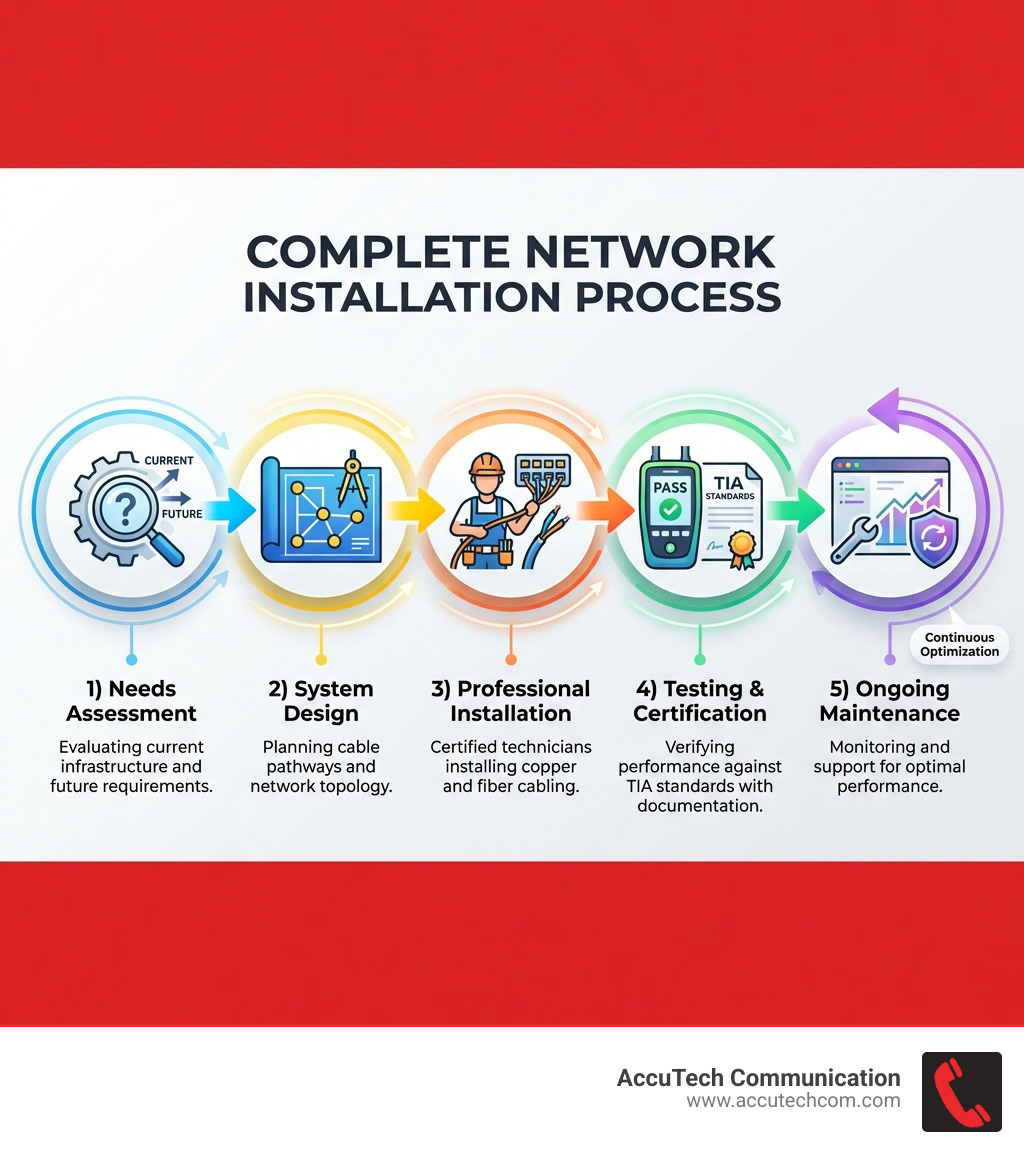
We believe that a successful network installation MA follows a rigorous, five-step process. This isn’t just about pulling cable; it’s about engineering a solution.
- Needs Assessment: We start by evaluating your current infrastructure and future goals. Are you planning to add 50 more employees next year? Do you need to support 4K video streaming?
- Hardware Selection: We help you choose the right routers, switches, and cable types (Cat6 vs. Fiber) that fit your budget and performance needs.
- Cable Layout and Installation: Our technicians fish wires through walls, install conduits, and set up innerducts to protect the lines. For specialized environments, we often provide innerduct installation services to ensure long-term durability.
- Configuration and Testing: Once the physical work is done, we configure the software, assign IP addresses, and set up security protocols.
- Certification: This is the most important step. We use state-of-the-art testers (like Fluke meters) to certify every single line.
Future-Proofing with Advanced Network Installation MA
A network that works today but fails tomorrow isn’t a good investment. Future-proofing means designing for scalability. We adhere to strict TIA and ANSI/TIA/EIA standards to ensure your system can handle the next generation of technology.
When the job is done, we provide a complete documentation package. This includes as-built drawings—a “map” of your network—and test results for every line. If you ever need to upgrade or troubleshoot in the future, you won’t be guessing where the wires go.
Performance, Security, and Scalability Benefits
Why bother with all this complexity? Because the benefits to your business are tangible.
- High-Speed Data: No more waiting for files to download or dealing with laggy Zoom calls.
- Zero-Trust Security: We can set up role-based segments, ensuring that a guest in your lobby can’t access your sensitive financial servers.
- Downtime Reduction: Meticulous installation minimizes the risk of signal interference and physical cable failure.
- Seamless Expansion: With a structured system, adding a new workstation is as simple as plugging in a patch cable.
Sometimes, protecting your network requires physical infrastructure upgrades. In many commercial buildings in Worcester and Marlborough, we use EMT piping services to provide a rigid, secure pathway for critical data lines, protecting them from pests, accidental cuts, or environmental damage.
Understanding the Costs of Network Services
We know that budget is always a consideration for our commercial clients in Massachusetts and New Hampshire. While we don’t provide fixed pricing without a site survey, we can share some general industry data to help you plan.
Note: Based on industry averages and publicly available internet data, the cost for a commercial network installation can range from $2,500 to over $15,000. Please keep in mind that these are average costs sourced from online data and do not reflect the actual prices of AccuTech Communications. Every project is unique, and a large-scale warehouse in Marlborough will have vastly different requirements than a small professional office in Boston.
Factors Influencing Installation Pricing
Several variables can swing the cost of your project:
- Cabling Type: Fiber optic materials and the specialized labor for fusion splicing are generally more expensive than standard copper Cat6.
- Building Size and Complexity: Wiring a historical building in Boston with thick stone walls is more labor-intensive than a modern office in Waltham with drop ceilings.
- Labor Complexity: Night work or weekend installations (to avoid disrupting your business) may influence the final tally.
- Hardware Quality: Enterprise-grade switches and firewalls offer better security and longevity but come at a higher initial cost than consumer-grade gear.
Frequently Asked Questions
What are the benefits of fiber optic over copper?
Fiber optic cabling offers much higher bandwidth and can transmit data over much longer distances without signal degradation. It is also immune to electromagnetic interference (EMI), making it ideal for industrial environments or connecting separate buildings. Copper is still excellent for shorter runs to individual desks and supports Power over Ethernet (PoE).
How does network topology affect business performance?
Topology refers to how your devices are connected. A Star Topology, where every device connects to a central switch, is the gold standard for offices because if one cable fails, the rest of the network stays online. A Mesh Topology is often used for wireless networks to ensure full coverage across a large floor plan.
Why is professional certification important for network cabling?
Certification proves that the installed lines actually meet the performance standards they are rated for. Without it, you might have “Cat6” cables that only perform at Cat5 speeds due to poor termination or interference. Certification gives you the peace of mind that you are getting exactly what you paid for.
Conclusion
At AccuTech Communications, we’ve spent over three decades perfecting the art of network installation MA. From our headquarters in Massachusetts to our service areas in New Hampshire and Rhode Island, we are committed to providing commercial clients with the backbone they need to compete in a digital world.
Whether you are in the Metro-West area, Boston, or Worcester, we offer the certified reliability and competitive pricing your business deserves. We don’t just pull wires; we build the infrastructure that allows your business to communicate, collaborate, and grow.
Ready to upgrade your connectivity? Get a quote for network cabling installation today and let us help you move beyond the wires.
