
Cable Infrastructure: 3 Essential Types to Master Today
Cabling infrastructure is the backbone of modern communication, playing a pivotal role in ensuring robust and efficient data transfer across your business landscape. Whether you’re in healthcare or another industry that relies heavily on seamless connectivity, understanding the essentials of cabling infrastructure is vital. Here’s a quick snapshot of what you need to know:
- Foundation of Communication Systems: Supports data, voice, and video transmission effectively.
- Components Include: Structured cabling solutions like twisted pair, coaxial, and fiber optics.
- Impact: Directly influences network performance, reliability, and future scalability.
A correctly installed and maintained cabling infrastructure ensures that your business can keep up with technological advancements. It prevents downtime and ensures compliance with industry standards, which is crucial for companies needing constant communication for their operations.
As Corin Dolan, a seasoned expert with over two decades of experience in network cabling and communication systems, I’ve witnessed how a solid cabling infrastructure transforms businesses. My focus is on ensuring that your cabling solutions meet current technology demands while enhancing operational efficiency, ensuring both present functionality and future growth potential.
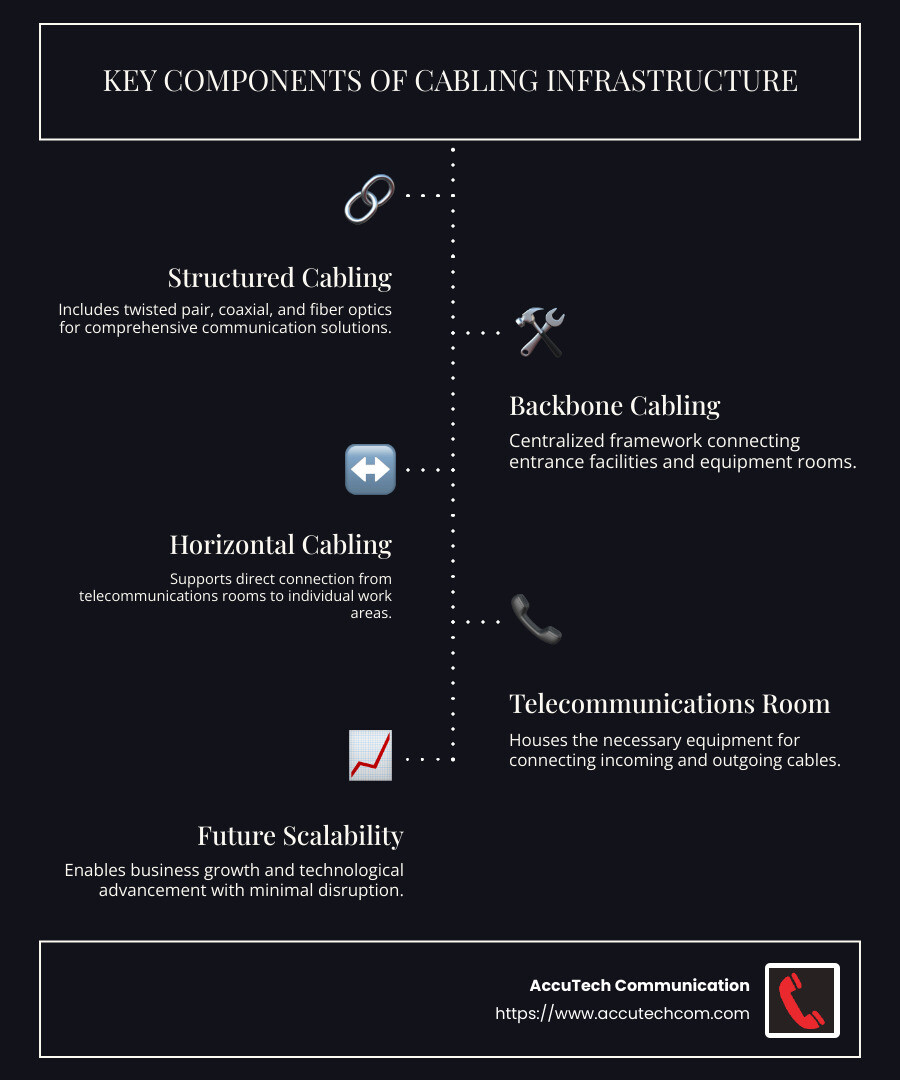
Cable infrastructure vocabulary:
– network data wiring
– structured cabling installation
– structured data cabling
Understanding Cabling Infrastructure
When it comes to network connectivity, cabling infrastructure is like the nervous system of your organization. It connects different parts of your business, ensuring that data flows smoothly and efficiently.
Structured Cabling
Structured cabling refers to a standardized approach to creating a network of cables. This involves organizing cables in a way that supports multiple hardware uses and is flexible for future changes. Think of it as building a solid foundation that can support various types of communication technologies. A well-planned structured cabling system helps in reducing maintenance costs and minimizes downtime.
- Key Elements:
- Entrance Facilities: Connects your internal network to external service providers.
- Backbone Cabling: Links different parts of your building or campus.
- Horizontal Cabling: Connects individual workstations to the network.
Communication Pathways
Communication pathways are the routes through which data travels within your network. These pathways need to be clear and efficient to ensure quick and reliable data transfer. A smooth communication pathway is essential for maintaining high network performance.
- Benefits of Clear Pathways:
- Reduced Interference: Minimizes the chances of data loss or corruption.
- Improved Speed: Ensures that data packets reach their destination faster.
- Scalability: Makes it easier to expand your network as your business grows.
In today’s business environment, having an efficient cabling infrastructure is not just a luxury but a necessity. It ensures that your business communication is uninterrupted and that your network can handle increased data loads as your company expands.

By investing in a robust cabling infrastructure, you set the stage for a reliable and future-proof communication network. This ensures that your business remains competitive and can adapt to new technologies as they emerge.
Next, let’s explore the different types of network cables and how they impact your cabling infrastructure.
Types of Network Cables
When setting up your cable infrastructure, choosing the right type of network cable is crucial. Each type has its own strengths and is suited for different applications. Let’s explore the three main types: twisted pair, coaxial, and fiber optic cables.
Twisted Pair Cables
Twisted pair cables are the most common type used in local area networks (LANs). They consist of pairs of wires twisted together, which helps to reduce electromagnetic interference.
- Types:
- Cat 5e: Suitable for small-to-medium-sized networks.
- Cat 6 and Cat 6a: Ideal for high-performance networks and data centers.
Advantages:
– Cost-Effective: Generally cheaper than other types of cables.
– Easy to Install: Telephone maintenance crews are familiar with these cables, making installation straightforward.
Twisted pair cables are reliable and easy to work with. If you unplug one, it only affects a single connection, unlike coaxial cables, which can disrupt the entire system.
Coaxial Cables
Coaxial cables have been used for many years, especially in television and internet connections. They have a central conductor, an insulating layer, and a metal shield.
Advantages:
– Sturdy and Durable: Resistant to physical damage.
– Good for Long Distances: Suitable for applications requiring long cable runs.
However, troubleshooting a coaxial network can be complex, and unplugging a cable might disrupt the whole system. Therefore, they are less favored in modern network setups.
Fiber Optic Cables
Fiber optic cables are the powerhouse of modern communication. They use light to transmit data at incredibly high speeds over long distances.
- Types:
- Single Mode: Delivers 10 GB Ethernet over 40 kilometers. More expensive and complex to handle.
- Multi Mode: Supports 10 GB Ethernet up to 550 meters. Easier to manage and install.
Advantages:
– High Speed: Capable of handling vast amounts of data quickly.
– Long Distance: Can transmit signals over thousands of miles without losing strength.
Fiber optics are more expensive initially, but their benefits in speed and reliability often outweigh the costs. As technology advances, the price of fiber optic components is expected to decrease, making them more accessible.
In summary, selecting the right type of network cable is essential for building a robust and efficient cabling infrastructure. Each type has its own set of benefits, and your choice will depend on your specific network needs and future scalability plans.
Next, we’ll dig into the components of structured cabling and how they form the backbone of your network infrastructure.
Components of Structured Cabling
A robust cable infrastructure relies on several key components, each playing a vital role in ensuring smooth communication and connectivity. Let’s break down these components to understand how they work together.
Entrance Facilities
The entrance facility is where the external network meets your building’s internal cabling system. This is the critical point where service providers connect their networks to your infrastructure. It acts as the gateway for all incoming and outgoing network traffic.
Equipment Room
Think of the equipment room as the nerve center of your network. It’s where all the telecommunications equipment, like servers and switches, are housed. This room is designed to support heavy-duty hardware, ensuring they operate efficiently and securely.
Backbone Cabling
Backbone cabling provides the main pathways for data to travel between different parts of your building or campus. It connects entrance facilities, equipment rooms, and telecommunications rooms. This cabling is essential for transferring large volumes of data quickly and efficiently.
Telecommunications Room
The telecommunications room is where backbone cabling connects to horizontal cabling. This room contains the necessary hardware for distributing network services to various areas within the building. It acts as a hub for managing and organizing network connections.
Horizontal Cabling
Horizontal cabling connects the telecommunications room to individual workstations or outlets. This cabling is typically installed in walls or ceilings and is crucial for delivering network services directly to end-users. It’s the final step in the network’s journey to the user.
Work Area
The work area is where the end-user interacts with the network. It includes all the components that connect users to the network, such as computers, phones, and other devices. Ensuring a well-organized work area can improve productivity and network efficiency.
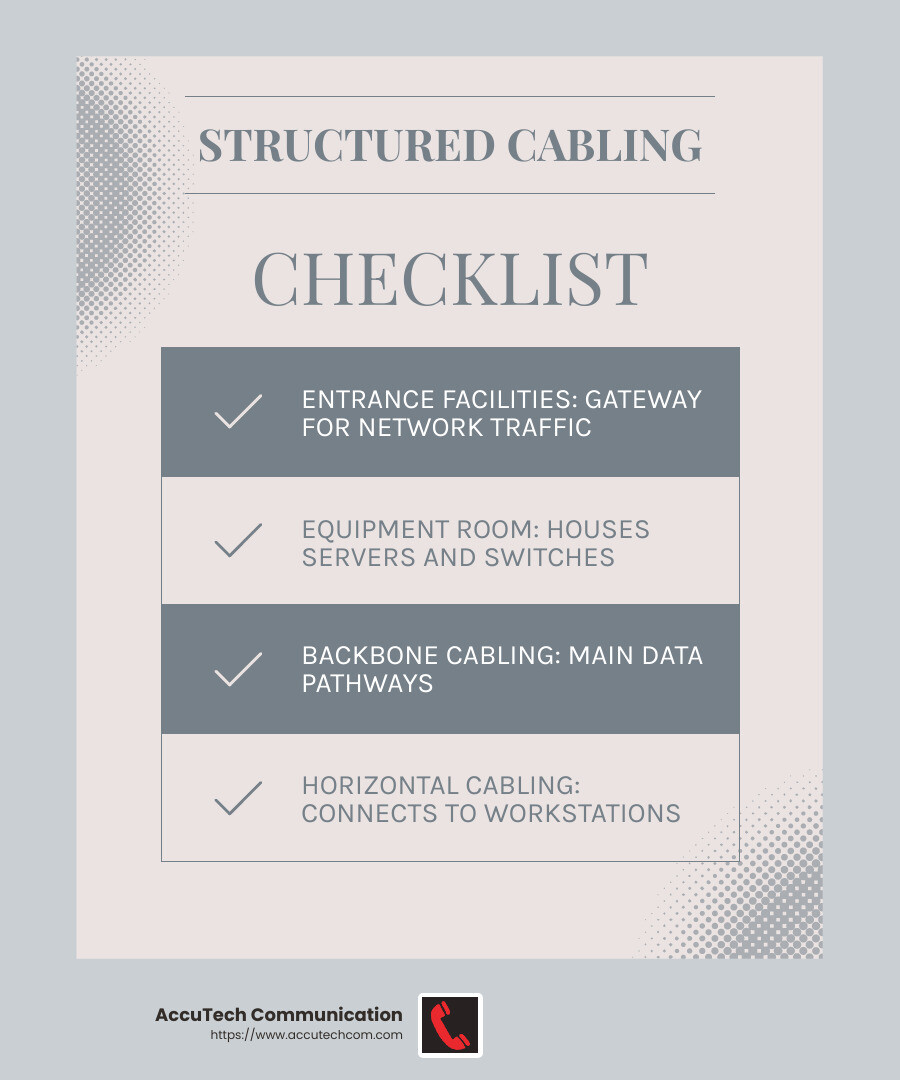
Understanding these components is essential for building a reliable and efficient cabling infrastructure. Each part plays a unique role in supporting your network’s functionality and performance. In the next section, we’ll explore why having a proper cabling infrastructure is crucial for your business’s success.
Importance of Proper Cabling Infrastructure
A well-designed cable infrastructure is the backbone of any successful business. It’s not just about connecting wires; it’s about enhancing network efficiency, optimizing data centers, and gaining a competitive edge, all while lowering the cost of ownership.
Network Efficiency
Imagine your network as a highway. If the roads are smooth and well-maintained, traffic flows seamlessly. Similarly, a robust cabling system ensures data moves swiftly and reliably, reducing packet loss and minimizing downtime. Poor cabling can degrade network performance, leading to dropped calls and missing data. In fact, a poorly designed infrastructure can lose up to 5% of packet information during transfers.
Data Center Optimization
Data centers are the heart of modern businesses. They route, process, and store vast amounts of data. Efficient cabling is crucial here. It supports high-speed data transfer, enabling the use of data-intensive applications that improve service quality. Features like rack space and cable pathways are vital for maximizing data center performance and cooling efficiency.
Competitive Advantage
In today’s business world, staying ahead of the competition is key. A flexible and scalable cabling infrastructure allows you to adapt to new technologies swiftly. As business applications evolve, having the capability to upgrade your network without overhauling the entire system is a significant advantage. For instance, optical fiber cabling can transmit signals over 5,000 miles, offering exceptional performance compared to traditional cables.
Lower Cost of Ownership
Investing in a proper cabling infrastructure might seem costly upfront, but it pays off in the long run. A well-planned system reduces the need for frequent repairs and upgrades, ultimately saving money. Moreover, as technology advances, the cost of components like Network Interface Cards (NICs) is expected to decrease, making future upgrades more affordable.
These elements highlight why proper cabling infrastructure is not just an option but a necessity for modern businesses. In the next section, we’ll dig into how to choose the right cabling infrastructure for your specific needs.
How to Choose the Right Cabling Infrastructure
Choosing the right cable infrastructure is like picking the foundation for a building. It needs to be strong, reliable, and adaptable to future needs. Let’s explore the main types of cables: twisted-pair, fiber-optic, and coaxial, and how they address scalability.
Twisted-Pair Cables
Twisted-pair cables are the workhorses of network cabling. They’re commonly used in local area networks (LANs) and are familiar to many because they’re similar to telephone wires.
Pros:
– Cost-Effective: These cables are relatively cheap and easy to install.
– Flexibility: They can handle speeds from 10 Mbps to 100 Mbps, making them suitable for many businesses.
– Easy Maintenance: Maintenance crews are familiar with them, making troubleshooting simpler.
Cons:
– Limited Distance: They are not ideal for long-distance data transmission.
– Susceptible to Interference: Electrical noise can affect performance, so they’re best for environments with minimal interference.
Fiber-Optic Cables
Fiber-optic cables are the future of high-speed data transfer. They use light to transmit data, offering unparalleled speed and reliability.
Pros:
– High Speed: Capable of delivering 10 GB Ethernet over long distances, up to 40,000 meters with single-mode fiber.
– Minimal Interference: Immune to electrical noise, making them ideal for noisy environments.
– Scalability: Easily supports future upgrades and increased bandwidth demands.
Cons:
– Cost: Initial installation can be expensive, though prices are dropping as technology advances.
– Complex Installation: Requires specialized skills for installation and maintenance.
Coaxial Cables
Coaxial cables are often used for video and some internet connections. They’re more robust than twisted-pair cables but less advanced than fiber-optic.
Pros:
– Durability: Coaxial cables are less affected by external interference.
– Good for Video: Commonly used for cable television and video applications.
Cons:
– Limited Speed: Not as fast as fiber-optic cables.
– Scalability Issues: Upgrading can be more challenging compared to fiber-optic solutions.
Scalability
Scalability is crucial when choosing a cabling infrastructure. As your business grows, your network should be able to expand without needing a complete overhaul.
- Twisted-pair and fiber-optic cables offer great scalability. Twisted-pair is easy to upgrade in small increments, while fiber-optic can handle massive bandwidth increases with minimal changes.
- Coaxial cables are less scalable, making them less ideal for fast-growing businesses.
In summary, your choice of cabling should align with your current needs and future plans. Consider factors like budget, expected growth, and the technical environment. Next, we’ll answer some frequently asked questions about cabling infrastructure to help you make an informed decision.
Frequently Asked Questions about Cabling Infrastructure
What is a cabling infrastructure?
Cabling infrastructure is the backbone of modern communication. It connects various devices, allowing them to communicate and share data. Think of it as the nervous system of your business operations, ensuring that information flows smoothly and efficiently. This infrastructure includes different types of cables and components that form a network, supporting everything from phone systems to internet connectivity.
What are the 3 types of network cable?
Network cables are the highways for data travel. There are three main types:
- Twisted-Pair Cables
- Common Use: Local Area Networks (LANs)
- Advantages: Cost-effective, easy to install, and flexible for various speeds.
- Limitations: Best for short distances and can be affected by electrical interference.
- Coaxial Cables
- Common Use: Cable TV and some internet connections.
- Advantages: Durable and less affected by interference.
- Limitations: Limited speed and scalability compared to other options.
- Fiber-Optic Cables
- Common Use: High-speed data transfer over long distances.
- Advantages: Extremely fast, minimal interference, and highly scalable.
- Limitations: Higher initial cost and complex installation.
How does cable internet infrastructure work?
Cable internet infrastructure involves a mix of fiber-optic cables and coaxial cabling. Here’s a simple breakdown:
- Internet Service Providers (ISPs) use fiber-optic cables to transmit data at high speeds over long distances. These cables form the backbone of the internet.
- Once the data reaches your neighborhood, coaxial cables take over. They carry the internet signal from local nodes to individual homes and businesses.
This combination allows ISPs to deliver fast and reliable internet access, balancing the high-speed capabilities of fiber optics with the established infrastructure of coaxial cabling.
By understanding these components and how they work together, you can appreciate the complexity and importance of a well-designed cabling infrastructure. This knowledge helps businesses make informed decisions about their communication needs.
Next, we’ll wrap up by highlighting how AccuTech Communications can support your cabling infrastructure needs.
Conclusion
At AccuTech Communications, we understand that a robust cable infrastructure is essential for modern communication. With our certified service, we ensure your network is optimized for peak performance. Our team of skilled technicians and engineers is committed to delivering high-quality solutions custom to your specific needs.
Since 1993, we’ve been providing businesses in Massachusetts, New Hampshire, and Rhode Island with reliable network cabling, business phone systems, and data center technologies. Our competitive pricing and unwavering commitment to quality have earned us the trust of our clients, many of whom have been with us for decades.
We know that choosing the right cabling infrastructure is crucial for network efficiency and a competitive advantage. Whether you need twisted-pair cables for a local area network, coaxial cables for video applications, or fiber-optic cables for high-speed data transfer, we have the expertise to design and implement the perfect solution for you.
Ready to take the next step? Let us help you build a strong foundation for your business communication needs. Learn more about our services and how we can support your cabling infrastructure by visiting our Structured Cabling Services page.
Trust AccuTech Communications to be your partner in creating a seamless and efficient communication network.
