
Cabling Contractor: 7 Powerful Reasons to Avoid Costly Mistakes
Understanding the Critical Role of Cabling Infrastructure
A Cabling Contractor is a specialized professional who designs, installs, and maintains the structured cabling systems that form the backbone of business communications networks. If you’re searching for information about cabling contractors, here’s what you need to know:
| What is a Cabling Contractor? | Core Services | Why Hire a Professional |
|---|---|---|
| A certified professional who designs and installs structured cabling systems | • Network & data cabling installation • Fiber optic cabling • Voice & data network design • Cable testing & certification • Documentation & labeling |
• Ensures 80% of network efficiency • Provides warranties up to 25 years • Follows industry standards (BICSI, TIA) • Reduces downtime & troubleshooting |
The network cabling infrastructure represents up to 80% of your overall network efficiency. Yet it’s often the most overlooked component until problems arise.
A properly designed and installed cabling system does more than just connect devices—it future-proofs your business, supports emerging technologies, and provides the foundation for everything from VoIP phone systems to security cameras and wireless access points.
Professional cabling contractors bring specialized knowledge of standards, materials, and installation techniques that ensure reliability and compliance. They understand that poor cabling can lead to:
- Network outages and slowdowns
- Difficult troubleshooting
- Expensive rework
- Security vulnerabilities
- Limited scalability
Beyond just running cables, certified contractors provide comprehensive documentation, testing reports, and warranties that protect your investment for decades.
I’m Corin Dolan, owner of AccuTech Communications with over 25 years of experience as a cabling contractor serving businesses across Massachusetts, New Hampshire, and Rhode Island. I’ve personally overseen thousands of structured cabling installations that have helped businesses transform their communications infrastructure for greater reliability and performance.
Terms related to Cabling Contractor:
– low voltage cabling
– telecommunications construction
– commercial data cabling
Who this guide is for
This comprehensive guide is designed for:
- IT Managers looking to upgrade network infrastructure or troubleshoot ongoing connectivity issues
- Facilities Directors planning new construction or renovations requiring communications infrastructure
- Startups establishing their first office space and needing scalable network solutions
- Enterprises expanding operations or modernizing legacy cabling systems in Massachusetts, New Hampshire, or Rhode Island
If you’ve ever walked into a server room and seen a tangled mess of unlabeled cables or experienced the frustration of network downtime, this guide will help you understand why professional cabling matters and how to choose the right contractor for your needs.
Cabling Contractor 101: Role, Services & Value
Remember the tangled mess of wires behind your TV? Now imagine that chaos multiplied by a hundred in your office. That’s what you get without proper structured cabling—the organized, standardized approach that forms the backbone of any modern business technology system. Gone are the days of chaotic point-to-point wiring; today’s businesses need infrastructure that’s reliable, manageable, and ready for whatever comes next.
What is a Cabling Contractor?
Think of a cabling contractor as the architect and builder of your digital highways. We’re the specialized professionals who design, install, maintain, and document the low-voltage communications infrastructure that keeps your business connected. Unlike general electricians who focus on power systems, we specialize in the complex networks that carry your data, voice, and video throughout your facility.
When you work with a professional cabling contractor, you’re getting experts who handle everything from initial cable installation to proper termination with the right connectors. We conduct thorough testing to verify performance meets or exceeds industry specifications, and provide detailed documentation that will save you countless headaches down the road.
As one of our Massachusetts clients recently told us: “The documentation our cabling contractor provided saved us countless hours when we needed to troubleshoot an issue months after installation. Every cable was clearly labeled and matched the diagrams perfectly.”
Core Services You Should Expect
A quality cabling contractor should offer comprehensive services that cover every aspect of your communications infrastructure. This starts with a thorough site survey to understand your current setup and future needs. We’ll then create a custom structured cabling design that follows TIA/EIA standards—ensuring your system will be compatible with industry requirements.
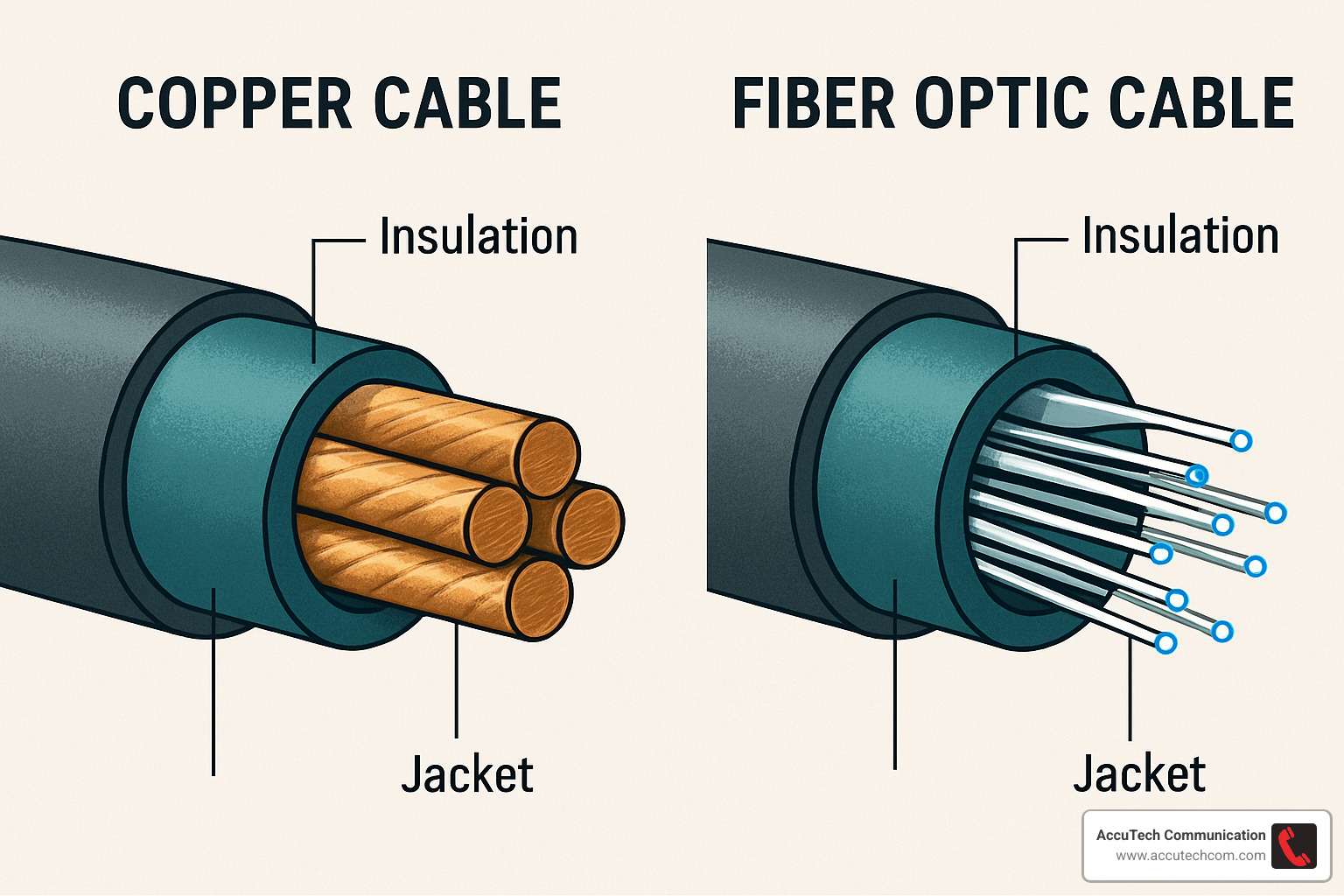
The heart of our work involves installing both fiber optic cabling (for those lightning-fast backbone connections) and copper cabling like Cat6A and Cat8 for your workstations and devices. We don’t just run cables; we create organized pathways with proper cable management systems that make future maintenance a breeze.
After installation comes the crucial testing and certification phase. At AccuTech, we perform comprehensive testing and provide detailed reports that verify every connection meets specifications. And because businesses evolve, we offer ongoing support for moves, adds, and changes (MACs) as your needs grow.
Perhaps most valuable is the documentation we provide—complete records of all installations and modifications that serve as your network’s roadmap. When you need to troubleshoot or expand, you’ll know exactly what you’re working with.
Why Hire a Professional Cabling Contractor
Did you know that network cabling can represent up to 80% of your overall network efficiency? That’s right—all those fancy switches and routers only account for about 20% of your network’s performance. This is why cutting corners on cabling infrastructure is one of the costliest mistakes businesses make.
Hiring a professional cabling contractor ensures reliability—certified professionals follow industry standards that minimize downtime and connectivity issues. We build in scalability so your system can grow with your business without requiring complete overhauls. Professional installation also improves security by reducing the number of standardized connection points where vulnerabilities might exist.
While DIY or handyman installations might seem cheaper initially, the cost efficiency of professional installation becomes clear the first time you avoid a network outage. Network downtime can cost thousands per hour in lost productivity—a price far exceeding professional installation.
One of our manufacturing clients in Massachusetts learned this lesson the hard way. They initially used their in-house maintenance team to install network cabling. Within six months, they experienced multiple network outages, costing approximately $5,000 per hour in lost productivity. After hiring AccuTech Communications, their network stability improved dramatically, and they haven’t experienced an infrastructure-related outage in over three years.
Perhaps best of all, certified installations typically come with manufacturer warranties of up to 25 years—protection you simply can’t get with amateur installations.
When your business depends on reliable connectivity, a professional cabling contractor isn’t just a service provider—we’re your partner in building the foundation for all your technology needs.
Why Professional Network Cabling Matters for Your Business
Your network cabling is the circulatory system of your digital operations—just as essential as your plumbing or electrical systems. While often hidden behind walls or above ceilings, this infrastructure silently supports everything from your email and cloud services to your phones, security cameras, and the growing universe of IoT devices.
Performance & Bandwidth Advantages
The appetite for bandwidth continues to grow at a staggering pace, and your cabling needs to keep up.
Modern Category 8 cabling operates at frequencies up to 2 GHz, delivering the speed needed for today’s data-hungry applications. According to industry research, Category 6A cabling will outsell Category 6 for the first time in 2024—a clear sign that businesses are preparing for higher bandwidth demands.
The shift toward 10 GbE, 25 GbE, and even 40 GbE connections isn’t coming—it’s already here. A professional Cabling Contractor understands this evolution and designs systems that not only meet your current needs but accommodate what’s coming next.
I recently spoke with a network administrator at a Boston financial firm who told me, “Upgrading from Cat5e to Cat6A was like going from a country road to a superhighway. File transfers that took minutes now happen in seconds, and our VoIP calls are crystal clear.”
Reliability, Safety & Compliance
When you partner with a professional for your cabling needs, you’re investing in peace of mind on multiple fronts:
Fire Safety matters tremendously in commercial buildings. Professional contractors select the appropriate cable ratings (plenum, riser, or general purpose) for your specific environment, ensuring you meet fire code requirements.
EMI Immunity is critical for data integrity. Properly designed structured cabling minimizes electromagnetic interference that can corrupt data and disrupt network performance. Scientific research on electromagnetic interference confirms that proper cable selection and installation significantly reduces these risks.
Fiber Security provides an inherent advantage over copper cabling. Since fiber transmits light rather than electrical signals, it’s virtually impossible to “tap” without detection—a crucial consideration for businesses handling sensitive information.
Code Compliance isn’t optional. Professional installations adhere to National Electrical Code (NEC) requirements, local building codes, and industry standards like ANSI/TIA-568, keeping your business both safe and legal.
Hidden ROI: Energy, Labor & Warranty Savings
The return on investment from professional cabling extends far beyond just better performance:
Power over Ethernet Efficiency becomes increasingly important as more devices—from security cameras to wireless access points to LED lighting—draw power through your network cables. Properly installed Cat6A cabling supports PoE with minimal energy loss, reducing your electricity costs over time.
Labor Savings are substantial with professional installations. For example, the MultiFiber Pro tester can reduce testing time for MPO fiber trunks by nearly 95%, saving more than 155 hours of labor on an average data center project—savings that benefit your bottom line.
Extended Warranties provide long-term protection. While typical equipment warranties might last 1-3 years, structured cabling systems installed by certified professionals often come with manufacturer warranties extending up to 25 years, with many contractors (including AccuTech) offering additional labor warranties.
Reduced Maintenance Costs represent ongoing savings. Industry data shows that contractors spend up to a week of labor dealing with setup, testing, and reporting issues on typical 1,000-drop jobs. Professional installations minimize these recurring costs through proper documentation and testing.
When every cable is clearly labeled and mapped in detailed as-built drawings, your IT team can quickly identify and resolve issues without the frustration of tracing mystery cables through crowded ceiling spaces or overflowing network closets.
For more insights on how structured cabling can transform your business operations, check out our detailed guide on the advantages of structured cabling for your business.
Key Cabling Systems Every Facility Should Know
Walking into a server room can feel like stepping into another world—one filled with colorful cables, blinking lights, and the soft hum of equipment. But behind this technological symphony lies a carefully orchestrated system that keeps your business running. Let me walk you through the essential cabling systems you should know about when working with a cabling contractor.
Structured Cabling Subsystems Explained
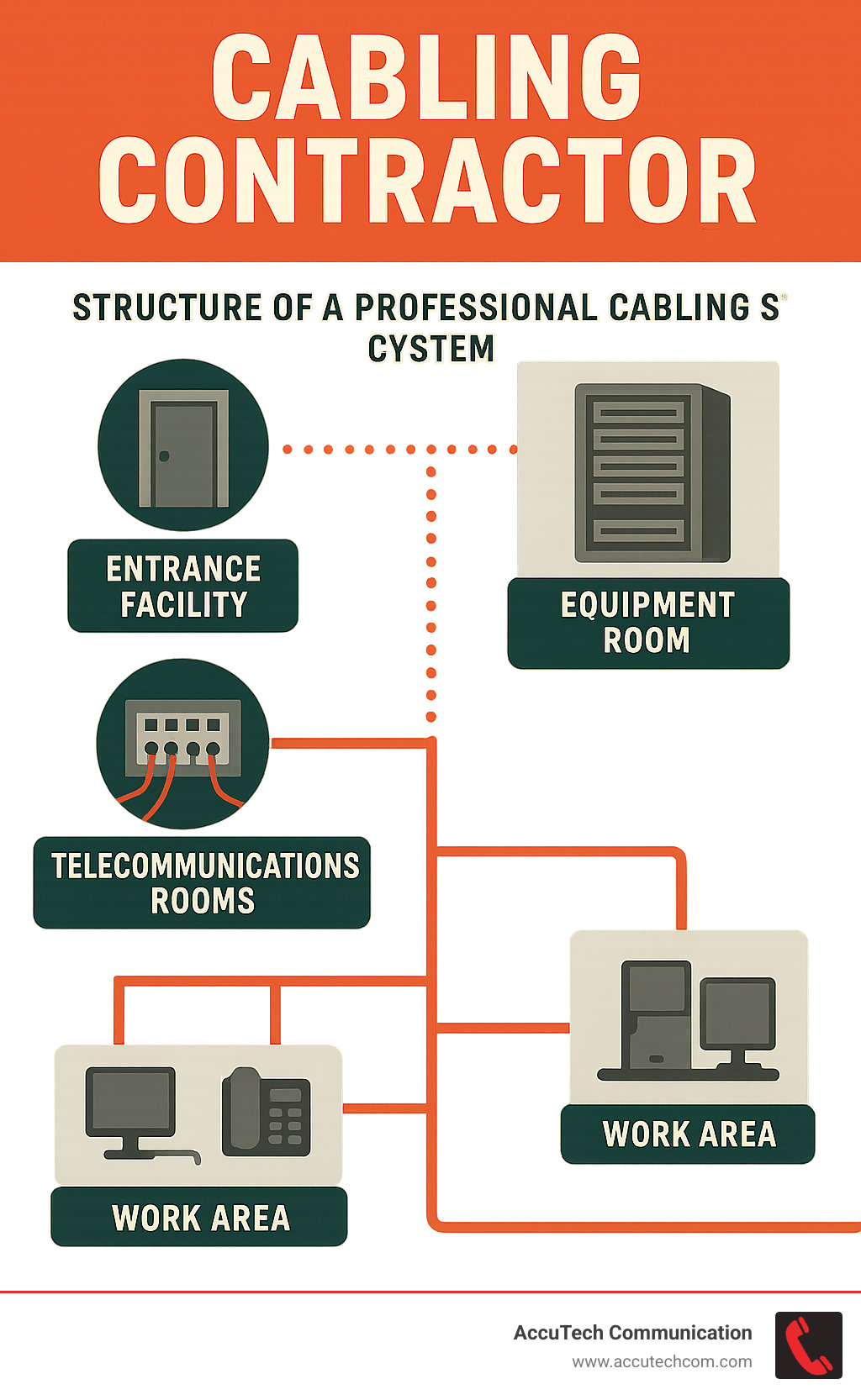
Think of structured cabling like your building’s nervous system—it has distinct parts that work together seamlessly. When I explain this to clients during site surveys, the lightbulb moment usually happens when they understand these six key components:
Your entrance facility is where the outside world connects to your building—the telecommunications equivalent of your front door. This is where service provider lines enter and connect to your internal systems.
The equipment room houses your digital brain trust—servers, switches, and other active equipment that power your network operations.
Backbone cabling acts as your network’s superhighway, connecting entrance facilities, equipment rooms, and telecommunications rooms. We typically use high-capacity fiber optic cables here to handle heavy traffic volumes.
Your telecommunications rooms serve as neighborhood distribution centers, housing patch panels and switches that direct traffic to specific areas of your building.
Horizontal cabling is the local road system, running from telecommunications rooms to individual workspaces. This is usually copper twisted-pair cabling that connects directly to devices.
Finally, work area components are the last mile—the outlets, patch cords, and adapters that connect your computers, phones, and other devices to the network.
Understanding these subsystems helps our Massachusetts clients visualize how their network functions as a whole rather than a collection of random cables.
Fiber Optic Essentials for High-Speed Backbones
When speed and distance matter, fiber optic cabling shines (literally!). I’ve seen businesses transform their operations after upgrading to fiber backbones.
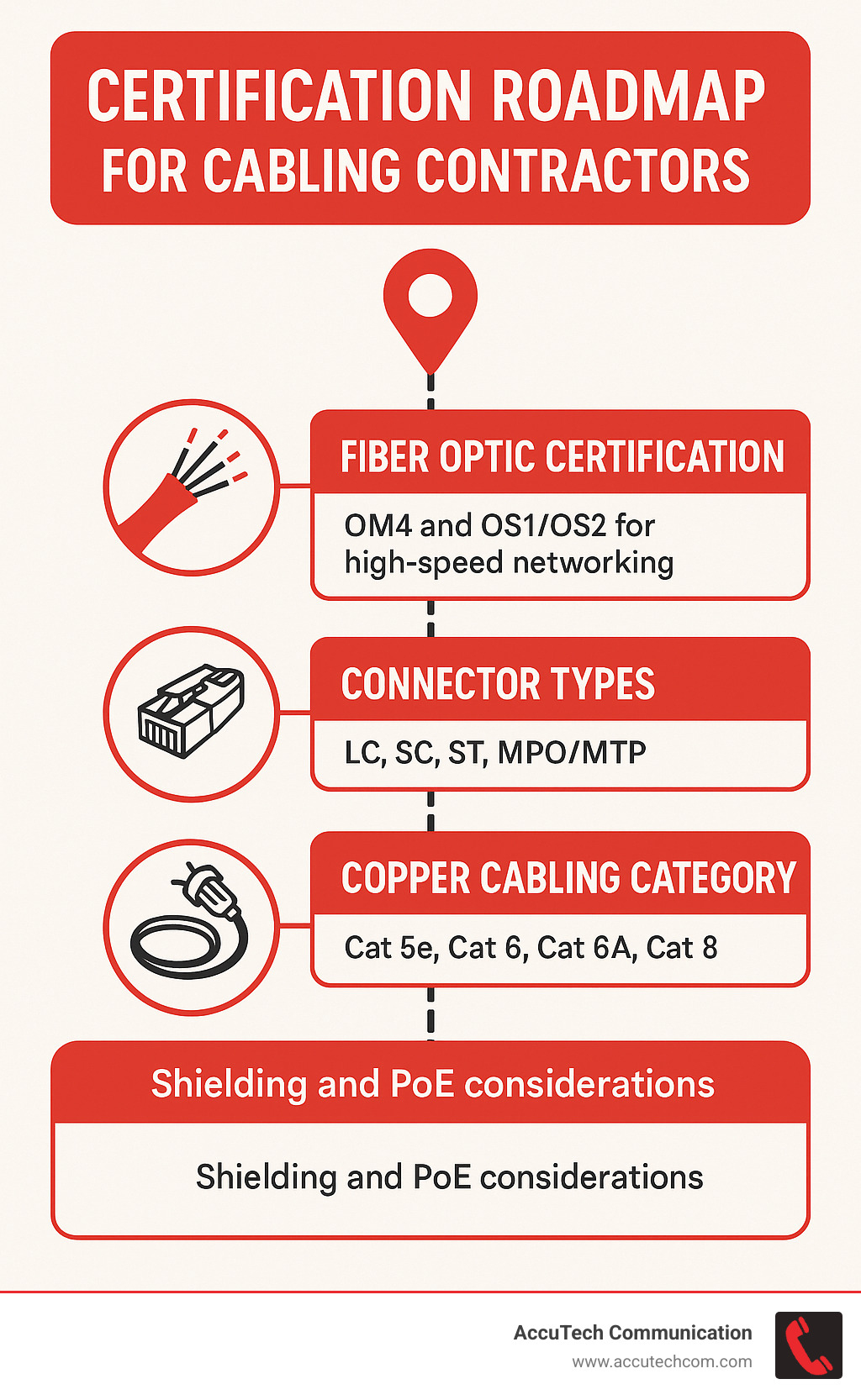
Multimode fiber (MMF) works wonderfully for connections within buildings or across campuses. The most common types we install are OM3 (supporting 10 Gbps up to 300 meters) and OM4 (extending that same speed to 550 meters, or handling 40/100 Gbps up to 150 meters).
For longer distances between buildings or across larger campuses, single-mode fiber (SMF) is your best friend. OS1/OS2 can carry 10 Gbps signals over 10 kilometers or more—perfect for connecting multiple buildings in a business park.
The connector types matter too. Traditional LC, SC, and ST connectors handle single fibers, while MPO/MTP connectors are the workhorses of data centers, supporting up to 24 fibers in a single connection. These high-density connections are becoming increasingly important as businesses consolidate their infrastructure.
The fiber market continues to grow exponentially, projected to reach $42 billion by 2017 and climbing steadily since. As a cabling contractor serving businesses throughout Massachusetts, New Hampshire, and Rhode Island since 1993, we’ve witnessed this growth as companies accept cloud services and data-intensive applications.
Copper Cabling for Versatile Deployments
While fiber gets the glory for long distances and blazing speeds, copper twisted-pair cabling remains the practical workhorse for connecting individual workstations and devices.
The evolution of copper standards tells an interesting story. Category 5e was once the gold standard, supporting 1 Gbps up to 100 meters. Today, it’s becoming obsolete for new installations, much like dial-up internet has given way to broadband.
Category 6 stepped things up, handling 1 Gbps over 100 meters and 10 Gbps up to 55 meters. It’s still common, but increasingly seen as a minimum rather than optimal choice.
Category 6A is today’s sweet spot, supporting 10 Gbps over the full 100-meter distance with significantly improved resistance to crosstalk (signal interference between cables). This has become our standard recommendation for new installations.
For data centers and specialized applications, Category 8 pushes the envelope even further, supporting up to 40 Gbps for distances up to 30 meters. It’s the Formula 1 car of copper cabling—specialized, powerful, and designed for specific high-performance environments.
Beyond the category ratings, there are important considerations that a good cabling contractor will help you steer:
Shielded vs. unshielded cabling is a choice that depends on your environment. Shielded twisted pair (STP) provides better protection against electromagnetic interference but costs more and requires proper grounding. In manufacturing environments with heavy machinery, this extra protection is often worth the investment.
Power over Ethernet (PoE) capabilities are increasingly important as more devices—from security cameras to wireless access points to LED lighting—draw power directly from the network. Cat6A and higher cables handle the latest PoE++ standard (IEEE 802.3bt), supporting devices requiring up to 100W of power.
When it comes to future-proofing, we’ve learned that being slightly ahead of current needs pays dividends. That’s why we recommend at minimum Cat6A for all new installations for Massachusetts businesses. The modest additional cost upfront can save you from a premature upgrade just a few years down the road.
After nearly three decades as a cabling contractor, I’ve seen the technology evolve dramatically, but one thing remains constant: quality infrastructure is the foundation of reliable business technology. When properly installed by certified professionals, your cabling system should provide decades of trouble-free service.
Standards, Certifications & Qualifications Your Cabling Contractor Must Hold
Let’s talk about something that might not seem exciting at first glance but is absolutely crucial when choosing a cabling contractor – their certifications and qualifications. Think of these as your safety net, ensuring you’re working with true professionals who know their craft inside and out.
Mandatory Codes & Industry Standards
When I meet with clients in Massachusetts, they’re often surprised to learn just how regulated our industry really is. Professional cabling contractors don’t just make things up as they go – we follow carefully developed standards that ensure your network will perform reliably for years to come.
The ANSI/TIA-568 standard is essentially our bible – it specifies exactly how commercial telecommunications cabling should be designed and installed. For clients with data centers, we follow ANSI/TIA-942-C guidelines that cover everything from the layout of your equipment rooms to the types of pathways your cables should follow.
International standards like ISO/IEC 11801 complement these American standards, while the National Electrical Code (NEC) ensures that all installations are safe and won’t create fire hazards. The Building Industry Consulting Service International (BICSI) provides additional best practices that experienced contractors follow religiously.
I’ve seen how following these standards makes a night-and-day difference in network performance and reliability. They’re not just bureaucratic hoops to jump through – they’re the foundation of a system that will serve your business faithfully for decades.
Technician & Company Credentials
When you’re evaluating a cabling contractor, certain credentials should be non-negotiable. The BICSI Registered Communications Distribution Designer (RCDD) certification is widely considered the gold standard in our industry. An RCDD has demonstrated mastery of cabling design principles through rigorous testing and continuing education.
Beyond design expertise, look for technicians with hands-on installation certifications. BICSI Technician and Installer certifications verify that the people actually pulling your cable know what they’re doing. The Certified Cabling Test Technician (CCTT) credential ensures they can properly test and verify that your system performs as promised.
Manufacturer certifications are equally important – they show that technicians have been specifically trained on the products being installed in your facility. Without these certifications, manufacturers often won’t honor their warranties.
Safety matters too – OSHA certifications demonstrate a commitment to workplace safety regulations, protecting both the technicians and your facility during installation.
“Having certified technicians isn’t just about hanging certificates on the wall,” a client once told me after we resolved persistent network issues that had plagued their previous installation. “It’s about the peace of mind knowing that the job is being done right the first time.”
How Certifications Protect Your Investment
Certifications do more than demonstrate knowledge—they directly protect your investment in ways many business owners don’t initially realize.
Most manufacturers offer impressive 25-year performance warranties on their cabling systems, but there’s a catch: they’ll only honor these warranties when the system is installed by a certified contractor. This protection alone can save you thousands in replacement costs down the road.
Certified installations also include comprehensive documentation that serves as your network’s birth certificate and medical history all in one. This documentation creates an audit trail that proves invaluable when troubleshooting issues or making future modifications.
There are practical benefits during the installation process too. Systems installed by certified cabling contractors typically sail through building inspections with fewer issues, reducing costly delays. Many insurance policies also specifically require certified installations to maintain coverage.
I remember working with a healthcare facility in Worcester that experienced network issues five years after their initial installation. Because they had chosen a certified contractor who provided proper documentation, the manufacturer honored their warranty without question or delay. Their neighboring facility wasn’t so lucky – they had chosen the lowest bidder without checking certifications, and ended up paying for an entirely new installation when problems arose.
When it comes to your network infrastructure, certifications aren’t just nice-to-have credentials – they’re your insurance policy against future headaches and unexpected costs. At AccuTech Communications, we’re proud that all our technicians maintain the industry’s highest certifications, ensuring your installation is done right the first time.
Inside the Cabling Project Lifecycle: From Design to Warranty
Understanding the lifecycle of a cabling project helps you set realistic expectations and ensure nothing is overlooked. As experienced cabling contractors, we follow a structured process for every installation.
Phase 1 – Design & Scope
The foundation of any successful cabling project is thorough planning:
- Needs Assessment: Identifying current and future requirements for data, voice, video, and specialty systems
- Site Survey: Evaluating existing infrastructure, pathways, and potential obstacles
- Capacity Planning: Determining the appropriate cable types, quantities, and pathways
- Pathway Design: Planning cable routes that minimize interference and maximize protection
- Documentation: Creating detailed design documents using CAD or BIM software
During this phase, a professional cabling contractor will ask questions about your business growth plans, technology roadmap, and budget constraints to design a system that meets both current and future needs.
For example, when working with a growing tech company in Boston, our initial design included 30% additional capacity beyond their immediate needs. Three years later, when they expanded their team, this foresight allowed them to add workstations without requiring a major infrastructure upgrade.
Phase 2 – Installation & Quality Control
The installation phase is where experience and attention to detail make a critical difference:
- Material Procurement: Sourcing high-quality components that meet design specifications
- Cable Routing: Installing cables following industry best practices for bend radius, support, and separation from power sources
- Termination: Connecting cables to patch panels, jacks, and other hardware
- Labeling: Implementing a comprehensive labeling system for easy identification
- Testing: Verifying each connection meets or exceeds performance standards
Quality control during installation includes:
- Regular inspections of work in progress
- Adherence to manufacturer guidelines
- Proper cable management and strain relief
- Maintaining appropriate separation from power cables
- Clean and professional appearance of all visible components
Scientific research on productivity gains has shown that proper cable management and labeling can reduce troubleshooting time by up to 80% over the life of the installation.
Phase 3 – Certification, Documentation & Warranty Support
The final phase ensures your system is properly certified and documented:
- Certification Testing: Using specialized equipment like Fluke Networks’ Versiv to verify performance
- Documentation Package: Providing as-built drawings, test results, and component specifications
- Warranty Registration: Registering the installation with manufacturers for extended warranty coverage
- Training: Educating your team on the new infrastructure
- Ongoing Support: Establishing procedures for maintenance and future modifications
A comprehensive documentation package typically includes:
- Cable ID charts matching labels to locations
- Test results for each cable run
- As-built drawings showing actual cable routes
- Manufacturer warranties and contact information
- Maintenance recommendations
This documentation becomes invaluable when troubleshooting issues, planning changes, or making warranty claims. As one IT director told us: “The documentation package was worth its weight in gold when we had to reconfigure our server room three years after installation.”
How to Choose the Right Cabling Contractor

Finding the perfect cabling contractor feels a bit like dating – you want someone reliable, skilled, and in it for the long haul. After all, your network cabling will likely outlast most of your other technology investments, so making the right choice now saves headaches for years to come.
Questions to Ask Your Cabling Contractor
When interviewing potential contractors, think of it as a job interview where you’re the boss. The right cabling contractor should welcome your questions and provide clear, confident answers.
Start by asking about their credentials – specifically which BICSI certifications their team holds and whether they’re a BICSI Corporate Member. This tells you they’re committed to industry standards. Then dive into their experience with similar projects in your industry. A contractor who’s wired dozens of medical offices will understand healthcare’s unique requirements better than someone who’s never stepped foot in a clinic.
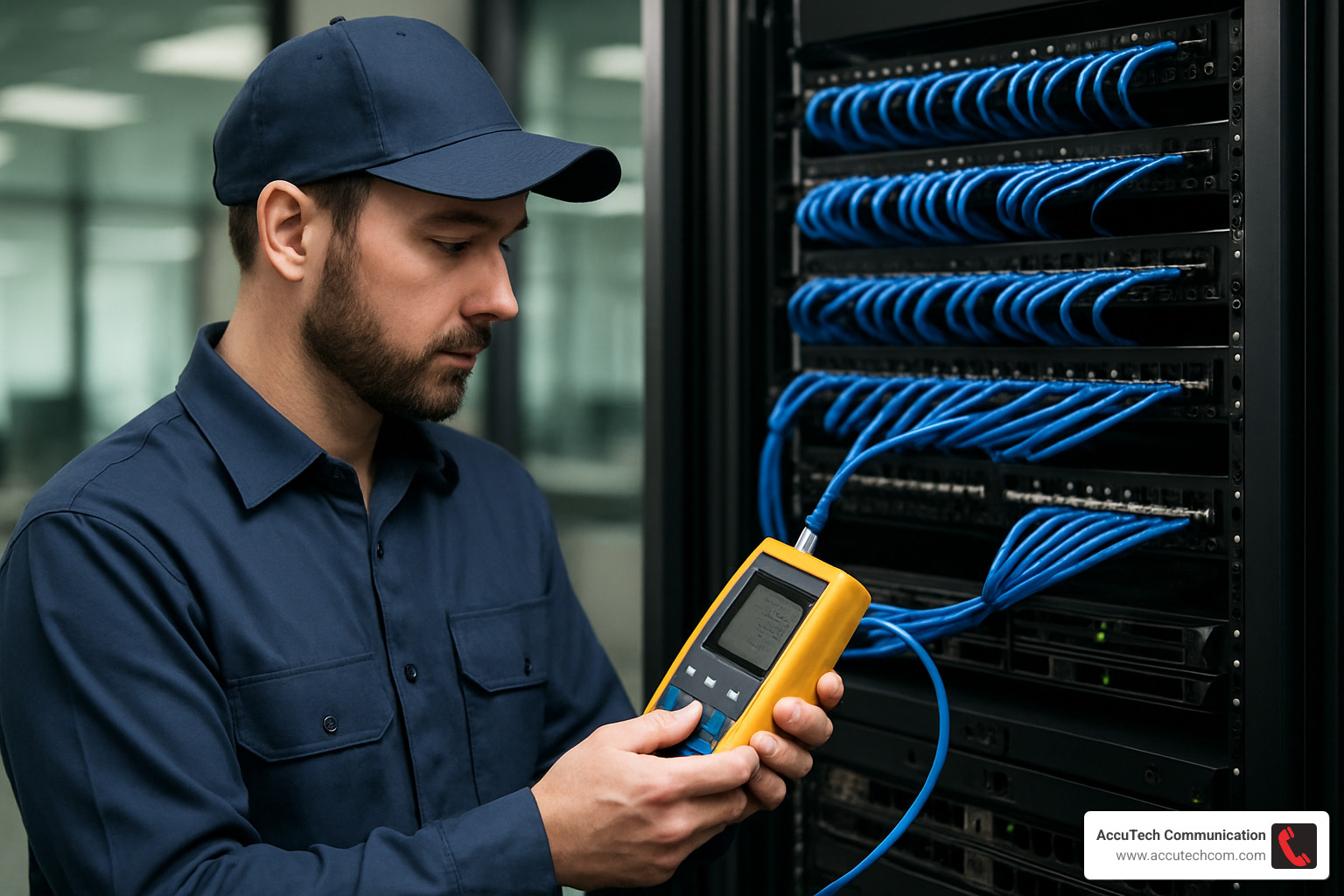
“We always encourage clients to ask about our testing equipment,” says Corin Dolan of AccuTech Communications. “Professional-grade testers from manufacturers like Fluke Networks cost thousands of dollars, but they’re essential for proper certification. If a contractor skimps here, they’re probably cutting corners elsewhere too.”
Don’t forget to discuss their permit handling process and project management approach. A seasoned cabling contractor should confidently explain how they’ll keep your project on track and communicate progress every step of the way.
Their change order policy reveals a lot about their business ethics. The best contractors have clear, written procedures for handling unexpected challenges without surprising you with excessive charges later.
Finally, get specific about warranties and documentation. A quality contractor should offer manufacturer warranties up to 25 years, plus their own labor warranty, backed by comprehensive documentation of every cable run.
Red Flags & Warning Signs
Not all cabling contractors are created equal, and spotting potential problems early can save you significant trouble down the road.
Be immediately wary of unusually low bids. When a quote comes in significantly below others, it usually means corners will be cut somewhere – often in cable quality, testing thoroughness, or documentation. As the saying goes, “Buy nice or buy twice.”
Vague documentation is another major red flag. A professional cabling contractor should provide detailed proposals that specify exactly what cables, connectors, and pathways they’ll use. If their quote reads like a fortune cookie – brief and open to interpretation – keep looking.
Watch out for contractors who seem reluctant to discuss certification testing or who don’t own professional testing equipment. Without proper testing, you’ll never know if your network meets industry standards until problems start appearing.
I once visited a client who’d hired the cheapest contractor they could find for their office renovation. Six months later, they couldn’t understand why their new 10Gb network was running at dial-up speeds. When we tested their cabling, we finded the contractor had used counterfeit Cat6 cable that couldn’t even reliably support 100Mb speeds. The “bargain” installation ended up costing them twice – once for the original work and again for us to replace everything properly.
Signs You Need a New Cabling Contractor
Even if you already have a cabling infrastructure in place, certain symptoms suggest it’s time for a professional evaluation from a new cabling contractor.
If your team experiences frequent network outages, your cabling may be to blame. Modern structured cabling should provide decades of reliable service. Likewise, slow performance that doesn’t match your equipment specifications often points to cabling issues.
When simple adds, moves, and changes turn into day-long ordeals, that’s another warning sign. A properly designed cabling system makes modifications straightforward. Similarly, if you’re missing proper documentation of your network infrastructure, you’re flying blind whenever problems arise.
Expired warranties leave you unprotected against potential failures, while outdated infrastructure (like Cat5e in a building requiring 10Gb speeds) creates performance bottlenecks that hold your business back.
Perhaps most concerning are safety issues – cables improperly installed in air handling spaces, penetrating fire barriers without proper firestopping, or creating tripping hazards all represent code violations that a professional cabling contractor can address.
“We frequently help businesses recover from problematic installations,” explains Dolan. “One financial services firm in Boston called us after their DIY cabling project left them with intermittent network issues that their IT team couldn’t solve. We finded cables routed too close to fluorescent lighting fixtures, creating interference. A proper installation following industry standards eliminated the problem completely.”
The right cabling contractor isn’t just installing wires – they’re building the foundation your business communications will rest on for years to come. Choose wisely, and that foundation will support your growth rather than limit it.
More info about cabling contractor selection
Frequently Asked Questions about Hiring a Cabling Contractor
What warranty should I expect?
When investing in your business network infrastructure, warranties provide crucial peace of mind. A quality cabling contractor will offer two distinct types of protection:
Most reputable contractors like us at AccuTech provide a comprehensive manufacturer system warranty extending 15-25 years. This covers all components and guarantees performance to specification. Alongside this, you should expect a labor warranty of 1-5 years that protects against any installation workmanship issues.
Here’s what’s important to remember: these warranties aren’t automatic. You’ll need proper documentation of your installation, complete certification test results for each cable run, and confirmation that your system was installed by an authorized contractor. Without these elements, you might find yourself facing unexpected costs down the road.
We take warranties seriously at AccuTech Communications. That’s why we back every installation with our 5-year labor warranty in addition to the manufacturer’s system warranty of up to 25 years. Our Massachusetts, New Hampshire, and Rhode Island clients tell us this comprehensive coverage gives them confidence their investment is protected for the long haul.
How long does a typical project take?
One of the most common questions we hear is about project timelines. While every installation is unique, I can give you a general sense of what to expect based on our decades of experience as cabling contractors.
For a typical office with 250 network drops, you’re looking at approximately 2-3 weeks from start to finish. The design phase usually takes 1-2 weeks as we carefully plan your infrastructure. The physical installation runs about a week per 100-150 cable drops, with testing and documentation requiring another 2-3 days to ensure everything meets specifications.
Several factors can influence this timeline. Building access restrictions might limit when we can work. Coordination with other trades sometimes creates scheduling challenges. Material availability has been particularly challenging in recent years. The condition of your existing infrastructure and any special requirements like plenum spaces or historical building considerations also impact our timeline.
What makes AccuTech different is our commitment to realistic scheduling and transparent communication. We’ve learned through experience that it’s better to set proper expectations upfront and keep you informed throughout the process. This approach has earned us the trust of businesses throughout New England.
Does my existing Cat5e need upgrading?
This is perhaps the most nuanced question we receive, and the honest answer is: it depends on your specific situation.
If your current Cat5e network is performing well without issues, you might not need an immediate replacement. However, several factors suggest it might be time for an upgrade. Cat5e supports speeds up to 1 Gbps, but many modern applications demand 10 Gbps or more. If you’re implementing Power over Ethernet (PoE) devices like security cameras, Wi-Fi access points, or PoE lighting, Cat6A handles power requirements much more efficiently with less heat buildup.
Cat5e cabling installed more than a decade ago may already show signs of degradation. Additionally, newer technologies like Wi-Fi 6/6E access points, 4K video conferencing, and bandwidth-intensive cloud applications often strain older infrastructure.
When making this decision, consider both immediate costs and long-term value. While upgrading represents an investment today, it might prevent costly downtime and productivity losses tomorrow. Many of our clients find that increased network performance delivers immediate productivity gains that offset upgrade costs.
As experienced cabling contractors, we often recommend a strategic approach—upgrading mission-critical areas first while developing a phased plan for complete infrastructure modernization. This balances immediate needs with budget considerations while ensuring your business remains competitive in an increasingly connected world.
During our initial consultation, we’ll evaluate your current setup and future needs to provide honest recommendations custom to your specific business situation. Our goal isn’t to sell you the most expensive solution, but rather the right solution for your unique requirements.
Conclusion
Choosing the right cabling contractor isn’t just a technical decision—it’s an investment in your organization’s future. Throughout my years in this industry, I’ve seen how quality cabling becomes the silent hero of successful businesses, while poor installations become an ongoing source of frustration and unexpected costs.
The network infrastructure you install today will likely remain in your walls and ceilings for the next 15-25 years. That’s why working with professionals who understand the nuances of structured cabling makes all the difference between a system that grows with you and one that holds you back.
At AccuTech Communications, we’ve been rolling up our sleeves for Massachusetts, New Hampshire, and Rhode Island businesses since 1993. Our team has climbed through countless ceiling tiles, steerd historic Boston buildings with challenging pathways, and designed modern infrastructure for everything from small offices to sprawling corporate campuses throughout New England.
What sets us apart isn’t just our technical knowledge—it’s our commitment to being a true partner in your success. When you work with us, you can count on:
Certified expertise that follows industry best practices and delivers peace of mind. Our technicians aren’t just trained—they’re passionate about getting every connection right the first time.
Meticulous documentation that protects your investment and simplifies future changes. We’ve had clients call us years later, grateful that every cable was properly labeled and mapped.
Straightforward pricing that delivers exceptional value without hidden fees or surprises. We believe quality cabling shouldn’t break your budget.
Ongoing support as your technology needs evolve. Many of our first clients from the 1990s still call us today when they need changes or expansions.
Whether you’re planning a brand-new office space, struggling with an aging network that can’t keep up, or recovering from a poor installation, we’re here to help. The right infrastructure creates possibilities—from supporting remote work to enabling smart building technology and whatever innovations come next.
I’m Corin Dolan, and my team and I would love to show you the AccuTech difference. Let’s build a foundation for your technology that’s as solid as the granite beneath New England.
More info about Cabling Contractors
