
Why Your Network’s Foundation Matters More Than You Think
Cabling infrastructure solutions are the physical systems of cables, connectors, and hardware that connect all your business’s computers, phones, security systems, and other devices into one unified network. Here’s what you need to know:
What are cabling infrastructure solutions?
- Structured systems of cables (copper and fiber optic) that form your network’s backbone
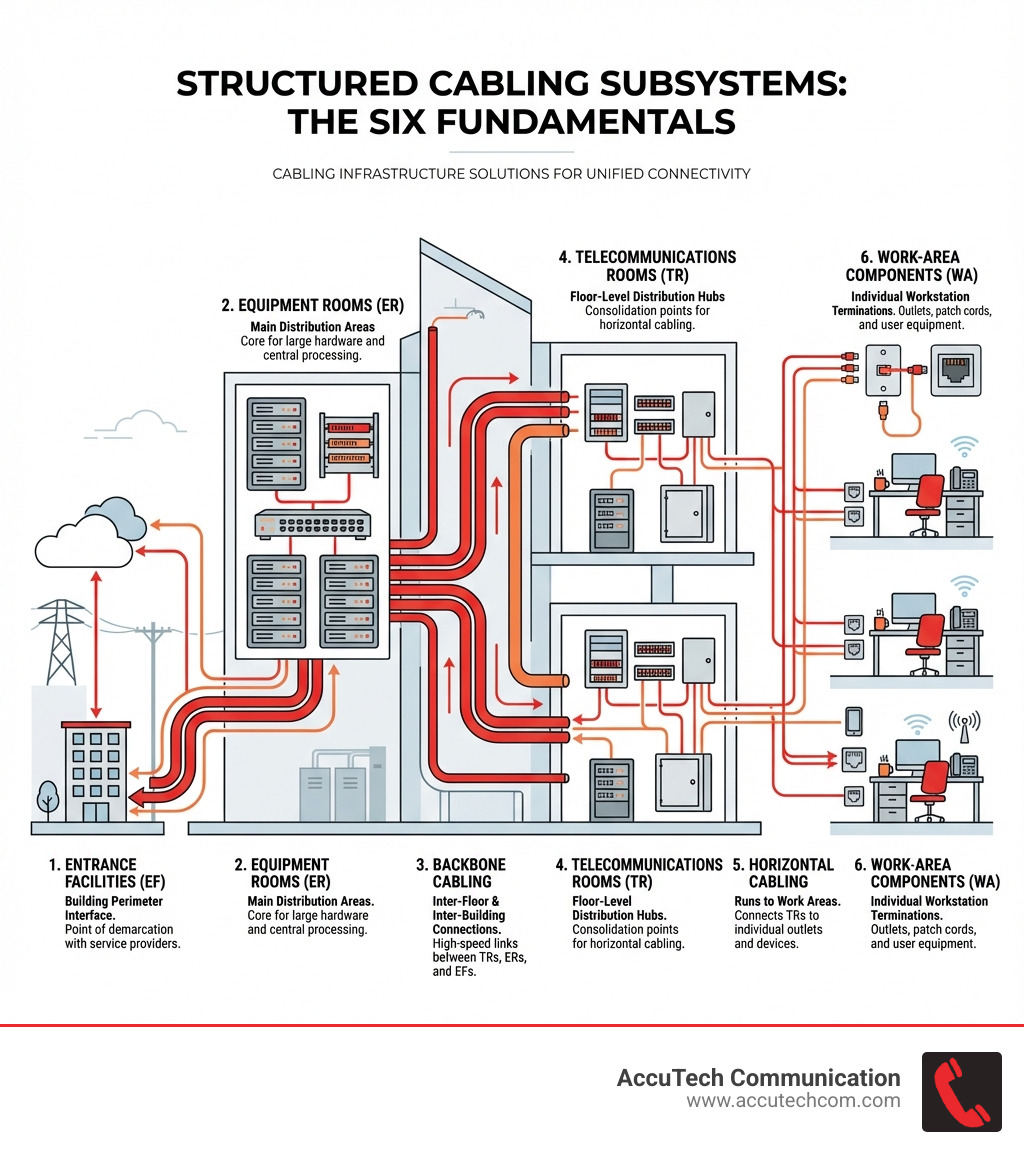
- Include six core subsystems: entrance facilities, equipment rooms, backbone cabling, horizontal cabling, telecommunications rooms, and work-area components
- Follow industry standards (TIA, ISO) for reliability and performance
Why they matter for your business:
- Account for nearly 80% of your network efficiency despite being a small portion of overall IT investment
- Prevent costly downtime and simplify troubleshooting
- Support current needs while preparing for future technologies like IoT and AI
- In healthcare alone, 50% of network issues stem from inadequate cabling infrastructure
Key decision: Fiber vs. Copper
- Fiber optic: High-speed, long-distance, ideal for backbone connections
- Copper (Cat6A/Cat8): Cost-effective for shorter runs, supports Power over Ethernet
- Most modern businesses use a hybrid approach combining both
Think of your cabling infrastructure as the nervous system of your organization. When it’s designed poorly, you face increased latency, higher downtime risks, and limited ability to grow. When it’s done right, it becomes a strategic asset that supports your business for 15+ years.
I’m Corin Dolan, owner of AccuTech Communications, and I’ve been helping businesses across Massachusetts, New Hampshire, and Rhode Island design and implement reliable cabling infrastructure solutions since 1993. Whether you’re upgrading an outdated system or building new facilities, understanding these fundamentals will help you make smarter decisions about your network’s foundation.
Cabling infrastructure solutions vocab to learn:
The Foundation: Understanding Structured Cabling
Structured cabling is a systematic, organized approach to building a complete telecommunications infrastructure for a commercial environment. Unlike traditional point-to-point wiring, structured cabling uses a hierarchical design and adheres to strict industry standards. This methodical approach is powerful for businesses in Massachusetts, New Hampshire, and Rhode Island seeking reliable, scalable networks.
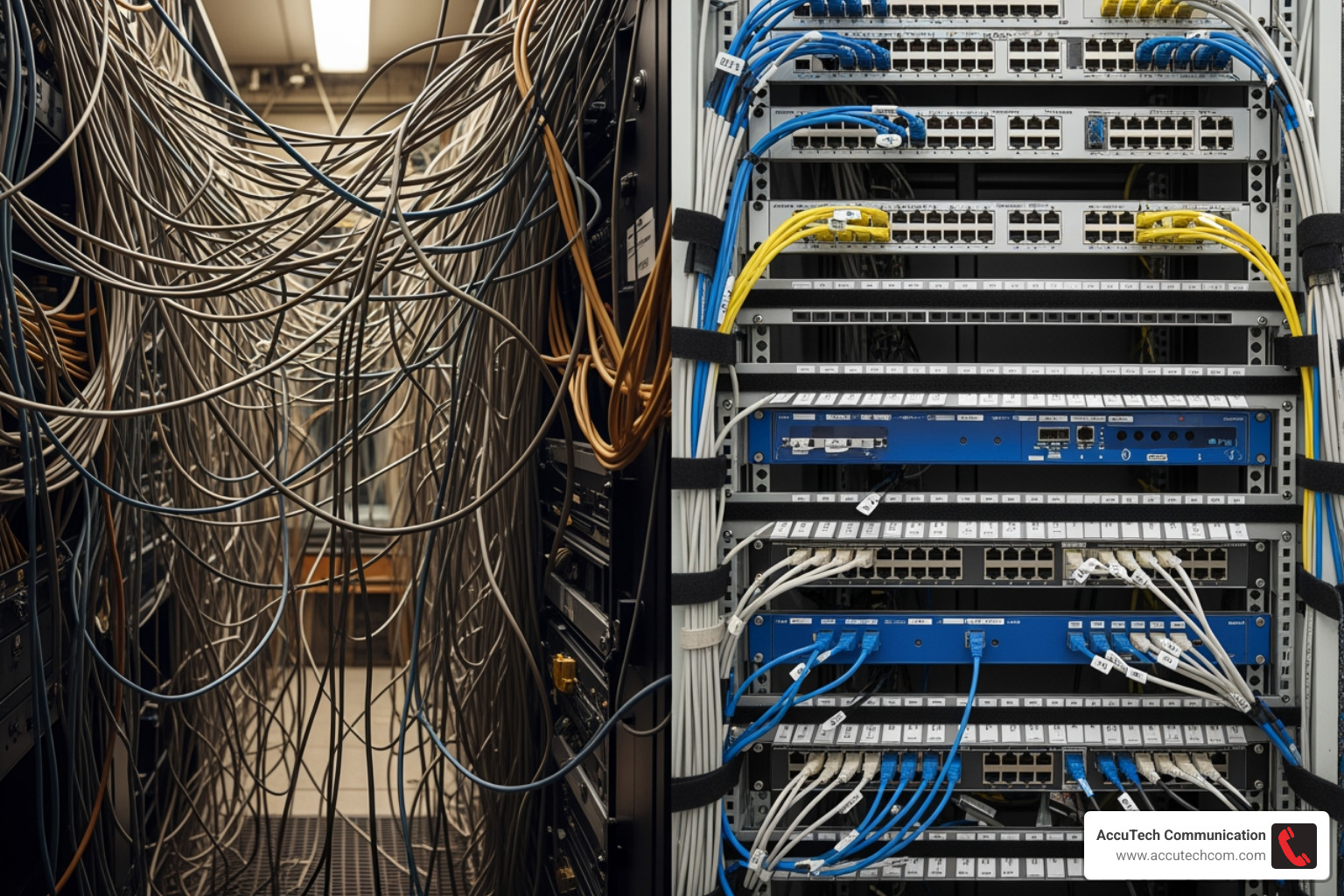
Traditional point-to-point wiring, where each device gets a dedicated cable, seems simple but quickly leads to tangled messes. This makes troubleshooting a nightmare, limits scalability, and increases downtime risk. While it might work for a small office, the volume of cables becomes unmanageable in a large commercial building or educational campus.
Structured cabling is designed for flexibility and longevity. It uses standardized components and a hierarchical structure to create a unified platform for all communication systems—from data and voice to security and AV equipment. This standardization ensures predictable performance, making it the best choice for organizations prioritizing long-term growth and efficiency. It creates a reliable foundation for any modern business or data center.
More info about network cabling installation
Core Components of a Structured Cabling System
A structured cabling system has six subsystems, each vital to the network’s function and organization. Understanding these is key to appreciating a well-designed infrastructure.
-
Entrance Facilities (EF): This is where external services (internet, phone lines) enter your building. It’s the demarcation point connecting the service provider’s network to your internal infrastructure. Proper design ensures a secure, reliable entry point for all services.
-
Equipment Rooms (ER): Also known as the Main Distribution Area (MDA), these rooms house primary network equipment like servers, switches, and routers. They are the central hub for your cabling system, managing external connections and distributing services internally. In large facilities, an ER may serve as the central point for multiple Telecommunications Rooms.
-
Backbone Cabling: This connects Equipment Rooms to Telecommunications Rooms and links buildings on a campus. It’s typically high-capacity fiber optic cable for long-distance, high-bandwidth transmission, forming the network’s critical arteries. A campus backbone requires robust infrastructure for long-term reliability.
-
Horizontal Cabling: This cabling runs from the Telecommunications Room to individual work areas, connecting wall outlets to network devices. Usually copper twisted-pair cable (like Cat6 or Cat6A), it forms the pathway for daily data, voice, and video traffic. The maximum permanent link distance is 90 meters, plus allowances for patch cords.
-
Telecommunications Rooms (TR): Also known as intermediate distribution frames (IDFs), these rooms house horizontal cabling terminations and network equipment like switches. They act as local distribution points, connecting horizontal to backbone cabling and providing an organized way to manage connections for a floor or area.
-
Work-Area Components: These are the final connections at the user’s end, including patch cables connecting devices (computers, IP phones, security cameras) to wall outlets. This segment also includes the outlets, ensuring a standard interface for connectivity.
By carefully designing these six subsystems, we create a network infrastructure that is highly efficient, easy to manage, and adaptable to future needs.
The Business Case: Benefits of Professional Cabling Infrastructure Solutions
Investing in professional cabling infrastructure solutions is more than just a technical necessity; it’s a strategic business decision that delivers tangible benefits, impacting everything from daily operations to long-term growth. For businesses in Massachusetts, New Hampshire, and Rhode Island, a robust cabling system can be a significant competitive advantage.
One of the most compelling statistics highlights this: while the structured cabling system represents a small portion of the overall network investment, it can represent nearly 80% of your network efficiency. This means that even a minor flaw in your cabling can have a disproportionately large impact on your entire network’s performance. Conversely, a well-designed system can open up immense potential.
The benefits are far-reaching:
- Scalability: A structured system is inherently designed to grow with your business. Adding new users, devices, or even entire departments becomes a streamlined process, not a disruptive overhaul.
- Future-Proofing: By adhering to current standards and anticipating future needs, structured cabling can support emerging technologies like IoT and AI without requiring costly re-cabling projects every few years. CAT6A cabling, for example, is considered a top choice for future-proofing.
- Reduced Downtime: Disorganized or poorly installed cabling is a major culprit for network outages. A structured system, with clear pathways and logical organization, minimizes the risk of accidental disconnections and makes maintenance far less prone to errors.
- Simplified Troubleshooting: When a problem arises, a structured system allows technicians to quickly identify and isolate issues. Color-coding, labeling, and organized patch panels mean less time spent tracing tangled wires, getting your business back online faster.
- Improved Performance: High-quality cabling, correctly installed, ensures optimal data transmission speeds and minimizes latency, directly contributing to higher productivity and a smoother user experience across all your networked applications.
- Long-Term ROI: While the initial investment might be higher than a haphazard approach, the reduced operational costs, increased efficiency, and extended lifespan of a structured system deliver significant returns over 15-20 years.
Consider the healthcare sector, where network reliability is literally a matter of life and death. A staggering 50% of healthcare network issues are related to inadequate or underperforming cabling infrastructure. This statistic alone underscores the critical importance of professional cabling in any industry where uptime and data integrity are paramount.
How a Robust Infrastructure Boosts Your Bottom Line
A well-implemented cabling infrastructure solution doesn’t just keep your lights on; it actively contributes to your financial health and operational excellence.
- Increased Reliability: By minimizing points of failure and adhering to best practices, a structured system ensures your network is consistently available. This means fewer disruptions to critical business operations, happier employees, and satisfied customers.
- Lower Maintenance Costs: With a clean, organized, and properly documented system, routine maintenance becomes quicker and less complex. Technicians can efficiently diagnose and resolve issues, reducing labor hours and avoiding costly emergency repairs.
- Adaptability for Moves, Adds, and Changes (MACs): Businesses in Massachusetts, New Hampshire, and Rhode Island are dynamic. Employees move desks, new equipment is installed, and office layouts change. Structured cabling is designed for this flexibility, allowing for rapid and cost-effective reconfigurations without disrupting the entire network.
- Improved Safety and Compliance: Professional cabling adheres to safety codes and industry standards, reducing risks like fire hazards from improperly run cables. It also helps businesses meet regulatory compliance requirements, which is crucial in industries like healthcare or finance.
- Support for Converged Networks: Modern businesses run data, voice (VoIP), and video (security cameras, video conferencing) over the same network. A robust cabling infrastructure seamlessly supports these converged applications, simplifying management and often reducing the need for separate, dedicated systems. This unified approach can lead to significant cost savings and operational efficiencies.
Designing for Today and Tomorrow
The evolving digital landscape requires cabling infrastructure solutions that meet current needs and anticipate future demands. This is crucial for data centers and high-density environments in Massachusetts, New Hampshire, and Rhode Island, where bandwidth needs are escalating due to IoT and AI.
When we approach a design project, we focus on several key considerations:
- Data Center Design: Data centers have unique demands, requiring solutions for fast, reliable transmission of increasing data volumes. This means focusing on modularity, high-density solutions, and environmental soundness.
- Bandwidth Requirements: Understanding your current and projected bandwidth needs is fundamental. Whether you need 1Gbps, 10Gbps, or are looking towards 40/100Gbps dictates the cabling and components we recommend.
- High-Density Environments: In data centers or server rooms, space is a premium. Cabling solutions must be compact and efficient, allowing maximum rack density without compromising airflow or accessibility.
- Emerging Technologies: The rise of the Internet of Things (IoT) and Artificial Intelligence (AI) means more devices generating more data. Your cabling must be ready to support these innovations and their power delivery needs (e.g., Power over Ethernet).
Fiber Optic Backbone Planning and Design
Fiber vs. Copper: Choosing the Right Cabling Infrastructure Solutions
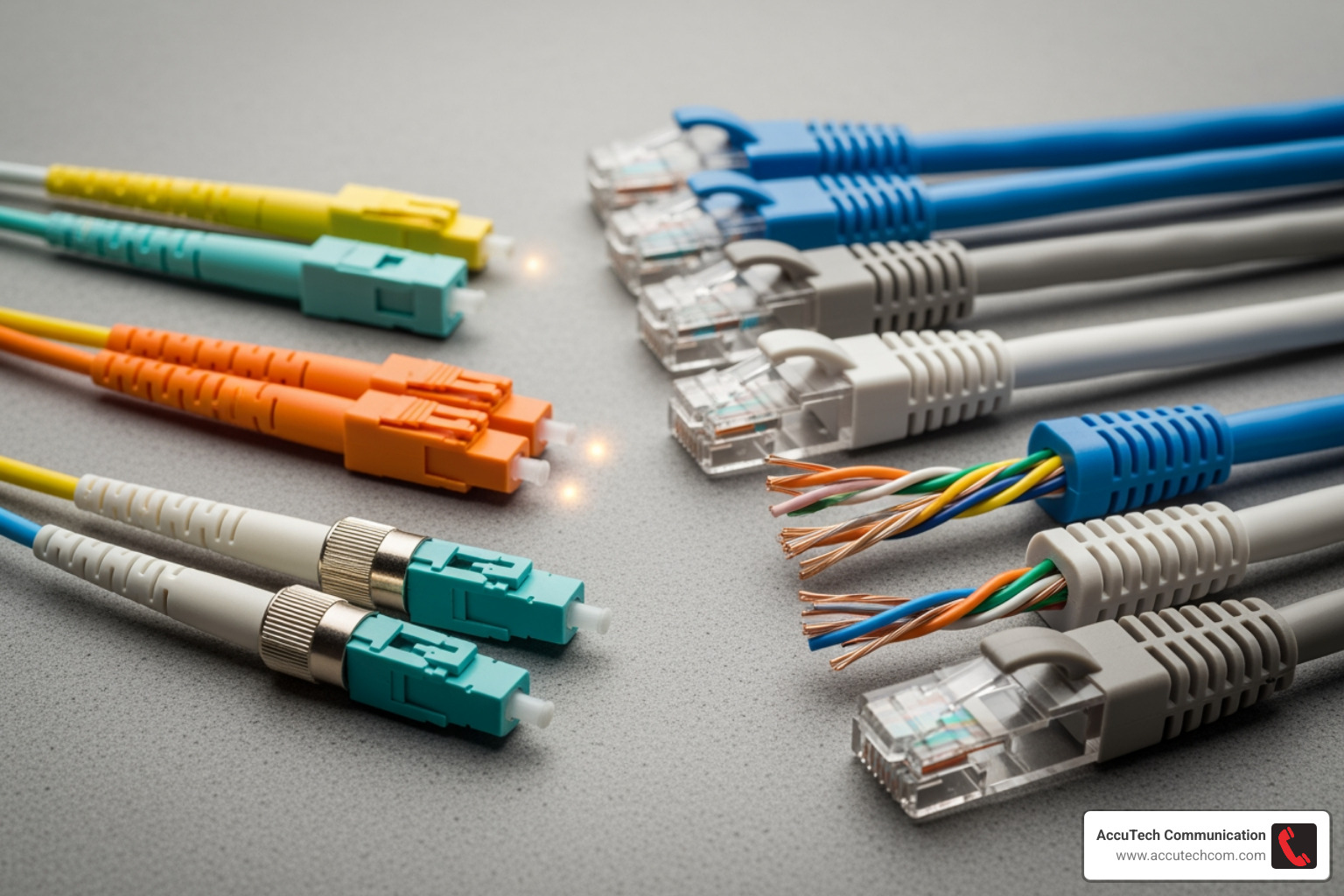
Choosing between fiber optic and copper cabling is a cornerstone of any cabling infrastructure solution. Each has advantages, and a hybrid approach often provides the best balance of performance, cost, and scalability for modern businesses.
| Feature | Copper Cabling (e.g., Cat6, Cat6A, Cat8) | Fiber Optic Cabling (e.g., SMF, MMF, OM5) |
|---|---|---|
| Speed/Bandwidth | Up to 10 Gbps (Cat6A), up to 40 Gbps (Cat8 for short distances) | Multi-terabit speeds, virtually limitless bandwidth |
| Distance | Limited (90m for horizontal, 30m for backbone) | Very long distances (miles for single-mode, hundreds of meters for multi-mode) |
| Cost | Generally lower for short runs and basic installations | Higher initial cost for cable and transceivers, but decreasing |
| EMI Immunity | Susceptible to Electromagnetic Interference | Immune to Electromagnetic Interference (EMI) |
| Security | Easier to tap (though still difficult with proper security) | Extremely difficult to tap, offers superior security |
| Power over Ethernet | Supports PoE (up to 90m) | Does not transmit power |
| Use Cases | Workstations, IP cameras, Wi-Fi access points, short data center runs | Data center backbone, inter-building connections, high-speed storage networks |
-
Fiber Optics: This cabling transmits data using light pulses. It’s ideal for high-speed, long-distance transmission, making it the choice for campus backbones, building risers, and data center cores. Advanced options like OM5 fiber and MTP/MPO connectors support next-generation networks and high-density data centers. Fiber offers superior security and is immune to electromagnetic interference (EMI), critical for industrial or healthcare settings.
-
Copper Cabling: Copper twisted-pair cables (Cat6, Cat6A, Cat8) are cost-effective for short-range connections. Cat6A is standard for 10 Gigabit Ethernet (10GbE) up to 100 meters, while Cat8 supports 40 Gbps over short distances in high-density racks. Copper’s unique advantage is supporting Power over Ethernet (PoE), which powers devices like IP phones, cameras, and Wi-Fi access points through the data cable, simplifying installation.
Most modern data centers and commercial buildings in Massachusetts, New Hampshire, and Rhode Island use a hybrid approach, leveraging fiber for high-speed backbones and copper for horizontal connections to end-devices and areas requiring PoE.
Learn about fiber optic installation
Future-Proofing with Advanced Cabling Infrastructure Solutions
Future-proofing your cabling infrastructure solutions means making strategic choices today to accommodate tomorrow’s technology. It’s about building a foundation to support emerging tech like IoT, AI, and cloud computing without constant, costly upgrades.
- CAT6A for Future-Proofing: We often recommend Category 6A (CAT6A) cabling for future-proofing. It supports 10 Gigabit Ethernet (10GbE) over full 100-meter channels, making it robust enough for most current and near-future bandwidth demands and extending your infrastructure’s lifespan.
- 10GbE and Beyond: As data consumption soars, 10GbE is becoming the baseline for many businesses. Planning for this and higher speeds (40/100GbE, often requiring fiber) ensures your network won’t become a bottleneck.
- Power over Ethernet (PoE): PoE is a game-changer, allowing network cables to carry power to devices and eliminating the need for separate power outlets. This is invaluable for deploying IP cameras, VoIP phones, and wireless access points flexibly and cost-effectively.
- Smart Buildings: The vision of smart buildings—where systems like HVAC, lighting, and security are networked and automated—relies on a flexible, high-capacity cabling infrastructure. Our solutions are designed to integrate these diverse systems.
- Scalable Design Principles: We ensure your cabling system is designed with inherent scalability. This means anticipating growth and structuring the cabling so expansions can be integrated smoothly, without ripping and replacing existing infrastructure.
View Infographic: 6 Reasons CAT6A is in Your Future
Standards, Management, and Industry-Specific Needs
A professionally installed cabling infrastructure solution is built on a bedrock of industry standards and meticulous management practices. This ensures not only optimal performance and reliability but also safety and compliance across various sectors in Massachusetts, New Hampshire, and Rhode Island.
The Role of Industry Standards in Cabling Design
Industry standards are not just guidelines; they are the blueprint for predictable performance, interoperability, and long-term reliability in cabling systems. Adhering to these standards is non-negotiable for any reputable cabling provider.
- TIA/EIA Standards: The Telecommunications Industry Association (TIA) and Electronic Industries Alliance (EIA) develop widely adopted standards in North America. TIA-568 is perhaps the most well-known, defining cabling types, distances, connector types, and installation methods. These standards ensure that different components from various manufacturers can work together seamlessly. For example, TIA 568.2-D introduced significant changes to accommodate newer cable types and testing procedures.
- ISO/IEC Standards: Internationally, the International Organization for Standardization (ISO) and the International Electrotechnical Commission (IEC) publish standards like ISO/IEC 11801, which are globally recognized benchmarks for generic cabling. These standards often align closely with TIA/EIA, ensuring global consistency.
- ANSI/TIA-942 for Data Centers: For data centers, the ANSI/TIA-942 standard is particularly critical. It specifies comprehensive guidelines for telecommunications infrastructure in data centers, including layout, cabling pathways, and environmental considerations. This standard helps ensure data center resiliency, categorizing facilities from Rated-1 (basic) to Rated-4 (fault-tolerant), each with specific requirements for redundancy and uptime. Following these guidelines helps us design and implement data center cabling that meets stringent performance and reliability targets.
These standards influence every aspect of cabling design and implementation, from the type of cable and connectors used to the maximum allowable length of a cable run and the proper labeling conventions. By adhering to them, we guarantee that your cabling infrastructure solutions will be robust, efficient, and compatible with a wide range of network equipment.
Get Guide: TIA 568.2-D: 5 Things You Need to Know
ANSI/TIA-942-B: Telecommunications Infrastructure Standard for Data Centers
Cabling Challenges and Solutions for Key Industries
Different industries present unique environments and demands for cabling infrastructure solutions. Our experience across Massachusetts, New Hampshire, and Rhode Island has equipped us to address these specific challenges with custom solutions.
- Healthcare Facilities: Hospitals and clinics require exceptional reliability and security. As mentioned, 50% of network issues in healthcare can stem from cabling. Challenges include electromagnetic interference from medical equipment, the need for secure and compliant data transmission (HIPAA), and support for critical systems like Nurse Call and patient monitoring. Our solutions focus on robust fiber optic backbones for high bandwidth and EMI immunity, coupled with carefully planned copper runs for patient rooms and administrative areas, ensuring continuous, secure connectivity.
- Educational Campuses: Modern educational institutions are technology-driven, with increasing bandwidth demands from smart classrooms, online learning, and a high density of mobile devices. Challenges include covering large areas (multiple buildings), supporting diverse user needs, and accommodating rapid technological changes. We implement robust campus backbone cabling, often fiber optic, to connect buildings, and design flexible horizontal cabling for classrooms and dorms to support high-speed Wi-Fi and PoE devices.
- Industrial Environments: Factories, warehouses, and manufacturing plants present harsh conditions with dust, moisture, extreme temperatures, and significant electromagnetic interference. These environments can cause unique problems for cabling infrastructure, especially with the rise of the Industrial Internet of Things (IIoT). Our solutions involve industrial-grade cabling (e.g., armored fiber, shielded copper), specialized connectors, and robust conduits to protect against physical damage and environmental stressors, ensuring reliable connectivity for automation, sensors, and control systems.
In each of these sectors, our approach involves a deep understanding of the operational environment, the specific technological needs, and the regulatory landscape to design and deploy cabling infrastructure solutions that are truly fit for purpose.
Optimizing for Performance and Energy Efficiency
Beyond mere connectivity, modern cabling infrastructure solutions play a significant role in optimizing overall network performance and contributing to energy efficiency, especially within data centers and large commercial facilities. This focus on efficiency not only reduces operational costs but also aligns with sustainability goals for businesses in Massachusetts, New Hampshire, and Rhode Island.
The U.S. Department of Energy’s Best Practices Guide for Energy-Efficient Data Center Design emphasizes that optimizing cable management and layout can directly improve energy performance while lowering costs. This is because disorganized cabling can impede airflow, forcing cooling systems to work harder and consume more energy.
Key areas where our solutions focus on optimization:
- Airflow Management: Proper cable routing and management are crucial for maintaining optimal airflow within server racks and throughout data centers. By preventing cable clutter, we ensure that cooling systems can effectively dissipate heat from active equipment, reducing the risk of hotspots and thermal issues.
- Reduced Cooling Costs: When airflow is optimized, cooling systems operate more efficiently. This translates directly into lower energy consumption for cooling, which is often one of the largest operational expenses in a data center.
- Cable Clutter: The enemy of efficiency is cable clutter. It not only looks messy but also obstructs airflow, makes troubleshooting difficult, and can lead to accidental disconnections. Our structured solutions are designed to eliminate clutter through organized pathways, trays, and conduits.
- Rack Density: Efficient cabling allows for higher rack density, meaning more equipment can be housed in the same physical footprint. This maximizes space utilization, which is especially valuable in expensive commercial real estate markets like Boston or other parts of Massachusetts.
- Sustainable Cabling: We also consider sustainable cabling solutions, which often involve materials that are recyclable and designs that allow for efficient layouts. This contributes to a greener footprint and supports corporate social responsibility initiatives.
U.S. Department of Energy’s Best Practices Guide
Best Practices for Cable Management and Maintenance
Effective cable management is an ongoing commitment, not a one-time setup. Implementing best practices for managing and maintaining your cabling infrastructure solutions is vital to ensure optimal performance, reliability, and longevity.
- Color-Coding: Using a consistent color-coding scheme for different types of connections (e.g., blue for data, yellow for voice, red for security) can dramatically simplify identification, troubleshooting, and maintenance. This visual cue helps technicians quickly understand the function of each cable.
- Cable Labeling: Every cable should be clearly labeled at both ends with unique identifiers. This is perhaps the single most important best practice for cable management. Accurate labeling saves countless hours during moves, adds, changes, and troubleshooting.
- Bend Radius Compliance: Cables, especially fiber optic, have a minimum bend radius that must be respected during installation. Exceeding this radius can damage the cable, leading to signal loss or complete failure. Proper routing and cable management accessories ensure compliance.
- Regular Audits: Periodically auditing your cabling infrastructure helps identify issues before they become critical problems. This includes checking for damaged cables, ensuring labels are intact, verifying proper routing, and documenting any changes.
- Removing Abandoned Cables: Over time, cables that are no longer in use can accumulate. These “abandoned cables” add clutter, impede airflow, and can pose fire hazards. Regular clean-outs to remove these unnecessary cables are an important part of maintenance.
- AI-Driven Management Tools: The future of cable management is increasingly intelligent. AI-driven cable management tools are emerging that can automatically detect, map, and diagnose cable issues. While still evolving, these tools promise to further improve efficiency and reduce manual effort in large-scale deployments.
By diligently applying these best practices, businesses can significantly extend the life of their cabling infrastructure, minimize operational disruptions, and maintain a high-performing network.
Conclusion
In today’s business world, your cabling infrastructure solutions are more than just wires; they are a strategic investment dictating your organization’s performance, reliability, and future growth. A well-designed system is indispensable for supporting daily operations and enabling technologies like IoT and AI.
We’ve explored the benefits of structured cabling, from improved scalability and simplified troubleshooting to better energy efficiency and long-term ROI. We’ve also highlighted the importance of industry standards and the unique needs of sectors like healthcare, education, and manufacturing.
For businesses across Massachusetts, New Hampshire, and Rhode Island, partnering with a certified expert is key to navigating modern cabling complexities. Since 1993, AccuTech Communications has provided certified, reliable service, helping commercial clients establish robust, future-ready networks. We understand your connectivity is crucial and are here to ensure your network foundation is built to last.
