
Commercial Data Network Cabling: 7 Powerful Benefits 2025
Why Commercial Data Network Cabling Forms Your Business Foundation
Commercial data network cabling is the physical infrastructure that connects all your business devices – from computers and phones to security cameras and wireless access points. It’s the hidden backbone that makes modern business operations possible.
Key components of commercial data network cabling:
– Structured cabling systems – organized pathways for voice, data, and video
– Cable types – Cat5e, Cat6, Cat6a, Cat8, and fiber optic for different speeds
– Supporting hardware – patch panels, racks, and cable management systems
– Standards compliance – TIA/EIA-568 and local building codes
– Professional installation – proper termination, testing, and certification
In today’s connected world, your commercial property’s success depends on the strength and reliability of your data and network infrastructure. Poor cabling leads to slow speeds, dropped connections, and costly downtime that can cripple business operations.
Why proper commercial data network cabling matters:
- Eliminates bottlenecks – supports current and future bandwidth needs
- Reduces maintenance costs – organized systems are easier to troubleshoot
- Enables technology upgrades – structured systems support new equipment without rewiring
- Ensures compliance – meets industry standards and building codes
- Protects your investment – quality installation provides decades of reliable service
I’m Corin Dolan, owner of AccuTech Communications, and I’ve been designing and installing commercial data network cabling systems across Massachusetts, New Hampshire, and Rhode Island since 1993. This guide will help you understand how to build a network infrastructure that grows with your business and supports your long-term success.
Why Read This Guide?
Whether you’re planning a new office build-out, upgrading an existing network, or trying to understand why your internet feels sluggish, this guide gives you the knowledge to make informed decisions about your network infrastructure.
You’ll learn how to choose the right cable types, understand cost factors, and avoid common mistakes that can cost thousands in downtime. Most importantly, you’ll find how proper planning creates a foundation that supports your business growth for decades.
What Is Commercial Data Network Cabling & Why It Matters
Commercial data network cabling is the physical foundation that connects every device in your business – from computers and phones to security cameras and wireless access points. Think of it as the circulatory system of your office, carrying the lifeblood of modern business: data.
Unlike simple home networks, commercial environments need to handle dozens or hundreds of users simultaneously. This means your cabling system needs to be robust enough to support everything from basic email to business-critical applications like cloud software, VoIP phone systems, and IoT devices.
When your network cabling can’t keep up with demand, it’s like trying to drink a milkshake through a coffee stirrer – frustrating and inefficient. Every aspect of your operation slows down when your infrastructure becomes the bottleneck.
The Hidden Backbone of Every Business
Your network cabling is literally invisible to most employees, but it’s what makes everything else possible. Every email sent, every video conference held, every cloud application accessed depends on the quality and capacity of those cables running through your walls and ceilings.
In today’s digital-first business environment, network downtime isn’t just annoying – it’s a potential disaster. Properly organized and documented cabling systems allow for much faster problem diagnosis and resolution, saving thousands in lost productivity.
The shift to remote work has made reliable office infrastructure even more critical. Your office now serves as the central hub for remote workers accessing company resources, cloud applications, and collaboration tools.
Key Business Benefits
Investing in quality commercial data network cabling delivers measurable benefits:
Reduced downtime might be the most important advantage. Professional installation with proper testing prevents mystery network failures that happen at the worst times. When problems occur, organized systems with clear documentation mean quick fixes instead of playing detective.
Faster speeds make a noticeable difference in daily operations. Modern cables like Cat6a can handle speeds up to 10 Gbps over 328 feet – enough bandwidth to support demanding applications without creating bottlenecks.
Simple upgrades protect your investment over time. Well-designed structured cabling means you can upgrade network equipment without rewiring your entire building, saving money and minimizing disruption.
Increased resale value is often overlooked. Quality network infrastructure makes your property more attractive to potential buyers or tenants who won’t need to invest in major cabling work.
Cable Types & How to Choose the Right Commercial Data Network Cabling

Choosing the right cables for your commercial data network cabling system is like buying a car – you need something that meets current needs while being reliable enough to serve you well into the future. The wrong choice today can mean expensive upgrades or frustrating bottlenecks when your business grows.
Copper Categories Explained
Copper cables remain the backbone of most commercial installations due to their cost-effectiveness and reliability.
Cat5e supports up to 1 Gbps over 100 meters and works perfectly for basic office applications like email, web browsing, and standard file sharing. If your business isn’t doing heavy data transfers, Cat5e might be sufficient.
Cat6 handles 1 Gbps over longer distances with better performance characteristics. The improved design reduces crosstalk – interference that happens when multiple cables run close together.
Cat6a has become the sweet spot for most commercial installations. It supports 10 Gbps over the full 328-foot distance, giving you serious room to grow. The “a” stands for “augmented,” and it makes a real difference in performance and future-proofing.
Cat8 supports blazing speeds up to 40 Gbps but is typically limited to shorter distances and mainly used for data center applications.
For shielded versus unshielded cables, your environment makes the decision. Standard office buildings with typical equipment work fine with unshielded cables. But environments with heavy machinery, motors, or electrical interference need shielded cables for protection against electromagnetic interference (EMI).
Fiber Optic Fundamentals
Fiber optic cables use light pulses instead of electrical signals, solving problems that copper cables can’t handle.
Single-mode fiber is designed for long-haul applications where you need to send data over great distances without losing signal strength.
Multi-mode fiber works better for shorter distances within buildings. It comes in OM3, OM4, and OM5 variants, each offering different bandwidth and distance capabilities.
The biggest advantage of fiber is its immunity to electromagnetic interference. According to scientific research on high-speed optical links, fiber also provides the foundation for ultra-high-speed networks that future technologies will demand.
Choosing the Right Commercial Data Network Cabling
Selecting the right cables balances several key factors:
Speed requirements should account for both current and future needs. The cost difference between cable categories is often minimal compared to rewiring later.
Environmental conditions play a huge role. Standard offices are forgiving, but industrial settings may require shielded cables. Temperature extremes, chemical exposure, and physical stress all influence which cables will perform reliably.
Distance requirements matter more than you might think. Copper cables have definite limitations – even Cat6a tops out at 328 feet for full performance.
Power over Ethernet (PoE) capabilities are increasingly important as more devices get power through network cables. IP cameras, wireless access points, and VoIP phones all benefit from PoE.
For detailed information about your options, check out our guide on Types of Network Wiring.
Structured Cabling Architecture & Components
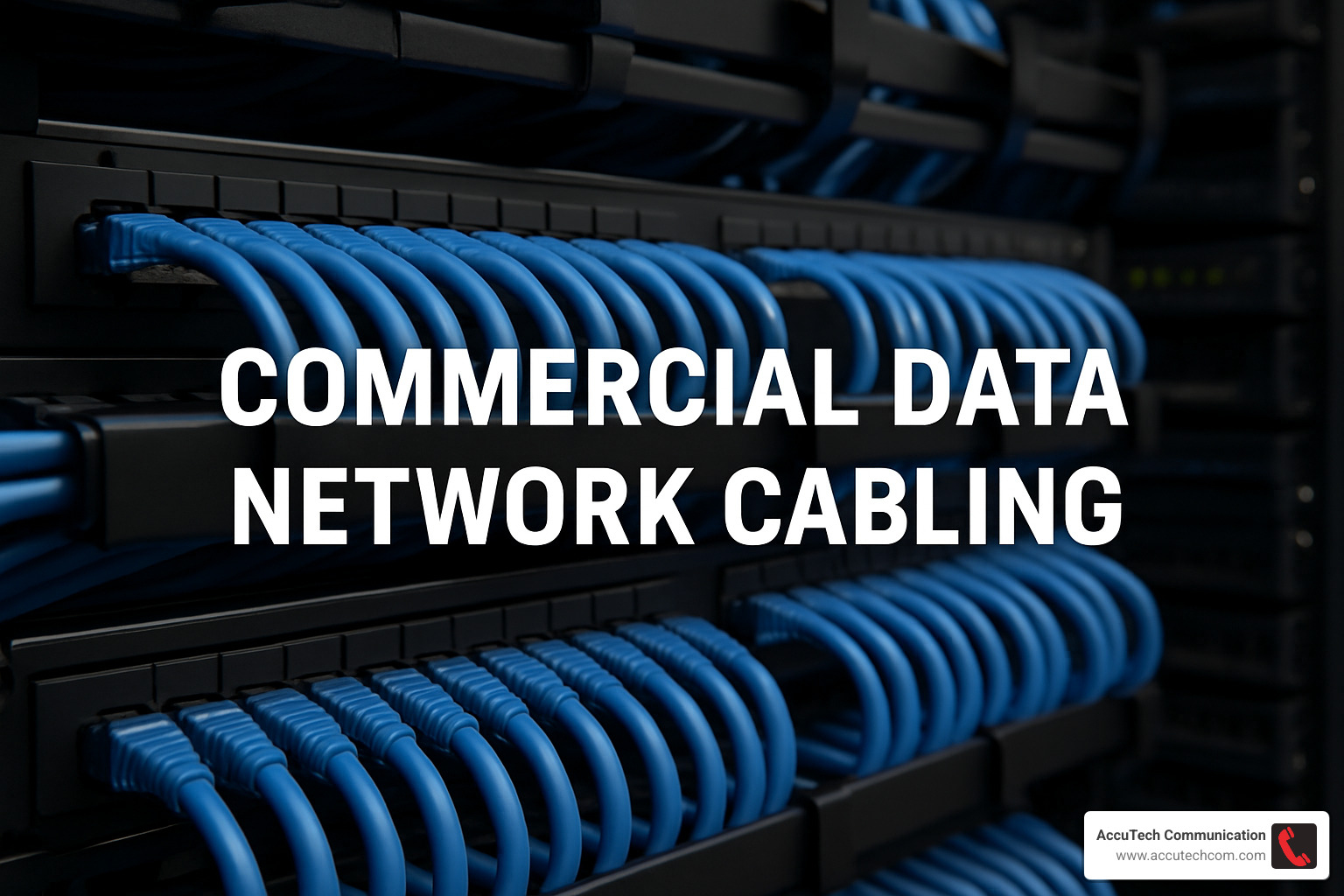
Think of commercial data network cabling like the circulatory system of your building. Just as your body needs organized pathways to deliver blood where it’s needed, your business needs a structured approach to deliver data efficiently throughout your facility.
Structured cabling transforms network management from a nightmare into something surprisingly straightforward when done right.
Six Subsystems Overview
The TIA/EIA-568 standard breaks everything down into six subsystems that work together:
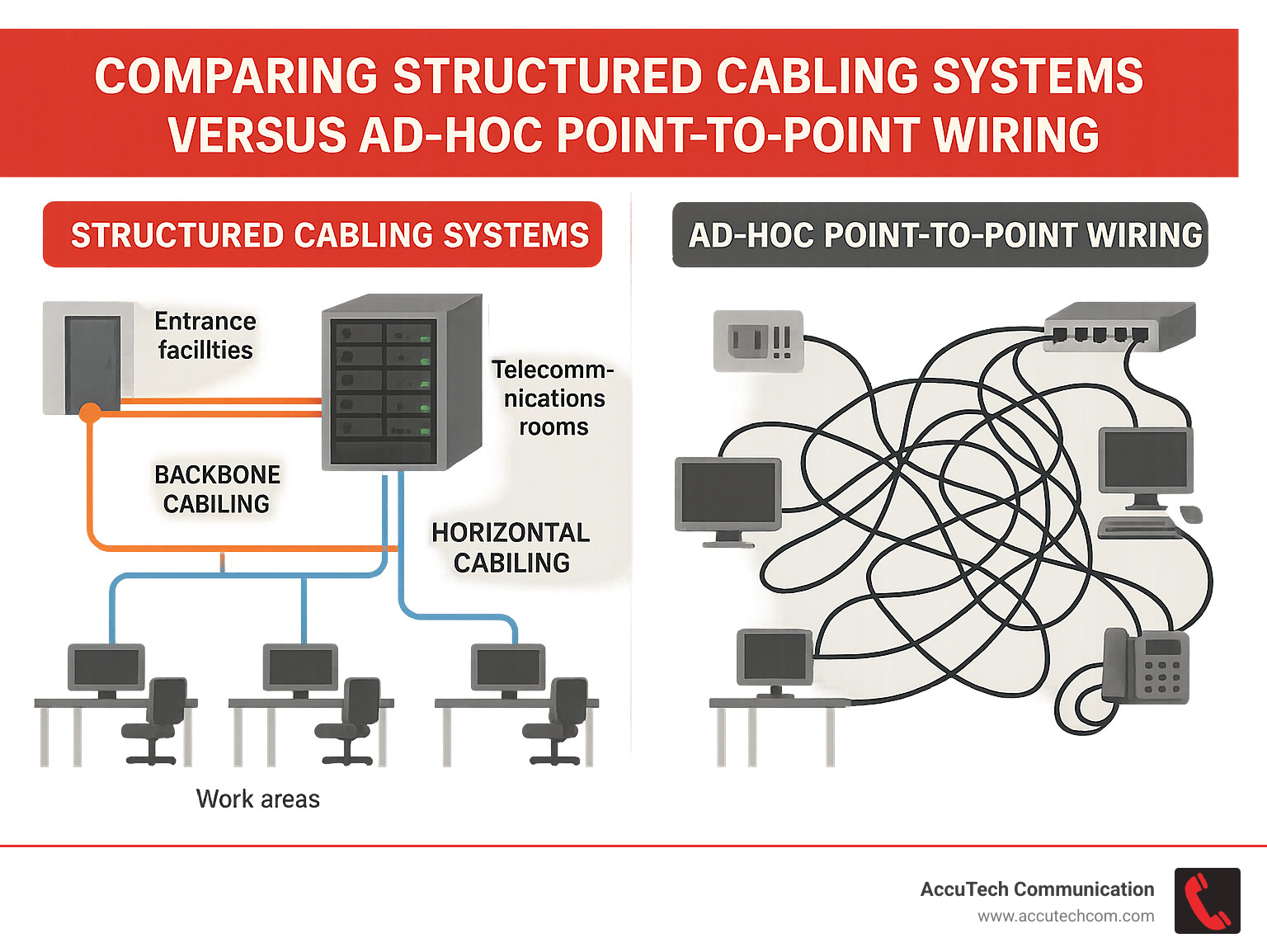
Your entrance facility is where the outside world connects to your building – where your internet service provider’s cables meet your internal network.
The equipment room serves as mission control, housing your servers, main switches, and other critical gear in a climate-controlled space.
Backbone cabling acts as your building’s information superhighway, connecting different floors and major areas with high-capacity cables.
Telecommunications rooms work as distribution centers, serving specific floors or building sections with patch panels and switches.
Horizontal cabling reaches from telecommunications rooms to every desk and work area, typically using copper cables following strict distance guidelines.
The work area is where employees connect their devices through wall outlets and patch cords.
The real magic happens through modular design and consistent color-coding. When everything follows standards, troubleshooting becomes logical rather than chaotic.
Component Deep-Dive
Racks and cabinets provide organized mounting space for network equipment. These promote proper airflow, allow easy maintenance access, and keep everything secure.
Patch panels provide neat termination points for horizontal cables, allowing you to connect and reconnect circuits using simple patch cords. Quality patch panels with clear labeling transform potential chaos into an organized system.
Cable management systems include trays, ties, and guides that keep cables healthy. Proper management prevents damage from excessive bending, improves airflow, and makes future changes easier.
Grounding and bonding systems provide electrical safety that protects both people and equipment.
How Structured Cabling Outperforms Ad-Hoc
The difference becomes clear when you need to make changes or fix problems.
For moves, adds, and changes, structured cabling shines. Moving an employee means simply unplugging their patch cord and plugging it elsewhere. With ad-hoc cabling, simple changes often mean running entirely new cables.
Troubleshooting becomes logical rather than frustrating. Properly documented and organized cables allow quick problem tracing and efficient fixes.
Growth and scalability happen naturally with structured systems that include spare capacity and organized pathways for expansion without major disruption.
For professional installation information, visit our Structured Cabling Installation Contractors page.
Planning, Installing & Testing for Long-Term Success
Success with commercial data network cabling starts with careful planning, continues with skilled installation, and ends with thorough testing. Skip any step, and you’ll likely face headaches down the road.
The planning phase begins with detailed site surveys mapping your space, measuring cable routes, and identifying potential challenges. Proper labeling might seem minor, but becomes crucial when troubleshooting problems months later.
Industry Codes & Standards
Professional installations must meet several standards ensuring safety and performance:
TIA/EIA-568 serves as the primary standard governing commercial telecommunications cabling. It specifies everything from cable types and distances to connector standards and testing requirements.
ANSI/BICSI 002 provides additional guidance for data center installations and high-performance networks.
Fire safety requirements fall under the National Electrical Code (NEC), mandating specific cable fire ratings. Plenum-rated cables are required in air-handling spaces, while riser-rated cables work in vertical shafts.
Local building codes may add requirements for permits, inspections, and installation methods.
For technical details about international standards, reference the ISO Cat7 standard documentation.
Best-Practice Installation Workflow
Professional installation follows systematic workflow building quality into every step:
Site survey and design involves detailed space assessment, requirements analysis, and infrastructure planning. We measure cable routes, identify interference sources, and plan equipment locations for current needs and future growth.
Pathway preparation installs cable trays, conduits, and support systems before pulling cables. This protects cables and creates organized routes for future additions.
Cable installation requires proper pulling techniques respecting bend radius requirements. Cables that get kinked during installation often develop performance problems later.
Termination involves precisely connecting cables to jacks, patch panels, and equipment using proper techniques and tools. Quality terminations are critical for performance.
Testing & Certifying Commercial Data Network Cabling
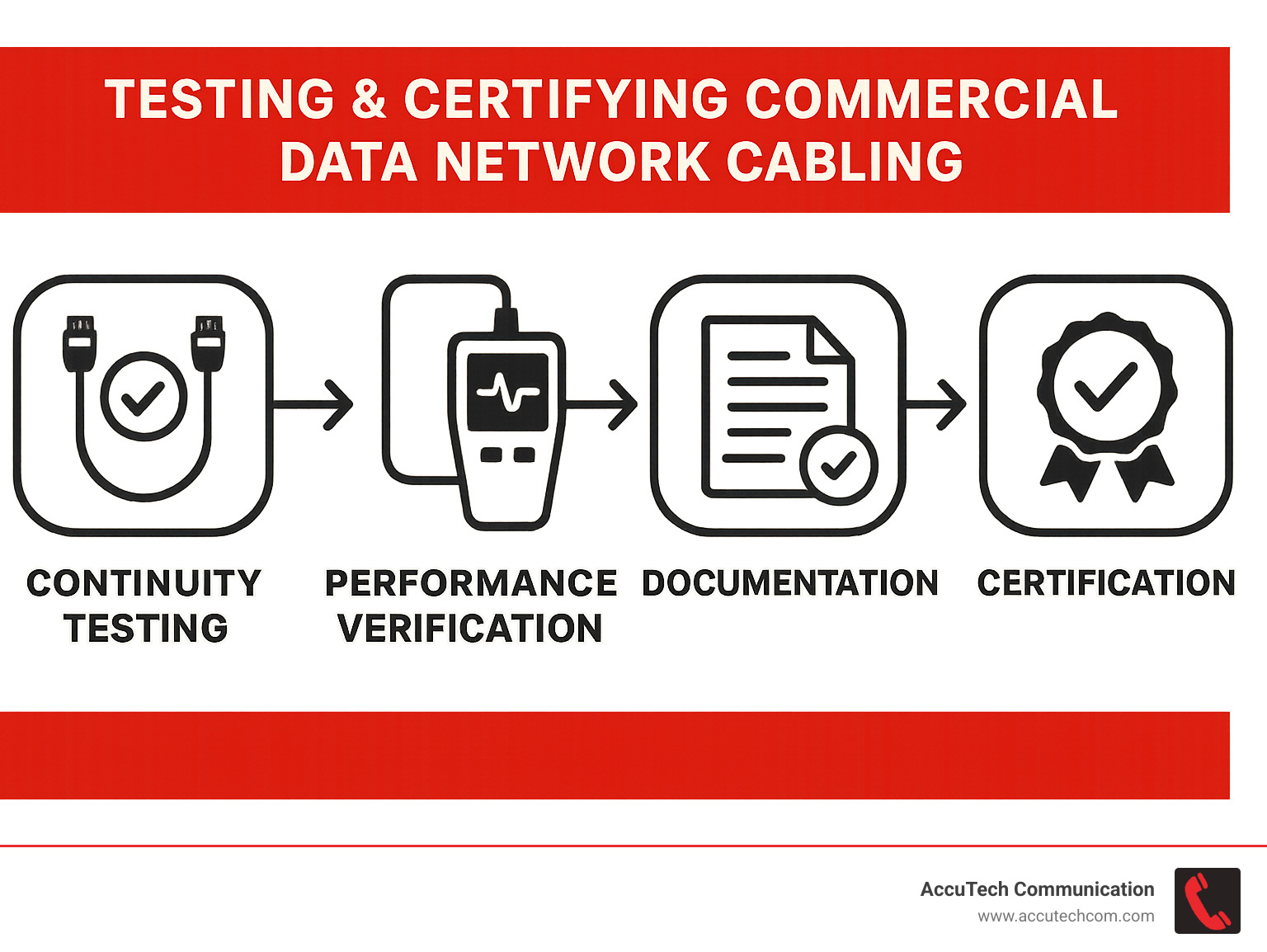
Testing verifies your cabling system will actually perform as designed:
Continuity testing verifies all connections are properly made and no cables were damaged during installation.
Performance testing measures key parameters like attenuation, NEXT (Near-End Crosstalk), and return loss. These measurements verify cables meet category specifications and will deliver expected speeds.
Fiber optic testing uses specialized OTDR equipment sending light pulses down fiber and analyzing reflections to reveal length, loss characteristics, and connection issues.
Complete documentation captures test results for every cable run, creating baseline measurements proving your system meets specifications. This protects warranty coverage and provides reference points for future troubleshooting.
For comprehensive network cabling information, visit our What is Network Cabling? resource.
Budgeting, Contractor Selection & Lifecycle Management
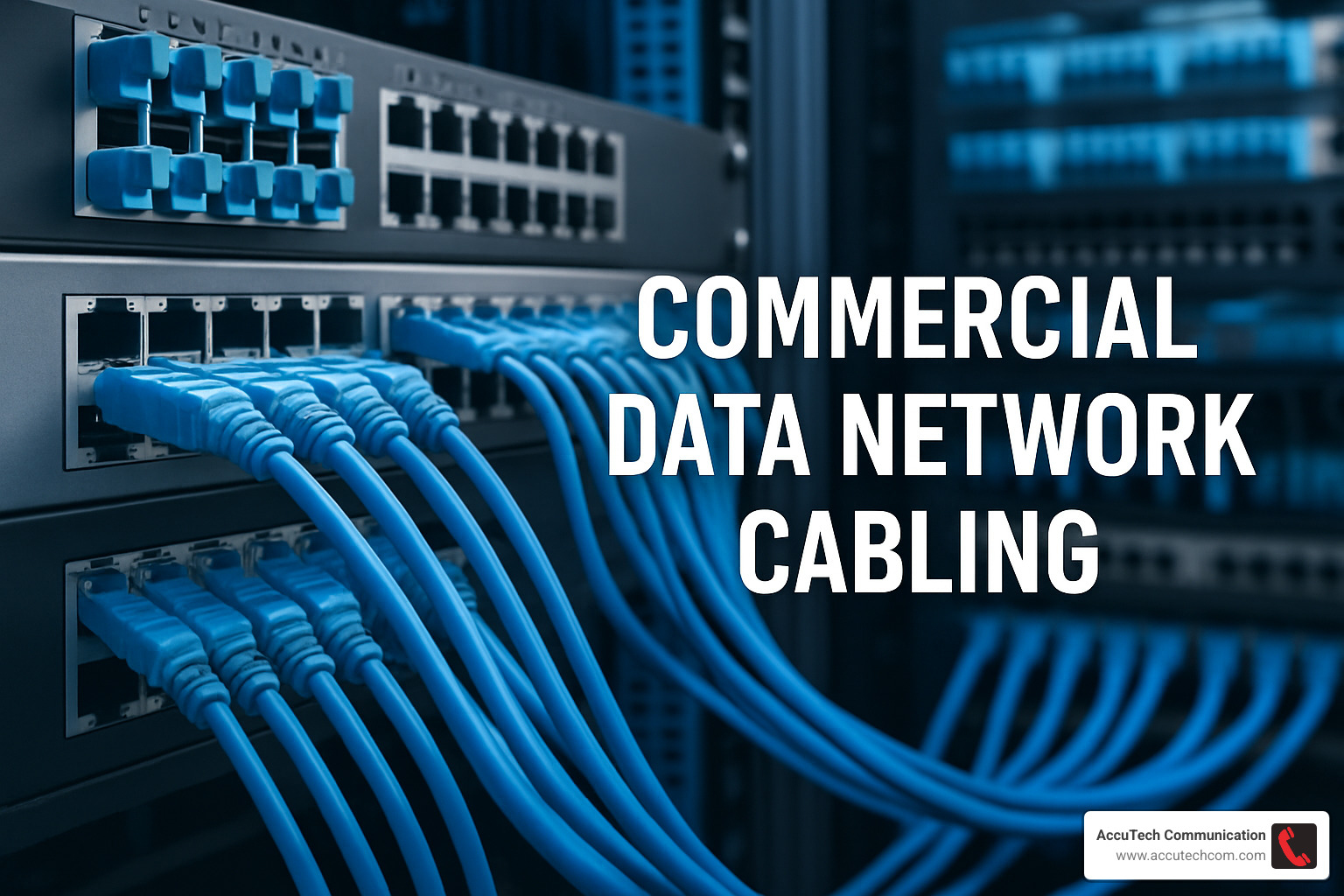
Getting your commercial data network cabling project budget right requires understanding real costs – not just obvious ones. Too many businesses focus only on upfront installation costs and get surprised by hidden expenses.
Understanding Project Costs
Per-data-point pricing is the most common approach, covering everything needed for a single network connection – cable, termination hardware, testing, and documentation. The wide pricing range reflects significant differences between cable types and installation complexity.
Per-square-foot pricing offers simpler cost estimation during early planning stages, useful for comparing spaces or getting rough budget numbers.
The split between materials and labor costs reveals an important truth – materials represent less than half your total investment. Choosing quality components makes financial sense when labor costs dominate your budget.
Total cost of ownership thinking changes how you evaluate options. Systems costing more initially but reducing maintenance headaches and preventing downtime often deliver better value over their 15-20 year lifespan.
Budget for project management, permits, equipment room preparation, and inevitable business disruptions that add significant costs if not planned upfront.
Selecting a Qualified Partner
Choosing the right contractor makes the difference between smooth projects delivering lasting value and frustrating experiences costing more with poor performance.
Professional certifications like RCDD credentials and manufacturer training show a contractor’s commitment to staying current with standards and best practices.
Insurance and bonding protection seems boring until something goes wrong. Professional contractors carry appropriate coverage because they understand risks in occupied buildings.
Local experience matters more than you might think. Contractors familiar with your area understand local codes, permit processes, and inspection requirements while providing better ongoing support.
References and portfolio reviews give insight into real-world performance. Quality contractors proudly share recent projects and customer feedback.
Testing capabilities separate professional installers from cable pullers. Proper testing equipment is expensive, and comprehensive documentation takes time.
For information about our services throughout Massachusetts, New Hampshire, and Rhode Island, visit our Network Cabling Company page.
Maintenance, Upgrades & Future-Proofing
Your investment doesn’t end when installers pack up. Like any infrastructure, it needs ongoing attention for peak performance.
Regular visual inspections catch problems before they cause outages. Annual walkthroughs can prevent expensive emergency repairs.
Performance monitoring through periodic testing verifies your system continues meeting specifications, especially important in high-use or challenging environments.
Documentation updates keep accurate records that become invaluable when troubleshooting or planning expansions.
Technology evolution happens faster than expected. PoE++ systems, Wi-Fi 7 requirements, and potential 40 Gbps desktop connections are emerging. Installing spare capacity during initial construction costs a fraction of retrofitting later.
Successful lifecycle management means thinking beyond today’s needs. Well-planned systems grow with your business and adapt to new technologies without complete replacement.
Frequently Asked Questions About Commercial Data Network Cabling
Over my 30+ years installing commercial data network cabling systems, I’ve heard the same questions countless times. Here are answers to the most common concerns business owners have about their network infrastructure.
How far can Cat6a reliably run?
Cat6a cables support 10 Gbps speeds over the full 328-foot (100-meter) distance specified in TIA standards. This is one of the main reasons we recommend Cat6a for most commercial installations today.
The distance advantage over standard Cat6 is significant. While Cat6 can only maintain 10 Gbps speeds over about 180 feet, Cat6a gives you that full 328-foot reach without performance degradation. This extra distance often means the difference between needing intermediate equipment rooms or running directly from your main network closet.
For runs longer than 328 feet, you’ll need fiber optic cables or intermediate switches to regenerate the signal.
Do I really need shielded cable in an office?
Most traditional office environments work perfectly fine with unshielded (UTP) cables. If your biggest interference sources are computers, printers, and standard office lighting, unshielded cable will serve you well and save money.
However, shielded cables become essential in certain environments. Manufacturing facilities with heavy machinery, areas near radio transmitters, or buildings with older fluorescent lighting can generate enough electromagnetic interference to disrupt network signals.
The trade-off with shielded commercial data network cabling is higher material costs and more complex installation requirements. Shielded systems must be properly grounded to work effectively.
How often should I re-certify my cabling plant?
I typically recommend testing every 3-5 years or after any major changes to your network infrastructure. Think of it like getting your car inspected – regular checkups catch small problems before they become big headaches.
More frequent testing makes sense in demanding environments. If your cables run through areas with temperature extremes, chemical exposure, or heavy vibration, annual testing might be worth considering.
Keeping current test records also protects your investment. Most cable manufacturers require certified test results for warranty claims, and baseline measurements make it easier to identify when performance has degraded over time.
Conclusion
Your business deserves a network that works as hard as you do. Commercial data network cabling isn’t just about connecting computers – it’s about building the digital foundation that lets your team collaborate seamlessly, serve customers efficiently, and grow without limits.
Think of it this way: you wouldn’t build a house on a shaky foundation, so why run your business on unreliable network infrastructure? A properly designed structured cabling system is like having superhighways for your data instead of bumpy back roads. Your applications run faster, your video calls don’t drop, and your team stays productive instead of waiting for files to transfer.
The best part? This is a one-time investment that pays dividends for decades. While other businesses struggle with slow connections and constant IT headaches, you’ll have the peace of mind that comes with rock-solid infrastructure. Your employees will thank you, your customers will notice the difference, and your bottom line will reflect the improved efficiency.
Since 1993, we’ve watched businesses transform when they invest in quality network cabling. The manufacturing company that can now monitor their entire production line in real-time. The growing law firm that seamlessly added 20 new employees without missing a beat. The retail chain that upgraded their point-of-sale systems without rewiring a single location.
These success stories all started with the same decision you’re facing now – choosing to build their network infrastructure the right way from the beginning.
At AccuTech Communications, we’ve been helping businesses throughout Massachusetts, New Hampshire, and Rhode Island make these smart infrastructure decisions for over three decades. Our certified technicians don’t just install cables – we design systems that grow with your business and adapt to whatever technology comes next.
Whether you’re moving into a new space, expanding your current location, or finally ready to replace that tangle of cables that’s been giving you headaches, we’re here to help. We’ll listen to your needs, explain your options in plain English, and design a solution that makes sense for your business and your budget.
For more information about our comprehensive network cabling services throughout Massachusetts, visit our Business Network Cabling Services in MA page or contact us to discuss your specific requirements.
Your business has big plans for the future. Make sure your network infrastructure is ready to support them every step of the way.
