
Communication Industry: 4 Key Growth Pillars
Why the Communication Industry Powers Our Connected World
The communication industry is the backbone of our modern economy, encompassing telecommunications, media, entertainment, and interactive services that connect billions of people worldwide. This vast sector includes everything from the fiber optic cables under our streets to the streaming services on our phones.
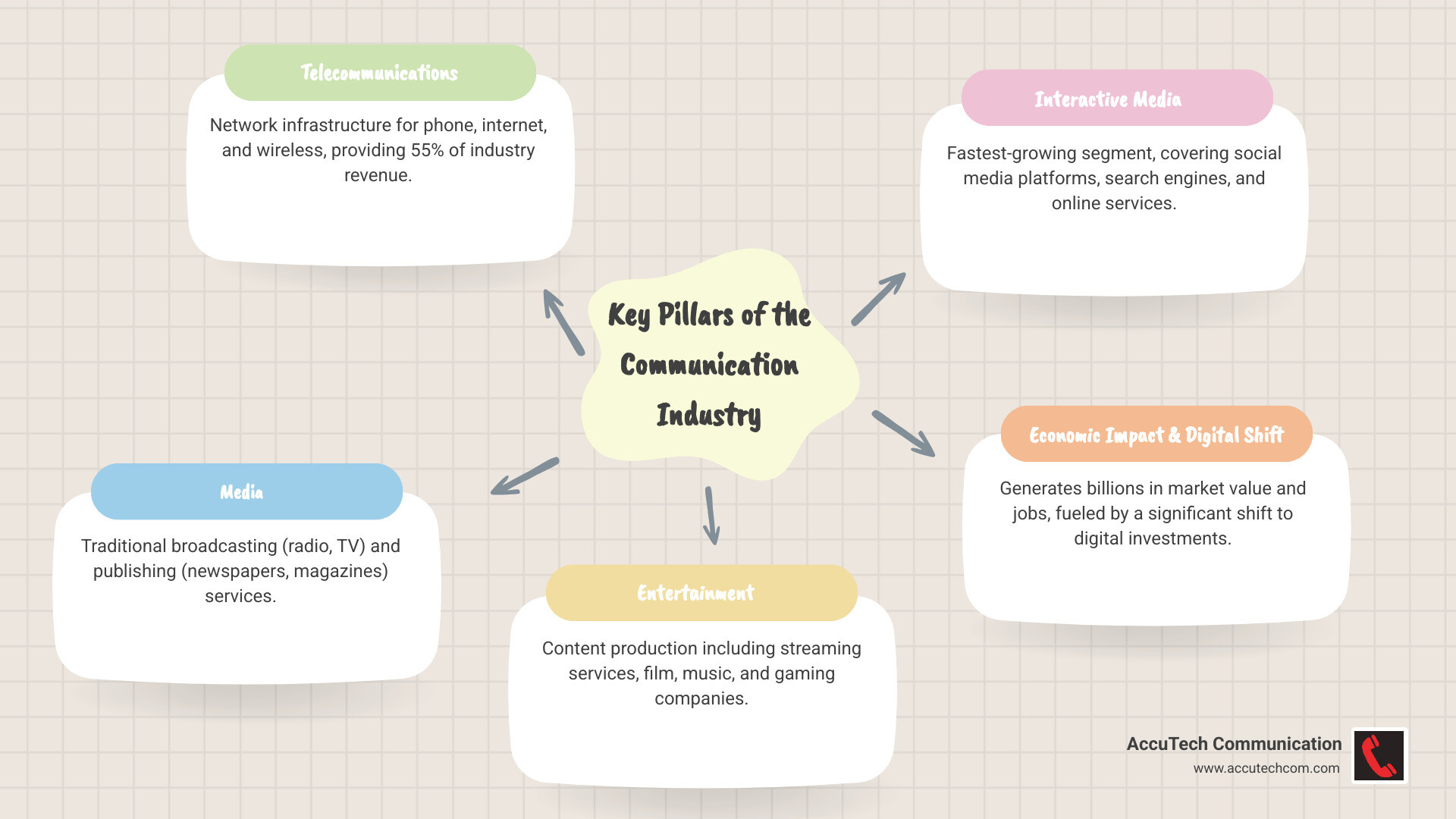
Key components of the communication industry:
- Telecommunications – Phone networks, internet providers, wireless carriers
- Media – Broadcasting, publishing, cable television
- Entertainment – Content production, streaming services, gaming
- Interactive Media – Social media platforms, search engines, online services
The industry generates massive economic value. In Quebec alone, the marketing and communications sector creates a $5.9 billion market with over 10,000 jobs. Globally, telecommunications services revenue was projected to reach $2.4 trillion by 2019.
The shift toward digital is reshaping everything. Between 2012 and 2014, digital media investments surged 21.5% while traditional media declined – television down 7.5%, newspapers down 14.4%.
This industry affects every business. Whether you’re running a hospital that needs reliable phone systems or a manufacturer coordinating across multiple locations, communication infrastructure determines how effectively you operate.
I’m Corin Dolan, owner of AccuTech Communications, and I’ve spent over three decades helping businesses build reliable communication systems across Massachusetts, New Hampshire, and Rhode Island. My experience in the communication industry has shown me that while the technology evolves rapidly, the need for dependable, well-designed infrastructure remains constant.
From Telegraphs to Terabytes: The Evolution and Key Segments
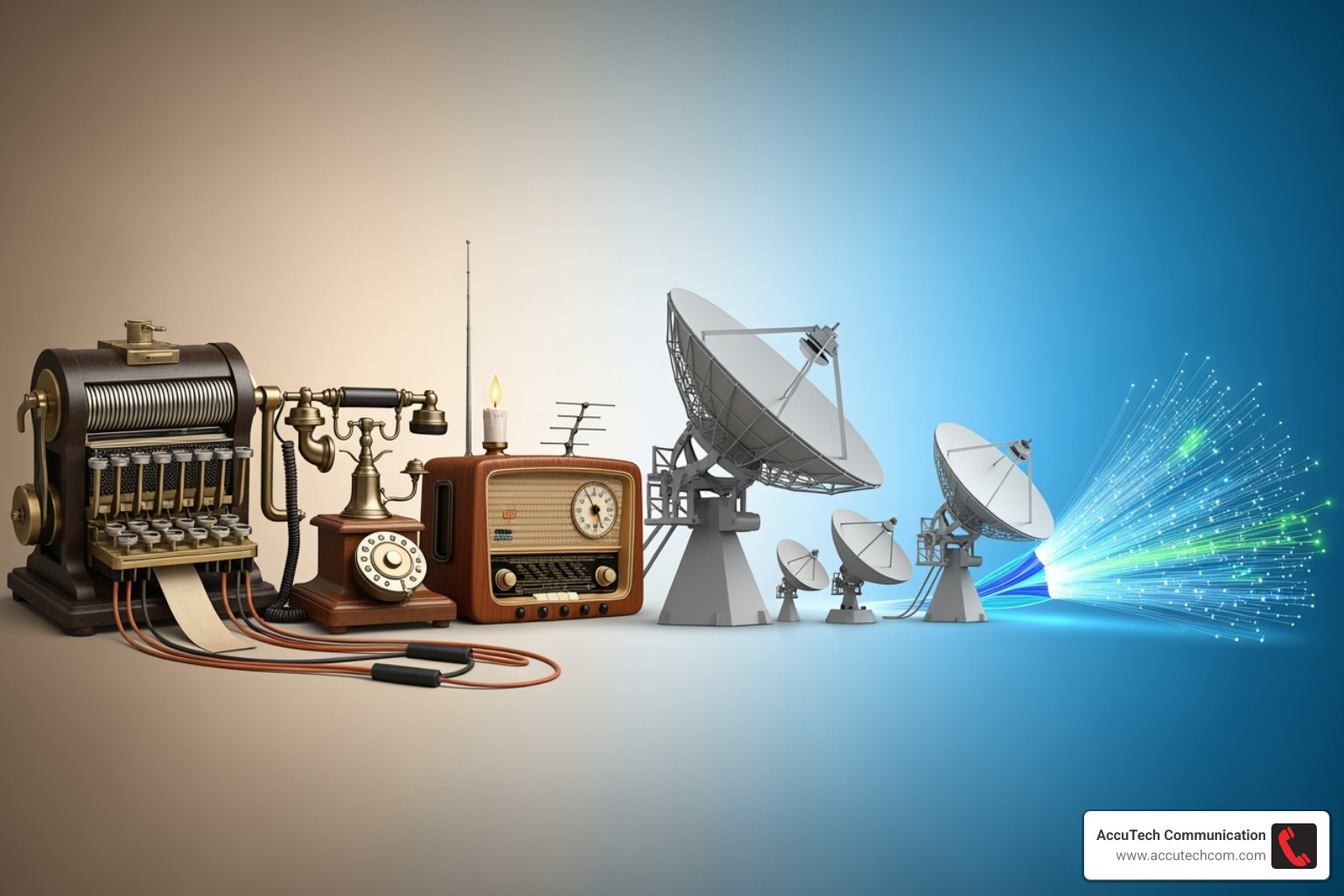
The communication industry has transformed our world in ways our ancestors could never have imagined. Picture this: in the 1830s, sending a message across the country took weeks by horseback. Then Samuel Morse invented the electrical telegraph, and suddenly that same message could travel hundreds of miles in minutes. It was nothing short of magical!
The telephone came next in 1876, letting people actually hear each other’s voices across vast distances. No more dots and dashes – just real conversation. Then radio waves freed us from wires altogether, bringing music and news right into people’s homes. Television followed, adding pictures to the mix.
The mid-1900s brought vacuum tubes and early computer networks like ARPANET. These might sound boring, but they were the seeds of today’s internet. Fast forward to now, and we’re living in an age of fiber optics that can carry terabytes of data at the speed of light. You can read more about the story of the telegraph to see where it all began.
Here’s what really amazes me: mobile broadband subscriptions jumped from 3.3 billion in 2015 to 7.7 billion in 2020. That’s more than double in just five years! This incredible growth shows that the communication industry isn’t just surviving – it’s thriving with stable, long-term growth that weathers economic storms. For businesses looking to tap into this evolution, we offer more info about fiber optic cabling services.
Defining the Scope of the Communication Industry
The modern communication industry is much bigger than just phone calls and text messages. Think of it as the nervous system of our global economy – it carries voice, audio, video, and data everywhere they need to go.
In 2018, the financial world recognized just how important this sector had become. The Global Industry Classification Standard created a whole new category called “Communication Services” within the S&P 500. This wasn’t just paperwork shuffling – it was acknowledging that communication companies had grown into economic powerhouses.
Today’s industry spans everything from telecommunication services that keep your phone working to media and publishing companies that create the content you consume. There’s entertainment production bringing you movies and shows, plus interactive media platforms where you share photos and videos with friends.
The beauty is in how it all works together. Whether the data travels through wired networks under city streets or wireless signals bouncing off cell towers, the goal remains the same: moving information quickly and reliably from point A to point B.
Key Industry Segments
The communication industry breaks down into four main areas that work together like pieces of a puzzle. Telecommunications forms the foundation – these are the companies building cell towers, laying fiber optic cables, and providing internet access. Without them, nothing else would work.
Media companies handle traditional broadcasting through radio and television, plus publishing newspapers and magazines. They’re the ones creating and distributing news and information that keeps us informed about our world.
Entertainment brings us movies, music, video games, and streaming shows. These companies don’t just make content – they figure out how to get it to your devices in the highest quality possible.
Interactive media is the newest and fastest-growing piece. This includes social media platforms, search engines, and online services that let us communicate in real-time with people anywhere.
Within telecommunications specifically, several key sub-sectors keep everything running smoothly. Communications equipment companies build the hardware – the routers, switches, and cables that form the internet’s backbone. Wireless communication providers run the cell networks that keep your phone connected. Processing systems handle the massive amounts of data flowing through networks every second.
Long-distance carriers specialize in moving calls and data across huge distances, while companies offering both domestic and foreign telecom services make sure you can reach anyone, anywhere in the world.
Each piece matters. The equipment manufacturers build the tools, the service providers run the networks, and the content creators fill those networks with information and entertainment that makes it all worthwhile. If you’re curious about the physical infrastructure that makes this possible, check out more info about network cabling installation.
The Economic Engine: Powering Prosperity and Investment
The communication industry is far more than just connecting phone calls or sending texts—it’s a massive economic powerhouse that drives prosperity across the globe. Think about it: every business, every government agency, every hospital needs reliable communication systems to function. That demand creates incredible economic value.
Take Quebec as an example. Their marketing and communications sector alone contributes a whopping $783.2 billion to GDP, with a total market value of $5.9 billion. That breaks down to $2.85 billion in media investment and $3.1 billion in non-media investment. These aren’t just numbers on a spreadsheet—they represent thousands of jobs, innovative companies, and the infrastructure that keeps our modern world running smoothly.
The revenue streams in telecommunications have evolved dramatically over the past decade. While telephone calls still generate significant income, the real money has shifted to data services, high-speed internet access, and video streaming. Mobile networks have become the primary delivery method for these services, and it’s easy to see why when you consider how much time we all spend on our phones!
What’s particularly interesting is how communication industry companies serve different types of clients. Corporate customers are often less concerned about price and more focused on quality and reliability. They need high-security private networks, crystal-clear video conferencing, and guaranteed uptime. This makes them incredibly valuable clients—much more so than residential customers who primarily shop on price.

Advertising Investment Shifts
The most dramatic change we’ve witnessed in the communication industry has been the complete reshuffling of advertising dollars. It’s like watching a massive migration—money has been flowing away from traditional media and rushing toward digital platforms at an unprecedented pace.
Between 2012 and 2014, Quebec’s advertising landscape told a fascinating story. Digital media investments surged by 21.5%, while traditional media took some serious hits. Television advertising dropped 7.5%, daily newspapers fell 14.4%, and magazines plummeted 16.1%. Meanwhile, signage grew a healthy 9.8%, and radio managed a modest 2.4% increase.
| Media Type | Investment Change (2012-2014) |
|---|---|
| Digital Media | +21.5% |
| Signage | +9.8% |
| Radio | +2.4% |
| Magazines | -16.1% |
| Daily Newspapers | -14.4% |
| Television | -7.5% |
This shift reflects how people actually consume media today. We’re scrolling through social feeds instead of reading newspapers, streaming shows instead of watching scheduled TV, and getting our news from apps rather than magazines. Smart businesses have followed their customers to these new platforms, forcing the entire industry to innovate or risk becoming irrelevant.
The Industry from an Investor’s Perspective
From an investment standpoint, the communication industry is both exciting and challenging. It’s a sector packed with some of the most valuable companies in the United States, but it’s also notorious for volatile price swings and massive capital requirements.
Here’s the thing about telecommunications: it’s incredibly capital-intensive. Companies constantly need to upgrade their infrastructure—sometimes replacing transmission systems every two years just to keep up with demand and technology advances. That’s expensive, but it’s also what keeps competitors from easily entering the market.
Despite these challenges, telecommunications remains a defensive investment because demand for communication services persists regardless of economic conditions. People and businesses need to communicate whether the economy is booming or struggling. This makes the sector relatively recession-resistant.
When evaluating companies in this space, smart investors look beyond traditional earnings metrics. Price-to-sales ratios help gauge efficiency, while Average Revenue Per User (ARPU) shows how much value companies extract from their customer base. The churn rate—how quickly customers leave for competitors—reveals customer satisfaction and loyalty levels.
The global players in this space operate on mind-boggling scales. Companies like T-Mobile US and China Mobile each boast market capitalizations around $246.83 billion. These giants connect billions of users worldwide, managing infrastructure that spans continents and handles unimaginable amounts of data every second.
For a deeper dive into how this sector is structured, you can explore an overview of the S&P 500 Communications Services sector.
The People and Culture Behind the Connection
When you make a phone call or stream a video, there’s an entire army of talented people working behind the scenes to make it happen. The communication industry is fundamentally a people business, built on the expertise and dedication of professionals who keep our connected world running smoothly.
This sector is a major job creator. In Quebec alone, the marketing and communications field employs over 10,000 people. What’s really impressive is the quality of these jobs – they’re not just any positions, but highly skilled roles that attract some of the brightest minds in technology and communications.
The workforce demographics tell an encouraging story. Women make up 57% of agency workers, creating a more balanced workplace than many tech sectors. Even more striking is the education level: 67% of workers hold a Bachelor’s degree or higher. This isn’t surprising when you consider the complexity of modern communication systems – from fiber optic networks to sophisticated business phone systems.
All this expertise comes at a premium. The average salary in Quebec’s communications sector hits $72,319, reflecting the value these skilled professionals bring to businesses and communities. At AccuTech, we’ve always believed in investing in our team’s expertise because the communication industry demands nothing less than the best.

Jobs and Demographics in the Communication Industry
The beauty of the communication industry lies in its incredible diversity of career paths. This isn’t just a field for engineers and technicians – though we certainly need plenty of those! You’ll find marketing specialists crafting campaigns that reach millions, communication strategists helping businesses tell their stories, and creative professionals bringing ideas to life.
On the technical side, there are network engineers designing the infrastructure that keeps data flowing, data analysts making sense of massive information streams, and IT support specialists solving problems when things go wrong. Then there are the artists and freelancers – directors, sound technicians, graphic designers – who bring creativity to the technical world.
The 67% of workers with Bachelor’s degrees or higher speaks to how sophisticated this industry has become. These aren’t just jobs you can walk into – they require real expertise and ongoing learning. Technology changes fast, and the people who succeed are those who keep growing their skills.
For those interested in the broader picture, the Telecommunications industry labor statistics provide fascinating insights into employment trends across the sector.
We’re proud to contribute to this skilled workforce by ensuring our technicians stay certified in the latest technologies. Whether we’re installing structured cabling services or troubleshooting complex network issues, our team brings the expertise that businesses depend on.
Cultural and Community Contributions
Here’s something that might surprise you: the communication industry is one of the biggest supporters of arts and culture you’ve probably never heard about. In Quebec, communication companies hired over 3,500 artists in just one year, making the industry their second primary source of income. That’s over $50 million flowing directly to directors, sound technicians, and other creative professionals.
This isn’t just about business – it’s about building communities. 76% of agencies’ income comes from local clients, showing how deeply rooted these companies are in their regions. They’re not just service providers; they’re genuine business partners helping local companies grow and succeed.
The giving doesn’t stop there. Communication agencies contribute an average of $110,800 annually to charitable causes and community organizations. Production companies go even further, contributing $348,375 each year on average. These aren’t token donations – they represent a real commitment to making communities stronger.
What strikes me most about these numbers is how they reflect the industry’s understanding of its role. We don’t just connect wires and configure networks – we connect people, businesses, and communities. Every reliable phone system we install or network we maintain helps local businesses thrive, which in turn supports the entire community ecosystem.
This community focus has always been central to how we operate at AccuTech. We’ve been serving Massachusetts, New Hampshire, and Rhode Island since 1993 because we believe in building lasting relationships with the businesses and communities we serve.
Frequently Asked Questions about the Communication Industry
After decades of working in the communication industry, I’ve noticed that people often ask similar questions about how this fascinating sector really works. Let me share some insights based on what we’ve seen evolve over the years.
What are the primary revenue streams for telecommunications companies?
Here’s something that might surprise you: telephone calls remain a major generator of revenue for telecom companies, even in our smartphone-obsessed world. But here’s the twist – the real money is increasingly coming from somewhere else entirely.
The industry’s growth engine has shifted dramatically toward data services, high-speed internet access, video streaming, and value-added services for corporate clients. Think about your own daily habits. How much time do you spend streaming videos, downloading files, or video chatting? All that data consumption translates into serious revenue.
There’s also a behind-the-scenes revenue stream that many people don’t realize exists. Telecommunications companies earn substantial income by providing network connectivity to other telecom providers and by wholesaling circuits to businesses that need heavy network usage.
Corporate clients are particularly valuable because they’re willing to pay premium prices for quality and reliability. They need high-security private networks, advanced cloud solutions, and sophisticated video conferencing platforms – services that command much higher margins than basic consumer plans.
How has the rise of digital media affected the industry?
The rise of digital media has been like watching a dam burst – it completely reshaped where money flows in the communication industry. We witnessed advertising investments surge by 21.5% for digital platforms between 2012 and 2014, while traditional channels took a beating. Television dropped 7.5%, newspapers fell 14.4%, and magazines declined 16.1%.
But this shift goes far deeper than just advertising dollars moving around. It has spurred innovation in content delivery and consumption that’s frankly mind-boggling. Streaming services have transformed how we watch movies and TV shows. Social media platforms have become news sources for millions. The internet is rapidly replacing traditional voice services as our primary communication method.
Traditional media outlets have had to completely reinvent themselves, embracing online strategies and competing in an increasingly crowded digital landscape. It’s an ongoing revolution that continues reshaping everything we thought we knew about media and entertainment.
What are the main segments within the broader communication industry?
The communication industry is beautifully diverse, like a complex ecosystem where different parts work together to keep us all connected. When we break it down, we typically see four main segments that each play crucial roles.
Telecommunications forms the foundation – this is all about the infrastructure and services that move information across distances. Whether it’s wired services like fiber optic internet, wireless cellular networks, or satellite communication, this segment builds and maintains the pipes that carry our data.
Media encompasses the companies focused on mass communication and content distribution. This includes traditional broadcasting through radio and television networks, publishing companies handling newspapers and magazines, and news agencies that gather and distribute information.
Entertainment is where creativity meets technology, covering content creation and distribution for our leisure time. Film and television production studios, music labels, video game developers, and live entertainment providers all fall into this exciting segment.
Interactive media and services represents the newest and fastest-growing piece of the puzzle. Social media platforms, search engines, online advertising services, and other digital services that let us interact and exchange information in real-time are changing how we communicate daily.
These segments constantly overlap and influence each other, creating a dynamic industry that’s always adapting to new technologies and changing habits. It’s what makes working in this field so fascinating – there’s always something new happening!
Conclusion
The communication industry has taken us on quite a journey, hasn’t it? From those early days when sending a telegraph message was cutting-edge technology to today’s world where we stream movies on our phones while video chatting with friends across the globe. It’s truly a testament to human creativity and our endless desire to connect with one another.
Throughout this exploration, we’ve seen how this industry has become so much more than just phone calls and internet connections. It’s an economic powerhouse that creates millions of jobs, supports artists and creative professionals, and keeps our communities connected. The shift from traditional media to digital platforms has been dramatic – and we’re still in the middle of that change.
What strikes me most is how the communication industry touches every aspect of our lives. Whether you’re running a small business that needs reliable phone systems, managing a healthcare facility that depends on secure data transmission, or operating a manufacturing plant that coordinates across multiple locations, your success depends on having rock-solid communication infrastructure.
The future promises even more exciting developments. As we move toward faster networks, smarter devices, and new ways of sharing information, the need for dependable, professionally installed communication systems becomes even more critical.
Here at AccuTech Communications, we’ve been part of this incredible evolution since 1993. We’ve watched technology change dramatically, but one thing remains constant: businesses need communication systems they can count on, day in and day out. That’s why we focus on certified installations, quality equipment, and the kind of reliable service that keeps your operations running smoothly.
For businesses needing a reliable foundation for their communication systems, explore our business communications services.
