
Communication Systems: 7 Powerful Basics You Must Know in 2025
The Foundation of Our Connected World
Ever wonder what makes our modern world tick? The answer is all around us, though often invisible. Communication systems form the vital foundation of our connected society—they’re the invisible threads that weave our digital world together.
Think about it: when you make a phone call, send an email, or stream your favorite show, you’re relying on complex communication systems that seamlessly transfer information across town or around the globe. These networks aren’t just convenient—they’re essential to how we live, work, and interact.
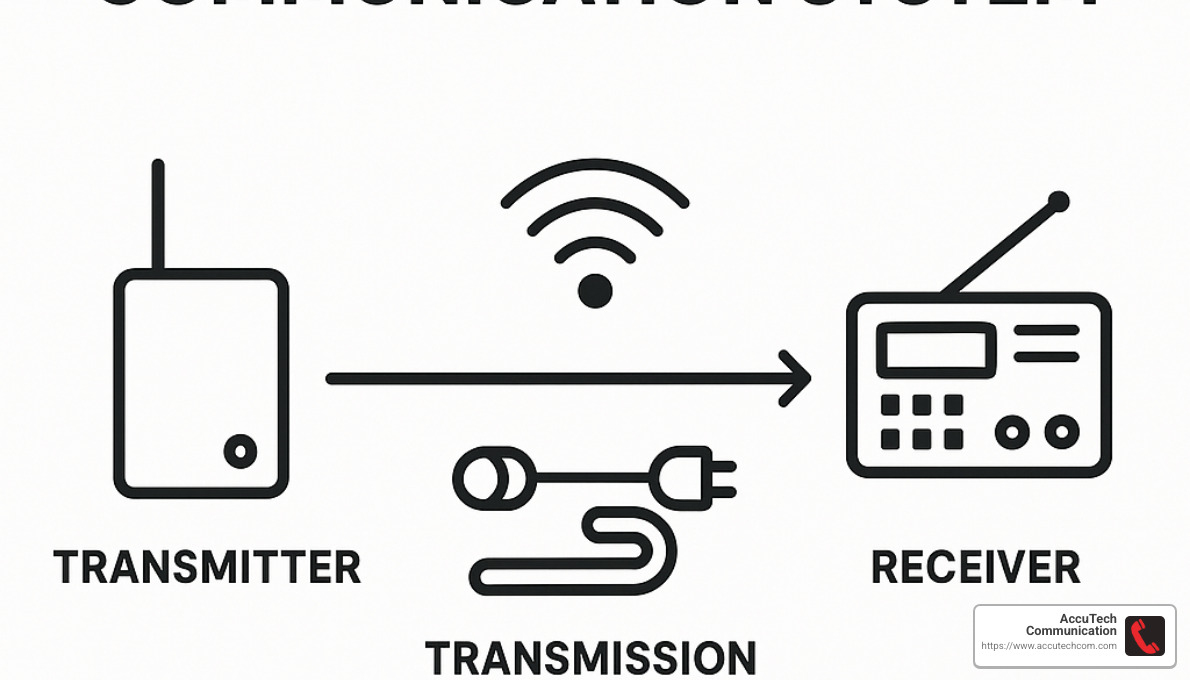
At its heart, a communication system is neatly simple yet remarkably powerful. The basic components work together like a well-rehearsed orchestra: the transmitter converts your information into signals, the channel or medium (whether wires, air, or fiber optics) carries those signals, and the receiver converts them back into something you can understand. Meanwhile, encoders and decoders ensure accurate transmission, while noise filters keep unwanted interference at bay.
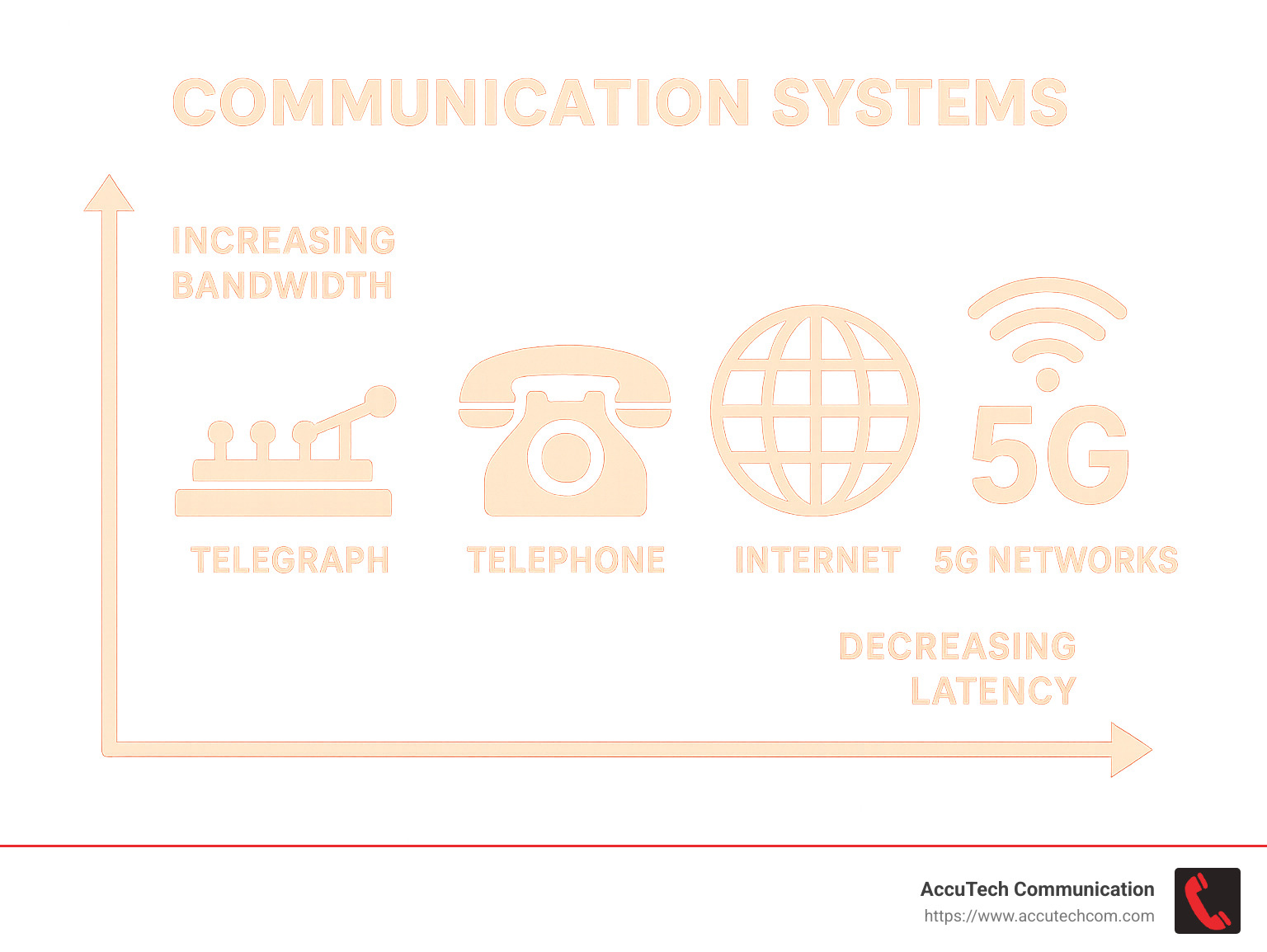
We’ve come a long way from Samuel Morse’s telegraph. What once took days or weeks—sending messages across vast distances—now happens in milliseconds. As science fiction writer David Gerrold wisely noted, “Control depends upon communication.” This simple truth explains why reliable communication systems are non-negotiable for businesses, governments, and individuals alike.
Today’s communication systems encompass five interrelated technologies that work together to keep our world humming. Broadcasting brings us radio and television, cable networks deliver high-speed internet, satellites provide global coverage, wireless technologies keep us connected on the go, and wireline systems form the backbone of our telephone and internet infrastructure.
These aren’t just technical curiosities—they’re the lifelines of modern society. When emergencies strike, communication systems coordinate first responders. When businesses operate, these systems enable collaboration across continents. When families connect, these technologies bridge the distance between loved ones.
I’m Corin Dolan, owner of AccuTech Communications, and I’ve spent over 30 years designing and implementing robust communication systems for businesses throughout New England. From structured cabling to advanced business telephony, I’ve seen how the right communication infrastructure can transform an organization’s efficiency and reliability.
Communication systems word roundup:
– telecommunication network
– business it network
– data communication and networking
Communication Systems 101: Definition & Components
Ever wonder how your voice travels across the country in an instant? Or how your email zips across the globe? Communication systems make it all possible. These remarkable networks and equipment work together like a well-rehearsed orchestra to move information from point A to point B.
At their heart, communication systems are both physical hardware and digital protocols working in harmony. As the Cybersecurity and Infrastructure Security Agency (CISA) puts it: “Communication infrastructure consists of both physical and cyber components that deliver voice, video, and data services.” This dual nature is what makes modern systems so powerful—and sometimes complex.
Whether you’re using a sophisticated business phone system or sending a simple text message, the same core components are always at work:
The transmitter encodes your information into signals suitable for travel. The channel or medium provides the physical path for these signals—think copper wires, fiber optic cables, or even the air itself. At the other end, a receiver decodes these signals back into something you can understand. The encoder/decoder pair ensures your message stays intact, while noise management systems filter out interference. Finally, feedback mechanisms confirm your message arrived safely.
This neat dance of components follows principles established by Claude Shannon, whose information theory from the 1940s still guides how we maximize reliability while using resources efficiently.
Anatomy of a Basic Link
Let’s break down what happens when you communicate through a basic link—it’s simpler than you might think!
It all starts with a source—your voice, a document, or a video. An input transducer (like your phone’s microphone) converts this information into electrical signals. These signals undergo modulation to prepare them for their journey through the transmission medium, whether that’s a fiber optic cable beneath the ocean or radio waves through the air. Upon arrival, demodulation extracts the original signal, and an output transducer (like a speaker) converts it back into something useful.
Think about your last business call: your voice was transformed into electrical signals, compressed, sent through network cables, decompressed, and finally played through a speaker—all in a fraction of a second!
Why Robust Communication Systems Matter
Communication systems aren’t just technical infrastructure—they’re the nervous system of our modern world. When they work well, we barely notice them. When they fail, everything from business operations to emergency services can grind to a halt.
For businesses, reliable communication is the difference between success and struggle. It ensures uninterrupted customer service that builds loyalty. It enables efficient internal collaboration across departments or even continents. It allows for rapid response to market changes that can mean the difference between profit and loss. It secures data transmission to protect sensitive information, and it helps maintain regulatory compliance in increasingly complex legal environments.
For society as a whole, robust communication systems are even more critical. They coordinate emergency response through 911 services, broadcast public alerts during natural disasters, deliver healthcare through telemedicine, provide educational access to remote learners, and facilitate financial transactions that keep our economy running.
The COVID-19 pandemic dramatically illustrated this importance. Organizations with flexible, robust communication infrastructure adapted quickly to remote operations, while others struggled with the transition. The difference often came down to having properly designed, professionally installed systems in place—exactly the kind of systems we at AccuTech Communications have been building since 1993.
Whether you’re upgrading existing infrastructure or building from scratch, understanding these fundamentals helps you make better decisions about the communication systems that will support your organization’s future.
Core Technologies & Media
Modern communication systems blend several technologies to create our connected world. Each has its own strengths and best uses, which helps explain why we use different systems for different needs.
| Technology | Medium | Advantages | Limitations | Typical Uses |
|---|---|---|---|---|
| Wireline | Copper, Fiber | High reliability, Security | Fixed location, Installation cost | Office networks, Data centers |
| Wireless | Radio waves | Mobility, Flexibility | Interference, Security challenges | Mobile phones, Wi-Fi |
| Optical | Light in fiber | Enormous bandwidth, Low interference | Installation complexity, Cost | Backbone networks, Data centers |
| Satellite | Radio waves | Global coverage, Remote access | Latency, Weather sensitivity | Rural internet, Maritime, Aviation |
Wireline & Optical Highlights
The backbone of fixed communication systems remains good old-fashioned cables – though they’re anything but old-fashioned these days. At AccuTech Communications, we’ve installed enough cable throughout Massachusetts, New Hampshire, and Rhode Island since 1993 to circle the earth a few times (well, almost).
Twisted-pair copper cables are the workhorses you’ll find in most buildings. Modern versions like Cat6A and Cat7 can handle speeds up to 10 Gbps, though only over shorter distances. The “twisted” part isn’t just a fancy name – those twisted wire pairs actually help cancel out electrical interference.
Coaxial cable (or “coax” as the techs call it) offers better protection from interference than twisted pair. While you won’t see it in many new office installations anymore, it’s still the go-to for cable TV and some specialized network applications. Think of it as the reliable middle-aged technology that still shows up to work every day.
Fiber optic technology changed everything by sending data as light pulses instead of electrical signals. The magic of fiber isn’t just its speed – it’s how we can send multiple light wavelengths through a single strand using Dense Wavelength Division Multiplexing (DWDM). Imagine turning a one-lane road into a hundred-lane superhighway without making it any wider.
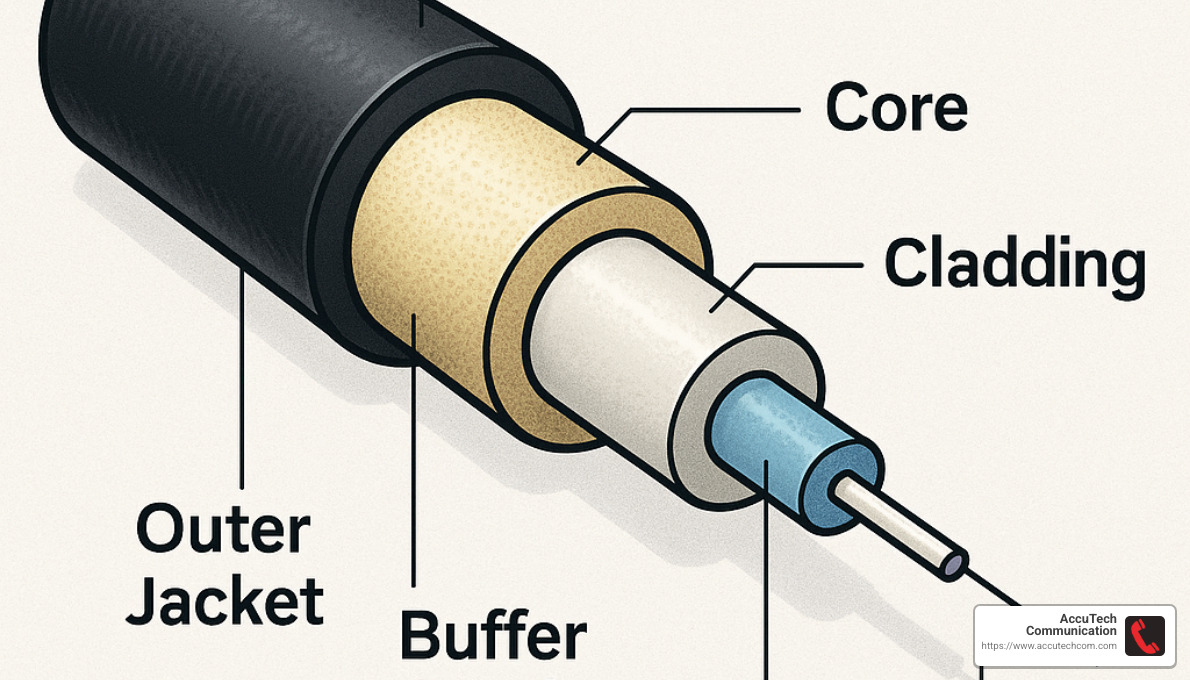
Fiber brings amazing benefits: incredible bandwidth measured in terabits per second, complete immunity to electrical interference (lightning storm? no problem), minimal signal loss over distance, better security since it’s harder to tap, and a much smaller physical footprint than copper.
As one network engineer told me during a data center project in Boston: “Fiber isn’t just the future—it’s the present. Any organization still planning around copper-only infrastructure is already behind.” Hard to argue with that!
Wireless, Satellite & Emerging Media
Wireless communication systems have transformed connectivity by freeing us from fixed locations. Remember when changing your office layout meant rewiring everything? Those days are thankfully behind us.
Cellular networks have evolved dramatically over just a few decades:
– 1G gave us analog voice calls in the 1980s (and brick-sized phones)
– 2G brought digital voice and text messaging in the 1990s
– 3G introduced mobile internet in the 2000s
– 4G/LTE delivered truly useful data speeds in the 2010s
– 5G now offers near-instant response times and massive device support
Wi-Fi keeps getting better too. The latest Wi-Fi 6 (802.11ax) handles crowded environments much better – perfect for modern offices where dozens of devices compete for bandwidth. Remember when connecting two devices to your Wi-Fi made everything crawl? Those days are gone.
Satellite communication is experiencing an exciting renaissance. Traditional satellites orbit 22,000 miles up (geostationary), creating noticeable delays. But new Low Earth Orbit (LEO) constellations like Starlink orbit just 340 miles above us, cutting delay from 600ms to under 40ms. That’s the difference between an awkward video call and a natural conversation.
On the horizon, we’re seeing fascinating developments like quantum communication links with theoretically unbreakable encryption, nanosatellites the size of shoeboxes providing specialized services, Li-Fi using light waves for blazing-fast short-range communication, and self-healing mesh networks that route around problems automatically.
As historian James Burke wisely noted: “The easier it is to communicate, the faster change happens.” Looking at how these technologies continue to evolve and transform businesses, I’d say he was absolutely right.
Communication Systems in Modern Infrastructure
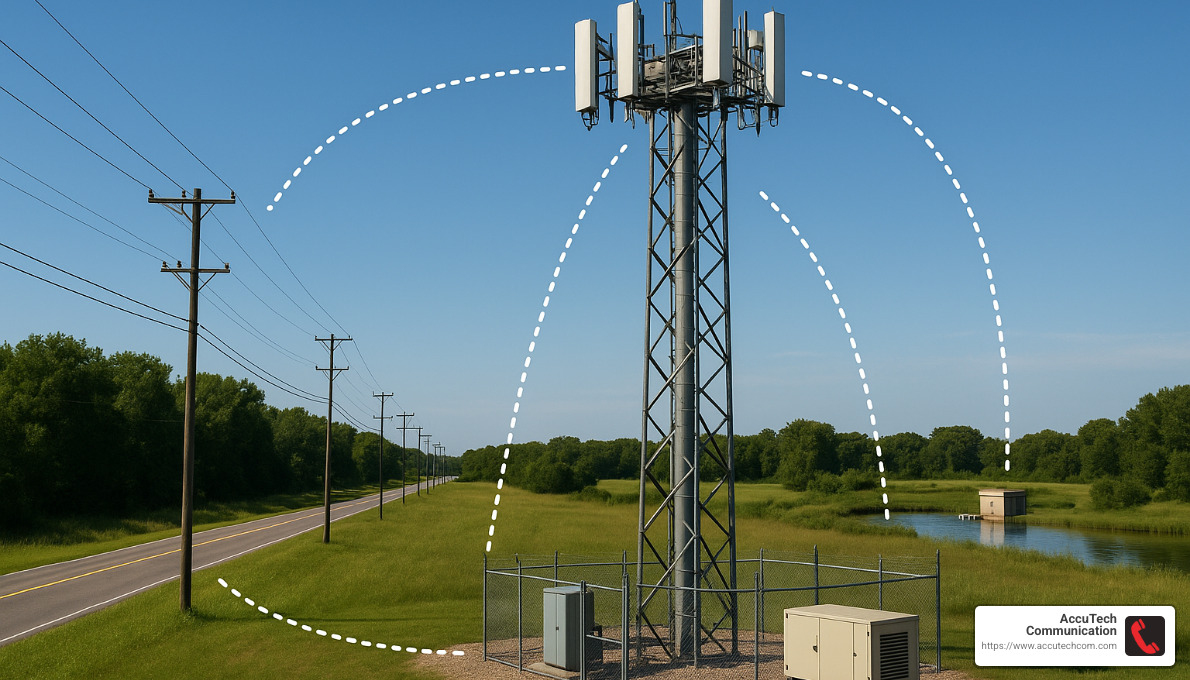
Think of communication systems as the nervous system of our modern world – they connect and coordinate everything from power grids to traffic lights. CISA (the Cybersecurity and Infrastructure Security Agency) puts it perfectly: “The Communications sector relies on services from other critical infrastructure sectors, including energy (to power cellular towers and central offices), IT (for control systems and Internet infrastructure), and transportation (for delivery of fuel for backup generators).”
This relationship works both ways. Our communication networks need power, transportation, and IT to function properly. But these same sectors also depend on communication systems to operate efficiently.
For example, power companies use communication networks to monitor electrical grids in real-time. Traffic management systems rely on constant data transmission. Water utilities remotely monitor water quality and distribution. Hospitals connect through telemedicine and electronic records. Banks process thousands of electronic transactions every second. And government agencies coordinate emergency services when we need them most.
How Communication Systems Enable Critical Infrastructure
When you dial 911, you’re witnessing a marvel of modern communication. Your call triggers a complex chain of events that must work flawlessly:
Your call routes through telephone networks to the appropriate Public Safety Answering Point. Your location data gets transmitted to dispatchers who communicate with first responders through dedicated radio networks. Those responders then coordinate using specialized tactical systems.
This system can’t fail – it must work 24/7/365, even during disasters. At AccuTech Communications, we’ve helped towns across Massachusetts build redundant communication links so emergency services stay online when they’re needed most.
But emergency services are just the beginning. Communication systems power so much more of our critical infrastructure:
Smart grid technology helps power companies balance electrical loads, detect outages instantly, and integrate renewable energy sources seamlessly. Intelligent transportation systems keep traffic flowing through coordinated lights, highway message boards, and vehicle navigation. Automated industrial control networks (SCADA systems) monitor and control equipment for manufacturing, utilities, and energy production.
Managed Technology Services & Security Layers
As these systems become more complex and critical, many organizations turn to managed technology services for peace of mind. Think of it as having a dedicated team watching over your vital communication networks day and night.
These services typically include 24/7/365 monitoring to catch problems before they affect your business, preventive maintenance to keep everything running smoothly, rapid response when issues do arise, redundancy management to ensure backup systems are always ready, and cyber hardening to protect against evolving threats.
Security has become particularly crucial as communication systems face increasingly sophisticated attacks. Modern protection requires multiple layers working together: physical security to protect equipment, network security with firewalls and intrusion detection, encryption for data protection, strong authentication to verify users, and constant monitoring to spot suspicious activity.
As one IT director at a Massachusetts healthcare organization recently told us: “Our communication system isn’t just about phones and internet anymore—it’s our lifeline to patients, providers, and critical services. Downtime isn’t an option.”
The truth is, in today’s interconnected world, reliable communication isn’t a luxury – it’s the foundation everything else depends on. That’s why at AccuTech, we take our role in building and maintaining these critical systems so seriously.
Challenges & Limitations Over Distance
No matter how advanced our communication systems become, they still bump up against some stubborn realities—especially when we’re trying to send information across vast distances. These aren’t just technical problems; they’re often the result of physics itself.
The most fundamental limitation? The speed of light—about 186,000 miles per second in a vacuum (and actually slower through physical materials like fiber optic cable). This creates unavoidable delays:
- Earth to Moon: 1.3 seconds (one-way)
- Earth to Mars: 3-22 minutes (one-way, depending on where each planet is in its orbit)
- Earth to Pluto: About 5.5 hours (one-way)
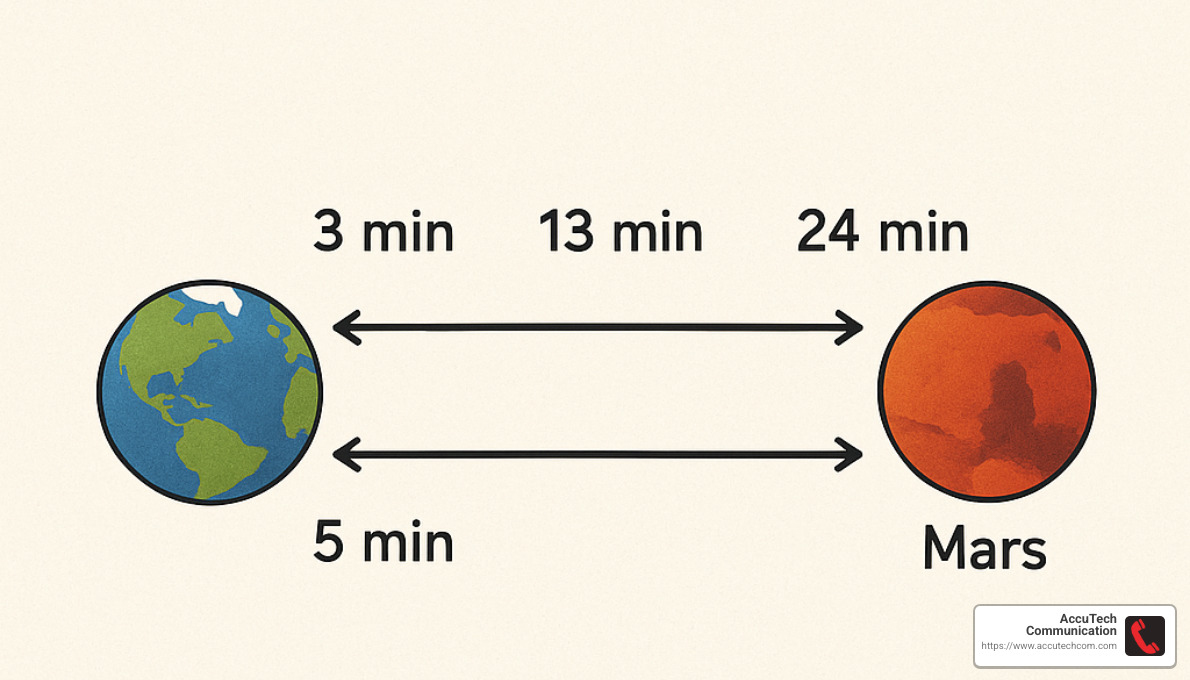
Distance also brings other challenges to communication systems. Each type of connection has its own bandwidth ceiling—a maximum amount of data it can handle. Signals grow weaker through attenuation as they travel farther. Interference from other signals or environmental factors can muddy the message. And let’s not forget the practical issues: scalability becomes more complex over distance, and costs typically rise the farther you need to send information.
Time-Lag Realities for Communication Systems
Time lag isn’t just a technical issue—it shapes how we interact with communication systems at a fundamental level. Within our solar system, the worst-case scenario is about an 11-hour delay—the time it takes for a radio signal to reach Pluto at its furthest point. This creates real challenges for anything requiring quick responses.
Throughout history, empires and organizations have been limited by communication speed. One research source suggests “the maximum time allowed to send a message from the central capital to a colony on the rim of the empire should be no more than about 12 weeks.” The Mongol Empire maintained its vast territory through an elaborate horse-relay system that worked within this time frame.
In today’s business world, even tiny delays matter. When I’m setting up networks for clients at AccuTech Communications, I’m always mindful of these thresholds:
Voice communication starts feeling awkward when there’s more than 150ms of delay.
Video conferencing quality noticeably suffers beyond 250ms.
Interactive applications feel sluggish after 100ms.
High-frequency trading operations demand responses in less than a millisecond.
These aren’t just theoretical concerns—they’re practical realities that affect how businesses across Massachusetts, New Hampshire, and Rhode Island experience their daily communications.
Reliability & Disaster Resilience
Beyond just distance, communication systems need to keep working when things go wrong. As CISA (Cybersecurity and Infrastructure Security Agency) points out, “Communications networks are geographically widespread, creating a complex web that enables people and systems to contact one another, access information instantly, and communicate remotely.”
This geographical spread is both a strength and a weakness. To keep communications flowing during problems, we focus on several key approaches:
Redundant pathways ensure there’s always another route if one goes down. At AccuTech, we often design networks with multiple connection paths between critical points.
Diverse technologies provide backup options. A combination of fiber, wireless, and satellite links means you’re not relying on a single type of connection.
Backup power is absolutely essential. I’ve installed countless generator systems, battery backups, and alternative energy sources to keep communications running when the grid fails.
Hardened facilities protect against physical threats. In New England, where we deal with everything from nor’easters to ice storms, this physical protection is particularly important.
Rapid restoration capabilities can make all the difference. Having the right equipment ready and personnel trained means getting back online quickly when problems occur.
Living in New England, our clients understand weather-related disruptions all too well. That’s why we at AccuTech Communications work with businesses across the region to implement disaster-resilient solutions that account for our unique regional challenges—from coastal flooding to inland ice storms.
Designing, Installing & Maintaining Robust Communication Systems
Building reliable communication systems isn’t just about buying the right equipment—it’s about thoughtful design, careful installation, and consistent maintenance. Think of it like building a house: you need solid blueprints, quality construction, and regular upkeep to ensure it stands the test of time.
Industry standards serve as our guiding light in this process. Organizations like the National Electrical Code (NEC) establish safety requirements, while ANSI/TIA develops structured cabling standards that ensure everything works together seamlessly. The IEEE creates networking protocols, and ISO/IEC provides international standards that help systems work across borders.
When we design a new system at AccuTech, we follow a proven process that starts with truly understanding what our clients need. We analyze their communication patterns, traffic volumes, and where they’re heading in the future. Next comes the site survey—walking the space, measuring distances, and identifying potential challenges like interference sources or structural obstacles.
With this information in hand, we create detailed system designs that specify every piece of equipment, cable run, and configuration setting. We then develop implementation plans that minimize disruption—because we understand that “downtime” is a four-letter word in most businesses!

Testing might not be the most glamorous part of the job, but it’s perhaps the most important. As one of our senior technicians often quips, “The test results tell the truth. You can have the prettiest installation in the world, but if it doesn’t pass certification testing, it’s just expensive art.” We’ve lived by this philosophy since opening our doors in 1993.
Maintenance is where many organizations drop the ball. A properly maintained communication system needs regular check-ups—just like your car or your health. We recommend scheduled inspections to catch small issues before they become big problems. Performance monitoring helps detect gradual degradation that might otherwise go unnoticed. Software updates keep systems secure, while comprehensive documentation ensures that knowledge doesn’t walk out the door when staff changes.
In our experience serving businesses across Massachusetts, New Hampshire, and Rhode Island, preventive maintenance reduces downtime by up to 70% compared to the “fix it when it breaks” approach. That’s the difference between a minor inconvenience and a major crisis.
Future Trends in Communication Systems
The world of communication systems never stands still, and several exciting trends are reshaping what’s possible.
6G wireless technology is already in development labs, though commercial deployment remains years away. With promises of terabit-per-second speeds and latency measured in microseconds, 6G will open doors to applications we can barely imagine today. When you consider that 5G was the breakthrough that made widespread IoT practical, the potential of 6G becomes truly mind-boggling.
Edge computing is changing where data processing happens. Instead of sending everything to distant data centers, edge computing brings processing power closer to where data is generated. This reduces latency and bandwidth requirements—critical factors for applications like autonomous vehicles that need split-second decision making.
Software-defined networking (SDN) represents a fundamental shift in how networks operate. By separating the control functions from the physical infrastructure, SDN creates more flexible, programmable networks that can adapt quickly to changing needs. It’s like having a highway where the lanes can be reconfigured on the fly based on traffic patterns.
AI-optimized networks use machine learning to predict traffic patterns, identify potential failures before they happen, and automatically reconfigure for optimal performance. These systems can essentially heal themselves and continuously improve based on operational data—something that would have seemed like science fiction just a decade ago.
Quantum communication remains in its early stages but promises theoretically unhackable encryption through quantum key distribution. While practical applications are still emerging, quantum communication may eventually form the backbone of security for our most sensitive information exchanges.
Career & Education Pathways
The field of communication systems offers diverse and rewarding career paths with strong growth prospects. If you’re interested in joining this dynamic industry, several educational pathways can help you get there.
Electrical and Computer Engineering (ECE) programs provide the theoretical foundation. These programs typically include courses in probability and random processes (ECE 313), digital communications (ECE 461), and communication circuits or lab work (ECE 453 or ECE 463). As one university resource notes: “Today’s information age is supported by the twin pillars of the Internet and wireless networks, two prototypical examples of communication systems.”
Industry certifications complement academic credentials and often provide practical, hands-on knowledge. Network+ and CCNA certifications establish networking fundamentals, while fiber optic certifications from organizations like FOA and BICSI validate specialized skills. Wireless certifications such as CWNA and CWSP demonstrate expertise in increasingly important wireless technologies.
Continuing education isn’t optional in this field—it’s essential. Technologies evolve rapidly, and staying current requires a commitment to lifelong learning. As one researcher in the field shared: “I value transitioning theoretical concepts to practice and sought a career where I could use my analytical skills to build communication systems that make a difference in today’s world.”
At AccuTech Communications, we invest heavily in ongoing training for our technicians. This commitment ensures they remain current with evolving standards and technologies—and it’s one of the reasons we’ve maintained our reputation for excellence since 1993. When you’re entrusting your business’s nervous system to someone, you want to know they’re bringing the latest knowledge and skills to the table.
Frequently Asked Questions about Communication Systems
What is the difference between wireline and wireless communication systems?
When clients ask me about the fundamental differences between wireline and wireless systems, I like to explain it in terms of their unique strengths rather than positioning one as superior.
Wireline communication systems connect your devices through physical media—the cables you can see and touch. Think of the ethernet cable connecting your computer to the router, or the fiber optic lines running beneath city streets. These physical connections typically deliver greater reliability, improved security, and substantially higher bandwidth. They’re like dedicated highways for your data with predictable travel times (low latency).
On the flip side, wireless communication systems transmit information through the air via radio waves. The obvious advantage? Freedom of movement. Your smartphone connects to cellular networks as you drive, and your laptop maintains its Wi-Fi connection as you move from your desk to the conference room. Wireless systems shine in environments where running cables would be impractical or impossible.
In my 30+ years at AccuTech Communications, I’ve rarely seen a modern business thrive with only one approach. Most successful organizations employ a thoughtful hybrid strategy—robust fiber optic wireline backbones providing rock-solid infrastructure, complemented by well-designed wireless systems offering flexibility and mobility. It’s not about choosing between technologies; it’s about leveraging each where it makes the most sense for your specific needs.
How much latency can I expect on a satellite link?
Latency—the delay between sending and receiving data—becomes particularly noticeable with satellite communications because signals must travel enormous distances. The primary factor determining your satellite latency is the orbit type.
Traditional geostationary (GEO) satellites hover 22,236 miles above Earth’s equator. This impressive distance creates a one-way trip of approximately 240-280 milliseconds, resulting in round-trip times of nearly half a second (480-560ms). While that might seem fast in human terms, it’s an eternity for certain applications. I’ve had clients try to run voice calls over GEO satellites only to experience awkward conversations with people talking over each other due to the delay.
Medium Earth Orbit (MEO) satellites operate closer to home at 5,000-12,000 miles altitude. This proximity cuts latency roughly in half compared to GEO systems, with round-trip times between 200-300 milliseconds. This improvement makes voice calls workable, though still not ideal.
The newest players are Low Earth Orbit (LEO) constellations like Starlink, orbiting just 300-1,200 miles up. With one-way latencies of 20-40 milliseconds, these systems deliver performance approaching terrestrial broadband. A manufacturing client in rural New Hampshire recently switched to Starlink and was amazed they could finally use video conferencing effectively.
Weather conditions, ground station processing, and network routing can all add additional delays beyond these baseline figures. When evaluating satellite options for your business, we always recommend matching these performance characteristics against your specific application requirements.
What certifications should my installer have?
Choosing properly certified installers for your communication systems is like selecting a surgeon—credentials matter enormously for the long-term success of your project. When vetting potential partners, here are the key certifications that separate professionals from amateurs:
BICSI credentials represent the gold standard in our industry. The Registered Communications Distribution Designer (RCDD) certification, in particular, demonstrates comprehensive knowledge of infrastructure design standards. For the technicians actually handling your installation, look for BICSI’s Technician certifications (TECH, INST1, INST2) which verify hands-on skills and standards knowledge.
Manufacturer certifications ensure your installer understands the specific systems they’re implementing. For structured cabling, companies like CommScope, Panduit, and Belden offer certification programs. If you’re installing a business phone system, your technicians should hold certifications from manufacturers like Mitel, Avaya, or Cisco.
Safety certifications might seem secondary but are absolutely critical. OSHA safety training provides a foundation, while specialized certifications for confined spaces or fall protection demonstrate commitment to proper procedures. I still remember a project where uncertified installers created serious fire code violations by improperly penetrating firewalls—an expensive mistake that certified professionals would have avoided.
At AccuTech Communications, we’ve maintained a simple philosophy since 1993: invest heavily in our team’s professional development. Every technician holds multiple industry certifications and receives ongoing training as standards evolve. This isn’t just about hanging credentials on the wall—it directly impacts the quality, compliance, and longevity of the systems we install for businesses throughout Massachusetts, New Hampshire, and Rhode Island.
Conclusion
Communication systems form the invisible foundation of our connected world. From the structured cabling running through office walls to the satellite constellations orbiting Earth, these systems enable the information exchange that powers modern business, government, and society.
As we’ve explored together, communication systems encompass a rich mix of technologies while facing unique challenges depending on distance, environment, and application requirements. It’s fascinating how the fundamental principles—transmitting information reliably across a medium—remain constant even as we’ve evolved from telegraph to 5G and beyond.
For organizations here in Massachusetts, New Hampshire, and Rhode Island, building robust communication infrastructure isn’t just about understanding technical specifications. It requires a special kind of regional knowledge too. Our New England weather patterns (those nor’easters don’t mess around!), specific building codes, and local regulations all play crucial roles in how your system should be designed and implemented.
At AccuTech Communications, we’ve spent three decades as your neighbors, helping businesses across New England build and maintain reliable, future-ready communication systems. When I meet with clients, I often say that our approach is like a good New England recipe—we combine industry-standard best practices with personalized service and the kind of attention to detail you’d expect from a company that’s been here since 1993.
Whether you’re planning a brand-new facility, upgrading existing infrastructure that’s seen better days, or troubleshooting those mysterious performance issues that keep your IT team up at night, understanding the fundamentals of communication systems helps you make informed decisions that truly support your organization’s goals.
For more information about network cabling services and how we can help strengthen your communication infrastructure, visit our network cabling services page or reach out directly. We’re committed to providing certified, reliable service with competitive pricing and an unwavering focus on quality—because when it comes to the systems that keep your business connected, “good enough” is never actually good enough.
