
Data Cabling Technician: Master Your 2025 Success
Why Data Cabling Technicians Are the Backbone of Modern Business
A data cabling technician is a professional who installs, maintains, and troubleshoots the physical network infrastructure that keeps businesses connected. They work with structured cabling systems—the standardized method of organizing cables and hardware for voice, data, video, and wireless communications.
Key responsibilities include:
- Installing CAT5e, CAT6, and fiber optic cables
- Terminating cables at jacks, patch panels, and equipment
- Testing and certifying network connections
- Troubleshooting connectivity issues
- Following safety and industry standards
- Documenting installations with proper labeling
Career requirements:
- High school diploma or equivalent
- Physical ability to lift 50+ pounds
- 0-2 years experience for entry-level roles
- Industry certifications like BICSI or FOA (preferred)
The demand for skilled data cabling technicians is growing as businesses upgrade their networks. According to the Bureau of Labor Statistics, jobs for line installers and repairers are projected to grow 8% through 2026, with median salaries around $44,601 annually.
I’m Corin Dolan, owner of AccuTech Communications, and I’ve worked with data cabling technicians across Massachusetts, New Hampshire, and Rhode Island since 1993. I’ve seen how this career offers stable employment, continuous learning, and the satisfaction of building the communication backbone modern businesses depend on.
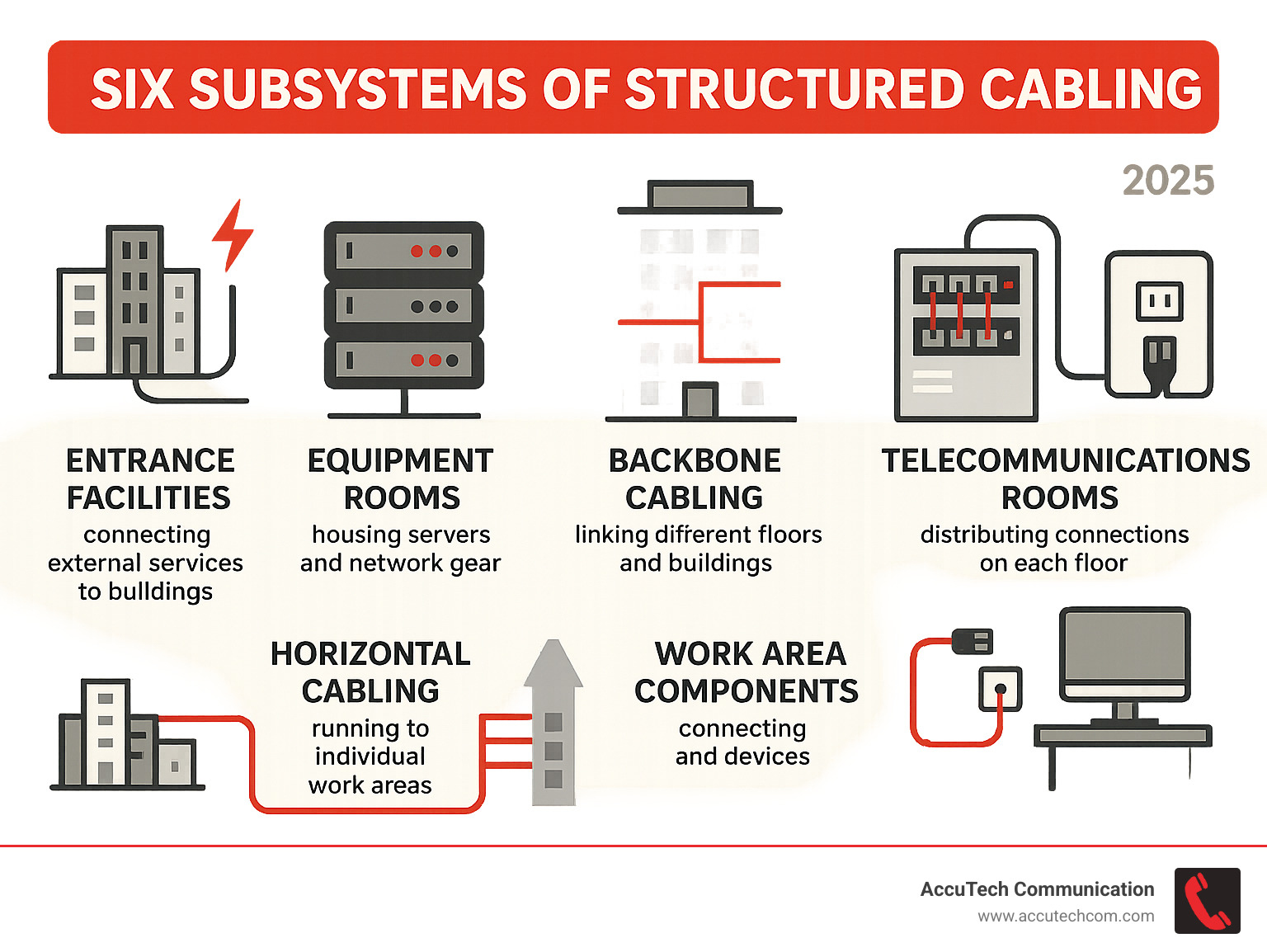
Data cabling technician terms to remember:
What is a Data Cabling Technician and Why Are They Essential?
Every email, video call, or database access is possible because of structured cabling—the hidden network of wires that keeps our world running. This standardized system of cables, connectors, and hardware supports telecommunications, data communication, Voice over IP (VoIP), video surveillance, and building access control. It is truly the backbone of modern business.
A properly designed structured cabling system offers scalability and flexibility, growing with a business without requiring a complete overhaul. This leads to simplified management and reduced downtime. For a deeper dive, see our guide on structured cabling.
The Primary Role of a Technician
Data cabling technicians handle the installation, maintenance, troubleshooting, and repair of these critical network systems. As physical layer experts, we are responsible for ensuring network integrity from the ground up. We spend our days connecting businesses by creating reliable pathways for data to travel using both copper and fiber optics. Every connection must be perfect, as one poorly terminated cable can disrupt an entire network. It’s detailed work requiring technical knowledge and steady hands. If you’re curious about fiber, our page on fiber optic installation offers more insight.
Understanding Structured Cabling
Structured cabling follows a standardized approach governed by TIA/EIA standards and ISO/IEC standards, ensuring reliability and compatibility. We work with several types of cabling:
- Copper cabling like Cat5e, Cat6, and Cat6a for different speed and distance needs.
- Fiber optic cabling for longer runs and higher bandwidth, transmitting data via light pulses.
- Coaxial cables for specific applications like video distribution.
The system also includes infrastructure like pathways and spaces (conduits, cable trays), patch panels for centralized connections, and work area outlets. Each piece works together to create an organized, maintainable network. To learn about the professionals specializing in fiber, visit our fiber optic cabling page.
How to Become a Data Cabling Technician: Skills, Education, and Certifications
The data cabling technician career path offers excellent stability and doesn’t require years of expensive college. Most technicians start with on-the-job training or apprenticeships, making it a field where a willingness to learn and work hard is more important than a specific educational background.

Essential Skills for a Successful Data Cabling Technician
A skilled data cabling technician needs a mix of technical, physical, and soft skills.
- Technical skills include working with copper (Cat5e, Cat6, Cat6a) and fiber optic cables, blueprint reading, and understanding color coding standards. Expertise with testing equipment, troubleshooting, and following industry standards (TIA/EIA, BICSI) is also crucial. Strong problem-solving skills are essential for diagnosing issues and planning cable routes.
- Physical demands include regularly lifting equipment up to 50 pounds, working at heights on ladders or lifts, and operating in confined spaces like ceilings and crawlspaces. Good physical stamina is important for a job that keeps you on your feet.
- Soft skills like attention to detail prevent costly errors. Good customer service and communication abilities are vital for interacting with clients and coordinating with team members.
Educational Background and Training
The educational barrier to becoming a data cabling technician is low; a high school diploma or GED is typically the only requirement for entry-level roles. This makes it an excellent choice for those who prefer hands-on learning.
Vocational school programs or community college certificates in electronics or telecommunications can provide a valuable foundation. Apprenticeships are also a great path, offering paid on-the-job training with experienced technicians. Since no degree is required for entry-level positions, the field is accessible to anyone with the right attitude. For related career paths, learn about becoming a low voltage installer.
Top Industry Certifications to Advance Your Career
While not required to start, certifications are a smart investment that can lead to better jobs and higher pay.
- BICSI certifications (INST1, INSTC, INSTF) are highly respected and validate installation skills. The advanced RCDD is for designing complex systems.
- The FOA Certified Fiber Optic Technician (CFOT) is essential for working with fiber, a rapidly growing part of the industry. Learn more from our certified fiber optic technician team.
- CompTIA Network+ provides foundational networking knowledge that complements cabling skills.
- The Certified Network Cable Installer (CNCI) focuses on installation best practices.
- Manufacturer-specific certifications are also valuable for technicians who frequently work with particular brands.
These credentials prove your expertise and commitment to staying current with technology.
A Day in the Life: Responsibilities, Tools, and Work Environments
Being a data cabling technician means no two days are the same. You might spend one day in a hospital ceiling and the next on a scissor lift in a new data center. The work is project-based and requires strong team collaboration to meet deadlines and quality standards.
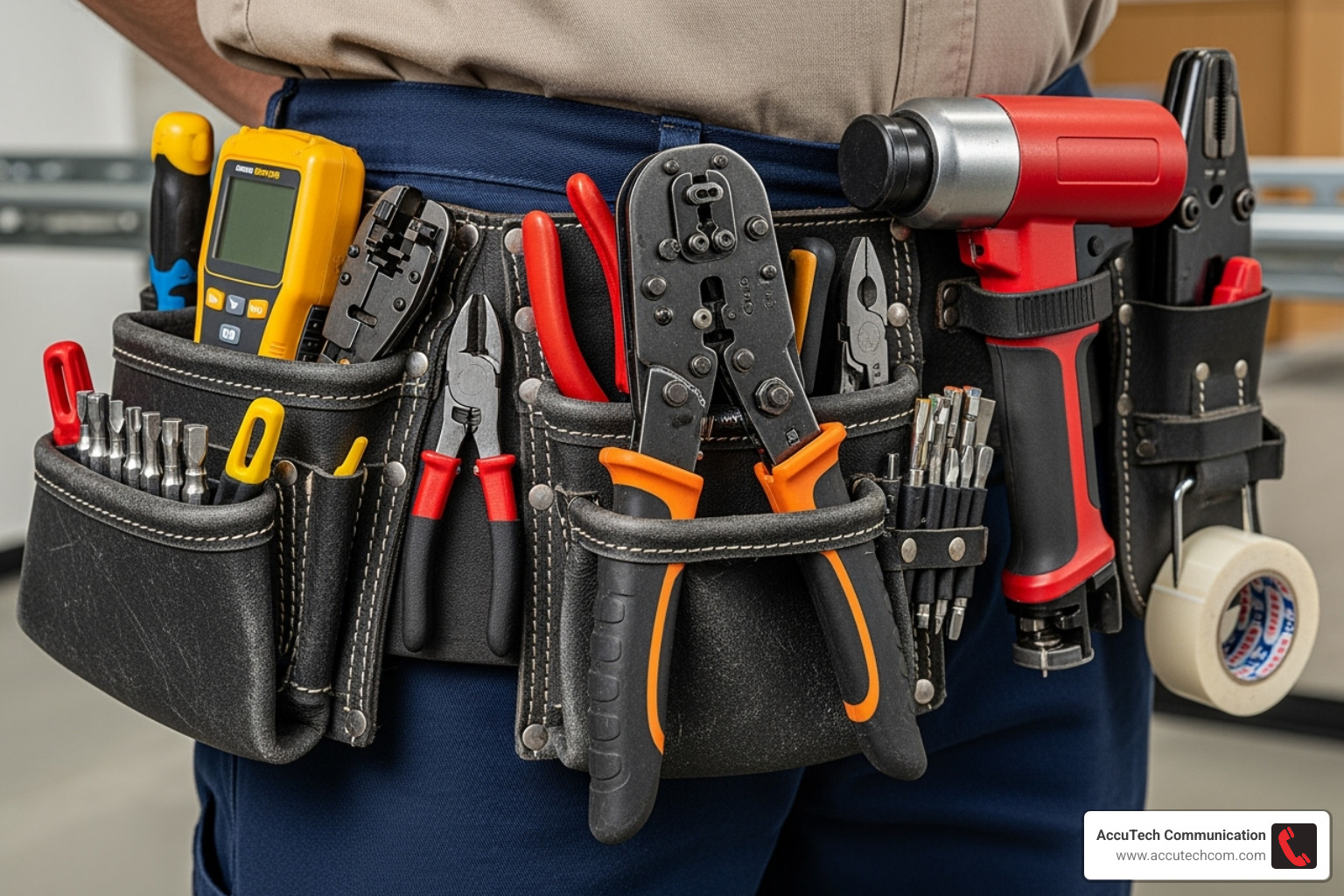
Key Responsibilities of a Data Cabling Technician
A technician’s day revolves around precision work that impacts business operations.
- Cable pulling and routing: Guiding copper and fiber optic cables through conduits, walls, and ceiling spaces while keeping them organized and supported.
- Terminating cables: Attaching connectors (like RJ45s) to copper cables or performing delicate splicing for fiber optics. Mastering how to terminate fiber optic cable is a key skill.
- Installing support structures: Mounting J-hooks, cable trays, and ladder racks to keep cabling neat and accessible.
- Testing and certifying installations: Using specialized equipment to verify that every cable meets performance and reliability standards.
- Labeling and documentation: Labeling every cable and port and maintaining detailed records of the installation for future maintenance.
- Troubleshooting connectivity issues: Diagnosing and fixing problems ranging from faulty cables to network configuration errors.
- Adhering to safety protocols: Strictly following OSHA guidelines and using Personal Protective Equipment (PPE), especially when working at heights or near electrical components.
Common Tools and Equipment
A data cabling technician relies on a specific set of tools for quality work.
- Cable testers and certifiers: To verify connections and certify that installations meet performance standards.
- Crimpers and termination tools: For attaching connectors to copper and fiber optic cables.
- Punch-down tools: To terminate copper wires on patch panels and wall jacks.
- Wire strippers: To safely remove cable jacketing without damaging internal conductors.
- Fish tape and pull rods: To pull cables through conduits and other tight spaces.
- Labeling machines: For creating clear, durable labels for all network components.
- Basic hand tools: Screwdrivers, pliers, tape measures, and flashlights.
- Personal Protective Equipment (PPE): Safety glasses, gloves, hard hats, and steel-toed boots are essential.
- Ladders and scissor lifts: For safely accessing cables in ceilings and other high areas.
Typical Projects and Work Environments
The work environments for a data cabling technician are diverse.
- Commercial buildings: From small offices to large corporate campuses.
- Data centers: Installing high-density cabling for servers and networking gear.
- Hospitals and healthcare facilities: Building ultra-reliable networks for critical systems.
- Educational campuses: Supporting classrooms, dorms, and administrative buildings.
- Industrial sites: Installing rugged cabling in factories and manufacturing plants.
- New construction and office renovations: Laying the groundwork for new networks or upgrading existing ones.
Our expertise in commercial data cabling ensures networks in any of these environments are built to perform.
Career Outlook: Salary, Job Growth, and Future Trends
The career of a data cabling technician is promising, with steady demand, competitive pay, and clear paths for advancement. As technology evolves, our role in keeping businesses connected becomes even more critical.

Salary Expectations and Job Growth
According to Payscale.com salary data, the median annual salary for a technician is around $44,601, with an average hourly rate of $20.08. However, this is just a starting point. With experience and certifications in high-demand areas like fiber optics, experienced technicians can earn up to $53 per hour. Wages in Massachusetts, New Hampshire, and Rhode Island are often higher than the national average due to strong regional demand.
The BLS job outlook for line installers projects 8 percent growth through 2026, reflecting the ongoing need for robust network infrastructure.
Career Advancement Paths
This field is not a dead-end job. Common advancement paths include:
- Lead Technician: Overseeing small teams and mentoring junior workers.
- Project Foreman/Manager: Managing larger installations, budgets, and client relations.
- Estimator: Using technical knowledge to provide accurate project cost estimates.
- RCDD (Registered Communications Distribution Designer): Designing complex telecommunications systems, often as a highly paid consultant.
- Specialization: Becoming an expert in fiber optics or data center cabling.
- Business Ownership: Starting your own cabling company after gaining experience.
Future Trends Shaping the Industry
Staying aware of industry trends is key to a long and successful career as a data cabling technician.
- The Internet of Things (IoT): An explosion of connected devices is driving demand for more cabling.
- 5G Implementation: Requires massive fiber optic backbones and in-building cabling to work effectively.
- Increased Demand for Fiber: High-speed fiber is quickly becoming the standard, replacing older copper systems.
- Data Center Expansion: The rapid growth of data centers creates high-paying opportunities for skilled technicians.
- Power over Ethernet (PoE): This technology, which delivers data and power over one cable, is simplifying installations for devices like cameras and access points.
- Smart Buildings: Integrated systems for lighting, HVAC, and security all rely on a structured cabling backbone.
These trends show why network cabling is crucial for business growth and ensure a bright future for the profession.
Frequently Asked Questions about Data Cabling Careers
Here are answers to some of the most common questions people have when considering a career as a data cabling technician.
What is the average salary for a data cabling technician?
The median annual salary is around $44,601, or $20.08 per hour, according to Payscale.com. However, this can increase significantly with experience, location, and specialized certifications. Experienced technicians in high-demand fields like fiber optics can earn up to $53 per hour.
Is data cabling a physically demanding job?
Yes, it is a physically active role. The job requires lifting equipment (30-50 lbs), being on your feet most of the day, climbing ladders, and working in various positions, sometimes in confined spaces like ceilings or telecom closets. Many find this aspect of the job rewarding.
Can I become a data cabling technician with no experience?
Absolutely. Many companies, including ours, hire entry-level technicians and provide on-the-job training. The most important qualifications are a strong work ethic, a willingness to learn, and a good attitude. A high school diploma or GED is typically the only educational requirement to get started.
Conclusion
A career as a data cabling technician is an accessible and rewarding path into a profession that forms the backbone of our connected world. It’s a field where you can start with a high school diploma and a willingness to learn, then build a stable career through hands-on work.
The combination of technical expertise, problem-solving, and continuous learning keeps the job engaging. The financial outlook is strong, with a median salary around $44,601 and clear pathways for advancement and specialization.
As technology evolves with 5G, IoT, and smart buildings, the need for skilled professionals who build and maintain the physical network layer will only grow. This is a profession with true staying power.
At AccuTech Communications, we’ve seen technicians thrive in this field since 1993, building careers that offer both personal satisfaction and professional growth.
For businesses in Massachusetts, New Hampshire, and Rhode Island seeking expert data cable installation, our certified technicians ensure your network is built for performance and reliability. We understand that behind every successful network is a team of dedicated professionals committed to excellence.
