Decoding the Network Cabling Price Tag for Your Business
Understanding the Average Network Cabling Price in 2026
Network cabling price is one of the first questions businesses ask when planning or upgrading their infrastructure, and the range can be surprisingly wide. Here is a quick snapshot of average costs based on publicly available industry data, so you have a baseline before diving deeper:
| Project Type | Average Cost Range (Industry Data) |
|---|---|
| Per commercial drop (Cat6) | $150, $300+ |
| Per commercial drop (Cat6A) | $200, $450+ |
| Small office (5-15 drops) | $2,500, $7,500+ |
| Medium business (15-50 drops) | $7,500, $25,000+ |
| Large installation (50+ drops) | $25,000, $100,000+ |
Note: These figures are industry averages drawn from publicly available online data. They are not the prices of AccuTech Communications. Your actual project cost will depend on building conditions, cable type, labor, and testing requirements.
These numbers only tell part of the story. A commercial cabling project in Massachusetts or New Hampshire involves far more moving parts than a simple price-per-foot calculation. Building architecture, ceiling type, cable category, regional labor rates, and testing standards all push costs up or down, sometimes significantly.
Understanding what drives those costs is what separates a well-planned infrastructure investment from a budget that blows up mid-project.
I’m Corin Dolan, owner of AccuTech Communications, and with over 30 years serving commercial clients across Massachusetts, New Hampshire, and Rhode Island, I have seen how confusing the network cabling price conversation can be for businesses. This guide breaks it all down so you can plan confidently and ask the right questions when requesting a quote.
Network cabling price basics:
As we navigate the technological landscape of April 2026, the demand for high-speed, reliable data has never been higher. When we talk about Network Cabling Installation, we are referring to the physical backbone of your business communication. Based on average internet data, the “per-drop” model remains the standard for commercial budgeting. A “drop” typically includes the cable run from the server room to the workstation, the wall jack, the faceplate, and the termination at the patch panel.
In 2026, commercial benchmarks show that most businesses should prepare for a tiered pricing structure based on the scale of the project. While a single cable run might seem simple, the logistics of a multi-floor office in Boston or a warehouse in Manchester, NH, add layers of complexity.
| Business Size | Typical Number of Drops | Average Project Range (Online Data) |
|---|---|---|
| Small Office | 5-15 | $2,500, $7,500+ |
| Medium Business | 15-50 | $7,500, $25,000+ |
| Large Enterprise | 100+ | $50,000, $150,000+ |
Pricing Disclaimer and Industry Variability
It is vital to understand that the figures provided above are estimates sourced from publicly available industry averages and are not the specific rates of AccuTech Communications. The network cabling price is subject to extreme variability. For instance, while a standard drop might average $150 in a simple environment, that same drop could exceed $450 if it requires specialized lifts, boring through masonry, or working in high-security environments.
In the Northeast, factors like historic building codes in areas like Salem, MA, or the specific labor standards in Rhode Island can also shift these ranges. Always view these numbers as a starting point for your internal budgeting rather than a fixed quote.
Key Factors Influencing Your Commercial Cabling Investment
If you have ever wondered What is Network Cabling?, it is helpful to think of it as the nervous system of your building. Just like a nervous system, the environment it lives in dictates how difficult it is to install.
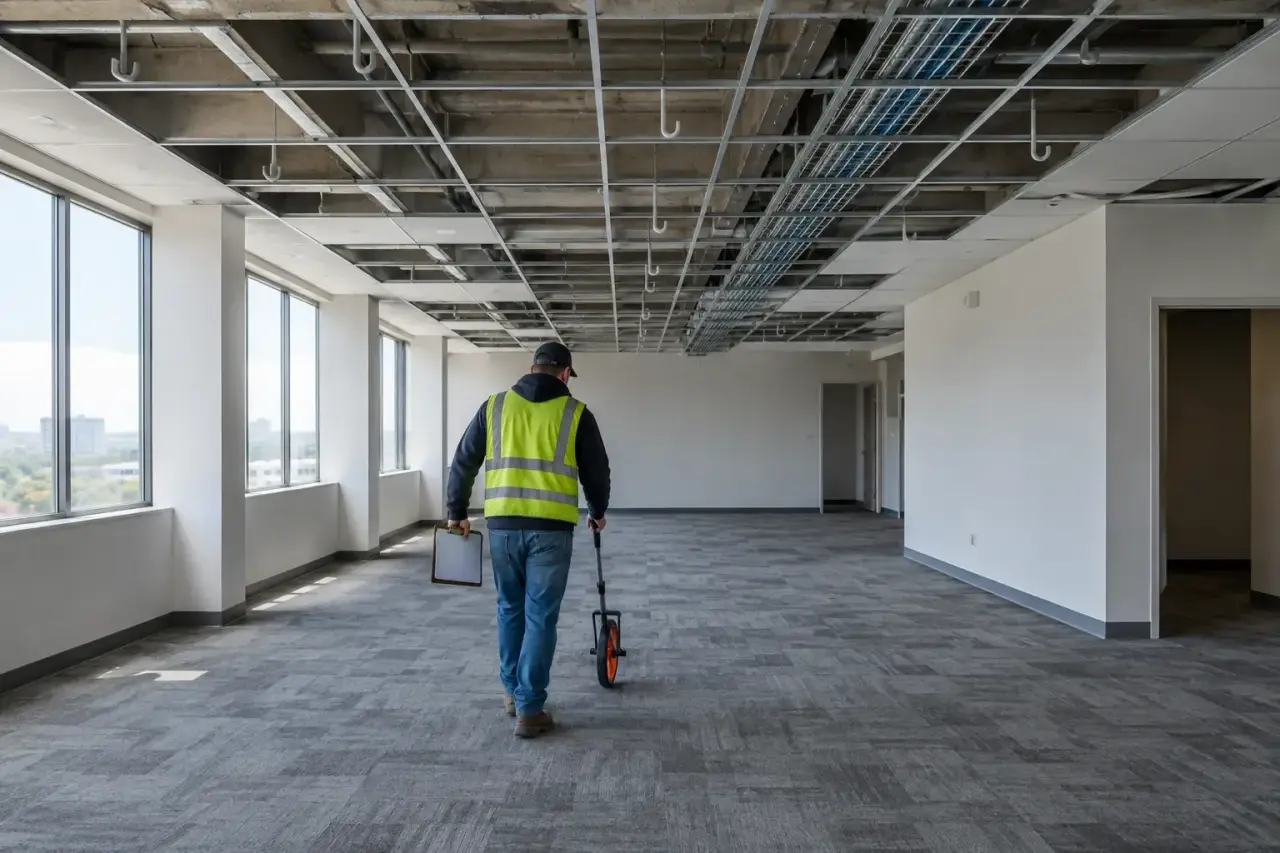
One of the most significant cost drivers is building architecture. If your office has a standard “drop ceiling” with removable tiles, technicians can move quickly. However, if you are in a modern “open-concept” office with exposed ceilings, we have to use conduit or specialized mounting hardware to keep the aesthetic clean and the cables protected. This adds both material costs and labor hours.
Furthermore, the “Plenum” requirement is a major factor. In many commercial buildings in Massachusetts, the space above the ceiling is used for air circulation (the plenum space). Fire codes require specialized plenum-rated cable that uses low-smoke materials. This cable typically carries a 30% to 70% price premium over standard PVC-jacketed cable.
How Material Choices Affect the Network Cabling Price
The type of copper you choose is the next big variable. According to the Cat 6 Cable Cost Guide for Home and Office, Well Built Florida, the difference between Cat6 and Cat6A is not just speed, it’s the physical thickness and shielding of the wire.
- Cat6: The workhorse of the modern office. It supports 1Gbps easily and can handle 10Gbps at shorter distances (usually up to 37-55 meters depending on interference).
- Cat6A: Designed for a full 10Gbps up to 100 meters. It is thicker, harder to bend, and takes longer to terminate, which increases the labor portion of the network cabling price.
- Solid Copper vs. CCA: We always advocate for 100% solid copper. Some low-cost providers use Copper Clad Aluminum (CCA), which is brittle and can be a fire hazard when used with Power over Ethernet (PoE). Avoiding CCA is a critical safety and performance standard for any reputable Network Cable Service.
Labor and Regional Variations in the Network Cabling Price
Labor accounts for roughly 60% to 70% of the total cost of an Ethernet installation. In our service areas: Massachusetts, New Hampshire, and Rhode Island, labor rates are influenced by local market conditions. For example, a project in Metro-west Boston or downtown Worcester may face higher costs due to parking logistics, union requirements, or strict building access windows compared to a suburban office park in Nashua, NH.
When searching for Network Cabling Near Me, businesses should look for installers who use professional-grade diagnostic tools. A technician using a Fluke cable certifier ensures that every drop meets TIA standards, which is a standard part of a professional commercial installation.
Comparing Cat6, Cat6A, and Fiber Optic Costs
Choosing the right “pipe” for your data is a balancing act between today’s budget and tomorrow’s needs. Structured Data Cabling is an investment that should last 15 to 20 years.
While Cat6 remains the standard for most desk-level connections, Cat6A is increasingly becoming the requirement for “backbone” runs and high-performance areas. As noted in the Ethernet Installation Cost 2026: Comprehensive Pricing Guide, Cat6A offers better protection against “alien crosstalk,” which is essential when you have dozens of cables bundled together in a tight tray.
Fiber optic cabling is the gold standard for distance and speed. While copper is limited to 100 meters (about 328 feet), fiber can carry data for miles without signal loss. In a large warehouse in Brockton or a multi-building campus in Warwick, fiber is essential for connecting different server closets (IDFs) back to the main server room (MDF). While the material cost for fiber has decreased, the specialized equipment needed to “splice” or terminate fiber means the labor cost remains higher than copper.
Impact of Wi-Fi 7 and PoE++ on Infrastructure
It is a common misconception that better Wi-Fi means you need fewer wires. In reality, the opposite is true. Wi-Fi 7 access points require massive “backhaul” speeds, often 2.5Gbps or 10Gbps, to function at full capacity. This means every Wi-Fi 7 access point in your ceiling needs a high-quality Cat6A drop.
Additionally, modern devices like high-end security cameras and smart lighting use PoE++ (802.3bt), which delivers more power over the data cable. This creates heat. High-quality Cabling Solutions use Cat6A specifically because its thicker gauge handles this heat better than older, thinner cables, preventing data errors or even cable failure over time.
Pre-Wiring vs. Retrofit: Timing Your Installation for Savings
When it comes to the network cabling price, timing is everything.
Pre-Wiring (New Construction): This is the ideal scenario. When the “studs” are exposed and there is no drywall, our Data Cable Installers can pull bundles of cable across a building in a fraction of the time. Industry data suggests that pre-wiring can save 30% to 40% on labor costs compared to working in a finished space.
Retrofit (Existing Office): If you are adding drops to an active office in Cambridge or Quincy, the process is more surgical. We have to “fish” wires through finished walls, navigate around existing HVAC ducts, and often work after hours to avoid disrupting your staff. This complexity naturally increases the per-drop price. One of the 5 Common Mistakes to Avoid When Installing Network Cabling is failing to plan for enough drops during a renovation, leading to expensive “add-on” visits later.
Professional Certification and Testing Standards
Not all cable “tests” are created equal. When you hire Cable Installation Contractors, you should clarify what level of testing is included in the quote.
- Wiremap Testing: This is the basic level. It simply checks if the wires are in the right order and if the signal gets from point A to point B. It doesn’t tell you if the cable can actually handle 10Gbps speeds.
- Certification (Fluke Testing): This is the commercial standard. Using a specialized certifier, we measure signal loss, crosstalk, and interference. You receive a printed or digital report for every single drop. This is often required for manufacturer warranties (which can last up to 25 years) and is a hallmark of Network Cabling Companies that stand behind their work.
What is Included in a Professional Quote?
A “cheap” quote often becomes expensive later when you realize what was left out. When you Request an Estimate, a professional proposal should be itemized and include:
- Materials: Specific cable grade (e.g., Cat6 Plenum), jacks, faceplates, and patch panels.
- Labor: Installation, termination, and “dressing” the cables neatly in the rack.
- Labeling: Every wall plate and patch panel port should be clearly labeled according to TIA-606 standards.
- Testing: A clear statement on whether you are receiving a basic wiremap or a full certification report.
- Documentation: “As-built” drawings or a port legend that tells you which jack goes to which port in the server room.
For more tips, see The Ultimate Guide to Finding a Data Cabling Installation Company.
Frequently Asked Questions about Network Cabling
Why does a single additional drop cost more than bulk installation?
We often get asked why adding one drop to an office in Framingham might cost $300 to $450, while a 50-drop project averages much less per line. This is due to “mobilization.” A technician still has to drive to the site, set up tools, and perform the same administrative work for one cable as they would for twenty. Most professional companies have a minimum service call fee to cover these fixed costs.
When should a business choose fiber over copper?
Copper is great for “horizontal” cabling (from the closet to the desk). However, you should choose fiber for:
- Distance: Anything over 328 feet.
- Interference: If the cable runs near heavy machinery or high-voltage power lines (common in manufacturing plants in Lowell or Worcester).
- Future-Proofing: Connecting two server rooms together. Fiber can be upgraded to 40Gbps or 100Gbps just by changing the electronics at the ends, without replacing the glass itself.
Is professional certification necessary for all commercial projects?
While a small 5-person office might get by with basic testing, certification is highly recommended for most businesses. It provides a “birth certificate” for your network. If you experience slow speeds six months later, you can look at the report to prove the cabling is perfect, which helps your IT team narrow the problem down to your hardware or service provider. Many commercial leases in Boston also require certified test results as part of the tenant improvement handoff.
Conclusion
Navigating the network cabling price doesn’t have to be a guessing game. By understanding the impact of cable categories, building architecture, and testing standards, you can build a budget that supports your business goals without hidden surprises.
At AccuTech Communications, we have spent over three decades perfecting the art of structured cabling across Massachusetts, New Hampshire, and Rhode Island. Whether you are moving into a new headquarters in Woburn, upgrading a medical facility in Providence, or expanding a warehouse in Manchester, our team of technicians is here to provide reliable, high-quality infrastructure.
Ready to get a clear picture of your project’s needs? From copper to Fiber Optic Cabling Installation, we provide the expertise required for a mission-critical network.