
Define Cabling: 7 Essential Facts for Powerful Success 2025
Why Understanding Cabling is Critical for Your Business
When you define cabling, you’re looking at the physical infrastructure that connects all your business technology together. Here’s what you need to know:
Cabling Definition:
- Physical Infrastructure: The cables, connectors, and hardware that link computers, phones, and other devices
- Data Transmission: Carries information between network devices using copper wires or fiber optic strands
- Building Backbone: Forms the foundation of your entire communication system
Key Components:
- Cables (twisted pair, coaxial, fiber optic)
- Connectors and patch panels
- Switches and distribution equipment
- Cable management systems
Think of cabling like the circulatory system of your building. Just as blood vessels carry nutrients throughout your body, cables carry data throughout your facility. Without proper cabling, your phones won’t work, computers can’t connect to the internet, and your security systems go dark.
Structured cabling takes this concept further by organizing everything into standardized subsystems. This approach supports data transmission speeds up to 10 Gbps over distances of up to 100 meters and can reduce network downtime by up to 50%.
The difference between good cabling and poor cabling often determines whether your business runs smoothly or faces constant technical problems. Properly installed network cabling creates a reliable foundation that supports current needs while preparing for future technology upgrades.
I’m Corin Dolan, owner of AccuTech Communications, and I’ve been helping businesses define cabling solutions across Massachusetts, New Hampshire, and Rhode Island since 1993. My experience with everything from healthcare facilities to manufacturing plants has shown me that when you properly define cabling requirements upfront, you avoid costly problems down the road.
Define cabling vocabulary:
- commercial data network cabling
- commercial network cable installation pricing
- types of cables in computer network
Define Cabling: The Foundation of Modern Connectivity
To properly define cabling, we need to understand that it’s the process of installing electrical wiring or communication cables in a building or construction site to ensure safe and efficient transmission of power, data, voice, and other signals. This definition encompasses both the physical installation and the systematic approach to organizing network infrastructure.
Cabling serves as the backbone of modern business communications. Unlike standard electrical wiring that delivers power using a three-wire system (black hot, white neutral, and bare copper ground), data cabling is specifically designed for transporting communications signals. This low-voltage infrastructure supports multiple applications including data, voice, video, wireless connectivity, and building controls.
The purpose of cabling extends beyond simple connectivity. A well-designed cabling system reduces downtime, improves network performance, increases security, and provides the flexibility needed for future technology upgrades. When we properly define cabling requirements, we’re essentially creating a roadmap for reliable business operations.
For more detailed information about structured cabling systems, visit our Structured Cabling Definition page.
What Does It Mean to “Define Cabling” in 2024?
When you define cabling in today’s technology landscape, you’re describing a comprehensive system that goes far beyond simple wire installation. The term “cabling” originates from the word “cable,” which historically referred to a rope of at least 10 inches in circumference. Today, when we define cabling, we’re talking about assemblies of insulated electrical conductors bundled together and terminated with connectors to create complete circuits.
Modern cabling systems consist of several key components:
- Cables: The physical medium (copper or fiber) that carries signals
- Connectors: Hardware that joins cables to devices or other cables
- Patch panels: Organized connection points for network management
- Switches: Devices that direct network traffic
- Cable management: Systems for organizing and protecting cables
The evolution of cabling has transformed it from simple point-to-point connections to sophisticated structured systems. Today’s cabling infrastructure must support everything from basic telephone calls to high-speed data transmission, video conferencing, and Internet of Things (IoT) devices.
Quick Glossary When You Search “Define Cabling”
Understanding cabling terminology helps clarify what we mean when we define cabling systems:
Cable vs. Wire: A wire is a single conductor, while a cable is a bundle of multiple wires or conductors enclosed in a protective sheath. For example, a Cat6 cable contains eight individual wires twisted into four pairs.
Conductor vs. Bundle: A conductor is the actual metal (usually copper) that carries the electrical signal. A bundle refers to multiple conductors grouped together, often with specific arrangements like twisted pairs to reduce electromagnetic interference.
Patch Cable vs. Permanent Link: Patch cables are flexible cords used to connect devices to wall outlets or switches. Permanent links are the fixed cables installed within walls and ceilings that form the building’s cabling infrastructure.
Structured vs. Unstructured: Structured cabling follows standardized design principles with organized pathways and centralized management. Unstructured cabling uses direct point-to-point connections without systematic organization.
Main Types of Cabling and Their Use Cases
The world of cabling includes several distinct types, each designed for specific applications and performance requirements. Understanding these differences helps businesses choose the right infrastructure for their needs.
Twisted Pair Cables represent the most common type of network cabling. These cables contain pairs of copper wires twisted together to cancel electromagnetic interference from external sources and adjacent pairs. The twisting pattern is crucial – it’s what allows these cables to maintain signal integrity over distance.
Coaxial Cables feature a central conductor surrounded by an insulating layer, then a conductive shield, and finally an outer jacket. This design confines electromagnetic waves between the inner conductor and shield, making coaxial cables excellent for certain applications like cable television and some networking scenarios.
Fiber Optic Cables use glass or plastic strands to transmit data via pulses of light. These cables can carry signals over much longer distances with higher bandwidth than copper alternatives. Fiber strands are less than one-tenth the thickness of human hair, yet they can transmit data at speeds approaching the speed of light.
Patch Cables are short, flexible cables used to connect devices to network outlets or to interconnect equipment in telecommunications rooms. These cables prioritize flexibility over the structured installation practices used for permanent cabling.
Power Line Communication represents an interesting alternative where existing electrical wiring carries network signals using standards like HomePlug and ITU-T G.hn. This approach leverages power lines originally designed for electricity to serve as network cabling.
For comprehensive information about cable types and their applications, explore our Types of Cables resource.
Copper Classics: Twisted Pair & Coax
Twisted pair cabling dominates the networking world for good reason. The twisting of conductor pairs serves a specific purpose: it cancels electromagnetic interference (EMI) that could corrupt data signals. This neat solution allows copper cables to maintain reliable performance in electrically noisy environments.
Category 5e (Cat5e) cables support speeds up to 1 Gigabit per second (Gbps) over distances up to 100 meters. These cables work well for most business applications and can effectively handle Power over Ethernet (PoE) applications up to 90 meters.
Category 6 (Cat6) cables offer improved performance with better isolation between wire pairs and reduced crosstalk. They support the same 1 Gbps speeds as Cat5e but with better signal quality and can handle 10 Gbps over shorter distances.
Category 6A (Cat6A) represents a significant upgrade, supporting 10 Gbps over the full 100-meter distance. These cables feature improved shielding and improved construction that makes them ideal for high-bandwidth applications. Cat6A also offers higher power efficiency for PoE applications compared to earlier categories.
Shielding options include Unshielded Twisted Pair (UTP) and Shielded Twisted Pair (STP). UTP cables work well in most office environments, while STP cables provide additional protection against electromagnetic interference from power lines, radio waves, and other sources.
Coaxial cables still find use in specific applications. While not recommended for modern commercial buildings due to distance limitations, coaxial cables excel in certain scenarios like cable television distribution and some specialized networking applications.
The Fiber Frontier
Fiber optic technology represents the pinnacle of cabling performance. These cables transmit data using light pulses traveling through glass or plastic cores, offering immunity to electromagnetic interference and supporting much higher bandwidths than copper alternatives.
Single-Mode Fiber uses a small core diameter (typically 9 micrometers) that allows light to travel in essentially one path. This design enables transmission over extremely long distances – often exceeding 100 kilometers – making single-mode fiber ideal for backbone connections between buildings or across campus environments.
Multi-Mode Fiber features a larger core (typically 50 or 62.5 micrometers) that allows multiple light paths. While this limits distance compared to single-mode fiber, multi-mode fiber costs less and works well for shorter runs within buildings. Common variants include OM3 and OM4 fibers optimized for different data center applications.
The distance capabilities of fiber optic cables far exceed copper alternatives. While copper Ethernet cabling maxes out at 100 meters, fiber optic cables can transmit data over distances exceeding 100 kilometers without signal degradation. This makes fiber the clear choice for long-distance and high-bandwidth applications.
Fiber cables may use as little as one-sixth of the space required by traditional copper network cables, making them valuable in high-density installations. The small size also simplifies cable management and improves airflow in equipment rooms.
For detailed technical information about fiber optic performance standards, reference Scientific research on optical fiber performance.
Structured Cabling vs. Traditional Point-to-Point
The difference between structured cabling and traditional point-to-point cabling fundamentally changes how networks operate and evolve. Understanding this distinction helps explain why structured approaches have become the standard for modern business installations.
Traditional Point-to-Point Cabling connects devices directly to each other using dedicated cables. While this approach works for simple installations, it quickly becomes unwieldy as networks grow. Each new device requires its own cable run, creating a web of connections that becomes increasingly difficult to manage and modify.
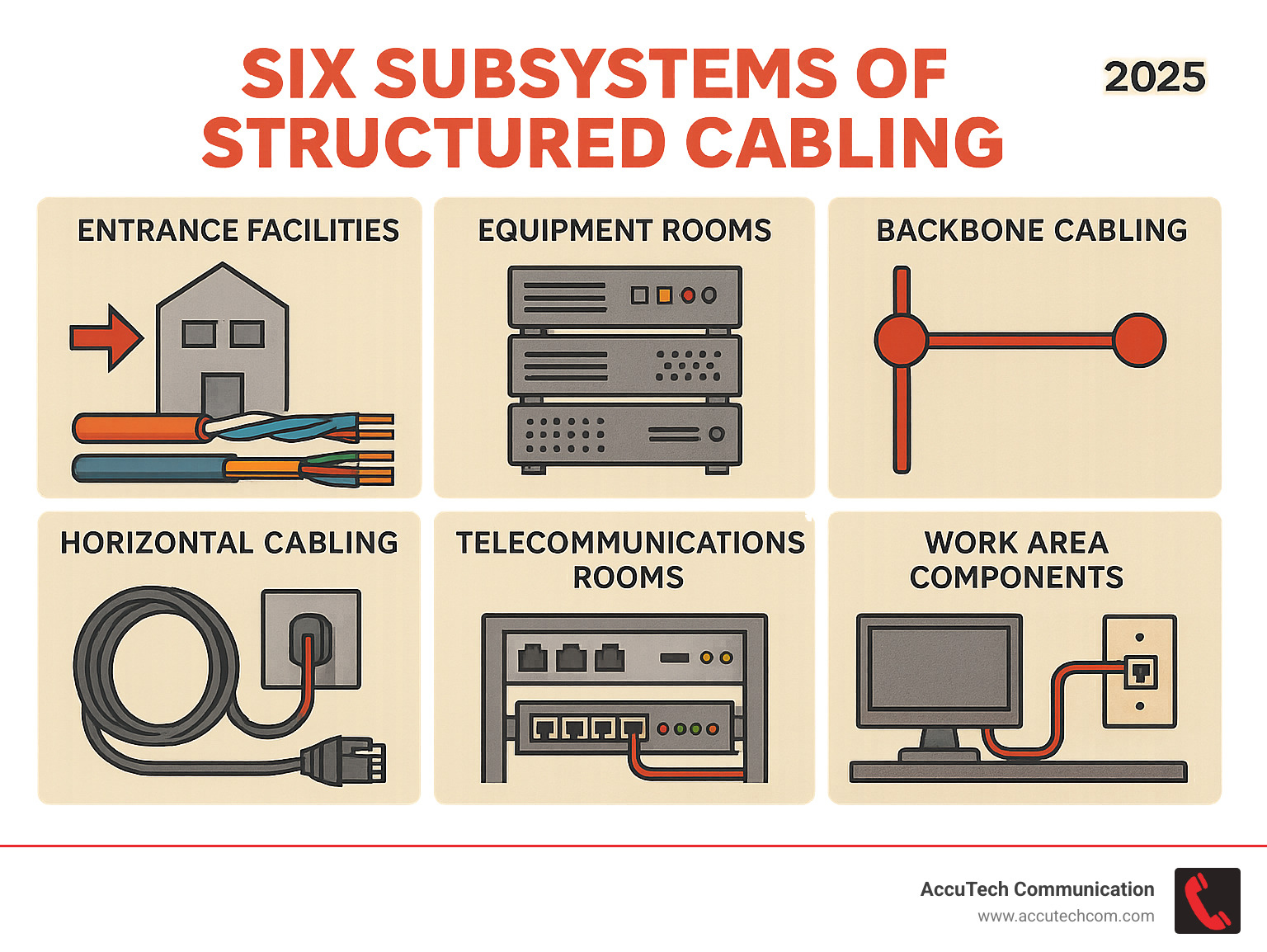
Structured Cabling organizes network infrastructure into six standardized subsystems:
- Entrance Facilities: Where service provider cables enter the building
- Equipment Rooms: Central locations housing main network equipment
- Backbone Cabling: Vertical connections between floors and buildings
- Horizontal Cabling: Cables running from telecommunications rooms to work areas
- Telecommunications Rooms: Floor-by-floor distribution points
- Work Area Components: Outlets, patch cords, and user connections
This systematic approach uses patch panels and distribution centers to create a modular network architecture. Instead of direct device-to-device connections, structured cabling creates a standardized infrastructure that supports multiple applications and simplifies network management.
The benefits of structured cabling become apparent when businesses need to make changes. Adding a new employee workstation or relocating equipment becomes a simple matter of moving patch cords rather than running new cables. This flexibility significantly reduces the time and cost associated with network modifications.
Learn more about the business advantages at The Advantages of Structured Cabling for Your Business.
Why Structured Cabling Matters for Performance & Reliability
Structured cabling systems deliver measurable improvements in network performance and reliability. These systems are designed to support data transmission speeds up to 10 Gbps over distances of up to 100 meters using Cat6A cabling, providing the bandwidth needed for modern business applications.
Network Uptime improves dramatically with structured cabling. Properly installed network cabling can reduce network downtime by up to 50% compared to unstructured installations. This improvement comes from better cable management, standardized connections, and easier troubleshooting when problems occur.
Standards Compliance ensures consistent performance across the entire network. Structured cabling follows standards like ANSI/TIA-568 and ISO/IEC 11801, which specify everything from cable categories to installation practices. These standards guarantee that different components work together reliably.
Electromagnetic Interference (EMI) Control becomes more effective with structured cabling. The organized approach allows for better separation between power and data cables, proper grounding, and strategic use of shielded cables where needed. This reduces signal degradation and improves overall network performance.
Future-Proofing capabilities mean structured cabling systems can support new technologies without complete infrastructure replacement. The modular design allows for selective upgrades while maintaining the overall system architecture.
Scalability supports business growth without major infrastructure changes. Structured cabling systems can support up to 1,000 users in a single building, depending on the design and infrastructure requirements.
Common Mistakes When You “Define Cabling” on Site
When businesses attempt to define cabling requirements without proper expertise, several common mistakes can compromise system performance and reliability.
Overlength Runs represent one of the most frequent errors. The maximum recommended length for copper Ethernet cabling is 90 meters for permanent link installation, plus an allowance for a combined 10 meters of patch cords at the ends. Exceeding these distances causes signal attenuation and performance degradation.
Poor Terminations occur when cables aren’t properly connected to jacks, patch panels, or equipment. Loose connections, incorrect wiring schemes, or damaged conductors create intermittent problems that are difficult to diagnose and fix.
Lack of Labeling creates ongoing maintenance nightmares. Without proper identification systems, technicians waste time tracing cables and risk disconnecting the wrong circuits during maintenance. A comprehensive labeling system should identify each cable’s origin, destination, and purpose.
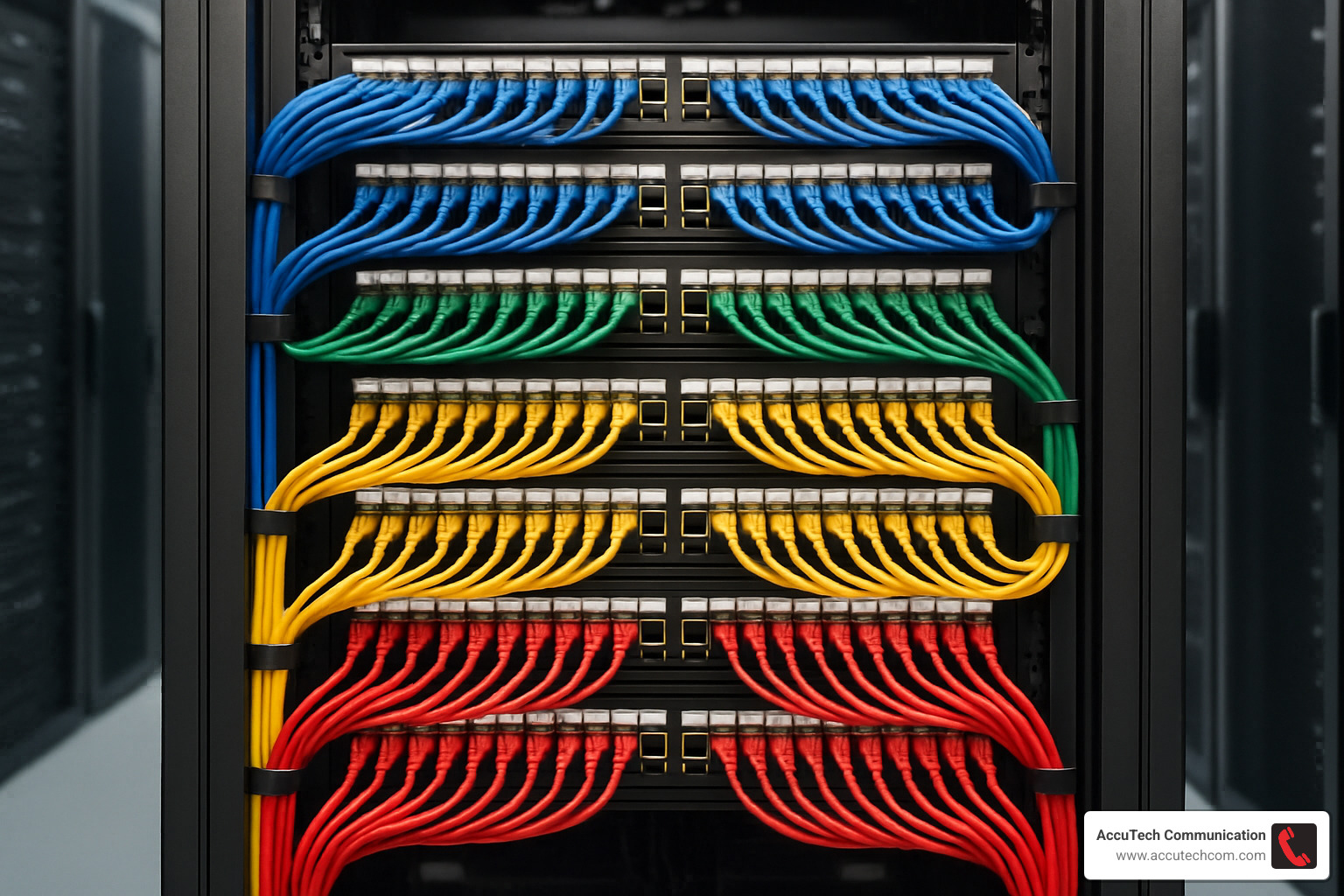
Inadequate Cable Management leads to tangled installations that impede airflow, complicate maintenance, and increase the risk of accidental damage. Proper cable dressing using appropriate ties, channels, and pathways maintains neatness and reduces space usage and interference.
Ignoring Environmental Factors such as electromagnetic interference sources, temperature extremes, or fire safety requirements can compromise system performance and code compliance. Proper planning considers these factors during the design phase.
For technical details about proper cable management techniques, see Cable dressing best practices.
Installation Best Practices, Standards, and Future-Proofing

Professional cabling installation requires careful planning, adherence to industry standards, and systematic testing to ensure optimal performance. The installation process involves much more than simply running cables – it requires a comprehensive approach that considers current needs and future requirements.
Planning Phase begins with assessing the building’s connectivity needs and designing optimal cable routing paths. This includes evaluating structural constraints, identifying interference sources, and determining the best locations for equipment rooms and telecommunications closets.
Material Selection involves choosing appropriate cables, connectors, and support hardware based on performance requirements and environmental conditions. This includes selecting between different cable categories, determining shielding requirements, and choosing appropriate fire ratings for different building areas.
Installation Process follows systematic procedures including proper cable pulling techniques, maintaining minimum bend radii, and avoiding stress that could damage conductors. Professional installers use specialized tools and follow manufacturer guidelines to ensure cable integrity.
Testing and Certification verify that installed cables meet performance specifications. This includes both continuity testing to ensure proper connections and performance testing to verify signal quality, bandwidth capabilities, and compliance with industry standards.
Documentation creates detailed records of cable locations, connections, and test results. This documentation proves essential for future maintenance, troubleshooting, and system modifications.
Standards Compliance ensures installations meet National Electrical Code (NEC) requirements, Building Industry Consulting Service International (BICSI) guidelines, and relevant TIA/EIA standards. These standards address everything from fire safety to electromagnetic compatibility.
For comprehensive installation services, explore our Structured Cabling Services offerings.
Cable Management & Safety Essentials
Proper cable management goes beyond organization – it’s essential for safety, performance, and long-term reliability. Effective cable management systems protect cables from damage while maintaining accessibility for future modifications.
Cable Trays and Raceways provide organized pathways for cable runs while protecting them from physical damage. These systems support cables without creating stress points and allow for easy access during maintenance. Proper sizing ensures adequate space for current cables plus future additions.
Fastening Methods include cable ties, cable channels, and cable lacing cord depending on the application. The key is selecting appropriate methods that secure cables without creating pressure points that could damage conductors over time.
Airflow Considerations become critical in equipment rooms and data centers. Poorly managed cables can obstruct airflow patterns, leading to overheating and equipment failures. Proper cable routing maintains clear airflow paths and supports effective cooling systems.
High-Tension Cable Arrangements require special attention to mechanical forces. High-tension cables are often arranged in trefoil patterns with cable cleats rated for short-circuit forces. This arrangement helps cable cleats withstand the electromagnetic forces generated during electrical faults.
Fire Safety requirements mandate specific cable types and installation methods in different building areas. Plenum-rated cables must be used in air handling spaces, while riser-rated cables are required in vertical runs between floors.
Electromagnetic Compatibility considerations include proper separation between power and data cables, appropriate grounding practices, and strategic use of shielded cables in high-interference environments.
Designing for Tomorrow’s Upgrades
Future-proofing cabling infrastructure requires understanding emerging technology trends and designing systems that can adapt to changing requirements. The goal is creating infrastructure that supports current needs while providing pathways for future upgrades.
10 Gigabit Ethernet is becoming standard for backbone connections and high-performance workstations. Cat6A cabling provides the foundation for 10GbE over the full 100-meter distance, while fiber optic cables support even higher speeds over longer distances.
Wi-Fi 7 and Beyond will require robust backbone cabling to support increased wireless access point density and bandwidth requirements. Each wireless access point needs wired connectivity, and higher-performance wireless standards demand correspondingly higher backbone capacity.
Internet of Things (IoT) devices will proliferate throughout buildings, requiring connectivity for everything from smart lighting to environmental sensors. Structured cabling provides the foundation for IoT device connectivity, whether through direct wired connections or wireless access points.
Power over Ethernet Plus (PoE++) enables higher power delivery over network cables, supporting devices like LED lighting, digital displays, and advanced security cameras. Cat6A cables offer higher power efficiency for PoE applications compared to earlier cable categories.
Modular Design principles ensure that infrastructure can evolve without complete replacement. Using standardized components, accessible pathways, and comprehensive documentation enables selective upgrades while maintaining overall system integrity.
Capacity Planning involves installing infrastructure that exceeds current requirements to accommodate future growth. This includes oversizing pathways, installing spare cables, and designing equipment rooms with expansion space.
Frequently Asked Questions about Cabling
How long can an Ethernet cable run before performance drops?
The maximum recommended length for copper Ethernet cabling is 90 meters for the permanent link installation, plus an allowance for a combined 10 meters of patch cords at both ends. This gives a total maximum distance of 100 meters (328 feet) for the complete channel.
Distance Limitations exist because electrical signals attenuate (weaken) as they travel through copper conductors. Beyond the specified distances, signal strength drops below the minimum levels required for reliable data transmission.
Attenuation Factors include cable quality, installation practices, and environmental conditions. Higher-quality cables like Cat6A maintain better signal integrity over distance compared to lower categories.
Fiber Optic Alternatives support much longer distances – often exceeding 100 kilometers for single-mode fiber and several hundred meters for multi-mode fiber. This makes fiber the preferred choice for long-distance connections.
Who should design and install a cabling system?
Professional cabling installation requires specialized knowledge and certifications. The complexity of modern cabling systems makes professional installation essential for optimal performance and reliability.
Registered Communications Distribution Designers (RCDD) possess advanced training in cabling system design and can create comprehensive plans that meet current needs while providing for future growth.
Certified Installers have demonstrated competency in proper installation techniques, testing procedures, and safety practices. Certification programs ensure installers understand industry standards and best practices.
Project Engineers coordinate complex installations, manage timelines, and ensure compliance with building codes and industry standards. They serve as the liaison between design teams and installation crews.
At AccuTech Communications, our team includes BICSI-certified professionals with decades of experience in cabling system design and installation across Massachusetts, New Hampshire, and Rhode Island.
Can my existing cabling handle future technologies?
The ability of existing cabling to support future technologies depends on the cable category, installation quality, and specific application requirements.
Cat6A Infrastructure provides excellent future-proofing capabilities, supporting 10 Gigabit Ethernet over the full 100-meter distance and offering superior performance for Power over Ethernet applications.
Fiber Optic Cables offer the best future-proofing potential, with bandwidth capabilities that far exceed current requirements. Existing fiber infrastructure can often support new technologies simply by upgrading the electronics at each end.
Upgrade Considerations include evaluating current cable categories, testing existing installations for compliance with newer standards, and identifying areas where selective upgrades might be necessary.
Assessment Services can determine whether existing cabling meets current standards and identify potential limitations for future applications. This evaluation helps prioritize upgrade investments for maximum benefit.
Conclusion
Understanding how to properly define cabling provides the foundation for making informed decisions about your business’s network infrastructure. From the basic definition of cabling as the physical backbone of modern connectivity to the sophisticated structured systems that support today’s high-speed applications, cabling represents a critical investment in your business’s future.
The evolution from simple point-to-point connections to structured cabling systems reflects the increasing complexity and capabilities of modern business technology. When you properly define cabling requirements and implement structured solutions, you create infrastructure that supports current needs while providing the flexibility needed for future growth.
Structured cabling systems offer measurable benefits including reduced network downtime, improved performance, improved security, and simplified management. These systems can support data transmission speeds up to 10 Gbps and accommodate up to 1,000 users in a single building, providing the scalability that growing businesses require.
Professional installation and design ensure that cabling systems meet industry standards, comply with safety codes, and deliver optimal performance. The expertise required for modern cabling installation makes professional services essential for businesses that depend on reliable network connectivity.
At AccuTech Communications, we’ve been helping businesses across Massachusetts, New Hampshire, and Rhode Island define cabling solutions since 1993. Our certified professionals understand the complexities of modern cabling systems and provide the expertise needed to design, install, and maintain infrastructure that supports your business objectives.
Whether you’re planning a new installation, upgrading existing infrastructure, or simply trying to understand your current capabilities, proper cabling forms the foundation of reliable business operations. The investment in quality cabling infrastructure pays dividends through improved productivity, reduced downtime, and the flexibility to adapt to changing technology requirements.
For more information about how structured cabling can benefit your business, visit our commercial network cabling page to explore comprehensive solutions custom to your specific needs.
