
ethernet cable standards: 10 Powerful Facts for 2025 Success
Understanding Ethernet Cable Standards
Ever wonder why some networks zip along while others crawl? The secret often lies in those unassuming cables running through your walls. Ethernet cable standards might not sound exciting, but they’re the backbone of every modern network connection.
Let me walk you through the essentials with a simple breakdown:
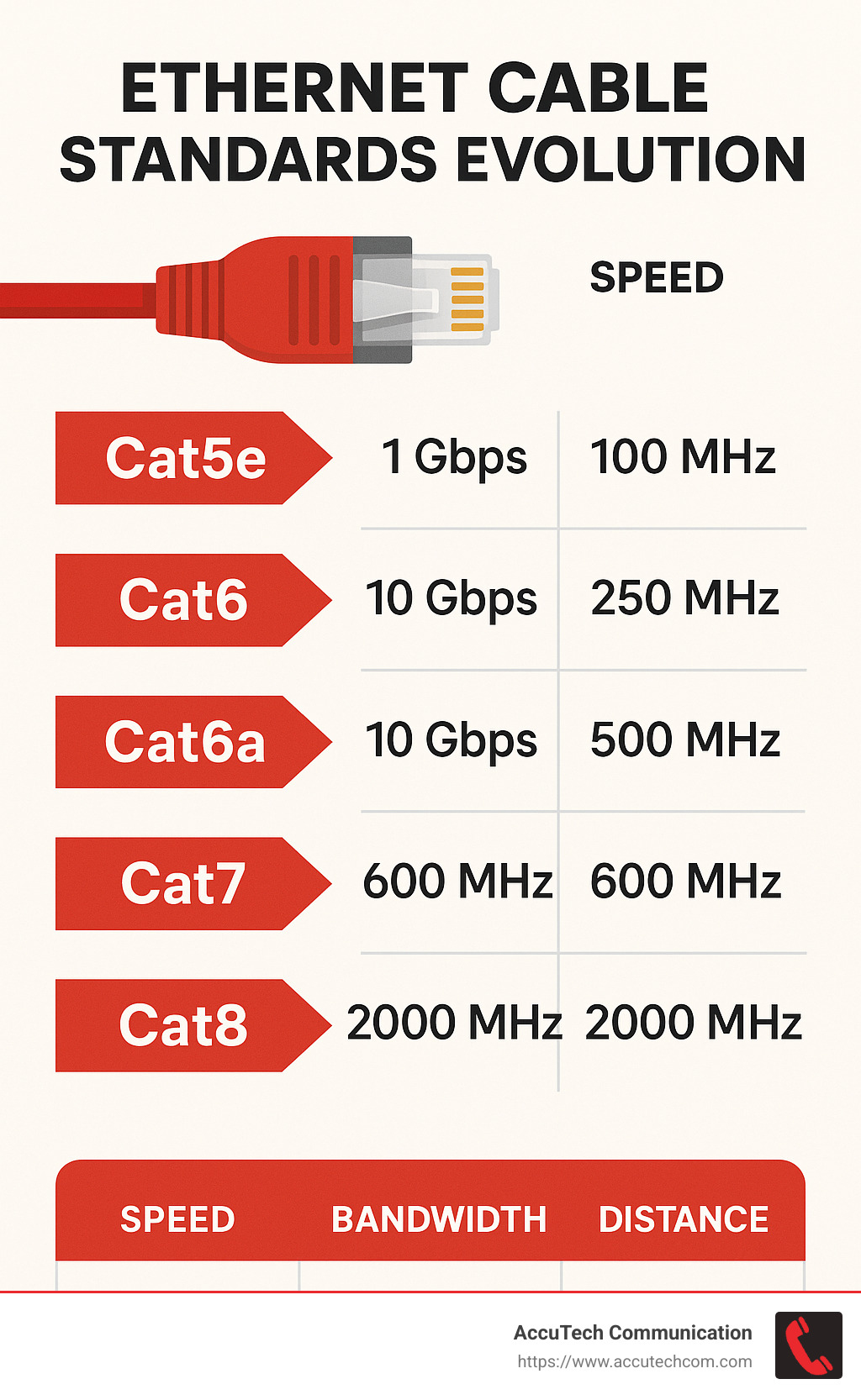
| Cable Category | Max Speed | Max Bandwidth | Max Distance | Best Use Case |
|---|---|---|---|---|
| Cat5e | 1 Gbps | 100 MHz | 100 meters | Home/small office networks |
| Cat6 | 10 Gbps | 250 MHz | 55 meters (at 10G) | Medium businesses |
| Cat6a | 10 Gbps | 500 MHz | 100 meters | Large enterprises |
| Cat7 | 10 Gbps | 600 MHz | 100 meters | High interference environments |
| Cat8 | 40 Gbps | 2000 MHz | 30 meters | Data centers |
Think of these standards as recipes for reliable connections. Each category has specific ingredients that determine how fast data travels, how far it can go, and how well it handles interference from other electronics.
When you’re setting up a network, these differences matter more than you might think. Choosing Cat5e might save you money today, but if your business grows and needs faster connections tomorrow, you could face a costly re-cabling project. On the flip side, installing Cat8 everywhere would be overkill (and expensive!) for a small office that only needs basic internet access.
What makes each standard unique? It comes down to four key factors:
Data transmission speed tells you how quickly information can travel through the cable – measured in megabits or gigabits per second. Bandwidth capacity (MHz) indicates how much data can flow simultaneously. Maximum transmission distance is exactly what it sounds like – how far the signal can travel before degrading. And resistance to interference determines how well your cables perform when surrounded by other electronic equipment.
Hi there! I’m Corin Dolan, owner of AccuTech Communications. For over 25 years, my team and I have been designing and implementing network solutions using ethernet cable standards across countless industries. We’ve installed thousands of structured cabling systems throughout Massachusetts, New Hampshire, and Rhode Island, always ensuring they comply with the latest standards for optimal performance.
Whether you’re planning a new office setup, upgrading your existing network, or troubleshooting connectivity headaches, understanding these standards helps you make smarter decisions that save time and money in the long run.
Want to learn more about specific networking solutions? Check out our resources on Business Network Cabling Services in MA, find out what makes a great cable technician, or explore the different types of computer cables that power modern businesses.
Why Ethernet Cable Standards Matter
The story of Ethernet begins in 1973 when Bob Metcalfe at Xerox PARC invented what would become the backbone of modern networking. What started as a modest 2.94 Mbit/s experimental network has transformed into today’s blazing-fast standards supporting up to 400 Gbps, with even more impressive 800 Gbps and 1.6 Tbit/s specifications on the horizon.
You might wonder why ethernet cable standards really matter in your day-to-day operations. Think of these standards as the “rules of the road” for your network traffic – without them, chaos would ensue!
When we install networks at AccuTech, we emphasize that standards provide performance guarantees that ensure your cables will consistently deliver the speeds you’re paying for. They also enable interoperability, so you can mix equipment from different manufacturers without worrying about compatibility headaches.
Perhaps most importantly, understanding these standards helps with future-proofing your investment. Nobody wants to rip out and replace their entire network infrastructure every few years!
Standards also give us clear benchmarks for troubleshooting when things go wrong, and they ensure compliance with industry regulations that might apply to your business.
As Robert Metcalfe himself once predicted: “Commercial applications using Terabit Ethernet may occur by 2015, though it might require new Ethernet standards.” While his timeline was a bit optimistic (aren’t we all when it comes to technology?), the steady march toward faster speeds continues to prove his vision correct.
The Role of Standards Bodies
Behind every reliable network connection is a group of organizations working tirelessly to develop and maintain ethernet cable standards:
The IEEE (Institute of Electrical and Electronics Engineers) develops the core 802.3 Ethernet standards that define how data moves across your network. Think of them as the architects drawing up the blueprints.
The TIA/EIA (Telecommunications Industry Association/Electronic Industries Alliance) creates the 568 series standards for commercial building telecommunications cabling – they’re like the building inspectors ensuring everything is up to code.
The ISO/IEC (International Organization for Standardization/International Electrotechnical Commission) develops international standards that align with IEEE and TIA specifications, ensuring global compatibility.
At AccuTech Communications, we’ve been ensuring compliance with these standards since 1993, which is why businesses throughout Massachusetts and New England trust us with their critical infrastructure needs.
Speed Labels vs. Real-World Throughput
Here’s a reality check: those speed labels on ethernet cable standards (like 10GBASE-T) represent theoretical maximums, not guaranteed real-world performance. It’s similar to how your car might have a speedometer that goes up to 140 mph, but various factors determine your actual travel time.
Your network’s actual throughput depends on several factors: cable quality and how well it was installed, your network equipment capabilities, any signal interference in your environment, network congestion during peak usage times, and even protocol overhead that consumes some bandwidth.
For example, while Cat6 proudly carries a 10 Gbps rating, this speed is only achievable up to 55 meters. Push beyond that distance, and performance drops to 1 Gbps—the same as Cat5e. This is why understanding the complete specifications, not just the marketing highlights, is crucial when planning your network infrastructure.
As we often tell our clients across Massachusetts, New Hampshire, and Rhode Island – knowing these nuances can save you from expensive surprises down the road. After all, in networking as in life, it’s better to plan ahead than to patch things up later!
Scientific research on Ethernet evolution
Ethernet Cable Categories & Performance Specs
The evolution of ethernet cable standards has been driven by increasing bandwidth demands across all industries. Let’s explore each major category in detail:
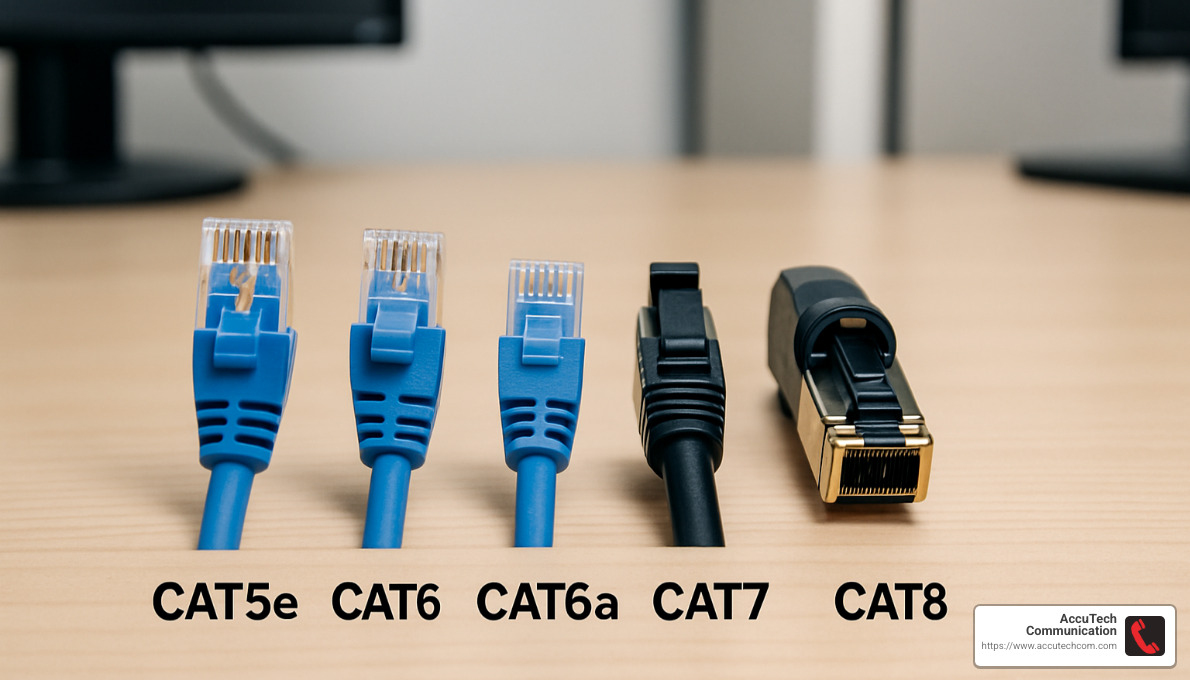
Understanding ethernet cable standards by category
Cat5e (Improved Category 5)
Remember when 100 Mbps seemed blazing fast? Those were the days! Cat5e changed the game when it arrived in 1995, delivering gigabit speeds that still serve many networks today. With its 100 MHz bandwidth and ability to push data up to 100 meters, Cat5e remains the reliable workhorse of the networking world.
At AccuTech, we still recommend Cat5e as the minimum standard for new installations. It hits that sweet spot of performance and cost-effectiveness for basic networking needs in homes and small offices. Think of it as the Toyota Corolla of network cables – not flashy, but incredibly dependable and gets the job done without breaking the bank.
Cat6 (Category 6)
Cat6 kicked things up a notch with 250 MHz bandwidth and the ability to handle 10 Gbps speeds – though only up to 55 meters. Beyond that, it drops back to Cat5e’s 1 Gbps speed. What makes Cat6 special is its construction – tighter twists and often a plastic spine separating the pairs to reduce crosstalk.
This standard has become our go-to recommendation for most business installations. It provides that extra headroom for performance-hungry applications while still maintaining reasonable installation costs. I like to think of Cat6 as future-proofing without overbuying – perfect for growing businesses that might need that extra bandwidth down the road.
Cat6a (Augmented Category 6)
When clients ask me about the “a” in Cat6a, I tell them it stands for “awesome” – well, actually “augmented,” but the performance is pretty awesome! With double the bandwidth (500 MHz) of regular Cat6 and the ability to maintain full 10 Gbps speeds all the way to 100 meters, Cat6a is where serious performance begins.
The improved shielding and alien crosstalk protection make Cat6a ideal for enterprise environments where reliability is non-negotiable. When we install Cat6a at AccuTech Communications, we’re essentially giving our clients a networking foundation that should serve them well for the next decade or more. It’s become the standard choice for forward-thinking businesses throughout Massachusetts.
Cat7 (Category 7)
Cat7 is a bit of an odd duck in the ethernet cable standards world. With 600 MHz bandwidth and fully shielded construction (including individual pair shielding plus an overall shield), it offers excellent performance in high-interference environments.
The catch? Cat7 isn’t officially recognized by TIA/EIA, though it is standardized by ISO. This has limited its adoption in many markets, especially here in the United States. It’s like having a European luxury car – impressive specs, but harder to find parts and service for. We typically recommend alternative solutions unless a client has specific requirements that only Cat7 can address.
Cat8 (Category 8)
Cat8 represents the current pinnacle of twisted-pair technology with a whopping 2000 MHz (2 GHz) bandwidth supporting speeds up to 40 Gbps. The trade-off is distance – it’s limited to just 30 meters.
This standard was purpose-built for data centers where switches and servers are relatively close together but require maximum throughput. It’s overkill for most office environments, but absolutely essential in certain high-performance computing scenarios. When Massachusetts businesses ask us about Cat8, we usually walk them through a needs assessment to determine if the premium performance justifies the investment.
Straight-Through vs. Crossover Wiring
When talking about ethernet cable standards, the wiring inside is just as important as the category on the jacket. It’s like knowing not just the model of car you’re buying, but also what’s under the hood!
Straight-through cables connect different types of devices (like your computer to a switch), while crossover cables were traditionally needed to connect similar devices (switch to switch). The good news is that modern equipment typically includes auto-MDIX technology that figures this out automatically, so you rarely need to worry about crossover cables anymore.
The color coding and pin assignments for RJ45 connectors follow either T568A or T568B standards:
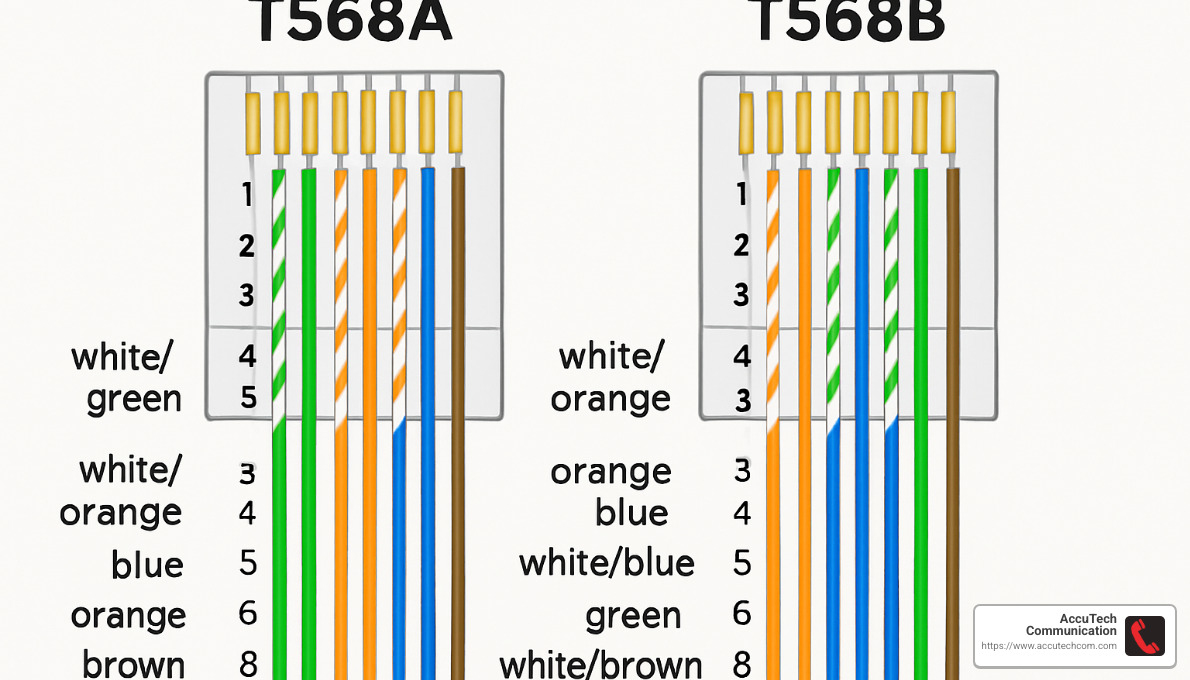
Neither standard is technically superior—what matters is consistency. At AccuTech, we typically use T568B throughout our installations to maintain uniformity, though we’re happy to match existing infrastructure when performing upgrades. It’s like choosing between metric and imperial wrenches – just pick one system and stick with it!
Want to learn more about the intricacies of cable wiring? Check out our detailed guide on Ethernet Cable Wiring that breaks down everything you need to know about proper termination and testing.
Construction Options: Shielding, Gauge, Materials
Beyond the category ratings, several construction variables affect an Ethernet cable’s performance, durability, and suitability for specific environments.
Shielded or Unshielded—When to Choose
Ethernet cable standards include specifications for both shielded and unshielded variants:
- UTP (Unshielded Twisted Pair): No metallic shielding, relies solely on the twisting of wire pairs to reduce interference
- F/UTP (Foiled/Unshielded Twisted Pair): Overall foil shield around all pairs
- S/FTP (Screened/Foiled Twisted Pair): Individual foil shields around each pair, plus an overall braided shield
- SF/UTP (Screened Foiled/Unshielded Twisted Pair): Combination of foil and braid shielding around all pairs
When should you use shielded cabling? Consider shielded options when:
- Installing in environments with high electromagnetic interference (EMI)
- Running cables near electrical equipment, motors, or fluorescent lighting
- Deploying in industrial settings
- Installing high-speed networks (10 Gbps+) where alien crosstalk becomes significant
In our experience at AccuTech Communications, most office environments can use unshielded cable without issues. However, manufacturing facilities, healthcare environments with medical equipment, and data centers often benefit from shielded cabling solutions.
Solid vs. Stranded Conductors
The copper conductors inside Ethernet cables come in two forms:
- Solid conductors: Single, solid copper wire per conductor
- More rigid, better electrical performance over distance
- Ideal for permanent installations in walls, ceilings, and between floors
- Better for Power over Ethernet (PoE) applications
- Stranded conductors: Multiple thin copper strands twisted together
- More flexible, withstands repeated bending
- Ideal for patch cables and movable connections
- Slightly higher attenuation (signal loss) than solid
As a rule of thumb, we install solid-core cable for all fixed horizontal runs and use stranded cable for patch cords. This approach maximizes both performance and durability.
Why Wire Gauge Matters for PoE
American Wire Gauge (AWG) measures the diameter of the copper conductors in the cable. For ethernet cable standards, this typically ranges from 22 AWG (thicker) to 28 AWG (thinner).
Wire gauge becomes particularly important when deploying Power over Ethernet (PoE) solutions, which deliver both data and electrical power over the same cable. Here’s why:
- Thicker wires (lower AWG number) have less resistance, generating less heat when carrying current
- Thinner wires (higher AWG number) have more resistance, generating more heat with the same current
The heat generated in bundled cables can degrade performance and potentially damage the cable over time. This is especially relevant for high-power PoE applications like powering security cameras, wireless access points, or VoIP phones.
For standard installations, 23-24 AWG is common for horizontal cabling. For high-density environments like data centers, slim patch cables using 28 AWG may be appropriate for short runs (up to 15 meters according to ANSI/TIA-568.2-D), improving airflow and cable management.
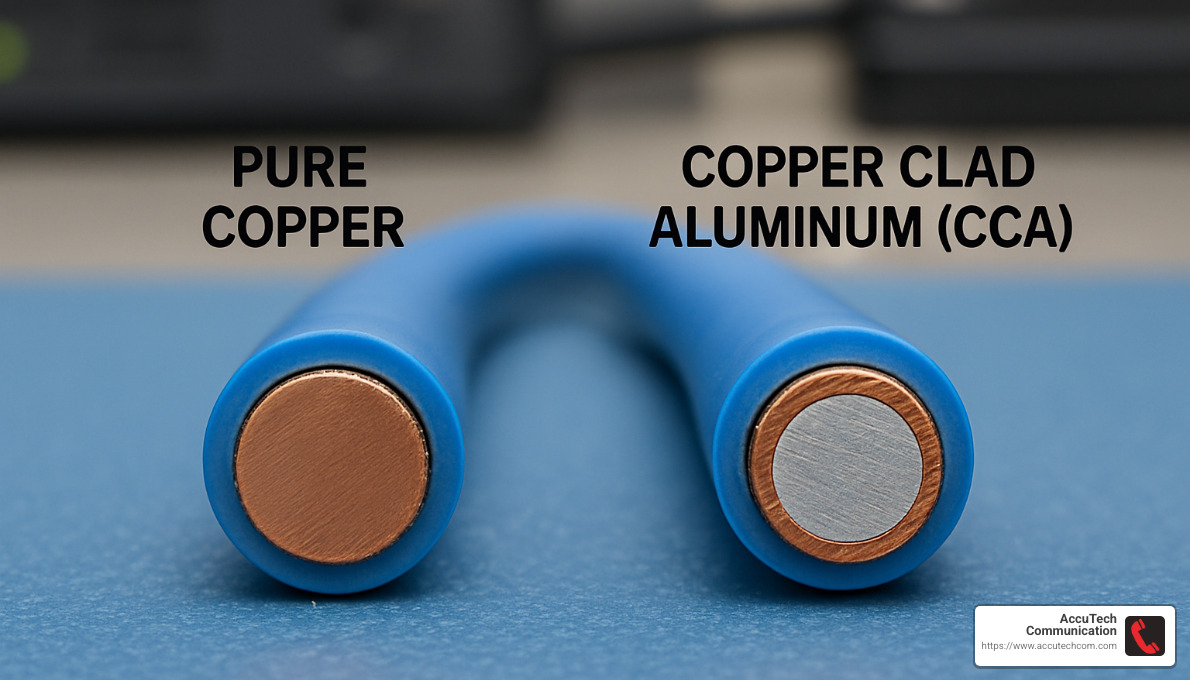
Another material consideration is the conductor composition:
- Pure copper conductors provide optimal performance and comply with TIA standards
- CCA (Copper Clad Aluminum) cables use aluminum cores with thin copper plating
- Less expensive but offer inferior performance
- Higher resistance, generating more heat with PoE
- Not compliant with TIA standards
- May void warranties and insurance coverage
At AccuTech Communications, we exclusively use 100% copper cables that meet or exceed all relevant standards, ensuring long-term reliability and performance for our clients throughout Massachusetts, New Hampshire, and Rhode Island.
Installation, Termination & Testing for Compliance
Proper installation is just as important as selecting the right ethernet cable standards. Even the highest-quality Cat8 cable will perform poorly if improperly installed.
Key installation considerations include:
- Maximum channel length: 100 meters total (typically 90 meters of horizontal cable plus two 5-meter patch cords)
- Bend radius: At least 4x cable diameter for unshielded, 8x for shielded
- Cable tension: No more than 25 pounds of pulling force
- Jacket ratings:
- CMP (Plenum) for air handling spaces
- CMR (Riser) for vertical shafts between floors
- CM/CMG for general purpose
- CMX for residential/limited use
Terminating to T568A or T568B
Proper termination is critical to maintaining the performance characteristics specified in ethernet cable standards. Whether using punch-down blocks, keystone jacks, or field-terminable plugs, several principles apply:
- Maintain the twist as close to the termination point as possible (untwist no more than 0.5 inches)
- Avoid excessive cable jacket removal
- Ensure proper pair placement according to T568A or T568B standards
- Terminate all conductors with the same tension
- Verify proper seating of conductors
As mentioned earlier, consistency in wiring standard (T568A or T568B) throughout a facility is more important than which standard you choose. Mixing standards can create confusion and potential crossover connections where not intended.
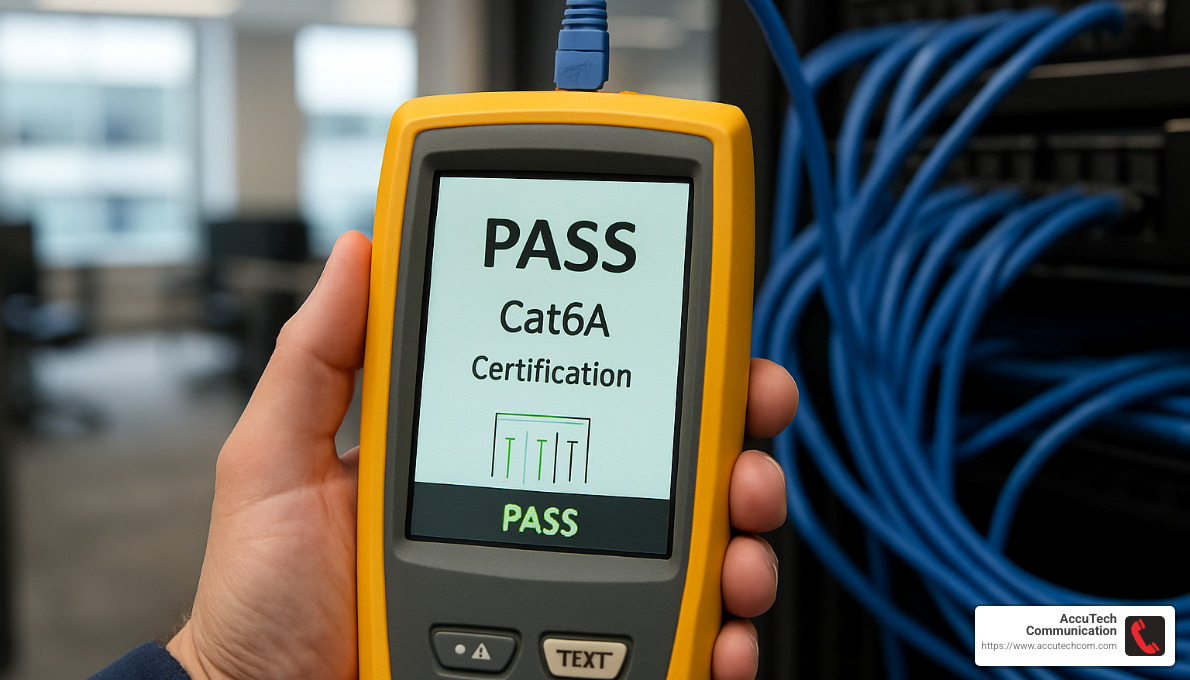
Verifying ethernet cable standards in the field
After installation, testing is essential to verify compliance with ethernet cable standards. Several levels of testing exist:
- Verification: Basic continuity and wiremap testing
- Qualification: Verifies if the cable can support specific network speeds
- Certification: Comprehensive testing against all parameters of the applicable standard
For professional installations, certification testing is the gold standard. It includes measurements of:
- Wire map: Proper conductor termination
- Length: Cable length within specifications
- Insertion loss (attenuation): Signal strength loss over distance
- NEXT (Near-End Crosstalk): Signal coupling between pairs at the same end
- PS-NEXT (Power Sum NEXT): Cumulative crosstalk from multiple pairs
- Return loss: Signal reflection due to impedance mismatches
- Propagation delay: Time for signal to travel the length of the cable
- Delay skew: Difference in propagation delay between pairs
At AccuTech Communications, we perform comprehensive certification testing on every installation, providing our clients with detailed documentation that verifies compliance with the appropriate ethernet cable standards.
Future Trends, Misconceptions & FAQs
The world of ethernet cable standards continues to evolve at a dizzying pace. As your network infrastructure partner, we’ve seen technologies come and go, but Ethernet has shown remarkable staying power—constantly adapting to meet new demands.
Emerging Standards on the Horizon
Remember when 100 Mbps seemed blazingly fast? Those days are long behind us! Today’s emerging standards are pushing boundaries we could barely imagine a decade ago.
Single-Pair Ethernet (SPE) is gaining traction for IoT and industrial applications. Unlike traditional four-pair cables, SPE uses just one twisted pair—perfect for connecting simple sensors and devices. The 10BASE-T1S standard delivers 10 Mbps up to 15 meters, while 10BASE-T1L extends that same speed to an impressive 1000 meters for building automation systems.
Meanwhile, the need for speed in data centers continues unabated. IEEE committees are actively developing the 802.3ck standard to support 100, 200, and 400 Gbps using advanced PAM4 signaling techniques. Looking even further ahead, the 802.3df working group is tackling the mind-boggling speeds of 800 Gbps and 1.6 Terabit Ethernet.
Even your car isn’t immune from the Ethernet revolution! Automotive Ethernet standards like 100BASE-T1 and 1000BASE-T1 are replacing the tangle of proprietary vehicle networking technologies with standardized, high-performance solutions.
Common Pitfalls When Selecting Cables
After installing thousands of networks throughout New England, we’ve seen clients make the same mistakes time and again when choosing ethernet cable standards.
Over-buying is surprisingly common—like purchasing a Ferrari for grocery runs. While Cat8 cabling might sound impressive on paper, it’s complete overkill for most office environments and wastes valuable budget dollars that could be better spent elsewhere.
The opposite problem—under-buying—can be even more costly in the long run. We often find businesses installing Cat5e to save money when Cat6 would provide better long-term value and future-proofing for just a modest upfront premium.
Environmental factors trip up many IT planners too. Using unshielded cable in high-interference areas is like trying to have a quiet conversation at a rock concert—the message gets lost in the noise. Similarly, installing cables with the wrong jacket rating (like using CM-rated cable in plenum spaces) can violate building codes and create serious safety hazards.
One of the most troubling trends we’ve encountered is the rise of copper-clad aluminum (CCA) cables. These bargain-basement options might save money initially, but they don’t meet TIA standards, void warranties, and often fail prematurely—especially with Power over Ethernet applications.
And please, don’t mix cable categories in a channel! Your network will only perform to the level of the lowest category component, creating bottlenecks and performance issues that can be maddening to troubleshoot.
Frequently Asked Questions about ethernet cable standards
What is the maximum recommended length for a twisted-pair run?
“How far can I run this cable?” might be the single most common question we hear. The short answer is 100 meters (328 feet) total channel length. But there’s a bit more nuance to it.
That 100-meter maximum typically breaks down into a 90-meter horizontal permanent link (the cable in your walls or ceilings) plus two 5-meter patch cords (one at each end). Push beyond this limit, and you’ll face increased signal attenuation and potential communication failures.
Need to go further? You have options! Fiber optic cabling can extend much farther, or you can use Ethernet extenders or intermediate switches to boost your signal. We’ve helped clients connect buildings hundreds of meters apart without sacrificing performance.
Do I need shielded cable in a typical office?
For most standard office environments, unshielded twisted-pair (UTP) cabling works perfectly fine. It’s simpler to install, more flexible, and typically less expensive.
That said, shielded cable becomes your friend when dealing with significant sources of electromagnetic interference, cables running parallel to electrical power lines, or environments with heavy machinery or medical equipment. It’s also increasingly important for 10 Gbps or faster networks where alien crosstalk becomes a significant concern.
One crucial tip: shielded cable must be properly grounded to be effective. We’ve actually seen improperly grounded shielding worsen performance by acting as an antenna for interference—the exact opposite of what you want!
Can I mix Cat5e and Cat6 in the same network?
Yes, different categories of Ethernet cable can absolutely coexist in the same network—we do it all the time during phased upgrades. However, your overall performance will be limited by the lowest category component in any given channel.
Think of it like a highway system. You can build eight-lane superhighways (Cat6a) between cities, but if the exits and on-ramps are still two-lane roads (Cat5e), you’ll still face bottlenecks. A connection with Cat6 horizontal cabling but Cat5e patch cords will only support Cat5e performance (1 Gbps to 100 meters).
For optimal performance, we typically recommend maintaining consistency in cable categories throughout your network infrastructure, especially for critical links between core network devices.
At AccuTech Communications, we help businesses throughout Massachusetts, New Hampshire, and Rhode Island steer these complex choices and build future-ready networks that balance performance, reliability, and budget considerations.
Conclusion
Understanding ethernet cable standards is like learning the foundation of a house – get it right, and everything built on top will be stable for years to come. Throughout my years at AccuTech Communications, I’ve seen how proper cabling provides the bedrock for all the digital tools businesses rely on daily – from basic internet to sophisticated cloud applications.
After diving deep into twisted pairs and MHz ratings, let’s bring it all together with some practical wisdom:
First, match your cable category to your actual needs. Cat6a might be fantastic, but if you’re setting up a small office with modest bandwidth requirements, Cat5e could serve you perfectly well while saving you money. On the flip side, trying to run a data-intensive operation on outdated cabling is like trying to drink a milkshake through a coffee stirrer – technically possible but frustratingly inefficient.
The details matter too. Shielding isn’t just a fancy upgrade – in environments with high interference, it’s essential. Similarly, solid conductors excel in fixed installations, while stranded cables make better patch cords. These seemingly small choices add up to significant differences in real-world performance.
I can’t emphasize enough how proper installation transforms even average cable into a reliable performer. I’ve seen beautiful Cat6a installations underperform because someone pulled too hard during installation or untwisted too much cable at termination points. The best cable in the world can’t overcome poor installation practices.
Trust but verify – that’s why we always perform certification testing at AccuTech. It’s not just about checking boxes; it’s about having confidence that when you plug in that mission-critical server or VoIP phone system, it will work flawlessly at the speeds you expect.
Being future-proof doesn’t mean buying the most expensive option available. It means thoughtfully considering your growth trajectory and selecting a solution that accommodates reasonable expansion. Think three to five years ahead, not twenty.
Since 1993, our team at AccuTech Communications has been helping businesses throughout Massachusetts, New Hampshire, and Rhode Island build network infrastructure that lasts. We understand that ethernet cable standards aren’t just technical specifications – they’re the difference between a network that enables your business and one that constrains it.
Whether you’re planning a new office space, upgrading existing infrastructure, or troubleshooting persistent connectivity issues, we bring decades of hands-on experience to every project. Our certified technicians don’t just install cables – we create solutions custom to your unique environment.
Ready to build a rock-solid foundation for your network? Let’s talk about how we can help. For more information about our comprehensive approach to network infrastructure, visit our network cabling installation page.
