
Fiber Optic Monitoring System: Top 5 Powerful Benefits
In the fast-evolving world of communication infrastructure, fiber optic monitoring system plays a crucial role in ensuring network integrity and reliable services. Businesses today expect seamless connectivity and uninterrupted operations, making it essential to identify issues in real-time. Here’s a quick overview of how a fiber optic monitoring system improves network stability:
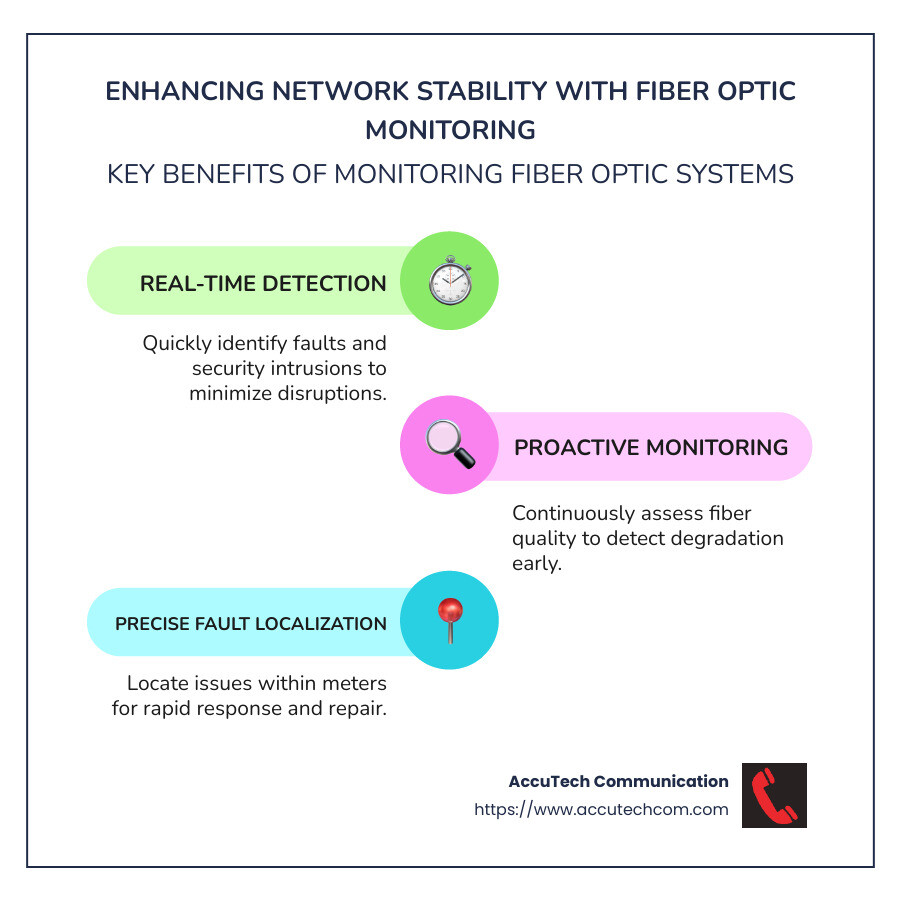
- Real-time Detection: Instantly identify faults and security intrusions to minimize disruptions.
- Proactive Monitoring: Constant assessment of fiber quality to detect degradation early.
- Precise Fault Localization: Pinpoint issues within meters for rapid response and repair.
Fiber optic cables are fundamental to modern communication, but they’re vulnerable to several hazards. From accidental cuts to environmental factors, maintaining their optimal performance is crucial. With fiber optic monitoring systems, not only can businesses identify problems quickly, but they can also prevent potential downtime, safeguarding their operations.
I’m Corin Dolan, with experience in optimizing fiber networks for businesses. My background in fiber optic monitoring system implementation has helped numerous companies improve their network reliability and performance.
Understanding Fiber Optic Monitoring Systems
Fiber optic monitoring systems are like the guardians of your network. They keep a watchful eye on the fiber optic cables that carry data across the globe. These systems ensure that the fiber quality is top-notch and that any issues are detected and resolved quickly.
Components of a Fiber Optic Monitoring System
At the heart of any fiber optic monitoring system are several key components:
- Optical Time-Domain Reflectometer (OTDR): Think of this as the detective of the system. It sends pulses of light down the fiber and measures the light that is reflected back. This helps pinpoint the exact location of any faults or breaks in the fiber.
- Optical Spectrum Analyzer: This tool analyzes the light signals traveling through the fiber. It’s like a health check-up for your network, ensuring that everything is functioning as it should.
- Real-Time Diagnostics: This feature allows for continuous monitoring of the network. It provides instant feedback on any issues, ensuring they can be addressed without delay.
The Role of Remote Fiber Test Systems (RFTS)
Remote Fiber Test Systems (RFTS) are the backbone of effective fiber monitoring. They collect data from various points in the network and provide comprehensive analytics. Here’s how they work:
- Data Collection: RFTS gather information from the fiber network, including signal strength and quality. This data is crucial for identifying potential problems.
- Network Analytics: Once the data is collected, it’s analyzed to provide insights into the network’s health. This includes identifying trends and predicting potential issues before they become serious problems.
- Secure Web Access: All this information is accessible through a secure web portal. This allows network administrators to monitor the system from anywhere, ensuring they are always informed and ready to act.
With an integrated management approach, these systems ensure that every aspect of the network is monitored and maintained. This proactive stance not only helps in maintaining the network’s health but also in enhancing its efficiency and reliability.

When communication is key, having a robust fiber optic monitoring system in place is not just beneficial—it’s essential. These systems are critical for maintaining the integrity and performance of fiber optic networks, ensuring that businesses can rely on their connectivity without worry.
In the next section, we’ll dive deeper into why fiber optic monitoring is so important for network infrastructure, fault detection, and security.
The Importance of Fiber Optic Monitoring
Fiber optic monitoring is crucial for maintaining a strong and reliable network infrastructure. These systems ensure that the thousands of data-carrying fibers remain intact and perform optimally. Let’s explore why proactive monitoring is beneficial and the challenges it faces.
Benefits of Proactive Monitoring
Proactive monitoring of fiber optic networks offers several advantages:
- Fault Localization: With tools like the Optical Time-Domain Reflectometer (OTDR), network operators can pinpoint the exact location of faults. This means repairs can be targeted and efficient, reducing the time needed to fix issues.
- Reduced Downtime: By identifying problems before they escalate, proactive monitoring minimizes network downtime. This ensures that businesses and residential customers experience fewer disruptions.
- Improved Service Level Agreements (SLAs): Faster repair cycles and consistent network performance lead to better service agreements with customers. This not only improves customer satisfaction but also builds loyalty.
- Security Intrusions: Fiber monitoring systems can detect unauthorized access or intrusions, safeguarding sensitive data. This is especially important in a world where data security is paramount.
Challenges and Limitations
Despite its benefits, fiber optic monitoring also faces some challenges:
- Dead Zones: During a “black-out” period when a detector is recovering, it may fail to detect nearby events. This can obscure new issues, complicating fault detection.
- Dark Fiber: Unused or “dark” fibers still need monitoring to ensure they are ready for future use. Monitoring these fibers helps verify cable integrity without affecting active fibers.
- Testing Interference: Factors like water ingress or rodent damage can interfere with testing. These need to be managed to ensure accurate monitoring results.
Fiber optic monitoring systems are essential for maintaining the health and security of network infrastructure. By addressing faults promptly and ensuring continuous operation, these systems play a critical role in modern communication networks.
In the next section, we’ll explore advanced fiber monitoring technologies, including innovations in passive optical networks (PON) and improvements in security.
Advanced Fiber Monitoring Technologies
In the changing world of fiber optics, staying ahead means embracing advanced technologies. Modern fiber optic monitoring systems are not just about spotting faults; they’re about ensuring network integrity and security. Let’s explore some of the cutting-edge technologies making this possible.
Innovations in Monitoring
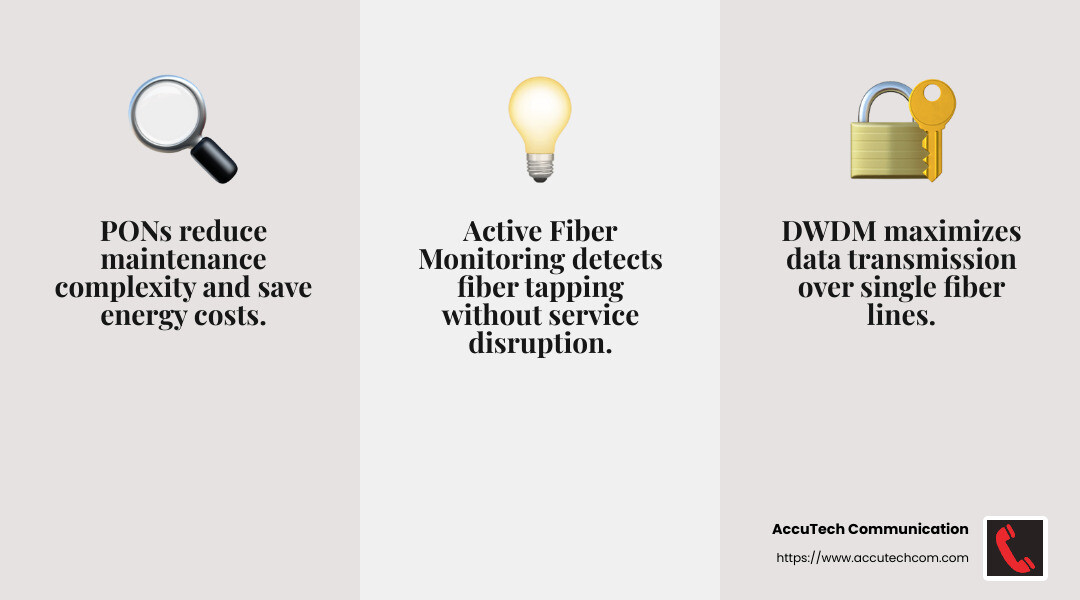
Passive Optical Networks (PON) are a game-changer. They allow data to be transmitted over long distances without the need for powered devices along the way. This not only saves on energy costs but also reduces maintenance complexity. PONs are particularly beneficial for delivering high-speed internet to homes and businesses.
Dense Wavelength Division Multiplexing (DWDM) and Coarse Wavelength Division Multiplexing (CWDM) are techniques that increase the capacity of fiber optic cables. By sending multiple signals over the same fiber at different wavelengths, these technologies maximize the amount of data transmitted. This is crucial for meeting the growing demand for bandwidth.
Active Fiber Monitoring (AFM) is another innovation that improves security. Unlike traditional methods that require separate fibers for monitoring, AFM can monitor active fibers carrying live data. This means potential issues, like fiber tapping, can be detected without disrupting service.
Monitoring for Security and Integrity
Security is a top priority in fiber networks. Optical Time-Domain Reflectometer (OTDR) technology plays a vital role in this. By accurately locating faults, OTDR ensures that any breaches or potential intrusions are quickly identified and resolved.
Fiber tapping, where unauthorized parties access data by bending the fiber to leak light, is a real threat. Advanced monitoring systems can detect changes in light transmission, alerting operators to potential breaches. Intrusion detection systems, combined with encryption, add an extra layer of protection. Encrypting data ensures that even if it is intercepted, it cannot be read without the decryption key.
These technologies underscore the importance of a robust fiber monitoring strategy. By leveraging innovations like PON, DWDM, and AFM, network operators can ensure both the efficiency and security of their fiber optic networks.
In the next section, we’ll address some frequently asked questions about fiber optic monitoring systems and how they work.
Frequently Asked Questions about Fiber Optic Monitoring Systems
What is fiber optic monitoring?
Fiber optic monitoring is a process that keeps an eye on the quality and performance of fiber optic networks. It’s like having a health check-up for your network. Using specialized software tools and management systems, it detects faults, degradation, or even security threats in real-time. This ensures that any issues are addressed quickly, keeping the network running smoothly.
Fiber optic monitoring systems are crucial because they help maintain the mechanical integrity of the network. This means ensuring the physical structure of the fiber cables remains intact and free from damage.
How do fiber optic sensors work?
Fiber optic sensors are fascinating devices that use the optical properties of fiber cables to monitor various conditions. Imagine them as tiny detectives inside the fiber, looking for changes in the light that travels through the cables. These changes can indicate physical changes, like bending or stretching, which might signal a problem.
These sensors are incredibly useful in monitoring large structures, such as bridges or buildings. They can detect shifts or strains that might not be visible to the naked eye, helping to prevent potential failures or damage.
How can I get fiber optics installed at my home?
Getting fiber optics installed in your home is a straightforward process. Here’s how it typically works:
- Installation Scheduling: First, you’ll need to contact a service provider to schedule an installation. They will provide you with a date and time for the technician’s visit.
- Technician Visit: On the scheduled day, a technician will come to your home. They will install the necessary equipment and ensure your home is ready to connect to the fiber optic network.
- Service Setup: After installation, the technician will set up the service, making sure everything is working correctly. They’ll test the connection and show you how to use any new equipment.
With fiber optics, you can enjoy fast and reliable internet, perfect for streaming, gaming, or working from home.
In the next section, we’ll wrap up our guide with a look at how AccuTech Communications can help you with your fiber network solutions.
Conclusion
At AccuTech Communications, we pride ourselves on delivering top-notch fiber network solutions. Our commitment to quality and customer satisfaction has been steadfast since 1993. With decades of experience, we understand the importance of reliable and efficient fiber optic systems.
Our team offers a comprehensive range of services custom to meet your unique business needs. From the initial consultation to the final installation, we ensure that every step is executed with precision and care. Our skilled technicians and engineers are equipped to handle any challenge, ensuring your network infrastructure is optimized for peak performance.
Why Choose AccuTech Communications?
- Certified Expertise: Our technicians are trained to provide certified and reliable service. You can trust us to deliver results that meet industry standards.
- Competitive Pricing: We offer quality services at competitive prices, ensuring you get the best value for your investment.
- Commitment to Quality: Our commitment to quality is unwavering. We strive to exceed your expectations with every project.
Whether you’re looking to upgrade your current network or install a new fiber optic system, we have the expertise and resources to help. Our focus is on providing solutions that improve network integrity and performance.
To learn more about how we can assist you with your fiber network needs, visit our Fiber Optic Cable page. Let us be your trusted partner in building a robust and reliable network infrastructure.
Your network is the backbone of your business. With AccuTech Communications, you can be confident that it will be stronger than ever.
