
Fiber Optic Technology History: 10 Powerful Milestones 2025
Why Fiber Optic Technology History Matters for Modern Business
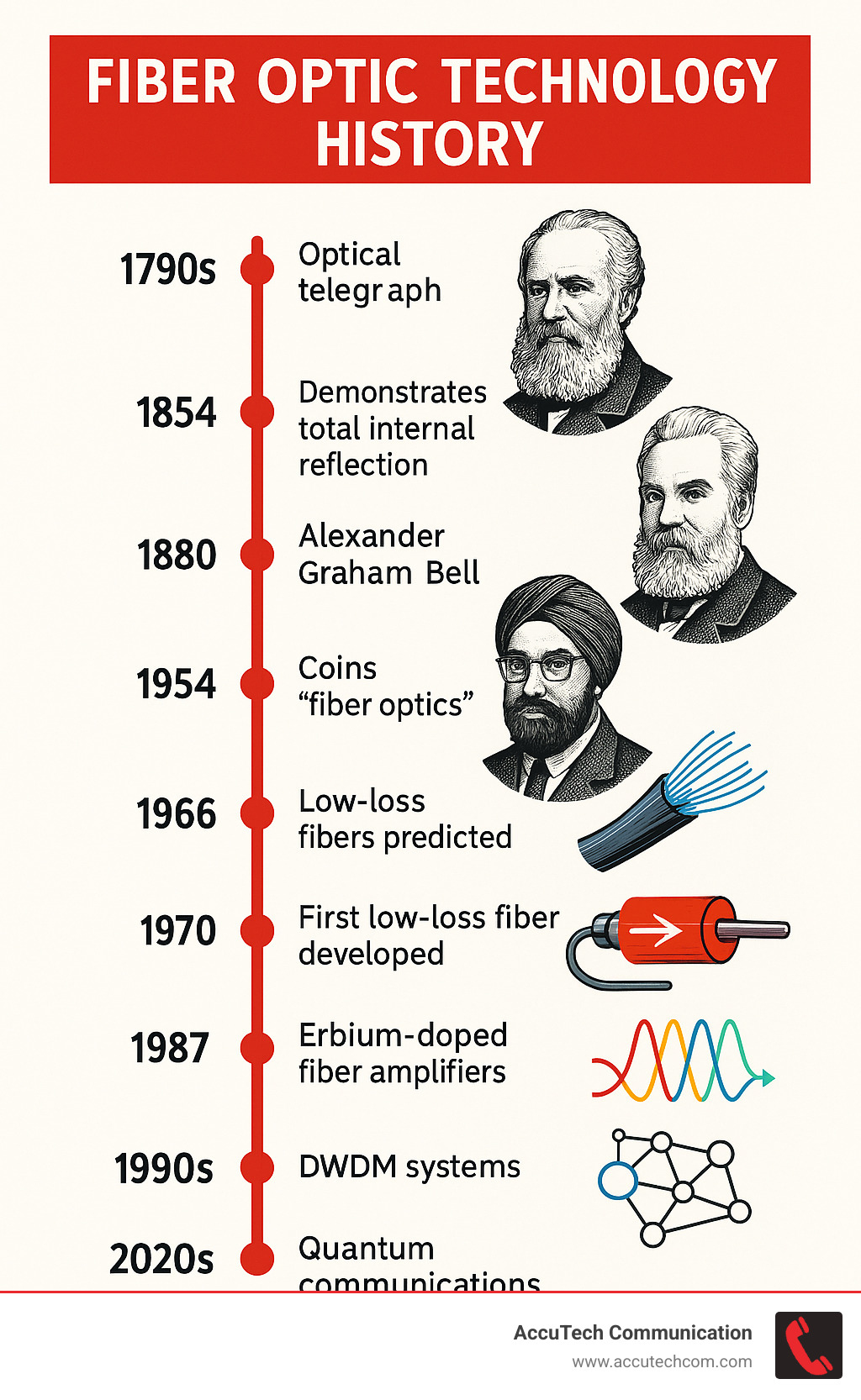
Fiber optic technology history stretches more than two centuries, moving from simple light signals on hill-top semaphores to the glass highways that carry today’s internet. For New England companies weighing cabling upgrades, seeing that arc of progress makes it easier to trust that fiber will remain the safest long-term bet.
Key Milestones
1790s – Chappe optical telegraph
1841 – Colladon guides light through water
1880 – Bell’s photophone
1954 – Kapany coins “fiber optics”
1966 – Kao predicts low-loss silica
1970 – Corning’s 17 dB/km fiber
1977 – First live phone traffic on fiber
1988 – TAT-8 transatlantic cable
1990s – DWDM terabit era
2020s – Fiber proves pandemic-ready
What began as scientific curiosity is now a $7.5 billion global market. Because the same physics that bent light in John Tyndall’s 1854 fountain still drives today’s networks, investments made in 2024 will stay relevant for decades.
I’m Corin Dolan, owner of AccuTech Communications, helping businesses in Massachusetts, New Hampshire, and Rhode Island steer this technology since 1993. The brief history above shows why we continue to recommend fiber: every breakthrough has added capacity, reliability, and lifespan—never subtraction.
Relevant terms:
• fiber optic cable technology
• fiber optic monitoring system
• fiber optic sensing technology
Understanding the Science Behind Fiber Optics
Sending data as light through glass thinner than a hair sounds magical, but it rests on three ideas:
- Core & cladding – a high-index core surrounded by lower-index cladding keeps light trapped by total internal reflection.
- Ultra-pure silica – modern fibers lose just 0.2 dB/km at 1550 nm, versus early 1960s fibers that lost 1000 dB/km.
- Laser precision – narrow-band lasers inject light cleanly into single-mode cores only 8–10 µm wide.
| Fiber | Copper | |
|---|---|---|
| Attenuation | 0.2 dB/km | 10+ dB/km |
| Reach w/o repeater | 100 km+ | <0.1 km |
| EMI immunity | Yes | No |
| Typical lifespan | 25 yrs+ | 10–15 yrs |
Why Light Stays Inside
When light in the core hits the cladding boundary above the critical angle, Snell’s Law forces it to reflect back—like an invisible mirror tunnel first demonstrated by Tyndall’s water fountain.
From Preform to Cable
Manufacturers create ultra-pure glass preforms with MCVD, heat them to ~2000 °C, draw kilometer-long strands, then add protective coatings. AccuTech technicians splice those strands with <0.1 dB loss—vital for your real-world performance.
For deeper details, see our guides on fiber optic cabling and how to install fiber optic cable.
Fiber Optic Technology History: Pioneering Experiments to Mid-Century
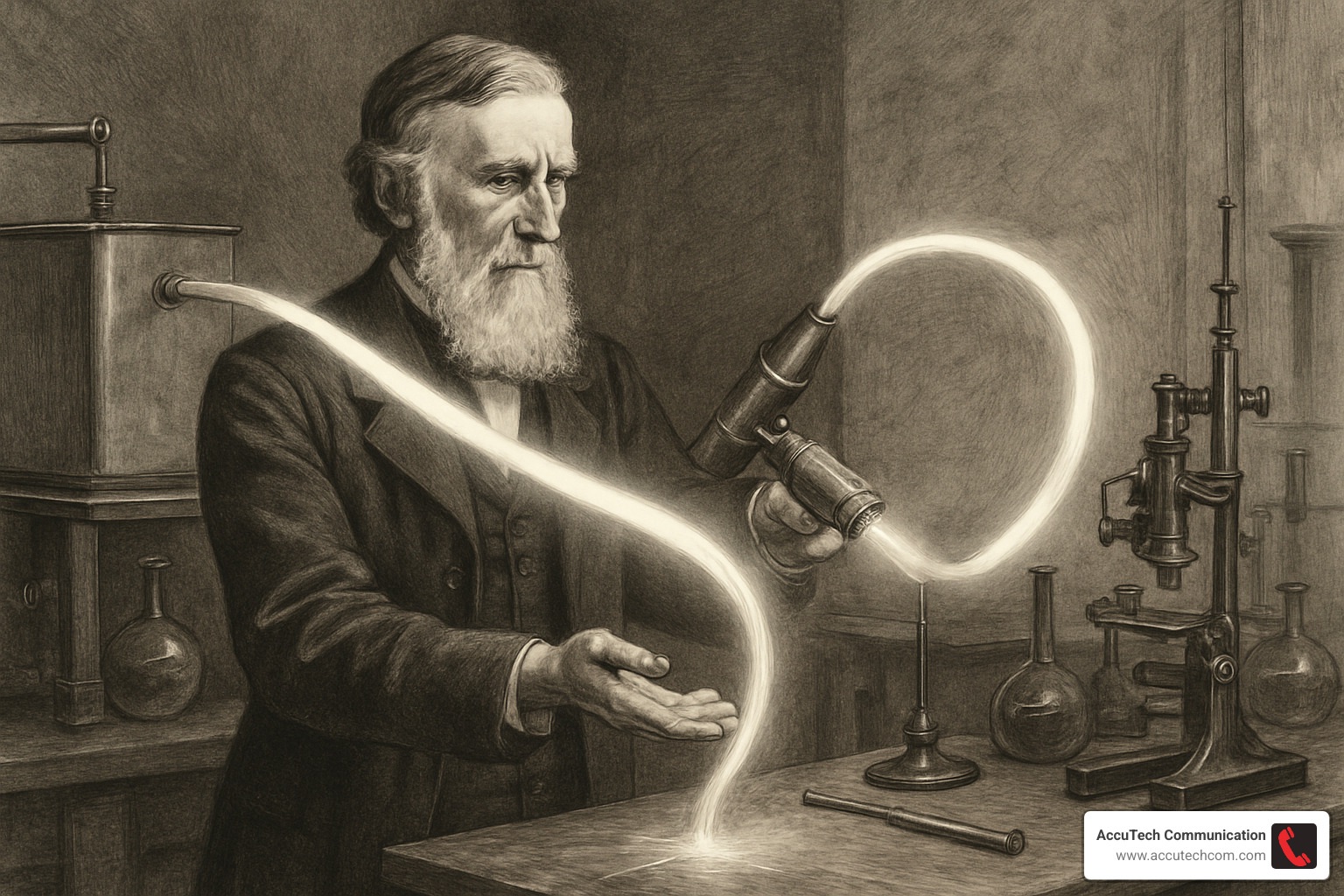
Early inventors were already steering light long before electronic communication existed.
• 1840s – Colladon & Babinet showed light hugging a water stream, revealing total internal reflection.
• 1854 – John Tyndall popularized the demo before London audiences.
• 1880 – Alexander Graham Bell’s photophone transmitted speech 213 m on a light beam—foreshadowing today’s fiber calls.
Medical pioneers soon bent glass rods for illumination, and by 1930 Heinrich Lamm sent the first image through a fiber bundle. In the 1950s, Narinder Singh Kapany added cladding and coined fiber optics, while Abraham Van Heel perfected coherent bundles. Losses were still 1 dB/m—fine for endoscopes, not telephones—but the foundation was laid.
Breakthroughs That Made Long-Distance Communication Possible (1960s-1980s)

The game-changing idea arrived in 1966 when Dr. Charles Kao argued that impurity—not glass itself—caused high loss. He predicted a feasible target of 20 dB/km.
1970 – Corning delivers. Their 17 dB/km fiber, followed by 4 dB/km multimode in 1972, proved Kao right and triggered frantic development of MCVD manufacturing.
Field trials moved quickly:
• 1975 Dorset police link (UK)
• 1977 Chicago 6 Mbps trial—first live phone traffic over fiber
By the 1980s fiber criss-crossed nations. Sprint built the first all-digital U.S. backbone, and the 1988 TAT-8 cable carried 40,000 calls under the Atlantic. The erbium-doped fiber amplifier (1986) removed the need to convert light to electricity at every repeater, slashing costs and boosting reliability.
Global Expansion and the Internet Boom (1990s-2010s)

The web’s arrival demanded more bandwidth than copper or satellites could ever offer. Fiber delivered by multiplying capacity without adding glass:
Dense Wavelength Division Multiplexing (DWDM) split a single strand into dozens—now hundreds—of color channels. Early 1990s systems pushed 16×2.5 Gbps; modern links carry 80×400 Gbps.
Monster projects followed: TPC-5 (1996) spanned 21,000 km across the Pacific; FLAG (1997) looped 28,000 km around three continents. Although the 2001 dot-com crash left “dark fiber” idle, it later fuelled affordable broadband.
Fiber-to-the-Home
The GPON standard (2003) let providers split one fiber to 32–64 homes. Deployments such as Verizon FiOS (2005) and Chattanooga EPB (2012) proved gigabit service could be mainstream. COVID-19 traffic spikes in 2020 underscored fiber’s headroom and inspired the $65 billion BEAD program, strongly favoring FTTH.
For business impact, see how fiber optic cabling can improve performance.
Cutting-Edge Innovations & Future Outlook
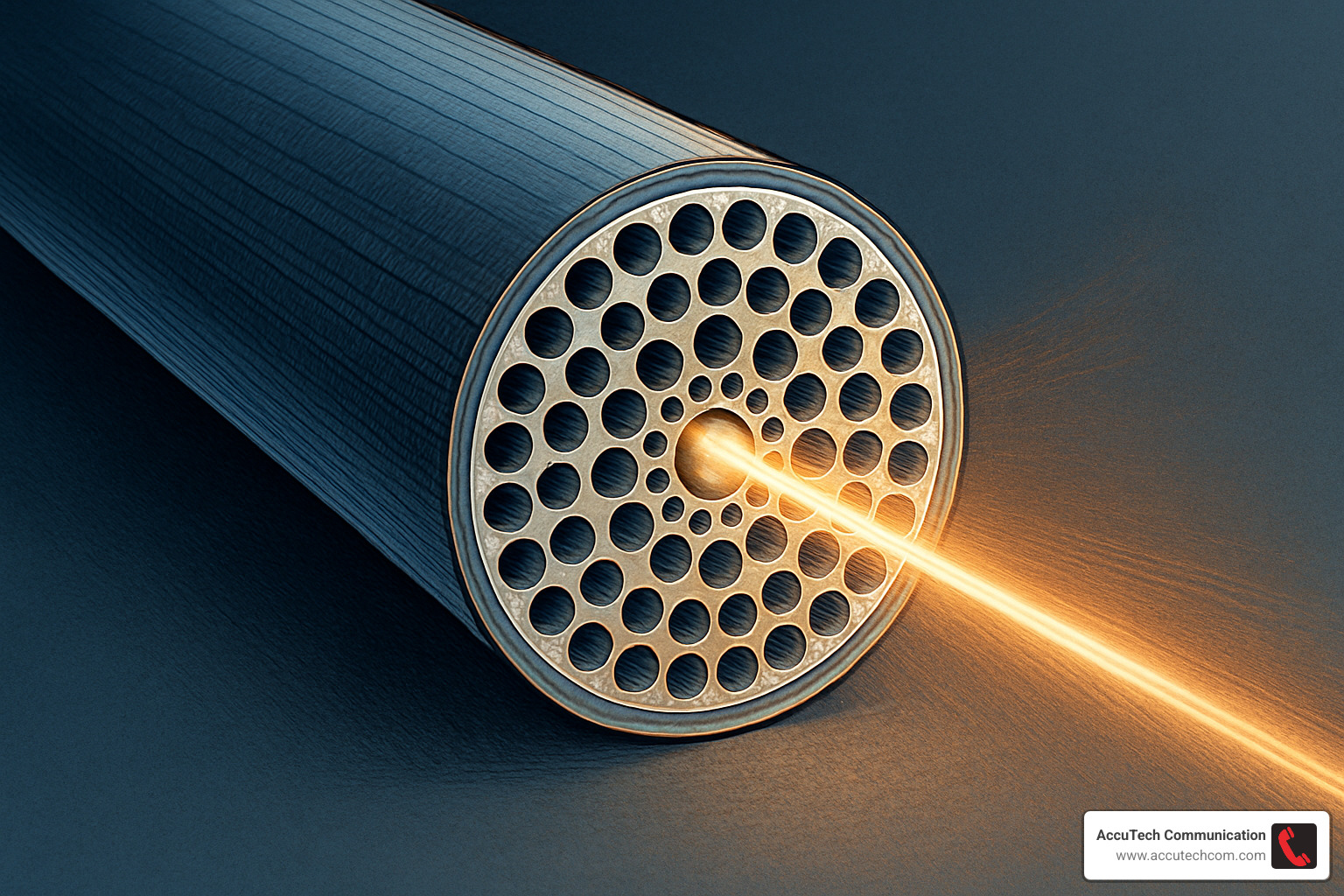
Fiber’s evolution is far from over:
• Hollow-core fibers (commercial 2021) move light through air, cutting latency ~30%.
• Photonic crystal fibers guide light via tiny hole patterns—ideal for high-power lasers and sensors.
• Ultra-low-loss records now sit at 0.154 dB/km, nearing silica’s theoretical floor.
• Bend-insensitive designs simplify tight indoor runs.
• Quantum key distribution over fiber offers encryption immune to classical hacking.
Challenges remain—installation cost in rural areas, cybersecurity for control electronics, and responsible recycling—but each generation of innovation has solved its predecessor’s limits. ITU standards will steer the next leap, while AccuTech keeps New England companies ready for it.
Frequently Asked Questions about Fiber Optic Technology History
How did lasers transform fiber communications?
Early fiber experiments used LEDs, but their broad light spectrum limited distance. Continuous-wave semiconductor lasers, first practical in 1970, produced narrow, high-power beams that fit perfectly into single-mode cores and later enabled DWDM. Without lasers, today’s terabit backbones would be impossible.
What makes fiber faster and more reliable than copper?
Light pulses in glass face almost zero resistance and are immune to electromagnetic interference. Modern fiber loses only 0.2 dB/km, so signals travel 100 km before amplification; copper needs boosting after a few hundred meters and is vulnerable to lightning, crosstalk, and corrosion.
When were the first low-loss fibers manufactured?
Corning produced the breakthrough 17 dB/km fiber in 1970, validating Charles Kao’s 1966 prediction. Losses fell below 0.5 dB/km by 1979 and reach 0.154 dB/km today.
Conclusion
The journey from Colladon’s 1841 water trick to 22-petabit test beds proves one thing: fiber capacity keeps growing while cost per bit keeps falling. At AccuTech Communications, we’ve watched that trend since 1993—installing networks across Metro-West Boston, Worcester, Waltham, Woburn, and beyond.
When you choose fiber, you’re not just buying cable; you’re plugging into two centuries of uninterrupted innovation that continues to accelerate. Ready to future-proof your business network?
Explore our fiber solutions and let’s build the next chapter together.
