
The New Standard for Business Connectivity

Fiber optics for business delivers internet connectivity using light pulses through glass cables, providing significantly faster speeds, greater reliability, and improved security compared to traditional copper-based broadband. Business fiber plans offer symmetrical upload and download speeds ranging from 1 Gbps to 100 Gbps, with dedicated options ensuring consistent performance and 99.9% uptime guarantees.
Key Benefits of Business Fiber Optics:
- Speed: Symmetrical speeds from 1 Gbps to 100+ Gbps
- Reliability: 99.9% uptime, immune to electromagnetic interference
- Security: Light signals are difficult to intercept or tap
- Distance: Minimal signal loss over long distances
- Scalability: Easily upgrade bandwidth as your business grows
In today’s digital-first economy, your internet connection is more than a utility—it’s the backbone of your entire operation. Slow speeds, unreliable service, and data bottlenecks can grind productivity to a halt, especially for businesses running cloud applications, video conferencing, or large data transfers.
Traditional broadband technologies like DSL and cable were designed for residential use and simply can’t keep up with modern business demands. Maybe you own a healthcare facility where employees rely on cloud-based patient records, or perhaps you lead a manufacturing operation where real-time data processing is critical. Whatever your business, there’s a good chance that quality internet is an important factor in your success.
This guide explores why traditional broadband is no longer enough and how fiber optic internet is becoming the essential upgrade for future-proofing your business. We’ll break down the technology in plain language, show you how it transforms daily operations, and walk you through the selection and implementation process.
I’m Corin Dolan, owner of AccuTech Communications, and I’ve been helping businesses across Massachusetts, New Hampshire, and Rhode Island upgrade to professional fiber optics for business solutions since 1993. Our team specializes in designing scalable network infrastructure that evolves with your business needs, ensuring reliable connectivity that supports your long-term success.
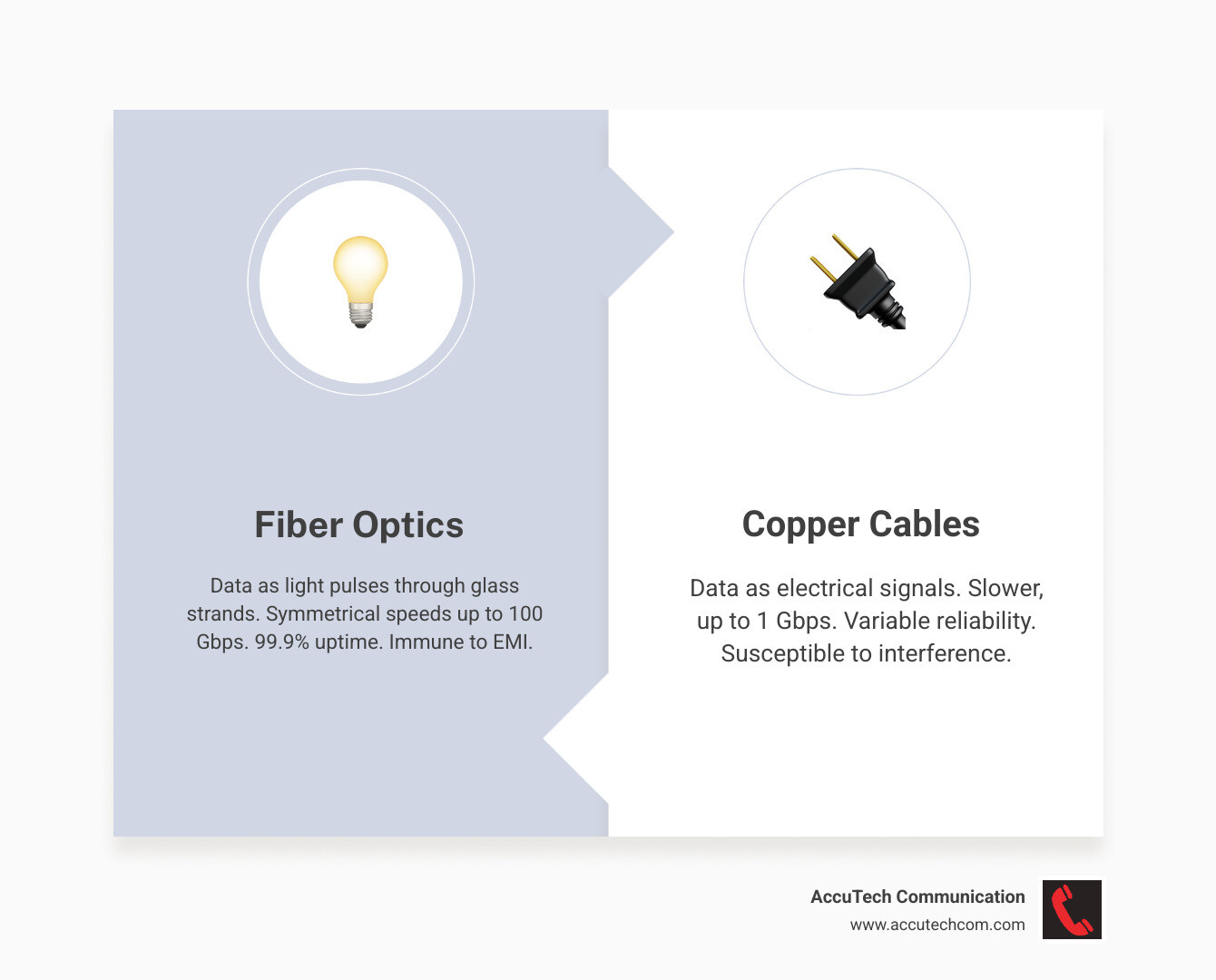
Fiber optics for business terms at a glance:
The Best Advantages of Fiber Optics for Business

At its core, fiber optics for business operates on a principle as neat as it is effective: using light to transmit data. Unlike traditional copper cables that rely on electrical signals, fiber optic cables send information as pulses of light through incredibly thin strands of glass or plastic. This fundamental difference is what open ups a world of superior performance, reliability, and security for your business in Massachusetts, New Hampshire, and Rhode Island.
Blazing-Fast, Symmetrical Speeds
Imagine sending and receiving data at nearly the speed of light – that’s the promise of fiber optics for business. Because data travels as light pulses, it moves incredibly fast and efficiently. This isn’t just about faster downloads; it’s about symmetrical speeds, meaning your upload speeds are as fast as your download speeds.
Why does symmetrical speed matter? For businesses, it’s a game-changer. Whether you’re uploading large CAD files, backing up critical data to the cloud, or hosting a high-definition video conference with clients, you need robust upload capabilities. Traditional broadband often offers much slower upload speeds, creating bottlenecks that can frustrate your team and hinder productivity.
With fiber optics for business, speeds commonly range from 1 Gbps (Gigabit per second) up to 100 Gbps, and for the most demanding institutional and large enterprise requirements, speeds can even reach 400 Gbps. This immense bandwidth ensures that even during peak usage hours, your internet connection remains stable and fast, avoiding the frustrating slowdowns common with shared, copper-based connections. This level of speed is essential for businesses that rely on data-intensive applications and cloud services to operate efficiently.
Superior Reliability and Uptime
Downtime is a business’s worst nightmare. Every minute your internet is down translates to lost productivity, missed opportunities, and potentially, lost revenue. One of the most compelling advantages of fiber optics for business is its inherent reliability.
Fiber optic cables are immune to electromagnetic interference (EMI), which can plague copper cables and disrupt service. This means your connection won’t be affected by nearby electrical equipment, power lines, or even lightning strikes. Furthermore, fiber is far more resistant to environmental factors like extreme weather conditions and temperature fluctuations. We’ve seen how harsh New England winters can impact infrastructure, but fiber holds strong.
Unlike copper, which experiences significant signal degradation over long distances, fiber optic cables can carry a signal efficiently and with fidelity for many miles without the need for signal boosters. This means fewer points of failure in your network infrastructure. Combined, these factors contribute to a remarkable 99.9% uptime potential, giving your business the consistent, dependable connectivity it needs to thrive.
Improved Data Security
In an era of increasing cyber threats, data security is paramount for any business. Fiber optics for business offers a significant advantage in this regard. Because fiber optic cables transmit data as light pulses, they are incredibly difficult to tap or intercept without detection. Any attempt to physically interfere with the cable would cause a noticeable disruption in the light signal, immediately alerting network administrators.
This contrasts sharply with copper wires, which can be more susceptible to electronic eavesdropping. The inherent nature of light transmission makes fiber a more secure medium for your sensitive business data. When combined with dedicated internet access, fiber provides a private, protected pathway for your information, safeguarding secure data transfers and backups from external threats. It’s a crucial layer of defense for businesses handling confidential client information, financial records, or proprietary intellectual property.
How Fiber Transforms Key Business Operations
A high-performance fiber connection isn’t just a faster internet line; it’s the catalyst for modernizing how your business operates, communicates, and grows. It removes digital roadblocks and opens up the full potential of cloud-based tools and collaborative platforms, allowing your team to work smarter, not harder.
Cloud Computing and SaaS
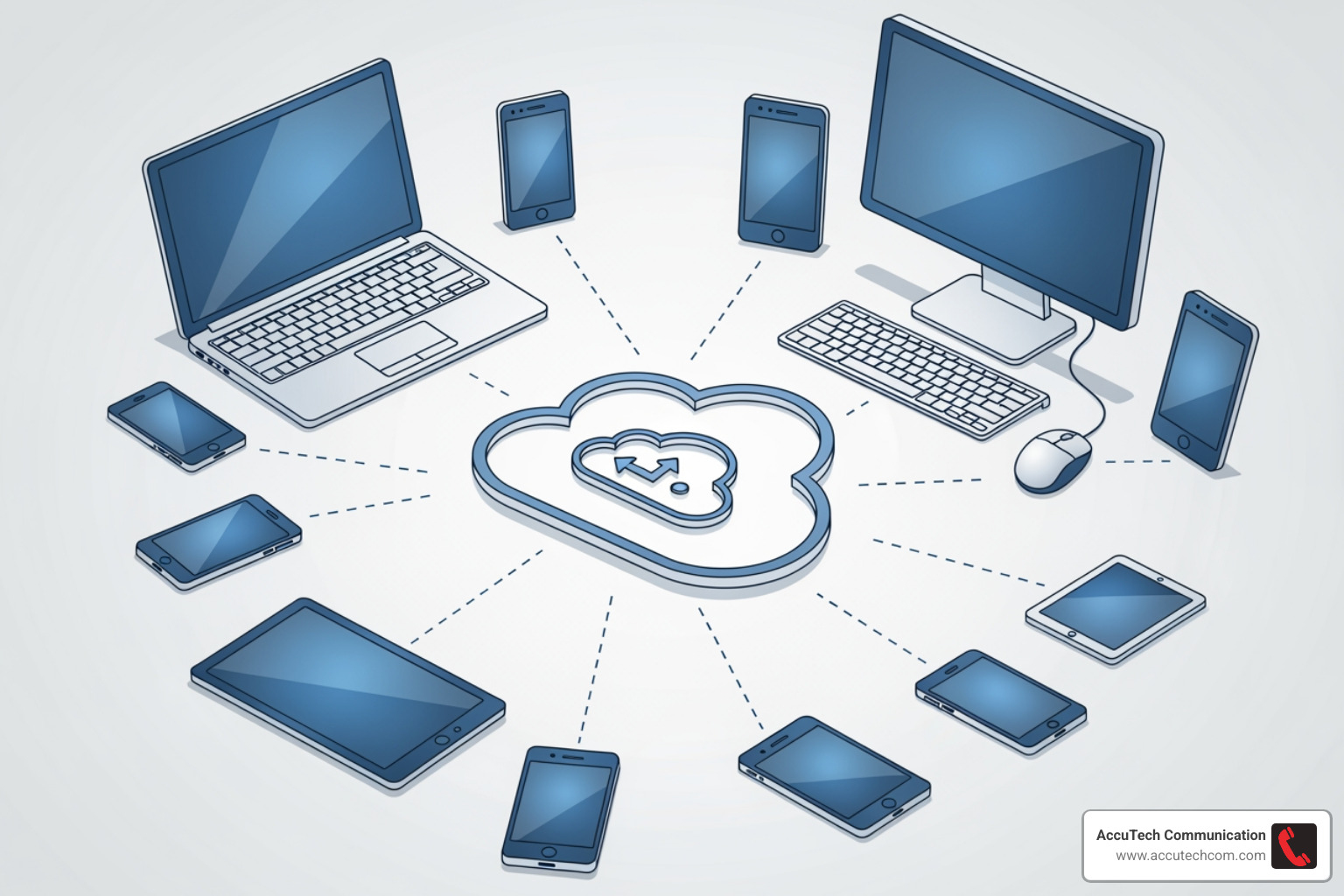
Cloud computing and Software-as-a-Service (SaaS) applications have become indispensable for businesses of all sizes, from managing customer relationships (CRM) to enterprise resource planning (ERP). However, the full potential of these tools can only be realized with a robust internet connection. Fiber optics for business eliminates the latency that often plagues traditional connections, ensuring your cloud applications respond in real-time.
With fiber, your team experiences faster access to cloud-hosted data, allowing for seamless collaboration and immediate information retrieval. Large-scale data migrations to and from the cloud become quick and efficient, rather than hours-long endeavors. This improved performance for SaaS platforms translates directly into improved productivity and operational efficiency, empowering your business to leverage the cloud without compromise.
Seamless Communication and Collaboration
Effective communication and collaboration are the lifeblood of any successful business. In today’s hybrid and remote work environments, these activities rely heavily on a stable, high-bandwidth internet connection. Fiber optics for business provides the foundation for truly seamless digital interactions.
Imagine crystal-clear Voice over IP (VoIP) calls where every word is heard, or lag-free video conferencing that feels as natural as an in-person meeting. Fiber’s symmetrical speeds mean you can upload your video feed in high definition without compromising the quality of your download. Instant large file transfers and sharing become effortless, whether you’re sending design mock-ups, marketing videos, or extensive reports. For businesses that rely on high-volume streaming for training or content delivery, fiber ensures a smooth, uninterrupted experience. It provides the reliable connectivity that empowers your remote workforce to stay connected and productive, no matter where they are in Massachusetts, New Hampshire, or Rhode Island.
Comparing Internet Technologies
Here’s a quick look at how fiber optics for business stacks up against older technologies:
| Feature | Fiber Optic | Cable | DSL |
|---|---|---|---|
| Max Speed | Up to 100 Gbps (institutional tiers higher) | Up to 1-2 Gbps (often lower in practice) | Up to 100 Mbps (often much lower) |
| Symmetrical Speeds | Yes (upload = download) | No (upload much slower than download) | No (upload much slower than download) |
| Reliability | Excellent (immune to EMI, weather) | Good (can be affected by network congestion) | Fair (prone to distance, line quality issues) |
| Security | Excellent (hard to tap light signals) | Good (can be more vulnerable than fiber) | Fair (more vulnerable to physical tapping) |
| Scalability | Excellent (easy to upgrade bandwidth) | Good (upgrades limited by infrastructure) | Poor (limited by copper line capabilities) |
Understanding Business Fiber Plans and Services
Not all fiber is created equal. While residential fiber offers fantastic speeds for homes, business-grade services provide features, guarantees, and performance tiers designed specifically for commercial demands, from small businesses to large enterprises in Massachusetts, New Hampshire, and Rhode Island.
Shared vs. Dedicated Fiber Connections
When exploring fiber optics for business, you’ll encounter options for both shared and dedicated connections. Shared bandwidth, often referred to as broadband fiber, means your internet connection is shared with other businesses or users in your area. While significantly faster than traditional broadband, performance can still fluctuate during peak usage times when everyone is online.
For many businesses, however, consistent performance is non-negotiable. This is where dedicated fiber connections shine. With a dedicated connection, your business receives guaranteed bandwidth that is not shared with anyone else. This ensures consistent performance throughout the day, every day, regardless of external network traffic. These services are typically backed by Service Level Agreements (SLAs), which are contractual guarantees from your provider regarding uptime, performance, and resolution times. We understand the importance of a robust infrastructure, and our expertise in structured cabling services ensures your internal network can fully leverage your fiber connection.
Dedicated Internet Access (DIA): The Ultimate in Fiber Optics for Business
For businesses where internet connectivity is mission-critical – think data centers, large corporations, or any operation that cannot tolerate downtime – Dedicated Internet Access (DIA) is the gold standard. DIA provides a private, uncontended connection directly to your business. This means your bandwidth is exclusively yours, and you never have to compete with other users for speed or reliability.
With DIA, you can expect symmetrical speeds typically up to 100 Gbps, ensuring your uploads are as robust as your downloads. These services often come with stringent 100% uptime guarantees, backed by comprehensive SLAs, offering unparalleled peace of mind. DIA is ideal for businesses that host their own servers, run extensive VPNs, or manage real-time applications where consistent, high-performance connectivity is absolutely essential. It’s truly the ultimate in fiber optics for business for those who demand the best.
Static vs. Dynamic IP Addresses
Understanding IP addresses is crucial when setting up your business network. An Internet Protocol (IP) address is a unique number assigned to each device on a network, much like a street address for your computer. It identifies your devices on the internet, allowing them to send and receive data.
Most residential and small business connections use dynamic IP addresses, which can change periodically. While this works well for general browsing, it can be problematic for certain business operations. For example, if you’re hosting a web server or email server on-site, a changing IP address would make it difficult for external users to consistently find your services.
This is where static IP addresses come in. A static IP address remains constant over time, providing a stable identifier for your business. You might need static IPs if you:
- Maintain your own web server or other internet server.
- Have external devices or services that must connect to your network via IP address (e.g., remote access to security cameras or specialized equipment).
- Use a VPN or other service to remotely connect to computers in your business, where a consistent endpoint is required.
While dynamic DNS can offer a workaround for some of these needs, a static IP provides a simpler, more direct solution for many business-critical applications. For more detailed information, you can explore what an Internet Protocol (IP) address is.
Choosing and Implementing Your Fiber Optic Solution
Transitioning to fiber requires careful planning and expert execution. From assessing your current needs to managing the physical installation, a strategic approach ensures you get the right solution for maximum return on your investment.
Assessing Your Needs for the Right Fiber Optics for Business Plan
Before diving into plans and providers, take a moment to honestly assess your business’s internet requirements. This isn’t just about how fast you want your internet to be; it’s about how your team actually uses it. Consider the following factors:
- Number of Users: How many employees or devices will be simultaneously connected? More users generally mean higher bandwidth needs.
- Types of Applications Used: Are you heavily reliant on cloud-based software, large file transfers, video conferencing, or other data-intensive applications?
- Data Backup Requirements: How frequently and how much data do you back up to off-site locations or the cloud? Symmetrical upload speeds are critical here.
- Future Growth Plans: Do you anticipate expanding your team, adding new locations, or adopting more advanced technologies like IoT or AI in the next few years? Your internet infrastructure should be scalable.
Some providers offer bandwidth calculator tools that can help you estimate your needs, but nothing beats a professional assessment. We can help you analyze your current and future demands to determine the optimal fiber optics for business plan for your operations in Massachusetts, New Hampshire, and Rhode Island.
Key Considerations When Selecting a Provider
Choosing the right fiber optics for business provider is as important as choosing the technology itself. You’re not just buying internet; you’re investing in a partnership. Here’s what to look for:
- Network Ownership and Infrastructure: Does the provider own their fiber network, or do they lease from others? Direct ownership often translates to better control over service quality and faster issue resolution.
- Service Level Agreements (SLAs): A strong SLA is a non-negotiable for business fiber. It should clearly define guaranteed uptime (ideally 99.9% or higher), performance metrics, and the remedies available if those guarantees aren’t met.
- 24/7/365 Customer Support: When an issue arises, you need immediate assistance. Look for providers with dedicated business support teams and a robust Network Operation Center (NOC) to proactively monitor and manage their network.
- Local Technicians: Having local technicians available in Massachusetts, New Hampshire, and Rhode Island means faster response times for installation and maintenance, minimizing potential downtime.
- Scalability Options: Ensure the provider can easily scale your bandwidth up or down as your business needs evolve, avoiding costly and disruptive upgrades down the line.
The Professional Installation Process
Once you’ve chosen your fiber optics for business solution, the physical installation process begins. This is where professional expertise truly matters. It’s not just about running a cable; it’s about designing and implementing a robust network backbone.
The process typically involves:
- Site Survey: Our certified technicians will conduct a thorough site survey of your property to assess existing infrastructure, identify optimal entry points, and plan the cabling pathways.
- Property Access Agreements: If your business is in a multi-tenant building, property access agreements may be necessary to allow for the installation of new fiber lines.
- Cabling Pathways: This involves installing the necessary conduits, innerducts, or trays to protect the delicate fiber optic cables. Our team specializes in innerduct and conduit installation services to ensure secure and future-proof pathways.
- Cable Pulling and Termination: Fiber optic cables are carefully pulled through the established pathways. Once in place, they are precisely terminated with connectors, a process requiring specialized tools and expertise.
- Testing and Certification: After installation, every fiber strand is rigorously tested to ensure optimal performance, signal integrity, and adherence to industry standards. This validation confirms that your new network is ready for prime time.
The importance of certified technicians cannot be overstated. Fiber optic cabling is intricate, and improper installation can lead to performance issues or even system failure. Our team of certified professionals ensures that your professional network cabling installation is done right the first time, providing a reliable foundation for your business’s connectivity.
The Future of Business Connectivity
Fiber optics for business isn’t just about today’s needs; it’s about future-proofing your operations for tomorrow’s innovations. The technology is constantly evolving, and staying aware of future trends ensures your business remains competitive and prepared for the next wave of digital change.
Emerging Trends and Advancements
We’re already seeing speeds beyond the common 10 Gbps and 100 Gbps tiers. For the most intensive institutional and large enterprise requirements, speeds of up to 400 Gbps are now available. This incredible capacity will continue to grow, supporting increasingly demanding applications.
The exponential growth in network traffic, driven by the increased adoption of Artificial Intelligence (AI) and the Internet of Things (IoT), will demand even more from our networks. AI applications require massive data processing and lightning-fast transfer, while IoT devices generate a constant stream of data that needs to be collected and analyzed in real-time. Fiber optics for business is the only technology capable of handling this impending data deluge.
Furthermore, we anticipate deeper integration of fiber optic backbones with emerging 5G wireless networks. Fiber will provide the high-capacity, low-latency infrastructure needed to support the widespread deployment and performance of 5G, enabling new possibilities for mobile business applications and connectivity. Investing in fiber today means building an infrastructure that is ready to accept these advancements, ensuring your business stays at the forefront of technological innovation.
Conclusion: Invest in Your Business’s Future with Fiber
In today’s digital landscape, the choice of internet connectivity is a strategic decision that profoundly impacts your business’s success. Upgrading to fiber optics for business is no longer a luxury—it’s an essential investment in your organization’s productivity, security, and scalability. By providing a reliable, high-speed foundation, you empower your team, improve customer experiences, and prepare your organization for the ever-increasing demands of tomorrow.
The benefits are clear: blazing-fast, symmetrical speeds for seamless cloud operations and collaboration, superior reliability that minimizes costly downtime, and improved security to protect your valuable data. As businesses in Massachusetts, New Hampshire, and Rhode Island continue to grow and accept new technologies like AI and IoT, the robust and future-proof nature of fiber optic internet will be the backbone of their success.
To ensure your transition to fiber is seamless, expertly installed, and built to last, partner with certified experts who understand the complexities of commercial network infrastructure. AccuTech Communications provides professional, certified fiber optic cabling installation for businesses across Massachusetts, New Hampshire, and Rhode Island. Contact a certified fiber optic technician to build the backbone for your business’s success.
