
Why Understanding Fiber Optic Network Components Matters for Your Business
Fiber optic network components are the building blocks that enable high-speed data transmission through light signals instead of electrical pulses. Here’s what you need to know:
Essential Fiber Optic Network Components:
- Optical Fiber Cables – The physical medium (glass or plastic strands) that carries light signals
- Transceivers (SFP/SFP+) – Convert electrical signals to light and vice versa
- Optical Line Terminal (OLT) – Central office equipment that manages the network
- Optical Network Terminal (ONT) – Customer premises equipment that receives the signal
- Optical Splitters – Divide one fiber signal to serve multiple endpoints
- Amplifiers – Boost signal strength over long distances
- Connectors & Patch Panels – Provide connection points throughout the infrastructure
When was the last time you thought about the technology underpinning your daily digital interactions? Whether you’re running VoIP systems, managing cloud-based services, or supporting real-time collaboration tools, your business relies on robust network infrastructure every single day.
The numbers tell the story: 82% of organizations consider migrating workloads to the cloud crucial, while 41% of IT leaders are actively ramping up cloud-based services. With over 5 billion kilometers of fiber-optic cable deployed globally as of 2020, fiber has become the backbone of modern business communications—and for good reason.
Unlike copper-based networks that date back to the 1820s, fiber optic technology transmits data as pulses of light through cables thinner than a human hair. This means faster speeds, longer transmission distances without signal loss, and immunity to electromagnetic interference that can plague traditional networks. For the first time in history, Fiber to the Home (FTTH) connections now account for more than half of all fixed broadband connections worldwide.
But here’s the challenge: while fiber offers unparalleled performance, the components that make it work can seem complex. From transceivers and splitters to OLTs and ONTs, understanding what each piece does—and how they work together—is essential for any business planning a network upgrade or new installation.
I’m Corin Dolan, and I’ve been helping businesses across Massachusetts, New Hampshire, and Rhode Island steer their communications infrastructure needs since founding AccuTech Communications in 1993. Our team has designed and installed countless fiber optic network components for commercial clients, from healthcare facilities to educational campuses, and I’ve seen how the right infrastructure transforms business operations.
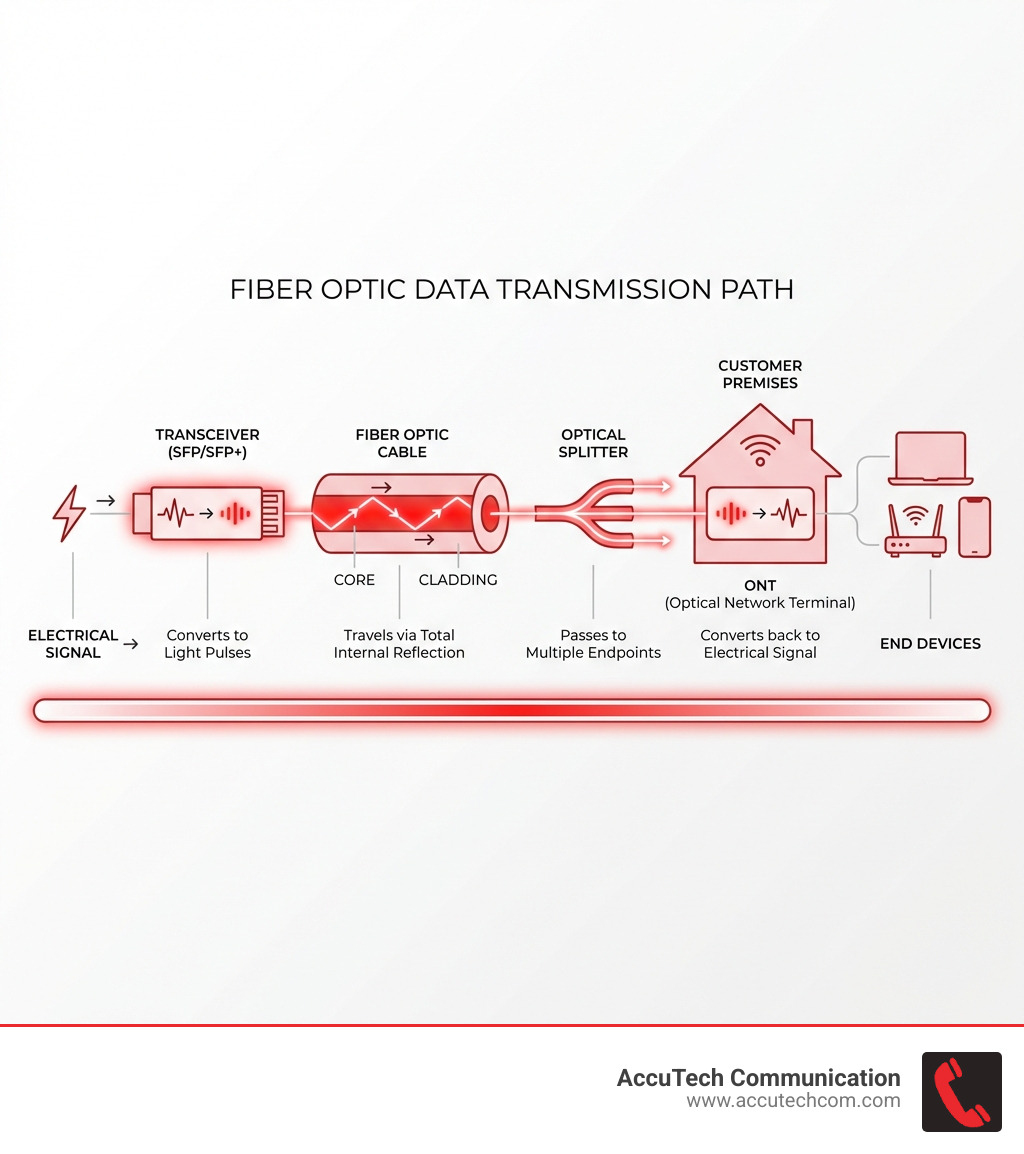
Simple guide to fiber optic network components terms:
The Backbone: Core Fiber Optic Network Components
The “backbone” is the combination of physical media and optoelectronics that create, carry, and interpret those laser-light pulses zipping around your network. Below are the essentials that every IT leader in Massachusetts, New Hampshire, and Rhode Island should recognize.
Optical Fiber Cables: The Data Superhighway
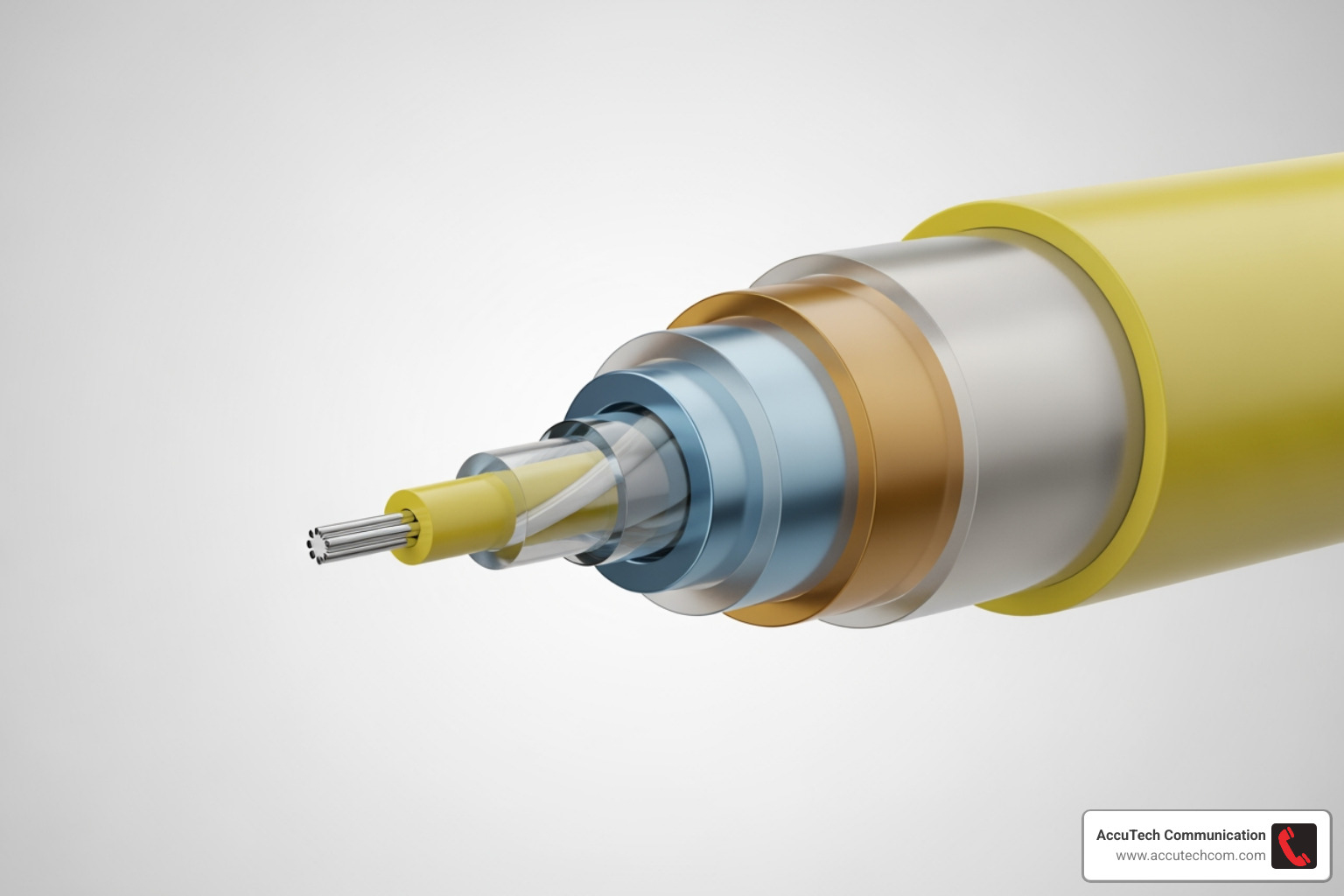
Fiber cables are made of incredibly pure glass (or sometimes plastic) that guide light through a tiny core, surrounded by cladding and protective coatings. Data rides those light pulses thanks to total internal reflection—think of it as a hall of mirrors, but far less spooky and way faster.
- Core: The light-guiding center (microns wide).
- Cladding: Keeps the light bouncing inside the core.
- Buffer/Jacket: Mechanical protection for handling and installation.
Two main flavors power most business networks:
| Fiber Type | Core Diameter | Typical Max Distance | Common Use Cases | Bandwidth/Notes |
|---|---|---|---|---|
| Single-mode (SMF) | ~8–10 µm | 40 km+ (with appropriate optics) | Data center interconnects, campus backbones, metro/long-haul links | Highest capacity over distance; wavelengths typically 1310/1550 nm |
| Multi-mode (MMF) | 50 or 62.5 µm | Usually 0.5–2 km | In-building runs, short data center links | Cost-effective at short range; commonly 850 nm sources |
References on wavelengths and practice are well covered by the Fiber Optic Association’s overview of wavelengths in fiber optics.
Why it matters: Multi-mode fiber can be budget-friendly inside a building or across a campus, but single-mode fiber future-proofs for higher speeds and longer distances. We routinely help clients select the right mix during fiber optic network design so upgrades are smooth and cost-effective.
Transceivers: The Network’s Translators
Transceivers are the tiny geniuses in your switches, routers, or firewalls that convert electrical signals into light—and back again. Form factors like SFP, SFP+, QSFP, and QSFP28 plug into network gear, matching the fiber type and distance with the right laser.
- Light sources: VCSELs (common at 850 nm for MMF), FP/DFB/EML lasers (common at 1310/1550 nm for SMF) per industry references like the FOA’s Guide to Fiber Optics & Premises Cabling.
- Connectors: LC is the most common today for density; SC and others still exist in legacy installations.
- Matchmaking matters: Single-mode transceivers pair with SMF; multimode transceivers pair with MMF, at the correct wavelength. No speed dating across types, please.
As your workloads and port counts grow, choosing the right optics keeps your links clean, fast, and standards-aligned. We specify optics that meet your distances today and your scaling plans for tomorrow.
Active Equipment: Powering and Directing Data Flow
Active equipment is where network intelligence and power live—managing bandwidth, enforcing policies, and ensuring traffic gets where it needs to go.
Optical Line & Network Terminals (OLT & ONT)
In fiber access architectures, the OLT sits upstream (often in a headend or central office environment) and the ONT sits at the customer premises.
- OLT: Aggregates traffic, assigns wavelengths/timeslots, and manages downstream ONTs. In GPON and successors, it’s the “air traffic controller” for the PON. See this overview of FTTH components and OLT role.
- ONT (customer premises): Terminates fiber, converts optical signals back to Ethernet, and interfaces with your LAN. In commercial deployments (FTTB/FTTO), ONTs often feed distribution switches and structured cabling.
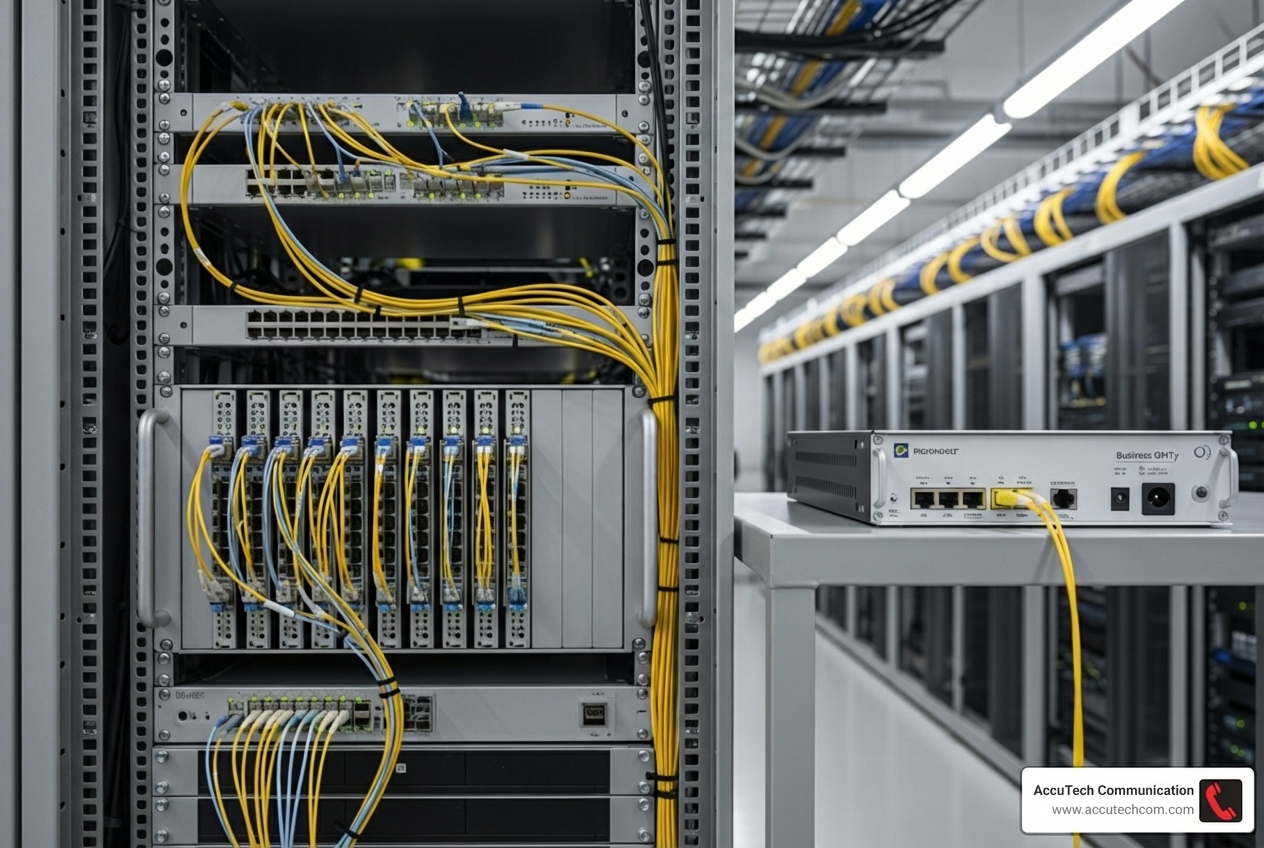
Why it matters: The OLT/ONT pair is the foundation of fiber-to-the-business topologies common across metro Boston, Woburn, Worcester, southern NH, and northern RI. Getting the optics, split ratios, and LAN handoff right prevents headaches later.
Amplifiers and Repeaters: Extending Your Network’s Reach
Even light gets tired over distance. As signals travel, they attenuate (weaken) and disperse (spread). To keep signals strong:
- Optical amplifiers: EDFA (Erbium-Doped Fiber Amplifier) is the long-haul workhorse, boosting entire wavelength bands without converting to electrical signals. See reference background at RP Photonics Optical Fiber Communications.
- Regeneration: Where needed, signals are fully converted and re-timed (more common in very long-haul or legacy systems).
Metro vs. long-haul:
- Metro fiber (city/regional rings): Shorter spans, tighter spacing between nodes, modest use of amplification, heavy on efficient distribution and resilience.
- Long-haul fiber (intercity/backbone): Longer spans between sites, greater use of EDFA and dispersion management to maintain high data rates over distance.
In business networks throughout MA, NH, and RI, most links are “metro-scale.” But inter-campus or data center interconnects can benefit from single-mode optics or even managed waves for resilience and growth.
Passive Infrastructure: Organizing and Splitting the Signal
Passive components don’t need power, but they’re crucial for tidy, scalable networks.
Essential passive fiber optic network components
Passive Optical Network (PON) systems use optical splitters to share a single feeder fiber among many endpoints—common for multi-tenant buildings or campuses.
- Optical Splitters: Divide one input into many outputs (1:2 up to 1:64 are common). Split ratio selection impacts budget (loss) and service reach.
- Optical Distribution Frame (ODF): The patching and termination hub that cleanly organizes incoming/outgoing fibers and integrates splitters or other passive elements—see an ODF description within this FTTH technology overview.
- Patch Panels: Provide modular termination and cross-connect points, simplifying moves/adds/changes.
- Fiber Distribution Hub (FDH): Outdoor or indoor cabinet that houses splitters and patching for distribution to suites/floors.
- Connectors & Adapters: LC, SC, and MPO are common; high-quality connectors reduce insertion loss and keep links stable.
For deeper planning and standards-based installation, our structured cabling services ensure labeling, documentation, and pathways are clean and expansion-ready.
Dark Fiber vs. Lit Fiber for Business
Choosing your path to optical capacity depends on your team’s expertise and business goals.
- Dark Fiber: Unused optical strands you lease and “light” with your own electronics. Pros: maximum control, scalability, and performance tuning (great for data center interconnects, campus backbones). Cons: you manage optics, monitoring, and maintenance end to end.
- Lit Fiber: A managed service where the provider delivers a committed bandwidth and SLA over their equipment. Pros: fast to deploy, predictable operations, lower internal overhead. Cons: less control over transport details and scaling granularity.
Both routes are common across MA/NH/RI commercial deployments. We help clients weigh control vs. convenience, factoring in security, compliance, and long-term capacity needs.
Installation and Future-Proofing Your Business Network
Fiber isn’t just plug-and-play—you’ll want seasoned pros to design, install, certify, and support your optical plant.
Key challenges of fiber optic network components and installation
- Precision splicing: Fusion splicing aligns cores within microns—sloppy splices create reflections and loss.
- Testing and certification: OTDRs, optical power meters, and visible fault locators verify end-to-end health, loss budgets, and connector quality.
- Pathways and bend radius: Fiber is tough but not invincible—respect minimum bend radius, protect terminations, and plan pathways around power and EMI sources for best practice.
- Integrating with existing infrastructure: Copper uplinks, legacy multimode runs, and mixed vendor optics can introduce surprises. Media converters and careful optics selection can smooth transitions.
- Documentation and labeling: Pay dividends during moves/adds/changes and during incident response.
We’ve been installing and certifying fiber for commercial environments since 1993. Learn about our process here: fiber optic cabling installation.
Future Trends in Fiber Technology
Bandwidth demand keeps rising with AI workloads, video collaboration, and cloud-first operations. Fortunately, fiber is built to scale.
- Capacity growth: Research keeps smashing records. In 2024, NICT announced 402 Tb/s transmission over standard fiber, underscoring how upgrades often happen at the optics layer—not by replacing the buried glass.
- PON evolution: GPON to XGS-PON and beyond improves split ratios, upstream capacity, and service symmetry—ideal for business-grade services and multi-tenant buildings.
- 5G and IoT integration: Densification needs fiber backhaul everywhere—from Worcester business parks to Boston life sciences districts.
- Standards and best practices: For drop cables and deployment approaches, see ITU-T guidance like L.87.
- Why fiber is future-proof: The FTTH Council Europe calls fiber “the only technology with enough bandwidth to manage projected consumer demands reliably and cost effectively.” That confidence supports long-term investment across New England.
For a broad survey of innovation areas, see this overview of Future Trends in Fiber Optics Communication. And for adoption context, global figures from Point Topic confirm momentum—fixed broadband hit 1.3B subscribers in early 2022 and, for the first time, FTTH exceeded half of all fixed broadband connections .
Frequently Asked Questions about Fiber Optic Components
Can I use my existing network equipment with a fiber optic upgrade?
Often yes, with the right plan:
- Many enterprise switches/routers accept SFP/SFP+/QSFP optics for fiber uplinks.
- Media converters can bridge copper to fiber for legacy gear.
- Verify wavelength, connector type (often LC), and distance for each link.
- A professional assessment is your best friend—mapping port capabilities, optics, and cabling ensures a smooth cutover without mystery bottlenecks.
We routinely audit environments across Boston, Waltham, Marlborough, Sudbury, Woburn, Worcester, southern NH, and RI to confirm compatibility and next steps.
How secure is a fiber optic network?
Very secure by design:
- Data is transmitted as light inside the core; tapping typically requires physical access and is difficult to do without detection.
- Fiber is immune to electromagnetic interference (EMI) and does not radiate signals like copper, reducing eavesdropping risk.
- Combine fiber’s physical advantages with strong encryption and segmentation for defense-in-depth in sensitive sectors (healthcare, finance, public sector).
What is the difference between fiber internet and fiber networking?
- Fiber internet: The service delivered to your business by a provider using fiber access technologies (often via OLT/ONT and splitters).
- Fiber networking: Your internal infrastructure—horizontal/vertical runs, patching, ONTs, media converters, distribution and core switches—connecting users, servers, Wi-Fi, cameras, access control, and more.
In short, fiber internet gets bandwidth to your building; fiber networking distributes it to every place it needs to be. Our structured cabling services make sure the inside plant is as robust as your outside plant.
The Backbone: Core Fiber Optic Network Components (Recap + Practical Tips)
To bring it all together:
- Cables: Choose SMF for distance/future-proofing; MMF for short, cost-effective links. Follow bend-radius and pathway best practices.
- Transceivers: Pair the right optics to fiber type, length, and data rate. See FOA’s quick reference on transceivers for wavelength guidance.
- OLT/ONT: In business PON designs, your OLT aggregates and manages, your ONT hands off clean Ethernet to your LAN.
- Splitters/ODF/FDH: Passive gear organizes, scales, and shares your optical plant tidily.
- Testing: OTDR and power meter results are your proof of performance and the first place to look when troubleshooting.
Passive Infrastructure: Organizing and Splitting the Signal (Deep Dive)
A few additional best practices we apply on every project in MA, NH, and RI:
- Label everything at both ends and in the middle. You’ll thank yourselves during maintenance windows.
- Standardize connector types when possible (LC is a common default) to reduce spare inventory and confusion.
- Keep spare capacity in FDHs and ODFs—growth is the only constant.
- Use quality splitters with known insertion loss across your required wavelengths. Place split points strategically (closer to endpoints can reduce dedicated fiber runs).
For reference illustrations and component overviews, resources like this FTTH architecture primer discuss the ODF and splitter placement in context.
Installation and Future-Proofing: What We See in New England
From MetroWest to the Seacoast, local fiber installations share themes:
- Hybrid environments: Many buildings still mix legacy copper backbones with new SMF/MMF runs. We design transitional stages that keep your network steady while modernizing.
- Documentation saves downtime: Accurate fiber maps and labeled patch fields shorten every change ticket.
- Test like you mean it: We certify links to standards with OTDR and power meter testing, handing you clean, printable results for your records.
- Design for tomorrow: The buried fiber you install today should support tomorrow’s optics (higher rates, new wavelengths), minimizing future construction.
Build a Future-Ready Network with Expert Guidance
Fiber gives businesses in Massachusetts, New Hampshire, and Rhode Island the trifecta: speed, reliability, and scalability. Global momentum is clear—Point Topic reports 1.3B global fixed broadband subscribers with FTTH surpassing half of connections for the first time —and industry groups like the FTTH Council Europe emphasize fiber’s unique ability to meet future demand.
Our take after three decades: the technology is brilliant, but design and installation determine your day-to-day experience. That’s where we come in.
- Since 1993, AccuTech Communications has delivered certified, reliable network cabling and data solutions for commercial clients across MA, NH, and RI.
- We design for growth, install to standards, document carefully, and support you through expansion.
- Whether you’re building a new facility, connecting campuses, or upgrading to business-grade optical access, we’ll help you select the right mix of fiber optic network components and put them to work—cleanly and confidently.
Ready to plan your next step? Contact us for your fiber optic cabling needs.
