
Why Every Business Network Needs a Network Cable Tester with PoE Finder
A network cable tester with PoE finder is a crucial diagnostic tool that verifies both the physical integrity of Ethernet cables and the availability of Power over Ethernet (PoE). It quickly distinguishes between cable faults and power delivery issues, saving hours of troubleshooting.
Modern business networks use PoE to power critical devices like IP cameras, VoIP phones, and wireless access points through a single cable. When these devices fail, it can disrupt operations. A faulty cable or insufficient power can knock systems offline, impacting businesses in Massachusetts, New Hampshire, and Rhode Island. In fact, a survey by the Ethernet Alliance found that four out of five installers experienced difficulties integrating PoE systems, with cable-related issues being a primary cause of failure.
I’m Corin Dolan, owner of AccuTech Communications, and since 1993, I’ve seen how essential these tools are. A network cable tester with PoE finder is one of the most valuable assets in our technicians’ kits for ensuring reliable, high-performance network installations.
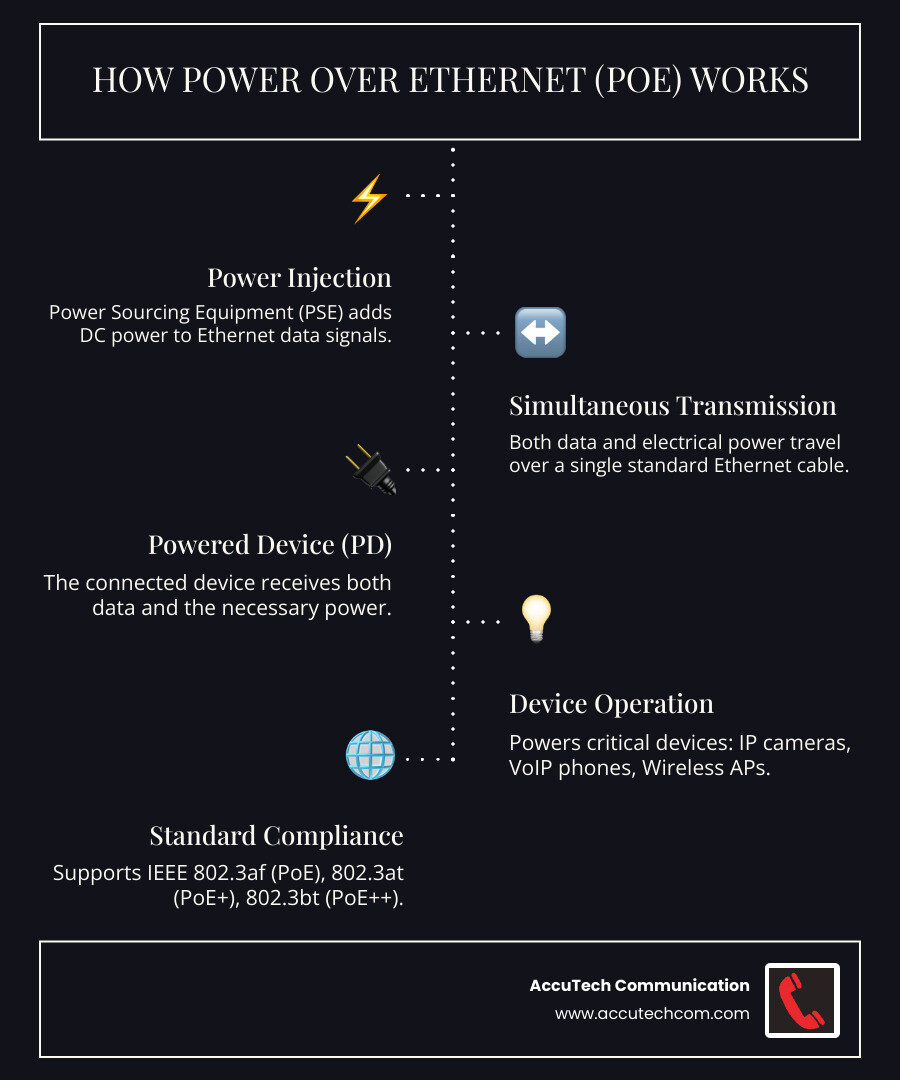
Know your network cable tester with poe finder terms:
What is a Network Cable Tester with PoE Finder?
Imagine a superhero tool for your network—that’s essentially what a network cable tester with PoE finder is. This hybrid device combines the essential functions of a traditional cable verifier with the specialized capabilities of a Power over Ethernet (PoE) detector. Its primary mission is to ensure the health and functionality of your network cabling infrastructure and the power delivery to your PoE-powered devices.
At its core, this tool is designed to provide comprehensive insights into your network. On one hand, it rigorously tests the physical integrity of your Ethernet cables, checking for common flaws that can degrade performance or cause outages. On the other, it dives deep into PoE analysis, determining if power is present, how much, and if it meets the necessary standards for your devices. This dual functionality makes it an indispensable asset for any business managing a modern network in Massachusetts, New Hampshire, or Rhode Island.
When we connect a network cable tester with PoE finder to a cable run, it initiates a “handshake” process with the Power Sourcing Equipment (PSE), typically a PoE switch or injector. This negotiation allows the tester to identify the type and amount of power being offered, providing crucial data for troubleshooting. Most of these testers use standard RJ45 connectors, making them compatible with the vast majority of Ethernet cabling found in commercial environments.
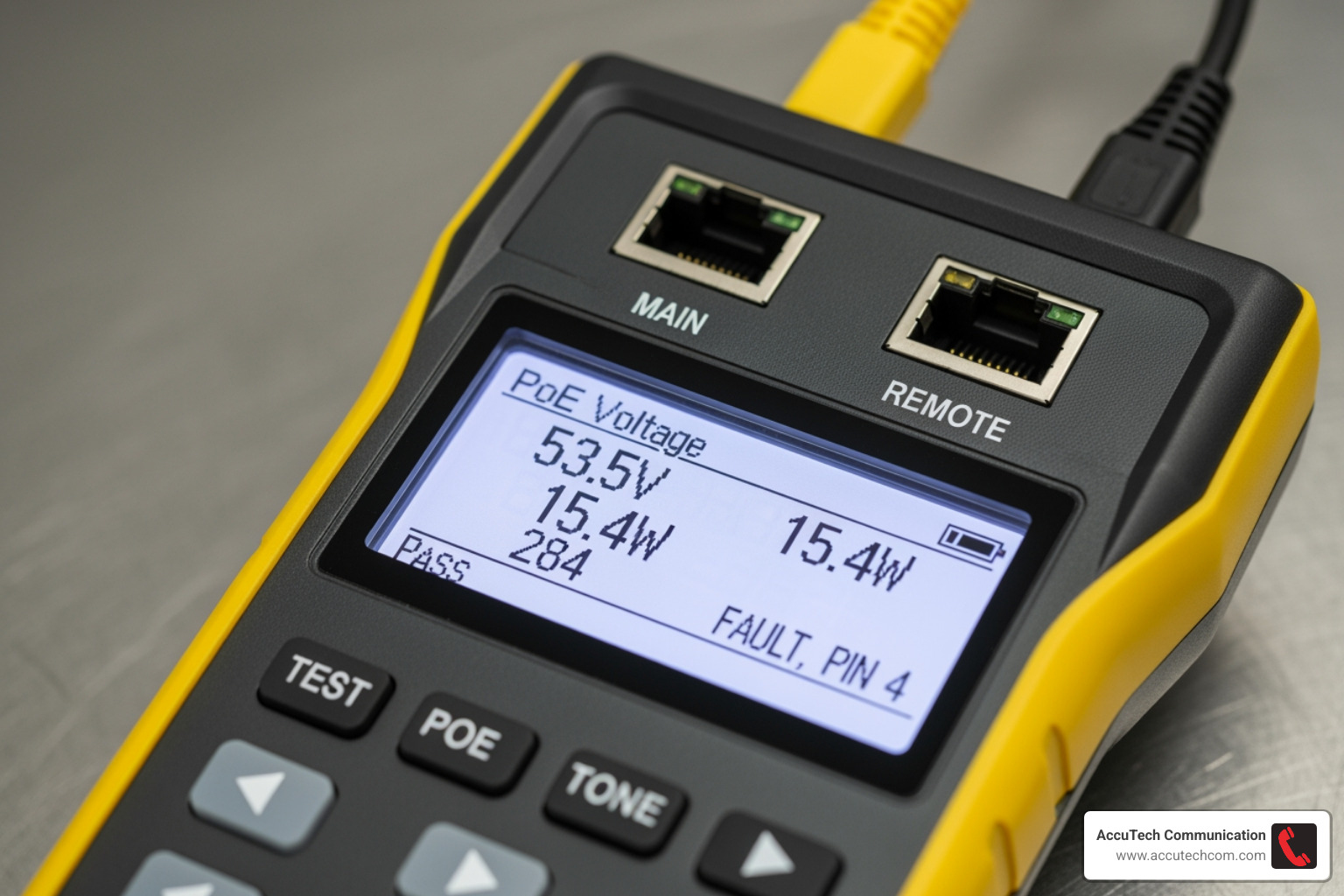
How it Tests Network Cables
Before we even consider power, a network cable tester with PoE finder first ensures the data highway is clear. Our testers perform a series of critical checks on the network cable itself:
- Continuity Testing: This is the most basic test, confirming that each wire within the cable has an uninterrupted path from one end to the other. Think of it as checking if all lanes on the highway are open.
- Wiremap: This function verifies that the individual wires within the cable are correctly paired and terminated according to industry standards (e.g., T568A or T568B). An incorrect wiremap can lead to significant data transmission problems. We’re making sure the exit ramps are where they should be!
- Opens, Shorts, and Crossed Wires: These are common cable faults. An “open” means a wire is broken, a “short” means two wires are accidentally touching, and “crossed wires” mean wires are connected in the wrong order. All these can prevent data from flowing correctly.
- Split Pairs: A more subtle but equally detrimental fault, a split pair occurs when two wires that should be twisted together are instead separated and twisted with other wires. This dramatically increases crosstalk and signal degradation.
- Cable Length Measurement: Testers can accurately measure the length of a cable, helping to identify if it’s within specifications or if there’s an issue with an overly long run. Some advanced testers can measure lengths up to 460 meters (1500 ft).
- Distance-to-Fault: This advanced feature pinpoints the exact location of an open, short, or other fault along the cable, saving invaluable time in identifying where a repair is needed.
- Toning and Cable Tracing: For those moments when you’re faced with a spaghetti junction of cables in a wiring closet or behind a wall, a toning function sends an audible signal down a specific cable. This signal can be picked up by a separate probe (often included in kits, like the IntelliTone™ Pro 200 probe with some Fluke models), allowing us to trace and identify the correct cable without guesswork.
How it Finds and Tests PoE
Once the cable’s integrity is confirmed, the network cable tester with PoE finder shifts its focus to the “power” part of Power over Ethernet. This is where the magic happens for powering devices like IP cameras or VoIP phones. Our testers can:
- PoE Detection: The tester first confirms if any power is present on the Ethernet cable. It’s a simple “yes” or “no” answer to whether the cable is live with power.
- Voltage Measurement: It measures the actual voltage being delivered. PoE operates within specific voltage ranges, and deviations can indicate a problem.
- Wattage Measurement: Crucially, it measures the wattage (power) available at the end of the cable. This tells us if the connected device will receive enough power to operate correctly. For instance, the TRENDnet Inline PoE Tester, TC-NTP1, tests wattage, voltage, and amperage.
- Polarity Check: PoE can deliver power on different wire pairs and with different polarities. The tester identifies which pairs are carrying power and their polarity, ensuring compatibility with the powered device.
- Endspan vs. Midspan: Testers can differentiate between Endspan (power delivered directly from a PoE-enabled network switch) and Midspan (power injected by a separate PoE injector between a non-PoE switch and the device). This helps us understand the power architecture.
- Negotiation with Switch: As mentioned, the tester performs a negotiation (a “handshake”) with the Power Sourcing Equipment (PSE) to determine the PoE class and available power. This ensures devices only draw the power they need, and the PSE doesn’t over-deliver.
- Load Testing: Some advanced testers, like the Fluke Networks LinkIQ™ Cable+Wi-Fi+Network Tester, can perform a load test. This is vital because it verifies that the advertised power is actually delivered by the switch when a device draws current, not just that it’s theoretically available. This helps us catch potential issues like insufficient power delivery under real-world conditions.
By performing these comprehensive tests, a network cable tester with PoE finder allows us to quickly diagnose whether a non-functioning PoE device is suffering from a bad cable, a lack of power, or a problem with the power source itself.
Understanding PoE Standards and How Testers Identify Them
Power over Ethernet isn’t a one-size-fits-all technology. It’s governed by a set of IEEE standards that define how power is delivered, ensuring interoperability between different manufacturers’ equipment. Our network cable tester with PoE finder tools are designed to recognize and report on these crucial standards.
Here’s a breakdown of the primary IEEE PoE standards:
| Standard | Common Name | Max Power per Port (PSE) | Typical Devices
What is a Network Cable Tester with PoE Finder?
A network cable tester with PoE finder is a hybrid device combining a cable verifier with a Power over Ethernet (PoE) detector. It tests the physical integrity of Ethernet cables for flaws and analyzes PoE to determine if power is present, how much, and if it meets device standards. This dual functionality is indispensable for any business in Massachusetts, New Hampshire, or Rhode Island.
When connected, the tester performs a “handshake” with the Power Sourcing Equipment (PSE) to identify the power type and amount, providing crucial troubleshooting data. Using standard RJ45 connectors, these testers are compatible with most commercial Ethernet cabling.
How it Tests Network Cables
A network cable tester with PoE finder first ensures the data highway is clear by performing a series of critical checks on the cable itself:
- Continuity, Wiremap, and Faults: This confirms each wire has an uninterrupted path (continuity), is correctly paired (wiremap), and is free of common faults like opens (breaks), shorts (accidental contact), or crossed wires.
- Split Pairs: This test identifies a more subtle fault where wires from different pairs are improperly twisted together, which can cause signal degradation and crosstalk.
- Cable Length and Distance-to-Fault: The tester measures the cable’s total length to ensure it’s within the 100-meter standard and can pinpoint the exact location of a fault, saving significant time.
- Toning and Cable Tracing: A toning function sends an audible signal down a cable, allowing a probe to identify it within a large bundle of wires, eliminating guesswork in crowded wiring closets.
How it Finds and Tests PoE
Once the cable’s integrity is confirmed, the network cable tester with PoE finder shifts its focus to the power aspect of PoE. Our testers can:
- PoE Detection and Measurement: It first confirms if power is present on the cable and then measures the exact voltage and wattage available to ensure a device will be powered correctly.
- Polarity and Source Identification: The tester identifies which wire pairs are carrying power and their polarity. It also differentiates between Endspan (power from a PoE switch) and Midspan (power from an injector) sources.
- Standard and Class Negotiation: It performs a “handshake” with the Power Sourcing Equipment (PSE) to determine the PoE standard (e.g., 802.3af/at/bt) and class, ensuring the device receives the correct power level.
- Load Testing: Advanced testers, like the Fluke Networks LinkIQ™, can simulate a device drawing power to verify that the PSE can deliver the advertised wattage under a real-world load, not just in theory. This is a vital check to prevent performance issues.
By performing these comprehensive tests, a network cable tester with PoE finder allows us to quickly diagnose whether a non-functioning PoE device is suffering from a bad cable, a lack of power, or a problem with the power source itself.
Understanding PoE Standards and How Testers Identify Them
Power over Ethernet (PoE) is governed by IEEE standards that define power delivery and ensure equipment interoperability. A network cable tester with PoE finder is designed to recognize and report on these crucial standards, confirming that a device is receiving the correct type of power.
Here’s a breakdown of the primary IEEE PoE standards:
| Standard | Common Name | Max Power per Port (PSE) | Typical Devices |
|---|---|---|---|
| IEEE 802.3af | PoE | 15.4W | VoIP phones, basic IP cameras, wireless access points |
| IEEE 802.3at | PoE+ | 30W | Video conferencing systems, PTZ IP cameras, advanced WAPs |
| IEEE 802.3bt | PoE++ (Type 3/4) | 60W (Type 3), 90W (Type 4) | Thin clients, LED lighting, large displays, video kiosks |
Testers can also identify non-standard Passive PoE, which supplies a constant voltage without the negotiation process, helping diagnose issues with incompatible equipment. Beyond standards, PoE devices are categorized into PoE Classes (0-8), which define the maximum power a device can request. A network cable tester with PoE finder displays the detected class, allowing technicians to instantly verify if the power supply matches the device’s requirements. This is critical for modern systems, where power needs can be as high as 90W. The evolution of PoE standards like The IEEE 802.3bt standard continues to expand the range of devices that can be powered over Ethernet, offering a safer and more flexible low-voltage power solution for commercial installations.
Key Features and Benefits of Using a Network Cable Tester with PoE Finder
For businesses in Massachusetts, New Hampshire, and Rhode Island, a network cable tester with PoE finder offers significant advantages in operational efficiency and cost savings. By quickly diagnosing the root cause of a network issue, our technicians can resolve problems faster, reducing labor costs and minimizing downtime. These testers are also invaluable for proactive maintenance and new installations, ensuring cable runs and PoE deployments are correct from the start. This preventative approach contributes to improved network uptime and overall reliability, which is critical for any business. To learn more about how comprehensive testing fits into a robust network, you can find More info about structured cabling services.
Essential Features to Look For in a Network Cable Tester with PoE Finder
When choosing a tester, certain features are critical for efficiency and diagnostic capability:
- Clear Display: An LCD or LED screen that shows detailed results like wiremap, cable length, and PoE voltage/wattage is essential for quick diagnostics.
- Versatile Connectors: Ensure the tester supports the connectors you use, such as RJ45 for Ethernet. Some models also support RJ11/RJ12 for phone lines or M12/M8 connectors for industrial applications.
- Long Battery Life: A long-lasting battery is crucial for field work. Some testers are even powered by the PoE line itself, eliminating the need for batteries.
- Comprehensive Cable Tests: The tool should perform essential tests like wiremap, length measurement, and fault detection (opens, shorts, split pairs). A distance-to-fault feature is highly valuable.
- Toning and Tracing: A built-in tone generator helps technicians quickly locate and identify cables within complex bundles.
- Reporting Capabilities: For documentation and compliance, look for testers that can generate and export detailed test reports, often via companion software.
- Rugged Design: A durable, shock-resistant housing is essential for use in commercial and industrial job sites.
The Benefits for Network Reliability and Performance
A network cable tester with PoE finder is a cornerstone of a reliable, high-performing network:
- Ensures Compatibility: Verifies that the power source (PSE) and the powered device (PD) are compatible, preventing underpowering or overdrawing issues.
- Prevents Equipment Damage: Confirms correct voltage and standards are being used, protecting sensitive network equipment from damage.
- Verifies Power Under Load: Advanced testers can simulate a device drawing power to confirm the source can supply the required wattage under real-world conditions.
- Validates Full Link Integrity: Confirms that the cable can support both data transmission and stable power delivery simultaneously.
- Reduces Downtime: By quickly diagnosing cable or power issues, technicians can resolve problems faster, minimizing disruption to business operations.
- Supports High-Power Devices: Modern testers can verify the higher power levels required by new devices like PoE lighting and large displays (up to 90W).
Practical Applications and Troubleshooting with a PoE Tester
The versatility of a network cable tester with PoE finder makes it an indispensable tool across various commercial environments, from busy offices to rugged industrial settings. Its primary benefit is faster problem resolution. When a network device goes offline, the tester allows us to quickly identify whether the issue is with the cable, the power, or the device itself, dramatically cutting down diagnostic time.
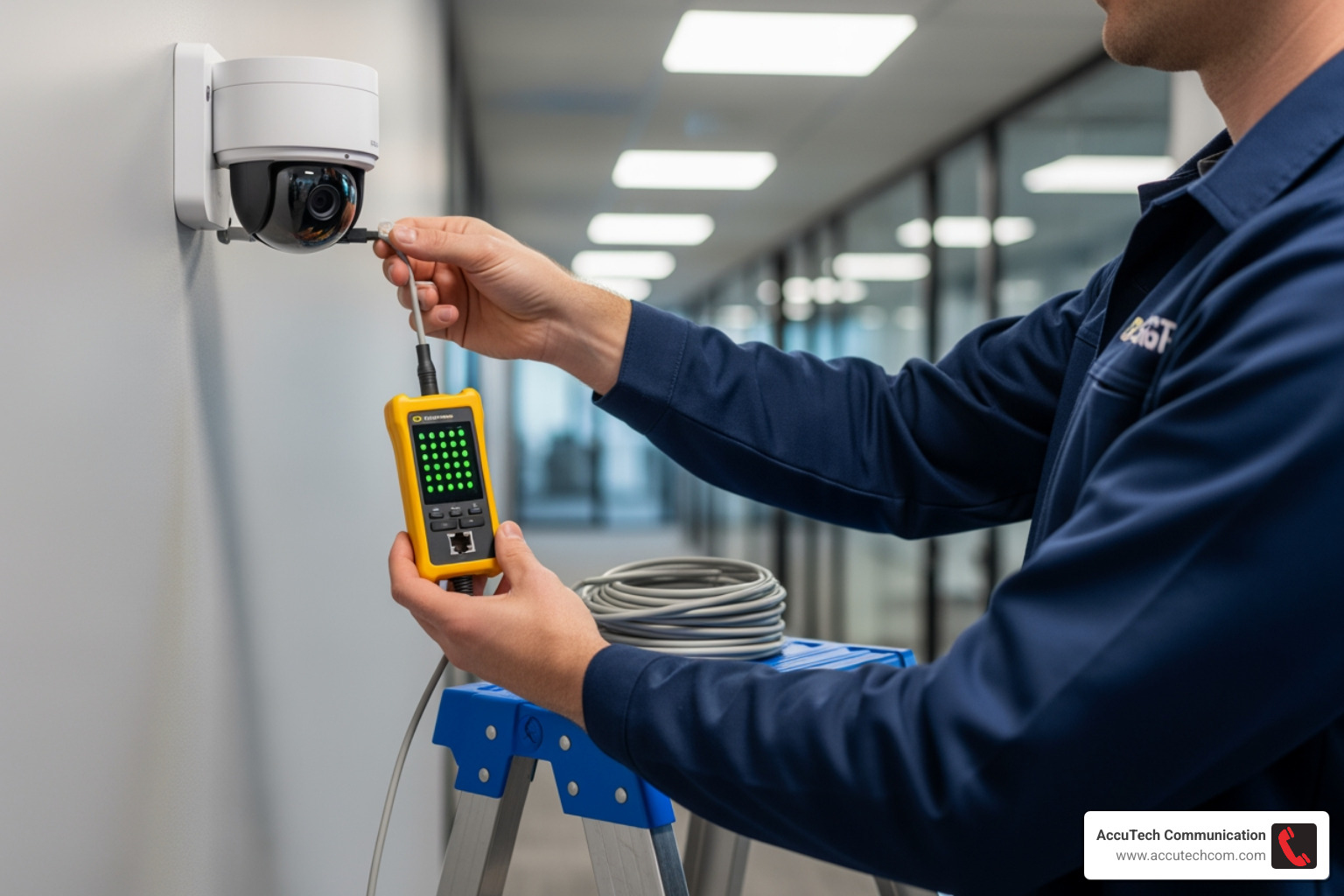
Common Commercial Use Cases for a Network Cable Tester with PoE Finder
Our technicians at AccuTech Communications use these testers for a wide array of applications for our clients across Massachusetts, New Hampshire, and Rhode Island:
- IP Security Systems: When a camera fails, we can instantly check if it’s receiving sufficient power and if the cable is intact.
- VoIP Phone Systems: We verify that phones are receiving the correct PoE class and power for clear, reliable communication.
- Wireless Access Point (WAP) Installations: Testers confirm proper power delivery to WAPs, which are often placed where AC power is unavailable, ensuring strong Wi-Fi coverage.
- PoE Lighting and Digital Signage: For modern systems like PoE-powered LED lighting and digital displays, testers are crucial for verifying power and ensuring proper function.
- Smart Building Controls: We use testers to commission and maintain integrated systems like access control and environmental sensors that rely on PoE.
Solving Common PoE-Related Problems
A network cable tester with PoE finder excels at diagnosing and resolving common PoE pitfalls:
- Insufficient Power: Identifies when a device isn’t receiving enough wattage, which can cause erratic behavior. The tester measures power at the device end to confirm delivery.
- Voltage Drops: Pinpoints power loss over long or low-quality cable runs by measuring voltage at the source and device ends.
- Differentiating Device vs. Network Issues: Quickly determines if a malfunction is due to the device itself or a problem with the cable or power source.
- Faulty Port Identification: Isolates problems to a specific port on a PoE switch, saving time on troubleshooting.
- Power Budget Management: Helps manage a PoE switch’s total power budget by verifying the power draw of individual devices, preventing overloads and outages.
Choosing the Right PoE Tester for Your Business Needs
Selecting the ideal network cable tester with PoE finder for your business in Massachusetts, New Hampshire, or Rhode Island depends on your specific needs, budget, and network complexity. Consider what types of cables and PoE devices you use, whether you need advanced features like reporting or industrial connector support, and how frequently the tool will be used.
Categories of PoE Testers
PoE testers fall into several categories, each with different capabilities:
- Basic Verifiers: Offer simple pass/fail results for cable continuity and PoE presence. Best for quick, non-detailed checks.
- Advanced Troubleshooters: Provide detailed cable tests (wiremap, length, distance-to-fault) and granular PoE data (voltage, wattage, class). Most network cable tester with PoE finder tools fall into this category.
- Network Qualifiers: Go a step further by testing if a cable can support specific network speeds (e.g., 1Gbps, 10Gbps) and may include active network tests like ping and switch port identification.
- Cable Certifiers: High-end tools for certifying that new cabling installations meet strict industry standards, often required for warranty validation.
For most commercial troubleshooting and installation verification, an advanced troubleshooter or network qualifier provides the best balance of features and cost.
Latest Advancements in PoE Testing Technology
Modern network cable tester with PoE finder tools are constantly evolving with new features to improve their capabilities:
- Touchscreen Interfaces: Simplify operation and data analysis.
- Wi-Fi Testing: Some models now include Wi-Fi analysis to troubleshoot both wired and wireless networks from a single device.
- Multi-Gigabit Ethernet Testing: Verifies a cable’s ability to support higher speeds like 2.5/5/10GBASE-T.
- Advanced Reporting: Generate and manage professional test reports for documentation and client verification, often with companion software like Fluke Networks’ LinkWare PC.
- Industrial Ethernet Support: Includes adapters for M12 and M8 connectors used in rugged industrial environments.
- Cloud Connectivity: Allows for easy storage and sharing of test results for remote collaboration.
These advancements make modern testers powerful, multifaceted tools capable of addressing the complex demands of today’s commercial networks.
Conclusion
In today’s interconnected business landscape, a network cable tester with PoE finder is an indispensable asset. It is the diagnostic powerhouse that empowers us to manage the complexities of modern networks, ensuring both data integrity and reliable power delivery.
The advantages are clear: by accurately identifying cable faults, verifying PoE standards, and measuring power delivery, these tools save our clients significant time and money. They enable proactive maintenance, prevent costly downtime, and contribute to a more stable, high-performing network. Whether installing a new IP security system or troubleshooting a VoIP phone network, the insights provided by these testers are invaluable.
At AccuTech Communications, we pride ourselves on delivering certified, reliable service with a commitment to quality for businesses throughout Massachusetts, New Hampshire, and Rhode Island. Our expertise in commercial network infrastructure, combined with the precision of advanced testing equipment, ensures that your network operates at its peak.
Don’t let cable issues or PoE power problems disrupt your operations. Partner with experts who use the best tools in the trade to keep your business connected and powered.
Learn more about professional network testing tools and services
