
Office network setup Boston: 7 Powerful Steps for Success 2025
Setting Up Your Boston Office Network: The Complete Guide
When it comes to office network setup Boston businesses need more than just cables and routers – they need a foundation that supports their growth and protects their digital assets. As someone who’s helped countless Boston companies build their technical infrastructure, I can tell you that a thoughtfully designed network makes all the difference between smooth operations and constant tech headaches.
Your network is essentially your business’s nervous system. It needs to be robust, secure, and adaptable, especially in Boston’s dynamic business environment where healthcare institutions, educational facilities, and tech startups all have unique networking demands.
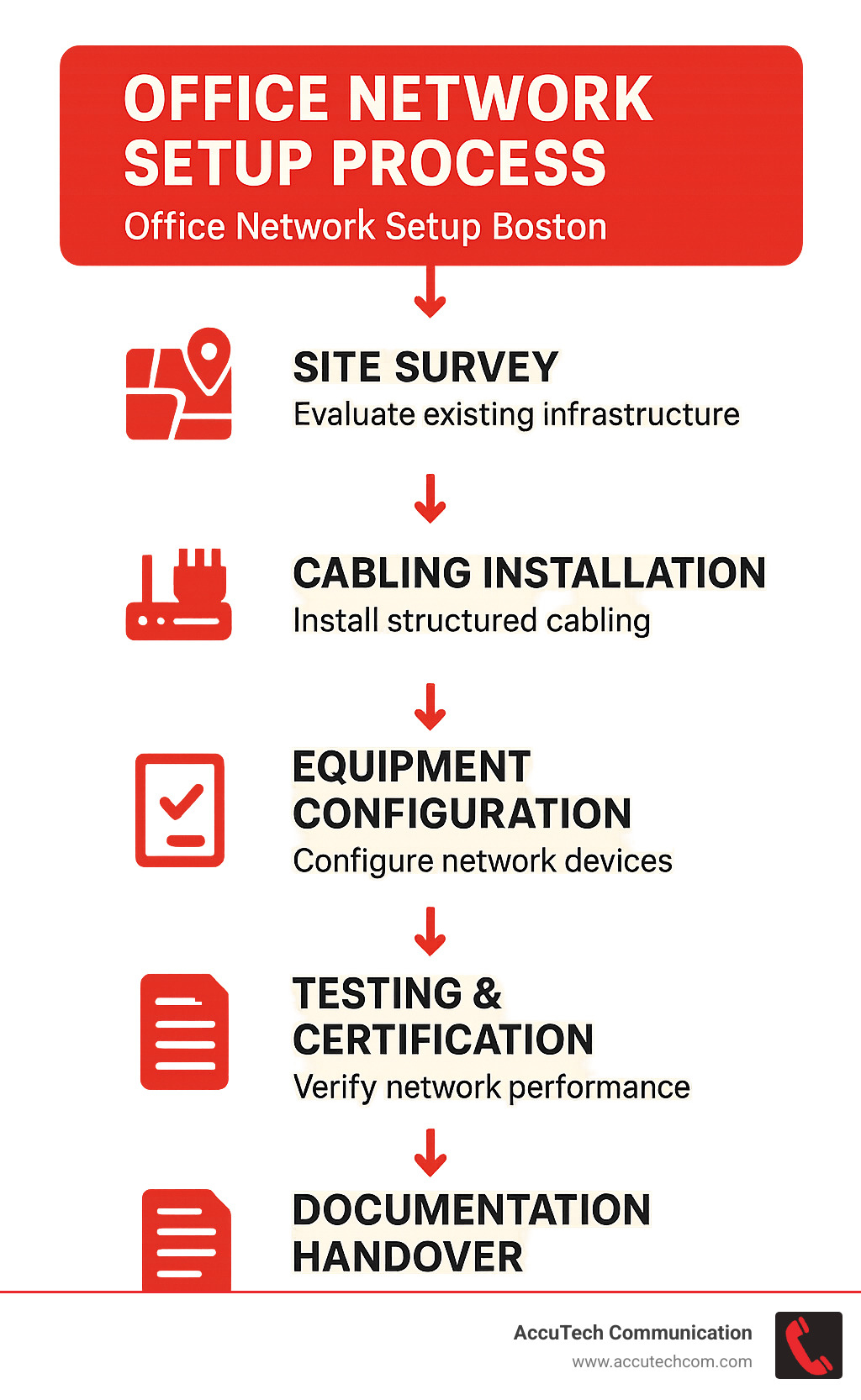
The path to a reliable network starts with a comprehensive assessment through a site survey. We’ll evaluate your current setup and identify opportunities for improvement. Then comes the design phase, where we create a network blueprint custom to your specific business requirements and growth projections.
The backbone of any great network is proper cabling – whether that’s Cat6/6a for standard connections or fiber optic for backbone runs between floors. Once the infrastructure is in place, we carefully select and configure equipment like routers, switches, and firewalls to create a secure, high-performance environment.
During implementation, we install and thoroughly test each component according to industry standards, ensuring everything works seamlessly together. Finally, we provide complete documentation and staff training so your team knows exactly how to make the most of your new network.
What makes Boston unique for network installations? For one, our dense urban landscape presents challenges like signal interference in high-rises. Then there’s the charm of historic buildings with their strict modification rules. And let’s not forget the high concentration of industries with strict data compliance requirements – from healthcare to finance.
Why do Boston businesses invest in professional network setup?
Professional network design delivers reliability that minimizes costly downtime. It provides scalability so your network can grow with your business without requiring a complete overhaul. Proper setup ensures security through network segmentation and modern protocols. You’ll also enjoy optimal performance for all your business applications and maintain compliance with industry-specific regulations that affect Boston businesses.
Hi there – I’m Corin Dolan, owner of AccuTech Communications. Since 1993, I’ve been helping Boston-area businesses build networks that stand the test of time. My team specializes in creating customized solutions for healthcare providers, educational institutions, and professional service firms that need reliable, future-proof infrastructure aligned with both immediate needs and long-term goals.
Looking for related services for your Boston business? We also provide Business phone systems Boston, Managed network services Boston, and Network Installation Services Boston to create a complete technology ecosystem for your organization.
Essential Steps for Office Network Setup in Boston
Setting up an office network in Boston isn’t just about connecting computers—it’s about creating the digital foundation your business will rely on every day. Boston’s unique landscape as a tech innovation hub (home to Harvard, MIT, and over 100 other institutions of higher learning) means businesses here often need sophisticated network infrastructure to stay competitive.
Site Survey & Requirements Gathering
Every successful Office network setup Boston project starts with a thorough site survey. When our AccuTech team visits your location, we roll up our sleeves and get to know your space inside and out:
We’ll walk through your office with floor plans in hand, examining the architecture and noting those pesky concrete walls or metal structures that love to block wireless signals. We’ll identify any existing infrastructure worth keeping, map out power sources, and assess cooling needs for your equipment rooms.
One of our favorite tools? Creating detailed WiFi heat maps that show exactly where you’ll need access points for perfect coverage. No more mysterious dead zones or frustrating connection drops!
“The hardest part of upgrading our network was simply making that first phone call,” a financial services client told us recently. “Once AccuTech came in for the site survey, everything became clear and manageable.”
And don’t worry about costs for this initial assessment—if you call us, we’ll come out quickly to evaluate your project and develop a proposal at no charge. It’s part of our commitment to Boston businesses.
During our conversations, we’ll dig into your specific requirements: How many people and devices will connect? What applications will run on your network? Are you planning to grow soon? What’s your budget looking like? Any special security or compliance needs? These details help us create a network that fits you perfectly—not some generic template.
Structured Cabling & Rack Layout for Office Network Setup Boston
Think of structured cabling as your network’s nervous system—it’s what connects everything together. For Boston offices, we typically recommend:
Cat6/6a cabling for workstations and access points, fiber optic backbones for connecting server rooms and IDFs, and proper cable management systems to keep everything neat and accessible.
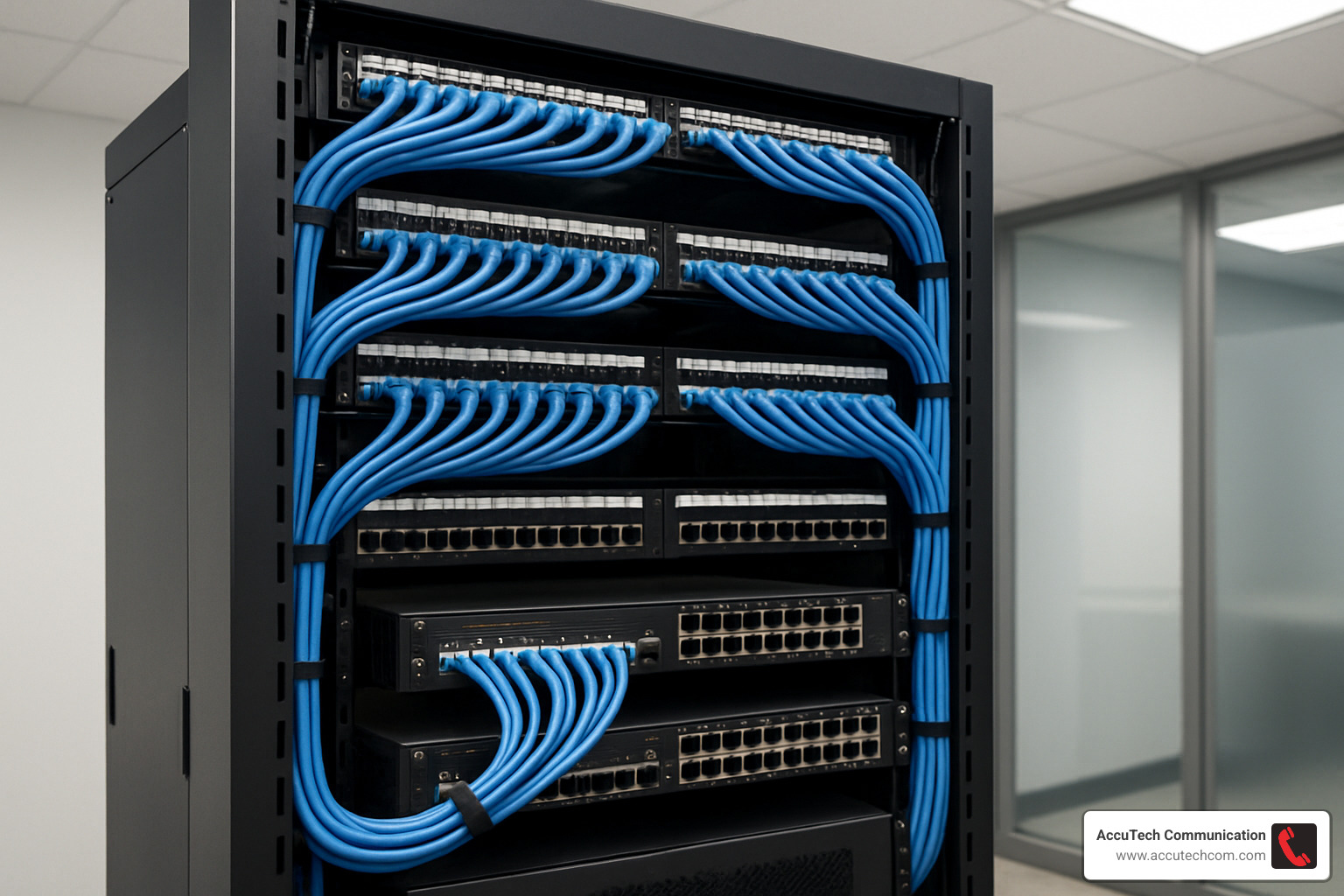
Since 1993, we’ve been perfecting our structured cabling installations, always following TIA/EIA 568-A/B standards. This isn’t just about being neat—it ensures your network meets industry specifications and will perform reliably for years.
For your equipment racks, we think strategically: grouping equipment logically for efficient cooling, implementing proper cable management (no spaghetti messes!), leaving room for future expansion, and clearly labeling everything for easy troubleshooting.
A Back Bay client put it perfectly: “AccuTech’s meticulous cable management made future changes so much easier. Three years after installation, we expanded our office, and the well-documented cabling system made the addition seamless.”
Internet Service & Bandwidth Planning
Boston businesses are fortunate to have excellent Internet Service Provider options, especially in the Financial District and Back Bay where fiber connectivity is widespread. But which one is right for you?
We’ll help you steer the options based on your specific needs: analyzing bandwidth requirements based on your user count and applications, reviewing Service Level Agreements to ensure guaranteed uptime, exploring redundancy options through different providers, and planning for future growth.
For businesses that simply can’t afford downtime, we often recommend a primary fiber connection with guaranteed bandwidth, backed by a secondary connection through different technology (like cable or fixed wireless), with automatic failover configuration so you stay connected even if one service goes down.
Boston’s position at the crossroads of major internet backbones means you can access enterprise-grade connectivity that businesses in other regions might envy. We’ll help you take full advantage of these options.
Hardware Deployment & Configuration
With your infrastructure in place, we’ll deploy and configure the right network hardware for your needs: enterprise-grade switches with appropriate port counts and Power over Ethernet capabilities, next-generation firewalls with advanced threat protection, strategically placed wireless access points, and network monitoring tools to keep an eye on performance.
Configuration is where the magic happens. We’ll set up VLAN segmentation to keep your network secure and performing well, implement Quality of Service settings to prioritize your critical applications, create redundant configurations where needed, and establish security policies that align with your compliance requirements.
For a Boston healthcare provider, we created a carefully segmented network that separated patient data systems from the guest WiFi. This ensured HIPAA compliance while still providing convenient internet access for visitors—a perfect balance of security and usability.
Testing, Certification & Handover for Office Network Setup Boston
The final step in your Office network setup Boston project is thorough testing and certification. We don’t just hope everything works—we prove it using professional-grade equipment like Fluke network analyzers.
We’ll test every single cable run for compliance with standards, verify wireless coverage throughout your space, confirm your bandwidth matches specifications, and test all failover systems to ensure business continuity when you need it most.
Documentation is the unsung hero of network installation. We provide comprehensive “as-built” network diagrams showing both physical and logical layouts, detailed IP addressing schemes and VLAN configurations, complete equipment inventories with model and serial numbers, plus warranty information and support procedures. This documentation becomes invaluable when troubleshooting or expanding your network later.
Finally, we’ll train your staff so they understand the system’s capabilities and can handle basic troubleshooting. This knowledge transfer ensures you’re not dependent on us for every little thing—though we’re always just a phone call away when you need us.
Choosing the Right Cabling & Hardware
The foundation of any reliable office network setup Boston is appropriate cabling infrastructure. Boston’s mix of historic and modern buildings presents unique challenges that require careful consideration when selecting materials.
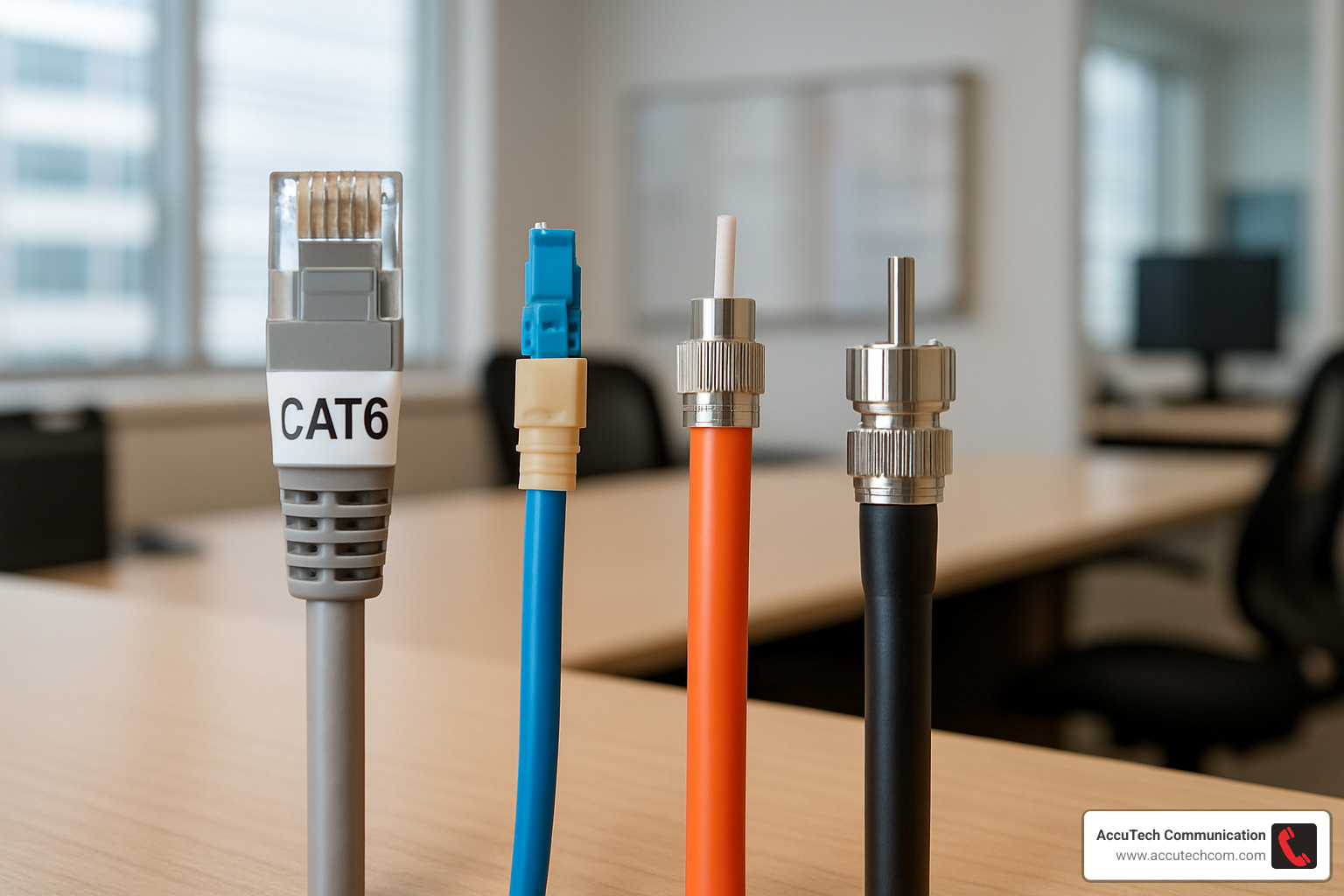
Copper Options: Cat6 to Cat7
For most Boston office environments, copper cabling remains the standard for workstation connections. When we’re planning your network, we’ll typically discuss Cat6/6a cabling, which supports speeds up to 10 Gbps (though Cat6 has distance limitations that Cat6a overcomes with its full 100-meter range). It’s more budget-friendly than higher categories while still handling most modern business applications beautifully.
If you’re looking to future-proof your investment, Cat7 cabling might be worth considering. It not only supports current 10 Gbps standards with room to grow, but also offers superior shielding against interference—something particularly valuable in Boston’s dense urban environment where signal noise can be an issue.
I remember a financial services client in downtown Boston who told me: “We initially hesitated at the higher cost of Cat6a throughout our office, but three years later when we upgraded our applications, we avoided a complete re-cabling project because of that decision.” That’s the kind of long-term thinking that often pays dividends.
For devices that need Power over Ethernet (PoE)—like your IP phones, security cameras, and wireless access points—higher-category cabling ensures you can deliver sufficient power without compromising performance. This is especially important as more devices in modern offices rely on PoE technology.
Fiber Backbones & Riser Design
When it comes to connecting different parts of your network infrastructure, fiber optic cabling really shines. We typically recommend fiber for backbone connections between telecom rooms, connections to data centers, and any application where you need serious bandwidth or have to cover distances beyond copper’s limitations.
For Boston businesses, we generally discuss two main fiber options:
Single-mode fiber is your marathon runner—it can carry signals over kilometers rather than mere meters. While it costs a bit more upfront, it’s incredibly future-proof for higher bandwidth needs. If you’re making a long-term investment in your infrastructure, this is often the way to go.
Multi-mode fiber is more cost-effective for shorter distances (typically under 300 meters). For new installations, we recommend OM4 or OM5 standards that can handle current 10G/40G/100G requirements for most business applications.
Boston’s 70 Innerbelt data center and other local colocation facilities are fully equipped to terminate and support both types of fiber connections. This makes hybrid designs practical for businesses that use off-site resources—something increasingly common in Boston’s tech-forward business environment.
As I often tell clients, “Data is sent, literally, at light-speed over fiber optic cables,” which makes fiber ideal for latency-sensitive applications common in Boston’s financial and healthcare sectors.
Hardware Standards & Vendor-Neutral Best Practices
At AccuTech Communications, we believe in following industry standards rather than proprietary solutions. Since 1993, we’ve aligned our work with established frameworks including IEEE 802.3 standards for Ethernet networking, TIA-568 for structured cabling systems, and BICSI guidelines for installation quality.
Our technicians are BICSI RCDD (Registered Communications Distribution Designer) certified, which means your installation will meet or exceed industry standards. This certification isn’t just a piece of paper—it represents a deep understanding of best practices that ensure your network will perform reliably for years to come.
When it comes to hardware selection, we maintain a vendor-neutral approach while focusing on enterprise-grade equipment that offers the reliability, warranty coverage, local support, and compatibility your business needs. We won’t push a particular brand just because it benefits us—we’ll recommend what truly works best for your specific situation.
Want to learn more about cabling options for your Boston office? Check out our detailed guide on Structured Cabling Boston MA for location-specific insights.
Wired vs Wireless: Designing a Hybrid Boston Office Network
When planning your office network setup Boston, one of the most important decisions you’ll face is finding the right balance between wired and wireless connectivity. In my 30 years of building networks across Boston, I’ve found that the best solutions almost always incorporate both approaches—each has distinct advantages that complement the other perfectly.
When to Choose Wired
There’s something reassuringly dependable about a good old Ethernet cable. In Boston offices, particularly in industries like finance, healthcare, and design, we still recommend hardwired connections for several key situations:
Fixed workstations benefit tremendously from wired connections. I remember walking into a downtown architectural firm where designers were frustrated with their rendering software—turns out they were all competing for wireless bandwidth! Once we installed dedicated Cat6a runs to each workstation, their productivity skyrocketed.
Latency-sensitive applications like trading platforms (which are abundant in Boston’s financial district) simply can’t tolerate the occasional hiccups of wireless. Even milliseconds matter when you’re moving millions.
VoIP phone systems perform much more consistently over wired connections. Nothing frustrates Boston professionals more than choppy client calls or dropped connections during important meetings.
One law firm IT director in the Seaport District told me: “We initially tried running everything on wireless, but quickly found that our document management system performed much better over wired connections. We now use a hybrid approach with wired connections at desks and wireless for mobile devices and meeting rooms.”
Printers, security systems, and high-bandwidth users like video editors are also prime candidates for hardwired connections. The consistency, security, and reliability simply can’t be matched by even the best wireless systems.
Optimizing Enterprise WiFi
That said, no modern Boston office can function without excellent wireless coverage. Your team expects to move freely throughout your space without losing connectivity, and visitors need easy access too.
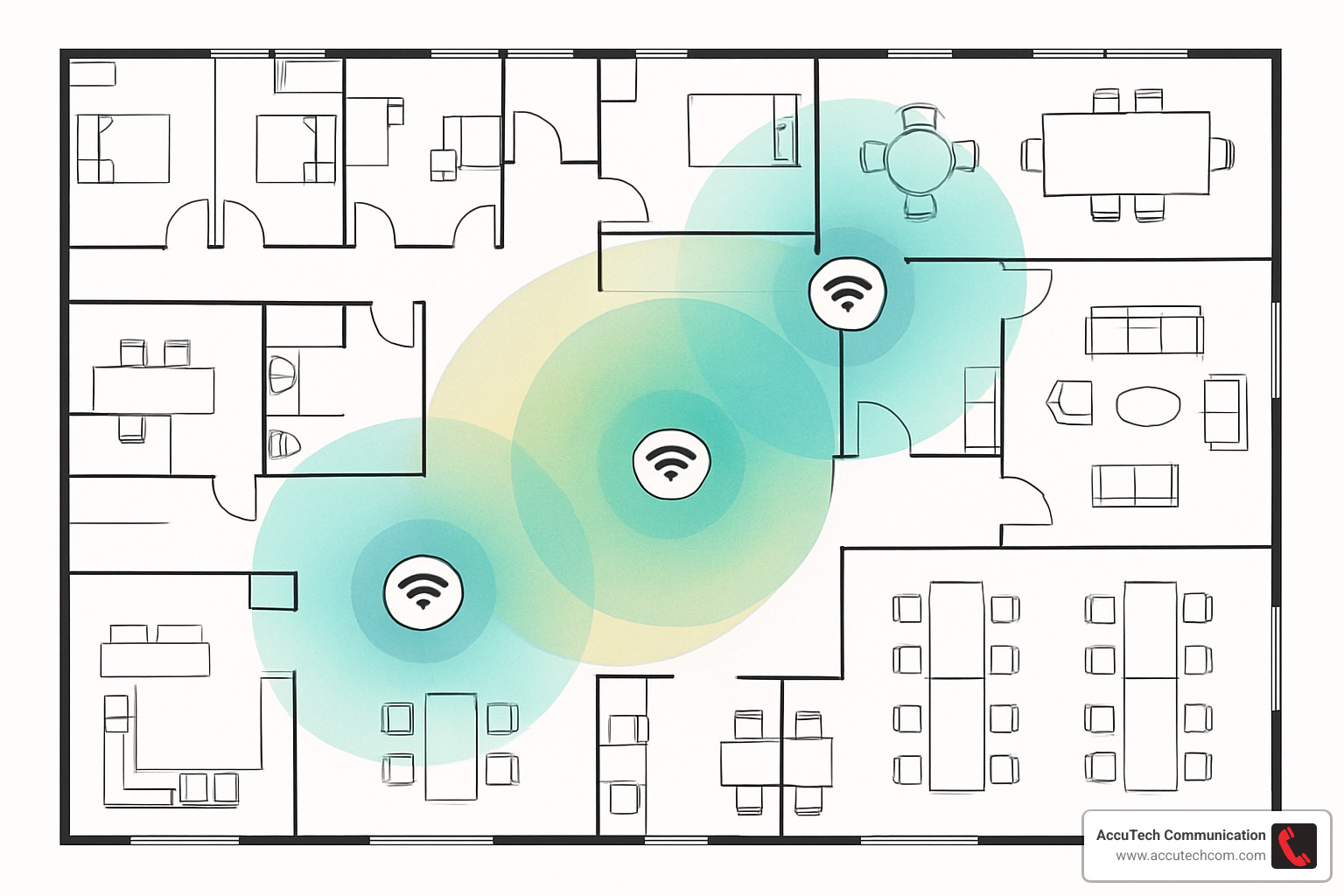
Boston presents unique wireless challenges I don’t see in suburban installations. Those gorgeous historic buildings with their thick masonry walls? They’re notorious signal blockers. And the density of businesses means you’re competing with dozens of neighboring networks for clean airspace.
We typically find Boston offices require 30-40% more access points than suburban locations because of these factors. During our site surveys, we use specialized RF mapping tools to identify potential interference sources and determine optimal access point placement.
For new installations, we strongly recommend WiFi 6 (802.11ax) or WiFi 6E equipment. These newer standards handle dense environments much better than older technologies. We’ll also implement proper channel planning to minimize interference, along with Wireless Intrusion Detection Systems for security.
Setting up separate guest networks with captive portals has become standard practice for our Boston clients. This keeps visitor traffic isolated from your sensitive business data while still providing the connectivity your guests expect.
Seamless Roaming & IoT Integration
There’s nothing more frustrating than having your video call drop as you walk from your office to a conference room. That’s why we implement mesh WiFi controllers that manage handoffs between access points, along with fast roaming protocols (802.11r) to ensure uninterrupted connectivity throughout your space.
The Internet of Things has arrived in Boston’s offices in a big way. Smart lighting, environmental sensors, security systems, and occupancy trackers are becoming standard features in forward-thinking workplaces.
I recently worked with a Boston tech startup that deployed over 200 IoT sensors throughout their office. By creating dedicated VLANs for these devices, we ensured they wouldn’t impact primary business operations while maintaining appropriate security boundaries.
“The ability to move freely throughout our office while staying connected has transformed how we work,” shared the operations director at a Kendall Square biotech firm. “Our teams collaborate more naturally, and the secure guest network makes bringing clients onsite much smoother.”
The best office network setup Boston solution will be custom to your specific needs. At AccuTech Communications, we take the time to understand your workflow, building characteristics, and future plans before designing a system that gives you the perfect balance of wired reliability and wireless flexibility.
Security, Compliance & Business Continuity in Boston Networks
Boston businesses face unique security and compliance challenges due to the city’s concentration of financial services, healthcare, education, and technology companies. An effective Office network setup Boston must address these concerns from the ground up.
Layered Network Security
When it comes to protecting your Boston business network, we believe in the power of layers. Think of it like the historic walls of Boston’s old forts – multiple lines of defense make for the strongest protection.
We implement a defense-in-depth approach that starts with next-generation firewalls that don’t just block traffic but actually understand the applications running on your network. These are paired with multi-factor authentication (MFA) for all remote access – because in today’s world, a password alone just isn’t enough.
For our more security-conscious clients, we’ve successfully implemented zero-trust architecture principles. As we like to tell clients, “In network security, trust no one, verify everything” is the new golden rule. We also create proper network segmentation to keep sensitive systems isolated from potential threats.
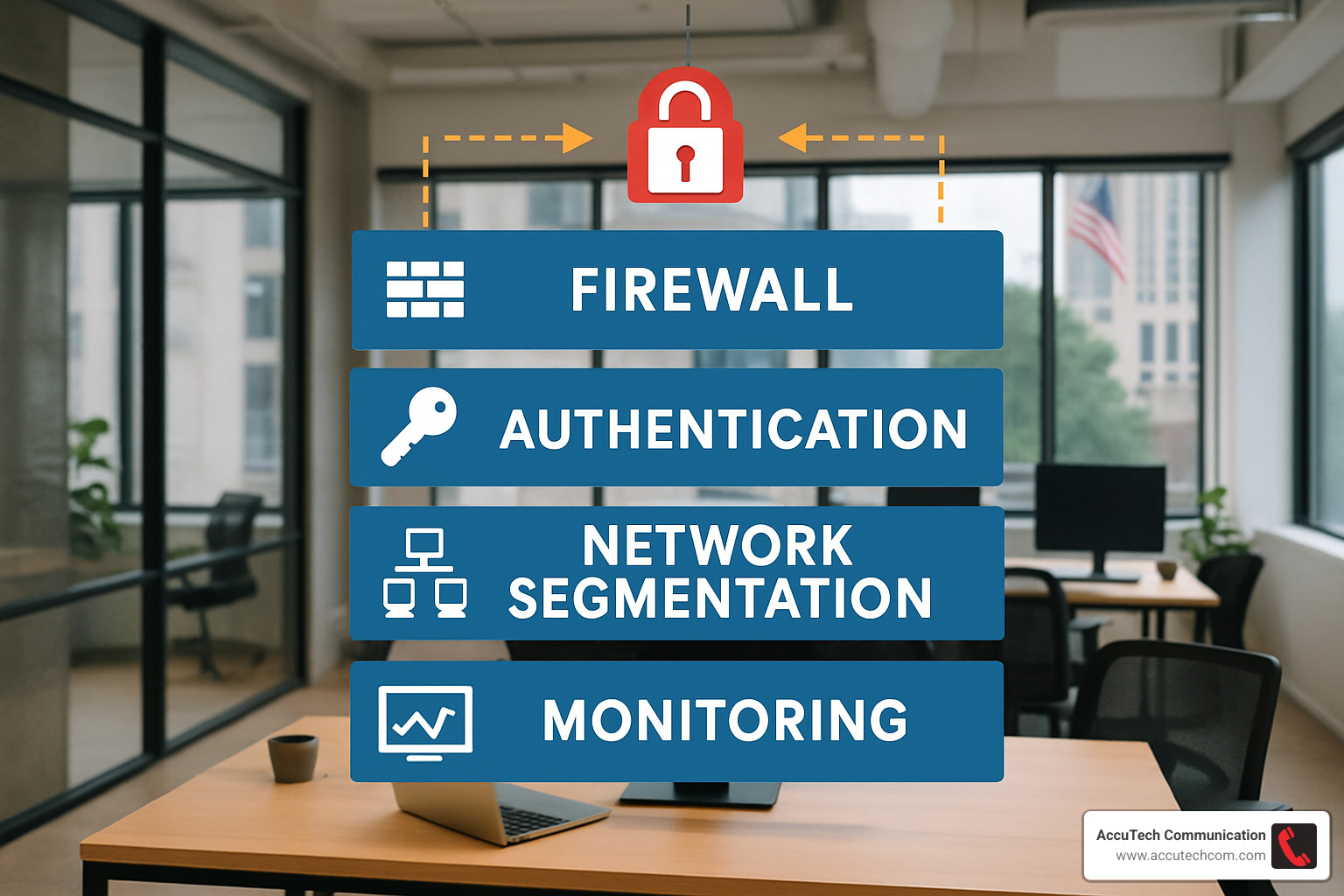
Recent data from professional IT consultants right here in Boston shows that regular infrastructure upgrades significantly reduce the risk of cyberattacks and data loss. This is especially important as ransomware and other threats become increasingly sophisticated.
I remember one medical practice we worked with that had their patient records system on the same network as their guest WiFi. This was a serious HIPAA violation waiting to happen! We immediately implemented proper VLAN separation and access controls to protect their patient data. You’d be surprised how common these basic security oversights are, even in sophisticated Boston businesses.
Want to learn more about avoiding common networking mistakes? Check out our guide on 5 Common Mistakes to Avoid When Installing Network Cabling.
Regulatory & Industry Compliance
Navigating compliance requirements can feel like driving through Boston’s notorious streets – confusing and full of unexpected turns. We’ve been helping Boston businesses stay compliant since 1993, so we know the landscape well.
Boston businesses must steer various compliance requirements including Massachusetts 201 CMR 17.00 data security regulations, which have specific requirements for protecting resident personal information. Healthcare providers need to address HIPAA compliance, retailers must handle PCI-DSS for payment card processing, and service organizations often need SOC-2 certification.
One financial services client told me, “AccuTech’s understanding of both technical requirements and regulatory frameworks saved us countless hours during our compliance audit. The network was designed with these considerations from day one.” This kind of forward thinking is essential when building compliant networks.
Our network designs incorporate compliance requirements from the beginning, with appropriate data encryption both in transit and at rest, comprehensive audit logging so you know who did what and when, role-based access controls to limit data exposure, and data retention policies aligned with your specific regulatory requirements.
Disaster Recovery & High Availability
Boston weather can be unpredictable – from nor’easters to summer heat waves – and so can business disruptions. That’s why we design networks with redundancy at multiple levels.
We recommend Uninterruptible Power Supplies (UPS) for all critical equipment because even brief power outages can cause significant disruption. For internet connectivity, we typically implement redundant connections from different providers – because when one provider has issues (and they all do occasionally), your business can continue without missing a beat.
Backup systems are designed with both on-site components for fast recovery and off-site elements for disaster protection. For mission-critical applications, we can implement cloud failover options that activate automatically when needed.
I still remember helping a Boston accounting firm after a water leak damaged some of their equipment. Because we had implemented a hybrid backup solution with local copies and automatic replication to a secure cloud service, they were back up and running within hours instead of days. Their partner told me, “That solution saved our tax season!”
For businesses interested in learning more about resilient network designs, check out the latest research on colocation resilience which highlights how Boston’s data center infrastructure can support business continuity strategies.
At AccuTech, we understand that security, compliance, and business continuity aren’t just IT concerns – they’re business survival essentials. That’s why we build these considerations into every Office network setup Boston project from day one.
Budgeting, Timelines, and Managed Support Options
Planning for an office network setup Boston project doesn’t have to be overwhelming. Let me walk you through what you can expect in terms of costs, timelines, and how to keep everything running smoothly after installation.
Typical Cost & Schedule Benchmarks
When clients ask me about budgeting for their network setup, I always explain that several factors influence the final investment:
Your office size naturally plays a major role – a 5,000 square foot space will require significantly different resources than a 500 square foot office. The complexity of your layout matters too, especially in Boston’s unique mix of historic and modern buildings. I’ve worked in Back Bay offices where the beautiful brick walls required creative solutions!
The number of network drops you need will directly impact both materials and labor costs. And of course, the quality of equipment you select makes a difference – while we never recommend cutting corners on critical infrastructure, we can help you find the right balance for your budget and needs.
When planning your project timeline, here’s what a typical Boston office network setup looks like:
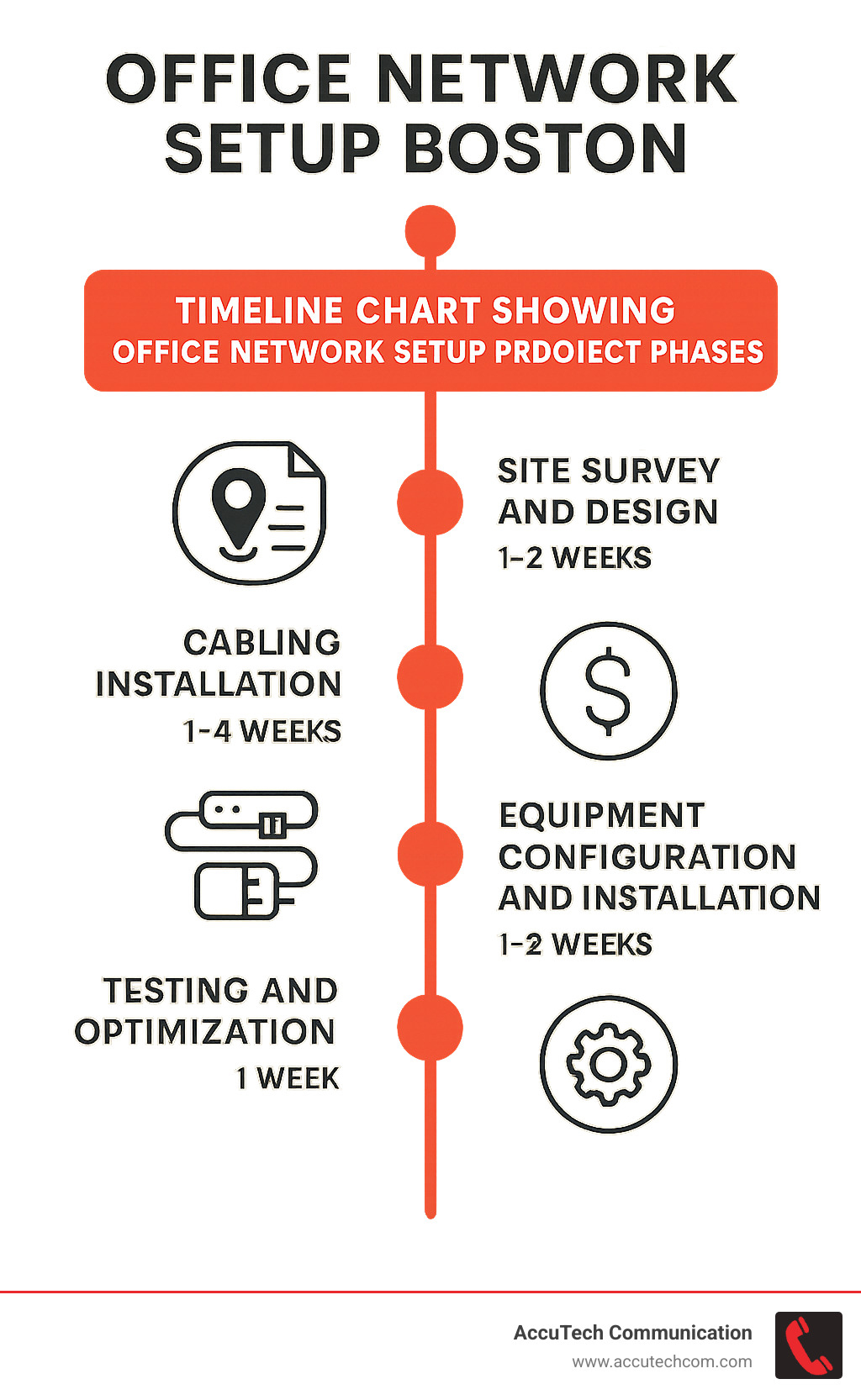
We usually start with a site survey and design phase lasting 1-2 weeks, where we get to know your space and needs. Cabling installation typically takes 1-4 weeks depending on your office size. We’ll need 2-3 weeks for equipment procurement (supply chain hiccups do happen, so we build in buffer time).
Once we have everything in hand, equipment configuration and installation usually takes 1-2 weeks, followed by a week of testing and optimization to make sure everything runs perfectly. We wrap up with documentation and training in the final week.
While some phases can overlap, I recommend planning for a 6-12 week process for a complete setup. The good news for startups or smaller businesses moving into coworking spaces like WeWork or Workbar is that much of the basic infrastructure is already in place, significantly shortening your timeline.
Integrating VoIP & Video Collaboration
“Can you hear me now?” has become the battle cry of the modern workplace. With remote and hybrid work here to stay, your network needs to support seamless communications.
Modern office network setup Boston projects must include considerations for:
VoIP phone systems that deliver crystal-clear calls. We implement proper Quality of Service (QoS) settings to ensure your important client call doesn’t break up when someone starts a large download.
Video conferencing capabilities are non-negotiable today. I recently helped a Boston marketing agency that needed to support up to 20 simultaneous video calls during client presentation days. We designed their network with this peak usage in mind, implementing QoS policies that ensured video quality even during maximum utilization.
Collaboration platforms like Microsoft Teams or Zoom need proper bandwidth allocation. As one Boston startup founder told me after moving into Workbar, “By leveraging their technology solutions, my team and I were able to bypass these problems and immediately start writing software.” That’s the power of a properly configured network!
For most Boston businesses, we recommend SIP trunking services that provide flexible, cost-effective calling options. Dedicated VLANs for voice and video traffic help maintain quality, and careful bandwidth planning ensures you’re ready for those days when everyone seems to be on video calls simultaneously.
Managed Services & Future Scalability
Setting up your network is just the beginning of our relationship. For ongoing support, you have several options:
Fully managed IT services give you 24/7 monitoring and support – think of it as having an IT department without having to hire one. This works beautifully for smaller organizations or those without dedicated IT staff.
Break/fix support provides assistance on an as-needed basis. Some clients prefer this approach when they have basic in-house capabilities but want expert backup for complex issues.
Hybrid approaches combine internal IT staff with specialist support from our team. This gives your team breathing room to focus on strategic initiatives while we handle the day-to-day maintenance.
At AccuTech Communications, we believe that “just because you are a small business doesn’t mean your technology has to act like one.” We offer flexible support options including network monitoring, regular maintenance, security patches, and handling changes as your business evolves.
Planning for growth is something I’m passionate about. There’s nothing more frustrating than building a network that needs to be completely redesigned when you add ten more employees. We recommend modular network designs that can expand without disruption, equipment with growth capacity, and detailed documentation that makes future changes smooth and predictable.
For Boston businesses in coworking spaces, we can help you steer the bandwidth tiers that typically start with shared connections and scale up to dedicated 100Mbps or 250Mbps options as your team grows.
Ready to discuss your office network setup Boston project? Learn more about our network cabling installation services or give us a call to start planning your perfect network solution.
Conclusion
Setting up an office network in Boston requires careful planning, quality components, and expert implementation. The unique business environment of Boston—with its concentration of education, healthcare, financial services, and technology companies—demands networks that are not only high-performing but also secure and compliant with relevant regulations.
At AccuTech Communications, we’ve been delivering certified cabling and network expertise since 1993. Our deep understanding of office network setup Boston requirements allows us to create solutions that align with your business goals while addressing the specific challenges of Boston’s urban environment.
I remember working with a healthcare provider in downtown Boston who was struggling with their network performance. After our team completed a proper site survey and implemented a structured solution, their staff could finally access patient records instantly instead of waiting for screens to load. That’s the kind of tangible difference proper network setup makes in daily operations.
Whether you’re establishing a new office, relocating within the Boston area, or upgrading your existing infrastructure, our team provides the expertise needed to connect with confidence. From initial site survey through implementation and ongoing support, we partner with you to ensure your network supports your business objectives.
The key to successful office network setup Boston starts with understanding your unique needs. Every business has different requirements—a financial services firm in the Seaport District needs different security protocols than a marketing agency in Cambridge. We take the time to understand these nuances before recommending solutions.
Start with a comprehensive site survey to evaluate your space and requirements. This foundation helps us determine whether Cat6a cabling will meet your needs or if fiber optic connections are necessary for your operation. We’ll design a hybrid wired/wireless approach custom specifically to your workflow, ensuring your team stays connected wherever they work within your space.
Security and compliance aren’t afterthoughts—they’re built into every network we design from day one. This proactive approach saves Boston businesses countless headaches when audit time rolls around. We also implement appropriate redundancy measures to keep your business running even when the unexpected happens (and in New England, the unexpected is practically guaranteed at some point!).
Ready to get started with your office network setup? Contact AccuTech Communications today to schedule your free site assessment and consultation. Our team serves businesses throughout Boston, Metro-west Boston, Marlborough, Sudbury, Woburn, Waltham, Worcester, and beyond in Massachusetts, New Hampshire, and Rhode Island.
Connect with confidence—partner with the network experts who understand Boston’s unique business landscape. After nearly three decades of serving local businesses, we’ve seen it all and solved it all. Your network is the foundation of your operations—let’s build it right together.
