
Structured cabling Boston MA: Essential 2025 Guide
Why Your Boston Business Needs Professional Network Infrastructure
Structured cabling Boston MA is the foundation that keeps modern businesses connected, productive, and competitive in today’s digital economy. If you’re looking for structured cabling providers in the Boston area, here’s what you need to know:
Top Structured Cabling Services in Boston MA:
- Design & Installation – Custom network infrastructure planning and implementation
- Testing & Certification – Ensuring systems meet industry standards (TIA/EIA)
- Cable Types – Cat5e, Cat6, Cat6a, and fiber optic solutions
- Integrated Systems – VoIP, Wi-Fi, security, and AV cabling
- Service Areas – Greater Boston, Massachusetts, New Hampshire, and Rhode Island
Your network infrastructure is literally the lifeline for your entire business operation. As one industry expert puts it: “Structured cabling is the lifeline for the entire Information Technology network and the foundation on which all other business activities depend.”
The numbers tell the story. Structured cabling can account for upwards of 80% of a network’s overall efficiency. For 25% of businesses, just one hour of network downtime can cost as much as $400,000. That’s why getting your cabling right from the start isn’t just about technology – it’s about protecting your bottom line.
Modern Boston businesses face unique challenges. Historic buildings need retrofitting. Growing companies need scalable solutions. Healthcare facilities require compliance with strict standards. Manufacturing operations can’t afford downtime.
The worldwide structured cabling market was valued at $7.7 billion in 2016 and is projected to expand by 7.6% through 2025. This growth reflects how critical proper network infrastructure has become for business success.
I’m Corin Dolan, owner of AccuTech Communications, and I’ve been helping Boston-area businesses solve their structured cabling Boston MA challenges since 1993. Over three decades of experience has taught me that the right cabling infrastructure isn’t just about connecting devices – it’s about connecting your business to its full potential.
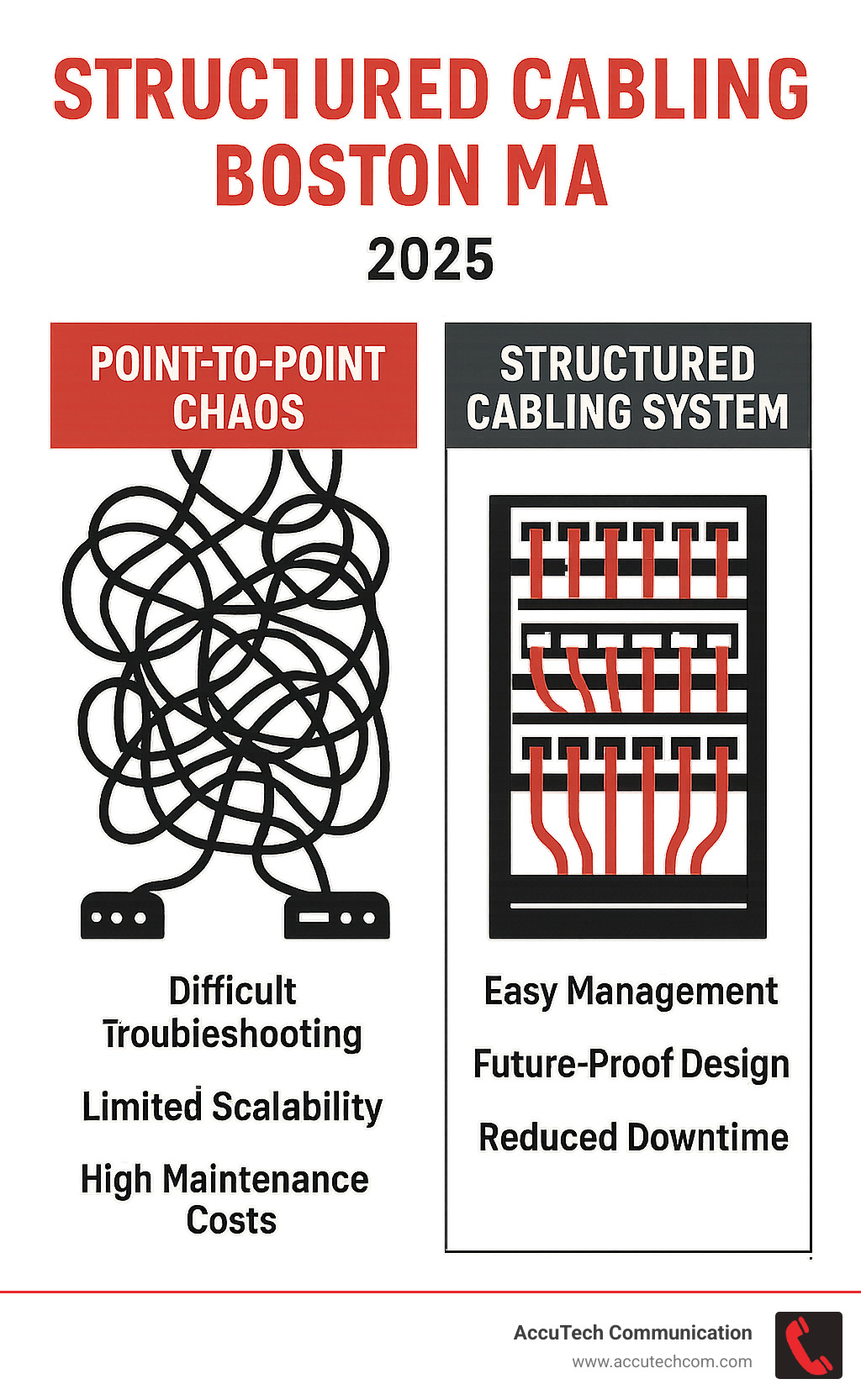
Basic Structured cabling Boston MA vocab:
Why Structured Cabling is the Backbone of Modern Boston Businesses
Think of your business network like the circulatory system in your body. When everything flows smoothly, you don’t even notice it’s there. But when something goes wrong? Everything grinds to a halt.
That’s exactly what happens when businesses try to get by with outdated, disorganized cabling. Your team can’t access files. Video calls freeze mid-presentation. Customer service slows to a crawl. It’s the kind of frustration that costs real money.
Structured cabling Boston MA systems solve these problems by creating a reliable foundation for everything your business does online. Instead of a tangled mess of cables running everywhere, you get an organized network backbone that’s built to perform.
The numbers don’t lie. Structured cabling accounts for upwards of 80% of a network’s overall efficiency. Even more eye-opening? For 25% of businesses, just one hour of network downtime costs $400,000. That’s not a typo – and it’s definitely not a bill any Boston business wants to pay.
But here’s the good news. A properly installed structured cabling Boston MA system delivers network performance you can count on, reliability that keeps you running, and reduced downtime that protects your bottom line. Plus, it’s designed for scalability and future-proofing, so your investment grows with your business.
When problems do pop up, easier troubleshooting means your IT team can fix things fast instead of playing detective with unmarked cables. That translates to lower cost reduction and higher network efficiency across the board.
Want to dive deeper into how this works? Check out The Advantages of Structured Cabling for Your Business or explore our structured cabling system services.
For readers who would like a big-picture overview of the subject, the Wikipedia article on structured cabling offers a helpful, vendor-neutral summary of the standards and terminology involved.
The Impact on Network Speed and Reliability
Remember the last time you waited for a file to upload while a client was on the phone? Or when your video conference turned into a slideshow of frozen faces? Those moments aren’t just embarrassing – they’re expensive.
Faster data transfer and consistent connectivity eliminate these painful interruptions. A well-designed structured cabling system minimizes network errors and gives you the bandwidth to run high-bandwidth applications without breaking a sweat.
This matters more than ever because today’s offices demand serious network power. Voice over IP (VoIP) systems need crystal-clear connections for every call. High-definition video conferences can’t afford to buffer during important presentations. Your team needs to move large files instantly, not eventually.
When your cabling infrastructure is built right, all of this happens seamlessly. Your network performs at its peak whether it’s a quiet Tuesday afternoon or the busiest day of the quarter.

Scalability and Future-Proofing Your Investment
Here’s something most business owners don’t realize: your cabling system will probably outlast every computer, phone, and piece of network equipment in your office. It’s the longest life-cycle component of your entire technology setup.
That’s why getting it right the first time matters so much. Adapting to new technologies becomes simple when your foundation is solid. Need to add workstations for new hires? No problem. Want to relocate a department? Easy. Ready to upgrade your network speed? Done.
These easy additions, moves, and changes happen without the chaos and expense of rewiring everything from scratch. Your cabling grows with your business, supporting business growth instead of holding it back.
We build every system to meet standard-compliant systems that work with today’s technology and tomorrow’s innovations. Whether you’re planning to expand next year or just want peace of mind, structured cabling Boston MA gives you a network that’s ready for whatever comes next.
Ready to learn more about building infrastructure that lasts? Visit our cable infrastructure solutions to see how we approach long-term network planning.
A Guide to Structured Cabling in Boston MA
When you’re looking to upgrade your network infrastructure, understanding structured cabling Boston MA options can feel overwhelming. Don’t worry – we’re here to break it down in plain English. At AccuTech Communications, we believe that making informed decisions about your network shouldn’t require an engineering degree.
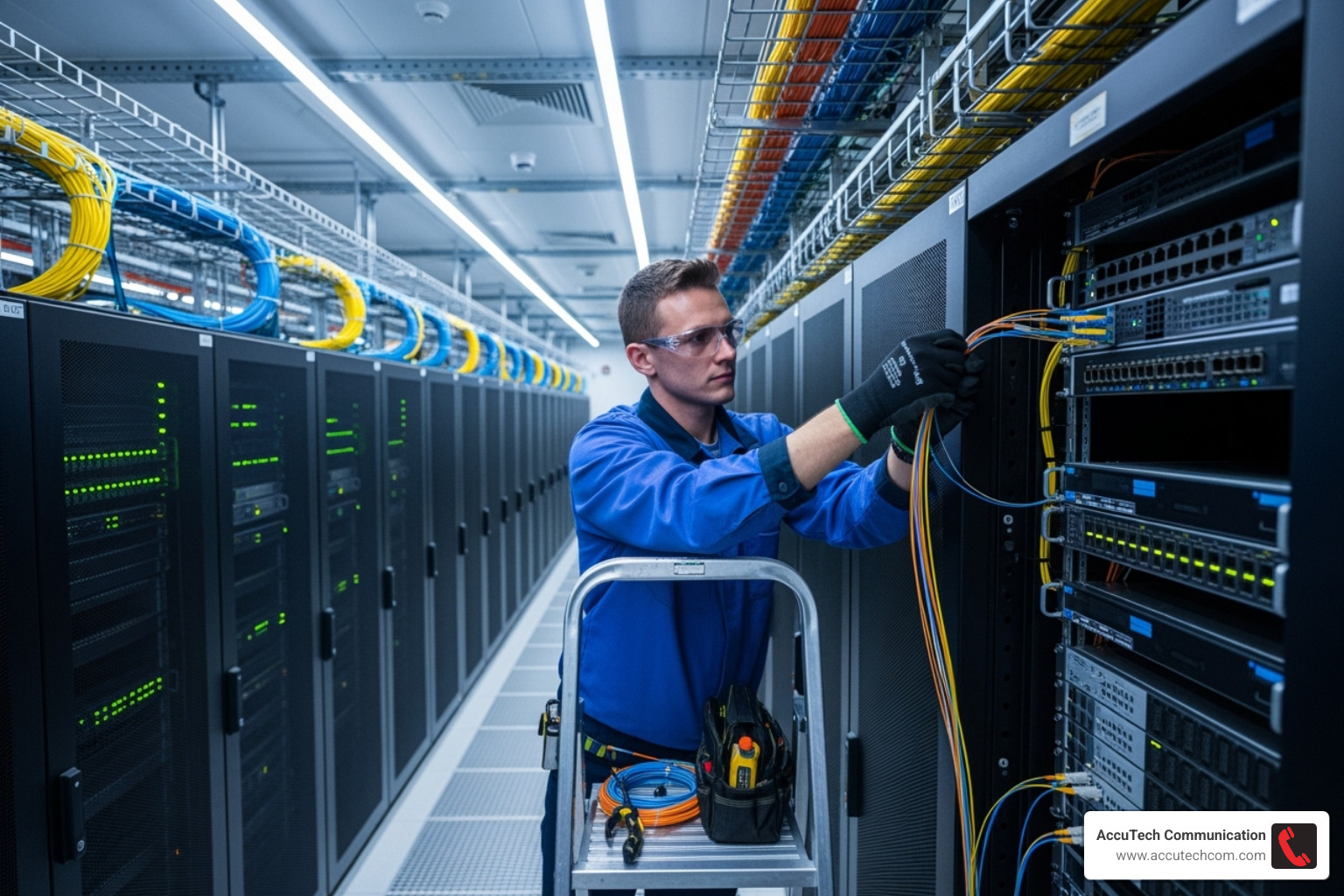
Think of structured cabling as the nervous system of your business. Just like your body needs a healthy nervous system to function properly, your business needs a well-designed cabling system to keep everything connected and running smoothly. We build these systems using specific cable types, carefully chosen components, and strict adherence to industry standards like TIA/EIA.
Every Boston business is unique. Whether you’re operating from a historic brownstone in Back Bay or a modern office park in Burlington, we design your cabling system to match your specific needs and environment. Our approach ensures your network can handle everything from basic email to complex data processing applications. For more details about our comprehensive approach, check out our structured data cabling services.
Common Cable Types and Their Applications
Choosing the right cable type is like picking the right tool for the job. You wouldn’t use a hammer to fix a watch, and you wouldn’t use the same cable for a small office as you would for a data center. Let’s look at your main options:
Cat5e is your reliable workhorse – perfect for most office applications with speeds up to 1 Gigabit. It’s cost-effective and handles standard business needs beautifully. Cat6 steps things up with better performance and less interference, supporting speeds up to 10 Gigabits over shorter distances. When you need even more power, Cat6a delivers 10 Gigabit speeds over longer distances, making it ideal for larger offices or demanding applications.
For the ultimate in performance, fiber optic cabling is in a league of its own. It can handle massive amounts of data over incredible distances without any signal loss. We typically recommend fiber for backbone connections between buildings or floors, and for businesses that need lightning-fast data transfer.
| Cable Type | Max Speed (Typical) | Max Distance (Typical) | Best Application |
|---|---|---|---|
| Cat5e | 1 Gigabit | 100 meters | Standard office applications, VoIP |
| Cat6 | 10 Gigabits | 55 meters | High-performance workstations, servers |
| Cat6a | 10 Gigabits | 100 meters | Data centers, future-proofing |
| Fiber Optic | 100+ Gigabits | 2+ kilometers | Long-distance backbone, high-bandwidth |
The beauty of copper cabling like Cat5e and Cat6 is its versatility. It handles everything from your internet connection to your phone system using standard Ethernet protocols. For businesses with data centers or long-distance backbone needs, fiber optic provides best performance. To learn more about these technologies, visit our pages on Fiber Optic Cabling Installation and What Is An Ethernet Cable?.
Core Components of a Professional Cabling System
A professional structured cabling Boston MA system is like a well-organized filing cabinet – everything has its place, and you can find what you need quickly. The magic happens when all these components work together seamlessly.
Patch panels are the central nervous system of your network, providing organized connection points where all your cables meet. Think of them as the switchboard operator of your network – they make sure every connection goes to the right place. Telecommunications closets (IDFs) house your network equipment on each floor, while your main equipment room (MDF) serves as mission control for your entire network.
Racks and cabinets keep everything organized and protected. No more tangled cables behind desks or equipment scattered around your server room. Cable pathways – including conduits, cable trays, and raceways – provide protected routes for your cables throughout the building. Finally, work area outlets are where your employees actually connect their devices, bringing all that infrastructure right to their desks.
When these components are properly designed and installed, troubleshooting becomes a breeze, changes are simple to make, and your entire system looks professional and organized. For more information about our comprehensive cabling solutions, visit our structured cabling services.
A Guide to Structured Cabling in Boston MA
Navigating network infrastructure can feel a bit like learning a new language, especially when it comes to the technical specifics of cabling. But don’t worry, we’re here to explain it for you. At AccuTech Communications, we pride ourselves on providing clear, comprehensive guidance on all aspects of structured cabling Boston MA, ensuring you make informed decisions for your business.
A professional structured cabling system is built with specific cable types, carefully chosen components, and strict adherence to industry standards like TIA/EIA. These elements are carefully combined to create a robust, high-performance network custom to the unique needs of Boston businesses, whether you’re in a busy downtown office or a sprawling industrial park. Find more about our approach to efficient data cabling at our structured data cabling services.
Common Cable Types and Their Applications
When we talk about network cabling, we’re primarily referring to different types of twisted-pair copper cables and fiber optic cables. Each has its own strengths, ideal applications, and cost considerations. Here’s a quick overview:
| Cable Type | Max Speed (Typical) | Max Distance (Typical) | Best Application |
|---|---|---|---|
| Cat5e | 1 Gigabit | 100 meters | Standard office, VoIP |
| Cat6 | 10 Gigabits | 55 meters | High-performance workstations |
| Cat6a | 10 Gigabits | 100 meters | Data centers, future-proofing |
| Fiber Optic | 100+ Gigabits | 2+ kilometers | Long-distance backbone |
Cat5e remains the most cost-effective choice for standard business applications. It reliably supports gigabit speeds and works perfectly for most office environments, VoIP systems, and general data transmission needs.
Cat6 offers improved performance with better shielding against interference. This makes it ideal for environments with high electromagnetic interference or when you need consistent 10-gigabit performance over shorter distances.
Cat6a provides the best of both worlds – full 10-gigabit speeds over the standard 100-meter distance. It’s the go-to choice for data centers and businesses planning for future bandwidth needs.
Fiber optic cabling delivers best performance for long-distance connections and high-bandwidth applications. It’s immune to electromagnetic interference and can carry signals over much greater distances without degradation.
Core Components of a Professional Cabling System
A well-designed structured cabling Boston MA system relies on several key components working together seamlessly:
- Patch panels serve as the central connection point where all cables terminate, providing organized access for network management
- Telecommunications closets (IDF) house network equipment on each floor, distributing connectivity throughout the building
- Equipment rooms (MDF) contain the main network infrastructure and serve as the central hub for the entire system
- Racks and cabinets provide secure, organized mounting for all network equipment and patch panels
- Cable pathways including conduits, cable trays, and raceways protect cables and provide clean routing throughout the facility
- Work area outlets deliver network connectivity directly to employee workstations
These components must be installed according to TIA/EIA standards to ensure optimal performance, reliability, and compliance with industry best practices. Proper installation of these elements creates a system that’s easy to manage, troubleshoot, and expand as your business grows.
The beauty of a professionally installed system is in its organization and accessibility. When changes are needed – whether adding new users, relocating equipment, or upgrading network components – the structured approach makes these tasks straightforward and cost-effective.
For comprehensive information about our complete cabling solutions and how we implement these components in Boston-area businesses, visit our structured cabling services.
