
Structured Cabling Near Me: 7 Pro Tips for Success
Structured Cabling Near Me solutions are crucial for businesses looking to improve their communication infrastructure. Structured cabling systems provide the backbone necessary to support a broad range of communication services, including data, voice, video, and more, ensuring your business stays connected and efficient.
Here’s a quick overview of what to consider:
- Types of Cabling: Cat 5e, Cat 6, Fiber Optic
- Key Components: Cable management, racks, enclosures
- Providers: Seek out certified technicians and robust maintenance options
- Flexibility and Scalability: Future-proof systems to accommodate growth
With the changing technology landscape, having a streamlined network infrastructure is vital for uninterrupted operations, especially in sectors like healthcare that require robust and reliable communication systems.
As the owner of AccuTech Communications, I have witnessed the transformative impact of structured cabling on businesses across Massachusetts, New Hampshire, and Rhode Island. My experience in delivering customized structured cabling solutions ensures that your network system will be not only efficient but also adaptable to meet future demands.
Learn more about Structured Cabling Near Me:
Understanding Structured Cabling
Structured cabling is the unsung hero behind seamless communication in modern businesses. It’s a comprehensive system that organizes all the cables and connectivity hardware in a building or campus. But what exactly goes into structured cabling? Let’s break it down.
Components of Structured Cabling
Structured cabling consists of several key components, each playing a vital role in keeping your network running smoothly:
- Entrance Facilities: This is where your network begins. It includes the cables, hardware, and equipment that connect your building to the external network. Think of it as your network’s front door.
- Equipment Room: This is the central hub of your network. It houses essential networking equipment like servers, switches, and routers. The equipment room is where all the magic happens.
- Backbone Cabling: These are the heavy-duty cables that connect different equipment rooms within the same building or across multiple buildings. Backbone cabling is responsible for carrying large amounts of data at high speeds.
- Telecommunications Room: Often referred to as the nerve center, this room contains the telecommunications equipment and cabling connections that link the backbone cabling to the horizontal cabling.
- Horizontal Cabling: These cables run from the telecommunications room to individual work areas. Horizontal cabling is what connects your computers, phones, and other devices to the network.
- Work Area: This is the endpoint of your network where users interact with their devices. The work area includes the outlets, connectors, and cables that link devices to the network.
Understanding these components is crucial for anyone looking to implement or upgrade their network infrastructure. Each part must be carefully planned and installed to ensure optimal performance and minimal interference.
In the next section, we’ll explore the benefits of structured cabling and how it can improve your business operations.
Benefits of Structured Cabling
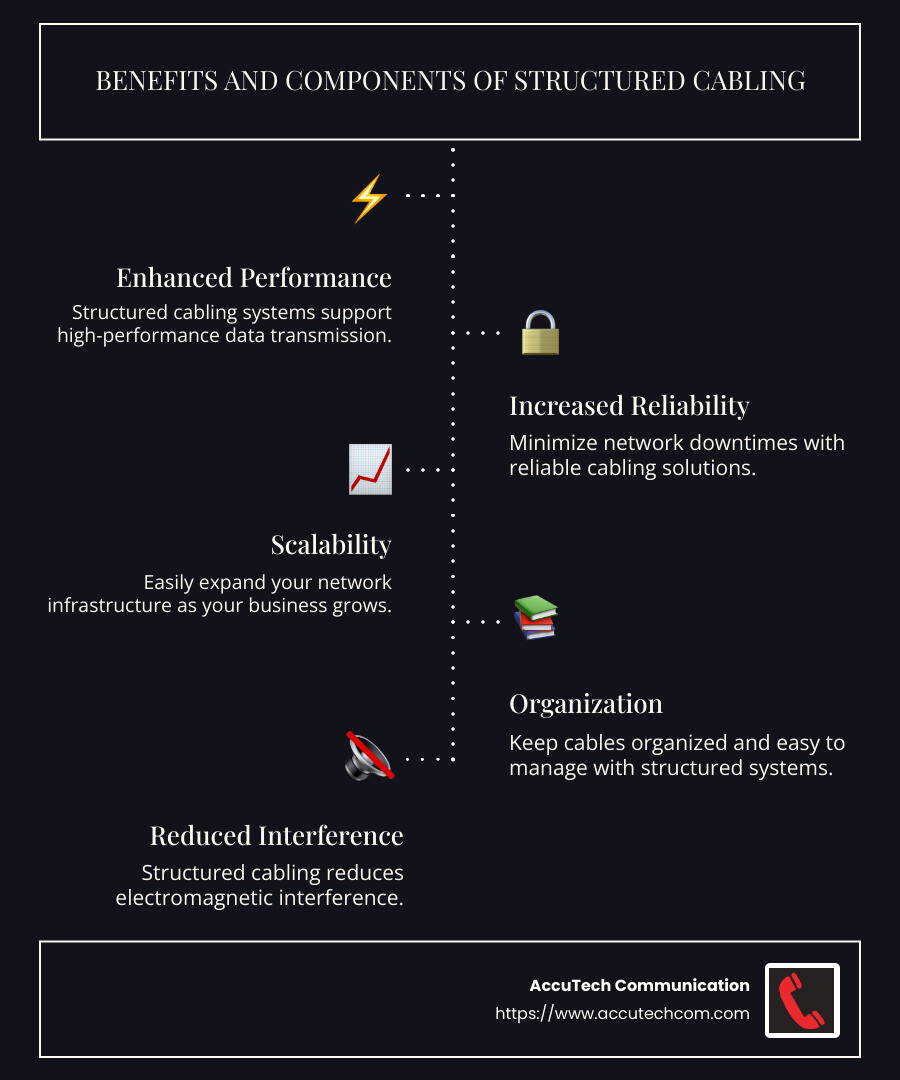
Investing in structured cabling brings a host of benefits that can transform your business’s network infrastructure. Here’s why it’s a smart choice:
Performance
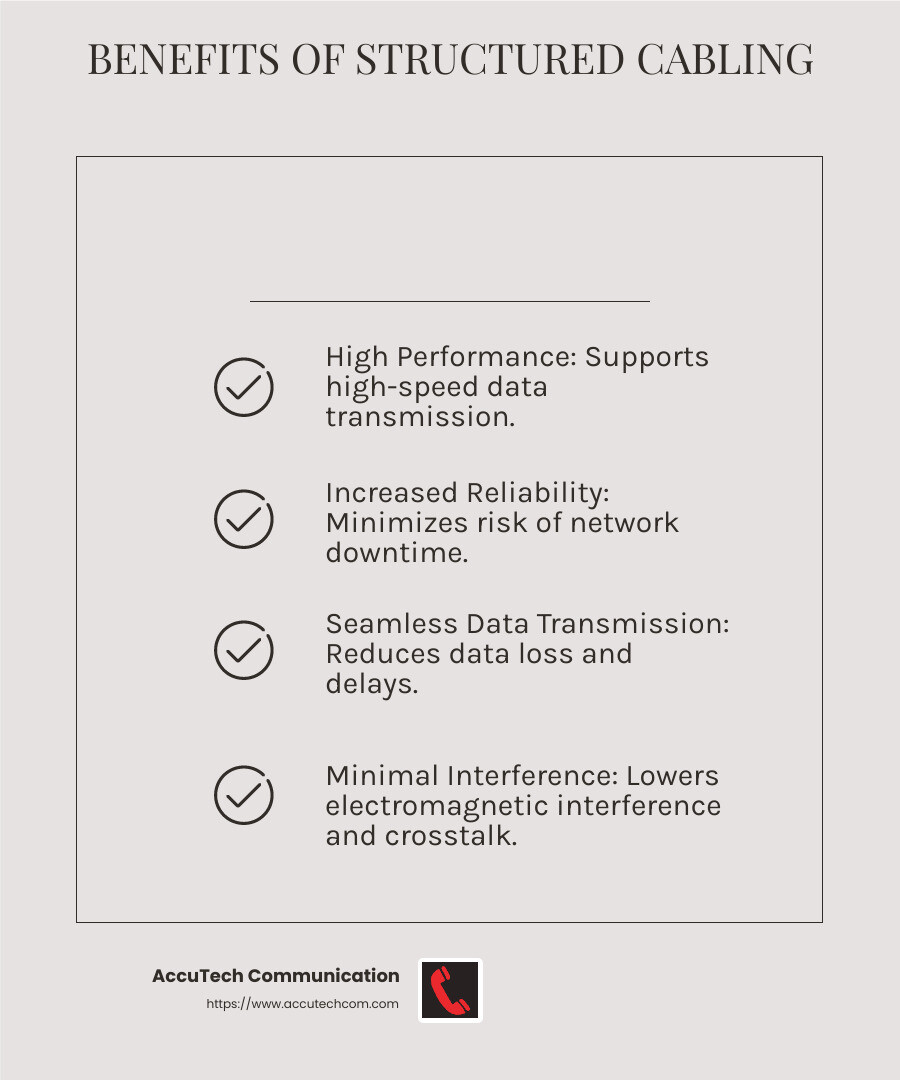
Structured cabling systems are designed to handle high data loads efficiently. They provide the backbone for high-speed data transmission, ensuring your network can support demanding applications and large volumes of traffic without a hitch. This means faster upload and download speeds, which translates to improved productivity.
Reliability
With structured cabling, you get a system that’s both robust and reliable. It minimizes the risk of downtime caused by network failures or connectivity issues. By organizing cables neatly and logically, it reduces the likelihood of human error during maintenance or upgrades. This reliability is crucial for businesses that cannot afford interruptions in their operations.
Data Transmission
Structured cabling supports seamless data transmission across your entire network. By using high-quality cables and components, it ensures that data moves smoothly from one point to another with minimal loss or delay. This is particularly important for businesses that rely on real-time data processing and communication.
Minimal Interference
One of the standout benefits of structured cabling is its ability to minimize interference. By adhering to industry standards and best practices, structured cabling systems reduce electromagnetic interference (EMI) and crosstalk between cables. This results in clearer signals and fewer errors, enhancing the overall quality of your network communications.
These benefits make structured cabling an essential investment for businesses looking to future-proof their network infrastructure. In the following section, we’ll discuss how to choose the right structured cabling service to meet your specific needs.
How to Choose the Right Structured Cabling Service
When it comes to selecting a structured cabling service, a few key factors can make all the difference. Here’s what you should consider:
Certified Technicians
Make sure the service provider employs certified technicians. Certifications like RCDD (Registered Communications Distribution Designer) and BICSI (Building Industry Consulting Service International) ensure that technicians are trained to industry standards. This expertise is crucial for designing and installing a network that performs reliably and efficiently. A company like AccuTech Communications, which offers certified and experienced professionals, ensures your cabling system is in capable hands.
Competitive Pricing
While pricing shouldn’t be the only factor, it’s important to find a service that offers competitive rates without compromising on quality. Look for providers that are transparent about their pricing structures and willing to offer written estimates. This approach helps you avoid unexpected costs and ensures you get the best value for your investment. That the cheapest option isn’t always the best—focus on getting the best service for your budget.
Quality Assurance
Quality assurance is non-negotiable. Ensure that the service provider follows industry standards like EIA/TIA 568A, which are critical for maintaining the integrity and performance of your network. A reliable provider will also offer testing and certification services to verify that your network cabling meets all necessary specifications. This step is vital for minimizing future issues and ensuring your network performs at its best.
Choosing the right structured cabling service is a crucial step in building a robust network infrastructure. By prioritizing certified technicians, competitive pricing, and quality assurance, you can ensure that your business is equipped with a reliable and efficient cabling system.
In the next section, we’ll explore what to look for when searching for “Structured Cabling Near Me” to ensure you find the best local service.
Structured Cabling Near Me: What to Look For
When you’re on the hunt for Structured Cabling Near Me, know what to look for to ensure you get a service that meets your needs.
Local Services
Start by narrowing down your options to local providers. Local services often offer quicker response times and a better understanding of regional infrastructure needs. Companies like AccuTech Communications, with locations in Massachusetts, New Hampshire, and Rhode Island, have the advantage of being familiar with local regulations and conditions. This local expertise can lead to more efficient project execution and fewer complications.
Site Survey
A comprehensive site survey is a must. Before any installation begins, the service provider should conduct a thorough assessment of your premises. This survey helps identify potential challenges and allows for a custom cabling solution that fits your specific environment. A good site survey will cover everything from existing infrastructure to future scalability needs, ensuring that your cabling system can grow with your business.
Written Estimate
Never start a project without a written estimate. A detailed estimate provides clarity on costs, timelines, and scope of work. It should break down all expenses, including materials, labor, and any additional services. This transparency helps you budget effectively and prevents any surprise charges. AccuTech Communications, for instance, emphasizes clear communication and offers written estimates to keep clients informed and confident about their investment.
By focusing on local services, insisting on a thorough site survey, and obtaining a written estimate, you’ll be well-equipped to choose a structured cabling service that meets your needs efficiently and effectively.
In the next section, we’ll dig into the cost considerations for structured cabling, helping you understand what factors influence pricing.
Cost Considerations for Structured Cabling
When planning your structured cabling project, understanding the cost factors is crucial. Here’s what you need to know:
Upfront Cost
The initial cost of structured cabling can vary widely. It depends on the size of your project and the materials you choose. While it might be tempting to go for the cheapest option, investing in quality cabling can save money in the long run. Quality materials reduce maintenance costs and improve performance.
Installation Complexity
The complexity of the installation can significantly affect costs. Simple installations in small offices are generally less expensive. However, larger projects, like those in multi-story buildings or campuses, require more planning and labor, increasing costs. Complex installations might also need specialized equipment or techniques, adding to the overall expense.
Choosing the Right Cable
The type of cable you select impacts both the upfront cost and long-term efficiency of your network. Here’s a quick guide:
- CAT-5: Suitable for basic networks with lower data transfer needs. It’s the most budget-friendly option but may not support high-speed requirements.
- CAT-6: A popular choice for medium to high-speed networks. Offers better performance and is more future-proof than CAT-5.
- CAT-7 and CAT-8: These are ideal for very high-speed data transfers and data centers. They offer superior performance but come at a higher cost.
Each type of cable has its pros and cons, so choose based on your current needs and future growth plans.
By considering these factors—upfront cost, installation complexity, and cable type—you can make informed decisions that balance budget with performance. In the following section, we’ll address some frequently asked questions about structured cabling to further guide your decision-making process.
Frequently Asked Questions about Structured Cabling
When exploring structured cabling solutions, you might encounter a few common questions. Below, we address some of these concerns to help you make informed decisions.
What are the disadvantages of structured cabling?
Structured cabling offers many benefits, but it also has some drawbacks. One major disadvantage is the upfront cost. Initial expenses can be high, especially if you opt for high-quality materials and complex installations. However, this investment often pays off over time through reduced maintenance and improved performance.
Another potential downside is the complexity of installation. Setting up a structured cabling system requires careful planning and skilled technicians. Complex projects, such as those involving multiple buildings or advanced technology needs, can be challenging and time-consuming.
How much does structured cabling cost?
The cost of structured cabling can vary based on several factors, including the type of cable used. Here’s a quick breakdown:
- CAT-5: Generally the least expensive, suitable for basic setups.
- CAT-6: Offers better performance, moderately priced.
- CAT-7 and CAT-8: Ideal for high-speed networks, but come with a higher price tag.
Costs are often calculated per foot, with higher category cables costing more. Additionally, installation complexity and project size will influence the total expense. It’s essential to get a written estimate from a reliable provider to understand the full scope of costs involved.
What is the difference between cabling and structured cabling?
Unstructured cabling refers to a more ad-hoc approach, where cables are installed without a comprehensive plan. This can lead to messy setups and potential performance issues.
In contrast, structured cabling involves a well-organized system with specific components like entrance facilities, equipment rooms, and horizontal cabling. This approach provides a more reliable, efficient, and scalable network infrastructure, minimizing downtime and ensuring better data transmission.
Understanding these differences can help you choose the right cabling solution for your needs. As you consider your options, structured cabling is a long-term investment in your network’s performance and reliability.
In the next section, we’ll conclude our exploration of structured cabling with a focus on the benefits of choosing AccuTech Communications for your cabling needs.
Conclusion
As we wrap up our exploration of structured cabling, it’s clear that choosing the right service provider is crucial for ensuring your network infrastructure meets your needs both now and in the future. At AccuTech Communications, we pride ourselves on delivering certified, reliable service across Massachusetts, New Hampshire, and Rhode Island. Our commitment to quality and competitive pricing has made us a trusted partner for businesses since 1993.
Our team of skilled technicians and engineers is dedicated to optimizing your network infrastructure for peak performance. We understand that every business has unique needs, and we tailor our solutions to match those requirements. Whether you’re setting up a new system or upgrading an existing one, our expertise ensures a seamless transition with minimal disruption.
By choosing AccuTech Communications, you’re investing in a partner who values long-term relationships and customer satisfaction. Our comprehensive range of services includes everything from consultation and design to installation and maintenance, ensuring that your network is always in top condition.
For those seeking Structured Cabling Near Me, look no further than AccuTech Communications. Our local presence and deep industry knowledge make us the ideal choice for businesses in the region.
Explore our structured cabling services to learn more about how we can support your business’s communication needs. Let us help you build a robust and future-proof network infrastructure that drives your success.
