The Future of Sight: A Guide to Advanced Commercial Surveillance Solutions
Defining Advanced CCTV Solutions for Modern Business
Advanced CCTV solutions have fundamentally changed how businesses protect their people, property, and operations. What used to be passive recording, grainy footage reviewed after an incident, is now active analysis: real-time monitoring, AI-powered alerts, and actionable intelligence delivered the moment something happens.
Here’s what advanced CCTV solutions include at a glance:
| Feature | What It Does |
|---|---|
| AI Video Analytics | Detects and classifies people, vehicles, and objects automatically |
| High-Resolution IP Cameras | Delivers crisp footage up to 4K–10K resolution |
| NVR Systems | Records and manages digital video over network infrastructure |
| Remote Monitoring | Live access from any device, anywhere |
| Perimeter Protection | Triggers alerts when boundaries are crossed, with false alarm rates under 2% |
| System Integration | Connects with access control, alarms, and intercoms |
| Cloud or Local Storage | Flexible retention options to meet compliance and operational needs |
Modern systems go far beyond a camera on a wall. They integrate with your entire network infrastructure, feeding data into centralized platforms that help you respond faster, reduce losses, and run a tighter operation.
For commercial businesses in Massachusetts, New Hampshire, and Rhode Island, the shift from analog DVR setups to intelligent, networked surveillance isn’t a luxury, it’s quickly becoming a baseline expectation.
I’m Corin Dolan, owner of AccuTech Communications, and I’ve spent decades helping commercial clients across New England with the cabling for advanced CCTV solutions as part of broader, integrated communications infrastructure. In this guide, I’ll walk you through everything you need to know to make a confident, informed decision for your facility.
Related content about Advanced CCTV solutions:
When we talk about Advanced CCTV solutions, we are primarily discussing the move from closed-circuit analog systems to open-network digital environments. In the past, cameras were “dumb” devices that simply sent a signal to a recorder. Today, a business security camera is essentially a high-powered computer with a lens.
These systems rely on Internet Protocol (IP) cameras and Network Video Recorders (NVRs). Unlike the old grainy footage of the 90s, modern IP cameras can provide crisp video with up to 10K resolution. This level of detail allows business owners in cities like Boston, MA, or Providence, RI, to zoom in on a license plate or a face without the image turning into a blur of pixels.
One of the most significant shifts is how these cameras connect to your building. Through Power-over-Ethernet (PoE), a single cable provides both the power and the data connection. This simplifies the network infrastructure and makes it much easier to scale your system as your business grows. Whether you are managing a small office in Andover or a massive warehouse in Worcester, the backbone of your security is now your structured cabling.
The Difference Between IP and Analog Systems
The technical divide between traditional analog systems and modern IP-based Advanced CCTV solutions is vast. Analog systems use coaxial cables to transmit raw video signals to a Digital Video Recorder (DVR), which then digitizes the footage. IP systems digitize the video right at the camera and send it over Ethernet cables to an NVR or the cloud.
| Feature | Analog (DVR) | IP (NVR) |
|---|---|---|
| Cable Type | Coaxial | Ethernet (Cat5e/Cat6) |
| Resolution | Limited (usually 720p/1080p) | High (4K, 8K, up to 10K) |
| Scalability | Difficult; requires new cables | Easy; can use existing network |
| Intelligence | Basic motion detection | AI, facial recognition, LPR |
| Remote Access | Often clunky or limited | Seamless via mobile/web apps |
| Power | Separate power cables needed | Power-over-Ethernet (PoE) |
By using digital signals, we can manage bandwidth much more effectively. Advanced codecs like AV1 offer up to 40% better video compression, meaning you get higher resolution without clogging up your local network.
Essential Camera Types for Comprehensive Coverage
Choosing the right hardware is about more than just resolution; it’s about the right tool for the specific job. When we design an office security camera system, we often mix and match several camera types:
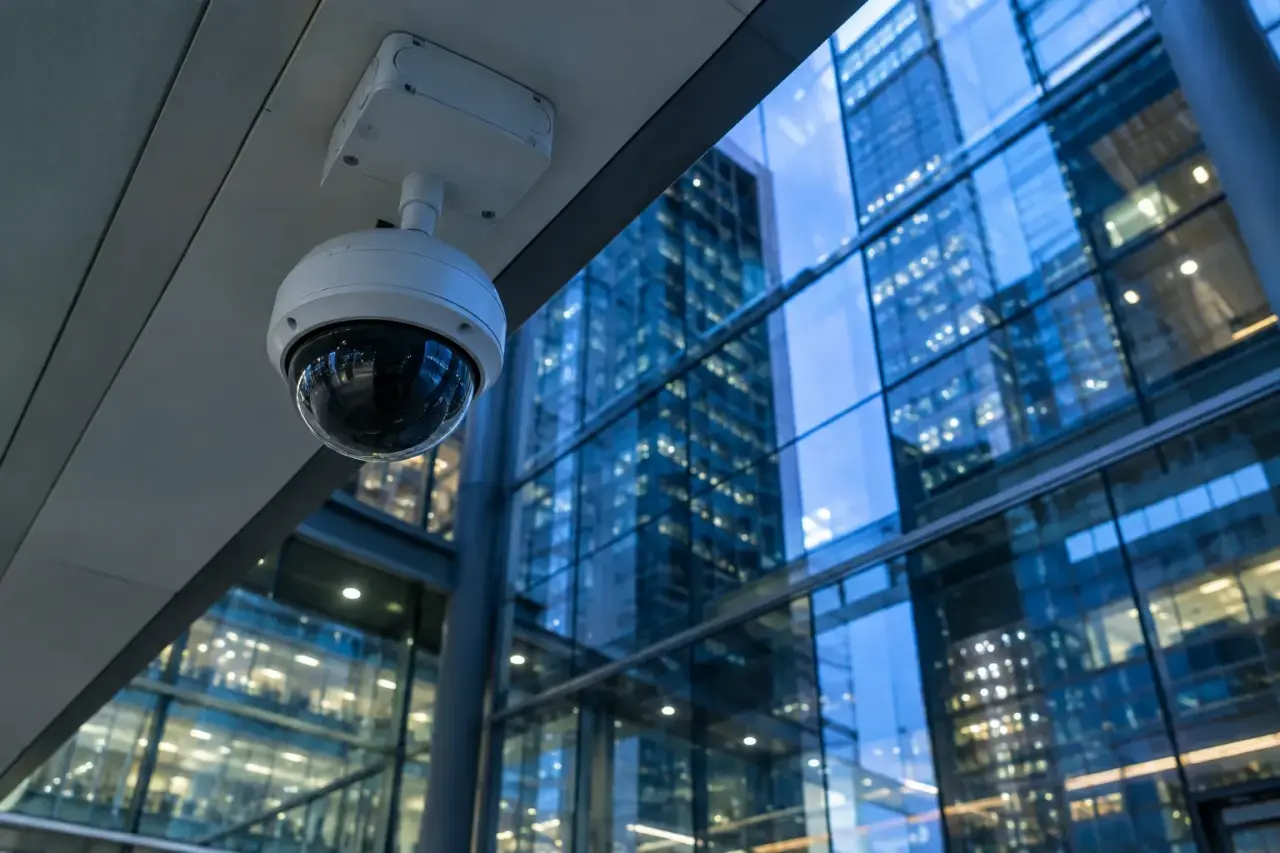
- Dome Cameras: These are discreet and vandal-resistant, making them perfect for indoor hallways in schools or hospitals.
- Bullet Cameras: Highly visible, these act as a great deterrent for parking lots and building exteriors.
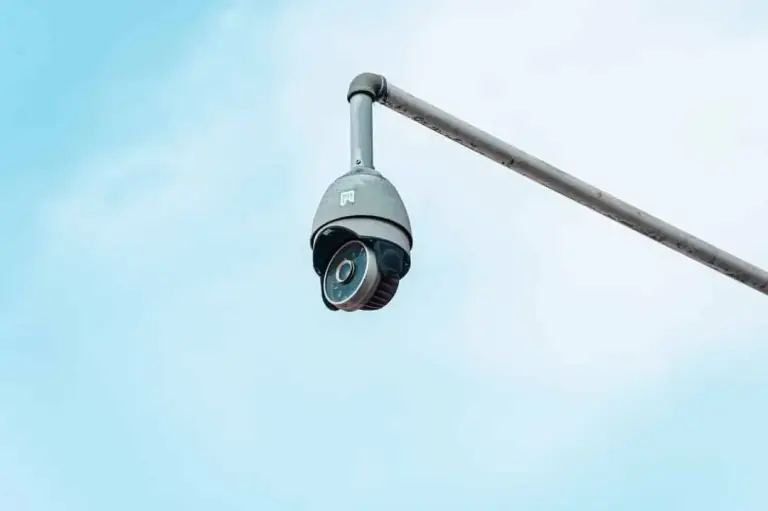
- PTZ (Pan-Tilt-Zoom) Cameras: These can be moved remotely to track a person of interest across a large area, like a shipping yard.
- Fisheye 360 Cameras: A single fisheye camera can often replace four standard cameras by providing a complete “bird’s eye” view of a room, eliminating blind spots in retail spaces.
- Multi-sensor Units: These house multiple camera lenses in one unit, providing wide-angle coverage with fewer cable runs and lower installation costs.
The Power of Intelligence: AI and Video Analytics
The “Advanced” in Advanced CCTV solutions really shines when we look at Artificial Intelligence. We often tell our clients that cameras aren’t just cameras anymore, they are sensors that deliver actionable data.
Through SecurOS Premium AI analytics, a system can distinguish between a tree swaying in the wind and a person climbing a fence. This is a game-changer for perimeter protection. In fact, advanced systems can achieve false alarm rates of less than 2%, ensuring that when your phone pings at 2:00 AM, it’s for a legitimate security concern, not a stray cat.
The Role of AI in Advanced CCTV Solutions
AI uses deep learning to recognize human silhouettes and vehicle types. This allows for incredibly specific searches. Instead of watching ten hours of footage to find a theft, you can simply ask the system to “show all people wearing red shirts” or “find all blue Ford trucks.”
Key AI features include:
- Object Classification: Differentiating between humans, cars, animals, and non-threatening movement.
- License Plate Recognition (LPR): Automatically logging every vehicle that enters your facility.
- Loitering Detection: Alerting security if someone stays in a sensitive area for too long.
- Trip-wire Technology: Creating a “virtual fence” that triggers an alarm the moment someone crosses a specific line.
This proactive approach turns your surveillance system for business into a preventative tool rather than just a way to see what you lost yesterday.
Operational Insights and Business Intelligence
Beyond security, Advanced CCTV solutions provide data that helps your business run better. This is often called “Business Intelligence.”
For a retail store in Braintree or a grocery chain in Nashua, NH, video analytics can provide:
- People Counting: Tracking how many customers enter and exit your store daily.
- Occupancy Estimation: Ensuring you stay within fire code limits automatically.
- Heat Mapping: Seeing which aisles customers spend the most time in, helping you optimize product placement.
- Queue Management: Alerting managers when checkout lines get too long so they can open another register.
Integration, Storage, and Network Security
A standalone camera system is a silo. An advanced system is an integrated ecosystem. We specialize in CCTV CATV wiring services.
Imagine a scenario where an unauthorized person tries to badge into a door. Your access control system denies them entry, and your CCTV system immediately swings a PTZ camera to that door and sends a live video clip to your phone. That is the power of unified security. To better understand these technical links, you can refer to this glossary of security terms and concepts.
Local vs. Cloud Storage Options
One of the most common questions we get from business owners in Massachusetts and Rhode Island is where the footage goes. You have three main options:
- On-Premise NVR: Your footage is stored locally on a physical recorder. This offers the most control and no monthly storage fees, but the hardware must be maintained and secured.
- Cloud Storage: Footage is sent directly to a secure data center. This is highly scalable and offers built-in redundancy, if a thief steals your recorder, your footage is still safe in the cloud.
- Hybrid Storage: This is often the best of both worlds. The system records locally for fast access and high-resolution playback while backing up critical events to the cloud.
Retention policies are also vital. Depending on your industry (like healthcare or finance), you may be legally required to keep footage for 30, 60, or even 90 days. We help you calculate the exact storage needs based on your camera count and resolution settings.
Hardening Your System Against Cyber Threats
Since modern Advanced CCTV solutions live on your network, they must be protected like any other IT asset. A poorly secured camera is a backdoor for hackers. Follow strict cybersecurity best practices to “harden” your system:
- Firmware Updates: Regularly updating camera software to patch vulnerabilities.
- VLANs (Virtual Local Area Networks): Keeping your security traffic on a separate network from your office computers and guest Wi-Fi.
- Encryption: Ensuring footage is encrypted both while it’s sitting on the hard drive and while it’s traveling over the internet.
- Compliance Standards: We prioritize hardware that meets NDAA (National Defense Authorization Act) standards, ensuring your equipment is secure and approved for use in sensitive environments.
Planning and Implementing Your Commercial System
A successful surveillance project starts long before the first camera is mounted. It begins with a thorough site assessment. We look at lighting conditions, traffic flow, and potential blind spots. For a business in a historic building in Salem, MA, the challenges are very different than for a new construction project in Manchester, NH.
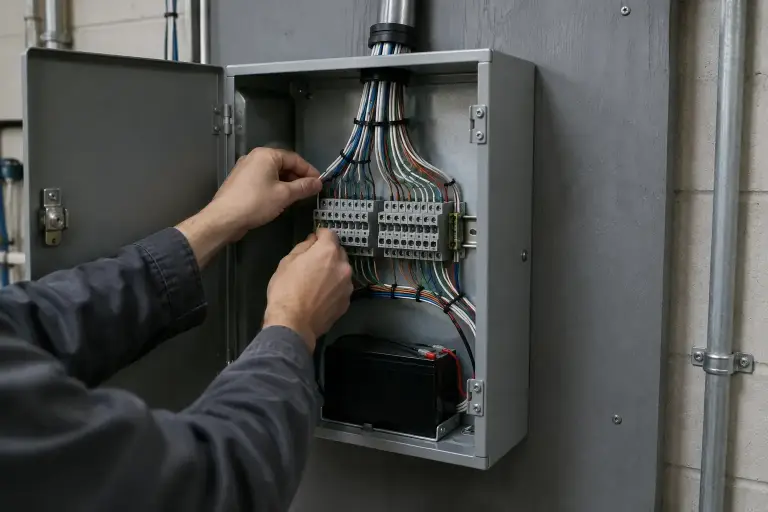
The foundation of any advanced system is the wiring. High-quality network cabling installation ensures that your cameras have the bandwidth they need to stream 4K video without lag.
Compliance and Industry Standards
Depending on where your business is located and what industry you are in, there are specific standards you must meet:
- ONVIF: This ensures that different brands of cameras and recorders can talk to each other.
- NDAA: Crucial for government contractors or businesses with high security requirements.
- HIPAA: If you are a healthcare provider in Massachusetts, your camera placement and footage storage must protect patient privacy.
- SOC2: Important for data centers and service organizations to prove their security controls are effective.
Average Costs for Commercial Surveillance
While we don’t provide fixed pricing without a site walk, we can provide industry averages based on publicly available data to help you budget.
For a commercial project, costs can range widely depending on complexity. A basic 4-camera setup for a small office might start around $1,500, while a comprehensive, AI-powered system for a large industrial facility can exceed $15,000 to $45,000+. Factors that influence the price include:
- The number of cameras and their resolution (4K vs 10K).
- The amount of storage required (local vs cloud).
- The complexity of the cabling run (plenum-rated ceilings, outdoor trenching).
- Integration with other systems like business camera systems or access control.
Frequently Asked Questions about Advanced CCTV Solutions
Can advanced CCTV systems work without an internet connection?
Yes. Many people assume that IP cameras require the internet to function, but they actually only need a local network (LAN). Your cameras can record to an NVR and you can view them on a monitor in your office without any internet connection at all. However, you would lose the ability to view the footage remotely on your smartphone or receive cloud-based alerts.
What is the advantage of Power-over-Ethernet (PoE) for businesses?
PoE is a massive advantage for commercial installations. In older systems, every camera needed two cables: one for video and one for power. PoE allows us to use a single cable for both. This reduces the amount of wiring in your ceilings, lowers labor costs, and makes it much easier to move or add cameras later. It also allows us to centralize the power for all cameras at a single PoE switch, which can be backed up by a UPS (Uninterruptible Power Supply) to keep your security running during a power outage.
How long can footage be stored in a modern NVR system?
This depends entirely on your hard drive capacity and how you configure the system. By using smart recording, where the system only records when it detects motion, you can save a significant amount of space. Modern compression codecs like H.265 also allow you to store more video in less space. Generally, most businesses aim for 30 days of retention, but with cloud archiving, you can keep footage indefinitely if needed for legal or compliance reasons.
Conclusion
At AccuTech Communications, we believe that security is the foundation of business continuity. Since 1993, we have been providing reliable service to businesses across Massachusetts, New Hampshire, and Rhode Island.
Whether you are looking to upgrade an aging analog system or design a ground-up Advanced CCTV solution for a new facility, our team has the expertise to build the cabling for a system that is scalable, secure, and easy to use. We don’t believe in “cookie-cutter” bundles; we provide customized solutions that address your specific vulnerabilities while respecting your budget.
Ready to see your business in a new light? Contact our commercial CCTV installers for a custom solution today. We’ll help you design a system that doesn’t just watch your business, but helps you protect it.