
Understanding Cable Categories and Fiber Optic Standards
When you start talking to a data cabling installation company, the first thing you’ll notice is the alphabet soup of cable categories. Choosing the right “Cat” or fiber type isn’t just about speed; it’s about future-proofing your business.
Twisted Pair Copper Cabling Most office networks rely on twisted pair cables. These contain eight individual wires twisted into four pairs to minimize electromagnetic interference (crosstalk).
- Cat6: The standard for many modern offices, supporting speeds up to 1 Gbps at 100 meters.
- Cat6A (Augmented): This is the “sweet spot” for many growing businesses. It supports 10 Gbps speeds and reduces crosstalk even further, making it ideal for high-density environments.
- Cat7 & Cat8: These are high-performance shielded cables often used in data centers or for specialized short-range, high-bandwidth needs.
Fiber Optic Standards For long distances or massive bandwidth requirements, fiber optic services are the gold standard. Instead of electrical pulses, fiber uses laser light signals sent through glass cores.
- Single-mode Fiber: Best for very long distances (like connecting buildings on a campus). It has a small core that allows light to travel in a single path.
- Multi-mode Fiber: Typically used for shorter distances within a building (up to 550 meters). It’s perfect for high-speed backbone links between server rooms.
Beyond performance, choosing high-quality materials and efficient routing can even have an environmental impact. By reducing the need for frequent replacements and optimizing data center cooling through better airflow, companies can align with sustainability goals like those supported by Ecologi.
Comparing Copper and Fiber Performance
| Feature | Cat6 | Cat6A | Fiber Optic (Multi-mode) |
|---|---|---|---|
| Max Speed | 1 Gbps | 10 Gbps | 10 Gbps – 100 Gbps+ |
| Max Distance | 100 Meters | 100 Meters | 550 Meters+ |
| Bandwidth | 250 MHz | 500 MHz | 2000 MHz+ |
| Interference | Moderate | Low | None (Immune to EMI) |
| Future-Proofing | Standard | High | Very High |
Why Your Business Needs a Data Cabling Installation Company
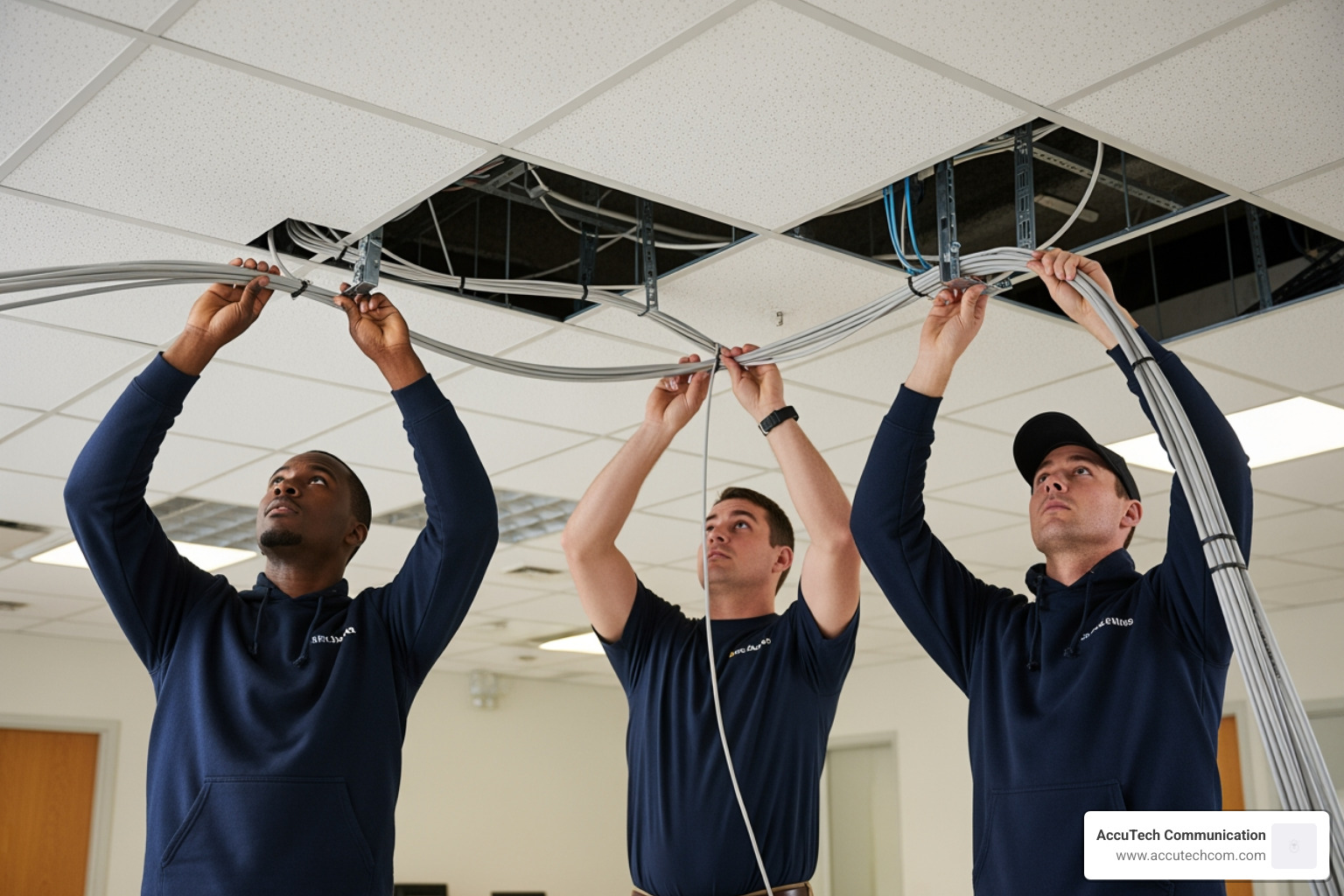
You might be tempted to have a general handyman run a few wires, but data cabling is a specialized trade. A professional data cabling installation company understands the difference between a “working” network and an “optimized” one.
Structured vs. Unstructured Cabling Unstructured cabling—often called “spaghetti cabling”—happens when wires are run point-to-point without a plan. It’s a nightmare to troubleshoot and can lead to network downtime. Structured cabling, however, follows a predefined design with patch panels and organized pathways. This approach increases the system lifespan and makes “Moves, Adds, and Changes” (MAC) much simpler.
Airflow and Efficiency In a server room, heat is the enemy. A professional network cabling installation in Massachusetts ensures that cables don’t block the exhaust fans of your expensive hardware. Proper cable management improves airflow, which keeps your equipment cool and lowers energy costs.
Labeling and Documentation We’ve all seen the “mystery wire.” A professional cabling contractor provides comprehensive labeling at both ends of every run. When a port goes down, your IT team can find the problem in seconds rather than hours.
Evaluating a Data Cabling Installation Company for Your Project
Don’t just hire the lowest bidder. Look for these markers of quality:
- Certified Technicians: Are they BICSI-certified? This ensures they follow global best practices.
- Standards Compliance: Every installation should meet ANSI/TIA/EIA-568 standards for performance and safety.
- Manufacturer Warranties: Top-tier installers can often provide 25-year manufacturer-backed warranties because the brands trust their workmanship.
- Local Expertise: Ensure they understand local building codes in areas like Boston, Worcester, or Manchester, NH.
Essential Services for Modern Commercial Networks
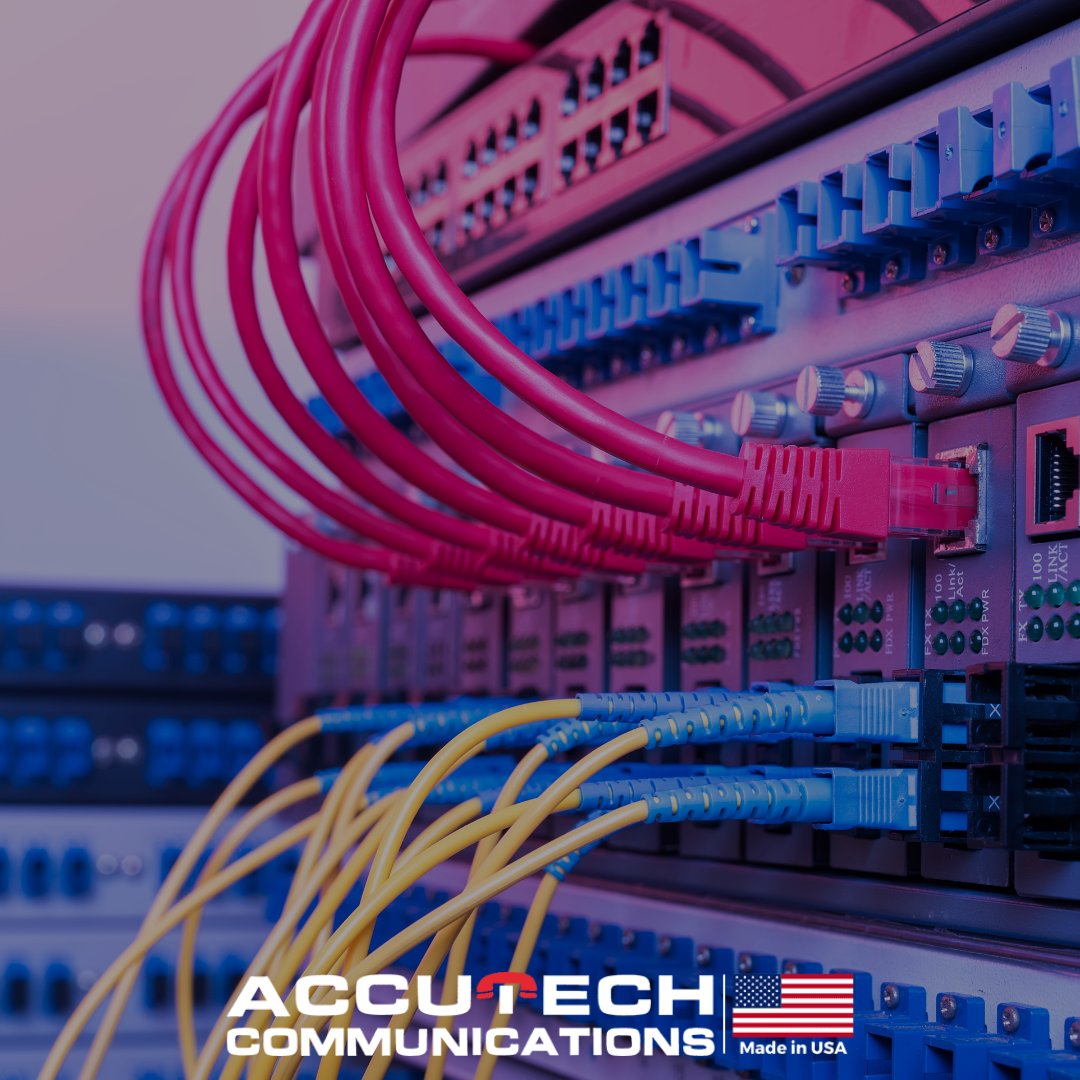
A full-service data cabling installation company does much more than just pull wire. They build the entire nervous system of your office.
- Data Center Build-outs: From the initial design to the final rack-and-stack, pros handle the heavy lifting of enterprise-level infrastructure.
- Cabinet Tidy Services: If your server closet looks like a bird’s nest, a “closet cleanup” can restore order and prevent accidental unplugging.
- VoIP and CCTV Integration: Modern phone systems and security cameras run on the same data cables as your computers. A unified network cabling service ensures your Power over Ethernet (PoE) devices get the juice they need.
- Wireless Solutions: Wi-Fi isn’t truly wireless—it needs a wired backbone. Professionals perform Wi-Fi site surveys to eliminate dead zones and install high-capacity Access Points (APs).
- Mobile Signal Boosting: If your office is a “dead zone” for cell service, installers can add boosters to ensure your team stays connected.
For a broader look at how these systems integrate, you can view a Data Cabling Solutions Overview to see how diverse components work together.
What to Expect from a Data Cabling Installation Company Site Survey
Before a single cable is pulled, a reputable company will perform a site survey. This is where the magic happens. We look at your blueprints, identify existing pathways, and determine the best locations for your Main Distribution Frame (MDF) and Intermediate Distribution Frames (IDF).
If you are looking for network cabling near you, ensure the surveyor discusses regional requirements—like specific fire-rated “Plenum” cable needs for air-handling spaces in Rhode Island or Massachusetts commercial buildings.
Planning Your Project: Costs and Industry Standards
Quality assurance is what separates the pros from the amateurs. After the cables are in, they must be tested. A professional structured cabling contractor won’t just see if a light blinks; they will use a certifier to provide a detailed PDF report showing the exact decibel loss and performance of every single line.
Industry Standards to Know:
- 10-Point System Audits: A thorough check of everything from grounding to bend radius.
- As-built Drawings: A map of your new network so you know exactly where every cable is hidden behind the walls.
- Abandoned Cable Removal: In many jurisdictions, it is a fire code violation to leave old, unused cables in the ceiling. We make sure the “trash” is cleared out.
Average Industry Pricing for Commercial Installations
While every project is unique, we can look at industry averages to help you budget. Based on publicly available internet data, the cost of a professional installation generally ranges from $150 to $750 per cable drop.
Note: These prices are average costs sourced from publicly available internet data and are not the actual prices of AccuTech Communications.
Factors that influence the price include:
- Material Quality: Cat6A costs more than Cat5e; Plenum-rated cable (required for many ceilings) is more expensive than Riser-rated cable.
- Building Complexity: Running cables through an open warehouse is much faster than fishing them through the brick walls of a historic building in downtown Boston.
- Labor Variables: High-ceiling work requiring lifts or after-hours installations to avoid disrupting your business will impact the total.
For a more tailored look at your specific needs, searching for network cable installation near me is the best way to get a localized quote.
Frequently Asked Questions about Data Cabling
What is the difference between Cat6 and Cat6A for business use?
Cat6 is great for standard office tasks, but Cat6A is better for businesses that handle large files, use 10Gbps equipment, or want their cabling to last 10+ years without needing an upgrade. Cat6A also handles heat better, which is important for high-power PoE devices like advanced security cameras.
How long does a typical commercial cabling installation take?
A small office (10-20 drops) can often be finished in a day or two. Larger projects, like a full floor of a high-rise or a data center build-out, can take several weeks. A good data cabling installation company will provide a clear timeline during the site survey.
Why is structured cabling better than a wireless-only office?
Wi-Fi is convenient, but it’s shared and susceptible to interference. A wired connection is dedicated, faster, and more secure. Most successful businesses use a “hybrid” approach: wires for stationary desks and servers, and high-quality Wi-Fi for mobile devices and guests.
Conclusion
Investing in your infrastructure today saves you from the “emergency” calls of tomorrow. Whether you are moving into a new office in Worcester, upgrading a school in Manchester, or building a data center in Providence, the quality of your cabling determines the quality of your business operations.
At AccuTech Communications, we’ve been the go-to data cabling installation company for Massachusetts, New Hampshire, and Rhode Island since 1993. We pride ourselves on delivering certified, reliable service that keeps your business moving at the speed of light.
Ready to build a network you can rely on? Start your project with a professional data cabling installation company today and let’s get your business connected.
