
Types of Fiber Optic Cable: Top Options for 2024 Success
Navigating Fiber Options: A Deep Dive into Types of Fiber Optic Cables
When it comes to high-performance data networking and telecommunications, fiber optic cables are the gold standard. Let’s quickly address what you’re likely searching for:
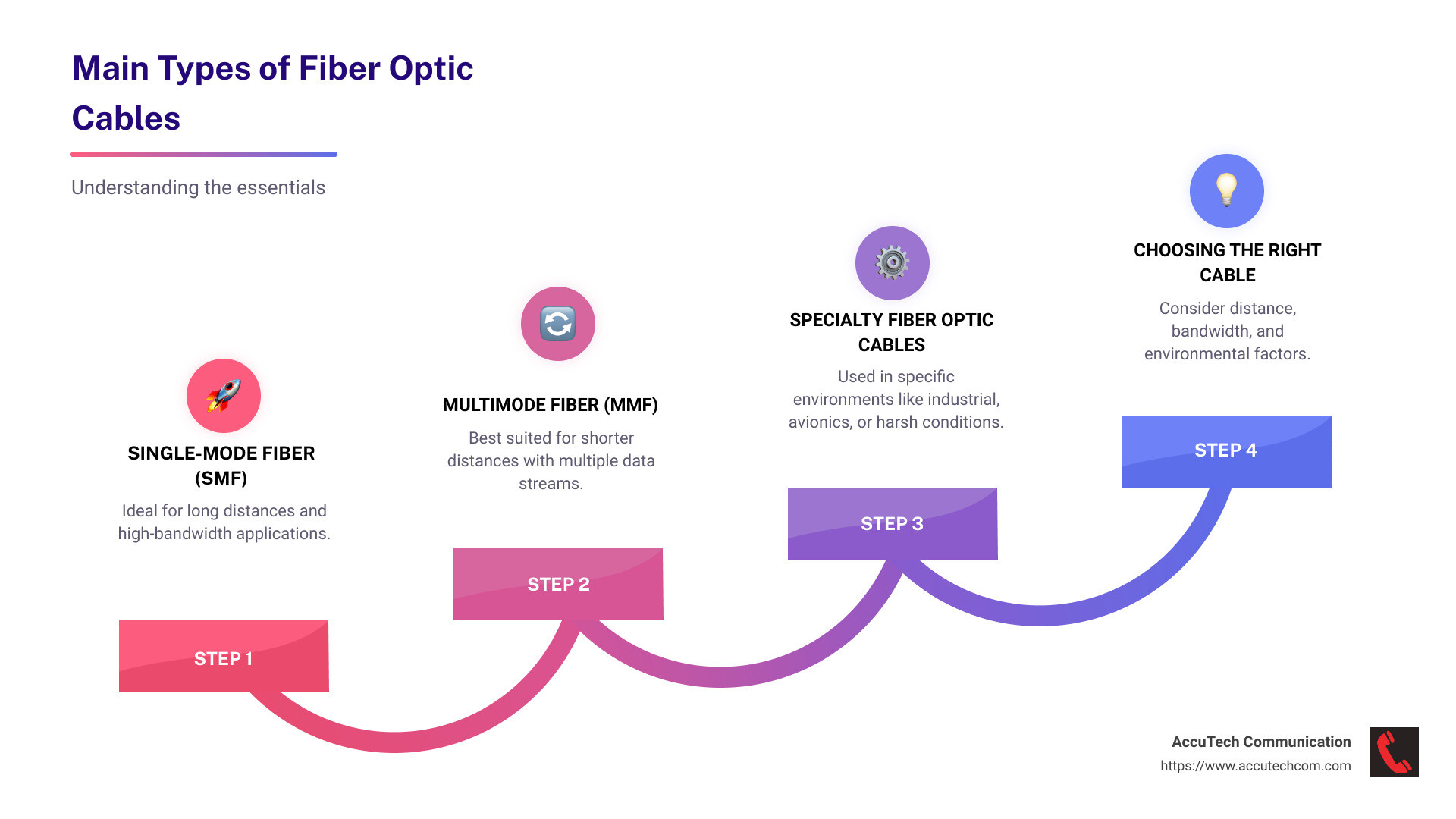
Main Types of Fiber Optic Cables:
1. Single-Mode Fiber (SMF): Ideal for long distances and high-bandwidth applications.
2. Multimode Fiber (MMF): Best suited for shorter distances with multiple data streams.
3. Specialty Fiber Optic Cables: Used in specific environments like industrial, avionics, or harsh conditions.
Fiber optic cables revolutionized how we transmit data. They use light instead of electricity, resulting in lightning-fast speeds and long-distance capabilities without signal degradation. This makes them perfect for businesses needing efficient, reliable communication systems, particularly in data-heavy sectors like healthcare.
I’m Corin Dolan, and for nearly three decades, I’ve been at the forefront of fiber optic cabling solutions through AccuTech Communications.
Our team has served industries with diverse needs, focusing on enhancing network infrastructure with the right types of fiber optic cables.
Understanding the Basics of Fiber Optic Cables
Fiber optic cables are the backbone of modern communication networks. They use light instead of electricity, resulting in lightning-fast speeds and long-distance capabilities without signal degradation. This makes them perfect for businesses needing efficient, reliable communication systems, particularly in data-heavy sectors like healthcare.
Fiber optic cables are made up of several key components:
Light Transmission
At the heart of every fiber optic cable is the ability to transmit light. This is done using tiny strands of glass or plastic, known as optical fibers. Light signals are sent through these fibers, carrying data at incredible speeds. The light signals are modulated to represent data, allowing for the transfer of vast amounts of information quickly and efficiently.
Glass Cores
The core of an optical fiber is a thin strand of glass or plastic, typically about the diameter of a human hair. This core is where light travels. Single-mode fibers have a very narrow core (around 9 microns in diameter), allowing light to travel straight down the fiber, making them ideal for long-distance communication. Multi-mode fibers, on the other hand, have a broader core (50 or 62.5 microns), allowing multiple light paths or modes. This makes them suitable for shorter distances.
Cladding
Surrounding the core is the cladding, a layer of glass or plastic with a different refractive index. The cladding’s job is to keep the light signals within the core through a process called total internal reflection. This ensures that the light signals can travel long distances without escaping the core, maintaining the integrity and speed of data transmission.
Protective Jacket
The outermost layer of a fiber optic cable is the protective jacket. This jacket is made from durable materials like plastic to shield the delicate glass fibers from physical damage, moisture, and other environmental factors. Depending on the intended use, the protective jacket can vary in thickness and strength. For example, cables used in outdoor or industrial environments might have more robust jackets compared to those used indoors.

These components work together to create a highly efficient and reliable means of data transmission. Whether it’s for long-distance telecommunications or high-speed data connections within a building, understanding the basics of fiber optic cables helps in choosing the right type for your needs.
Next, we’ll dive into the different types of fiber optic cables available and their specific applications.
Types of Fiber Optic Cables
When it comes to types of fiber optic cables, they mainly fall into two categories: single-mode and multimode. Each type has its unique features and ideal use cases.
Single-Mode Fiber Optic Cables
Single-mode fiber optic cables are designed with a very narrow core, usually around 9 micrometers (µm) in diameter. This narrow core allows the light to travel straight down the cable without bouncing off the walls of the core. The result? Less signal loss and higher bandwidth over longer distances.
- Narrow Core: The core diameter is about 9µm.
- Long Distances: Can transmit data over many miles before needing improvement.
- High Bandwidth: Supports high data rates, making it ideal for long-distance telecommunications.
There are two main types of single-mode fibers: OS1 and OS2.
- OS1: Designed for indoor use and can handle up to 10 Gigabits per second over distances up to six miles. It’s more affordable but less durable.
- OS2: Suited for outdoor use and can stretch up to 125 miles while supporting data rates up to 100 Gigabits per second. OS2 cables are more expensive but offer better performance and durability.
Multimode Fiber Optic Cables
Multimode fiber optic cables have a much broader core, either 50µm or 62.5µm, which allows multiple streams of data to be sent simultaneously. This makes them suitable for shorter distances but not for long-distance data transmission.
- Broad Core: Core diameter of either 50µm or 62.5µm.
- Short Distances: Ideal for distances within a building or campus.
- Multiple Data Streams: Can handle multiple light paths, allowing for more data to be transmitted at once.
Multimode fibers are classified into several types, known as OM1, OM2, OM3, OM4, and OM5. Each type supports different distances and bandwidths:
- OM1: Core size of 62.5µm, supports up to 10 Gigabits per second at distances up to 100 feet.
- OM2: Core size of 50µm, supports up to 10 Gigabits per second at distances up to 260 feet.
- OM3: Core size of 50µm, supports up to 10 Gigabits per second at distances up to 1000 feet.
- OM4: Core size of 50µm, supports up to 10 Gigabits per second at distances up to 1,300 feet.
- OM5: Core size of 50µm, supports up to 10 Gigabits per second at distances up to 1,640 feet and can handle additional wavelengths.
The choice between single-mode and multimode fibers largely depends on the specific needs of your network, such as distance and data rate requirements.
Next, we’ll explore the key specifications and standards that help in selecting the right fiber optic cable for your project.
Key Specifications and Standards in Fiber Optic Cabling
When selecting fiber optic cables, understanding the key specifications and standards is crucial. These factors will help you choose the right cable for your needs. Let’s break down the specifications for both multimode and single-mode fibers.
Multimode Fiber Specifications
Multimode fibers are identified by their OM (Optical Multimode) ratings, which specify their performance characteristics. Here’s a quick rundown:
- OM1:
- Core Size: 62.5µm
- Jacket Color: Orange
- Data Rate: 1Gb @ 850nm wavelength
- Distance: Up to 300 meters
- Applications: Short-haul networks, LANs, private networks
- OM2:
- Core Size: 50µm
- Jacket Color: Orange
- Data Rate: 1Gb @ 850nm wavelength
- Distance: Up to 600 meters
- Applications: Short-haul networks, LANs, private networks
- OM3 (Laser-Optimized Multimode):
- Core Size: 50µm
- Jacket Color: Aqua
- Data Rate: 10Gb @ 850nm wavelength
- Distance: Up to 300 meters
- Applications: Larger private networks
- OM4 (Laser Optimized Multimode):
- Core Size: 50µm
- Jacket Color: Aqua
- Data Rate: 10Gb @ 850nm wavelength
- Distance: Up to 550 meters
- Applications: High-speed networks, data centers, financial centers, corporate campuses
- OM5:
- Core Size: 50µm
- Jacket Color: Lime Green
- Wavelengths: 850nm to 953nm
- Data Rate: Can transmit 40Gb/s and 100Gb/s
- Applications: High-speed networks and data centers requiring greater link distances and higher speeds
Single-Mode Fiber Specifications
Single-mode fibers are categorized by OS (Optical Single-mode) ratings. These cables have a much smaller core and are designed for long-distance communication.
- OS1:
- Core Size: 8-9µm
- Jacket Color: Yellow
- Data Rate: Supports speeds up to 10G
- Distance: Up to 10km (6 miles)
- Applications: Indoor use, moderate distance telco local loops, LANs, point-to-point links in cities, buildings, factories, office parks, or campuses
- OS2:
- Core Size: 8-9µm
- Jacket Color: Yellow
- Data Rate: Supports speeds up to 100G
- Distance: Up to 200km (124 miles)
- Applications: Outdoor use, high fiber count, long distance telco backbone and backhaul lines, direct bury applications along streets and railroads
Core Size and Wavelengths
Core Size: This is the diameter of the fiber core. Multimode fibers typically have a core size of 50µm or 62.5µm, while single-mode fibers have a core size of 8-9µm.
Wavelengths: Multimode fibers operate at wavelengths of 850nm and 1300nm. Single-mode fibers operate at 1310nm and 1550nm.
Understanding these specifications will help you make an informed decision when selecting the right type of fiber optic cable for your project.
Next, we’ll dig into the various applications and uses of different types of fiber optic cables.
Applications and Uses of Different Fiber Optic Cables
Fiber optic cables are incredibly versatile, finding applications across multiple domains. Let’s explore how different types of fiber optic cables are used in various settings.
Indoor vs. Outdoor Applications
Communications: Fiber optic cables are the backbone of modern communication networks. They support high-speed internet, telephone, and television services. For instance, DryBlock® cables are ideal for outdoor applications like duct, direct-buried, and lashed aerial installations. Their corrugated steel armor and polyethylene jacket provide durability and rodent resistance.
Industrial: In industrial settings, fiber optic cables must withstand harsh conditions. EZ-Bend® cables are perfect for these environments. They offer reliable connections with virtually zero loss, making them ideal for settings where cables may be bent or flexed frequently.
Sensing: Fiber optic cables are also used in sensing applications. They can detect temperature, pressure, and other physical changes. These cables are crucial in monitoring systems in power plants and other industrial facilities.
Avionics: Avionics cables must endure the unique conditions found in aircraft. Brands like FlightGuide®, FlightLink, and Avioptics® provide lightweight, high-strength, and high-durability fiber optic cables specifically designed for aerospace applications.
Specialty and High-Density Applications
Rollable Ribbons: Rollable ribbon cables are a game-changer in high-density applications. They can roughly double fiber density compared to traditional cables. This makes them invaluable for network designers who need to install more fibers in less space. The fibers in rollable ribbons are attached intermittently, making the ribbon flexible and “rollable.”
AccuRibbon®: These cables hold up to 24 colored optical fibers in a planar array, providing high fiber density. They are ideal for use in fiber optic cabling or routing inside electronic equipment. AccuRibbon® simplifies mass-fusion splicing, saving time and money.
Central Core Cables: These cables are designed for easy deployment in a variety of settings, including duct, aerial, direct buried, and outdoor/indoor installations. They offer increased fiber density, making them suitable for large-scale network deployments.
Microcables: Microcables are compact and lightweight, making them ideal for installations where space is limited. They are perfect for use in data centers and other high-density environments.
Fiber optic cables are essential for both indoor and outdoor applications, offering unique solutions for communications, industrial, sensing, and avionics needs. Specialty and high-density cables like rollable ribbons and AccuRibbon® provide efficient and cost-effective solutions for complex network designs.
Next, we’ll answer some frequently asked questions about fiber optic cables.
Frequently Asked Questions about Fiber Optic Cables
What are the main differences between single-mode and multimode fiber optic cables?
Understanding the differences between single-mode and multimode fiber optic cables is crucial for selecting the right type for your project.
Core Size:
– Single-mode fiber (SMF) has a small core size of about 8-9 microns.
– Multimode fiber (MMF) has a larger core size, typically 50 or 62.5 microns.
Light Paths:
– Single-mode transmits light in a single path, which minimizes dispersion.
– Multimode allows multiple light paths, which can cause more dispersion.
Use Cases:
– Single-mode fiber is ideal for long-distance and high-bandwidth applications like telecommunications and data centers.
– Multimode fiber is best for short-distance applications such as within buildings, schools, and hospitals.
How do I choose the right type of fiber optic cable for my project?
Choosing the right type of fiber optic cable depends on several factors:
Distance Needs:
– For distances over several kilometers, single-mode fiber is the best choice.
– For shorter distances (under 300 meters), multimode fiber is usually sufficient.
Bandwidth Requirements:
– If your application demands high bandwidth and speed, go for single-mode fiber.
– For less intensive applications, multimode fiber will suffice.
Environmental Factors:
– Consider the cable jacket to ensure it meets local fire codes and other environmental conditions. For instance, cables running through plenum spaces should have a plenum-rated jacket.
What are the common types of connectors used with fiber optic cables?
Connectors are essential for linking fiber optic cables to network equipment. Here are some common types:
LC (Lucent Connector):
– Small form factor, ideal for high-density environments.
– Commonly used in data centers.
SC (Subscriber Connector):
– Push-pull design, easy to install and remove.
– Used in both single-mode and multimode applications.
MTP/MPO (Multi-Fiber Push On):
– High-density connector, supports multiple fibers.
– Ideal for data centers and high-speed networks.
ST (Straight Tip):
– Bayonet-style, commonly used in network applications.
– Often found in multimode networks.
FC (Ferrule Connector):
– Screw-on mechanism, secure connection.
– Typically used in single-mode applications.
Choosing the right fiber optic cable and connectors can significantly impact the performance and reliability of your network. Always consider your specific needs and consult with experts if you’re unsure.
Next, we’ll dive into the conclusion and explore future trends in fiber optic technology and how AccuTech Communications can help you stay ahead.
Conclusion
As we look to the future of fiber optic technology, several exciting trends are emerging. One key trend is the increasing adoption of 5G networks, which require robust fiber optic infrastructure to support high-speed data transmission and low latency. This shift will drive the demand for both single-mode and multimode fiber optic cables, especially in urban areas where data traffic is densest.
Another significant trend is the growth of Internet of Things (IoT) devices. These devices generate massive amounts of data that need to be transmitted quickly and reliably. Fiber optic cables are ideally suited for this task due to their high bandwidth and long-distance capabilities.
Data centers are also evolving. With the rise of cloud computing and big data, data centers need to handle higher volumes of data more efficiently. Innovations like rollable ribbon cables, which offer higher fiber density in smaller spaces, are becoming increasingly important.
AccuTech Communications: Your Partner in Fiber Optic Solutions
At AccuTech Communications, we stay at the forefront of these trends to provide you with the most advanced and reliable fiber optic solutions. Our expertise spans various applications, from installing high-speed data networks in corporate environments to setting up robust communication systems in industrial settings.
We offer a comprehensive range of services, including consultation, design, installation, and maintenance of fiber optic cabling. Our team of skilled technicians ensures that your network infrastructure is optimized for peak performance, whether you need single-mode or multimode fiber optic cables.
Why Choose AccuTech Communications?
- Proven Expertise: Over two decades of experience in network cabling and business communications.
- Comprehensive Services: From initial consultation to ongoing maintenance, we cover all your fiber optic needs.
- Quality Assurance: We use only the best materials and adhere to industry standards to ensure the reliability and longevity of your network.
- Customer Satisfaction: Our clients trust us for our responsiveness, technical know-how, and commitment to quality.
Ready to future-proof your network? Contact us today to discuss your fiber optic cabling needs and get a personalized estimate. Let AccuTech Communications help you stay ahead in the changing world of fiber optic technology.
