
Voice Data Cabling: Essential 2025 Guide
The Backbone of Modern Business Communication
Voice data cabling is the physical infrastructure carrying signals throughout your business, connecting computers, phones, security systems, and other network devices into a unified system. Without it, expensive workstations become paperweights, and your team loses the ability to communicate.
What Voice Data Cabling Includes:
- Structured cabling systems for both voice and data
- Ethernet cables (Cat5e, Cat6, Cat6a, Cat7) for different performance needs
- Fiber optic cables for high-speed, long-distance connections
- Professional installation following industry standards (ANSI/TIA/EIA)
- Integration with VoIP, Wi-Fi, security, and AV systems
In today’s interconnected world, business communications depend on the cables behind your walls. The voice and data cabling market is expected to reach $15 billion globally by 2025, as businesses recognize that a proper cabling infrastructure is the foundation of productivity. The success of your business depends on your ability to access, transmit, and share data effectively—and that all starts with the right cabling.
I’m Corin Dolan, owner of AccuTech Communications. Since 1993, my team and I have designed and installed voice data cabling systems across Massachusetts, New Hampshire, and Rhode Island, helping hundreds of businesses build reliable communication infrastructures to support their growth.
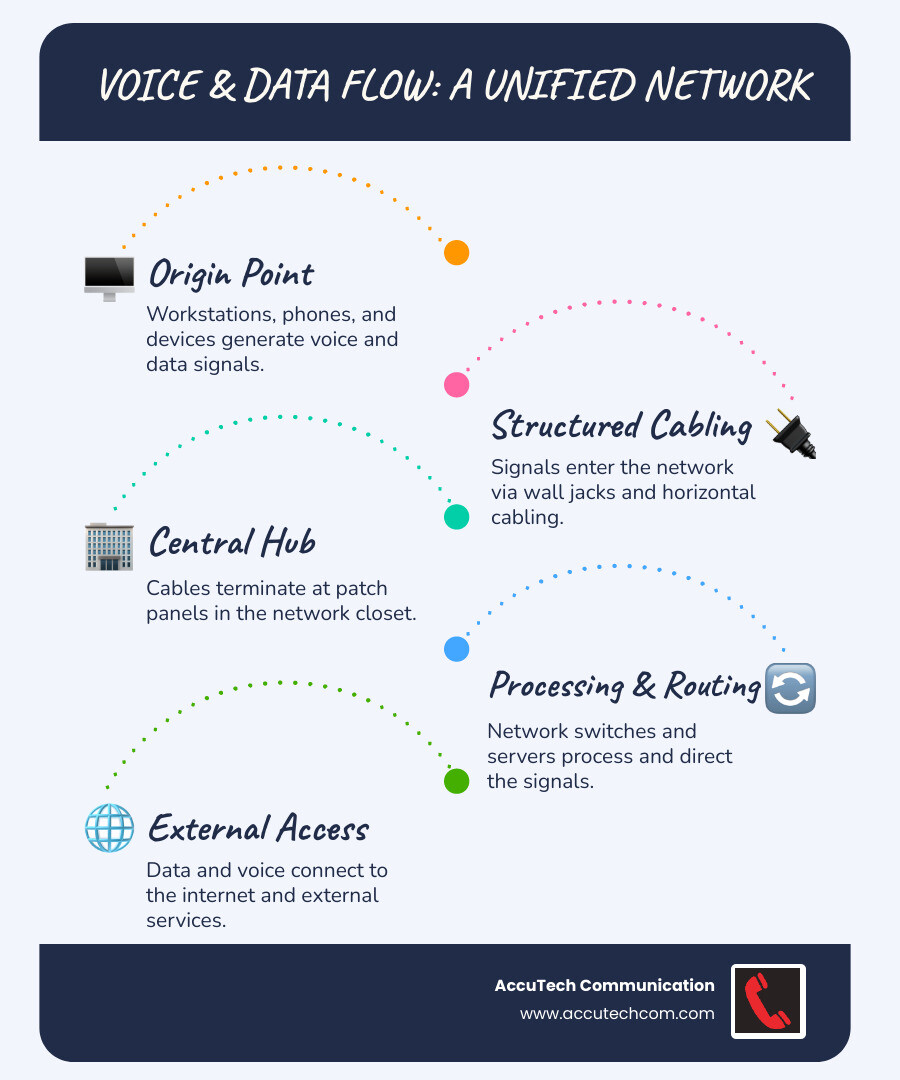
Voice data cabling terms at a glance:
What is Voice and Data Cabling and Why is it Essential?
Think of voice data cabling as your business’s circulatory system, carrying the digital lifeblood that keeps your company running. It’s the telecommunications infrastructure that connects all your devices—computers, phones, security cameras, and wireless access points—into one unified network, allowing information to flow seamlessly.

A structured cabling system creates an organized, standardized approach to your network. Instead of a tangled mess, you get a thoughtfully designed system that can grow with your business, supporting multiple technologies through one cohesive infrastructure.
The voice data cabling market is projected to reach $15 billion globally by 2025, driven by businesses recognizing that proper cabling is fundamental to success. For business continuity, every email, video call, and file transfer depends on these cables. When a cabling system fails, productivity halts. When designed and installed properly, it becomes an invisible enabler of everything your team needs to accomplish.
For more comprehensive information about how we approach these challenges, explore our cabling and networking services.
The Core Benefits of a Structured Cabling System
A structured system is like a modern highway compared to a country road—more efficient and reliable.
- Reduced downtime: Organized and labeled cables make troubleshooting fast, minimizing costly operational disruptions.
- Improved performance: Quality materials and professional installation mean faster data speeds, clearer video calls, and less frustration.
- Scalability for future growth: A structured system adapts as your business expands, making it simple to add new employees or upgrade equipment.
- Simplified management: A clean, organized system with clear documentation makes changes and additions easy without disrupting your network.
- Cost-efficiency: A quality upfront investment pays dividends through years of reliable operation, fewer repairs, and easy upgrades.
- Improved flexibility: Your office layout can evolve without major infrastructure changes, whether you’re moving a department or adding a conference room.
How Cabling Integrates with Modern Business Technology
Modern business technology is an ecosystem where everything works together, and voice data cabling is the foundation that makes this integration possible.
- VoIP systems: Our Business Phone Systems rely on quality data networks. Proper cabling prevents choppy calls and dropped connections.
- Wi-Fi access points: Your Wi-Fi is only as good as the cables connecting access points to your network. Proper cabling ensures solid, high-speed connections without dead zones.
- Security systems: IP cameras, access control, and alarms benefit from the reliability of structured cabling, simplifying monitoring and management.
- Audio/Visual equipment: Conference room displays, video conferencing, and presentation tools perform better when supported by a quality cabling infrastructure.
A well-designed Low Voltage Cabling system allows all these technologies to coexist on one cohesive network, simplifying management and improving performance.
Types of Voice and Data Cables: Making the Right Choice
Choosing the right voice data cabling is critical for your business’s performance and future growth. Getting this decision right from the start saves money and prevents future headaches. The choice primarily comes down to two main categories: copper and fiber optic cabling.
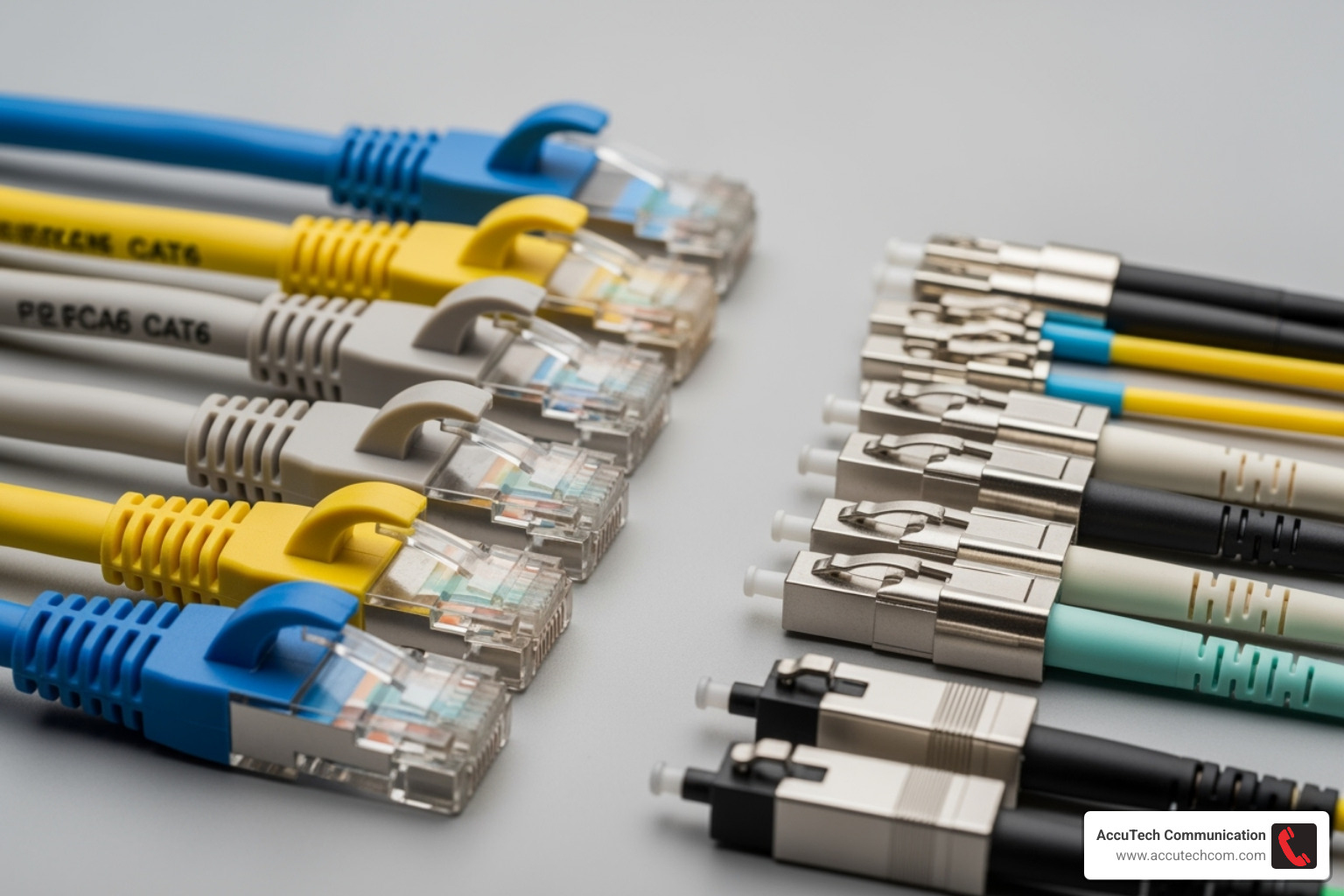
| Cable Type | Speed (Max) | Bandwidth (Max) | Max Distance (for max speed) | Best Use Case |
|---|---|---|---|---|
| Cat5e | 1 Gbps | 100 MHz | 100 meters (328 feet) | Basic networking, residential, small offices, voice services |
| Cat6 | 10 Gbps | 250 MHz | 55 meters (180 feet) | Professional environments, high-performance networks, supporting 1 Gbps over longer distances |
| Cat6a | 10 Gbps | 500 MHz | 100 meters (328 feet) | Demanding applications, data centers, industrial environments, reduced crosstalk |
| Cat7 | 10 Gbps | 600 MHz | 100 meters (328 feet) | Data centers, high-performance networks, server connections, superior shielding |
| Fiber Optic | 100 Gbps+ | Terahertz (THz) | Kilometers | Long-distance backbone, data centers, high-bandwidth applications, immunity to interference |
Copper Cabling Categories (Cat5e, Cat6, Cat6a, Cat7)
Copper cables are the cost-effective workhorses for most internal office networks.
- Category 5e (Cat5e): Reliable and affordable, Cat5e handles speeds up to 1 Gbps, making it suitable for basic internet, email, and voice services in small businesses.
- Category 6 (Cat6): Offering better performance, Cat6 supports 1 Gbps over the full 100-meter distance, making it our go-to for most professional office installations.
- Category 6a (Cat6a): The “a” for “augmented” means it maintains 10 Gbps speeds over the full 100-meter distance. Its better shielding reduces crosstalk, making it ideal for busy office environments.
- Category 7 (Cat7): With superior shielding around each wire pair, Cat7 minimizes interference. We recommend it for data centers and high-density server environments where maximum performance is critical.
For businesses upgrading their infrastructure, our Office Data Cabling services can help you choose the right copper solution.
Fiber Optic Cabling: The High-Speed Solution
Fiber optic cabling uses light pulses to transmit data at incredible speeds over vast distances, making it the backbone of the modern internet.
- Single-mode fiber: Designed for long-haul connections between buildings or across campuses, its signal can travel for miles without losing strength.
- Multi-mode fiber: With a larger core, it’s perfect for shorter, high-speed connections within a building or data center. Multi-mode fiber can be particularly useful for smaller businesses needing connections between floors.
Fiber’s key advantage is its immunity to interference from electrical noise, making it perfect for manufacturing or medical environments. Our team specializes in Fiber Optic Cable Installation and can help determine if it’s right for you.
Choosing the Right Voice Data Cabling for Your Business
We consider five key factors to select the perfect voice data cabling for your business:
- Current bandwidth needs: We analyze your daily data usage to ensure your cabling can handle your workload, from basic email to large file transfers.
- Future growth plans: We help you think five to ten years ahead. Quality cabling can last over 15 years, so building in capacity now saves on future re-cabling costs.
- Budget considerations: While it’s tempting to choose the cheapest option, investing in quality cabling upfront saves money long-term through better performance and reliability.
- Office environment: The physical space matters. Factories with heavy machinery have different needs than quiet offices, and long cable runs may require fiber.
- Distance requirements: Copper has distance limits for high speeds, while fiber can span miles. Your building’s layout often helps determine the best choice.
The Critical Steps of Professional Voice Data Cabling Installation
A proper voice data cabling installation requires careful planning, precise execution, and rigorous testing to ensure a solid foundation for your network.
- Planning and design: We start by creating a network roadmap based on your current team, technologies, and future growth to design a system that meets your specific needs.
- Cable pathways: We map out how cables will travel through your building—behind walls, above ceilings, or under floors—using conduits and trays for safety and organization.
- Installation standards: We strictly follow ANSI/TIA guidelines. These proven industry standards ensure your system works reliably and is compatible with future equipment.
- Termination: This is the precise process of attaching connectors (like RJ45 plugs) to the cables. A single incorrect connection can degrade network performance.
- Labeling and documentation: We label every cable, port, and connection point. This documentation acts as a user manual for your network, simplifying future troubleshooting.
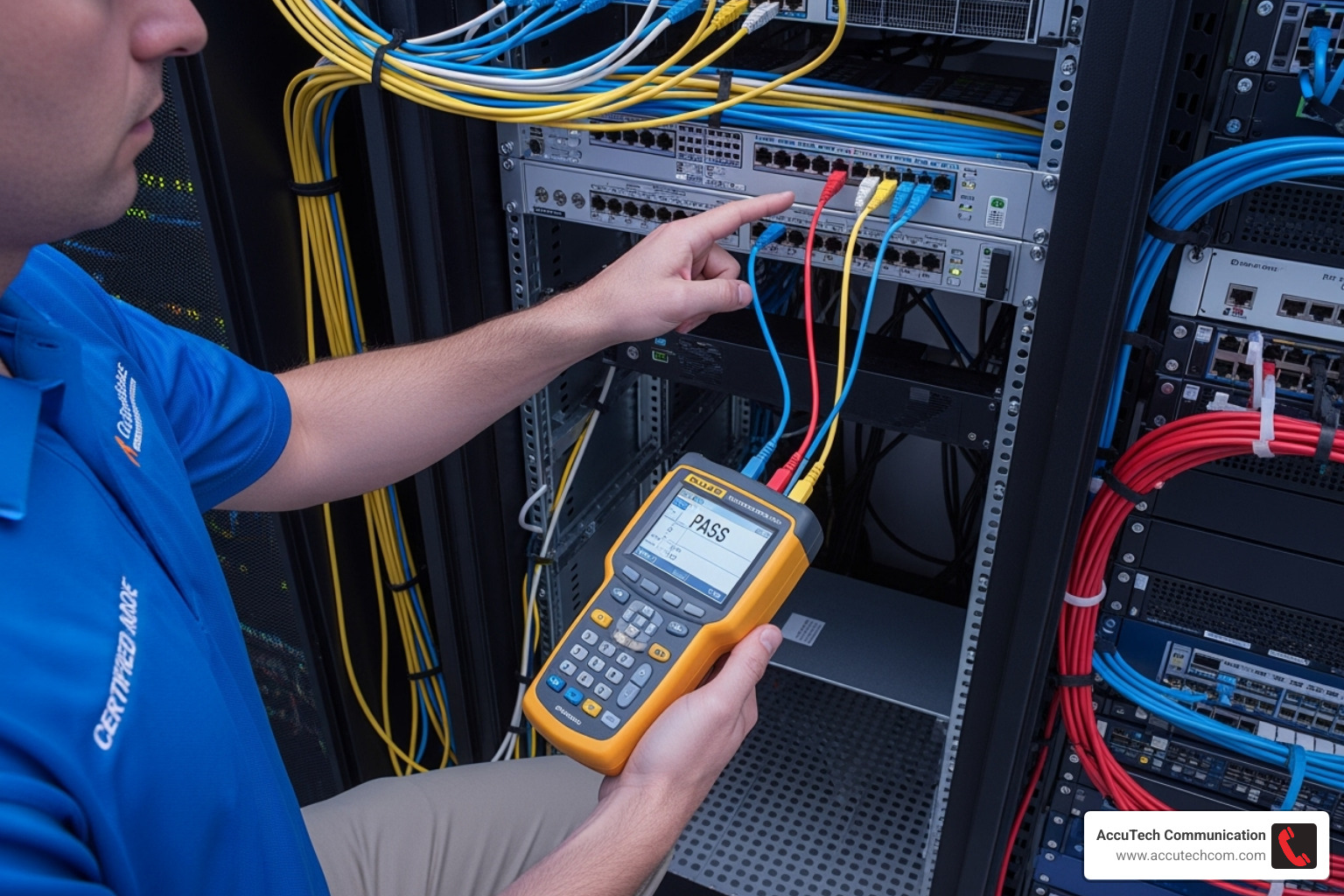
- Testing and certification: Using specialized cable certifiers, we test every cable run to verify it meets performance standards for signal quality and bandwidth.
For expert installation services in your area, check out our Network Cable Installation options.
Why You Should Always Hire a Professional Installer
Attempting to save money on installation often leads to costlier fixes later. Professional expertise pays for itself.
- Expertise and experience: Our team has installed thousands of systems. We understand how to design networks that perform flawlessly and avoid common pitfalls.
- Proper tools and equipment: We use specialized certifiers and professional tools that ensure precise connections and accurate testing, which can’t be achieved with basic hardware.
- Adherence to codes and standards: Our certified technicians are current on all building codes and industry standards, ensuring your installation is safe and compliant.
- Safety: We are trained in proper safety protocols, protecting your property and our workers during installation.
- Warranty and reliability: We stand behind our work. A professional installation works better, lasts longer, and gives you peace of mind.
- Long-term ROI: A professional installation saves money over time through reduced maintenance, fewer performance issues, and easier future upgrades.
For larger projects, our Commercial Network Cabling services handle complex business requirements with the same attention to detail.
Common Issues in Voice Data Cabling and How to Avoid Them
Several preventable problems can plague a cabling system if proper care isn’t taken.
- Signal loss: Data weakens over distance, often due to cheap cables or exceeding length limits.
- Crosstalk: Interference between wire pairs, typically caused by poor quality cables or improper installation.
- Poor termination: Improperly attached connectors are the most common issue we fix, causing significant performance drops.
- Cable damage: Cables bent too sharply, pinched, or crushed will eventually fail.
- Inadequate planning: Not accounting for future growth leads to networks that are difficult and expensive to upgrade.
How we prevent these problems: We use only high-quality, certified materials and follow ANSI/TIA standards religiously. Every installation is thoroughly tested and certified to catch issues before they impact your business. Doing it right the first time prevents virtually all common cabling problems.
Frequently Asked Questions about Voice and Data Cabling
Over the years, business owners often ask similar questions when planning their voice data cabling projects. Here are the straight answers to the most common ones.
How long does network cabling last?
This is a smart question, as you’re making a long-term investment. The lifespan depends on the cable type and installation quality.
- Ethernet cable lifespan: With proper installation, copper cables like Cat5e and Cat6 typically last 10-15 years.
- Fiber optic lifespan: Fiber optic cables are the marathon runners, easily lasting 25 years or more.
Environmental factors like extreme temperatures or humidity can shorten a cable’s life. More importantly, the quality of installation is critical. Cables that are bent, pinched, or improperly terminated can fail prematurely. Professional installation and proper maintenance are key to maximizing the life of your system.
What is the difference between Cat6 and Cat7 cables?
Both are excellent choices, but they serve different needs. The main differences are bandwidth and shielding.
- Bandwidth: Cat6 handles frequencies up to 250 MHz, while Cat7 supports up to 600 MHz, allowing more data to travel simultaneously.
- Shielding: Cat7 cables have superior shielding around each wire pair and the overall cable (S/FTP), making them highly resistant to electrical interference. Cat6 is available in unshielded (UTP) or shielded (STP) versions.
- Performance: Both support 10 Gbps speeds, but Cat6 is limited to 55 meters (180 feet) at that speed, while Cat7 delivers it over the full 100-meter (328-foot) distance.
For most office environments, Cat6 provides excellent value. We typically recommend the more expensive Cat7 for data centers or other high-performance applications where maximum speed and reliability are essential.
Can I use the same cable for both voice and data?
Yes, absolutely. The days of running separate cables for phones and computers are over, thanks to modern VoIP technology.
VoIP converts your voice into digital data that travels over the same network as your emails and files. Ethernet standards like Cat6 are designed to handle both voice and data traffic simultaneously. This convergence leads to:
- Simplified infrastructure: One system to install and maintain.
- Cost-efficiency: Lower installation and maintenance costs.
- Flexibility and Scalability: Easily move workstations or add new employees without major rewiring.
A single Structured Cabling Services system from AccuTech Communications can seamlessly support all your voice and data needs.
Future-Proof Your Business with Expert Cabling Solutions
Your voice data cabling system is the foundation that your entire business depends on. Without the cables behind your walls, your computers, phones, and collaborative tools would go silent.
As we’ve explored, quality infrastructure delivers tangible benefits: reduced downtime, improved performance, and scalability for future growth. A well-designed cabling system becomes the foundation for future technologies, ensuring that whether you adopt next-gen VoIP, advanced security, or other innovations, your network will be ready.
Since 1993, we’ve helped businesses across Massachusetts, New Hampshire, and Rhode Island build reliable networks. We’ve learned that cutting corners on cabling always costs more in the long run. Businesses that invest in quality infrastructure from the start adapt more quickly and spend less time dealing with network headaches.
For businesses in Massachusetts, New Hampshire, and Rhode Island, partnering with a certified installer like AccuTech Communications ensures your network is built for reliability and performance. We design systems that fit your specific needs and growth plans.
Your communication infrastructure should be an asset you can count on, not a liability you worry about. Invest in your connectivity by exploring professional Data Cable Installation with our team. Let’s build a network that supports your business goals for years to come.
