
Structured Cabling System: Top Benefits in 2024
Structured cabling system is a strategy used to organize your business’s network infrastructure, ensuring efficient data transmission and connectivity. For those wondering what this entails, here’s the quick scoop:
- Organization of Telecommunication Cables: Helps in systematically arranging the complex web of cables in a building or campus.
- Improved Data Flow: Facilitates smooth, rapid, and reliable data transmission with reduced interference.
- Scalability and Flexibility: Supports future expansions and technology upgrades without disruption.
AccuTech Communications specializes in designing and implementing structured cabling system solutions that align with our clients’ overarching communication needs.
As the owner of AccuTech Communications, I, Corin Dolan, bring more than 30 years of expertise in delivering state-of-the-art network solutions. My team and I are committed to helping businesses modernize their communication infrastructure, ensuring reliability and longevity.

Structured cabling system vocab explained:
– ethernet cable installer
– network cabling installation Massachusetts
– network installation near me
What is a Structured Cabling System?
A structured cabling system is like the backbone of your building’s network infrastructure. It consists of a standardized architecture that provides a reliable foundation for telecommunications cabling. This system ensures that all your network devices can communicate effectively, no matter how complex your setup might be.
Components of a Structured Cabling System
Let’s break down the six essential components that make up a structured cabling system:
- Entrance Facilities
This is the point where telecom facilities from a local service carrier or a private network enter your building. These facilities connect through an opening in the exterior wall and lead into a room equipped with network connection points, patch panels, and equipment racks. It’s where your building’s network starts.
- Equipment Room
The equipment room is where entrance cabling connects to the internal wiring of your building. This room houses patch panels, network switches, PBXs, servers, and other crucial devices. It’s vital to keep this area environmentally controlled to maintain the equipment in optimal condition.
- Backbone Cabling
Also known as riser cabling, backbone cabling connects different parts of your building’s network. It links entrance facilities, equipment rooms, and telecommunications rooms. This cabling can include 100-ohm twisted-pair, multimode, and single-mode optical fiber. It’s the core pathway for data to travel across your building.
- Telecommunications Room
The telecommunications room is where horizontal and backbone cables meet. This space is often environmentally controlled and contains patch panels and jumpers to connect different cables. It acts as a central hub for your building’s network.
- Horizontal Cabling
Horizontal cabling connects telecommunications rooms to individual outlets or work areas on a floor. It typically runs through conduits or ceiling spaces and includes connectors, patch panels, and jumpers. The maximum length for horizontal cabling is 295 feet to ensure signal integrity.
- Work Area
The work area is the final destination in the structured cabling system. It’s where user devices connect to the network through a wall outlet or jack. This area ensures that all end-user equipment has a reliable connection to the network.
These components work together to create a structured cabling system that is standardized and interoperable, following guidelines like the EIA/TIA TR42 and TIA 568 standards. This ensures compatibility and reliability across different network devices and setups.
By implementing a structured cabling system, businesses can enjoy improved organization, flexibility, and efficiency in their network infrastructure, making it easier to manage and scale as needed.
Benefits of Structured Cabling Systems
Structured cabling systems offer a myriad of benefits that improve the efficiency and reliability of network infrastructure. Let’s dig into some of these key advantages:
Improved Reliability
A structured cabling system minimizes errors and reduces the risk of signal interference and data loss. By organizing cables systematically, the system prevents performance issues, ensuring that your network runs smoothly and reliably. This organized approach reduces potential failure points, leading to fewer disruptions.
Scalability
As businesses grow, so does the demand for increased network capacity. Structured cabling provides the flexibility to add more devices and accommodate higher data transfer rates without overhauling the entire system. This adaptability means your infrastructure can evolve with your needs, supporting new technologies and applications seamlessly.
Simplified Troubleshooting and Maintenance
With a clear structure and well-labeled cabling, diagnosing network issues becomes much easier. This organized layout reduces the time needed for troubleshooting, leading to improved network uptime. Technicians can quickly identify and resolve problems, minimizing disruptions and keeping your business running efficiently.
Cost-effective Solution
While the initial investment in structured cabling might be higher, it offers significant long-term savings. The system’s reliability reduces the need for frequent upgrades and minimizes downtime, cutting operational costs. The ease of maintenance and troubleshooting further contributes to cost-effectiveness, making it a smart investment for any organization.
Aesthetics
Beyond functionality, structured cabling also improves the visual appeal of your network setup. By avoiding the “spaghetti” look of tangled cables, it presents a cleaner and more organized appearance. This not only makes maintenance easier but also creates a professional and aesthetically pleasing environment.

In summary, structured cabling systems provide a robust and flexible framework that supports current and future network needs. They improve reliability, scalability, and maintenance while offering cost savings and a neater appearance. These benefits make structured cabling an essential component of modern network infrastructure.
Structured Cabling vs Conventional Point-to-Point Cabling
When it comes to network cabling, choosing between a structured cabling system and conventional point-to-point cabling can significantly impact the efficiency and reliability of your network. Let’s break down these two approaches to understand why structured cabling is often the superior choice.
Structured Cabling Solution
Structured cabling is all about organization and efficiency. It uses a series of patch panels and trunks to create a structured network environment. Here’s how it works:
-
Patch Panels and Trunks: Patch panels serve as centralized hubs where cables from different hardware ports connect. These panels are then linked by trunks—multi-fiber assemblies designed for efficient data conveyance.
-
Main Distribution Area (MDA): This is the heart of a structured cabling system. The MDA allows for easy Moves, Adds, and Changes (MACs) using short-length patch cords, making network management a breeze.
-
Hardware Ports: Instead of running long cables directly from one device to another, hardware ports connect to patch panels. This reduces clutter and keeps the cabling organized.
This structured approach not only minimizes errors but also reduces the potential for downtime. With cables neatly organized, the risk of unplugging the wrong port or causing signal interference is significantly lowered.
Point-to-Point Cabling
In contrast, point-to-point cabling, often dubbed “spaghetti cabling,” involves running cables directly between devices. This method might seem simpler at first but comes with several drawbacks:
-
Direct Connections: Each device is connected directly to another, often resulting in long patch cords that snake through the facility. This can quickly lead to a tangled mess.
-
Disorganization and Inefficiency: As more devices are added, the cabling becomes increasingly disorganized. This makes maintenance and troubleshooting difficult and time-consuming.
-
Increased Potential for Errors: With cables running haphazardly, it’s easy to make mistakes that can lead to network downtime. Identifying and resolving issues in a spaghetti cabling setup can be a nightmare.
In summary, while point-to-point cabling might initially appear straightforward, it lacks the organization and efficiency of a structured cabling system. Structured cabling not only keeps your network tidy but also supports growth and minimizes errors, making it the preferred choice for modern network infrastructures.
The Six Components of Structured Cabling
A structured cabling system is like the backbone of a reliable network. It consists of six key components that work together to ensure your network runs smoothly and efficiently. Let’s explore each component.
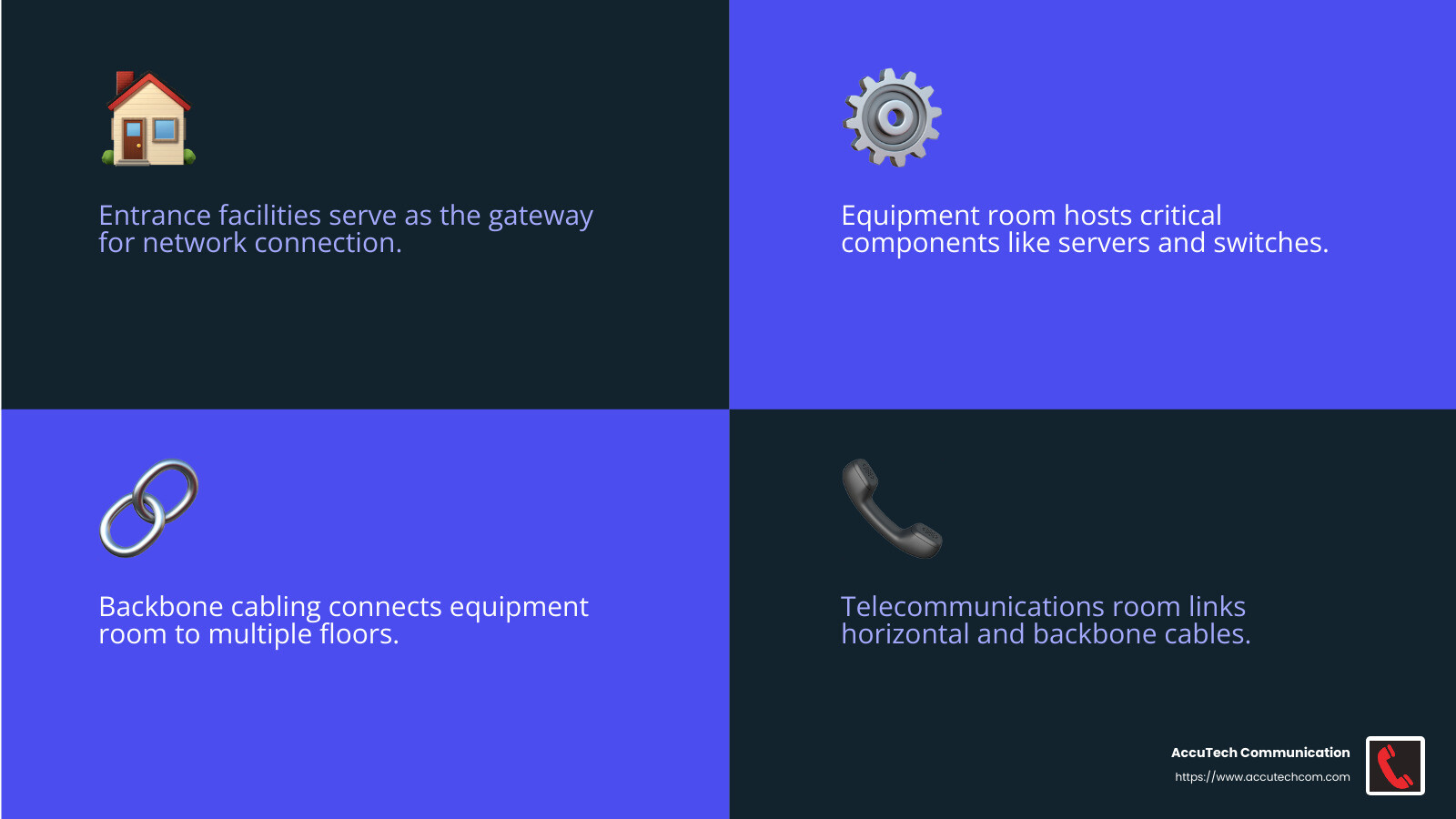
Entrance Facilities
The entrance facilities are where telecom services enter your building. Think of it as the gateway for your network. This is where cables from a local service carrier or a private network connect to your building’s wiring system. These facilities include network connection points and protection devices for grounding and shielding.
Equipment Room
The equipment room is the nerve center of your network. Here, you’ll find patch panels, network switches, PBXs, and servers. It’s crucial to keep this room environmentally controlled to maintain optimal performance and longevity of your equipment. This room connects the entrance facilities to the internal building wiring.
Backbone Cabling
Backbone cabling is the glue that holds your network together, linking the equipment room to telecommunications rooms across different floors. Also known as riser cabling, it runs through vertical channels and uses various types of cables, like 100-ohm twisted-pair, multimode optical fiber, and single-mode optical fiber.
Telecommunications Room
A telecommunications room is where horizontal and backbone cables meet. Often environmentally controlled, this space houses the jumpers and patch cords that connect different parts of your network. It acts as a central point for managing connections and can include intermediate cross-connects or main cross-connects.
Horizontal Cabling
Horizontal cabling delivers telecom resources directly to user devices. It runs from the telecommunications room to individual work areas, with a maximum allowed cable length of 295 feet. This setup ensures that user devices remain connected without signal loss. It includes connectors, patch panels, and sometimes even multiuser telecommunications outlet assemblies.
Work Area
Finally, the work area is where the network meets the user. It includes the connectors and jacks that link user devices like computers and phones to the network. This is the final destination in a structured cabling system, ensuring that every device has a reliable connection.
By understanding these six components, you can appreciate how a well-designed structured cabling system keeps your network organized, efficient, and ready for future growth.
Frequently Asked Questions about Structured Cabling Systems
What is meant by a structured cabling system?
A structured cabling system is a standardized approach to organizing and installing telecom cabling in buildings or campuses. It consists of smaller, standardized elements that work together to form a cohesive and flexible network infrastructure. This system ensures that your network is not just a tangled mess of cables but a well-organized setup that supports communication needs efficiently.
What are the six components of structured cabling?
Structured cabling is built around six essential components:
-
Entrance Facilities: The starting point where telecom services enter your building, connecting external networks to your internal setup.
-
Equipment Room: This is the central hub housing key network equipment like switches and servers. It connects entrance facilities to internal wiring.
-
Backbone Cabling: This component links equipment rooms to telecommunications rooms across different floors, using various cable types like twisted-pair and fiber optics.
-
Telecommunications Room: A space where horizontal and backbone cables converge, facilitating connections with patch cords and jumpers.
-
Horizontal Cabling: Extends telecom resources to user devices across the building, ensuring reliable connectivity with a maximum cable length of 295 feet.
-
Work Area: The endpoint where user devices connect to the network, using jacks and connectors to ensure seamless access.
What are the benefits of structured cabling systems?
A well-implemented structured cabling system offers numerous benefits:
-
Organization: Keeps your network tidy and easy to manage, reducing the chaos of tangled cables.
-
Flexibility: Allows for easy modifications and expansions as your network needs grow.
-
System Availability: Ensures your network is consistently operational and dependable.
-
Redundancy: Provides backup paths for data to travel, minimizing downtime in case of a failure.
-
Future-proofing: Designed to accommodate new technologies and increased data loads, ensuring long-term usability.
Structured cabling systems are not just about wires; they are about creating a robust, scalable, and efficient network that supports your organization’s needs now and in the future.
Conclusion
At AccuTech Communications, we understand that a dependable network infrastructure is crucial for any business. Our structured cabling systems offer a host of benefits designed to improve your network’s performance and reliability. By investing in a structured cabling system, you’re not just organizing cables; you’re laying the foundation for a robust and flexible network that can grow with your business.
Why choose AccuTech Communications? Since 1993, we’ve been committed to delivering reliable service and competitive pricing to businesses in Massachusetts, New Hampshire, and Rhode Island. Our expertise in network cabling, business phone systems, and data center technologies ensures that we can meet your unique needs with precision and quality.
Our structured cabling systems are designed with the future in mind. They offer the flexibility to adapt to evolving network demands and the reliability to minimize downtime. This means you can focus on your core business activities, knowing that your network is in capable hands.
If you’re ready to improve your network infrastructure with a structured cabling system, consider partnering with us at AccuTech Communications. Our commitment to quality and customer satisfaction makes us the ideal choice for businesses seeking a reliable and cost-effective solution.
For more information on our services and to see how we can help your business, visit our Network Cabling Installation page. Let’s work together to strengthen your network and drive your business forward.
