Unearthing Connectivity: Your Essential Guide to Fiber Optic Trenching
Why Fiber Optic Trenching Powers Modern Business Connectivity
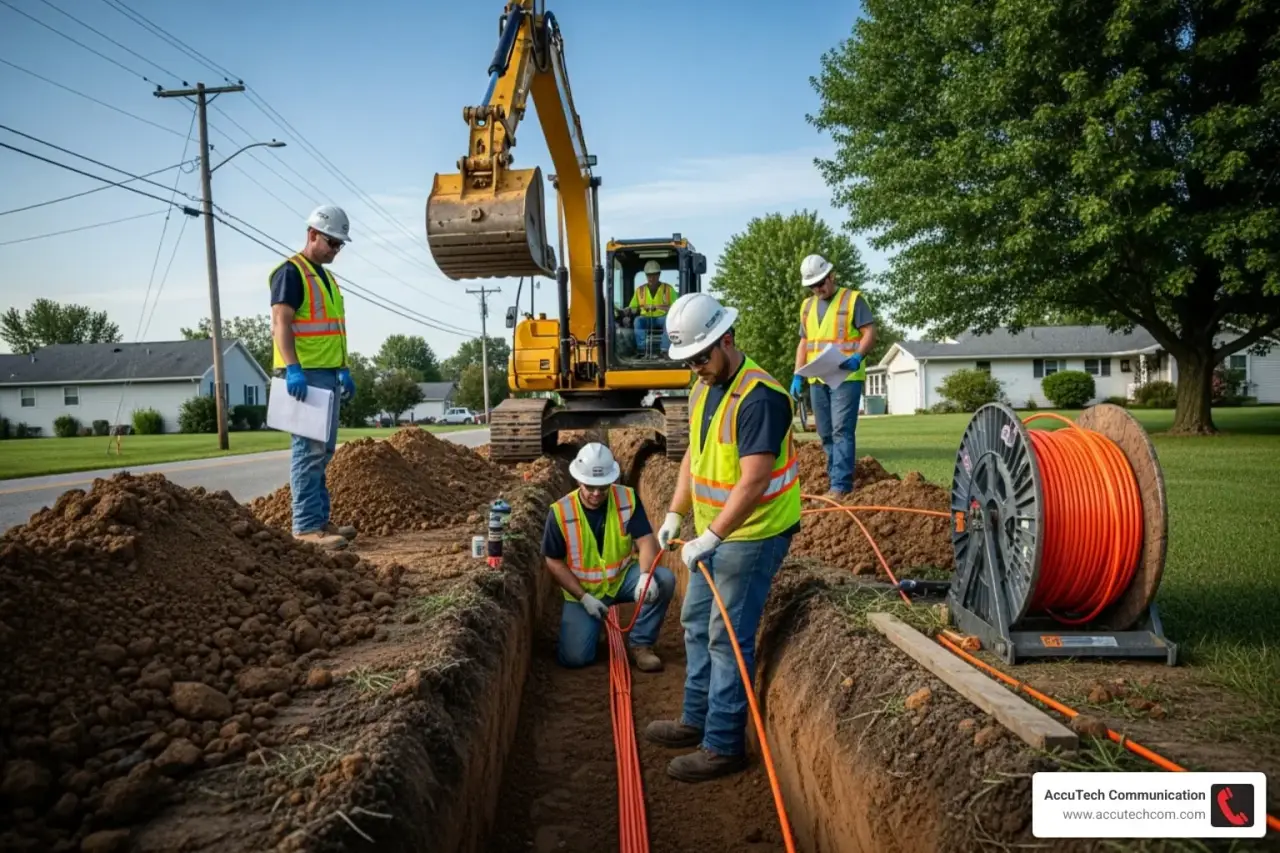
Fiber optic trenching is the process of creating underground pathways to install fiber optic cables for high-speed commercial networks. This method involves excavating a trench, placing protective conduit, and restoring the surface to deliver reliable connectivity with minimal long-term visual impact.
Key Trenching Methods:
- Traditional Trenching, Excavates a trench 12+ inches wide and 24-36 inches deep; suited for greenfield sites and rural areas.
- Microtrenching, Cuts a narrow slot 0.75-2 inches wide and 8-12 inches deep; ideal for urban streets and paved surfaces.
- Directional Boring, Drills horizontally underground to cross obstacles like roads or rivers without surface disruption.
Primary Benefits:
- 60% cost savings with microtrenching compared to traditional excavation.
- Faster deployment for FTTx (Fiber-to-the-X) networks.
- Reduced disruption to traffic, businesses, and pedestrians.
- Long-term durability with proper backfill and protection.
Whether expanding a hospital network, connecting manufacturing facilities, or upgrading a corporate campus, fiber optic trenching provides the underground infrastructure for mission-critical communication.
Across Massachusetts, New Hampshire, and Rhode Island, the demand for high-speed connectivity is accelerating. Healthcare organizations need reliable links for electronic health records, manufacturers require real-time data for automated systems, and educational institutions depend on robust networks for campus-wide collaboration.
Underground fiber installation is the gold standard for these applications. Unlike aerial cables exposed to weather and vehicle strikes, buried fiber offers superior protection and longevity. Modern methods like microtrenching have transformed this process from a weeks-long disruption into a streamlined operation.
This guide covers everything you need to know about fiber optic trenching for commercial projects, from choosing the right method and navigating regulations to selecting equipment and ensuring network reliability.
I’m Corin Dolan, owner of AccuTech Communications, and I’ve overseen fiber optic trenching projects across Massachusetts, New Hampshire, and Rhode Island since 1993. Whether you’re installing new infrastructure or upgrading existing systems, proper fiber optic trenching execution makes the difference between a network that performs and one that fails.
Easy Fiber optic trenching glossary:
Choosing Your Method: Microtrenching vs. Traditional Trenching
Choosing the right trenching method is a critical first step in any fiber optic installation. The decision between traditional trenching and microtrenching depends on project scope, location, infrastructure, and budget. While both methods safely bury cables, their approach and impact differ significantly.
Traditional trenching involves excavating a wide, deep trench, typically at least 12 inches wide and 24 to 36 inches deep to get below the frost line. This method is effective for laying multiple conduits and is generally preferred in greenfield developments, rural areas, or large commercial properties where surface disruption is less of a concern.
In contrast, microtrenching is a newer technique popular in urban and suburban areas across Massachusetts, New Hampshire, and Rhode Island. It creates a narrow, shallow channel, making it highly efficient for FTTx (Fiber-to-the-X) deployments. Its minimal invasiveness is ideal for connecting high-density areas with less disruption.
To help illustrate the differences, here’s a comparison:
| Metric | Traditional Trenching | Microtrenching |
|---|---|---|
| Installation Speed | Slower, more labor-intensive | Dramatically faster, enabling rapid deployment |
| Project Cost | Higher due to extensive excavation and restoration | Typically 60% cheaper than traditional excavations |
| Surface Disruption | Significant, often requiring road closures and extensive restoration | Minimal, creating a precise, narrow cut that is quickly restored |
| Environmental Impact | Greater excavation, more debris, higher carbon footprint | Reduced excavation, less debris, lower environmental impact |
| Ideal Use Case | Greenfield sites, rural areas, large-scale conduit runs, deep burial | Urban environments, paved surfaces (asphalt, concrete), FTTx deployments, minimal disruption |
What is Microtrenching?
Microtrenching, or slot-cut trenching, is a technique that creates a precise, narrow cut in an existing surface instead of a wide, deep excavation. Trenches are typically 0.75 to 2 inches wide and 8 to 12 inches deep, though some applications may go up to 20 inches.
This method is effective in dense areas like Boston, Worcester, or Manchester, where traditional trenching is too disruptive. A specialized saw with a diamond blade cleanly cuts asphalt or concrete, minimizing impact, debris, and business interruption.
Key Advantages of Microtrenching
Microtrenching offers substantial benefits over traditional methods, making it a preferred choice for many commercial fiber optic projects.
- Cost-effectiveness: Microtrenching is more affordable, requiring less equipment, manpower, and restoration. It can be up to 60% cheaper than traditional excavation, a major draw for businesses expanding their networks.
- Faster Deployment: The speed of microtrenching reduces installation time, allowing businesses to get connected faster. This minimizes downtime and is ideal for deploying fiber in high-density urban areas.
- Reduced Environmental Footprint: The narrow trench disturbs less earth, creating less debris and requiring less heavy machinery. This results in a lower carbon footprint and a more sustainable installation.
- Less Traffic and Business Disruption: The narrow cut and quick restoration minimize disruption. Roads, sidewalks, and parking lots reopen faster, reducing inconvenience for pedestrians, drivers, and businesses in busy commercial districts across Massachusetts, New Hampshire, and Rhode Island.
- Improved Safety: Less open trenching and faster completion times reduce accident risks for workers and the public. The precise cut also lowers the chance of damaging existing utilities.
- Reduced Risk to Existing Utilities: The narrower, shallower trenches reduce the risk of damaging existing infrastructure like gas and water lines, avoiding costly and dangerous utility strikes.
Planning Your Project: Key Pre-Trenching Considerations
Meticulous planning before digging is paramount for a successful fiber optic trenching project. Thorough preparation, from regulatory compliance to site-specific challenges, helps mitigate risks, control costs, and keep projects on schedule. Proper documentation is also crucial for future maintenance.
Navigating Regulatory and Municipal Requirements
Understanding and adhering to local regulations in Massachusetts, New Hampshire, or Rhode Island is a critical step. These rules can vary significantly between towns.
- Permit Acquisition: Obtaining necessary permits from local authorities is non-negotiable to ensure compliance with ordinances and safety standards.
- Municipality Rules: Each municipality has specific rules for working hours, traffic control, and restoration. Some may even mandate trench locations.
- Call Before You Dig (811): A universal best practice is contacting 811 before excavation to have existing underground utilities marked, preventing costly and dangerous strikes.
- Utility Location Services: Beyond 811, we use advanced services like Ground Penetrating Radar (GPR) for a comprehensive subsurface map.
- Dig Once Policy: Many local governments encourage “Dig Once” policies. When a trench is opened, extra conduits are installed for future use, saving time, money, and preventing future disruption.
- Massachusetts, New Hampshire, and Rhode Island Regulations: Our local expertise with regulations across our service area ensures projects proceed smoothly. For general guidance, resources like The FOA Reference For Fiber Optics -Outside Plant Construction provide valuable insights.
Route Planning and Site Investigation
A detailed route plan and site investigation are essential to avoid surprises during installation.
- Pre-survey Importance: A pre-survey identifies potential conflicts like existing utilities, tree roots, and challenging terrain along the proposed route.
- Marking Existing Services: Before cutting, existing services and the planned route are marked with paint and flags as a critical visual guide for operators.
- Ground Penetrating Radar (GPR): GPR is invaluable for detecting unmapped underground structures like pipes and conduits that could impede trenching.
- Identifying Obstructions: We also identify natural obstructions like rock or dense roots to plan for alternative methods like directional boring if needed.
- Road Crossings: Road crossings require special planning, often using directional boring to minimize disruption, and coordination with road authorities.
- Soil Condition Analysis: Analyzing soil conditions (sand, clay, rock) influences equipment and backfilling choices. Geotechnical experts may be consulted for complex sites.
- Pilot Holes: In dense areas, pilot holes are dug to verify utility depths before mechanical excavation, allowing for safer hand-digging around sensitive infrastructure.
The Ultimate Guide to Fiber Optic Trenching Best Practices
Effective fiber optic trenching requires following best practices, from equipment selection to backfilling. Our goal is to deliver a robust, long-lasting network with minimal impact on your business and the environment.
Equipment Selection for Fiber Optic Trenching
The right tools ensure precision and efficiency, especially for microtrenching.
- Microtrenchers: These machines use diamond circular saws to cut narrow, shallow trenches cleanly through asphalt or concrete. Models like the MT12 and MT16 are known for creating ideal trenches with minimal disruption. For more information on specific models, you can compare models and request info from equipment manufacturers.
- Diamond Circular Saws: These are the core of many microtrenching operations, cutting precise slots in hard surfaces.
- Vacuum Excavators: These are essential for efficient debris removal, following the trencher to keep the trench clean and ready for duct placement.
- Ride-on Trenchers: For traditional trenching in softer soils or larger projects, these offer power and speed.
- Stand-on Skid Steers: These versatile machines can be fitted with various attachments, including microtrenching saws.
The Cutting, Ducting, and Cable Placement Process
Precision during the physical installation is critical for long-term network performance.
- Standard Cutting Procedures: Operators follow strict procedures for consistent trench depth and width, planning paths to avoid tight corners that can compromise trench integrity.
- Consistent Trench Depth: Maintaining a consistent depth is crucial for proper cable protection and backfilling.
- Minimum Bend Radius: We respect the minimum bend radius of microducts (recommended 6 inches) to avoid kinking. 90-degree turns are often made with a 45-degree cut to ease the bend.
- Debris Removal & Cleaning the Trench: After cutting, the trench is thoroughly cleaned with high-pressure air or water. If the bottom is rough, a compacted one-inch sand bed is added for a smooth base.
- Microduct Installation: High-quality, crush-resistant microducts are placed in the clean trench. They must handle roadway pressure (up to 2900 psi) and high backfill temperatures (up to 400°F). Ducts are laid flat without overlap and straightened if twisted.
- Tone Wire Placement: A tone wire is included in at least one microduct. This conductive wire allows for easy location of the conduit after backfilling, simplifying future maintenance.
- Securing Ducts: Duct ends are secured and sealed with plugs to prevent water and dust ingress. For more details, explore our innerduct installation services.
Backfilling and Surface Restoration
The final steps involve carefully backfilling the trench and restoring the surface.
- Backfill Materials: Microtrenches use specialized materials like hot polymer, elasto-polymer, or grout for stability and protection. Traditional trenches use clean, granular bedding free of large stones.
- Sand Bedding: If the trench bottom is rough, a compacted layer of sand (at least 1 inch deep) provides a protective bed for the ducts.
- Compaction Techniques: Backfill is compacted in layers (not exceeding 12 inches) to ensure stability and prevent settling.
- Dynamic Cone Penetrometer (DCP) Testing: On some commercial projects, compaction is verified with a DCP test to ensure trench density matches or exceeds the surrounding soil, preventing sinkholes.
- Restoring Asphalt and Concrete Surfaces: The surface is restored with materials meeting local regulations. Microtrenches use a specialized sealant for a seamless blend, while traditional trenches are restored to a smooth finish. Our crews ensure the site is left clean and safe.
Ensuring Long-Term Network Reliability and Safety
Our commitment extends beyond installation to ensuring the long-term reliability and safety of your fiber optic network, mitigating challenges and future-proofing your investment.
Mitigating Risks and Challenges
Even with careful planning, trenching presents potential challenges that our expertise helps anticipate and mitigate.
- Identifying Existing Utilities: The primary risk is damaging existing utilities. Our rigorous pre-survey, 811 calls, GPR, and hand-digging in sensitive areas are crucial to prevent “backhoe fade”, accidental digging that causes system failures.
- Hard Rock Conditions: Trenching through hard rock requires specialized equipment. Depth requirements may be relaxed to 12 inches with concrete slab protection. Any necessary blasting follows strict local laws and safety protocols.
- Traffic Control: High-traffic areas require robust traffic control, including barricades, signage, and flag persons. Microtrenching helps minimize road closures and their impact on businesses.
- Hand-Digging Near Sensitive Areas: In areas with a high density of utilities, hand-digging is employed to ensure maximum control and minimize risk.
- Trench Safety: For trenches deeper than 4 feet where workers must enter, we implement strict OSHA-compliant safety measures like shoring, trench boxes, and safe ladder access. For comprehensive guidelines, consult resources like Best practices for buried cable installation.
Durability, Maintenance, and Future-Proofing Your Network
A well-installed fiber network should be a long-term asset. Our practices ensure maximum durability and easy maintenance.
- Long-Term Durability: Properly backfilled microtrenches are highly durable, with grout protecting ducts from shifting soil. In traditional trenching, proper compaction and bedding protect the conduit from external pressures.
- Protection from Soil Shifting: Our backfilling and compaction techniques create a stable environment, minimizing impact from soil shifting and frost heave, which is critical in MA, NH, and RI.
- Ease of Access for Repairs: Though rare, damage can occur. The shallow placement of microtrenches facilitates easier repairs. The precise location can be identified (using the tone wire), and only a small area needs re-excavation, making repairs faster and less disruptive.
- Future-Proofing with Extra Conduits: In line with “Dig Once” policies, we install extra conduits during the initial trenching. This allows for easy future upgrades or network expansion without more costly excavation.
- Sealing Plugs: Properly installed sealing plugs prevent water, dirt, and rodents from entering the conduit system, protecting the fiber.
- Maintenance Testing: We recommend periodic OTDR testing every two years to monitor system health and proactively identify issues. Learn more about maintaining your infrastructure on our fiber optic cabling installation page.
Frequently Asked Questions about Fiber Optic Trenching
We often receive questions from our commercial clients in Massachusetts, New Hampshire, and Rhode Island regarding fiber optic trenching. Here are some of the most common ones:
How deep does fiber optic cable need to be buried?
The required burial depth for fiber optic cable varies by installation method, local codes, and environmental factors like the frost line.
- Traditional Trenching: Cables are typically buried between 24 to 36 inches deep. In croplands, a minimum of 36 inches is often required. In colder climates like parts of New Hampshire, greater depths may be needed to get below the frost line.
- Microtrenching: This method uses much shallower trenches, usually between 8 to 12 inches deep, though some applications can be up to 20 inches deep.
- Hard Rock Conditions: In hard rock, the minimum cover can sometimes be relaxed to 12 inches if protected by a concrete slab.
Always consult local municipal regulations in your area (e.g., Boston, Worcester, Manchester, Providence) for specific minimum burial depths.
Is microtrenching better than directional boring?
Microtrenching and directional boring (HDD) are complementary trenchless techniques for different scenarios; neither is inherently better.
- Microtrenching is best for installing cable along a paved route like a road or sidewalk. It is fast, cost-effective, and minimally disruptive.
- Directional Boring (HDD) is designed to cross under obstacles like roads, rivers, or railways without disturbing the surface. It is more complex and generally more expensive but is indispensable when an open cut is not feasible.
We often use a combination of both on large commercial projects: microtrenching for linear runs and directional boring for crossings.
What happens if a microtrenched cable is damaged?
Microtrenched cables are installed in protective microducts with durable backfill, making them resistant to damage. While no installation is immune, the risk is significantly lower than with direct burial.
If damage occurs:
- Location: A tone wire within the microduct helps precisely locate the damaged section.
- Precision Repair: Because the trench is narrow and shallow, repairs are faster and less disruptive. Only a small, specific section needs to be re-excavated.
- Minimal Impact: The specialized backfill allows for quick removal and reapplication, enabling efficient access to the damaged fiber. This minimizes business downtime and impact on the area.
Our proactive maintenance and rapid response teams are equipped to handle such situations efficiently, ensuring your network is restored quickly.
Conclusion
Fiber optic trenching is the backbone of modern commercial connectivity, enabling the high-speed, reliable networks that businesses in Massachusetts, New Hampshire, and Rhode Island depend on. From the precision and efficiency of microtrenching in urban centers to the robust capacity of traditional trenching in larger developments, choosing the right method is critical for success.
The benefits are clear: significantly faster deployment, substantial cost savings (microtrenching can be 60% cheaper), and minimal disruption to your operations and the surrounding community. By adhering to meticulous planning, stringent regulatory compliance, and best practices in installation and restoration, we ensure your fiber optic infrastructure is durable, secure, and future-proof.
At AccuTech Communications, we bring decades of experience to every project, understanding the unique challenges and opportunities across the tri-state area. Our commitment to quality service ensures that your commercial fiber installation is executed with precision and professionalism, providing the foundation for your business’s continued growth and connectivity.
Ready to unearth the potential of advanced fiber optic connectivity for your business? Learn more from our network cabling team and let us help you design and implement a fiber optic solution that meets your specific needs.