
Why Managed Wi-Fi Is Essential for Modern Businesses

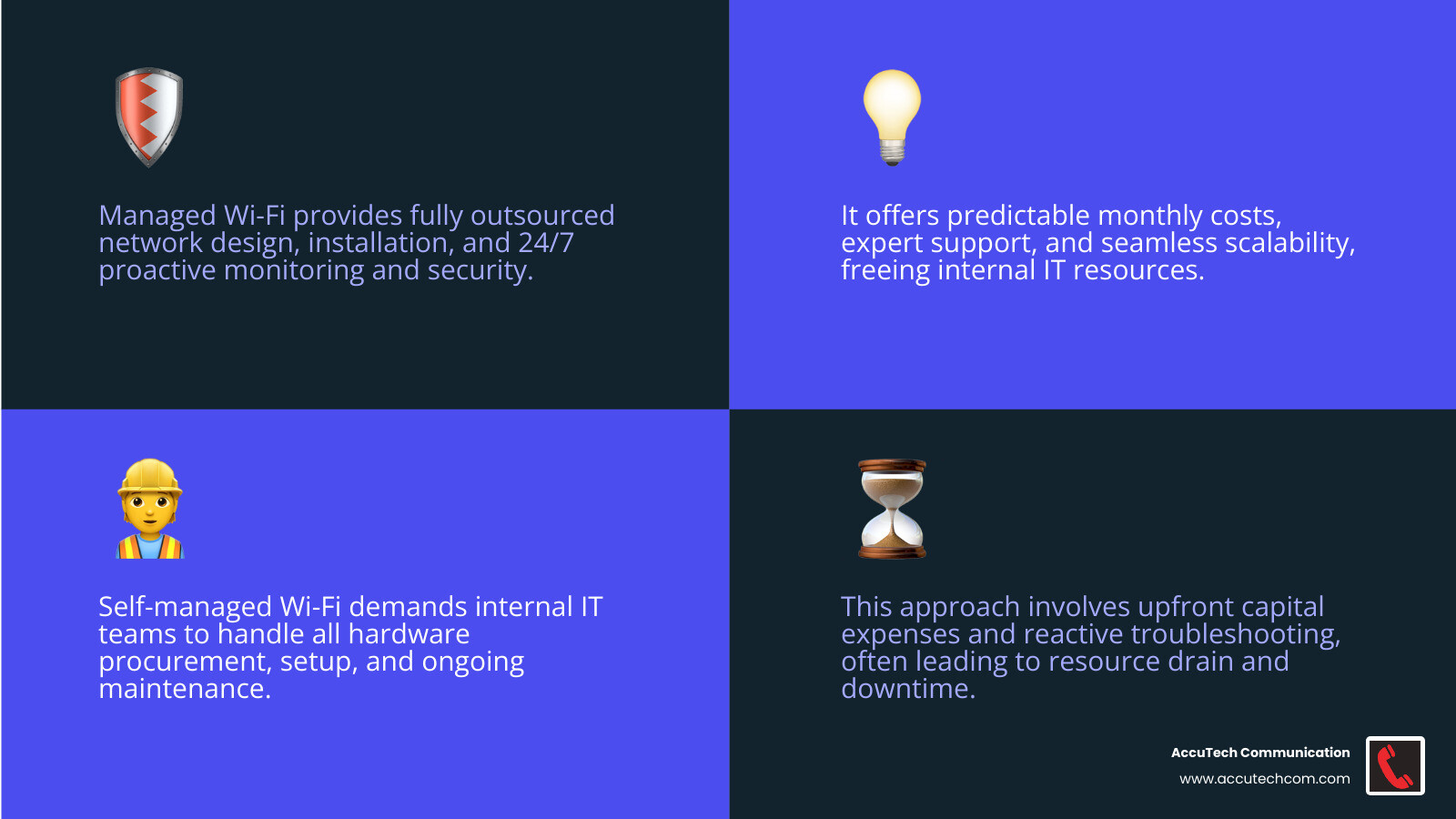
Managed WiFi for business is a fully outsourced wireless networking service where a third-party provider handles the design, installation, monitoring, security, and ongoing support of your business’s Wi-Fi infrastructure. Unlike traditional self-managed setups, you don’t purchase and maintain your own equipment or dedicate internal IT staff to troubleshooting connectivity issues.
Key differences between managed and traditional Wi-Fi:
| Aspect | Managed Wi-Fi | Traditional Wi-Fi |
|---|---|---|
| Setup | Provider designs and installs | Business purchases and configures |
| Maintenance | 24/7 proactive monitoring and support | Internal IT team handles issues |
| Security | Automatic updates and threat monitoring | Manual patches and monitoring |
| Scalability | Easy expansion through service adjustments | Requires new hardware purchases and configuration |
| Cost Model | Predictable monthly subscription | Upfront capital expense plus ongoing maintenance |
In today’s business environment, reliable Wi-Fi isn’t optional. It’s a fundamental utility that directly impacts customer satisfaction and operational efficiency. Research shows that 96% of consumers prefer to shop at brands that offer free Wi-Fi, making wireless connectivity a strategic business tool rather than just a technical requirement.
For businesses across Massachusetts, New Hampshire, and Rhode Island, the complexity of managing wireless networks continues to grow. Multiple devices, IoT sensors, guest access requirements, and cybersecurity threats create challenges that strain internal IT resources. 41% of tech and hiring managers report increasing difficulty finding qualified technical talent, making the burden of self-managed networks even heavier.
I’m Corin Dolan, owner of AccuTech Communications, and I’ve been helping commercial clients across the region implement robust wireless infrastructure since 1993. Our team has designed and deployed managed WiFi for business environments ranging from healthcare facilities to manufacturing plants, and we understand how the right wireless solution transforms operations.
Quick managed wifi for business definitions:
- enterprise wireless network solutions
- wireless network problems and solutions
- wireless network security issues and solutions
What is Managed Wi-Fi and How Does It Differ from Traditional Setups?
Navigating the complexities of modern business connectivity can feel like trying to solve a Rubik’s Cube blindfolded. That’s where managed wifi for business comes in, changing a potential headache into a seamless operation. It’s a comprehensive service that covers every aspect of your wireless network, from initial setup to ongoing optimization.
Defining Managed Wi-Fi for Business
At its core, managed Wi-Fi is an outsourced IT function. Instead of your internal team wrestling with routers and access points, a third-party provider, like us at AccuTech Communications, takes the reins. We handle the entire lifecycle of your network:
- Network design: Crafting a wireless blueprint custom to your specific business layout and connectivity needs in Massachusetts, New Hampshire, or Rhode Island.
- Hardware installation: Setting up enterprise-grade equipment, ensuring optimal placement for maximum coverage and performance.
- Software configuration: Fine-tuning settings for security, speed, and user experience.
- 24/7 monitoring: Keeping a watchful eye on your network around the clock to detect and resolve issues before they impact your operations.
- End-to-end service: Providing comprehensive support that covers everything from hardware procurement to troubleshooting.
Think of it as having a dedicated wireless expert in your corner, ensuring your network is always running at peak performance. This turnkey solution allows you to focus on your core business goals, knowing your connectivity is in professional hands. For more insights into comprehensive network solutions, explore our Enterprise Wireless Network Solutions.
The Challenges of Self-Managed Business Wi-Fi
While a DIY approach might seem cost-effective initially, the reality of self-managed business Wi-Fi often presents a host of challenges.
- Complex infrastructure: Modern business environments, especially those with multiple devices, diverse applications, and IoT integration, demand sophisticated network infrastructure. Managing this in-house requires specialized knowledge and constant attention.
- IT resource drain: Your internal IT team is likely stretched thin, dealing with mission-critical tasks. Asking them to also become Wi-Fi specialists can divert valuable resources from strategic initiatives. The statistics back this up: 41% of tech and hiring managers report more difficulty in finding talent with the right technical skill sets. This talent shortage makes it even harder for businesses to maintain an in-house Wi-Fi expert.
- Security vulnerabilities: Without continuous monitoring and updates, self-managed networks can become easy targets for cyber threats. A single breach can have devastating consequences for your business and customer trust.
- Inconsistent coverage: Dead zones, slow speeds, and dropped connections are common complaints in self-managed setups, leading to frustrated employees and customers.
- Downtime impact: When your Wi-Fi goes down, so does productivity and potentially sales. Reacting to issues rather than proactively preventing them can lead to significant losses.
- Difficulty scaling: As your business grows—adding new locations, more employees, or new devices—scaling a self-managed network can be a costly and complex undertaking, requiring significant capital investment and IT expertise.
The importance of reliable Wi-Fi extends beyond internal operations. As mentioned, 96% of consumers prefer to shop at brands that offer free Wi-Fi. If your self-managed network struggles with performance or security, you’re not just inconveniencing your staff; you’re actively deterring potential customers. A poorly managed network isn’t just a technical issue; it’s a direct impediment to customer satisfaction and business growth. You can read more about consumer preferences here: 96% of consumers prefer to shop at brands that offer free Wi-Fi.
The Core Business Benefits of a Managed Wi-Fi Solution
Moving to a managed wifi for business solution isn’t just about offloading IT tasks; it’s a strategic investment that yields significant returns across your entire organization. From enhancing daily operations to delighting your customers, the benefits are far-reaching.

Reduce the Burden on Your Internal IT Team
One of the most immediate and tangible benefits of managed Wi-Fi is the relief it brings to your internal IT department. We understand that your IT professionals in Metro-west Boston, Marlborough, or Worcester are critical to your strategic initiatives, not just keeping the lights on.
- Focus on core initiatives: By entrusting your Wi-Fi management to experts, your IT team can reallocate their time and expertise to projects that directly impact your business’s innovation and competitive edge.
- IT talent shortage: With 41% of tech and hiring managers reporting more difficulty in finding talent with the right technical skill sets, it makes sense to maximize the efficiency of your existing team. Offloading network management to specialists helps mitigate the impact of this shortage. You can learn more about this trend here: Why 41% of IT hiring managers say finding tech talent is becoming harder.
- Expert support: You gain access to a team of dedicated Wi-Fi professionals who live and breathe network infrastructure. This means specialized knowledge is always available, without the overhead of hiring and training in-house experts.
- Proactive issue resolution: Managed services include 24/7 monitoring, allowing for the proactive identification and resolution of potential issues. This minimizes downtime and ensures a consistently reliable connection, saving your team from reactive, stressful troubleshooting.
- Network management offloading: The daily grind of managing a complex wireless network—firmware updates, security patches, configuration changes, performance optimization—is completely handled by your managed Wi-Fi provider. This frees your team to innovate rather than just maintain. Industry data from TechValidate shows that 90% of Meraki customers experience significant time/resource savings with managed solutions.
Improve Customer Experience and Engagement
In today’s connected world, customers expect seamless Wi-Fi access. Managed WiFi for business can transform this expectation into a powerful tool for customer satisfaction and loyalty.
- Reliable guest access: Provide a fast, secure, and easy-to-use guest Wi-Fi network. This isn’t just a courtesy; it’s a crucial part of the modern customer experience, especially in retail, hospitality, or healthcare settings across New Hampshire or Rhode Island.
- Branded splash pages: Customize the Wi-Fi login page with your company’s branding, promotions, or important announcements. This creates a professional impression and an additional touchpoint for engagement.
- Seamless connectivity: Eliminate frustration caused by slow or unreliable connections. When customers can easily access the internet, they tend to stay longer, engage more, and have a more positive perception of your business.
- Attract and retain customers: As the statistic highlights, 96% of consumers prefer to shop at brands that offer free Wi-Fi. Offering high-quality, free Wi-Fi can be a significant differentiator, drawing new customers and encouraging repeat visits.
- Positive brand impression: A well-managed Wi-Fi network reflects positively on your brand’s commitment to quality and customer service.
- Data analytics for business insights: Many managed Wi-Fi solutions offer analytics that can provide valuable insights into customer behavior, foot traffic patterns, and peak usage times. This data can inform marketing strategies and operational adjustments.
Support for Business Growth and Scalability
As your business in Massachusetts expands, your network infrastructure needs to keep pace. Managed Wi-Fi is inherently designed for growth, offering flexibility and future-proofing.
- Adding new locations: Whether you’re opening a new branch in Boston or expanding to a new facility in Waltham, managed Wi-Fi providers can seamlessly extend your network infrastructure, ensuring consistent service across all your sites.
- Increasing device density: From new employee devices to an influx of customer smartphones and tablets, your network must support a growing number of connections. Managed solutions are designed to handle high-density environments without sacrificing performance.
- Supporting IoT: The Internet of Things (IoT) is rapidly changing how businesses operate, from smart sensors in your Sudbury office to connected machinery in a Worcester manufacturing plant. Managed Wi-Fi provides the robust and secure backbone needed to support a myriad of IoT devices.
- Flexible service plans: Managed Wi-Fi services typically offer tiered plans or customizable options that can be adjusted as your business needs evolve. This means you can scale up or down your services without needing to invest in new hardware or overhaul your entire system.
- Future-proof infrastructure: Providers stay abreast of the latest Wi-Fi technologies, like Wi-Fi 6 and the emerging Wi-Fi 7, ensuring your business benefits from the most advanced and efficient wireless standards. This means your investment today will continue to serve you well into the future. For more on how we can help your business grow with advanced network solutions, visit our page on Wireless Network Solutions for Business.
Key Features and Security in Managed Wi-Fi for Business
Beyond simply providing internet access, a robust managed wifi for business solution integrates a suite of features and stringent security protocols designed to optimize performance and protect your valuable data.

Essential Features to Look For
When evaluating managed Wi-Fi solutions, certain features stand out as critical for modern business operations.
- High-performance access points: Look for solutions that deploy enterprise-grade access points capable of handling high user density and delivering fast, reliable speeds across your entire premises. These devices are a far cry from consumer-grade routers.
- Mesh Wi-Fi capabilities: For larger spaces or those with architectural challenges, mesh Wi-Fi creates a unified, strong signal throughout, eliminating dead zones and ensuring seamless roaming for users.
- Network analytics dashboard: A comprehensive dashboard provides real-time insights into network usage, performance, and security. This data can help us identify trends, optimize bandwidth, and make informed decisions.
- Bandwidth allocation controls: The ability to prioritize traffic for critical business applications (like VoIP or POS systems) over less critical uses (like guest browsing) ensures essential operations never suffer from network congestion.
- Content filtering: Protect your employees and your network by filtering out inappropriate or malicious websites. This improves productivity and reduces security risks.
- Customizable guest portals: Beyond branded splash pages, sophisticated guest portals can offer features like timed access, data caps, and even integration with loyalty programs, turning guest Wi-Fi into a marketing tool.
- IoT device support: As the number of connected devices grows, your Wi-Fi solution needs to securely and efficiently manage everything from smart thermostats to inventory trackers without compromising network integrity.
How Managed Wi-Fi Improves Cybersecurity
Cybersecurity is not an afterthought with managed Wi-Fi; it’s a foundational element. We understand that businesses in Boston, Waltham, and beyond face constant threats, and your Wi-Fi network is a potential entry point.
- Proactive threat monitoring: Managed Wi-Fi providers continuously monitor your network for suspicious activity, unusual traffic patterns, and potential breaches. This 24/7 vigilance allows for rapid detection and response to threats.
- Automatic security updates: Firmware and software updates are automatically applied, ensuring your network hardware and software are always protected against the latest vulnerabilities. This crucial task is often overlooked in self-managed environments.
- Firmware management: Managing firmware versions across numerous access points can be tedious. Managed services ensure all devices are running optimized and secure firmware.
- Secure network segmentation: Managed Wi-Fi allows for the creation of multiple, isolated networks (e.g., separate networks for employees, guests, and IoT devices). This segmentation prevents unauthorized access to sensitive internal systems, even if a guest network is compromised.
- Compliance standards: For businesses in regulated industries (e.g., healthcare, finance), managed Wi-Fi solutions can help ensure your network adheres to necessary compliance standards, reducing audit risks.
- Firewall management: Providers often integrate advanced firewall capabilities into the managed service, offering an additional layer of defense against external threats. These firewalls are regularly updated and configured by experts.
These cybersecurity measures are paramount to protecting your business. For more detailed information on securing your wireless infrastructure, please refer to our guide on Wireless Network Security Issues and Solutions.
Implementation: Choosing and Deploying Your Solution
Starting on a managed wifi for business journey involves careful planning and execution. From assessing your unique requirements to understanding service tiers and overseeing a professional installation, each step is crucial to success.
Assessing Your Business Needs
Before diving into provider selection, conduct a thorough assessment of your business’s specific needs. This helps tailor the perfect solution for your operations in Massachusetts, New Hampshire, or Rhode Island.
- Number of users: How many employees, customers, and guests will be connecting to your Wi-Fi daily? This dictates the necessary capacity and number of access points.
- Device types: What kind of devices will be connecting? Laptops, smartphones, point-of-sale (POS) systems, IoT sensors, or specialized industrial equipment each have different connectivity demands.
- Coverage area (indoor/outdoor): Do you need Wi-Fi exclusively indoors, or does your business require seamless connectivity in outdoor areas like patios, parking lots, or campus grounds?
- Security requirements: What level of security is necessary for your industry and data sensitivity? Do you handle sensitive customer data, requiring compliance with specific regulations?
- Bandwidth demands: What are your peak usage times? Do you rely on bandwidth-intensive applications like video conferencing, cloud services, or large file transfers?
- Budget: While we don’t discuss specific pricing, understanding your budget helps us recommend solutions that offer the best value and align with your financial planning.
Understanding Service Tiers and Cost Implications
Managed Wi-Fi solutions are typically offered in various service levels, allowing businesses to choose a plan that aligns with their needs and budget. These tiers can range from basic connectivity to highly customized, feature-rich packages.
- Basic: This tier usually covers core connectivity, essential security features, and standard support. It’s often suitable for smaller businesses with less complex needs.
- Premium: This level often includes advanced features like in-depth analytics, customizable guest portals, improved security protocols, and higher levels of technical support with faster response times.
- Custom: For businesses with unique or highly complex requirements, custom solutions offer bespoke network design, specialized hardware, and custom support to meet very specific operational demands.
Regarding cost, managed Wi-Fi often shifts expenses from a capital expenditure (Capex) to an operational expenditure (Opex). Instead of a large upfront investment in hardware, you pay a predictable monthly fee. This model can offer significant advantages:
- Opex vs. Capex: Moving from Capex to Opex can free up capital for other business investments and simplify budgeting.
- Predictable monthly costs: A consistent monthly fee helps with financial planning and avoids unexpected repair or upgrade costs.
- Total cost of ownership comparison: While self-managed systems have an upfront cost, they also incur ongoing expenses for maintenance, repairs, upgrades, and the opportunity cost of your IT team’s time. Managed Wi-Fi often offers a lower total cost of ownership by bundling all these expenses into a single, predictable payment.
The cost of managed Wi-Fi services can vary widely based on factors such as the size and complexity of your network, the number of access points, the level of service, and the features included. Industry averages from online data suggest a broad range for these services, with the higher end often being several times the basic entry price, reflecting the extensive customization and advanced capabilities available. All prices referenced in general discussions are industry averages from online data and do not reflect AccuTech Communications’ actual rates. We always strive to provide solutions that are both effective and cost-efficient for our clients across Massachusetts, New Hampshire, and Rhode Island.
The Installation and Setup Process
Once your needs are assessed and a service tier selected, the installation and setup process is handled professionally to ensure optimal performance.
- Site survey: Our team begins with a detailed wireless site survey of your premises. This involves analyzing your building’s layout, identifying potential interference sources, and determining the optimal placement for access points to ensure complete and consistent coverage.
- Network design: Based on the survey, we design a network architecture specifically for your business, considering traffic flow, security segmentation, and future scalability.
- Professional installation: Certified technicians handle the physical installation of all hardware, including access points, switches, and any necessary cabling. We ensure all equipment is discreetly and securely mounted.
- Cabling and hardware setup: This includes running the necessary network cabling (often structured cabling or fiber optic cabling for optimal performance) and configuring all hardware components.
- System configuration: We carefully configure the entire system, setting up SSIDs, security protocols, guest network access, content filters, and any other features specified in your service plan.
- Performance testing: Before handover, the network undergoes rigorous testing to verify signal strength, speed, and reliability across all areas, ensuring it meets or exceeds the agreed-upon performance metrics.
Conclusion: Partnering for a Connected Future
In today’s business landscape, a robust and reliable wireless network is no longer a luxury; it’s a strategic imperative. From enhancing customer satisfaction to boosting employee productivity and safeguarding your sensitive data, managed wifi for business offers a comprehensive solution that empowers your organization to thrive.
By opting for a managed service, you gain a significant strategic advantage. You free your internal IT team from the demanding task of network maintenance, allowing them to focus on innovation and core business objectives. You provide your customers and employees with the seamless, high-performance connectivity they expect, turning your Wi-Fi into a tool for engagement and efficiency. Furthermore, you fortify your defenses with expert-managed cybersecurity, protecting your business from an changing threat landscape.
For businesses in Massachusetts, New Hampshire, and Rhode Island, partnering with a certified expert is key. AccuTech Communications provides professional design, installation, and support for robust commercial wireless networks, ensuring your connectivity is always future-ready. We understand the unique needs of businesses in our region and are committed to delivering custom solutions that drive success.
Don’t let complex network infrastructure hold your business back. Accept the power of a professionally managed Wi-Fi solution and open up your full potential in the connected world.
