
Why Fiber Optic Infrastructure is Critical for Boston Businesses
Fiber Optic Services Boston businesses need include professional network design, installation, testing, certification, and maintenance of single-mode and multi-mode fiber optic cabling. These services provide symmetrical speeds up to 800 Gbps, ultra-low latency, and the reliability required for healthcare, finance, education, and technology sectors across Massachusetts.
Key Fiber Optic Services Available in Boston:
- Network Design & Planning – Custom fiber infrastructure custom to your business needs
- Installation Services – Single-mode and multi-mode fiber installation for buildings and campuses
- Fusion Splicing – Professional splicing for permanent, low-loss fiber connections
- Testing & Certification – Tier 1 and Tier 2 compliance testing to industry standards
- Emergency Repair – 24/7 support for critical fiber infrastructure failures
- Dmarc Extensions – Connecting carrier fiber to your internal network
- Structured Cabling – Complete voice, data, and fiber backbone systems
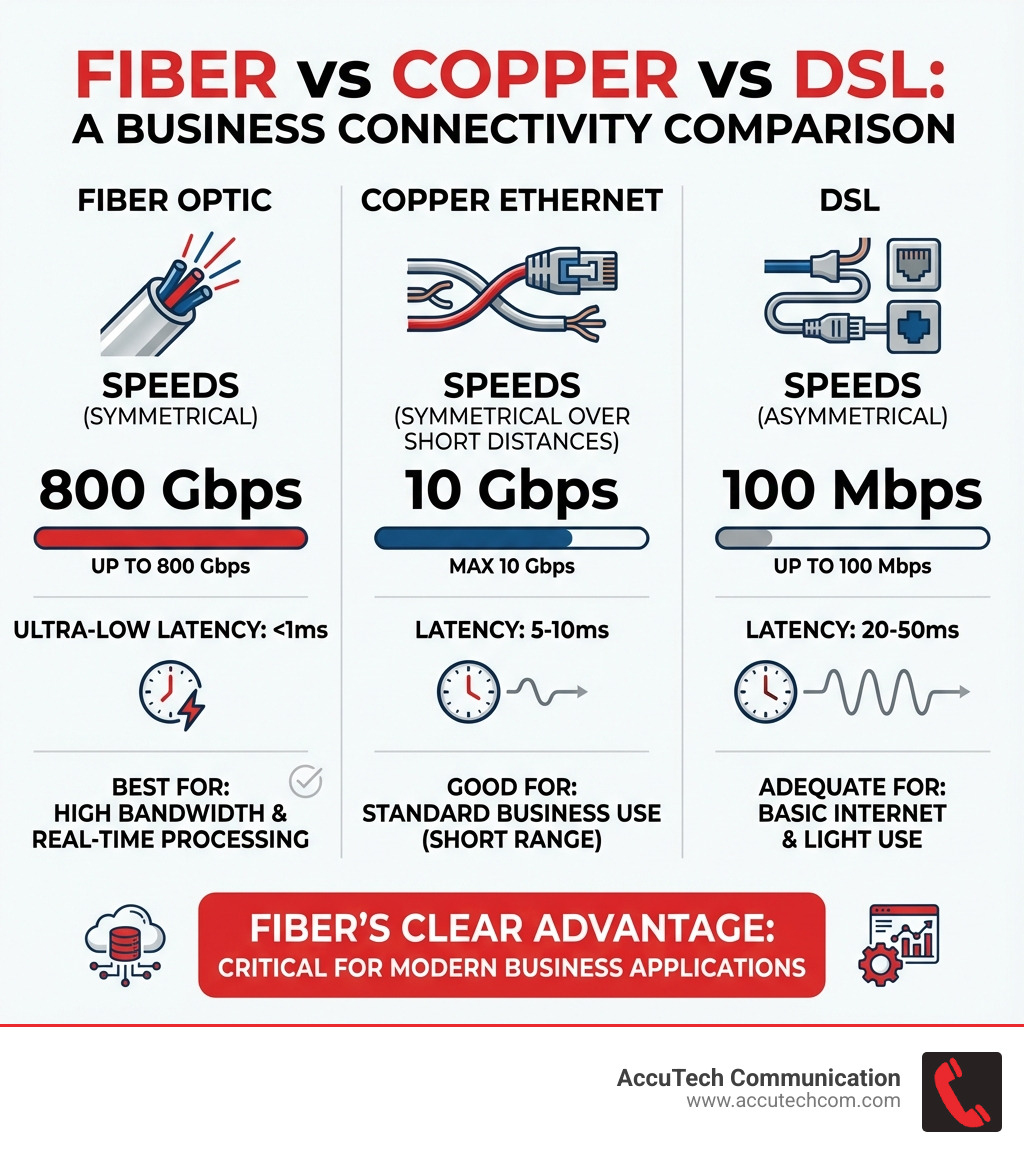
Boston’s booming technology sector means companies across Greater Boston are rapidly upgrading from copper to fiber optic infrastructure. The reason is simple: fiber delivers the symmetrical speeds, minimal latency, and bandwidth capacity modern businesses require for cloud computing, real-time data processing, and uninterrupted operations.
Unlike residential services, commercial fiber installations require expertise in structured cabling design, ANSI/TIA/EIA standards, and integration with existing building infrastructure. Whether connecting multiple buildings, upgrading a data center, or future-proofing your network for 5G and IoT, professional fiber optic services are essential for maintaining a competitive advantage.
I’m Corin Dolan, owner of AccuTech Communications. Since 1993, I’ve designed and installed commercial network infrastructure across Massachusetts, New Hampshire, and Rhode Island, including hundreds of Fiber Optic Services Boston projects. In this guide, I’ll explain fiber optic technology, how to choose the right services, and what to expect when upgrading your business network.
Why Boston Businesses are Switching to Fiber Optic Networks
Boston is a hub of innovation demanding the best in connectivity. Businesses here, from startups in Cambridge to financial institutions downtown, know their network infrastructure is the backbone of their operations. This is where fiber optics shines, offering unparalleled advantages over older technologies.
The Best Speed and Reliability of Fiber
For Boston-area businesses, speed and reliability are everything. Enterprises need dedicated, fast internet to keep employees productive and applications running. Fiber optic internet delivers by providing:
- Symmetrical Upload/Download Speeds: Fiber offers equally fast upload and download speeds, crucial for cloud applications, video conferencing, and large file transfers. Symmetrical speeds can scale up to 800 Gbps, allowing your business to handle massive data flows.
- Low Signal Degradation: Fiber optic cables transmit light signals with minimal loss over long distances. This ensures data integrity for large campuses or inter-building connections in the Greater Boston area.
- Electromagnetic Interference (EMI) Resistance: Unlike copper, fiber optic cables are immune to EMI. This ensures a clean, reliable signal, making fiber ideal for environments with heavy electrical equipment.
- Business Continuity: A robust fiber network improves business continuity. Features like dedicated bandwidth and proactive monitoring keep businesses connected. Wireless internet also offers cost-effective redundancy, with failover to 5G or 4G to prevent downtime during outages.
- Data Security: Tapping a fiber optic cable is much harder to do undetected than with copper. Any attempt to intercept the light signal causes a noticeable performance drop, alerting network administrators. You can read more about how fiber works at a high level here: Fiber-optic communication overview.
Comparing Fiber to Traditional Copper and Wireless Solutions
Boston’s competitive market requires informed decisions about network infrastructure. Heres how fiber stacks up against other solutions:
- Fiber vs. Ethernet/Copper: Traditional copper-based Ethernet (like Cat5e or Cat6) has limitations. Copper cables experience signal attenuation, weakening the signal over distance and limiting effective runs to about 100 meters. This restricts bandwidth, with Cat6 maxing out at 10 Gbps over short distances. Fiber transmits data over much longer distances with minimal data loss, supporting far greater bandwidth.
- Fiber vs. Wireless: While convenient, wireless solutions often struggle with speed, latency, and reliability compared to a wired fiber connection, especially for mission-critical use. Interference and shared bandwidth can lead to inconsistent performance. However, wireless internet is an excellent redundancy option. We can implement a failover strategy where your primary fiber connection is backed by a robust 5G or 4G wireless service, ensuring your business stays online if the primary line fails.
Understanding the Core Technology: Single-Mode vs. Multi-Mode Fiber
Fiber optic cables are not one-size-fits-all. The two primary types are single-mode and multi-mode. Understanding their differences is key to selecting the right Fiber Optic Services Boston businesses need.
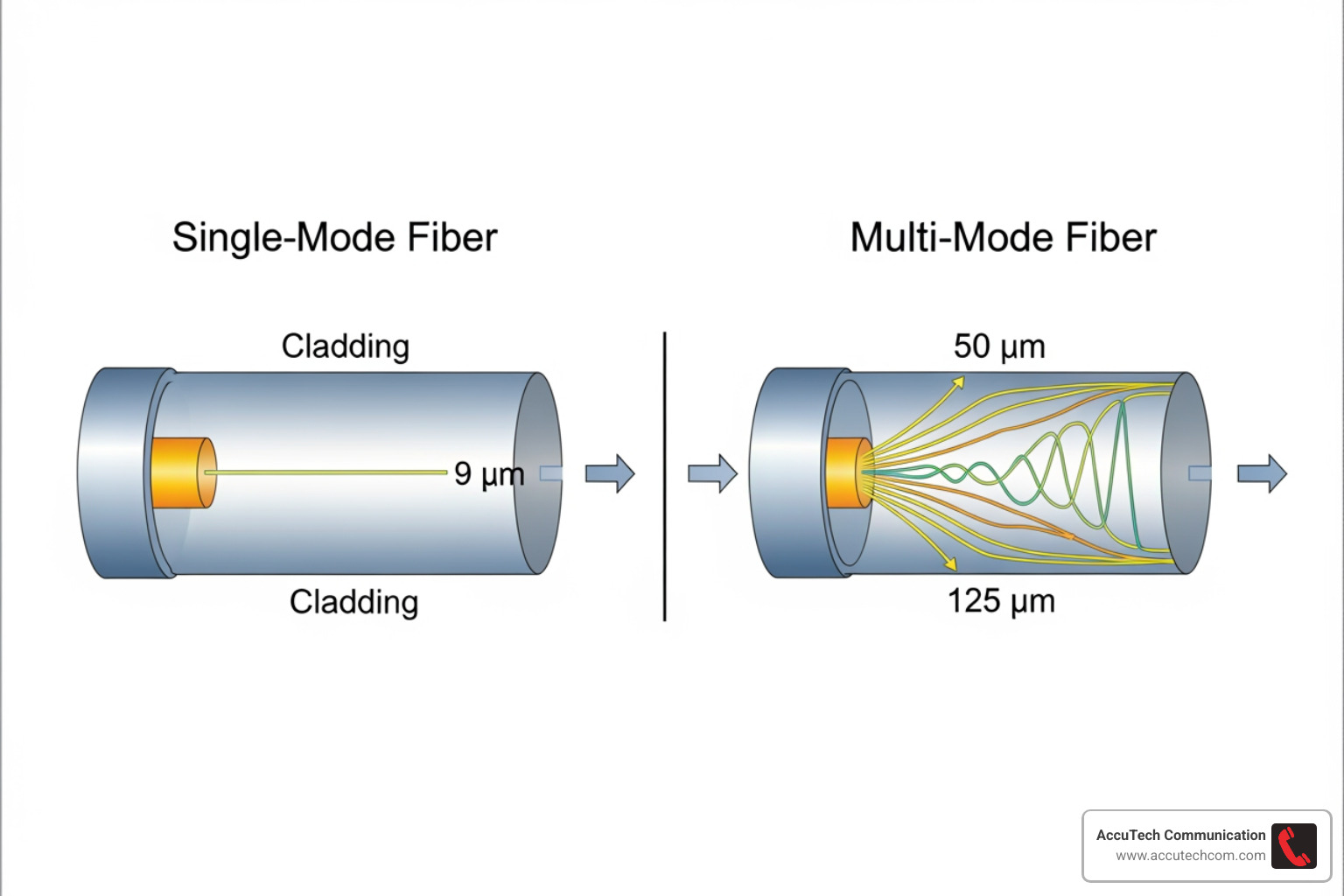
Core Diameter
The main difference is the diameter of the fiber’s core, which carries the light signal.
- Single-Mode Fiber (SMF): Has a very narrow core (8-10 microns) that allows only a single path of light. This reduces reflections and enables data to travel much further.
- Multi-Mode Fiber (MMF): Has a thicker core (50-100 microns) that allows multiple light paths to travel simultaneously.
Light Source
- Single-Mode Fiber: Uses a precise, more expensive laser diode light source, producing a focused beam ideal for long distances.
- Multi-Mode Fiber: Uses less expensive light sources like LEDs or Vertical-Cavity Surface-Emitting Lasers (VCSELs), which produce broader light pulses suitable for shorter distances.
Transmission Distance
- Single-Mode Fiber: Designed for very long distances, often exceeding 10 miles. It’s the choice for connecting separate buildings, city-to-city connections, and telecom backbones.
- Multi-Mode Fiber: Best for shorter distances, typically up to a few hundred meters. Beyond about 3,000 feet, the multiple light paths can cause signal distortion.
Bandwidth Capacity
- Single-Mode Fiber: Carries significantly more bandwidth than multi-mode, especially over long distances. The single light path allows for higher data rates like 100 Gbps and beyond.
- Multi-Mode Fiber: Provides high speeds over short runs, but its bandwidth capacity diminishes with distance due to modal dispersion.
Cost Implications
- Single-Mode Fiber: The cable itself can be slightly more expensive, but the main cost difference is the more expensive transceivers (which convert electrical signals to light).
- Multi-Mode Fiber: Generally more cost-effective for shorter distances due to less expensive transceivers.
When to Use Single-Mode Fiber
For businesses in Boston requiring extensive network reach and maximum bandwidth, single-mode fiber is superior. We typically recommend it for:
- Long-haul networks: Connecting your Boston HQ to a data center in Marlborough or bridging distances within a large campus in Waltham.
- Connecting separate buildings: Ideal for linking geographically dispersed facilities where signal integrity over distance is paramount.
- High bandwidth requirements: When your business demands 10 Gbps, 40 Gbps, 100 Gbps, or more, single-mode is the only viable option.
- Data center interconnects: Essential for high-speed links between your business and critical data centers.
- Telecom backbones: For large-scale infrastructure projects that form the core of communication networks.
The Role of Multi-Mode Fiber in Business Networks
While single-mode handles long distances, multi-mode is crucial for shorter-range, high-speed applications. We often deploy it for:
- Local Area Networks (LANs): Providing high-speed connectivity within offices for servers, workstations, and network devices.
- Short-distance data center links: Ideal for connections between racks and servers within a single data center.
- Backbone cabling within a building: For a high-capacity link between different floors or departments.
- Cost-effective for shorter runs: For distances under a few hundred meters, multi-mode is a high-performance, economical solution.
For more detailed information on how we approach fiber optic cabling installation, you can explore our services here: More info about fiber optic cabling installation.
A Guide to Professional Fiber Optic Services Boston Businesses Need
Implementing a reliable fiber optic network requires specialized expertise. From design to maintenance, professional Fiber Optic Services Boston ensure your investment yields maximum performance and longevity.
Network Design
A successful deployment starts with a meticulous design. Our process involves assessing bandwidth needs, planning pathways, selecting appropriate fiber and connector types (ST, SC, LC, MTRJ), and ensuring the design is scalable, secure, and compliant.
Installation
Our installation services cover all commercial needs, including new cabling, underground and aerial runs between buildings, fiber backbones, and Dmark/Dmarc extensions to connect your internal network.
Termination
Proper termination is critical for signal integrity. We prepare fiber cables and use high-quality connectors, polishing end faces to ensure a clean connection. All terminations are tested before project completion.
Splicing
Splicing is required to repair or extend a fiber cable.
- Fusion Splicing: The preferred method for permanent, low-loss connections. We can perform mass fusion splicing (up to 12 fibers at once) to save time on large projects.
- Mechanical Splicing: A quicker method often used for emergency repairs.
Testing & Certification
Rigorous testing is non-negotiable. We test every project to guarantee functionality, including:
- Tier 1 & Tier 2 Testing: Ensuring the system is compliant with industry standards and supports your network speed.
- Documentation: Providing a complete package with patch panel records, test results, and as-built drawings.
Emergency Repairs
Fiber failures cause productivity loss. We offer 24/7 emergency repair services to quickly identify and fix problems, restoring your network with minimal downtime.
Finding a Certified Provider for Fiber Optic Services Boston
Choosing the right partner is paramount. Look for a provider who demonstrates:
- Certification (BICSI RCDD): Certifications like BICSI RCDD (Registered Communications Distribution Designer) signify deep expertise. Our certified professionals ensure expert design and implementation.
- Adherence to industry standards (ANSI/TIA/EIA): We strictly follow these standards to minimize network problems.
- Commercial Experience: Since 1993, we’ve focused exclusively on commercial clients in Massachusetts, New Hampshire, and Rhode Island.
- Complete Documentation: You should receive comprehensive drawings, pathways, and test results.
- Workmanship Warranties: We offer a free five-year warranty on all our workmanship.
Key Installation and Maintenance Services
Our comprehensive services include structured cabling design, fusion and mechanical splicing, Tier 1 & 2 testing, and Dmark/Dmarc extensions.
For more details on how we can help with your overall structured cabling needs, please visit our page on More info about structured cabling services.
The Future of Connectivity: Fiber’s Role in Boston’s Tech Ecosystem
Boston’s role as a leading tech hub means its infrastructure must continuously evolve. Fiber optic technology is the foundational layer for emerging technologies that will drive business innovation for decades.
Powering 5G and IoT in the Greater Boston Area
The rollout of 5G and the Internet of Things (IoT) is changing how businesses operate, and fiber is indispensable to these advancements:
- Fiber as the essential backbone for 5G cells: 5G relies on a dense network of small cell antennas, each requiring a high-capacity fiber connection to the core network. Extensive fiber deployment is necessary to realize 5G’s full potential in Greater Boston.
- Low latency for real-time data processing: 5G and IoT applications (e.g., autonomous vehicles, smart factories) demand near-instantaneous response times. Fiber’s ultra-low latency is critical for the real-time data processing these technologies require.
- Supporting massive device connectivity for IoT: The sheer volume of IoT devices generates enormous amounts of data. Fiber provides the necessary bandwidth to collect, transmit, and analyze this data efficiently.
Future-Proofing Your Business Network
Investing in fiber optic infrastructure today is an investment in your business’s future. Its scalability and capabilities ensure it can adapt to technological advancements:
- Scalability to 400 Gbps/800 Gbps: As data demands grow, fiber networks can already support speeds up to 800 Gbps. Your current installation can likely accommodate future upgrades without a complete cabling overhaul.
- Evolving network standards: Fiber is inherently more adaptable to future standards than copper-based systems.
- Supporting future cloud and AI applications: Cloud computing, AI, and machine learning rely on massive data transfer. Fiber provides the high-speed, low-latency connectivity essential for these applications.
- Long-term infrastructure investment: While the initial cost might be higher, fiber’s longevity and upgrade potential make it a smart long-term investment, reducing future upgrade cycles and operational expenses.
To ensure your business network is prepared for these advancements, our team specializes in comprehensive network cabling installation services. Learn more about how we can future-proof your connectivity: More info about network cabling installation.
Budgeting for Fiber Optic Installation in Boston
Understanding the costs for Fiber Optic Services Boston businesses need is crucial for budgeting. While fiber offers significant long-term benefits, upfront costs vary widely.
Understanding the Cost Factors
Several elements influence the total cost of a commercial fiber optic installation:
- Project Scope: The size and complexity—a single building, a multi-building campus, or a data center interconnect—significantly impact costs.
- Building Infrastructure: Existing conduit and pathways can reduce installation time and costs. The need for new conduit in older buildings can increase expenses.
- Trenching vs. Aerial Installation: For outdoor runs, trenching is often more expensive but offers greater protection. Aerial installation can be more cost-effective but is subject to environmental factors.
- Number of Connection Points: Each termination, splice, and patch panel adds to material and labor costs.
- Required Hardware: The cost of active equipment like switches, transceivers, and media converters contributes to the budget. Single-mode transceivers are considerably more expensive than multi-mode ones.
A Note on Average Costs
Prices for commercial fiber optic services vary dramatically. The general ranges provided here are based on publicly available industry data, not the actual prices of AccuTech Communications. We always recommend a custom quote for an accurate project estimate.
Disclaimer on pricing: All prices mentioned here are average costs sourced from publicly available internet data and are not the actual prices of AccuTech Communications. We do not imply these prices reflect our rates or guarantees.
Typically, commercial fiber installation can range from $5,000 for a small indoor project to over $50,000 for complex multi-building or data center runs. Very large or specialized deployments can exceed $150,000, reflecting the wide variability in project scope. This wide price range, with the high end often more than 3x the average, accounts for differences in labor, materials, and infrastructure.
Focusing on value and ROI is crucial. While fiber can cost more upfront than copper, the long-term benefits—reduced downtime, higher productivity, and scalability—often lead to a lower Total Cost of Ownership (TCO).
| Feature / Cost | Copper Cabling (e.g., Cat6) | Fiber Optic Cabling |
|---|---|---|
| Upfront Material Cost | Lower (e.g., $0.50-$1.50/ft) | Higher (e.g., $1.50-$5.00/ft) |
| Installation Labor | Moderate | Moderate to High (due to specialized skills) |
| Equipment (Transceivers) | Lower | Higher (especially for single-mode) |
| Max Bandwidth (typical) | 10 Gbps (short distance) | 100 Gbps – 800 Gbps |
| Max Distance (typical) | 100 meters | 10+ miles (single-mode) |
| EMI Resistance | No | Yes |
| Lifespan | 10-15 years | 20-30+ years |
| Scalability for Future Needs | Limited | High |
| Long-term Operational Benefits | Lower | Higher |
| Total Cost of Ownership (TCO) | Moderate | Lower (over lifespan) |
Frequently Asked Questions about Fiber Optic Services Boston
We often receive questions from Boston-area businesses considering a fiber optic upgrade. Here are some common inquiries:
How long does a typical commercial fiber installation take?
The timeline for a commercial fiber installation is highly variable, depending on the project’s scope. Key phases include the site survey, design, permitting, installation, and testing. A simple indoor installation within an existing conduit might take a few days to a week. More complex projects involving trenching or multiple buildings can take several weeks to a few months. We always provide a detailed project timeline after our initial site survey.
Is my Boston business building “fiber-ready”?
Many commercial buildings in Greater Boston are “fiber-ready,” but this can mean different things:
- Lit Buildings: Some buildings are already “lit,” meaning a fiber connection is available at the building’s demarcation point (Dmarc). This speeds up and reduces the cost of connecting your business.
- Construction-Ready: Other buildings are near available fiber, but the final connection needs to be constructed from the street to your building.
- Dmarc Extensions: Even if fiber reaches your building, you may need a Dmarc extension to bring that connection from the entry point to your internal network room.
We can assess your building’s fiber readiness and work with building management to determine the best connection path.
What kind of maintenance does a fiber optic network require?
A key advantage of fiber is its durability and low maintenance requirements compared to copper.
- Durability of Glass Fiber: The glass or plastic fibers are highly durable and resistant to environmental factors that degrade copper.
- Importance of Initial Quality Installation: The most critical “maintenance” is a high-quality initial installation. Proper termination, splicing, and cable management prevent future issues.
- Periodic Testing Recommendations: We recommend periodic testing to ensure ongoing performance, especially for mission-critical networks or after significant network changes.
- Professional Repair Services for Cuts or Damage: While strong, fiber cables are not indestructible. In the event of physical damage, professional repair involving fusion splicing is required. Our 24/7 emergency repair services are available for such situations.
Conclusion
The demand for high-performance, reliable connectivity in Boston is undeniable, and fiber optic technology stands as the clear solution for businesses seeking a competitive edge. From the symmetrical speeds and ultra-low latency that power today’s cloud-centric operations to its role as the essential backbone for tomorrow’s 5G and IoT innovations, fiber is an indispensable asset.
We’ve explored the distinct advantages of fiber over traditional copper and wireless, detailed the critical differences between single-mode and multi-mode fiber for various applications, and outlined the comprehensive professional Fiber Optic Services Boston businesses require—from expert network design and installation to precise termination, splicing, and rigorous testing and certification.
As your trusted partner since 1993, we are committed to providing certified, reliable service with a focus on quality, helping businesses across Massachusetts, New Hampshire, and Rhode Island build robust and future-ready network infrastructures. We understand the unique demands of the Boston market and are equipped with the expertise and experience to ensure your fiber optic project is a resounding success.
Don’t let outdated infrastructure hold your business back. Accept the future of connectivity. Contact us for your Boston fiber optic installation project today and let us help you design, install, and maintain a fiber optic network that propels your business forward.
