
What You Need to Know About Massachusetts Data Centers
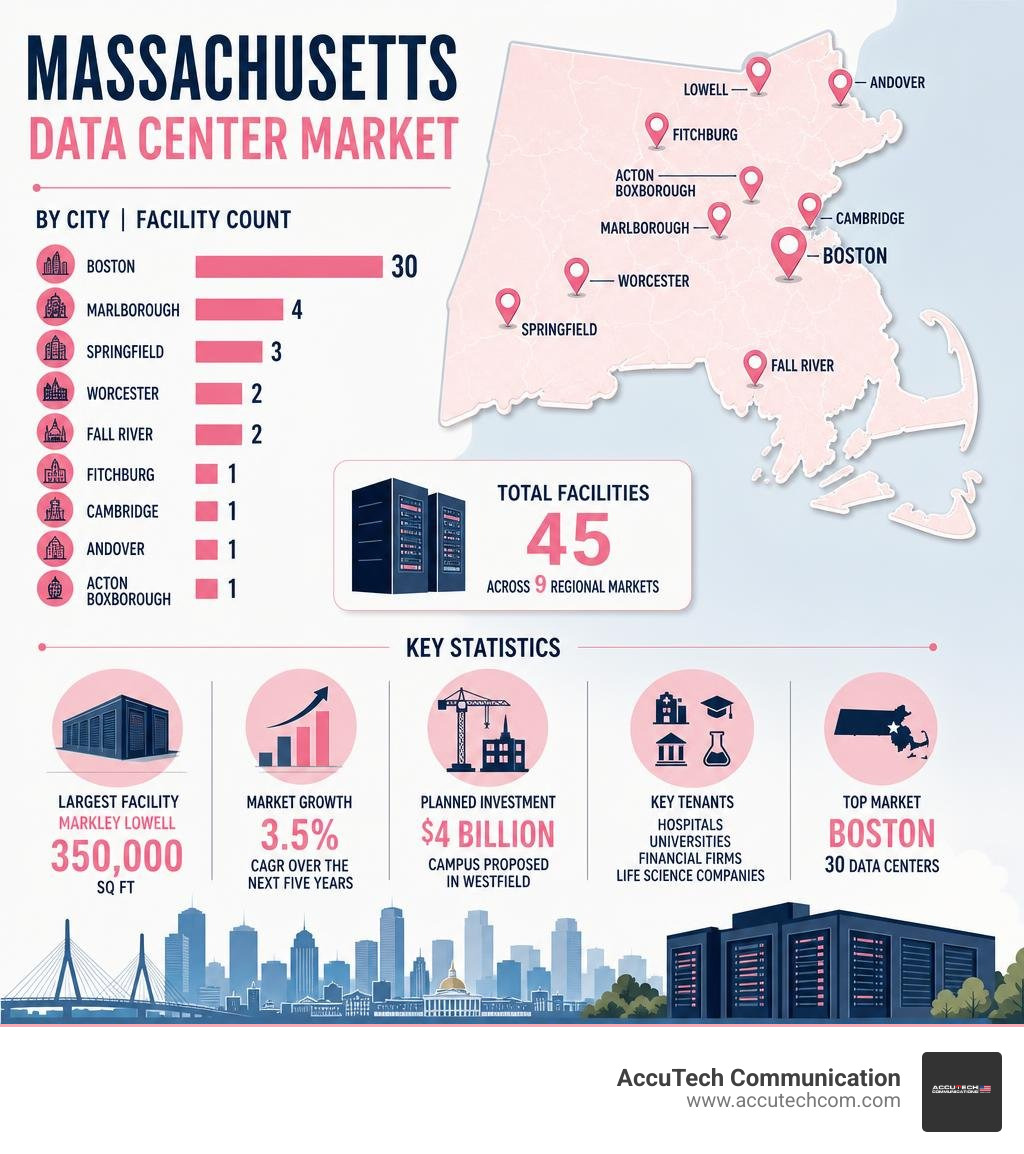
Massachusetts data centers form one of the most active and fast-growing infrastructure markets in New England. With 45 facilities spread across 9 regional markets, the state supports everything from hospital records and financial data to AI computing and cloud storage.
Here’s a quick snapshot of the Massachusetts data center landscape:
| Category | Key Facts |
|---|---|
| Total facilities | 45 data centers across the state |
| Top market | Boston (30 data centers) |
| Other active markets | Marlborough, Springfield, Worcester, Fall River, Fitchburg, Cambridge, Andover, Acton Boxborough |
| Largest facility | Markley Lowell — 350,000 sq ft |
| Market growth | Projected 3.5% CAGR over the next five years |
| Planned investment | $4 billion campus proposed in Westfield |
| Key tenants | Hospitals, universities, financial firms, life science companies |
Whether you’re a business evaluating colocation options or an IT leader planning infrastructure upgrades, Massachusetts offers a dense, well-connected network of data center options — from downtown Boston to the Route 495 Technology Corridor.
The demand is real and growing fast. The rise of AI and cloud computing is pushing data centers to expand, and communities across the state are responding — some with open arms, others with moratoriums and zoning reviews. As one resident near the Markley facility in Lowell put it, the facility is nicknamed “the dungeon” — a reminder that data center growth isn’t without friction.
I’m Corin Dolan, owner of AccuTech Communications, and I’ve spent decades helping commercial businesses across Massachusetts build the cabling and communications infrastructure that connects them to Massachusetts data center environments. In this guide, I’ll break down the key locations, facility specs, environmental considerations, and what businesses like yours should know before making infrastructure decisions.
Massachusetts data center helpful reading:
Mapping the Massachusetts Data Center Landscape
To truly understand the regional market, we must look at how these facilities are distributed. According to industry databases, there are currently 45 data centers operating across 9 distinct municipal markets in Massachusetts. This distribution is highly concentrated near major transportation, power, and fiber-optic pathways, which ensures low-latency connectivity for local enterprises.
The geographic footprint breaks down as follows:
- Boston: 30 data centers (the highest concentration in New England)
- Marlborough: 5 data centers (acting as a critical suburban backup and high-density hub)
- Springfield: 2 data centers
- Worcester: 2 data centers
- Fall River: 2 data centers
- Fitchburg: 1 data center
- Cambridge: 1 data center
- Andover: 1 data center
- Acton Boxborough: 1 data center
For a comprehensive overview of specific projects and site listings across these municipal areas, you can explore the Data Centers in Massachusetts — Project List & Locations directory.
While Boston remains the undisputed heavyweight, suburban zones like Marlborough have quietly grown into premier enterprise-class alternatives. If you want to dive deeper into why this specific Metrowest city has become a magnet for digital infrastructure, read The Ultimate Guide to Marlborough Data Center to learn about its routing advantages and facility layouts.
Key Regional Hubs and Facility Specifications
Selecting the right Massachusetts data center requires looking beyond simple location. You must evaluate critical specs such as total square footage, utility power capacity, cabinet density limits, and carrier neutrality.
Modern workloads—especially high-performance computing (HPC) and artificial intelligence (AI)—demand extreme power densities. Traditional cabinets that once supported 4 kW to 10 kW are being replaced by high-density frames capable of handling 20 kW to 85 kW per cabinet, often requiring advanced cooling mechanics.
To help you compare the primary facilities operating in our service territory, we have compiled a comparison of key regional sites:
| Facility Name | Location | Size (Sq. Ft.) | Potential Power Capacity | Key Features |
|---|---|---|---|---|
| CoreSite BO1 | Somerville, MA | 273,000+ | High-Density Capable | Bordering Boston CBD, Open Cloud Exchange, Rooftop Access |
| Krypt BOS1 | Somerville, MA | 46,000 | 6.0 MW | Dual 13.8 kV feeds, closed-loop cooling, 20 kW cabinet loads |
| Iron Mountain BOS-1 | Northborough, MA | 22,000 (58.3-acre campus) | 3.6 MW (1.2 MW active) | LEED Gold, waterless cooling, Category 4 hurricane rating |
| TierPoint Marlborough | Marlborough, MA | 115,000+ | Up to 85 kW/cabinet | Liquid cooling for AI, 2N power design, business continuity space |
| Markley Lowell | Lowell, MA | 350,000 | Multi-Megawatt | Former Prince Spaghetti site, stores petabytes for hospitals/universities |
| Equinix BO2 | Billerica, MA | 75,735 (colocation space) | Multi-Megawatt | Bloom Energy fuel cells, 100% wind RECs, decoupled dehumidification |
Boston and Somerville: The Core Massachusetts Data Center Hub
The immediate Boston metro area, including Somerville, represents the primary connectivity core of New England. Facilities here are strategically positioned close to the Boston central business district to deliver the lowest possible latency for financial services, healthcare institutions, and academic research hubs.
A prime example is the CoreSite BO1 – Boston Data Center BO1, located at 70 Inner Belt Road in Somerville. This massive 273,000-square-foot facility sits just 3.8 miles (about 15 minutes) from downtown Boston. It provides direct, low-latency access to major public cloud providers via the Open Cloud Exchange, offers rooftop space for specialized wireless infrastructure, and supports liquid cooling systems for high-density setups.
Right next door at 50 Inner Belt Road is the Krypt BOS1 facility. Spanning 46,000 square feet (with 21,600 square feet of raised floor), it features a 6 MW utility power capacity backed by dual 13.8 kV diverse feeds and three 2 MW emergency backup generators. Designed for high-performance hosting, its infrastructure accommodates heavy cabinet loads of up to 20 kW.
Operating in these urban environments requires sophisticated fiber routing and structured cable management to prevent bottlenecks. To understand how these physical connections impact data transmission speeds, read our technical guide on Connecting the Dots: A Deep Dive into Data Center Connectivity.
Suburban Corridors: Marlborough, Andover, and Northborough
As land and power become scarcer in Boston, suburban corridors along Route 495 and Route 9 have emerged as powerful alternatives. These locations offer excellent physical security, larger footprints for horizontal expansion, and natural protection against localized coastal disasters, while remaining within a 30-minute drive of the city.
In Northborough, the Boston Data Center | Boston Colocation | Iron Mountain United States (BOS-1) sits on a secure 58.3-acre campus. It features a 22,000-square-foot facility with a potential critical power capacity of 3.6 MW. Built to withstand Category 4 hurricane winds, BOS-1 is Boston’s first LEED Gold-certified multi-tenant data center. It utilizes a waterless cooling design and is situated near a National Grid substation for priority power restoration.
Further west in Marlborough, TierPoint operates a premier 115,000-square-foot facility. This data center is engineered specifically for next-generation workloads, supporting up to 85 kW per cabinet with specialized liquid cooling. It also features a true 2N power distribution design and over 20,000 square feet of dedicated on-site business continuity workspace.
Connecting suburban facilities back to corporate offices in Boston or Worcester requires high-count single-mode fiber backbones. We discuss the physics of these long-distance connections in our article, Why Your Data Center Needs Fiber: Speed, Distance, and Beyond.
Environmental Impact and Sustainability Initiatives
As data demand explodes, so does the consumption of local resources. Data centers require massive, constant streams of electricity to run processors and millions of gallons of water to cool them. In Massachusetts, where municipal utilities and state regulators closely monitor environmental footprints, sustainability is no longer optional.

Consider the scale of resource consumption:
- Water Usage: The Markley data center in Lowell consumes between 60,000 and 120,000 gallons of water per day to keep its 350,000-square-foot facility operating. While this is far less than the millions of gallons used daily by some mega-scale AI facilities in other states, it still represents a significant draw on local municipal water systems.
- Power Demand: Nationally, data center energy consumption has doubled over the last few years. In Massachusetts, operators are under pressure to offset this load by adopting green building practices and securing renewable energy sources.
Balancing Resource Consumption in a Massachusetts Data Center
To mitigate their environmental impact, forward-thinking operators are redesigning their mechanical, electrical, and plumbing (MEP) systems.
One of the most effective methods is the transition to waterless cooling systems, such as the closed-loop air-cooled chillers utilized at Iron Mountain’s Northborough campus. These systems recirculate a set volume of water or refrigerant in a closed loop, eliminating evaporation losses and saving millions of gallons of municipal water annually.
Improving Power Usage Effectiveness (PUE) is another key focus. By implementing hot/cold aisle containment, smart variable-speed fans, and real-time environmental monitoring, facilities can reduce the overhead energy required to keep servers running. For a detailed breakdown of these green technologies, check out our guide on Energy Efficient Data Centers.
Green Building Standards and Renewable Energy
Operators in Massachusetts are actively pursuing third-party certifications and innovative on-site power generation to meet corporate sustainability mandates:
- LEED Certifications: Leading facilities are achieving LEED Silver and LEED Gold ratings by incorporating recycled building materials, energy-efficient LED lighting, and high-efficiency UPS systems.
- On-Site Fuel Cells: The Equinix BO2 facility in Billerica utilizes 1,900 kW of Bloom Energy fuel cells. These cells generate clean, on-site electricity through an electrochemical process, reducing reliance on the local coal- and gas-fired grid.
- Renewable Energy Credits (RECs): Many operators purchase wind and solar RECs to match 100% of their operational energy. For example, Equinix offsets its Billerica load using wind RECs sourced from virtual Power Purchase Agreements (vPPAs).
- Advanced HVAC: Modern facilities use decoupled dehumidification systems to control humidity levels independently from temperature cooling, which drastically reduces compressor energy consumption.
Economic Growth, AI Demand, and Community Responses
The rapid expansion of cloud computing and artificial intelligence has triggered a wave of multi-billion-dollar development proposals across New England. However, this growth has met mixed reactions from local municipal governments and residents.
On the economic front, the benefits of these projects can be massive:
- The Westfield Proposal: Developers have proposed a massive $2.5 billion to $4 billion data center campus in Westfield, MA. Planned to span 120 acres and house 10 to 14 buildings, the project is projected to create 400 permanent, high-paying technical jobs (with average salaries exceeding $100,000) and support up to 2,000 construction jobs over an 8- to 10-year build-out.
- State Tax Incentives: To attract these investments, a Massachusetts economic development law provides sales and use tax exemptions on computer equipment, software, electricity, and construction materials for qualified data centers. To qualify, a facility must be at least 100,000 square feet and represent a minimum investment of $50 million over 10 years.
Despite these financial incentives, local communities are increasingly pushing back:
- Moratoriums and Bans: In Lowell, public concern over noise and resource usage led the city council to pass a one-year moratorium on new data center development. In Everett, residents campaigned for a citywide ban to protect former industrial waterfront sites from data center re-development.
- Resident Quality of Life: Neighbors living near existing facilities frequently complain about the constant low-frequency hum of industrial cooling fans and the emissions from weekly testing of massive backup diesel generators.
- Regional Precedents: This local resistance reflects a broader trend across New England. For instance, a major data center proposal in Nottingham, NH was recently withdrawn following widespread community opposition over environmental and noise concerns. You can read more about this regional pushback in the report on the Nottingham NH data center proposal withdrawn – NBC Boston .
Balancing municipal concerns with technical demands requires careful planning during the early stages of a project. To learn how modern facilities are designed to minimize their physical and environmental impact on surrounding neighborhoods, refer to our detailed resource on Data Center Infrastructure Design.
Frequently Asked Questions about Massachusetts Data Centers
How many data centers are currently operating in Massachusetts?
There are currently 45 data centers operating across 9 distinct municipal markets in Massachusetts. The vast majority of these facilities are concentrated in the Boston metropolitan area (30 facilities), with Marlborough serving as the primary suburban hub with 5 facilities. Other active municipalities include Worcester, Springfield, Fall River, Andover, Billerica, and Somerville.
What tax incentives exist for data center development in the state?
Under a Massachusetts economic development law, qualified data center operators can receive sales and use tax exemptions on server hardware, software, electricity, and construction costs. To qualify for these exemptions, a facility must meet strict state thresholds: it must be at least 100,000 square feet in size and represent a minimum capital investment of $50 million over a 10-year period.
How are operators addressing water and energy usage concerns?
Operators are increasingly adopting sustainable technologies to reduce their environmental impact. Key measures include implementing waterless, closed-loop cooling systems that eliminate evaporation losses, utilizing on-site Bloom Energy fuel cells for cleaner electricity generation, and purchasing wind and solar Renewable Energy Credits (RECs) to offset 100% of their utility power consumption.
Conclusion
Navigating the Massachusetts data center market requires balancing location, high-density power requirements, connectivity, and environmental sustainability. Whether you are looking to migrate your workloads to a carrier-neutral colocation facility in Somerville, establish a backup site in the Route 495 corridor in Marlborough, or design a private on-premise server room, the physical infrastructure supporting your hardware is critical.
At AccuTech Communications, we have provided commercial network cabling, business phone systems, and data center technology services across Massachusetts, New Hampshire, and Rhode Island since 1993. Our team of certified technicians ensures your physical layer is built for speed, reliability, and future expansion.
If you are planning a migration, upgrading your current server room, or preparing for a new deployment, let us help you build a solid foundation. Explore our services for Data Center Build Outs and contact us today to discuss your project.
