
Why Choosing the Right Fiber Optic Contractor Matters
When searching for an isp fiber optic contractor, you need a partner who can handle everything from network design and installation to testing and ongoing maintenance. The right contractor offers expertise in both Inside Plant (ISP) and Outside Plant (OSP) work, uses advanced testing methods like OTDR, and provides 24/7 emergency support.
Key services to look for include:
- Network Design & Installation: Single-mode and multi-mode fiber deployment.
- Testing & Validation: OTDR testing, power meter analysis, and fiber characterization.
- Splicing Services: Fusion and mechanical splicing for low signal loss.
- Emergency Support: 24/7 response for repairs and troubleshooting.
- Documentation: As-built drawings, test reports, and network auditing.
The demand for high-speed internet, 5G expansion, and data center growth is causing the fiber optic market to boom. For businesses, this means your network infrastructure must keep pace. Outdated copper systems cannot deliver the speed, bandwidth, and reliability that fiber optics provide. Fiber is the foundation of modern business communications, whether you’re connecting data closets, building a campus backbone, or establishing redundant paths for mission-critical operations.
However, not all fiber optic contractors are created equal. A poorly installed network can lead to signal loss, outages, and costly repairs, especially for critical sectors like healthcare and manufacturing. Conversely, a properly designed and installed system can last for decades with minimal maintenance, supporting your business as it scales.
I’m Corin Dolan, owner of AccuTech Communications. Since 1993, we’ve provided comprehensive fiber optic solutions to businesses across Massachusetts, New Hampshire, and Rhode Island. Our experience has shown us what separates an exceptional isp fiber optic contractor from the rest.
Isp fiber optic contractor terms to remember:
Understanding the Core Services of a Fiber Optic Contractor
Partnering with an isp fiber optic contractor means engaging a specialist for your network’s entire lifecycle. The process begins with a consultation to understand your current and future bandwidth needs. From there, we create a detailed network design, mapping out cable runs and equipment.
Once the design is approved, certified technicians handle the installation. This work requires precision, whether inside a building or across a campus, to ensure every cable is placed, terminated, and spliced correctly. After installation, we conduct rigorous testing with specialized equipment to verify that every connection meets performance specifications. A true isp fiber optic contractor also provides ongoing maintenance and support, proactively monitoring your network and responding quickly to any issues. For more details, see our structured cabling services.
What is the Difference Between Inside Plant (ISP) and Outside Plant (OSP)?
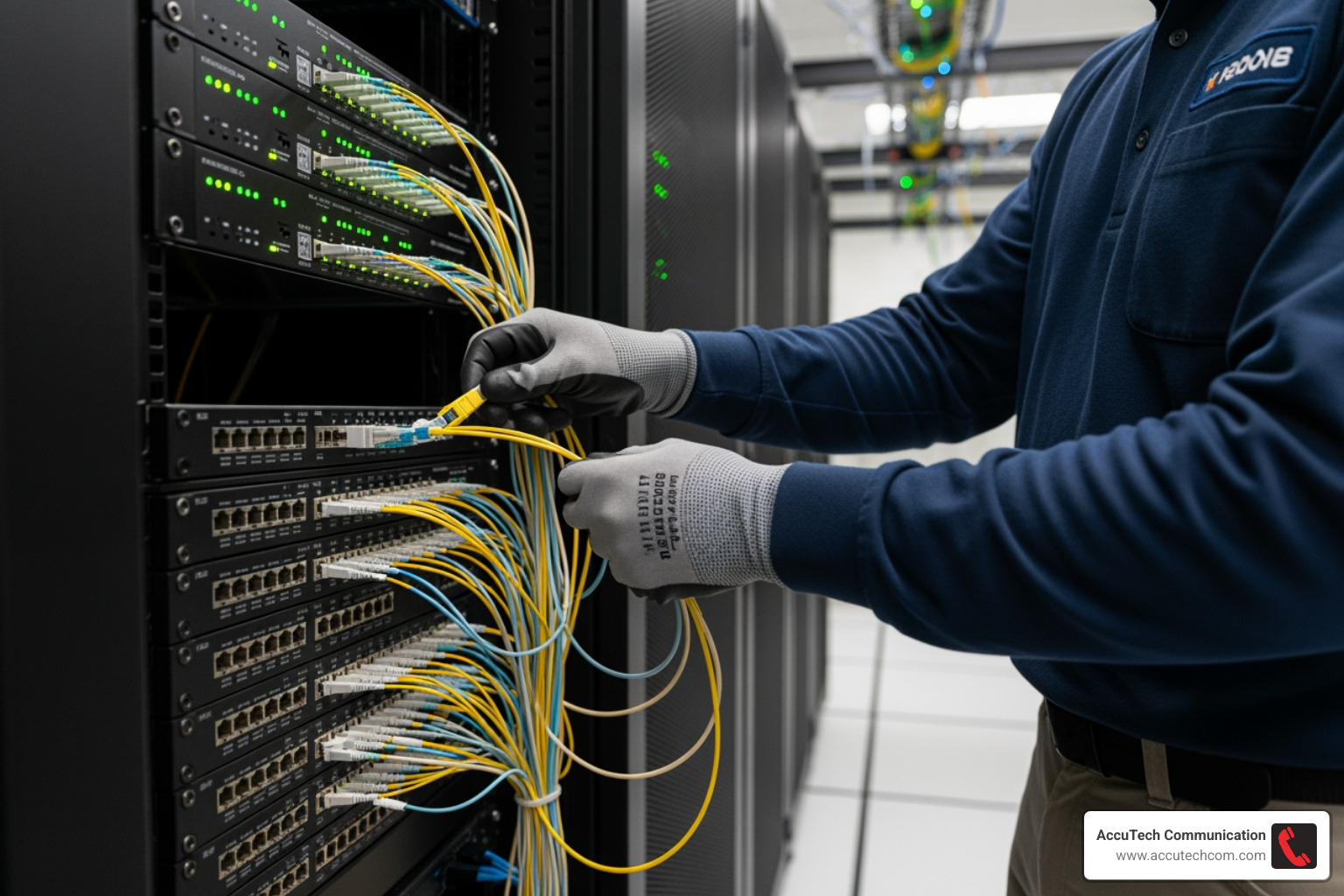
When evaluating an isp fiber optic contractor, you’ll encounter the terms Inside Plant (ISP) and Outside Plant (OSP), which describe two distinct types of work.
Inside Plant (ISP) refers to all cabling within a building’s walls. This includes fiber running through data centers, connecting floors via vertical risers, and linking network closets. ISP work requires knowledge of building codes, fire safety compliance, and how to work with minimal disruption to daily operations.
Outside Plant (OSP) involves installing fiber outdoors to connect different buildings or build community networks. OSP projects may involve trenching, boring under roads, or stringing cables on utility poles. The challenges include weather, underground utilities, and environmental regulations. A capable isp fiber optic contractor must have expertise in both ISP and OSP to provide a complete network solution.
What Types of Fiber Optic Cables Are Commonly Installed?
A knowledgeable isp fiber optic contractor will help you choose the right cable for your needs.
Single-mode fiber (SMF) is the standard for long-distance communication. Its thin core minimizes signal loss, allowing data to travel for miles. This makes it ideal for connecting facilities across town or for wide area networks (WAN) that require maximum bandwidth and a future-proof design.
Multi-mode fiber (MMF) has a larger core that is less expensive to work with but is limited to shorter distances (typically under 550 meters). It is perfect for use within a single building or campus, such as connecting servers in a data center or linking floors in an office. Different grades (OM1, OM3, OM4, and OM5) offer progressively better performance, with OM3 and higher supporting faster speeds.
Ruggedized fiber optic cables feature reinforced jacketing and armor, making them essential for harsh industrial or outdoor environments where they may face physical stress or extreme temperatures.
The right choice depends on your application’s specific distance, speed, environmental, and budget requirements.
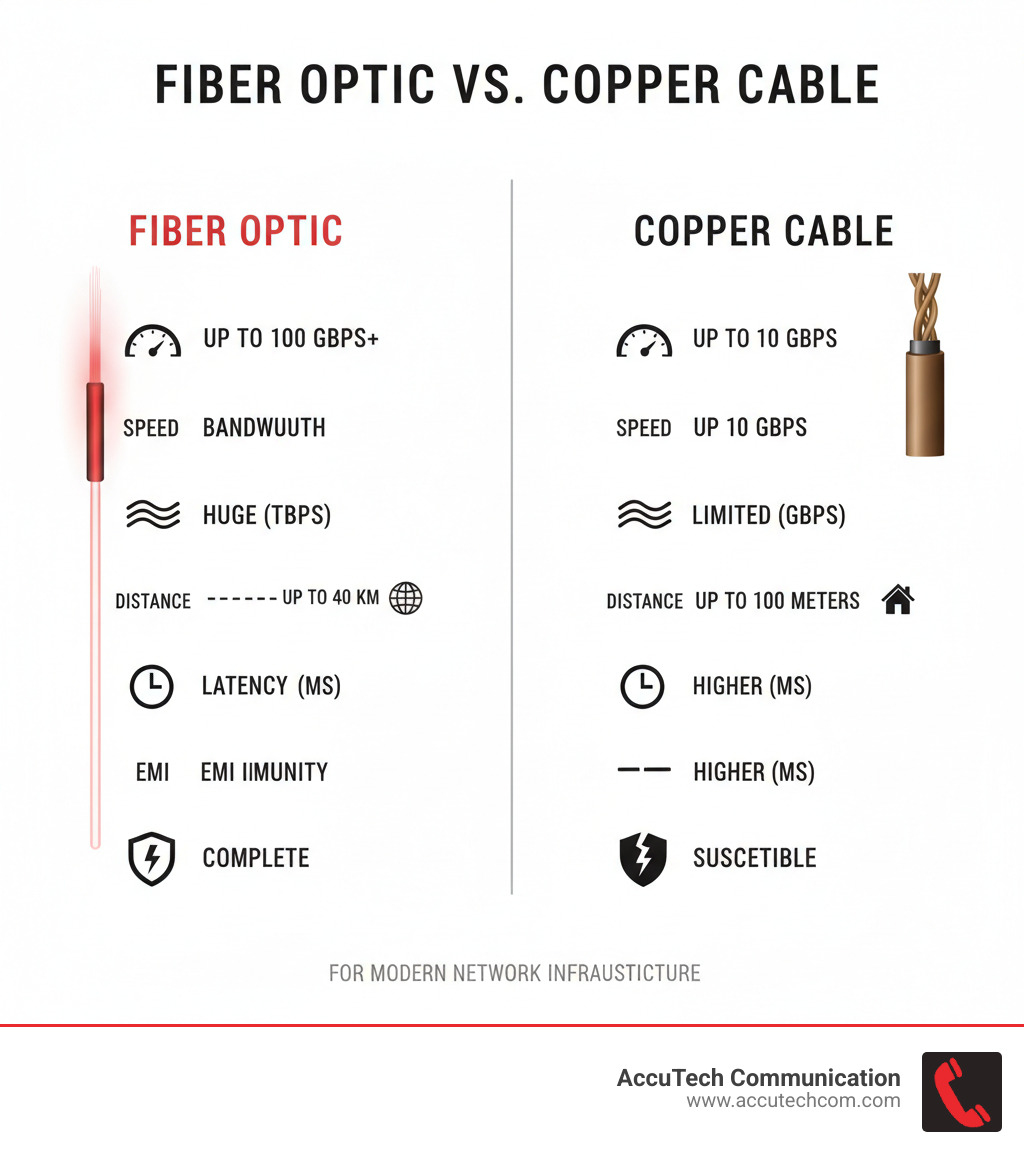
The Advantages of Fiber Optic Technology Over Copper
While copper cabling was once standard, it cannot match the performance of modern fiber optics. The transition to fiber is a strategic upgrade that removes fundamental limitations.
- Speed and Bandwidth: Fiber transmits data at speeds of 100 Gbps and beyond, with a vastly higher bandwidth capacity than copper. This eliminates bottlenecks and supports data-intensive applications.
- Lower Latency: Fiber dramatically reduces data transmission delays, which is critical for real-time applications like VoIP phone systems. The emerging trends in VOIP applications rely on this low-latency performance.
- Security: Fiber optic cables do not emit electromagnetic signals, making them nearly impossible to tap without detection.
- Immunity to EMI: Fiber is immune to electromagnetic interference (EMI), ensuring a reliable signal in environments with heavy electrical noise, such as manufacturing plants or hospitals.
- Scalability: A well-installed fiber network can support increasing bandwidth demands for decades, often requiring only equipment upgrades at the endpoints. This future-proofs your investment.
The Installation Process: From Underground to Splicing
A successful fiber optic installation relies on careful coordination of project management, supply chain, and specialized expertise. As an isp fiber optic contractor, we manage every project from the initial site survey and design through final testing and handoff.
Our strong supplier relationships and logistics planning ensure that all materials—cables, connectors, and equipment—arrive on time, preventing costly delays. This is crucial for projects across the diverse terrains of Massachusetts, New Hampshire, and Rhode Island. We provide turnkey services, giving you a single point of contact to manage the entire project, which reduces complexity and ensures accountability.
Key Considerations for Underground vs. Aerial Installations
Choosing between underground and aerial installation is a key decision that an experienced isp fiber optic contractor will help you make.
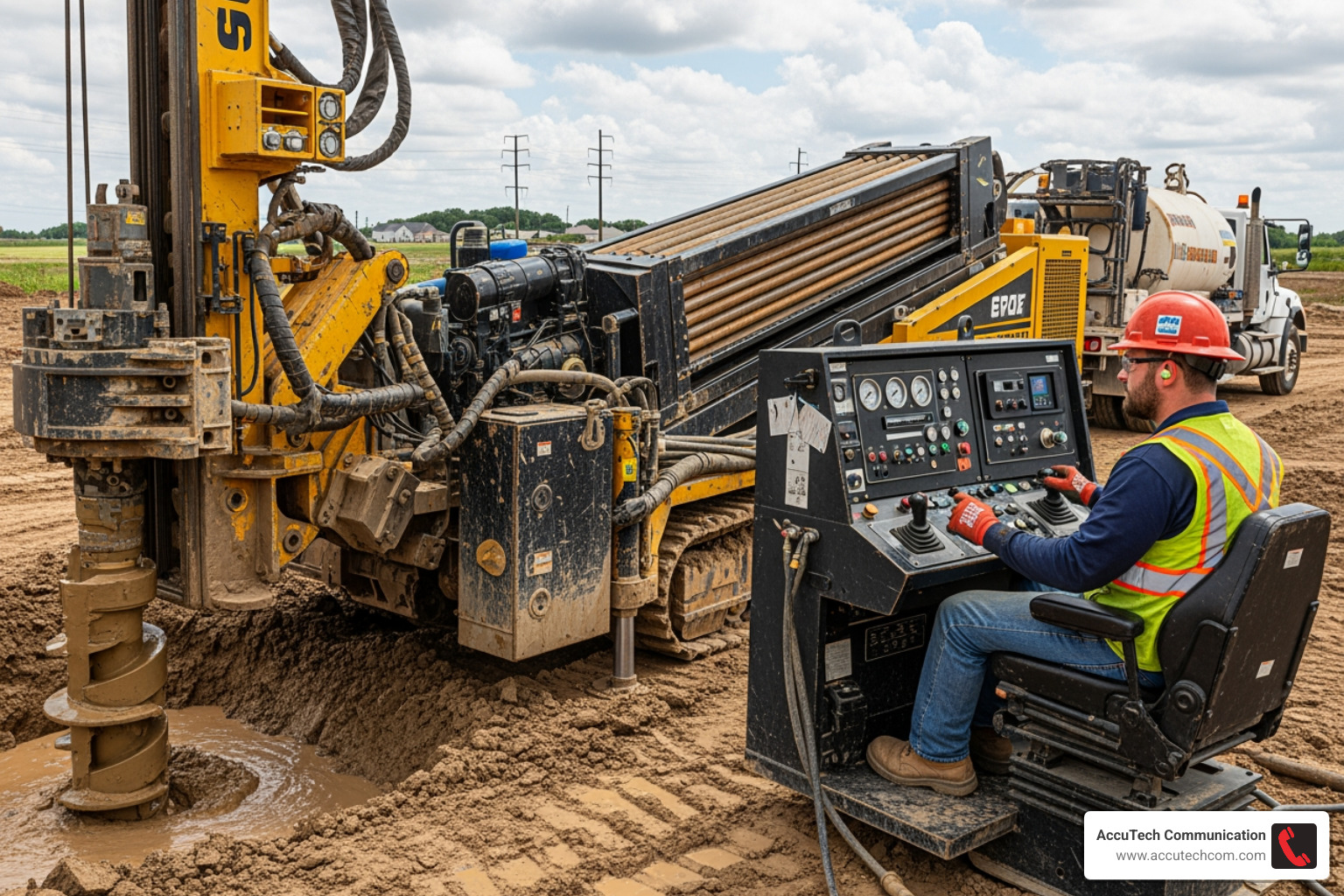
Underground installation offers maximum protection from weather, physical damage, and vandalism. It also preserves the visual landscape. We use methods like trenching or directional boring to install conduit or direct-bury armored fiber. While the initial cost is higher due to excavation and specialized equipment, the long-term reliability and reduced maintenance often justify the investment. You can find more info about innerduct installation services and how we prepare conduit systems on our site.
Aerial installation involves attaching fiber cables to existing utility poles. This method is generally faster and more cost-effective than underground options, especially over long distances. Maintenance and repairs are also simpler since the cables are easily accessible. The main drawback is exposure to the elements, such as ice storms, high winds, and falling tree branches. We mitigate these risks with weather-resistant cables and proper engineering, but the vulnerability remains.
The right choice depends on terrain, budget, local regulations, and how critical uninterrupted service is to your operations. A hybrid approach is often used.
How Contractors Handle Complex or Large-Scale Splicing Projects
Splicing connects fiber optic strands with a precision that is critical for network performance. For large-scale projects, this process requires meticulous planning and technical skill.
Fusion splicing is the preferred method for permanent, high-performance connections. It uses an electric arc to melt and fuse two fiber ends, creating a continuous strand with minimal signal loss (often less than 0.1 dB). This requires sophisticated equipment and trained technicians.
Mechanical splicing is a faster alternative used for temporary repairs. It uses a mechanical connector to align the fibers but is not as robust as a fusion splice.
For large projects with high-count fiber cables, we use detailed splice plans and color-code mapping to ensure organization. Splice enclosures are used to protect these delicate connections from moisture and damage, whether in an outdoor pedestal or an indoor rack-mounted tray.
In some cases, pre-terminated fiber optic cables with factory-installed connectors are used to speed up installation and ensure quality, particularly in data centers. Handling everything from simple connections to complex high-count splicing projects is what sets a professional isp fiber optic contractor apart.
How an ISP Fiber Optic Contractor Ensures Network Performance
Ensuring peak network performance requires a commitment to quality assurance, reliability, and unwavering support. As your isp fiber optic contractor, we understand that your business depends on a stable connection, and we build our services around this critical need.
We design networks with redundancy and use high-quality components to minimize points of failure. Our mission-critical deployment strategies account for contingencies to ensure your network can withstand challenges. Furthermore, we offer 24/7 support because network issues don’t follow a 9-to-5 schedule. Our team is always ready to diagnose and resolve problems promptly, ensuring continuous operation.
What Advanced Testing and Validation Methods Are Used?
After installation, an isp fiber optic contractor uses advanced testing to verify a network’s quality and performance against industry standards.
Our primary testing tools include:
- Optical Time Domain Reflectometer (OTDR): This instrument acts like an X-ray for fiber cables. It sends light pulses down the fiber to create a graphical trace, which allows us to:
- Locate faults: Pinpoint the location of breaks, bends, or poor splices.
- Measure signal loss: Quantify light loss at connectors and splices.
- Characterize fiber: Assess the overall quality and length of the link.
- Power Meter and Light Source Testing: This test measures the total signal loss (insertion loss) across a fiber link to confirm that signal strength is adequate for network equipment.
- Fiber Characterization: For high-speed, long-distance networks, we perform advanced tests to measure parameters like Chromatic Dispersion (CD) and Polarization Mode Dispersion (PMD) to prevent data errors.
These methods validate that your fiber infrastructure is robust, reliable, and ready for demanding applications.
What Emergency Fiber Services and Documentation Are Offered?
Even the best networks can face unexpected issues. A leading isp fiber optic contractor must offer reliable emergency services and comprehensive documentation.
Emergency Fiber Services:
We offer 24/7 emergency response across Massachusetts, New Hampshire, and Rhode Island. Our services include:
- Rapid Fault Diagnosis: Using OTDRs, our technicians quickly locate the source of a fiber break or fault.
- Expedited Cable Repair: Our teams perform on-site fusion splicing to restore damaged cables with minimal signal loss and downtime.
Documentation and Auditing Services:
Meticulous record-keeping is vital for network management and future upgrades. Our documentation includes:
- As-Built Documentation: Detailed drawings showing final cable routes, splice locations, and equipment placement.
- Network Diagrams: Clear maps of your fiber infrastructure.
- Test Reports: Full reports from all validation procedures (OTDR, power meter, etc.).
- Auditing Services: Periodic reviews of your infrastructure to identify weaknesses and recommend proactive maintenance.
Who Uses Fiber Optic Contractors and Why?
High-speed, reliable connectivity is essential across all sectors. An isp fiber optic contractor is a critical partner for a wide range of clients who recognize that fiber infrastructure is a strategic investment.
Industries that rely on fiber optic contractors include:
- Data Centers: Require massive bandwidth and low latency for connecting servers, storage, and networking equipment.
- Telecommunication Providers: Depend on contractors to deploy Fiber-to-the-Home (FTTH) and build backhaul for cellular networks.
- Municipalities: Enable smart city initiatives and city-wide broadband networks.
- Healthcare Facilities: Need ultra-reliable networks for electronic health records, telemedicine, and patient safety.
- Educational Institutions: Support online learning, campus-wide Wi-Fi, and research applications.
- Enterprise and Financial Businesses: Rely on fiber for cloud services, VoIP, secure transactions, and data transfer.
- Wireless Carriers: Use fiber for high-capacity backhaul connections to support 5G network expansion.
These clients choose a specialized isp fiber optic contractor for the expertise, equipment, and understanding of the unique challenges each industry faces. At AccuTech Communications, we have provided these services across Massachusetts, New Hampshire, and Rhode Island since 1993.
The Benefits of a Full-Service Data Center Build Contractor
Building or expanding a data center is a complex undertaking where there is no room for error. A full-service data center build contractor with deep fiber optic expertise offers significant advantages.
The primary benefits include:
- Single Point of Contact: Working with one integrated team eliminates communication breakdowns and simplifies project management.
- Integrated Design: A unified approach ensures that fiber pathways, power distribution, and cooling systems are designed to work together efficiently.
- Streamlined Project Management: A single contractor manages all timelines, budgets, and subcontractors, leading to projects that stay on schedule and within budget.
- Expertise in Power and Cooling: A full-service provider understands how to design resilient power and cooling systems that are as critical as the network itself.
- Scalable Infrastructure: A good contractor plans for future growth, ensuring your data center’s backbone can scale with your business without a complete rebuild.
This comprehensive approach reduces complexity and ensures the facility is built right the first time.
How a Reputable ISP Fiber Optic Contractor Supports Rural Broadband
The digital divide is a significant barrier in many rural communities. A reputable isp fiber optic contractor plays a crucial role in bridging this gap by bringing high-speed connectivity to underserved areas in Massachusetts, New Hampshire, and Rhode Island.
Our role in supporting rural broadband includes:
- FTTH (Fiber-to-the-Home) Deployment: We specialize in the complex OSP work required to bring fiber directly to individual homes and businesses, providing the gold standard in internet connectivity.
- Community Network Builds: We collaborate with municipalities and local leaders to plan, design, and construct fiber networks that meet the community’s specific needs.
- Navigating Funding Sources: We assist communities in structuring projects that align with state and federal grant requirements, improving the chances of securing investment.
- Overcoming Terrain Challenges: Our experienced teams use specialized drilling, boring, and installation techniques to deploy fiber efficiently across difficult landscapes, from rocky hills to dense forests.
By tailoring network designs to local conditions, we help build robust, future-proof networks that connect people to economic, educational, and healthcare opportunities.
Key Criteria for Selecting Your Reputable ISP Fiber Optic Contractor
Choosing the wrong fiber optic contractor can lead to budget overruns, poor performance, and network failures. To make an informed decision, vet potential partners thoroughly. Developing a Request for Proposal (RFP) can help you compare contractors based on a clear set of requirements.
When selecting your isp fiber optic contractor, focus on these critical areas:
- Experience and Track Record: Look for contractors with a long history of successful projects. They should readily provide client testimonials and references.
- Certifications and Standards Compliance: Technicians should hold industry credentials like BICSI certification. The contractor must adhere to TIA/EIA standards and all local and national building codes.
- Comprehensive Service Offerings: The best partners offer end-to-end capabilities, including design, installation, and ongoing maintenance. See our network cabling installation resources for more.
- Safety Record and Insurance: The contractor must have a documented safety program, comprehensive insurance, and a history of OSHA compliance.
- Local Knowledge and Support: A contractor familiar with your region can better steer local permitting and environmental challenges. Local teams also ensure faster response times for emergency support.
Taking the time to choose the right isp fiber optic contractor is an investment in your network’s long-term reliability and performance.
Experience, Certifications, and Compliance
When evaluating a contractor, ask for specific examples of projects similar in size and scope to yours. A proven track record is your best indicator of future performance.
Client testimonials and references provide insight into a contractor’s real-world performance. Call their references and ask about communication, problem-solving, and whether the project stayed on budget. Would they hire the contractor again?
Industry certifications like BICSI demonstrate a commitment to professional standards. Adherence to TIA/EIA standards ensures your network will perform reliably and integrate with multi-vendor equipment. Finally, compliance with all building and safety codes is non-negotiable and protects your business from liability.
A contractor who can demonstrate a long track record, proper certifications, and strict standards compliance is a partner who takes their work seriously.
Comprehensive Services and Safety Record
Comprehensive services mean your isp fiber optic contractor can manage every phase of the project, from initial design to long-term maintenance.
This end-to-end capability starts with a detailed design phase, followed by a professional installation that includes everything from splicing to testing and documentation. Just as important are maintenance capabilities. A contractor who offers ongoing support becomes a true partner in keeping your business connected.
Safety should never be an afterthought. Fiber installation involves significant hazards, and a reputable contractor must prioritize safety with a documented program, regular training, and a culture that empowers workers to identify unsafe conditions.
Verify insurance coverage by asking for current certificates of general liability and workers’ compensation. OSHA compliance is mandatory and reflects a contractor’s commitment to doing things the right way. A strong safety record often correlates with high-quality installation work.
When a contractor combines comprehensive services with an excellent safety record, you have found a partner built to deliver quality results while protecting everyone involved.
