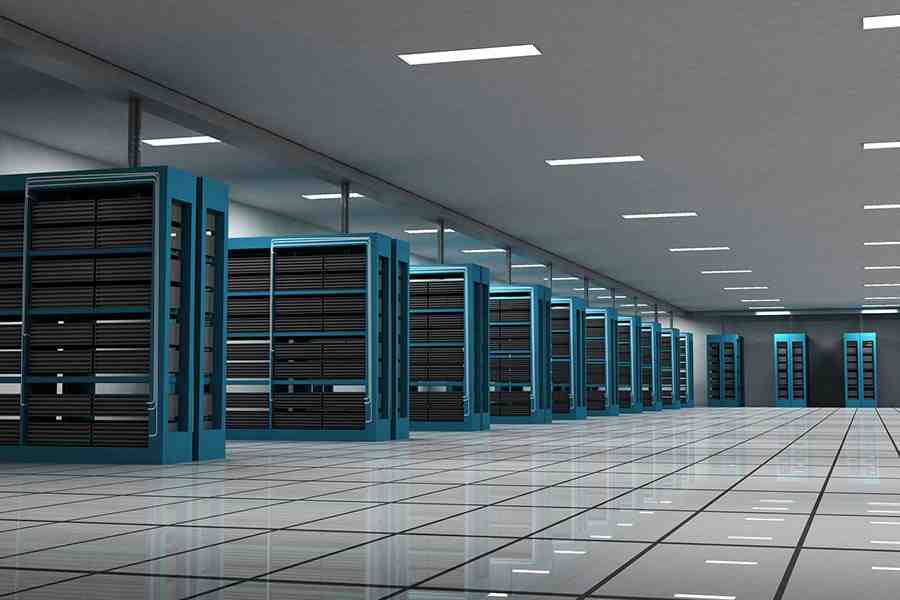
The Data Center Boom is Here
Data center build-outs are large-scale construction projects that create purpose-built facilities to house servers, networking equipment, power systems, and cooling infrastructure that support cloud computing, AI applications, and digital storage at massive scale. Here’s what you need to know:
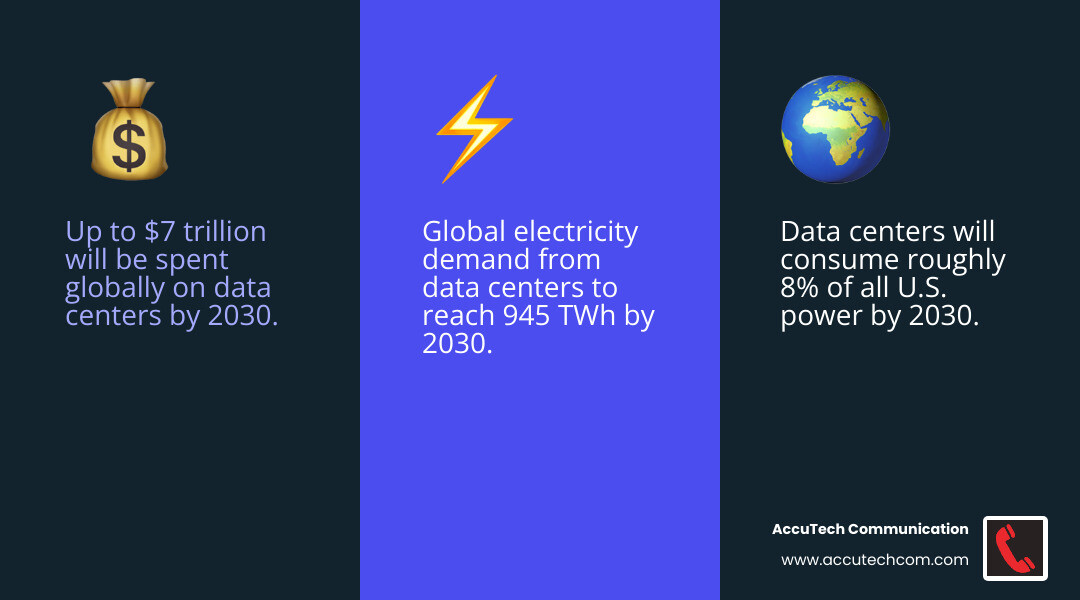
- Scale of Investment: Up to $7 trillion will be spent globally on data centers by 2030
- Construction Timeline: A typical build takes 18-30 months from concept to commissioning
- Cost Range: $8-12 million per megawatt of IT load, or $600-$1,100 per square foot
- Energy Impact: Data centers will consume roughly 8% of all U.S. power by 2030
- Key Types: Hyperscale (20-100+ MW), Colocation (1-20 MW), Enterprise (0.5-10 MW), Edge (50 kW-1 MW)
- Primary Drivers: AI workloads, cloud computing expansion, and exponential data growth
The unseen forces of AI and cloud computing are driving a construction boom as tangible as bricks and mortar. Companies are predicted to spend $375 billion in 2025 on AI infrastructure alone—a 67% surge from last year. This isn’t just about tech giants anymore. The demand for compute power is reshaping entire communities, with nearly 1% of U.S. counties now accounting for 72% of all data center activity.
But this digital gold rush comes with serious challenges. Power and land constraints threaten to slow growth. Supply chain issues, labor shortages, and permitting delays can derail projects worth billions. The electricity demand from data centers worldwide is set to more than double by 2030, reaching around 945 TWh—comparable to Japan’s entire energy consumption.
For businesses relying on robust network infrastructure, understanding data center build-outs matters because your digital services depend on these facilities. Whether you’re evaluating colocation options, planning edge computing deployments, or simply ensuring your organization’s connectivity is future-proof, the data center boom directly impacts your operational capabilities.
I’m Corin Dolan, and over my 30+ years at AccuTech Communications, I’ve witnessed the evolution of network infrastructure firsthand, from simple cabling installations to complex data center build-outs that demand precision, scalability, and unwavering reliability. That experience has shown me that successful data center projects require meticulous planning, adherence to standards, and expert partners who understand both the technology and the business implications.
Similar topics to data center build-outs:
The Driving Force: Why the Unprecedented Expansion?
The digital world’s insatiable hunger for data is driving an unprecedented expansion in data center infrastructure. From the smallest businesses in Massachusetts to the largest enterprises in New Hampshire, the need to store, process, and access information instantly is constant. This demand is fueled by several interconnected factors, creating a massive wave of data center build-outs across the globe, including here in New England.
At the heart of this expansion are the staggering projections for investment. Up to $7 trillion is expected to be spent on data centers by 2030, with AI demand alone requiring $5.2 trillion of that investment. This flood of capital is reshaping our digital landscape. We’re seeing a significant portion of this investment going into what McKinsey calls “The $7 trillion race to scale data centers.” This race involves various financial archetypes, including “Builders” who focus on land and site development, “Energizers” securing power, “Technology developers and designers” creating hardware, “Operators” managing the facilities, and “AI architects” optimizing the software. Each plays a crucial role in bringing these complex projects to life.
The AI Catalyst
If there’s one technology truly igniting the data center boom, it’s artificial intelligence. The rise of Generative AI and Large Language Models (LLMs) like those used by OpenAI and Google has created an insatiable demand for computational power. These advanced AI models require immense computing power, especially during their “training” phase. This is where Graphics Processing Units (GPUs) come into play, as they are uniquely suited to handle the parallel processing needed for AI workloads.
But it’s not just training. Once trained, these models still need significant compute power for “inference”—the process of applying the AI model to new data to make predictions or generate content. As AI becomes more integrated into our lives, from personalized learning to automated customer service, the demand for both training and inference compute power will only grow. This means data centers must be designed for incredibly dense, power-hungry equipment, a challenge we at AccuTech Communications are well-versed in addressing through robust cabling and infrastructure solutions.
Economic and Community Impact
The influx of investment into data center build-outs brings a mixed bag of economic and community impacts. These massive projects generate significant job creation. During construction, thousands of skilled trade workers, including electricians and construction workers, are needed. Once operational, data centers require a smaller, but highly specialized, workforce for maintenance and technical operations. These facilities also contribute substantial tax revenue to local communities, which can fund schools, public services, and infrastructure improvements.
However, the rapid pace of development isn’t without its challenges. Data centers are enormous consumers of local resources, particularly power and water. This can strain existing infrastructure and lead to concerns among residents about resource availability and cost. There’s also the potential for land value speculation, which can drive up housing costs and change the character of communities. While data centers can be economic boons, thoughtful planning and community engagement are essential to ensure benefits are equitably distributed and potential detriments are mitigated.
Anatomy of a Modern Data Center: Types and Tiers
At its core, a data center is the physical manifestation of our digital world—a specialized building designed to house the critical IT infrastructure that stores, processes, and transmits vast amounts of data. Think of it as the brain and nervous system of our connected lives, handling everything from daily transactions to complex scientific research.
The core functions of a data center revolve around providing a secure, stable, and high-performance environment for IT equipment. This includes a robust physical infrastructure with countless servers and networking equipment to store, process, and analyze information. Crucially, these facilities are engineered with sophisticated power and cooling systems to ensure uninterrupted operation and optimal performance.
Data Center Models Explained
Different data needs require different types of data centers designed to meet them. Understanding these models is crucial for anyone considering a data center build-out.
| Type of Data Center | Scale (IT Load) | Primary Purpose | Construction Needs |
|---|---|---|---|
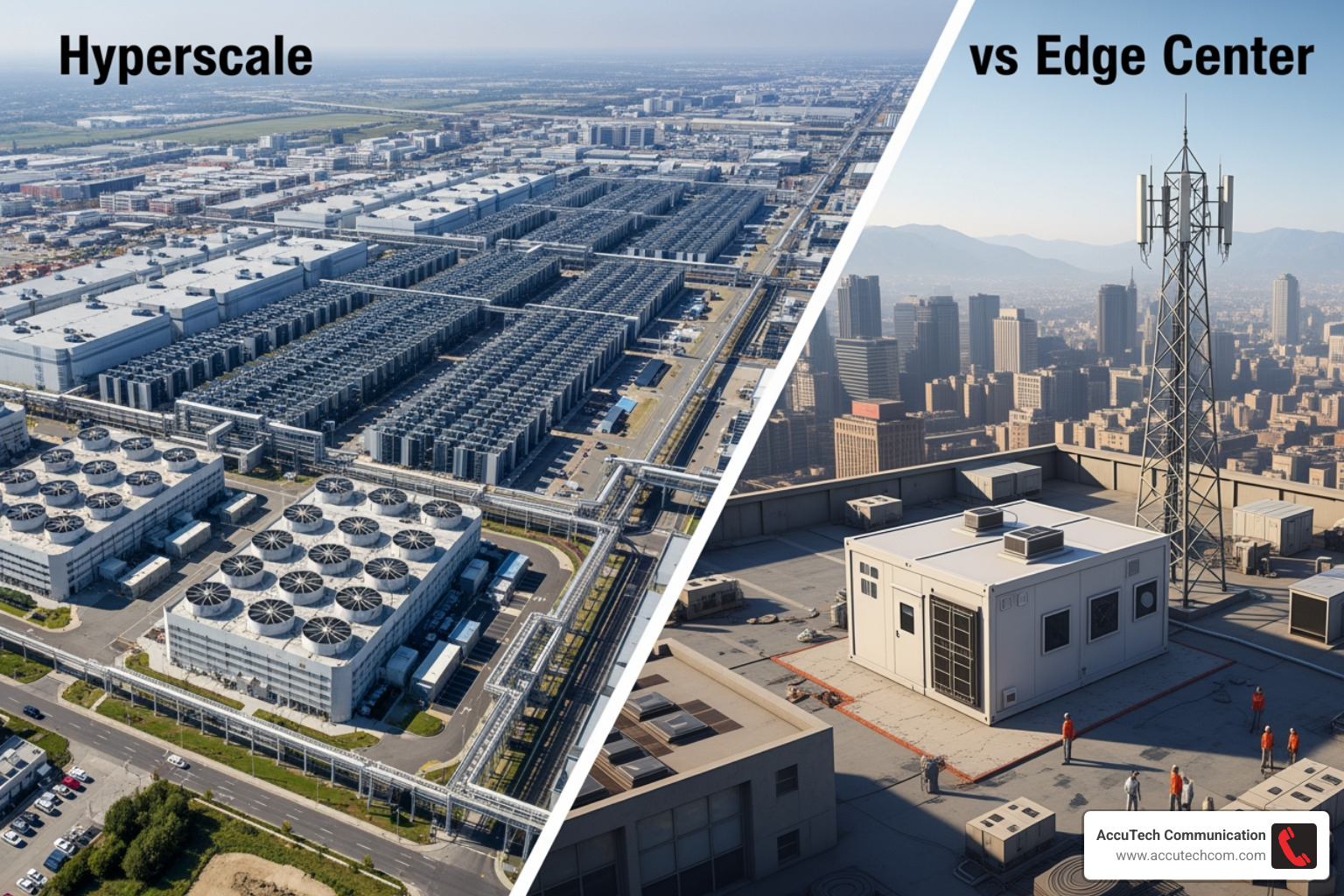
| Hyperscale | 20-100+ MW | Cloud platforms, AI systems, heavy computing | Massive scale, highly specialized, often custom-built, extreme power/cooling density |
| Colocation | 1-20 MW | Shared space for multiple tenants, leased racks/suites | Modular, flexible, robust shared infrastructure, varying redundancy levels |
| Enterprise | 0.5-10 MW | Single organization’s specific internal IT needs | Custom to specific business, internal policies, and risk thresholds |
| Edge | 50 kW-1 MW | Bring compute closer to users/devices for low latency | Compact, often modular, situated near end-users, optimized for connectivity |
Hyperscale data centers are the giants of the industry, typically housing more than 5,000 file servers. These are the facilities built by tech titans (like major cloud providers) to power their global platforms and AI initiatives. They demand massive scale, extreme power and cooling density, and highly specialized construction.
Colocation facilities offer a flexible alternative where multiple businesses lease space—from a single rack to entire suites—within a shared, purpose-built data center. This allows companies to leverage enterprise-grade infrastructure without the massive capital expenditure of building their own. For many businesses in Massachusetts, New Hampshire, and Rhode Island, colocation offers a scalable, cost-effective solution.
Enterprise data centers are built and owned by a single organization for its specific internal IT needs. These facilities are custom to the company’s unique policies, security requirements, and risk thresholds, offering complete control.
Finally, Edge data centers are smaller, compact facilities situated closer to end-users or specific activities, reducing latency for applications like autonomous vehicles, real-time analytics, or IoT devices. They bring compute power closer to where data is generated and consumed.
Understanding Data Center Tiers
When we talk about data center reliability, we often refer to the Uptime Institute’s Tier Standards. These tiers (I, II, III, and IV) provide a standardized way to classify a data center’s infrastructure based on its uptime guarantees and redundancy levels.
- Tier I (Basic Capacity): Offers single-path for power and cooling, no redundancy, susceptible to planned and unplanned outages.
- Tier II (Redundant Capacity Components): Single-path but with some redundant components, allowing for slightly better uptime than Tier I.
- Tier III (Concurrently Maintainable): Multiple independent paths for power and cooling, allowing for planned maintenance without downtime. This tier requires N+1 redundancy.
- Tier IV (Fault Tolerant): Multiple independent active power and cooling paths, with 2N redundancy, meaning any single component can fail without impacting operations. This is the gold standard for continuous availability.
Achieving higher tiers involves significantly greater complexity and cost. For example, a Tier IV facility can cost 25% to 40% more than a Tier III due to the stringent redundancy requirements. For businesses in our region, understanding these tiers is crucial for matching operational needs with the right level of infrastructure resilience.
The Blueprint for Successful Data Center Build-Outs
Starting on a data center build-out is a monumental undertaking, akin to building a small city dedicated to data. It’s a complex, multi-disciplinary capital project with high stakes, tight specifications, and zero room for delays. At AccuTech Communications, we understand that this journey, from the initial concept to the final commissioning, requires meticulous planning and execution.
A full data center build typically takes 18 to 30 months from concept to commissioning. This timeline encompasses several critical stages:
- Planning and Feasibility: Defining requirements, assessing risks, and financial modeling.
- Design and Engineering Development: Creating detailed architectural, electrical, mechanical, and network designs.
- Procurement and Long-Lead Equipment Strategy: Ordering specialized equipment, often with lead times of 36-48 weeks.
- Civil Works and Shell Construction: Building the physical structure.
- MEP (Mechanical, Electrical, Plumbing) Installation and System Integration: Installing critical power, cooling, and fire suppression systems.
- Testing, Commissioning, and Final Handover: Rigorous testing to ensure all systems perform as designed, simulating live loads and fault scenarios.
Each stage is critical, and delays in one can cascade through the entire project, leading to significant cost overruns.
Critical Site Selection Factors
Choosing the right location for a new data center is arguably one of the most important decisions, impacting everything from operational costs to long-term scalability. For our clients in Massachusetts, New Hampshire, and Rhode Island, we emphasize several key factors:
- Power Availability and Grid Stability: Data centers are power hogs. Access to a robust, reliable, and affordable power supply is non-negotiable. Grid stability is crucial to avoid costly outages.
- Network and Fiber Connectivity: Proximity to major fiber optic networks ensures high-speed, low-latency data transmission, which is vital for both internal operations and connecting to the outside world.
- Water Access for Cooling: Many cooling systems rely on substantial amounts of water. Access to a sustainable water source, or the ability to implement advanced water-efficient cooling, is key.
- Geographic and Environmental Risks: We assess risks from natural disasters like floods, hurricanes, or seismic activity. A stable climate and low risk of natural disruptions are preferred.
- Proximity to Users/Talent: For edge data centers, proximity to end-users is paramount for low latency. For all data centers, access to a skilled workforce for construction and operations is important.
- Permitting Environment: A streamlined and predictable local permitting process can significantly impact project timelines and costs. We help clients steer these complexities in our region.
Design, Cabling, and Construction
Once a site is selected, the intricate process of design and construction begins. Architectural design must not only meet functional requirements but also consider security, scalability, and efficiency. Electrical and mechanical systems are the lifeblood of the data center, providing redundant power, precise climate control, and advanced fire suppression.
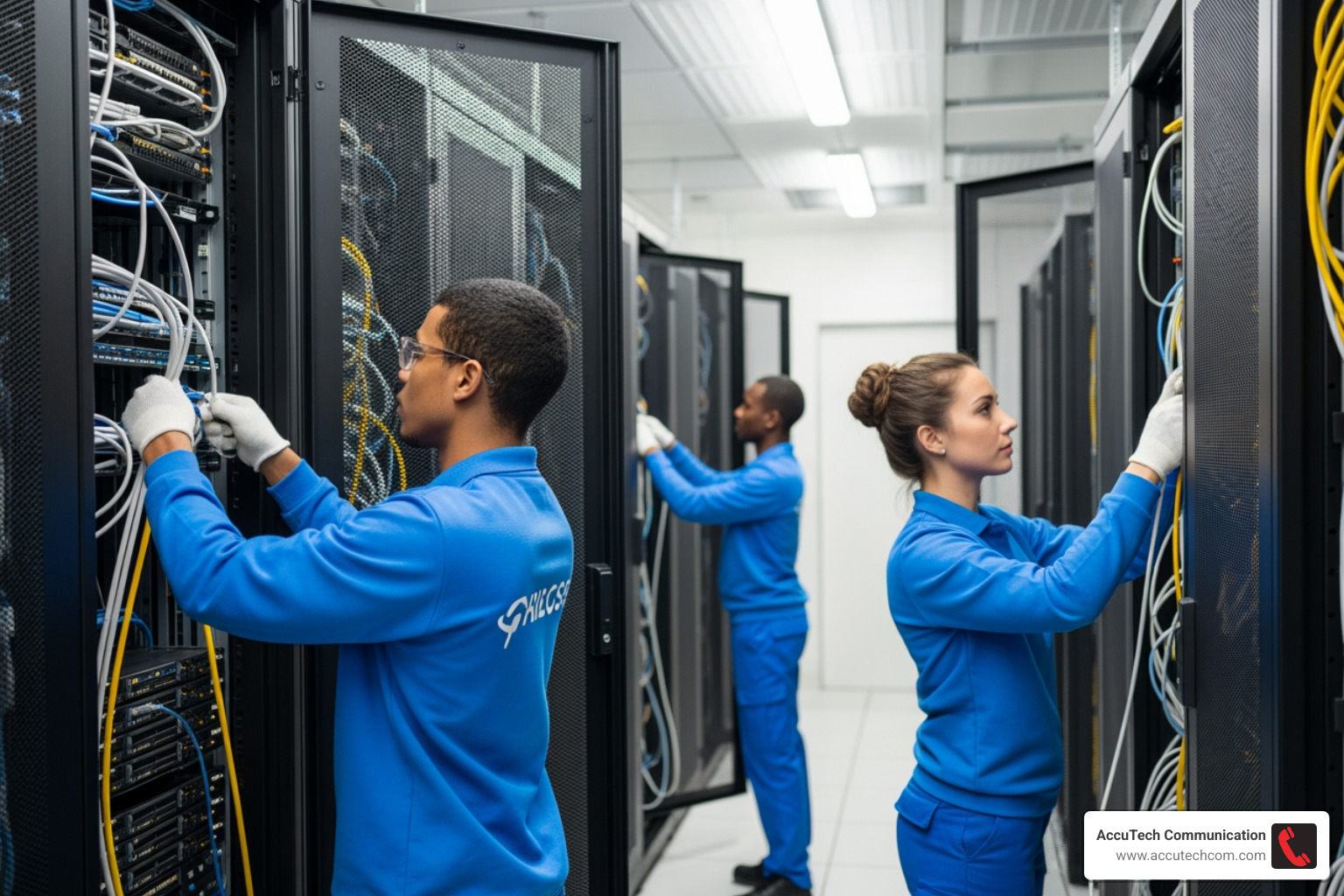
However, often overlooked, but absolutely critical, is the cabling infrastructure. We like to say that cabling is the “nervous system” of any data center. A well-designed cabling system ensures optimal performance, reliability, and scalability. That’s why we offer more info about structured cabling services, which provide a standardized and organized approach to data center connectivity. Structured cabling simplifies management, improves airflow, and allows for easier upgrades and troubleshooting.
For high-speed, low-latency requirements, fiber optic cabling is often the preferred choice. Fiber transmits data using light pulses, delivering ultra-high-speed transfers (100G to 800G and beyond) with near-zero latency, making it ideal for AI, machine learning, and big data analytics. You can find more info about fiber optic cabling installation on our site. While fiber dominates for high-bandwidth backbones, high-speed copper cabling (like Cat8) still plays a valuable role for shorter connections within racks. Most modern data centers employ a hybrid approach, leveraging the strengths of both.
Key Standards and Certifications for your data center build-outs
To ensure the quality, reliability, and performance of a data center, adherence to industry standards and certifications is paramount. These guidelines provide a framework for design, construction, and operation, ensuring that facilities meet specific criteria for uptime, efficiency, and security.
Key standards include:
- Uptime Institute Tier Standards (I-IV): As discussed, these define the level of redundancy and fault tolerance.
- ASHRAE TC 9.9 Guidelines: These set the recommended temperature and humidity ranges for optimal IT equipment operation, crucial for maintaining hardware health and efficiency.
- ISO 50001 (Energy Management): Focuses on establishing systems and processes to improve energy performance, including efficiency, use, and consumption.
- NFPA 75 (Fire Protection for IT Equipment): Provides guidelines for fire safety specifically within IT equipment areas.
- IEC 60364 (Low-Voltage Electrical Installations): Ensures the safe installation and maintenance of electrical systems.
- ISO 27001 and PCI DSS (Physical Security): Outline best practices for information security management and physical access control, critical for protecting sensitive data.
For businesses in Massachusetts, New Hampshire, and Rhode Island, pursuing these certifications demonstrates a commitment to operational excellence, reliability, and security. They are not just badges of honor; they are proof of a carefully planned and executed data center build-out.
Navigating the Gauntlet: Major Challenges and Risks
The promise of AI and cloud computing is bright, but the path to building the supporting infrastructure is fraught with risks that can derail data center build-outs, inflate costs, and delay deployment.
Building a data center is a complex undertaking with tight specifications, where any deviation can lead to significant cost overruns and delays. From unexpected site conditions to equipment failures, the journey from concept to commissioning is rarely smooth.
Power and Resource Scarcity
Perhaps the most pressing challenge is the soaring demand for energy and water. Data centers are incredibly power-intensive. According to Goldman Sachs, data centers will use roughly 8% of all U.S. power by 2030, and U.S. utilities will need to invest around $50 billion in new generation capacity to support them. This dramatic increase in electricity demand, projected to more than double globally by 2030 to around 945 TWh, places immense strain on existing power grids. In many areas, including potentially in our New England states, grid capacity cannot keep pace with demand, leading to delays in connecting new facilities.
Water consumption is another growing concern. Data centers require significant amounts of water for cooling, with some facilities consuming as much as 500,000 gallons per day. This can be a substantial draw on local water resources, especially in communities where clean water is already in short supply. This creates a critical need for innovative, water-conserving cooling solutions in every new data center build-out.
Supply Chain, Labor, and Policy Problems for data center build-outs
The physical construction of data centers relies on a global supply chain that has faced significant disruptions. Critical components like copper, steel, and aluminum are needed in massive quantities. Geopolitical factors, including tariffs, can dramatically raise material prices. For instance, tariffs on copper have been as high as 50%, and on steel and aluminum between 25% to 50%, directly impacting construction costs. Similarly, the costs of imported semiconductors and electronic equipment have seen increases, creating further financial pressure.
Labor shortages are another critical bottleneck. There aren’t enough skilled electricians in the U.S. to meet the demand for installing complex electrical systems in these facilities. Beyond electricians, there are also shortages of construction workers generally. This scarcity of skilled labor can lead to increased costs and project delays.
Finally, navigating the permitting and regulatory landscape can be a lengthy process. Obtaining state and local permits involves mandated checks for environmental impact, worker safety, and community well-being. These necessary processes can be time-consuming, making efficient project management and proactive engagement with local authorities essential for any data center build-out in Massachusetts, New Hampshire, or Rhode Island.
Mitigating Operational and Environmental Risks
Data centers face numerous operational and environmental risks that must be managed to ensure continuous uptime. Natural disasters, such as severe weather events common in New England, pose major threats. Fire suppression systems are critical, especially given the density of IT equipment and the use of lithium-ion batteries in server racks. Physical and cybersecurity measures are also paramount to protect the data and the facility.
To manage these risks effectively, we emphasize several strategies:
- Proactive Planning: Order long-lead equipment (generators, UPS systems, chillers) early to mitigate supply chain delays.
- Rigorous Change Control: Maintain tight change control to prevent scope creep, which leads to budget overruns and schedule delays.
- Comprehensive Testing: Conduct thorough testing and commissioning across all systems to verify performance.
- Site Selection: Carefully choose sites that minimize exposure to natural disasters and have robust infrastructure.
- Redundancy: Implement N+1 or 2N redundancy in critical systems to ensure operations continue if a component fails.
- Contingency Planning: Build buffer days into schedules for potential disruptions and include risk-adjusted contingency in budgets.
By integrating these strategies, we help our clients in Massachusetts, New Hampshire, and and Rhode Island build resilient and reliable data centers.
The Future is Now: Emerging Trends in Data Center Construction
The landscape of data center construction is constantly evolving, driven by the relentless pursuit of efficiency, sustainability, and the ever-growing demands of AI. We are seeing exciting emerging trends that are reshaping how data center build-outs are conceived, designed, and operated.
One of the most significant shifts is towards liquid cooling technologies. As AI workloads demand increasingly dense and powerful hardware, traditional air cooling struggles to keep up. We’re also seeing a rise in modular and prefabricated builds, which can significantly shorten construction timelines and improve quality control. On-site power generation and the deep integration of renewable energy sources are becoming standard, reducing reliance on strained grids and meeting sustainability goals. Furthermore, AI itself is being leveraged for operational efficiency, optimizing everything from power distribution to predictive maintenance. Finally, there’s a growing interest in waste heat reuse, changing what was once a byproduct into a valuable resource.
Innovations in Cooling and Efficiency
The sheer heat generated by modern AI processors is pushing the boundaries of traditional cooling. This has led to rapid innovation in cooling technologies:
- Direct-to-chip liquid cooling: This involves circulating a dielectric fluid directly over the hot components, such as GPUs and CPUs, capturing heat much more efficiently than air.
- Immersion cooling: Servers are submerged in a non-conductive liquid, providing highly effective and uniform cooling across all components.
- Closed-loop systems: These advanced cooling systems minimize water consumption by recirculating cooling fluids, significantly reducing the data center’s Water Usage Effectiveness (WUE). This is particularly important in regions facing water scarcity.
- Microfluidics: This cutting-edge field explores the precise control and manipulation of fluids at the microscale, offering potential for even more efficient and localized cooling solutions in the future.
These advancements are crucial for managing the power density required by AI workloads and improving the overall Power Usage Effectiveness (PUE) of data centers.
The Rise of Sustainable and Smart Builds
Sustainability is no longer an optional extra; it’s a core requirement for modern data center build-outs. This has led to a surge in green data centers that prioritize environmental responsibility.
- Renewable Energy Integration: Data centers are increasingly powered by renewable sources. This includes direct connections to wind and solar farms, as well as entering into Power Purchase Agreements (PPAs) with renewable energy providers. There’s even a growing interest in small modular reactors (SMRs) as a potential source of clean, reliable, on-site power for future hyperscale facilities.
- AI-driven Energy Management: AI itself is becoming a tool for sustainability. AI-powered systems can analyze vast amounts of operational data to optimize energy consumption, predict maintenance needs, and manage cooling systems more efficiently, helping to reduce the overall carbon footprint.
- Modular and Prefabricated Construction: These methods involve building components or even entire data center modules off-site in a controlled environment. This not only speeds up construction but also reduces waste and improves quality, contributing to a more sustainable build.
- Waste Heat Reuse: Instead of simply venting hot air into the atmosphere, innovative projects are exploring ways to capture and reuse waste heat from data centers to heat nearby buildings, greenhouses, or even for district heating systems.
These trends highlight a shift towards a more responsible and intelligent approach to data center development, ensuring that our digital future is not built at the expense of our planet.
Conclusion
The data center build-outs we’re witnessing today represent a complex, high-stakes race to build the foundational infrastructure for our AI-driven future. From the massive investments and rapid expansion to the intricate engineering and significant environmental considerations, every aspect demands careful attention. It’s a journey that requires balancing the imperative for speed and capacity with an unwavering commitment to sustainability, efficiency, and community well-being.
For businesses in Massachusetts, New Hampshire, and Rhode Island, ensuring the reliability of your network infrastructure is paramount. As the digital landscape continues to evolve at breakneck speed, having expert partners who understand the nuances of data center design, construction, and cabling is more critical than ever. At AccuTech Communications, we bring decades of experience in delivering certified, reliable service with a commitment to quality. Our expertise in network cabling, structured cabling, and fiber optic installation ensures that your data center infrastructure is not just built, but built to last and to perform at its peak.
We believe that the future of data centers lies in smart, sustainable, and carefully planned data center build-outs. We are ready to help you steer this complex terrain, ensuring your digital backbone is robust, efficient, and future-ready.
Learn more about our comprehensive data center build-out services