
Why Your Business Needs Professional Structured Cabling
In the commercial landscape of Massachusetts and New Hampshire, your network is only as strong as the wires connecting it. Many business owners view cabling as an afterthought, but the reality is that network cabling can account for upwards of 80% of a network’s efficiency, as noted in industry resources such as USTelecom’s overview of structured cabling. If your foundation is shaky, even the most expensive servers and switches won’t save you from lag and dropped connections.
When we talk about structured cabling services, we are referring to a standardized way of organizing your entire communication infrastructure. According to the structured cabling definition, this isn’t just “running wires”; it’s a planned system that handles data, voice, and video through a series of integrated subsystems.
For 25% of businesses, one hour of network downtime can cost as much as $400,000. In sectors like Boston’s thriving biotech and healthcare industries, where data integrity and 24/7 uptime are non-negotiable, a professional installation is a form of insurance. By investing in a high-quality structured cabling solution, we help you minimize the risk of human error and hardware failure.
Furthermore, professional cabling provides:
- Scalability: As your company grows from 10 employees to 100, a structured system allows for “plug-and-play” expansion without rewiring the entire building.
- Future-Proofing: Technology changes rapidly. We install systems designed to handle the bandwidth requirements of 2026 and beyond.
- Reduced Downtime: Organized, labeled cables make troubleshooting a breeze. No more “spaghetti” messes behind the server rack.
Core Components of Structured Cabling Services Boston

Choosing the right “pipe” for your data is the most critical decision in the design phase. We typically categorize these into copper and fiber optic solutions, each serving a specific purpose within your building’s architecture.
Copper Cabling: Cat6 vs. Cat6a
For most horizontal cabling (the wires running from the telecommunications closet to individual desks), copper is the standard.
- Cat6: Supports speeds up to 1 Gbps and is excellent for standard office environments.
- Cat6a: The “a” stands for augmented. It supports 10 Gbps speeds at longer distances and offers superior protection against crosstalk (interference). We often recommend Cat6a for modern offices in Cambridge and Boston that handle large data transfers.
Fiber Optic Cabling
When you need to connect different floors or separate buildings, fiber optic is the gold standard. Fiber optic cabling installation uses light signals rather than electrical pulses, allowing for incredible speed and bandwidth over long distances. It is also immune to electromagnetic interference, making it ideal for manufacturing plants in towns like Worcester or Billerica where heavy machinery is present.
Subsystems of a Complete Build
A comprehensive data cabling installation complete guide identifies several key areas we address:
- Backbone Cabling: The “trunk” of the tree that connects entrance facilities, equipment rooms, and telecommunications closets.
- Horizontal Cabling: The “branches” that extend to the work areas.
- Telecommunications Closets: The hubs where hardware and cabling terminations reside.
| Feature | Cat6 Copper | Cat6a Copper | Fiber Optic |
|---|---|---|---|
| Max Data Rate | 1 Gbps | 10 Gbps | 10 Gbps – 100 Gbps+ |
| Max Distance | 100 Meters | 100 Meters | Up to 40 Kilometers |
| Interference | Moderate | Low | None (Immune) |
| Best Use Case | Small Offices | High-Performance Workstations | Backbones & Data Centers |
The Installation Process and Industry Standards
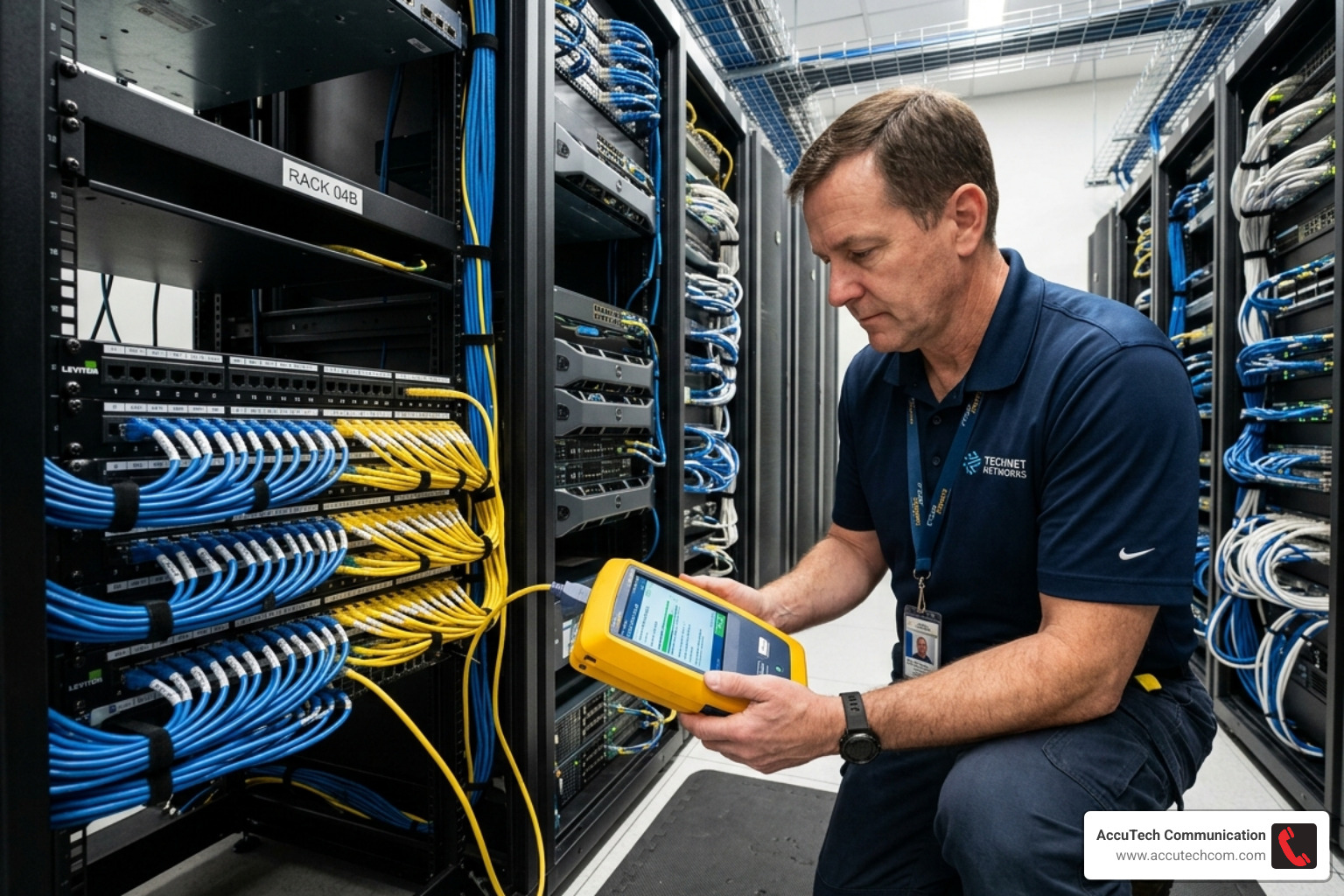
At AccuTech Communications, we don’t just pull cable and hope for the best. Every project follows a rigorous structured cabling installation workflow to ensure compliance with international standards like ANSI/TIA/EIA-568. These standards dictate everything from the bend radius of the cable to how much the pairs can be untwisted at the termination point.
The Site Survey
Before a single cable is run, we conduct a thorough site survey. This helps us identify potential obstacles, determine the best paths for cable runs, and ensure we have adequate cooling and power in your server rooms. For clients in the Greater Boston area, this step is vital for staying on schedule and avoiding “ugly surprises” mid-project.
Labeling and Documentation (606-B)
We adhere to the 606-B labeling standard. This means every single cable, xpatch panel, and faceplate is clearly labeled with machine-generated tags that won’t scratch off. When your IT team needs to move a printer three years from now, they’ll know exactly which port to activate without playing a guessing game.
Testing and Certification
Once the installation is complete, we use advanced Level IV certification tools to test every link. We verify that the cables meet or exceed the required performance specifications for their category. We then provide you with a full documentation package, including test results and “as-built” drawings, which are essential for future maintenance or relocations.
Choosing the Right Contractor in Massachusetts and New Hampshire
Not all cabling contractors are created equal. In an industry where much of the work is hidden behind walls and above ceiling tiles, you need a partner you can trust to do the job right the first time.
Why Certifications Matter
When evaluating structured cable contractors, look for the following:
- BICSI Certification: This is the industry’s premier association for IT infrastructure.
- RCDD Designers: A Registered Communications Distribution Designer has reached the highest level of knowledge in the design and implementation of telecommunications systems.
- Manufacturer Certifications: Being a certified installer for major manufacturers allows us to offer extended warranties—often 15 to 25 years—on the system’s performance.
Commercial Expertise
Commercial environments have unique requirements. Whether it’s navigating the strict building codes of a historic building in downtown Boston or coordinating with other trades in a new construction project in Manchester, NH, experience matters. Since 1993, we have provided network cabling services that prioritize clean aesthetics and technical precision. We understand the “MEP” (Mechanical, Electrical, Plumbing) coordination required to ensure your data lines aren’t draped over fluorescent lights or wrapped around hot water pipes—mistakes that DIY or inexperienced installers often make.
Frequently Asked Questions about Structured Cabling
How much do structured cabling services Boston typically cost?
While we provide customized quotes based on your specific building layout and needs, many businesses look for general benchmarks during the planning phase. Based on industry averages and online data, the cost for structured cabling services Boston typically ranges from $115 to $550 per drop.
Please note that these figures are average costs sourced from publicly available internet data and are not the actual prices of AccuTech Communications. Factors that influence the final price include:
- Cable Type: Cat6a and fiber optic materials are more expensive than standard Cat6.
- Building Architecture: Running cable through an open-ceiling warehouse is generally faster and less expensive than fishing wires through the finished walls of a high-rise office.
- Labor: Complex commercial data cabling projects requiring union labor or after-hours work to minimize downtime will see higher labor costs.
What are the benefits of professional structured cabling services Boston?
The primary benefit is long-term ROI. While a professional install has an upfront cost, it prevents the massive financial drain of network outages. As mentioned earlier, one hour of downtime can cost $400,000 for some firms.
Hiring professional structured cabling installation contractors ensures that your infrastructure is organized and easy to manage. This organization significantly reduces the “mean time to repair” (MTTR). If a port goes down, your IT staff can identify and fix the issue in minutes rather than hours spent untangling a “rat’s nest” of unlabeled wires.
Which industries in the Boston area require structured cabling?
We service a diverse range of clients across Massachusetts, Rhode Island, and New Hampshire. Some of the most common sectors include:
- Biotech and Life Sciences: Labs in Cambridge and Lexington require high-speed fiber backbones to move massive genomic data sets.
- Healthcare: Hospitals and clinics need reliable structured cabling services in Boston to support telemetry, nurse call systems, and electronic health records.
- Manufacturing: Facilities in the 495 corridor use specialized cabling to connect IoT sensors and industrial control systems.
- Data Centers: We specialize in data center build-outs, ensuring that high-density environments have the airflow and cable management necessary for peak performance.
Conclusion
Your network is the lifeblood of your business. From the initial site survey to the final certification test, AccuTech Communications is committed to providing the most reliable structured cabling services Boston has to offer. Since 1993, we have helped businesses across Massachusetts, New Hampshire, and Rhode Island build the foundations they need to succeed in a digital-first world.
Don’t let poor wiring hold your company back. Whether you are moving into a new office in Quincy, upgrading a lab in Waltham, or building out a data center in Providence, we have the expertise to get the job done right.
Additional Resources for Your Infrastructure:
