In-Depth Guide to Data Center Maintenance

Why Data Center Maintenance Determines Whether Your Business Stays Online
Data center maintenance is the ongoing practice of inspecting, testing, and servicing the physical and electrical systems that keep your critical IT infrastructure running, and for businesses across Massachusetts, New Hampshire, and Rhode Island, getting it right is the difference between smooth operations and costly, unplanned downtime.
Here’s what data center maintenance covers at a glance:
- Power systems: UPS units, generators, PDUs, and battery testing
- Cooling systems: CRAC/CRAH units, chillers, airflow management, and humidity control
- IT hardware, servers, storage, and networking equipment
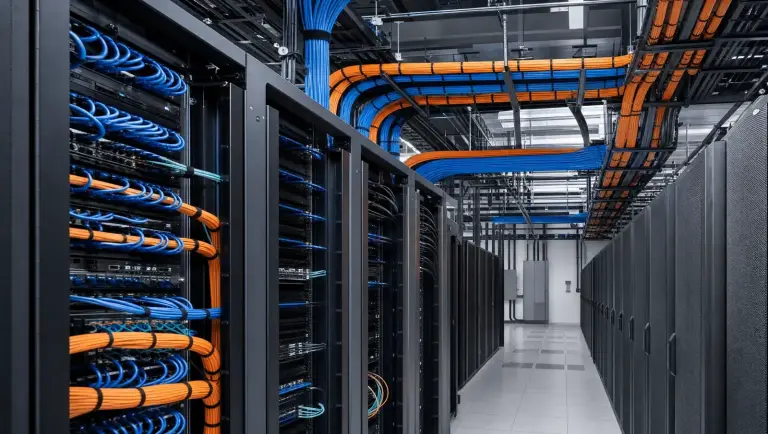
- Cabling infrastructure, structured cabling, fiber, and cable management systems
- Environmental monitoring, temperature sensors, leak detection, and air quality
- Fire suppression, clean agent systems, pre-action sprinklers, and detectors
- Physical security, access control, cabinet-level locks, and audit documentation
- Software and compliance, patching, CMMS platforms, and regulatory recordkeeping
The stakes are high. Power issues alone account for roughly 52% of all data center downtime, and a single cooling failure can push rack temperatures past safe limits in under four minutes. According to industry data, 70% of outage incidents cost $100,000 or more, with 25% exceeding $1 million.
This isn’t routine facility upkeep. It’s a disciplined, systems-level discipline that directly protects your revenue, your SLAs, and your customers’ trust.
I’m Corin Dolan, owner of AccuTech Communications, and I’ve spent decades helping commercial clients across New England design, install, and maintain the infrastructure that data center reliability depends on, including structured cabling, cable management, and data center buildouts. That hands-on experience with data center maintenance infrastructure informs everything in this guide.
Data center maintenance terms to remember:
What is Data Center Maintenance and Why is It Critical?
At its core, data center maintenance is the comprehensive process of monitoring, inspecting, servicing, and repairing the physical and logical assets that keep a data center functional. In today’s hyper-connected business environment, your data center is the heart of your commercial operations. Whether you run a private enterprise data hall in Worcester, MA, or operate a colocation space in Providence, RI, keeping your systems running at peak performance is essential.
Effective maintenance ensures business continuity by preventing the hardware and infrastructure failures that cause costly service interruptions. It also protects your organization from high financial penalties associated with Service Level Agreement (SLA) breaches. When your clients expect “five-nines” (99.999%) uptime, there is simply zero margin for error.
A structured maintenance program also helps maximize the lifespan of your expensive capital assets. Modern data centers cost between $7 million and $12 million per megawatt to construct. Proactive upkeep protects this massive investment, ensuring that your power, cooling, and structural assets perform efficiently throughout their intended lifecycle. To achieve this level of operational reliability, facilities must be built on solid foundations. For more details on establishing a resilient physical space, see our guide on data center infrastructure design.
The Financial and Operational Risks of Neglecting Data Center Maintenance
Neglecting your critical infrastructure maintenance carries catastrophic risks. When equipment is left unserviced, minor anomalies compound into major system failures. For instance, power issues were responsible for roughly 52% of data center downtime in 2023. A single loose electrical connection or a neglected UPS battery can trigger a cascade of breaker trips, shutting down entire server rows in an instant.
Cooling neglect is equally dangerous. In modern high-density server environments, racks can easily push 30 kW to 50 kW of heat. If a Computer Room Air Conditioner (CRAC) unit fails due to a clogged filter or a refrigerant leak, the affected data hall can reach thermal shutdown limits in under four minutes. This rapid spike in temperature causes permanent thermal stress to silicon chips, solder joints, and integrated circuits, destroying expensive server hardware and corrupting active databases.
Furthermore, poor maintenance directly translates to poor energy efficiency. Neglected cooling systems must work significantly harder to maintain target temperatures, driving up your Power Usage Effectiveness (PUE) ratio and inflating utility bills. For businesses looking to optimize their operational overhead while reducing environmental impact, proper upkeep is mandatory. You can learn more about minimizing power waste in our article on energy efficient data centers.
Core Components and Systems Requiring Regular Upkeep
A data center is an intricate ecosystem where mechanical, electrical, and digital systems depend on one another. If one link in the chain breaks, the entire facility is compromised. Therefore, a comprehensive maintenance program must address every infrastructure layer systematically.
Special attention must be paid to the physical layer. Overlooking physical cabling and rack organization is a common path to disaster. Poorly managed cables block critical exhaust pathways behind server chassis, creating localized hot spots that standard cooling units cannot reach. Over time, heavy, unmanaged cable bundles can also put physical stress on network ports, causing intermittent connectivity drops. To keep your data pathways clean and clear, read our expert advice on datacenter cable management.
Power Infrastructure and Backup Systems
The electrical distribution system is the lifeblood of your data center. Keeping the power flowing cleanly and continuously requires a strict testing and maintenance cadence for several critical components:
- Uninterruptible Power Supply (UPS) Systems: The UPS acts as the immediate bridge between utility power and your backup generators. Maintenance teams must perform quarterly inspections of battery terminals, checking for corrosion and verifying torque specifications. Crucially, an annual load bank test at 80% of rated capacity for at least 30 minutes must be conducted to ensure the battery strings can support the actual load during a transition.
- Backup Diesel Generators: Generators must be tested weekly under no-load conditions and monthly under load using an Automatic Transfer Switch (ATS). This verifies that the generator can start, reach stable operating voltage, and accept the building’s electrical load within 10 seconds of a utility outage. Fuel quality testing is also required annually to prevent fuel algae from clogging filters.
- Power Distribution Units (PDUs): Technicians should conduct quarterly infrared thermal imaging on PDU circuit breakers and electrical connections. This non-invasive test identifies high-resistance connections and “hot spots” (temperatures exceeding 40°C above ambient) before they cause an electrical fire or breaker trip.
Cooling and Environmental Control Systems
Modern silicon runs hot, making environmental control the most high-consequence system in your facility. Your maintenance program must protect specific operating parameters defined by ASHRAE TC 9.9 guidelines. For typical data halls, this means maintaining a consistent server inlet temperature of 18-27°C (64-81°F) and relative humidity levels between 20% and 80%.
To prevent cooling-related outages, maintenance teams should follow a structured routine:
- Filter Replacements: Air filters (typically MERV-8 or MERV-11) should be inspected monthly and replaced every 90 days, or sooner if differential pressure sensors indicate a 150% increase over the clean baseline.
- Coil and Condenser Cleaning: Evaporator and condenser coils must be cleaned quarterly. Dirty coils reduce heat transfer efficiency, forcing compressors to run longer and hotter, which can lead to premature compressor failure.
- Standby Unit Rotation: One of the most common mistakes is leaving redundant cooling units in standby mode indefinitely. Standby units accumulate silent maintenance deficits (such as seized fan bearings or dried-out seals). Teams must rotate active and standby units monthly to verify operational readiness.
- Refrigerant Leak Testing: Under EPA Section 608, regular leak inspections are required for systems exceeding threshold refrigerant charges. These tests must be documented meticulously to maintain environmental compliance.
Types of Data Center Maintenance and Redundancy Strategies
To build a reliable facility, you must choose the right operational strategy. Relying solely on a “break-fix” model is a recipe for operational disaster. Instead, modern facilities utilize a combination of preventive, predictive, and reliability-centered maintenance methodologies.
The application of these strategies is heavily influenced by standardized operational guidelines. Organizations throughout New England look to the BICSI 009 Data Center Operations and Maintenance Best Practices standard to establish baseline procedures for safety, governance, and system-level inspections.
| Maintenance Type | Core Methodology | Best Used For | Key Advantage |
|---|---|---|---|
| Preventive Maintenance (PM) | Calendar- or run-time-based scheduled inspections, cleanings, and parts replacements. | Filters, belts, UPS batteries, and general mechanical wear items. | Simple to schedule; significantly reduces baseline equipment failures. |
| Predictive Maintenance (PdM) | Continuous monitoring using IoT sensors, vibration analysis, and thermal imaging. | Critical fan motors, chillers, and electrical breakers. | Identifies failures weeks before they occur; avoids unnecessary maintenance. |
| Reliability-Centered Maintenance (RCM) | Analyzing system criticality to focus resources on assets that present the highest risk of outage. | Dual-path power systems, redundant cooling pumps, and core switches. | Maximizes budget efficiency by prioritizing high-consequence assets. |
Preventive, Predictive, and Reliability-Centered Data Center Maintenance
Implementing a modern maintenance program means shifting from reactive work to proactive, data-driven workflows. Under a standard preventive maintenance framework, tasks are performed on a strict, calendar-based cadence. This includes monthly filter swaps, quarterly sensor calibrations, and annual generator servicing. This disciplined approach eliminates the vast majority of common wear-and-tear failures.
However, advanced facilities supplement preventive maintenance with predictive and prescriptive technologies. By integrating real-time sensor data into a Computerized Maintenance Management System (CMMS), operators can monitor key indicators such as compressor current draw, fan motor vibration, and chilled water delta-T.
For example, if vibration analysis on a primary cooling pump shows a microscopic deviation from baseline performance, the CMMS can automatically generate a work order. This allows technicians to replace a failing bearing during a scheduled maintenance window, long before the pump seizes and triggers an emergency.
How Redundancy Levels (N+1 vs 2N) Impact Maintenance Scheduling
Your facility’s redundancy design directly dictates how and when you can perform maintenance. The Uptime Institute classifies data centers into four distinct Tiers based on their infrastructure design and fault tolerance:
- Tier I & II (Basic Redundancy): These facilities typically feature N or N+1 redundancy. Because there are single paths for power and cooling, performing major maintenance on switchgear or chillers often requires taking critical IT workloads offline. Maintenance in these environments must be scheduled during low-traffic, late-night maintenance windows.
- Tier III (Concurrently Maintainable): Tier III facilities feature redundant distribution paths (typically 2N or N+1 with independent routing). This means any critical component, including Path A UPS strings, chillers, or PDUs, can be completely isolated and shut down for maintenance without interrupting the IT load on Path B.
- Tier IV (Fault Tolerant): Featuring active-active redundant paths (2N or 2(N+1)), Tier IV facilities can withstand a major equipment failure or an unplanned maintenance event without any interruption to the data hall.
When scheduling maintenance in redundant environments, it is vital to track Path A and Path B assets as completely independent records. A work order completed on a Path A UPS must never satisfy the maintenance requirement for the Path B UPS. Each path must maintain its own strict, independent testing history to ensure that a backup path is truly ready to carry 100% of the load in an emergency.
Operational Best Practices: Safety, Vendor Management, and Technology
Operating a data center requires combining technical expertise with absolute operational discipline. Because human error accounts for up to 70% of all data center outages, establishing clear procedures, strict safety protocols, and robust software tracking is non-negotiable. To ensure your facility is set up for success from day one, it is critical to work with certified professionals during initial deployment. You can find comprehensive guidance on this phase in our data center installation complete guide.
Safety Protocols and Physical Security Integration
Working in a high-voltage, high-energy environment like a data center presents real physical hazards. Maintenance teams must strictly enforce safety standards to protect human life and maintain system integrity:
- Lockout-Tagout (LOTO): Before any technician touches electrical switchgear, UPS systems, or generator terminals, a formal LOTO procedure must be executed. This ensures that electrical circuits are completely de-energized, locked, and tagged out so they cannot be accidentally re-energized while work is underway.
- NFPA 70E Compliance: Technicians working on or near energized electrical equipment must wear appropriate Personal Protective Equipment (PPE) rated for the specific arc flash risk of that circuit.
- Physical Access Control: Maintenance activities naturally introduce external contractors into secure zones. All visitors must be logged and escorted by authorized personnel.
- Cabinet-Level Security: Modern security frameworks require tracking access down to the individual server cabinet. Integrating cabinet-level electronic locks with your access control system ensures that a technician working on Rack 12 cannot accidentally open or disrupt Rack 13.
Managing Spare Parts, Vendor SLAs, and Technology Systems
To minimize Mean Time to Repair (MTTR), organizations must manage their supply chains and vendor relationships with extreme precision:
- Virtual Parts Storeroom: For businesses operating multiple locations across Massachusetts, New Hampshire, or Rhode Island, maintaining a centralized, digital catalog of critical spare parts (such as hot-swappable power supplies, fan modules, and fiber patch cables) is highly effective. Knowing exactly which parts are in stock in Boston, MA, or Nashua, NH, prevents costly shipping delays.
- Vendor SLA Management: When outsourcing complex maintenance, such as generator overhauls or chiller servicing, ensure your contracts feature guaranteed response times (e.g., 2-hour or 4-hour on-site response). Integrate vendor portals directly with your work order management system to track performance against these SLAs.
- DCIM and BMS Integration: Modern Data Center Infrastructure Management (DCIM) and Building Management Systems (BMS) provide a single pane of glass for monitoring power, cooling, and security. These platforms automate compliance reporting, making it simple to assemble audit trails for frameworks like SOC 2, HIPAA, and PCI DSS in hours rather than weeks.
Frequently Asked Questions
How much does data center maintenance cost on average?
Note: All prices mentioned below are average industry costs sourced from publicly available internet data and do not represent the actual pricing of AccuTech Communications.
Data center maintenance costs vary widely based on the size of your facility, the complexity of your redundant systems, and the age of your equipment. On average, commercial organizations can expect to invest between $15,000 and $180,000+ annually on comprehensive maintenance contracts, emergency break-fix services, and spare parts management. Smaller, localized server rooms on the lower end of the spectrum require fewer resources, while large enterprise data halls with 2N redundancy and active-active cooling architectures will sit at the higher end of this range.
How do you perform maintenance without causing downtime?
Performing maintenance without disrupting operations requires a combination of hardware redundancy and strict change management. In a concurrently maintainable (Tier III or Tier IV) facility, technicians can safely isolate and de-energize one power or cooling pathway (Path A) while the active IT load seamlessly runs on the alternate pathway (Path B).
For facilities with single-path (N) architectures, maintenance must be scheduled during pre-approved, low-traffic maintenance windows. In these scenarios, temporary mobile generators or portable cooling units can be deployed to support the data hall while primary systems are offline, ensuring continuous data availability.
What are the key elements of a data center emergency response plan?
An effective emergency response and disaster recovery plan must include:
- Automated Failover Protocols: Immediate, tested transition of IT workloads to redundant systems or secondary disaster recovery sites.
- Emergency Generator Activation: Automated ATS transfer to backup diesel generators within 10 seconds of a utility power drop.
- Clear Communication Chains: Pre-defined notification lists, escalation paths, and designated roles for facilities staff, IT operations, and external vendors.
- Disaster Recovery Runbooks: Step-by-step, printed procedures for manually overriding automated systems, re-routing network traffic, and safely shutting down non-essential equipment if systems fail.
Conclusion
A successful data center maintenance program is not a series of reactive fixes, it is a proactive, highly disciplined strategy that protects your business’s digital foundation. From testing backup generators to maintaining clean fiber optic connections and structured cabling, every detail directly impacts your bottom line.
Since 1993, AccuTech Communications has provided reliable and competitively priced network cabling, business phone systems, and data center technologies for commercial clients throughout Massachusetts, New Hampshire, and Rhode Island. Our commitment to quality ensures your critical infrastructure is built to perform and easy to maintain.
Ready to optimize your data center’s physical infrastructure or plan your next deployment? Request an estimate for data center build-outs with AccuTech Communications today, and let our team help you achieve unwavering operational reliability.