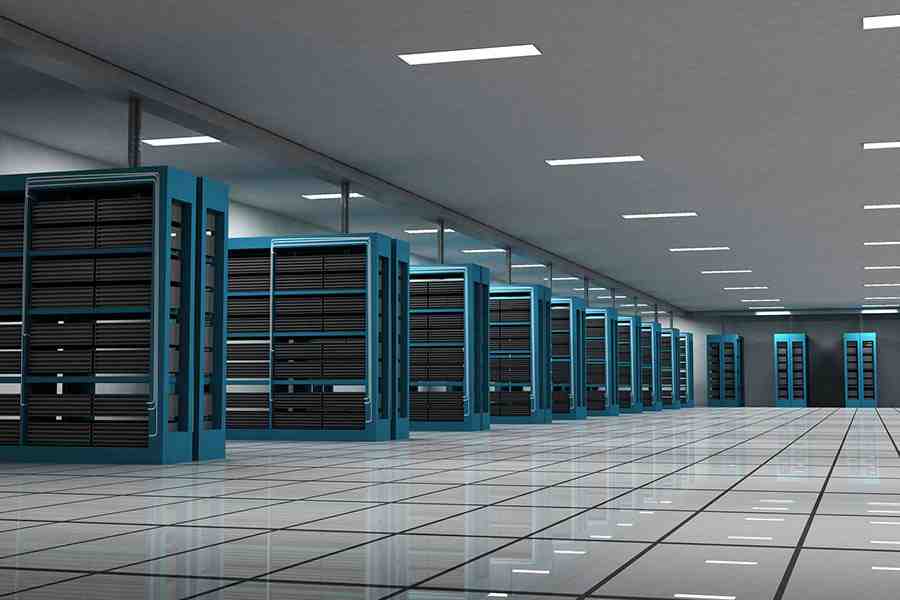
Why Every Commercial Facility Needs a Data Center Build Out Checklist Before Breaking Ground
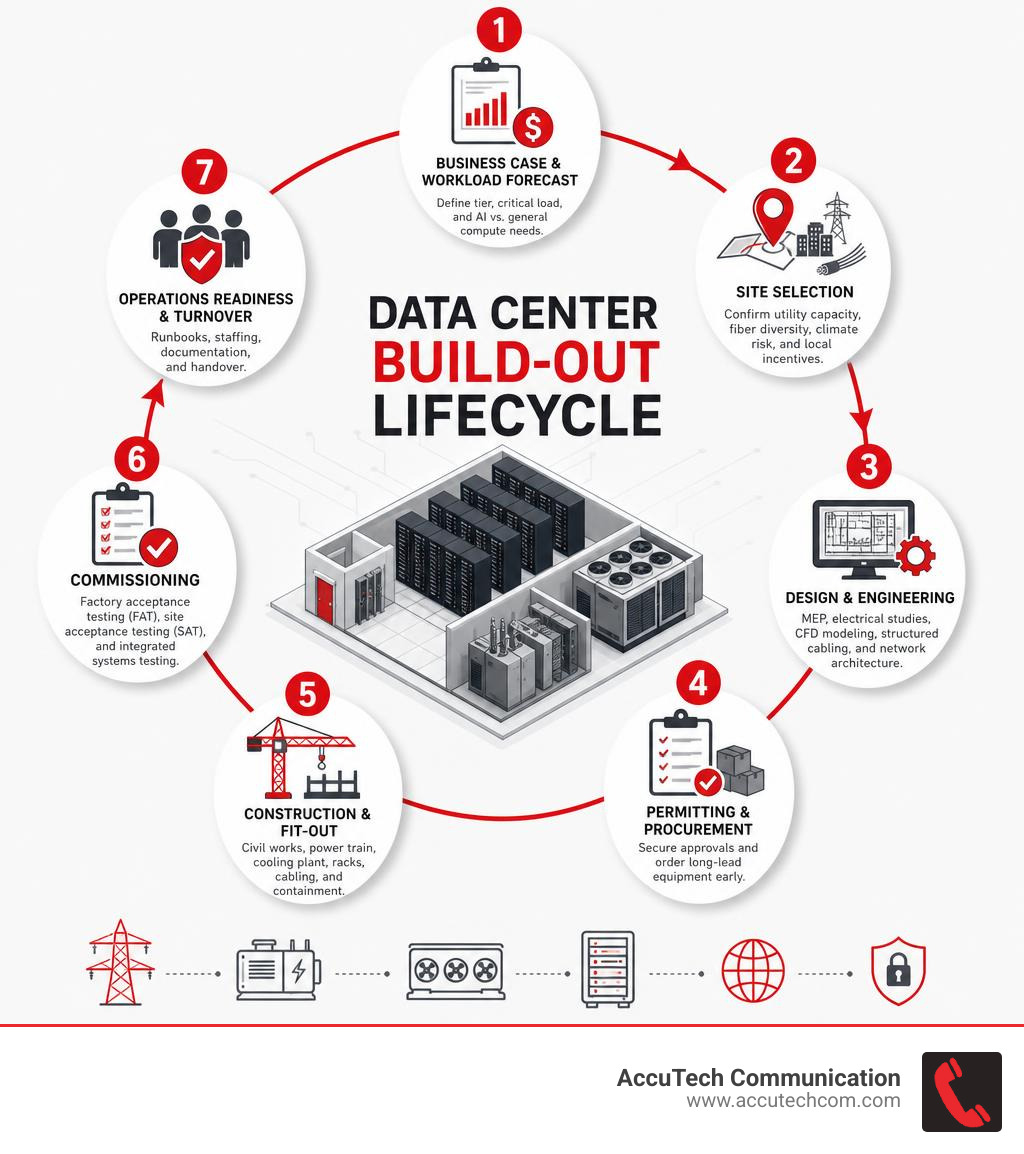
A solid data center build out checklist is the difference between a facility that comes online on time and one that stalls in permitting, blows its power budget, or fails commissioning. Here is a quick overview of the core phases every build-out must cover:
- Business case and workload forecast — define tier, critical load, and AI vs. general compute needs
- Site selection — confirm utility capacity, fiber diversity, climate risk, and local incentives
- Design and engineering — MEP, electrical studies, CFD modeling, structured cabling, and network architecture
- Permitting and procurement — secure approvals and order long-lead equipment early (transformers can take 40–65 weeks)
- Construction and fit-out — civil works, power train, cooling plant, racks, cabling, and containment
- Commissioning — factory acceptance testing (FAT), site acceptance testing (SAT), and integrated systems testing
- Operations readiness and turnover — runbooks, staffing, documentation, and handover
In 2026, this process is more complex than ever. AI and GPU workloads are pushing rack densities past 100 kW in some facilities, global data center power demand could rise 50% by 2027, and power-related failures remain the leading cause of outages — most of which now cost businesses more than $100,000 per incident. Whether you are planning a greenfield build or a major fit-out in Massachusetts, New Hampshire, or Rhode Island, skipping steps on your build-out checklist is not a risk you can afford.
This guide walks you through every phase, from strategy and site selection to commissioning and day-2 operations, so your team has a clear, actionable roadmap.
I’m Corin Dolan, owner of AccuTech Communications, with decades of hands-on experience designing and installing commercial data center infrastructure across Massachusetts, New Hampshire, and Rhode Island — including the structured cabling, fiber backbones, and network rooms that every data center build out checklist depends on. AccuTech has supported facilities of all sizes, and this guide reflects the real-world lessons learned on those projects.
Data center build out checklist helpful reading:
Data Center Build Out Checklist: A–Z Phases from Business Case to Turnover
Before pouring concrete or pulling miles of fiber-optic cables, we must establish a clear project charter. A successful data center buildout is not merely a construction project; it is a long-term capital program designed to support your organization’s digital backbone for the next 10 to 15 years.
Every successful buildout begins with a robust business case and a thorough workload forecast. With generative AI spend projected to top $650 billion by 2028, we must design today’s facilities to handle both traditional enterprise applications and high-density AI workloads. This means establishing your target critical load (measured in megawatts) and planning your average and peak rack densities early.
By defining these metrics, your team can establish clear budget gates, coordinate procurement timelines, and align stakeholders from civil engineering to IT operations. To keep your project structured, we recommend utilizing a comprehensive data center project plan template and following our data center installation complete guide to ensure no steps are missed.
Pre-Construction Data Center Build Out Checklist for 2026
The pre-construction phase is where the strategic foundation of your facility is poured. According to the Data Center Development: Full Pre-Construction Guide , developers must complete several critical milestones before reaching a Final Investment Decision (FID).
- Establish the Owner’s Project Requirements (OPR): This is your north star document. It details the exact performance criteria, target critical IT load, redundancy goals, and compliance standards the facility must achieve.
- Reconcile the Basis of Design (BOD): Your engineering team must draft a BOD that directly addresses every requirement in the OPR, detailing the mechanical, electrical, and plumbing (MEP) pathways.
- Secure Land Control and Utility Interconnection: Before moving forward, you need stamped utility commitments. In legacy New England markets, utility interconnection queues can take 12 to 18 months.
- Assess Long-Lead Equipment Timelines: Procurement is a major risk factor in 2026. High-voltage transformers currently carry lead times of 40 to 65 weeks. Generators, switchgear, and large mechanical chillers must also be ordered well in advance of site mobilization.
- Draft the Risk Register and Permitting Playbook: Map out environmental approvals, local zoning variances, and ESG (Environmental, Social, and Governance) targets. For a deeper look at navigating this phase, consult From Dirt to Data: The Full Lifecycle Playbook for Data Center … .
Design, Engineering, and Procurement Steps
Once the pre-construction gates are cleared, the detailed design and engineering work begins. This phase translates conceptual drawings into highly precise schematics.
- Architectural and MEP Design: Lock in the spatial layouts for the data halls, battery rooms, generator yards, and administrative offices.
- Electrical and Thermal Studies: Perform mandatory arc flash and discrimination studies to protect personnel and equipment. Utilize Computational Fluid Dynamics (CFD) modeling to simulate airflow and ensure your cooling design can handle localized hot spots.
- Structured Cabling and Network Topology: Design the physical layer. This includes mapping fiber-optic backbones, carrier-neutral Meet-Me Rooms (MMRs), overhead cable trays, and rack-level patch panels. For detailed standards on bend radiuses and grounding, refer to our data center cable installation complete guide.
- Incorporate DCIM Software: Plan for data center infrastructure management from day one to monitor real-time power, cooling, and environmental metrics.
Construction, Fit-Out, and Installation Steps
With designs finalized and permits in hand, the physical build begins. This is where your general contractor and specialized technology partners execute the physical fit-out.
- Civil Works and Structural Shell: Pouring the high-load concrete slab, establishing a comprehensive facility grounding grid, and installing weather-tight roofing.
- Pathway and Containment Construction: Installing heavy-duty overhead cable trays, ladder racks, and hot/cold aisle containment systems.
- MEP Infrastructure Installation: Setting up UPS (Uninterruptible Power Supply) systems, backup diesel generators, fuel storage systems, and mechanical cooling plants.
- IT Equipment Fit-Out: Placing server cabinets, installing rack power distribution units (PDUs), and routing thousands of structured copper and fiber connections.
- Testing and Certification: Every single fiber strand must undergo Optical Time-Domain Reflectometer (OTDR) testing to verify signal integrity before any equipment cutover occurs.
AI-Ready Power, Cooling, Network, and Security Requirements
The rapid rise of artificial intelligence has fundamentally changed the rules of data center design. Traditional enterprise data halls designed for 5 to 10 kW per rack cannot support modern GPU clusters running NVIDIA H100s, B200s, or next-generation accelerators, which routinely demand 30 to 100 kW+ per rack.
How AI and GPU Workloads Change the Build-Out
AI training and inference workloads run at sustained, near-100% compute capacity for weeks or months at a time. This continuous draw places immense stress on the electrical power train.
To support these densities, electrical designs must shift from traditional power whips to high-capacity overhead busways. This allows for rapid scaling of power drops without requiring structural rewiring. Furthermore, because GPU server chassis are significantly heavier than traditional CPU servers, structural engineers must design raised floors and slabs to support elevated structural weight limits.
Cooling Strategy by Rack Density
As rack densities climb, traditional air cooling quickly reaches its physical limits. Air cooling is highly efficient up to 10–15 kW per rack, and with hot/cold aisle containment, it can be stretched to roughly 20–35 kW. Beyond 35 kW, however, air becomes an inefficient thermal medium.
| Cooling Strategy | Rack Density Range | CapEx Impact | Best Use Case |
|---|---|---|---|
| Air Cooling (with Containment) | 1–25 kW | Baseline | Traditional enterprise workloads, legacy applications, and light hybrid clouds. |
| Direct-to-Chip (Liquid) | 30–80 kW | Moderate to High | High-density GPU clusters, localized AI training, and high-performance computing (HPC). |
| Immersion Cooling | 80–100 kW+ | High | Hyperscale AI training factories, extreme-density compute, and warm-climate facilities seeking low PUE. |
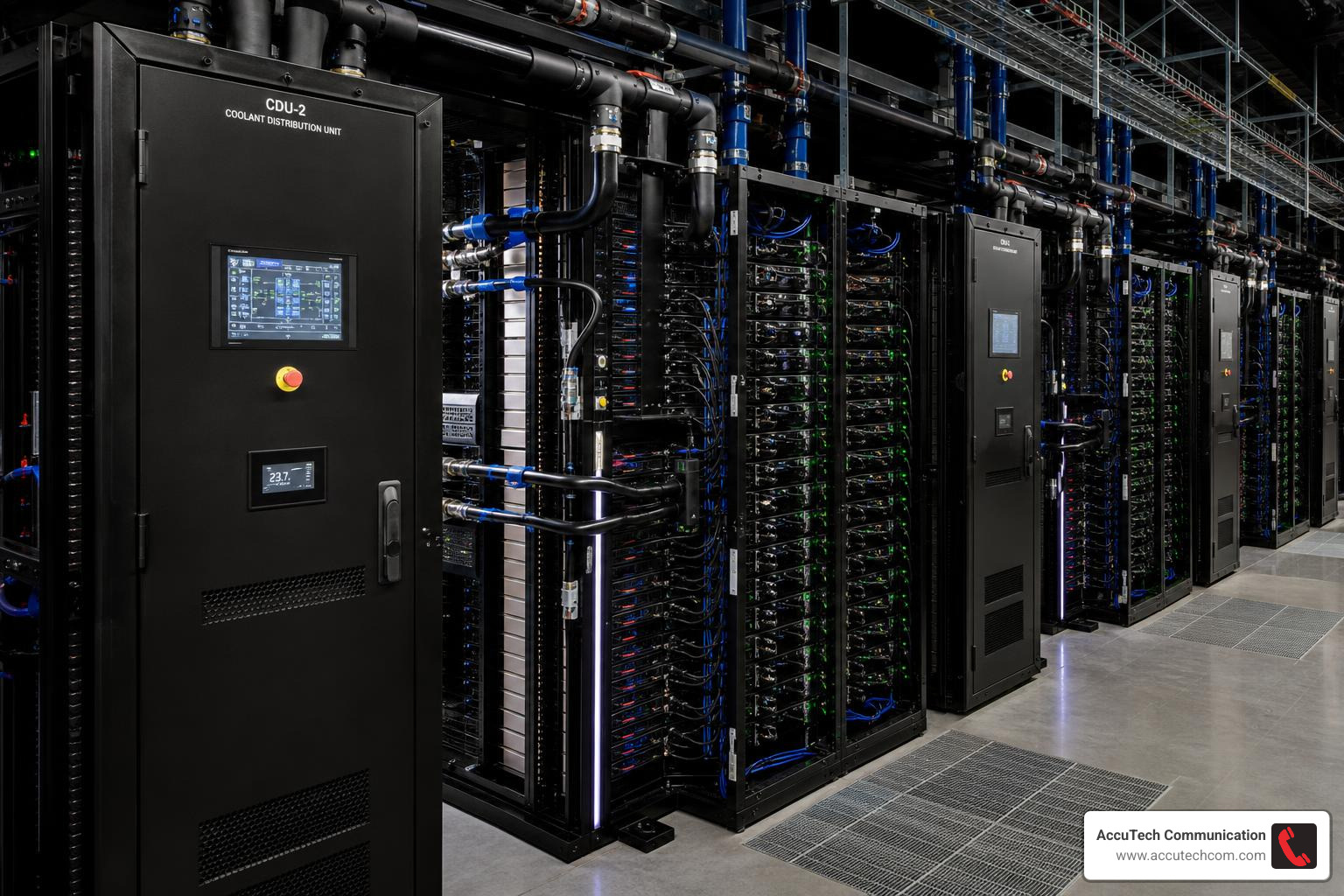
Transitioning to direct-to-chip liquid cooling or full liquid immersion requires dedicated Coolant Distribution Units (CDUs), secondary piping loops, precise water filtration, and robust leak detection. For organizations aiming to build energy efficient data centers, liquid cooling is no longer an option—it is a strategic necessity to keep Power Usage Effectiveness (PUE) ratios low.
Network Architecture for GPU-to-GPU Communication
AI workloads require massive east-west traffic bandwidth. When thousands of GPUs operate in parallel during a training run, the speed of the network interconnect is often the primary bottleneck.
To support this, network architects deploy non-blocking spine-leaf fabrics utilizing high-speed InfiniBand or low-latency Ethernet with RDMA over Converged Ethernet (RoCE). These architectures require high-density fiber trunks utilizing MPO/MTP connectors to support 400G and 800G pathways. Network performance must be validated using tail metrics (such as 99th percentile latency and packet jitter) rather than simple averages to ensure consistent GPU-to-GPU communication.
Observability, Automation, and Security for AI Data Centers
Operating an AI-ready facility requires advanced monitoring and rapid, automated responses to environmental changes.
- Fine-Grained Telemetry: Deploy thousands of environmental sensors to feed real-time temperature, humidity, and flow-rate data into your BMS (Building Management System) and DCIM platform.
- Closed-Loop Automation: Enable automated cooling and power adjustments to mitigate thermal spikes before they trigger system throttles or equipment damage.
- Zero-Trust Security: Integrate physical and digital security. Implement multi-factor authentication (MFA), biometric access controls, and comprehensive CCTV coverage from the property perimeter down to individual server cabinets. Ensure your facility is fully prepared to pass SOC 2, HIPAA, and PCI DSS audits.
Site Selection, Tier Choice, Redundancy, Timeline, and Cost
Selecting where and how to build your data center determines your long-term operational success, regulatory compliance, and overall return on investment.
Choosing the Right Site in Massachusetts, New Hampshire, or Rhode Island
When building in New England, site selection requires balancing local regulatory landscapes, utility capacities, and environmental factors.
- Power and Grid Reliability: In Massachusetts and Rhode Island, securing immediate access to megawatts from local utilities can be highly competitive. Proximity to transmission lines and substations is critical.
- Fiber Connectivity: Look for sites with access to multiple, physically diverse carrier routes to prevent single-point-of-failure outages. For businesses looking to establish robust regional nodes, utilizing a Boston Data Center Checks All the Boxes For Multicloud, Hybrid … approach ensures low-latency paths to major metropolitan hubs.
- Local Regulations and Climate: Take advantage of New England’s cool seasonal climate to maximize “free cooling” hours, significantly lowering PUE. However, designs must account for localized coastal flood risks in Rhode Island and heavy winter snow loads in northern New Hampshire and Central Massachusetts. Additionally, ensure your plans align with local municipal guidelines, such as the IT Roadmap | Andover, MA .
Tier II vs Tier III vs Tier IV Data Centers
The Uptime Institute’s Tier Classification System remains the global standard for defining a facility’s availability and reliability targets.
| Metric | Tier II | Tier III | Tier IV |
|---|---|---|---|
| Uptime Target | 99.741% | 99.982% | 99.995% |
| Redundancy Path | Single path for power and cooling; redundant components (N+1). | Multiple power and cooling paths, but only one active; concurrently maintainable. | Multiple active power and cooling paths; fully fault-tolerant (2N+1). |
| Annual Downtime | Up to 22.7 hours | Up to 1.6 hours | Up to 26.3 minutes |
| Cost Impact | Baseline | Moderate CapEx premium | Very high CapEx premium |
For most enterprise and AI training workloads, Tier III is the industry sweet spot, offering concurrent maintainability without the extreme cost premium of a fully fault-tolerant Tier IV design.
Power Redundancy: N, N+1, 2N, and 2N+1
With power-related issues remaining the leading cause of impactful data center outages, your electrical topology is your primary line of defense.
- N+1 Redundancy: Provides one extra unit (such as a UPS or generator) beyond what is required to support the full IT load. If one unit fails or goes offline for maintenance, the system still operates safely.
- 2N Redundancy: Provides two completely independent, parallel power trains (A-side and B-side). If an entire utility feed or UPS system fails, the secondary side carries the load seamlessly.
- 2N+1 Redundancy: The gold standard of reliability. It combines dual-path 2N protection with N+1 redundancy on each path, ensuring complete fault tolerance even during active maintenance windows.
Timeline and Cost Expectations in 2026
Building a data center from scratch is a massive financial and operational undertaking. A typical greenfield build takes 18 to 36 months from initial planning to final commissioning, heavily driven by utility interconnection queues and equipment lead times.
In terms of capital expenditure, total program costs in 2026 routinely reach tens to hundreds of millions of dollars. Based on general industry averages and publicly available online data, a standard commercial build-out can range anywhere from $7 million to over $25 million for mid-sized facilities, with hyperscale or high-density AI facilities scaling far higher (often exceeding $75 million on the high end).
Please note: These figures represent average industry ranges compiled from public market data and do not reflect the actual pricing or guaranteed rates of AccuTech Communications. Every project is highly variable based on local utility costs, regional labor rates, structural requirements, and targeted rack densities.
Build vs Colocation vs Hybrid Decision Framework
Before breaking ground, organizations must carefully evaluate whether building an owned facility is the most strategic choice.
- Build Your Own: Best for organizations with highly stable, long-term workloads, specialized AI infrastructure requirements, or strict regulatory data sovereignty needs.
- Colocation: Offers faster time-to-market, predictable OpEx cost structures, and shared responsibility for power, cooling, and physical security.
- Hybrid Model: Many modern enterprises choose a hybrid approach—keeping highly sensitive, low-latency core data in a localized private facility while utilizing colocation or public cloud for burst capacity.
If your organization decides to consolidate or transition facilities, we highly recommend using a structured data center move checklist and partnering with experienced professionals to manage the complex data center relocation process.
Commissioning Data Center Build Out Checklist and Operations Readiness
Commissioning is the formal process of proving that your data center operates exactly as designed. It is not a simple “rubber-stamp” phase; it is a rigorous, multi-level testing workflow that must occur before any live IT equipment is installed.
Commissioning Data Center Build Out Checklist Before Turnover
According to the DATA CENTER | Commissioning Checklist – Constructandcommission.com , professional commissioning follows a structured seven-level hierarchy:
- Level 0 (Design & Planning): Reviewing OPR, BOD, and design documents for commissionability.
- Level 1 (Factory Testing): Witnessing factory acceptance tests (FAT) of major equipment (UPS, generators, chillers) before shipment.
- Level 2 (Component Delivery & Installation): Inspecting equipment upon arrival and verifying correct installation.
- Level 3 (Systems Start-Up): Energizing individual components and performing initial vendor startups.
- Level 4 (Functional Performance Testing): Verifying that individual systems operate correctly under baseline conditions.
- Level 5 (Integrated Systems Testing – IST): Simulating real-world failure scenarios across the entire facility.
- Level 6 (Closeout & Handover): Compiling as-builts, warranties, and training operations staff.
For a deeper dive into managing this transition safely, review the Data Center Commissioning Checklist: What Developers Need to Verify Before Turnover | Insights | Build .
Integrated Systems Testing Scenarios
Integrated Systems Testing (IST) is the ultimate test of your facility’s resilience. It involves simulating worst-case operational failures under peak simulated heat loads using load banks.
- Complete Utility Loss: Cutting main utility power at full load to verify that UPS systems ride through seamlessly and generators start, sync, and carry the load within the required 10-to-12-second window.
- Cooling Loop Failures: Simulating a chiller or Coolant Distribution Unit (CDU) failure to verify that redundant pumps and backup loops engage without causing thermal throttling at the rack level.
- Emergency Power Off (EPO) and Fire Alarms: Ensuring that fire detection and suppression systems interact correctly with electrical breakers and mechanical dampers to protect human life and equipment.
- 24-to-48-Hour Stability Run: Running the entire facility under full simulated load continuously to identify any weak connections, hot spots, or control sequence errors.
Documentation, Runbooks, and Day-2 Operations
A successful handover requires transition from the construction team to the day-2 operations team.
- As-Built Documentation: Compiling precise CAD/BIM drawings, detailed circuit schedules, and comprehensive cable routing maps.
- Operational Runbooks: Drafting step-by-step Standard Operating Procedures (SOPs) and Emergency Operating Procedures (EOPs) for maintenance and incident response.
- Asset Management and DCIM: Ensuring every physical asset, patch panel port, and power circuit is logged into your centralized management system.
- Preventive Maintenance Schedules: Establishing routine testing intervals for generators, UPS batteries, and cooling systems.
Frequently Asked Questions About a Data Center Build Out Checklist
What are the essential steps to build a data center from scratch in 2026?
Building a data center from scratch requires a highly coordinated, multi-phase approach. The journey begins with defining your business requirements and establishing a detailed workload forecast. From there, site selection must be finalized—ensuring access to reliable high-voltage utility power and diverse fiber paths. Next, engineering teams develop the mechanical, electrical, and structural designs, followed by securing local zoning permits and ordering long-lead equipment. Once construction is complete, the physical space undergoes rigorous multi-level commissioning before final operational handover.
When should a data center use liquid or immersion cooling?
Air cooling is highly effective for traditional workloads up to 15 kW per rack. Between 15 kW and 35 kW, hot/cold aisle containment systems can keep temperatures stable. Once rack densities exceed 35 kW—which is common for modern GPU and AI accelerator clusters—direct-to-chip liquid cooling or full liquid immersion cooling becomes necessary to maintain safe operating temperatures and protect hardware.
How do organizations future-proof a data center build-out?
Future-proofing requires designing for modularity and scalability. Build out physical pathways, overhead cable trays, and underground conduits with at least 50% extra capacity to accommodate future expansion. Utilize standards-based structured cabling and modular overhead busways to allow for rapid reconfigurations. Finally, ensure your mechanical footprints and piping designs are pre-engineered to support a seamless transition from air cooling to liquid cooling when your compute needs scale.
Conclusion
Building or expanding a data center is a major commercial undertaking that requires precise engineering, disciplined project management, and a deep understanding of evolving technology standards. In the era of high-density AI workloads, skipping steps on your data center build out checklist can lead to costly delays, operational bottlenecks, or catastrophic system outages.
At AccuTech Communications, we specialize in helping businesses across Massachusetts, New Hampshire, and Rhode Island design, install, and future-proof their critical physical layer infrastructure. Since 1993, we have delivered certified, reliable service with competitive pricing and a commitment to quality. Whether you need a robust fiber-optic backbone, organized structured cabling, or expert guidance on your next data center fit-out, our team is here to support you.