
Backbone Cabling: Top 10 Essential Facts in 2024
Backbone cabling is crucial for modern businesses, forming the core of structured cabling systems that support seamless communication and data transmission across various facilities. It interconnects different equipment and telecommunications rooms, providing essential pathways for high-capacity data transfer between floors or even buildings. This cabling system ensures that the backbone of your network is robust and capable of handling current and future demands.
- Definition: Backbone cabling concentrates data flow within and across buildings.
- Function: Connects various network components to facilitate high-speed data transfer.
- Importance: Supports uninterrupted and efficient communication in business infrastructures.
Structured cabling systems, encompassing backbone and horizontal cabling, are pivotal in ensuring reliable and efficient network performance. AccuTech Communications has been a leader in designing, installing, and maintaining these systems for over 20 years. Their expertise ensures your backbone cabling system meets rigorous industry standards for performance and reliability.
I’m Corin Dolan, founder of AccuTech Communications. With experience in backbone cabling projects across various sectors, I ensure your network is optimized for today and scalable for tomorrow. Let’s explore what makes backbone cabling indispensable for your digital infrastructure.
Backbone cabling terms to learn:
– structured cabling
– network installation services
– network cable wiring
What is Backbone Cabling?
Backbone cabling is the central framework of a network. It connects different sections and ensures smooth data flow across a business’s infrastructure. Think of it as the main highway that carries large volumes of data traffic between different parts of a network. This is crucial for maintaining high-speed and reliable communication within and between buildings.
Components of Backbone Cabling
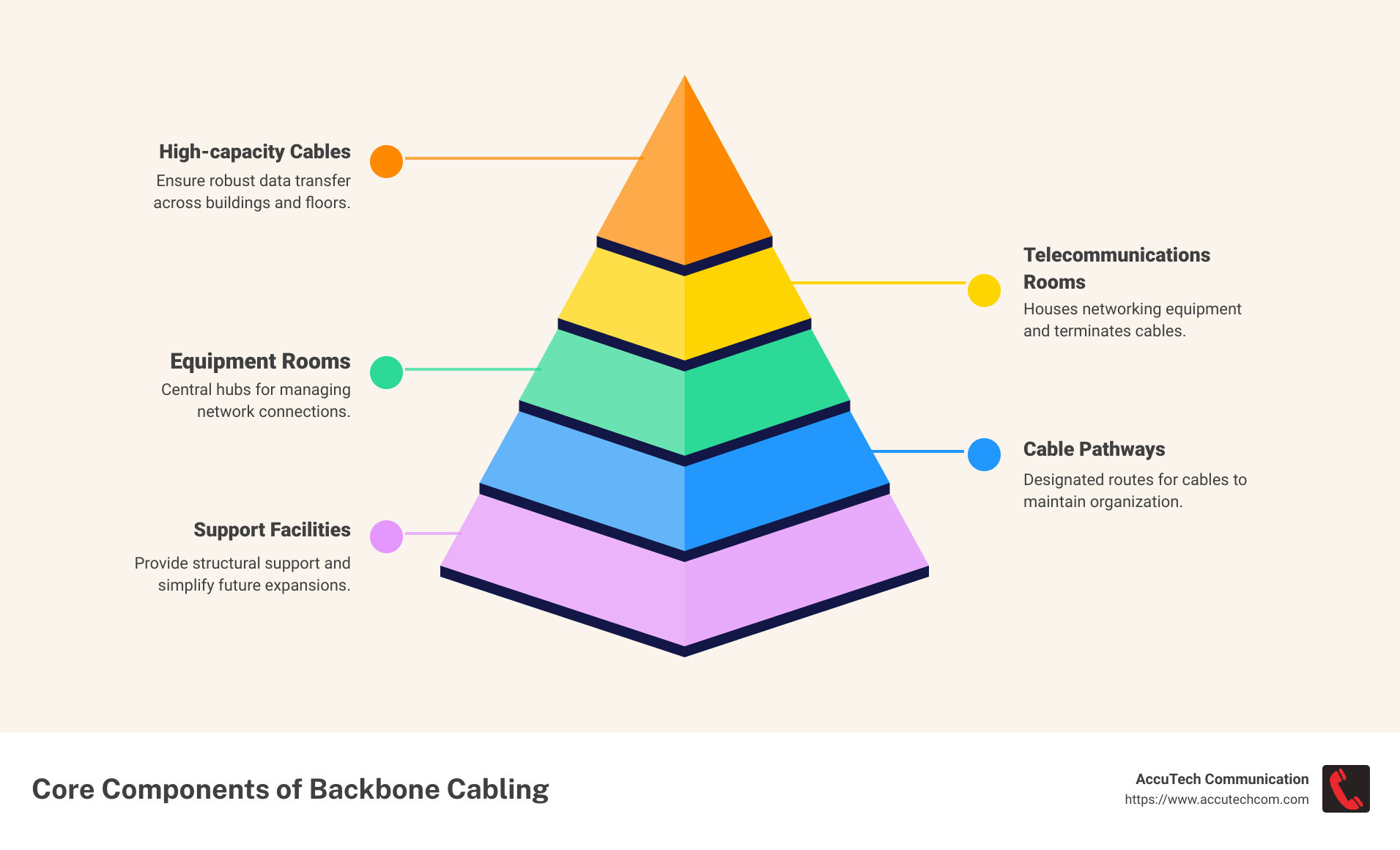
Backbone cabling consists of several key components:
- Cable Pathways: These are the routes through which cables are laid. Pathways must be carefully planned to ensure efficient and organized cable management, reducing the risk of damage and interference.
- Connecting Hardware: This includes all the equipment needed to link different network segments, such as patch panels and connectors. Proper connecting hardware ensures that data can flow seamlessly through the network.
- Backbone Wiring: The actual cables used in backbone systems are typically high-capacity, like fiber optics, which can handle large data loads over long distances.
- Support Facilities: These are additional elements like racks and trays that help manage and support the physical infrastructure of the cabling system.
Types of Backbone Cabling
Backbone cabling can be categorized based on the areas it serves:
- Inter-Building Backbone: This type connects different buildings within a campus or a corporate environment. It is also known as campus backbone cabling. These cables are often installed underground or through conduits to protect them from environmental damage.
- Intra-Building Backbone: This type connects different floors or sections within the same building. It typically runs vertically between floors, linking various telecommunications rooms and equipment rooms.
- Campus Backbone: Similar to inter-building but often refers to larger-scale installations that connect multiple buildings over a wider area. These systems must be robust and scalable to accommodate future growth.
Understanding these components and types is essential for designing a backbone cabling system that meets the specific needs of a business. The choice of materials, pathways, and hardware all play a critical role in ensuring the network’s efficiency and reliability.
Backbone Cabling vs Horizontal Cabling
When it comes to network infrastructure, backbone cabling and horizontal cabling play distinct but complementary roles. Understanding their differences is crucial for designing an efficient and reliable network.
Backbone Cabling
Backbone cabling acts as the main artery of a network, running vertically through buildings and connecting different floors and equipment rooms. It’s designed to handle large volumes of data traffic, much like a highway that connects different cities.
- Coverage Areas: Backbone cabling links entrance facilities, equipment rooms, and telecommunications rooms. It typically runs vertically, which is why it’s sometimes called “vertical cabling.”
- Cable Types: The cables used in backbone systems are usually high-capacity, such as fiber optic cables. Fiber optics are preferred because they can transmit large amounts of data over long distances without losing signal quality.
- Distance Limitations: Backbone cabling spans longer distances than horizontal cabling, often between different floors or even buildings. This makes it ideal for connecting various parts of a large campus or corporate environment.
Horizontal Cabling
On the other hand, horizontal cabling connects individual work area outlets to telecommunications rooms within the same floor. It’s like the local streets that connect houses to the main road.
- Coverage Areas: Horizontal cabling extends from telecommunications rooms to individual workstations, typically within a single floor. It’s installed in a star topology, where each work area is directly linked to the telecommunications room.
- Cable Types: The most common cables used for horizontal runs are twisted-pair copper cables, such as Cat5e, Cat6, or Cat6a. These cables are suitable for shorter distances and are cost-effective for connecting individual devices.
- Distance Limitations: Horizontal cabling is limited to 90 meters (approximately 295 feet) from the telecommunications room to the work area outlet. This restriction ensures optimal performance and meets industry standards.
In summary, backbone cabling and horizontal cabling each serve unique purposes within a network. Backbone cabling is all about connecting larger network segments with high-capacity cables over longer distances, while horizontal cabling focuses on linking individual work areas within a floor using copper cables. By understanding these differences, you can design a network that is both efficient and scalable.
Backbone Cabling Installation
Installing backbone cabling is a critical step in setting up a robust network infrastructure. It’s important to get it right from the start to ensure seamless data transmission across your organization. Let’s explore some key considerations for installation.
Installation Process
The installation of backbone cabling involves running cables vertically between floors, connecting equipment rooms, and ensuring that all components are securely in place. This process requires careful planning and execution to avoid any disruptions in service.
- Floor-to-Floor Connections: Backbone cabling typically runs through risers or vertical shafts in a building. This allows for seamless data flow between different floors and ensures that network resources are accessible where needed.
- IT Rooms: Equipment rooms, often located on each floor, serve as hubs where backbone and horizontal cabling meet. These rooms need to be environmentally controlled to protect sensitive equipment from temperature and humidity fluctuations.
Considerations for Installation
When installing backbone cabling, several factors must be taken into account to ensure longevity and performance.
- Weight Support and Securing Cables: Backbone cables can be heavy, especially when using materials like fiber optics. Proper weight support is crucial to prevent sagging or damage over time. This might involve using cable trays or other support structures.
- Fire-Rating Specifications: Safety is paramount. Backbone cabling must adhere to specific fire-rating specifications to prevent hazards. This involves choosing cables that are designed to resist fire and installing them in compliance with local building codes.
- Underground Routing: In some cases, backbone cabling may need to be routed underground, especially for inter-building connections. This requires additional considerations, such as protection from moisture and environmental factors.
Future Expansions
Planning for the future is a smart move when installing backbone cabling. As your organization grows, your network needs will likely expand, too.
- Scalability: Choose cable types and installation methods that allow for easy upgrades. Fiber optic cables, for instance, offer high capacity and are future-proof, making them ideal for expanding networks.
- Flexibility: Design your network infrastructure to accommodate changes. This could mean leaving space for additional cables or using modular components that can be easily swapped out as technology evolves.
By carefully considering these factors, you can ensure that your backbone cabling installation supports your organization’s current and future networking needs. This sets the stage for a reliable and efficient network that can adapt to changing demands.
Backbone Cabling in Network Topologies
When it comes to network topologies, backbone cabling plays a crucial role in ensuring efficient data flow and connectivity. Let’s explore the different types of backbone topologies and their unique characteristics.
Distributed Backbone
A distributed backbone is a network architecture where connectivity devices like routers and bridges are spread across different locations. This setup allows for expansion and network traffic segregation, meaning each local area network (LAN) can operate independently, reducing congestion on the main network.
One major benefit of a distributed backbone is its resilience. If one segment fails, the rest of the network can continue to function. This makes it a suitable choice for large organizations with multiple departments or buildings.
Collapsed Backbone
In a collapsed backbone or “backbone-in-a-box,” all network connections converge at a central location, typically a single switch or router. This centralization brings ease of management, as all network controls are located in one spot.
However, there’s a downside: if the central device fails, the entire network can go down. To mitigate this risk, redundancy measures, such as backup devices, are essential. Despite this potential drawback, the collapsed backbone’s simplicity and high performance make it popular for smaller networks or when high-speed data processing is required.
Parallel Backbone
A parallel backbone is a robust variation of the collapsed backbone. It involves duplicate connections between switches and routers, enhancing fault tolerance. This means if one connection fails, others can take over, ensuring continuous network operation.
Parallel backbones are ideal for networks with critical devices that require constant connectivity, such as those handling sensitive data like payroll systems. While more expensive due to additional cabling, the investment pays off in reliability and performance.
Serial Backbone
The serial backbone is the simplest form of backbone topology. Devices are connected in a daisy-chain fashion, one after another. This setup is straightforward and cost-effective, but it has limited use in large-scale networks due to potential bottlenecks and single points of failure.
Serial backbones are typically used in small networks or as temporary solutions. Their simplicity makes them easy to implement, but they may not be suitable for environments requiring high-speed data transfer or complex network structures.
In summary, choosing the right backbone topology depends on your network’s size, complexity, and critical needs. Each topology offers distinct advantages and challenges, making it essential to align your choice with your organization’s specific requirements.
Frequently Asked Questions about Backbone Cabling
What is backbone cabling system?
A backbone cabling system is the main network infrastructure that connects various parts of a building or campus. Think of it as the central highway for data, voice, and video signals to travel between different areas. It links equipment rooms, telecommunications rooms, and sometimes even entire buildings. Backbone cabling typically uses high-capacity cables like fiber optic or high-pair-count copper cables to handle large volumes of data over long distances. This setup ensures that all parts of the network can communicate efficiently and reliably.
Is backbone cabling the same as vertical cabling?
While often used interchangeably, backbone cabling and vertical cabling aren’t exactly the same. Backbone cabling refers to the entire network infrastructure that connects different parts of a building or campus. It includes both vertical and horizontal pathways.
Vertical cabling, on the other hand, is a subset of backbone cabling. It specifically refers to the cables that run vertically, usually between floors in a building. These cables connect different telecommunications rooms and equipment rooms. Vertical cabling is crucial for multi-story buildings where data needs to travel up and down efficiently.
What is the difference between horizontal and backbone cabling?
Horizontal cabling and backbone cabling serve different purposes in a structured cabling system. Here’s a quick breakdown:
- Purpose: Backbone cabling carries data between different floors or buildings, acting as the main artery of the network. Horizontal cabling connects the telecommunications rooms to individual work area outlets, delivering data to end-users.
- Location: Backbone cabling is typically installed vertically or between buildings. Horizontal cabling runs horizontally within a single floor.
- Cable Types: Backbone cabling often uses fiber optic or high-pair-count copper cables for high capacity and long distances. Horizontal cabling usually employs twisted-pair copper cables like Cat5e, Cat6, or fiber optics for shorter runs.
- Distance Limitations: Backbone cabling can cover longer distances with its high-capacity cables. Horizontal cabling is limited to 90 meters (about 295 feet) from the telecommunications room to the work area outlet.
Understanding these differences helps in designing a network that meets the specific needs of a building or campus.
Conclusion
At AccuTech Communications, we pride ourselves on delivering reliable service that our clients can count on. Since 1993, we’ve been committed to providing top-notch network cabling solutions across Massachusetts, New Hampshire, and Rhode Island. Our team of experts ensures that your network infrastructure is robust and future-ready.
Competitive pricing is one of our key strengths. We believe that high-quality service shouldn’t come with a hefty price tag. Our goal is to offer affordable solutions without compromising on quality. This approach has helped us build lasting relationships with businesses of all sizes.
Our unwavering commitment to quality sets us apart. We adhere to industry standards and best practices in every project we undertake, ensuring that your network is not only efficient but also reliable. Our certified and experienced technicians work diligently to meet and exceed your expectations.
Whether you’re looking to upgrade your existing cabling system or need a complete installation, we’re here to help. Our network cabling installation services are designed to meet the unique needs of your business, ensuring seamless communication and data transfer.
Choose AccuTech Communications for a partner who prioritizes your success. Let us strengthen the backbone of your business with our expert cabling solutions.
