Demystifying Electrical Installation: A Comprehensive Wiring Guide

What Commercial Installation and Wiring Actually Involves (And Why It Matters)
Installation and wiring is the foundation of every reliable business communication and power system, from the cables running through your walls to the circuits powering your equipment.
Here is a quick overview of what commercial installation and wiring covers:
| Area | What It Includes |
|---|---|
| Safety & Planning | Load calculations, permits, NEC compliance, PPE |
| Wire Selection | AWG sizing, sheathing types, amperage ratings |
| Rough-In Work | Conduit runs, cable routing, box placement |
| Structured Cabling | Cat 6, fiber optics, low-voltage systems |
| Testing & Compliance | Continuity checks, inspections, labeling |
Getting any one of these wrong can mean downtime, code violations, or serious safety risks for your business.
For commercial facilities in Massachusetts, New Hampshire, and Rhode Island, the stakes are especially high. Outdated or improperly installed wiring slows down operations, creates compliance headaches, and puts infrastructure at risk. A well-planned installation, on the other hand, supports everything from high-speed networks to access control systems, and scales as your business grows.
I’m Corin Dolan, owner of AccuTech Communications, and I’ve spent decades helping commercial clients across New England design and implement reliable installation and wiring solutions for structured cabling, fiber optics, and business communication systems. In this guide, I’ll walk you through everything you need to know to understand the process, and make smart decisions for your facility.
Basic installation and wiring terms:
- Do You Need a License to Install Low Voltage Cable
- LV Cable Installation
- How to Install Low Voltage Lighting
Essential Safety and Planning for Commercial Installation and Wiring
Before a single reel of cable is ever unwound, the most critical phase of any project begins: safety and planning. In a commercial environment, whether it’s a bustling office in Boston or a data center in Manchester, electricity isn’t just a utility; it’s a powerful force that requires respect and meticulous management.
The Foundation of Safety
Safety isn’t just about wearing a hard hat. For professional installers, it involves a rigorous set of Electrical wiring safety principles that protect both the workers and the building’s future occupants.
- Lockout/Tagout (LOTO): This is the gold standard. We ensure that power sources are physically locked in the “off” position and tagged with the technician’s information before any work commences. This prevents accidental re-energization.
- Voltage Verification: We never trust a breaker label alone. Using non-contact voltage testers and multimeters, we verify that every wire is truly “dead” before handling it.
- Personal Protective Equipment (PPE): This includes insulated tools, safety glasses, and flame-resistant clothing where necessary.
Infrastructure Planning and Blueprints
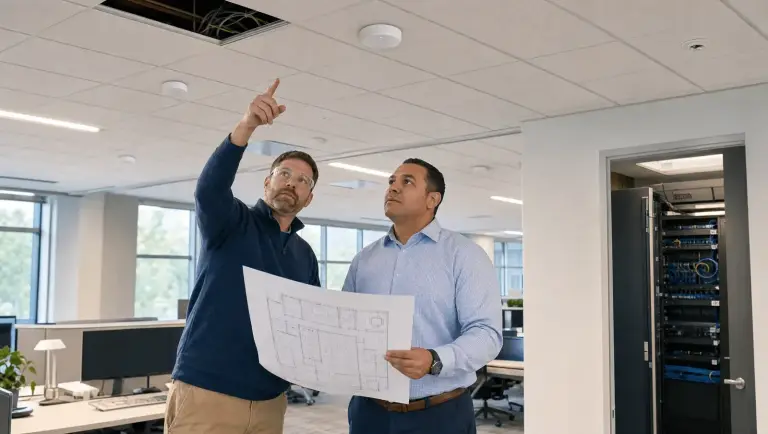
Commercial installation and wiring requires a detailed roadmap. We don’t just “wing it.” We start with architectural blueprints that outline every outlet, switch, data port, and heavy-duty appliance.
- Load Calculations: We calculate the anticipated electrical demand for each circuit. For example, a standard double-pole 60-amp circuit breaker can provide up to 48 amps of continuous output (11.5 kW at 240 volts). Overloading these circuits is a leading cause of electrical fires.
- Circuit Protection: We plan for the right mix of standard breakers, GFCI (Ground Fault Circuit Interrupter), and AFCI (Arc Fault Circuit Interrupter) protection as required by local codes in MA, NH, and RI.
- Future-Proofing: We look at where your business will be in five years. This might mean installing extra Professional Wiring Services capacity or larger conduits to accommodate future technology upgrades.
Best Practices for Commercial Installation and Wiring
In the commercial world, “good enough” isn’t good enough. Adhering to Commercial Wiring Services best practices ensures longevity and safety.
- NEC Compliance: The National Electrical Code (NEC) is our bible. It dictates everything from how many wires can fit in a box to how far apart staples must be placed.
- Permit Requirements: We handle the paperwork. Major wiring projects in cities like Worcester or Providence require permits and staged inspections (rough-in and final) to ensure the work meets legal safety standards.
- Load Balancing: We distribute the electrical load evenly across the phases of your electrical panel. This prevents one side of the panel from working harder than the other, which can lead to premature equipment failure.
Standard Height and Placement Guidelines
Consistency is key for both aesthetics and accessibility. While specific needs vary, we generally follow these standard height guidelines (measured from the floor to the center of the box):
- Switches: 48 inches.
- Outlets: 12 to 18 inches.
- ADA Compliance: In many commercial settings, we must ensure that all controls are reachable for individuals in wheelchairs, which often means keeping switches between 15 and 48 inches.
- Equipment Racks: For Data Cabling for Offices, placement is determined by the rack layout and cooling requirements.
Understanding Wire Gauges, Amperage, and Standards
Choosing the wrong wire size is like trying to force a fire hose’s worth of water through a drinking straw, something is going to burst. In electrical terms, that “burst” is heat, which leads to fires.
The AWG System
The American Wire Gauge (AWG) system is how we measure wire thickness. Counter-intuitively, the smaller the number, the thicker the wire.
| AWG Size | Sheathing Color (NM Cable) | Max Amperage | Common Commercial Use |
|---|---|---|---|
| 14 AWG | White | 15 Amps | Lighting circuits, light-duty office outlets |
| 12 AWG | Yellow | 20 Amps | Standard office receptacles, small appliances |
| 10 AWG | Orange | 30 Amps | Large copiers, small HVAC units |
| 8 AWG | Black | 40 Amps | Heavy machinery, large HVAC |
| 6 AWG | Black | 50-60 Amps | Main feeders, EV charging stations |
Proper Electrical Wire Sizing is critical to prevent voltage drops. If a wire is too thin for the distance it travels, the voltage will drop by the time it reaches the device, causing motors to burn out and electronics to malfunction. For specialized data needs, we often transition to Network Data Wiring which follows different standards but requires the same level of precision.
Identifying Conductors in Complex Systems
In a commercial three-phase system or even a complex single-phase setup, wire identification is paramount. We use a standardized color-coding system:
- Hot (Line): Typically black, red, or blue. These carry the “juice” from the panel to the device.
- Neutral: Always white or gray. These return the current to the source.
- Ground: Bare copper or green. This is your safety valve, providing a path for electricity to escape safely if there’s a short circuit.
- Travelers: Often used in 3-way or 4-way switch configurations (like at the ends of a long office hallway), these allow multiple switches to control the same light fixture.
Modern systems, such as those found in Caséta Support documentation, often require a neutral wire at the switch box to power smart features, a common stumbling block in older New England buildings that we frequently resolve.
Calculating Box Fill and Capacity
One of the most common code violations is “box overfill.” If you cram too many wires into a single electrical box, they can’t dissipate heat, and the insulation can melt.
According to the Universal Wall Connector Manual and NEC standards, we calculate box fill by assigning a specific cubic-inch volume to each conductor:
- #14 AWG: 2.00 cubic inches per wire.
- #12 AWG: 2.25 cubic inches per wire.
- Devices: We subtract space for switches or outlets (usually equivalent to two wires).
For example, a standard 18-cubic-inch box can safely hold nine #14 wires, but if you add a switch, that capacity drops to seven wires. We always prefer to use a slightly larger box than the bare minimum to ensure better airflow and easier maintenance.
The Technical Process of Rough-In Installation and Wiring
The “rough-in” phase happens after the wall studs are up but before the drywall is installed. This is when the skeleton of your system is built.
Routing and Conduit
In commercial settings, we rarely just pull loose cable through holes. We often use conduit, metal or plastic tubing, to protect the wiring. This is especially true in “exposed” ceilings often found in modern office designs in Cambridge or Portsmouth.
- Conduit Bending: We use specialized tools to create smooth bends in EMT (Electrical Metallic Tubing), ensuring we don’t exceed the “360-degree rule” (no more than four quarter-turns between pull points).
- Drilling Framing: When we do run cable through studs, we drill 3/4-inch holes centered on the member. If a hole is closer than 1-1/4 inches to the edge, we must install a steel nail plate to prevent someone from accidentally driving a drywall screw into the wire.
Refer to our Conduit Installation Guide and our specific tips for Installing Conduit for Network Cable for more technical details on this process.
Securing and Protecting Cables
Cables shouldn’t just flop around inside the walls.
- Stapling: In non-conduit installations, cables must be stapled within 8 to 12 inches of every box and then every 4.5 feet thereafter.
- Innerduct: For sensitive fiber optic lines, we use Innerduct Installation Services, a flexible, often brightly colored protective sleeve, to prevent the cable from being crushed or kinked.
Terminating and Labeling Connections
The final step of the rough-in (and the beginning of the “trim-out”) is termination.
- Stripping: We use precision wire strippers to remove exactly the right amount of insulation without nicking the copper core.
- Connectors: We use high-quality wire nuts or lever-style connectors to ensure tight, vibration-resistant joins.
- Torque Specs: For larger connections in the main panel, we use torque wrenches to meet specific inch-pound requirements. As noted in heavy-duty equipment manuals, under-tightening causes heat, while over-tightening can snap the conductor.
- Labeling: This is where we shine. Every single cable is labeled at both ends. Using a system provided by Structured Cabling Services, we ensure that any future technician can troubleshoot your system in minutes rather than hours.
Advanced Infrastructure: Structured Cabling and Fiber Optics
In the modern business world, your data wiring is just as important as your power wiring. This is known as “structured cabling.”
High-Speed Data Standards
- Category 6 (Cat 6): This is the workhorse of the modern office, supporting speeds up to 10 Gbps. It features tighter twists and often a plastic internal separator to reduce “crosstalk” (interference between wires). Learn more about Category 6 Cable standards.
- Fiber Optics: When you need to transmit massive amounts of data over long distances, or between floors in a Boston high-rise, fiber is the only choice. It uses light instead of electricity, meaning it’s immune to electrical interference. We offer expert Fiber Optic Cabling and splicing services.
Future-Proofing Business Networks
We don’t just install for today; we install for the “next big thing.”
- Scalability: We design backbone infrastructures that can handle increased bandwidth as your team grows.
- High-Speed Backbone: By installing a High-Speed Network Cabling foundation now, you avoid the massive expense of ripping out walls later.
- Certification: As a Fiber Optic Cable Installer, we use specialized testers to certify that every line meets its rated speed, providing you with a printed report of the results.
Testing, Compliance, and Professional Standards
Once the installation and wiring is physically complete, the “verification” phase begins. We never just flip the switch and hope for the best.
- Continuity Testing: We check that the path from point A to point B is unbroken.
- Polarity Check: We ensure that the hot and neutral wires aren’t reversed, which can be a significant safety hazard.
- Insulation Resistance: We test that the “skin” of the wire hasn’t been nicked during installation, which could lead to a slow-burning short circuit.
- Final Inspections: We walk through the project with the local building inspector to ensure every inch of the job meets the strict codes of Massachusetts, New Hampshire, or Rhode Island.
Searching for Network Installation Near Me will often lead you to various providers, but the hallmark of a professional firm is the thoroughness of this testing phase.
Avoiding Common Pitfalls in Commercial Systems
We’ve seen it all, and we work hard to help our clients avoid these expensive mistakes:
- Overloaded Circuits: Adding “just one more” server or copier to a circuit that is already at 80% capacity.
- Undersized Neutrals: In modern offices with lots of “switching” power supplies (like computers), the neutral wire can actually carry more heat than the hot wire. We often “oversize” neutrals to compensate.
- Improper Grounding: A “floating ground” can destroy sensitive networking equipment during a minor power surge.
- Mixing Wire Types: Using residential-grade NM cable in a plenum-rated commercial ceiling is a major fire code violation.
Our Network Cable Services are designed to catch these issues in the design phase, long before they become hazards.
Frequently Asked Questions about Installation and Wiring
How do I calculate the correct electrical box size for commercial use?
To calculate box fill, you must sum the “volume allowances” for all conductors, internal clamps, support fittings, and devices. For example, a #12 AWG wire requires 2.25 cubic inches. If you have four #12 wires and one duplex outlet (which counts as two wires), you need a box with at least 13.5 cubic inches of space. We recommend going larger to allow for heat dissipation.
What are the average costs for commercial rewiring in New England?
Based on industry averages and publicly available internet data, commercial rewiring projects typically range from $1,500 to $15,000+. This is a broad range because costs depend heavily on the square footage, the age of the building, and the complexity of the systems being installed (e.g., adding fiber optics vs. standard outlets). These figures are average costs and do not reflect the specific pricing of AccuTech Communications. For an accurate quote tailored to your project, it is always best to consult with a professional. Explore our Commercial Network Cabling options for more context.
When is it necessary to hire a professional for commercial wiring?
In Massachusetts, New Hampshire, and Rhode Island, commercial electrical work almost always requires a licensed professional by law. Beyond legal requirements, hiring a pro is about liability and safety. Complex systems, high-voltage panels, and data-sensitive environments carry risks that go far beyond a simple blown fuse. Professional Professional Wiring Services ensure that your insurance remains valid and your employees remain safe.
Conclusion
At AccuTech Communications, we believe that high-quality installation and wiring is the invisible engine that drives business success. Since 1993, we have been the trusted partner for businesses across Massachusetts, New Hampshire, and Rhode Island, providing reliable service that stands the test of time.
Whether you are building out a new data center in Boston, upgrading a business phone system in Providence, or need high-speed fiber optics in Nashua, our team is committed to quality and competitive pricing. Don’t leave your infrastructure to chance, work with the experts who understand the unique demands of New England’s commercial landscape.
Ready to secure your business’s future? Contact us today for Structured Cabling Services Near Me and let’s get your project started the right way.