What Is a Hyper Converged System? (Quick Answer)
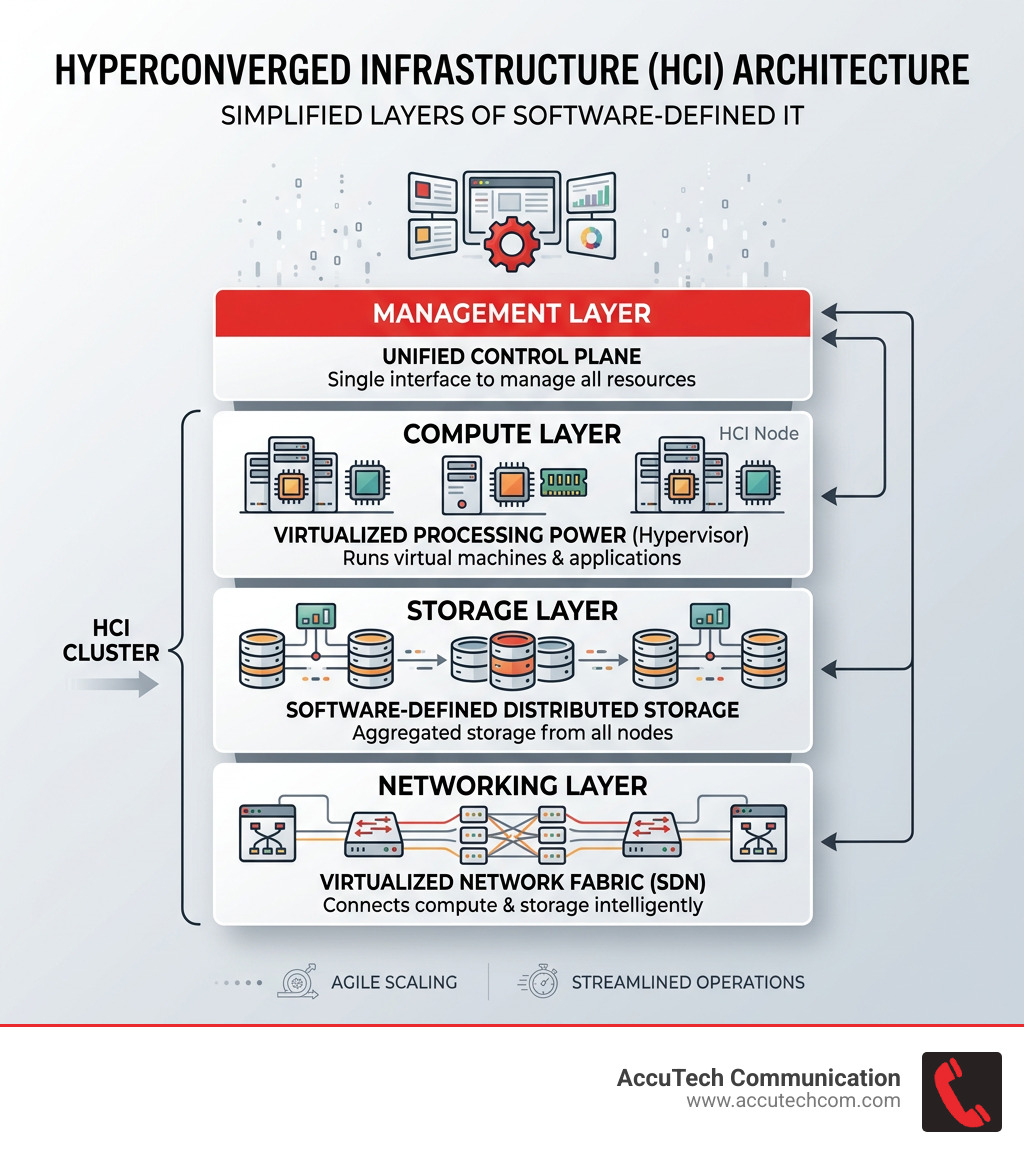
A hyper converged system is a software-defined IT infrastructure that combines compute, storage, and networking into a single, unified platform — managed through one interface.
At a glance:
- Compute — virtualized processing power (via a hypervisor)
- Storage — software-defined, distributed across each node
- Networking — virtualized network fabric (SDN)
- Management — single control plane for the entire cluster
In plain terms: instead of buying and managing separate servers, storage arrays, and networking gear, everything runs together as one system on commodity hardware.
IT infrastructure used to mean racks of separate, specialized hardware — each piece managed independently, each requiring its own team, budget, and expertise. For many businesses in Massachusetts, New Hampshire, and Rhode Island, that complexity still exists today. It slows down deployments, drives up costs, and makes scaling a painful process.
That’s exactly the problem hyper converged systems were designed to solve. By collapsing traditional data center layers into a single software-defined platform, HCI gives organizations a faster, leaner, and more agile foundation for modern workloads — from virtual desktops to edge computing and beyond.
The shift toward software-defined infrastructure isn’t just a trend. It represents a fundamental change in how IT resources are built, managed, and scaled. And for mid-to-large businesses looking to modernize without the overhead of legacy systems, it’s worth understanding clearly — beyond the buzzwords.
I’m Corin Dolan, owner of AccuTech Communications, and with decades of experience designing and deploying commercial network infrastructure across New England, I’ve seen how the right hyper converged system can transform an organization’s IT operations. In the sections ahead, I’ll break down exactly how HCI works, where it fits, and what to look for when evaluating it for your business.
Explore more about hyper converged system:
- data center infrastructure design
- data center infrastructure management
- data center cooling technologies
Defining the Hyper Converged System: Architecture and Components
To understand a hyper converged system, we have to look at how it differs from the “build-it-yourself” approach of the past. In a traditional data center, you have three distinct silos: servers for processing, a Storage Area Network (SAN) for data, and switches to connect them. Each silo has its own management tools and hardware requirements.
HCI flips this script. It uses Hyper-converged infrastructure principles to virtualize these elements and run them on standard, commercial off-the-shelf (COTS) servers.
The Core Building Blocks
- The Hypervisor: This is the engine. It virtualizes the physical CPU and memory of the servers, allowing multiple virtual machines (VMs) to run on a single node.
- Software-Defined Storage (SDS): This is the “secret sauce.” Instead of a physical SAN, the system pools the local drives (often high-performance flash storage) across all nodes in the cluster to create one massive, shared storage pool.
- Virtualized Networking (SDN): This handles the communication between VMs and nodes, often automating complex tasks like load balancing and security filtering.
- Unified Management: Often called a “single pane of glass,” this allows an IT administrator in Boston or Worcester to manage the entire cluster—compute, storage, and networking—from one dashboard.
By pooling these resources, a hyper converged system enables federated management. This means if you have multiple sites—say, a headquarters in Framingham and a branch in Manchester, NH—you can manage the resources across all instances as a single administrative platform.
HCI vs. Converged Infrastructure: Key Differences
It is common to hear the terms “converged” and “hyper converged” used interchangeably, but they are quite different animals. If we look at Hyper-Converged Architecture, the distinction lies in how tightly the components are integrated.
The Evolution of Convergence
- Traditional (Non-Converged): Separate servers, separate storage (SAN/NAS), and separate networking. You buy them from different vendors, and if something breaks, you’re calling three different support lines.
- Converged Infrastructure (CI): This was the first step toward simplicity. A vendor packages the servers, storage, and networking into a pre-validated rack. It’s easier to deploy, but the components are still discrete. You can technically pull the storage array out and use it elsewhere.
- Hyper-Converged Infrastructure (HCI): This is “convergence on steroids.” The integration is purely software-defined. You cannot separate the storage from the compute because the storage controller runs as a service on every node.
| Feature | Traditional Systems | Converged (CI) | Hyper-Converged (HCI) |
|---|---|---|---|
| Hardware | Discrete/Siloed | Pre-packaged Racks | Commodity X86 Nodes |
| Integration | Manual | Hardware-centric | Software-defined |
| Storage | Physical SAN/NAS | Integrated Array | Software-Defined (SDS) |
| Scalability | Complex/Slow | Modular (by rack) | Linear (by node) |
| Management | Multiple Consoles | Unified Hardware Tool | Single Software Interface |
As we often tell our clients in the Metro-west Boston area, while CI simplifies the purchase, HCI simplifies the life of the system. HCI is hardware-agnostic, meaning the software does the heavy lifting, allowing for much greater flexibility as your hardware ages.
Strategic Advantages of Modern Infrastructure
Why are so many enterprises in New England making the switch? It usually comes down to agility. When business needs change weekly, waiting months to procure and configure a new SAN is no longer an option.
A hyper converged system offers several strategic wins:
- Cost Efficiency: By using commodity hardware and reducing the need for specialized storage experts, organizations can significantly lower their Total Cost of Ownership (TCO).
- High Availability: HCI is designed for resilience. Most systems require a minimum of three nodes to ensure that if one fails, the data and VMs automatically migrate to the others without downtime.
- Performance Optimization: Modern HCI platforms often leverage all-flash storage and advanced caching, providing the high-speed I/O required for demanding applications like SQL databases or real-time analytics.
For those looking for more info about scalable data solutions, the beauty of HCI is that it grows with you.
Scaling Your Hyper Converged System for Business Growth
Traditional scaling is “lumpy.” You buy a big storage array, use 20% of it, and hope you grow into the rest before it becomes obsolete. HCI uses a “pay-as-you-grow” model.
When you need more power or space, you simply add another node to the cluster. The system automatically recognizes the new resources and redistributes the workload. This linear scaling ensures that performance stays consistent whether you have three nodes or thirty. For a growing company in Quincy or Lowell, this means you never pay for more than you need today, but you can expand in minutes when the time comes.
Operational Efficiency and Simplified Management
One of the biggest drains on IT staff productivity is “keeping the lights on”—managing updates, patching firmware, and troubleshooting connectivity. HCI automates much of this lifecycle management. With a single control plane, an admin can update the entire stack—from the hypervisor to the disk firmware—with a few clicks. This allows your team to focus on high-value projects rather than mundane maintenance.
Real-World Applications and Industry Use Cases
The versatility of a hyper converged system makes it a fit for almost any sector. Here is how we see it being used across Massachusetts, New Hampshire, and Rhode Island:
- Healthcare (EHR Management): Hospitals in cities like Worcester or Providence use HCI to ensure that Electronic Health Records are always available. The high availability of HCI is critical for patient care, where even five minutes of downtime is unacceptable.
- Finance (Real-Time Analytics): Financial firms in Boston leverage the high-performance flash storage of HCI to run complex trading algorithms and fraud detection systems that require sub-millisecond latency.
- Education (VDI Support): Universities use HCI to power Virtual Desktop Infrastructure (VDI). This allows students to access high-powered lab software from their own laptops, whether they are on campus in Amherst or studying remotely in Nashua.
- Manufacturing (IIoT): Smart factories use compact HCI clusters at the “edge”—right on the factory floor—to process data from Industrial IoT sensors in real-time, enabling predictive maintenance without sending all that data to a distant cloud.
- Government (Data Compliance): Local municipalities use HCI to consolidate aging servers into a secure, compliant platform that simplifies disaster recovery for critical public services.
Whether you need more info about data center services in New England or are looking to refresh a specific branch office, HCI provides a standardized blueprint for success.
Future Trends in Hyper Converged System Technology
The HCI market isn’t standing still. As we look toward the next generation of data centers, several trends are emerging:
- AI and Machine Learning Integration: Future systems will use AI to self-optimize. Imagine a cluster that predicts a hardware failure before it happens or automatically moves workloads to different nodes to save energy during off-peak hours.
- Containerization and Kubernetes: While HCI started with Virtual Machines, it is rapidly becoming the preferred platform for containers. Modern HCI now offers native Kubernetes support, allowing developers to deploy cloud-native apps on-premises with the same ease as the public cloud.
- Sustainability: With the rising cost of energy in New England, “green” data centers are a priority. HCI’s ability to consolidate multiple racks of gear into a few small appliances significantly reduces power and cooling requirements.
- Edge Computing: As 5G and IoT expand, we are seeing a shift toward smaller, two-node HCI clusters deployed in retail stores or remote offices, bringing data center power to the edge of the network.
Frequently Asked Questions about HCI
What is the minimum number of nodes required for an HCI cluster?
While some vendors offer two-node “edge” configurations, the industry standard for high availability is three nodes. This allows the cluster to maintain a “quorum” and ensure data integrity even if one node fails or is taken offline for maintenance.
How does HCI improve disaster recovery compared to traditional systems?
HCI simplifies disaster recovery because the entire environment is software-defined. You can easily replicate data from a cluster in Woburn to another cluster in Concord, NH. Because the hardware is abstracted, you don’t need identical server models at both sites, making your DR strategy much more cost-effective.
Can hyperconverged systems support both virtual machines and containers?
Yes. Modern hyper converged system platforms are designed to be “multi-modal.” They can run traditional legacy applications in virtual machines alongside modern, microservices-based applications in containers (like Docker or Kubernetes) on the same unified hardware.
Conclusion
The move to a hyper converged system is more than just a hardware upgrade; it’s a strategic shift toward a more agile, responsive IT department. By breaking down the silos of compute, storage, and networking, businesses across New England can reduce complexity and focus on what really matters: driving innovation and growth.
At AccuTech Communications, we’ve been helping businesses navigate these technological shifts since 1993. From our headquarters in Massachusetts to our service areas in New Hampshire and Rhode Island, we provide the certified, reliable expertise needed to build a modern data center foundation. Whether you are looking for a complete data center build-out or need to optimize your current network cabling to support high-speed HCI traffic, our team is committed to quality and competitive pricing.
Ready to move beyond the hype and see what HCI can do for your business? We’re here to help you design an infrastructure that’s ready for whatever the future holds.