
Business Cabling Services: 5 Powerful Reasons to Upgrade 2025
The Foundation of Modern Business Communications
Business cabling services form the critical backbone of any organization’s network infrastructure. If you’re searching for reliable business cabling solutions, here’s what you need to know:
- Structured Cabling: Organized, standards-compliant cabling that forms the foundation of your business network
- Cable Types: Options include Cat5e (1Gbps), Cat6 (1Gbps+), Cat6A (10Gbps), and fiber optic (highest speeds/distances)
- Key Benefits: Reduced downtime, easier troubleshooting, scalability for future growth
- Professional Installation: Ensures reliability, proper documentation, and warranty coverage
Modern businesses rely heavily on stable, high-speed connectivity for everything from cloud applications to video conferencing. Your cabling infrastructure represents nearly 80% of your network efficiency, even though it’s just a small portion of your overall network investment.
The structured cabling market is expected to grow from $11.7 billion in 2022 to $15 billion by 2027, showing the increasing importance of professional cabling services as businesses digitally transform.
Unlike the tangled “spaghetti wiring” often found in aging infrastructure, properly designed business cabling creates an organized foundation that supports reliable voice, data, and video applications while simplifying future changes and expansions.
I’m Corin Dolan, owner of AccuTech Communications with over 25 years of experience designing and implementing business cabling services across Massachusetts, New Hampshire, and Rhode Island. My team specializes in creating scalable, future-proof cabling infrastructures that grow with your business needs.
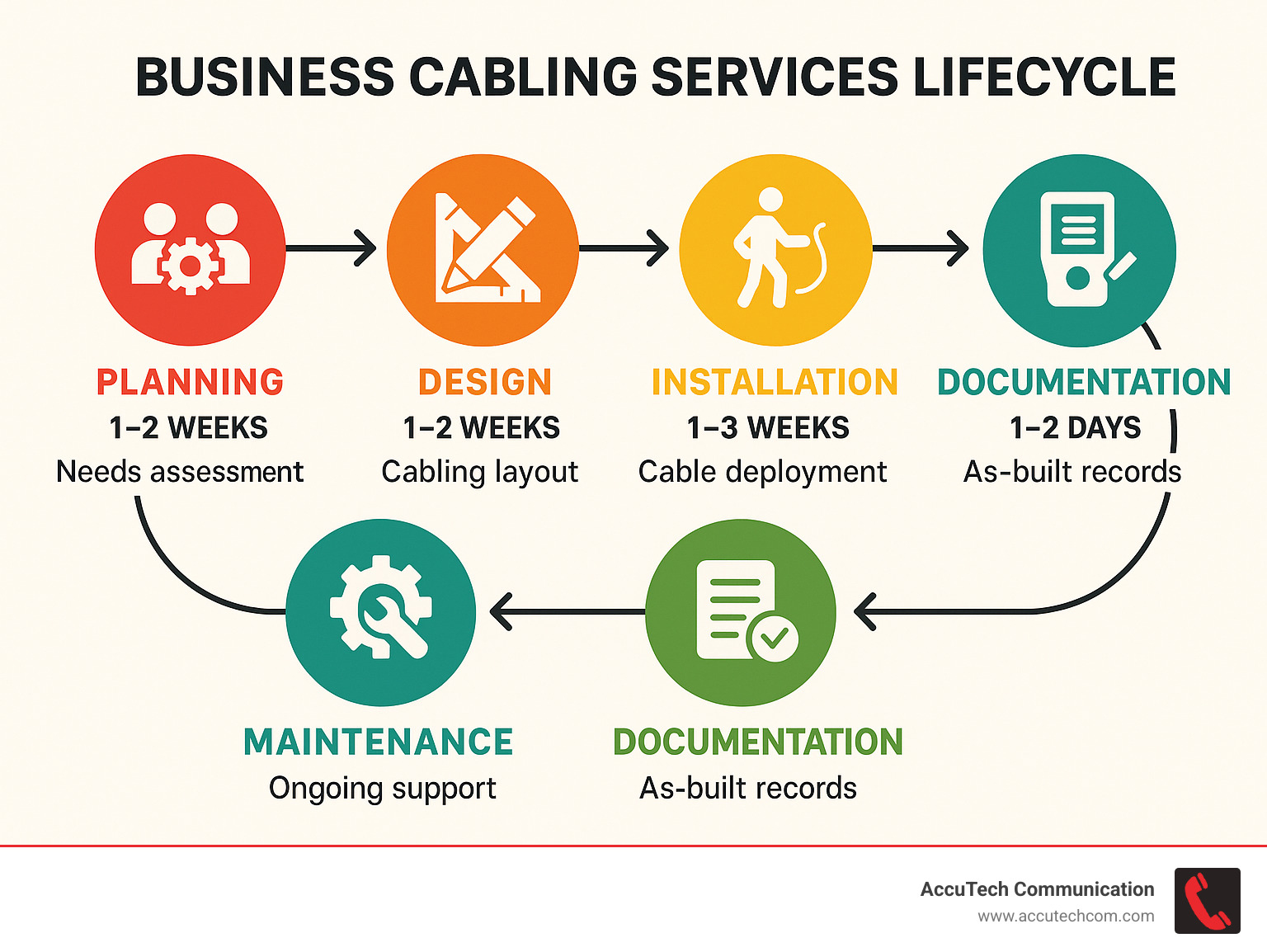
Important Business Cabling Services terms:
– cable technician
– different types of computer cables
– ethernet cable standards
Business Cabling Services at a Glance
When planning your network infrastructure, choosing the right cables might seem like a small detail—but it’s actually one of the most critical decisions you’ll make. Let me walk you through the options so you can make an informed choice for your business cabling services needs.
| Cable Type | Max Speed | Max Distance | Shielding | Best For | Typical Cost |
|---|---|---|---|---|---|
| Cat5e | 1 Gbps | 100m | Unshielded | Basic office networks, VoIP | $ |
| Cat6 | 1 Gbps (10 Gbps at shorter distances) | 100m (55m for 10 Gbps) | Shielded/Unshielded | Modern office networks | $$ |
| Cat6A | 10 Gbps | 100m | Shielded | Data centers, future-proofing | $$$ |
| Fiber Optic | 10-100+ Gbps | 10km+ | Inherent | Long distances, high bandwidth, security | $$$$ |
| Coaxial | Up to 1 Gbps | 500m | Shielded | Video, legacy systems | $$ |
Cat5e: The Baseline Standard
I still encounter many businesses limping along with outdated Cat5e installations. While this cable type technically supports gigabit speeds, it’s becoming the minimum acceptable standard rather than the recommended one. In our daily work, we frequently find networks restricted to just 10/100 megabit speeds—painfully slow for today’s bandwidth-hungry applications like video conferencing and cloud services.
Cat6 and Cat6A: Modern Business Standards
If you’re setting up a new office or upgrading your existing network, Cat6 offers significantly better performance with improved protection against crosstalk and interference. For businesses planning ahead, Cat6A (the “A” stands for Augmented) delivers full 10 Gigabit support across the entire 100-meter distance—making it an excellent investment for future-proofing your network infrastructure.
Fiber Optic: The Gold Standard
When clients ask me about the absolute best option for their backbone connections, server rooms, or applications requiring maximum reliability, I always recommend fiber optic cabling. While it represents a higher initial investment, fiber delivers best benefits:
- Complete immunity to electromagnetic interference (crucial in manufacturing environments)
- Support for extremely high bandwidths that will remain viable for decades
- Improved security since fiber is much more difficult to tap than copper
- Transmission distances measured in kilometers rather than meters
Coaxial: Still Relevant for Specific Applications
Don’t write off coaxial cable just yet. While it’s less common in new data installations, coax remains important for video applications, security cameras, and some specialized network segments where its unique characteristics are beneficial.
The structured cabling market is projected to grow at a healthy 5.1% CAGR through 2027, reaching $15 billion from $11.7 billion in 2022. This growth reflects the increasing recognition that robust network infrastructure is not just an IT expense but a critical business investment that impacts everything from employee productivity to customer experience.
When considering the true cost of your network, scalability is paramount. The right cabling infrastructure will grow with your business needs, while poor choices can lead to expensive rework and frustrating downtime.
More info about structured cabling installation
External stats on market growth
Copper vs Fiber: Choosing the Right Medium
When planning your Business Cabling Services, one of the most important decisions is whether to deploy copper (Cat5e/Cat6/Cat6A) or fiber optic cabling. This choice impacts everything from performance to longevity and cost.
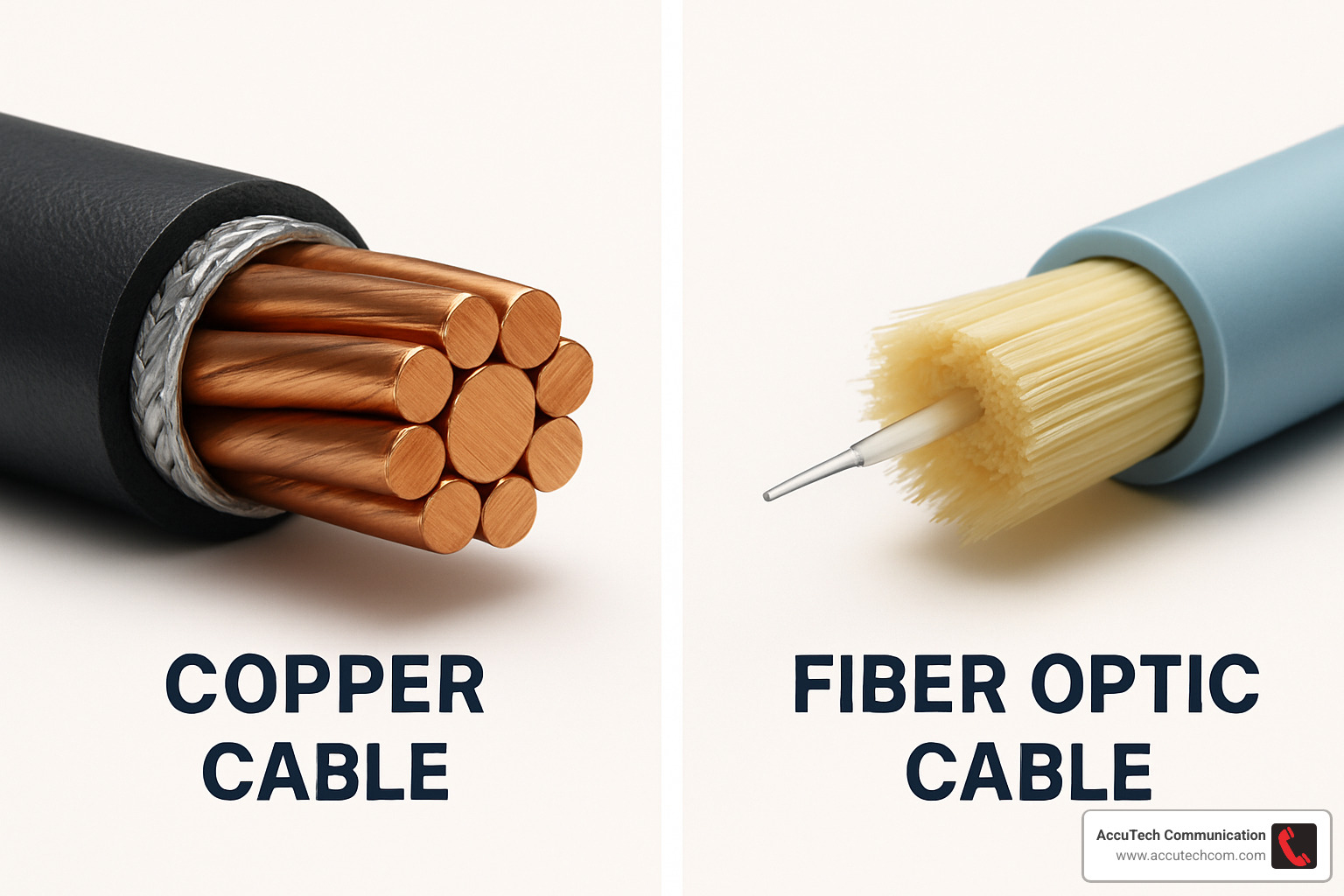
Copper Cabling: The Workhorse
Copper-based twisted pair cabling remains the backbone of most office networks, and for good reason. I’ve installed thousands of Cat5e, Cat6, and Cat6A runs throughout Massachusetts, and they continue to be the go-to solution for connecting workstations to network closets.
Why do businesses love copper? It’s cost-effective for shorter runs, plays nicely with your existing infrastructure, and delivers Power over Ethernet (PoE) for your wireless access points, security cameras, and VoIP phones. Plus, it’s generally simpler to terminate and test compared to fiber.
That said, copper isn’t without its challenges. Have you ever experienced mysterious network slowdowns or disconnections? Electromagnetic interference (EMI) might be the culprit. Copper cabling is susceptible to interference from electrical equipment, motors, and other sources – a real problem in industrial settings, healthcare facilities, and manufacturing plants. Scientific research on electromagnetic interference confirms this can significantly impact network performance.
I’ve seen this with clients across New England – copper cabling also hits a wall at about 100 meters (328 feet), which can be limiting in larger facilities or campus environments.
Fiber Optic: The Future-Proof Solution
Fiber optic cabling is like upgrading from a country road to a superhighway. Instead of electrical signals traveling through metal, fiber uses pulses of light through glass or plastic fibers – and the difference is remarkable.
While your copper Cat6A maxes out at 10 Gbps, fiber can handle 100 Gbps and beyond. Need to run cable between buildings or across a large warehouse? Single-mode fiber can transmit data over kilometers without breaking a sweat. Working in an environment with heavy electrical equipment? Fiber’s complete immunity to EMI means your connection stays rock-solid.
Security-conscious businesses particularly appreciate fiber’s resistance to tapping – it’s extremely difficult to intercept data without detection. And if you’re tight on conduit space, fiber’s smaller diameter is a blessing in disguise.
Real-World Considerations
When I sit down with clients from Boston to Worcester and throughout New England, we don’t just talk specs – we talk about their actual business needs. Does your team regularly transfer massive design files? Are you planning to implement bandwidth-hungry applications in the next few years? Do you handle sensitive financial or healthcare data?
For most businesses, I recommend a thoughtful hybrid approach: copper cabling for workstation connections where PoE is needed, and fiber optic for backbone connections between floors, buildings, or for server room connections. This balanced approach gives you the best of both worlds – cost-effectiveness where it makes sense, and future-proof performance where it matters most.
Your bandwidth requirements, distance needs, environmental factors, budget constraints, and security requirements all play crucial roles in this decision. At AccuTech Communications, we’ve helped countless businesses across Massachusetts, New Hampshire, and Rhode Island steer these choices based on their specific situations rather than pushing a one-size-fits-all solution.
Ready to explore the right cabling medium for your business? More info about data cable installation is just a click away.
Structured Cabling, Cable Management & Smart Building Integration
The heart of professional Business Cabling Services is structured cabling—a standardized approach to building network infrastructure that follows established industry guidelines. Unlike the chaos of point-to-point cabling, structured cabling creates an organized, hierarchical system that supports multiple applications and makes future changes much simpler.
The Six Subsystems of Structured Cabling
When we design cabling systems for our Massachusetts clients, we follow industry standards that break down structured cabling into six essential components. Think of it as the blueprint for your network’s physical layer.
First, the Entrance Facility serves as your building’s telecommunications gateway—where external services connect to your internal network. This connects to your Equipment Room, which houses your critical servers, core switches, and network equipment.
Backbone Cabling ties everything together, connecting your equipment rooms and telecommunications rooms—often using high-speed fiber optic cables for maximum performance. From there, Horizontal Cabling branches out like a tree, running from telecommunications rooms to individual workstations throughout your facility.
Your Telecommunications Rooms serve as mini-hubs on each floor, housing patch panels, switches, and cross-connects. Finally, Work Area Components bring connectivity to your employees through outlets, patch cords, and equipment connections.
This systematic approach creates a network foundation that’s reliable, scalable, and much easier to manage than the “spaghetti mess” we often encounter when called in to fix problematic networks.
Cable Management: The Unsung Hero
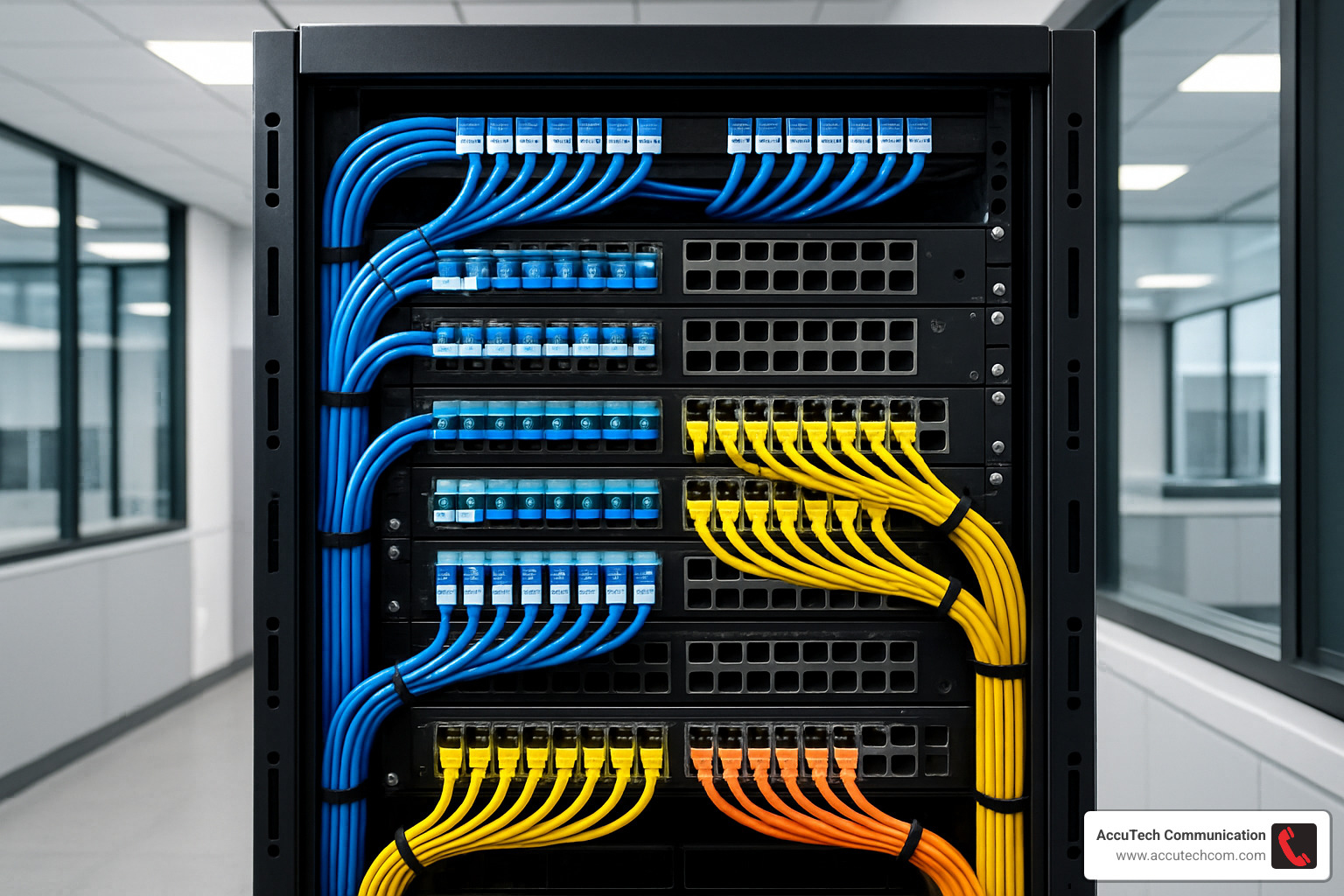
Even the highest-quality cabling becomes a nightmare without proper management. I’ve personally witnessed how a well-organized rack can save hours of troubleshooting time when issues arise.
Good cable management isn’t just about aesthetics (though a tidy rack is certainly satisfying to see). It’s about functionality and future-proofing. We implement color-coded cables so you can quickly identify different systems or network segments at a glance. We maintain appropriate bend radius to prevent signal degradation that occurs when cables are bent too sharply.
Proper cable routing minimizes crosstalk and interference between adjacent cables. Every connection gets clear labeling on both patch panels and outlets, making troubleshooting dramatically faster. And we use the right cable management accessories like D-rings, cable trays, and vertical managers to keep everything neat and accessible.
I’ve seen how proper cable management can transform a 3-hour troubleshooting headache into a 5-minute fix. When every cable is labeled, organized, and documented, finding and resolving issues becomes remarkably simple.
Smart Building Integration
Modern Business Cabling Services extend far beyond traditional data networks. Today’s infrastructure must support a whole ecosystem of smart building technologies.
Your cabling system now serves as the foundation for IP-based security cameras monitoring your facility, access control systems protecting sensitive areas, and strategically placed wireless access points ensuring comprehensive Wi-Fi coverage. The same infrastructure supports your building automation systems controlling HVAC, lighting, and energy management.
We’re increasingly incorporating support for digital signage, sophisticated audiovisual systems, and countless IoT sensors and devices that monitor everything from space utilization to environmental conditions.
The secret to successful smart building integration isn’t treating these systems as afterthoughts. By planning for them during the initial cabling design, we create an integrated approach that reduces overall costs while improving system performance and reliability.
Power over Ethernet (PoE): Expanding Possibilities
One of the most exciting developments in our field is Power over Ethernet technology. PoE allows network cables to carry electrical power alongside data, eliminating the need for separate power cables for many devices.
This technology has transformed how we deploy IP phones, wireless access points, and security cameras. It’s now extending to LED lighting, access control readers, and digital displays throughout your facility.
The latest PoE standards deliver up to 90 watts of power—enough to run increasingly sophisticated devices. However, this increased power transmission demands high-quality cabling to prevent overheating and maintain signal integrity.
For our clients across Massachusetts, New Hampshire, and Rhode Island, we design cabling systems that not only meet current needs but anticipate future smart building applications. This forward-thinking approach ensures your infrastructure investment remains valuable as technology evolves—something we’ve been helping businesses with since 1993.
More info about Structured Cabling Definition
Provider Checklist & Business Cabling Services FAQs
Choosing the right partner for your business cabling services isn’t just about finding someone who can run cables – it’s about finding a team that understands your business needs and can deliver a solution that grows with you. After helping hundreds of businesses throughout New England, I’ve learned what separates the professionals from the amateurs.
Provider Evaluation Checklist
When you’re evaluating potential cabling partners, don’t just focus on price. Look for credentials that matter. BICSI certification and RCDD credentials tell you the technicians understand proper installation techniques and industry standards. These aren’t just fancy acronyms – they represent rigorous training that ensures your cabling infrastructure will be built right the first time.
Experience matters too, especially in your specific industry. A provider who’s wired medical facilities understands the unique demands of healthcare environments, just as someone experienced with manufacturing plants knows how to handle high-EMI environments. Always ask for references from similar projects and actually call them – you’d be surprised what you might learn!
Documentation might sound boring, but trust me, those as-built drawings and testing results become incredibly valuable when you need to troubleshoot or expand your network years later. And speaking of the future, verify the warranty terms – the industry standard is 15-25 years, and anything less should raise eyebrows.
Since 1993, we at AccuTech Communications have maintained these professional standards while serving businesses throughout Massachusetts, New Hampshire, and Rhode Island. Our BICSI-certified technicians aren’t just running cables – they’re building the foundation of your business technology.
What Makes Business Cabling Services Professional?
Professional business cabling services go far beyond just connecting point A to point B. When we tackle a cabling project, we bring several critical elements to the table.
First, there’s certification. Our BICSI-certified technicians understand not just how to run cables, but how to create systems that meet rigorous industry standards. Having an RCDD (Registered Communications Distribution Designer) involved in your project ensures your solution is properly engineered from the ground up, not just cobbled together.
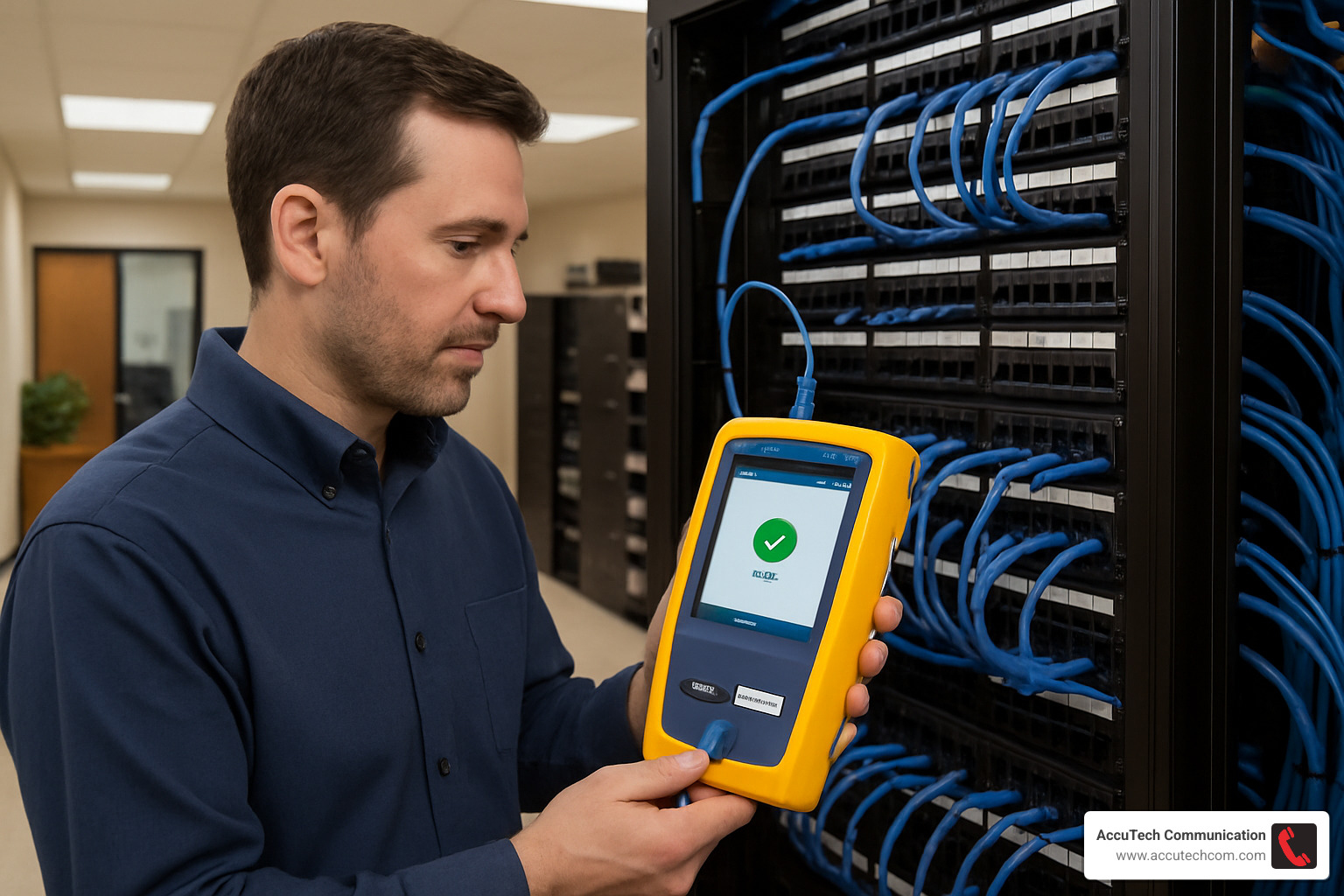
Testing is where the professionals truly separate themselves from the amateurs. We use advanced Fluke DTX Cable Analyzers to certify every single cable run. This isn’t just a simple connectivity check – we’re measuring multiple parameters including wire mapping, length, insertion loss, near-end crosstalk (NEXT), and several other metrics that sound technical but directly impact how your network performs day-to-day.
Detailed documentation is another hallmark of professional service. When we finish a project, you’ll receive comprehensive as-built drawings showing exactly where cables run, detailed patch panel layouts, complete test results, and clear labeling schemes. This documentation becomes invaluable during troubleshooting or when you’re planning expansions.
Perhaps most importantly, professional installations dramatically reduce network downtime. Studies show that structured cabling represents nearly 80% of your network efficiency, despite being just a small portion of your overall network investment. When your cabling is done right, those mysterious network glitches that plague so many businesses simply disappear.
More info about The Importance of Professional Cabling Installation for Your Business
How Much Do Business Cabling Services Cost?
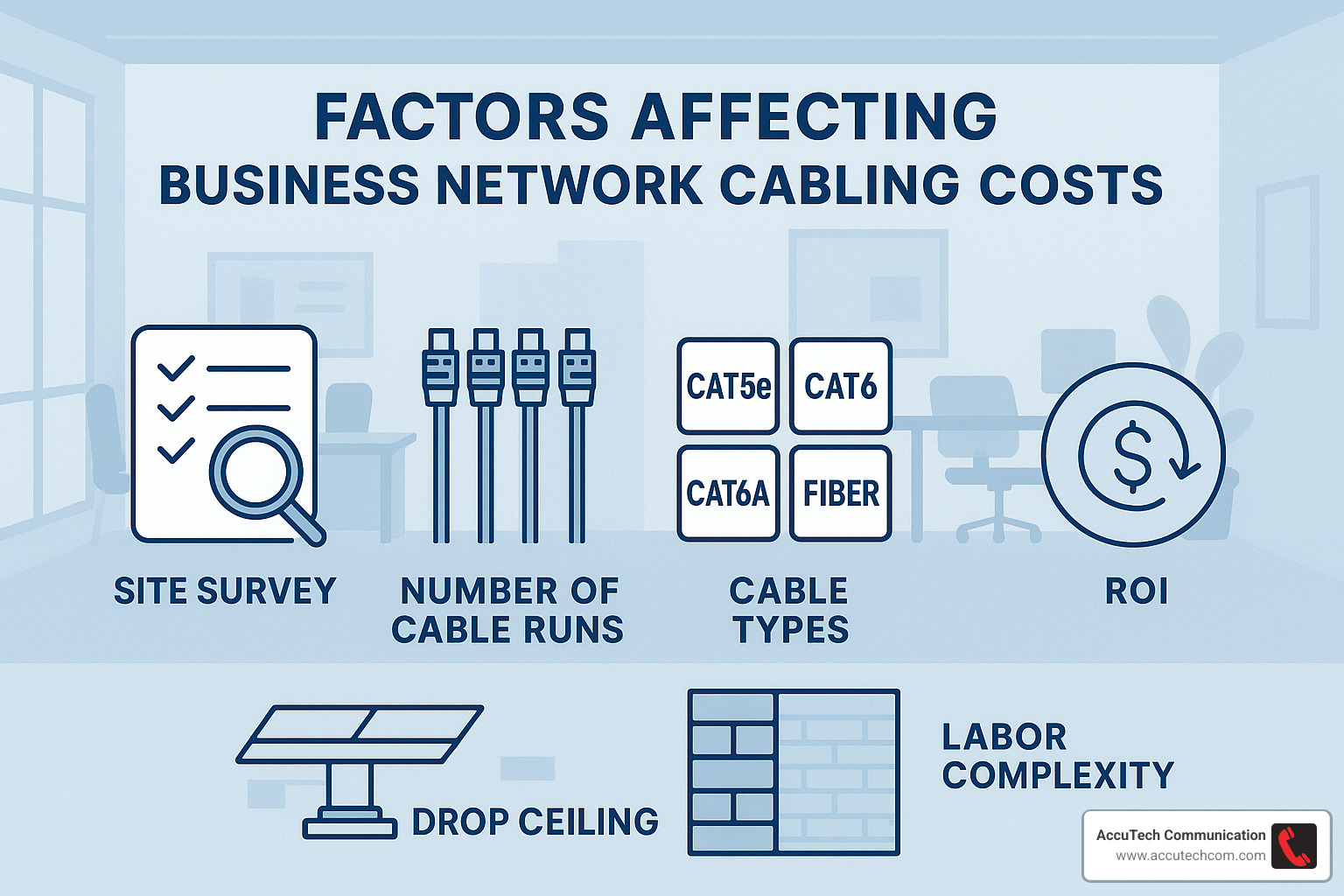
I’m often asked, “What does cabling cost?” The honest answer is: it depends on several factors unique to your situation. Every project begins with a thorough site survey – this isn’t just a quick walkthrough, but a detailed assessment of your existing infrastructure, potential challenges, and optimal cable pathways. This critical step ensures accurate pricing and prevents those dreaded “surprises” during installation.
The number of cable runs is naturally a primary cost driver. Each workstation typically needs at least one data connection, while meeting rooms might need several for phones, computers, displays, and wireless access points. Then there’s the cable type – Cat5e is most economical but offers limited future-proofing, while Cat6A costs more but supports full 10 Gigabit speeds. Fiber optic cabling represents a higher initial investment but offers superior performance and longevity.
Installation complexity varies dramatically based on your building. Drop ceilings make our job easier (and your cost lower), while solid ceilings or walls may require core drilling. Plenum spaces require special fire-rated cabling, and historic buildings – which we encounter frequently in New England – often present unique challenges that require creative solutions.
While professional cabling might have a higher initial cost than a quick-and-dirty installation, it delivers significant ROI through reduced downtime, lower maintenance costs, and easier moves/adds/changes down the road. When your business grows or evolves, a properly designed cabling system grows with you without requiring a complete overhaul.
Signs You Need to Upgrade Business Cabling Services
Many businesses push their cabling infrastructure until it’s practically begging for mercy. Here are some telltale signs it’s time for an upgrade:
If your network feels like it’s running through molasses despite having fast internet service and modern equipment, your cabling might be the culprit. Most networks we encounter are still limping along at 10/100 megabit speeds – woefully inadequate for today’s bandwidth-hungry applications.
Frequent connection drops are another red flag. Those mysterious disconnections that force you to unplug and replug your network cable? They’re often symptoms of aging or improperly installed cabling, and they typically worsen over time as connectors oxidize and cable integrity degrades.
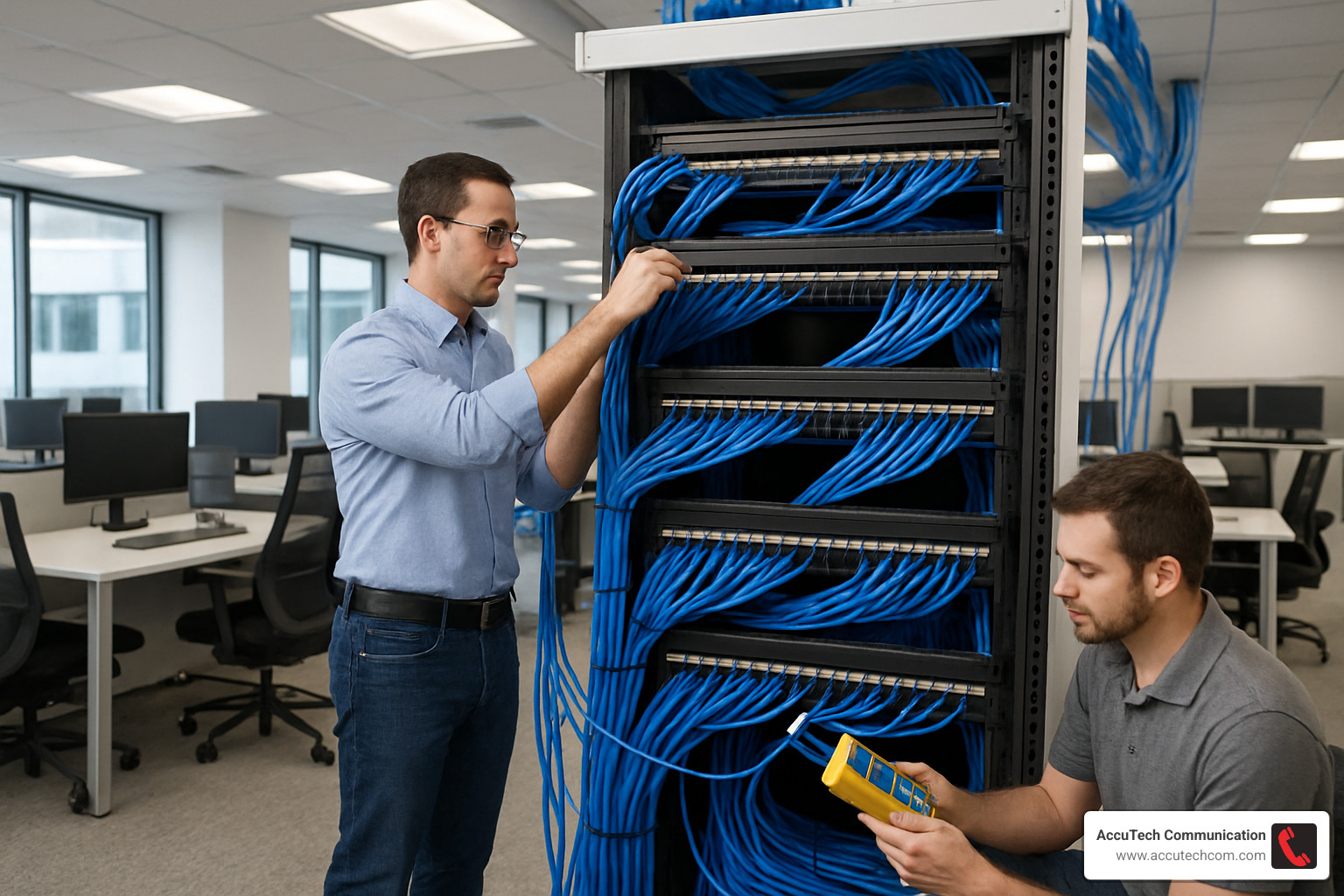
Take a look at your server room or network closet. If it resembles a spaghetti bowl of unlabeled, tangled cables, you’re not just looking at an eyesore – you’re seeing inefficiencies that will create major headaches during troubleshooting or changes.
Business expansion often reveals the limitations of existing cabling. Adding new workstations, departments, or locations becomes significantly more challenging with outdated infrastructure. Similarly, new technology adoption like VoIP phones, video conferencing, and IoT devices places greater demands on your network backbone.
If your organization is planning for 10 Gigabit Ethernet – which is increasingly common even in small to mid-sized businesses – Cat6A or fiber optic cabling isn’t just nice to have, it’s essential. Attempting to run 10 Gigabit over older cabling is like trying to drink a milkshake through a coffee stirrer – technically possible but frustratingly ineffective.
For businesses throughout Massachusetts, New Hampshire, and Rhode Island, we offer comprehensive network assessments to identify potential cabling limitations before they impact your operations.
More info about Boost Your Connectivity
Conclusion
Business cabling services aren’t just wires running through your walls—they’re the lifeline of your entire technology ecosystem. It’s easy to overlook cabling until something goes wrong, but by then, you’re already facing downtime, frustration, and potentially significant costs.
Throughout this article, we’ve seen how professional cabling creates a solid foundation that pays dividends in multiple ways. When we install structured cabling systems for our Massachusetts clients, they immediately notice the difference in network performance and reliability. But the benefits extend far beyond that initial improvement.
Think of quality cabling as an insurance policy against future headaches. When your network runs smoothly day after day, when adding new workstations doesn’t require extensive rewiring, when troubleshooting takes minutes instead of hours—that’s when you truly appreciate professional installation.
Since opening our doors in 1993, AccuTech Communications has partnered with businesses across Massachusetts, New Hampshire, and Rhode Island to create cabling infrastructures that stand the test of time. Our approach combines technical expertise with practical business sense—we understand that you need solutions that work today while preparing you for tomorrow’s challenges.
The real value of professional business cabling services becomes apparent over time. When your competitors are struggling with network bottlenecks or spending thousands on emergency repairs, you’ll be leveraging your robust infrastructure to adopt new technologies, expand operations, and keep your team productive.
Whether you’re building from scratch, renovating an existing space, or simply addressing nagging network issues, investing in professional cabling pays off through improved reliability, superior performance, simplified scalability, thoughtful future-proofing, comprehensive documentation, and valuable warranty protection.
Ready to transform your network foundation? We’d love to visit your site, understand your unique challenges, and design a cabling solution custom to your specific needs. Our BICSI-certified technicians bring decades of experience to every project, ensuring your installation meets the highest industry standards while preparing your business for whatever comes next.
More info about Network Cabling Installation
