
Why CCTV Cameras for Business Are a Smart Investment
CCTV cameras for business are one of the most effective tools for protecting your commercial property, deterring theft, and keeping operations running smoothly. Here’s a quick overview of what matters most when choosing a system:
Top things to know before buying business CCTV cameras:
- Resolution: Look for at least 1080p; 2K or 4K is ideal for identifying faces and license plates
- Camera type: Dome, bullet, turret, and PTZ cameras each suit different environments
- Technology: IP cameras offer the best scalability and image quality for commercial use
- Storage: Local NVR storage is more reliable and cost-effective than cloud for most businesses
- Smart features: AI motion detection, people counting, and two-way audio add real operational value
- Installation: Professional installation eliminates blind spots and ensures proper coverage
- Integration: The best systems connect with alarms, access control, and mobile apps
The stakes are real. According to the University of Florida’s National Retail Security Survey, small businesses lose between $25,000 and $33,000 every minute to shoplifters — and over 50% of small businesses in the U.S. reported experiencing retail theft in the past year alone. A well-planned surveillance system does more than record incidents after the fact. Visible cameras deter criminals before they act, protect employees, support compliance requirements, and give business owners remote visibility into daily operations.
Whether you’re securing a single office in Massachusetts or managing multiple commercial facilities across New England, the right camera system can make a measurable difference.
I’m Corin Dolan, owner of AccuTech Communications, and I’ve spent decades helping commercial clients across Massachusetts, New Hampshire, and Rhode Island design and implement reliable CCTV cameras for business as part of their broader network and communications infrastructure. In the sections below, I’ll walk you through everything you need to know to choose the right system for your business.
Learn more about cctv cameras for business:
Essential Features of CCTV Cameras for Business
When we sit down with business owners in Boston or Manchester to design a surveillance plan, we start by looking at the specific environmental challenges of their facility. A one-size-fits-all approach rarely works for commercial enterprises. You need hardware that can handle the specific lighting, weather, and physical layout of your site.

Key features to prioritize include:
- Resolution and Image Clarity: Grainy footage is useless when you need to provide evidence to the police. Modern systems range from 1080p (2 megapixels) to 4K UHD (8 megapixels). Higher resolution allows you to cover more floor space with fewer cameras because you can zoom into digital footage without losing critical detail.
- Night Vision and Low-Light Performance: Most crimes happen under the cover of darkness. Look for cameras equipped with Infrared (IR) LEDs that can reach 30 meters (about 100 feet) or more. For parking lots or poorly lit alleyways, cameras with high-end low-lux sensors or full-color night mode can provide clear images even in near-total darkness.
- Field of View (FOV): Wide-angle lenses are essential for monitoring large open areas like lobbies or warehouses, while narrower lenses are better for focused areas like cash registers or entryways.
- Weatherproofing and Durability: For our New England clients, cameras must survive harsh winters and humid summers. Look for IP66 or IP67 ratings, which indicate the housing is dust-tight and protected against powerful water jets or temporary immersion.
- Vandal Resistance: In unattended areas or public-facing exteriors, “IK10” rated vandal-resistant housings (typically found on dome cameras) prevent intruders from easily disabling the unit.
For more details on hardware selection, check out our guide on commercial security cameras.
High-Resolution CCTV Cameras for Business
The jump from 1080p to 4K is significant for business owners. While 1080p is the bare minimum for general monitoring, 4K UHD captures four times as many pixels. This is the difference between seeing a “person in a red hoodie” and being able to read the logo on that hoodie or clearly identify facial features. In parking lot applications, high resolution is the only way to reliably perform license plate recognition (LPR).
Scalable CCTV Cameras for Business Systems
Your security system should grow with your company. We always recommend “future-proof” installations that use Network Video Recorders (NVRs) with extra channels. If you start with eight cameras today but expand your warehouse next year, you shouldn’t have to replace your entire head-end unit. Scalable systems also allow for multi-site management, letting you view footage from your Worcester office and your Providence warehouse on a single dashboard.
Comparing Camera Technologies: IP, Analog, and Wireless
Choosing the underlying technology is the most important technical decision you’ll make. While older analog systems still exist, the industry has largely shifted toward IP (Internet Protocol) technology.
| Feature | IP Cameras (Digital) | Analog Cameras (CVI/TVI/AHD) | Wireless Cameras |
|---|---|---|---|
| Resolution | Up to 4K and beyond | Max 4K (often lower frame rate) | Typically 1080p to 2K |
| Cabling | Single Cat5e/Cat6 (PoE) | Coaxial + Power cable | Power cable only (usually) |
| Scalability | High (Network-based) | Limited by DVR ports | Limited by Wi-Fi bandwidth |
| Cybersecurity | Advanced (Encrypted) | Low (Physical access focus) | Moderate (Wi-Fi risks) |
| Distance | 100m (can extend via switches) | Up to 500m without boosters | Limited by Wi-Fi range |
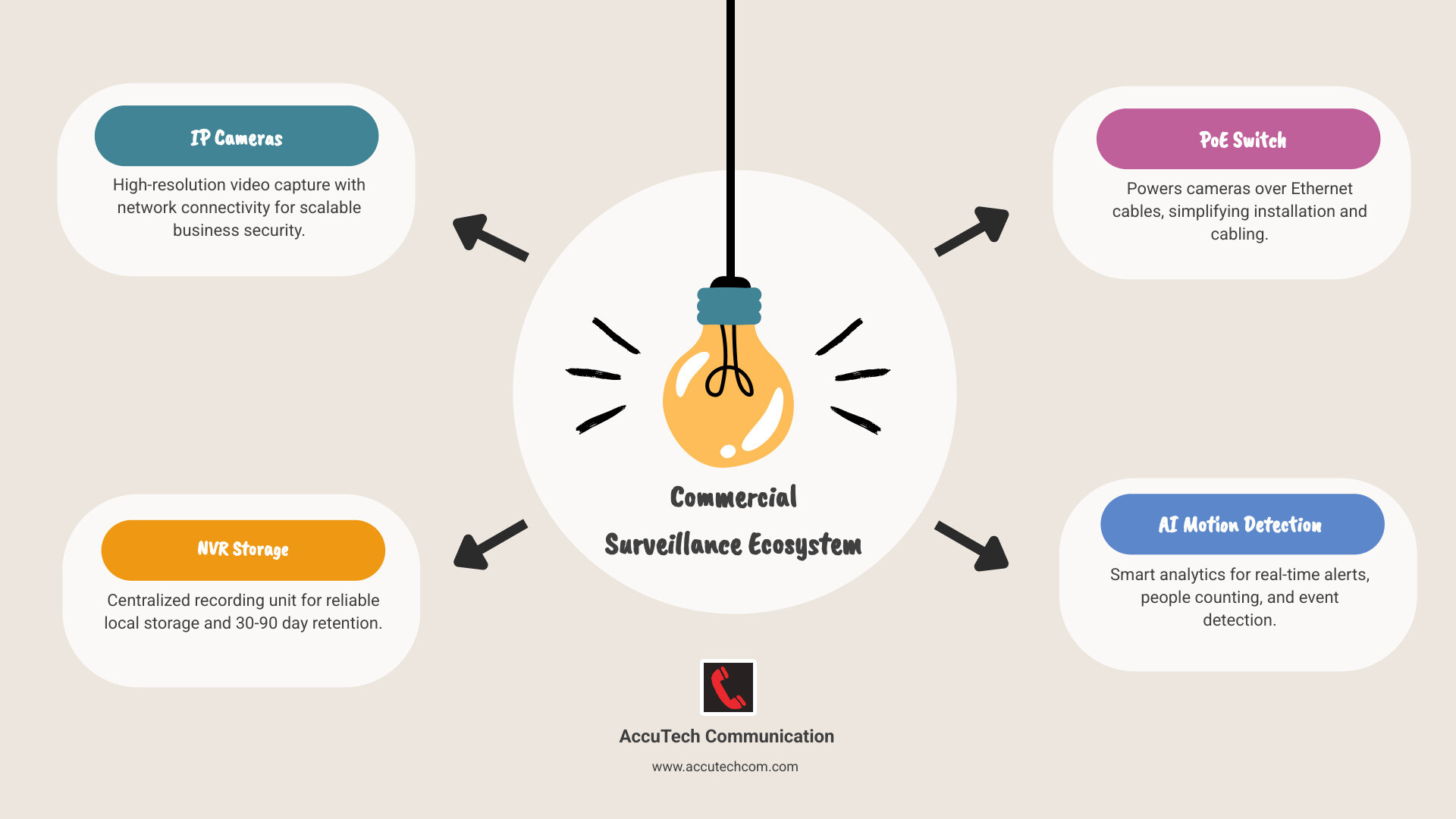
IP cameras are the gold standard for business CCTV systems. They use Power over Ethernet (PoE), meaning one single network cable provides both data and power. This simplifies installation and allows for much higher data throughput, which is necessary for AI analytics and high-resolution streaming.
While wireless cameras seem convenient, they are rarely suitable for enterprise-grade security. They still require a power cord, and the risk of Wi-Fi interference or signal “jamming” makes them less reliable than a hardwired connection. For a robust commercial setup, we almost always recommend a wired IP infrastructure.
Choosing the Right Hardware: Dome, Bullet, Turret, and PTZ
The shape of the camera dictates where it should be placed and how it will perform.
- Dome Cameras: These are low-profile and encased in a transparent protective dome. They are the best choice for indoor retail environments or low ceilings because they are aesthetically pleasing and make it difficult for people to see which way the lens is pointing.
- Bullet Cameras: These have a distinct “barrel” shape. They act as a strong visual deterrent, signaling to everyone that the area is under surveillance. They are ideal for outdoor use and long-range viewing.
- Turret (Eyeball) Cameras: These offer the best of both worlds. They provide high-quality night vision (because the IR LEDs are separate from the lens, preventing “spiderweb” glare) and are easier to adjust than dome cameras.
- PTZ (Pan-Tilt-Zoom) Cameras: These can be moved remotely by a security operator or programmed to automatically “tour” an area. They are excellent for large parking lots or loading docks where you need to track movement in real-time.
Explore more about these options in our section on video surveillance camera systems.
Strategic Planning: Storage, Analytics, and Integration
According to SafeWise and the University of Florida, retail theft is an escalating problem that requires more than just “passive” recording. Modern cctv cameras for business provide “active” intelligence.
Storage and Retention
How long do you need to keep your footage? While a standard office might only need 14 days of history, certain industries have strict legal requirements. For instance, cannabis facilities in many jurisdictions are required to maintain 30 to 90 days of continuous footage.
We typically recommend local NVR storage over cloud-only solutions. Local storage offers higher bit rates (better image quality), no monthly subscription fees for storage, and continues to record even if your internet goes down. For maximum reliability, we configure NVRs with RAID redundancy, ensuring that if one hard drive fails, your data remains safe.
Smart Analytics
AI is changing the way we use surveillance. Instead of a manager sitting and watching hours of empty hallways, AI detection can send an alert only when a person or vehicle enters a restricted zone after hours.
- People Counting: Helps retail managers understand foot traffic patterns and optimize staffing.
- Line Crossing: Alerts security if someone climbs a fence or enters a “staff only” area.
- Two-Way Audio: Allows you to speak through the camera to delivery drivers or warn off trespassers remotely.
Integrating these features with your existing video monitoring services creates a proactive security shield.
Investment and Professional Installation in New England
When budgeting for a system, it is important to look at the Total Cost of Ownership (TCO). Based on industry averages and online data, a small business system (4-8 cameras) might range from $500 to $4,500, while enterprise-level systems for large warehouses or multi-floor offices can range from $7,000 to over $25,000. These are average costs sourced from publicly available internet data and are not the actual prices of AccuTech Communications.
Professional installation is where the real value lies. A DIY setup often results in:
- Blind Spots: Cameras placed too high or at the wrong angle.
- Cable Failures: Using non-rated cables that degrade in New England weather.
- Legal Liability: Failing to follow OSHA safety compliance standards or privacy laws regarding camera placement in sensitive areas like break rooms.
At AccuTech, we ensure your system is integrated with your cctv installation services and broader network cabling to ensure 99.9% uptime.
Frequently Asked Questions about Commercial Surveillance
How do security cameras help reduce business theft?
Visible cameras act as a primary deterrent. When criminals see high-quality cctv cameras for business, they are less likely to target that location. Internally, cameras help reduce “shrinkage” by monitoring cash-handling areas and inventory rooms. If a theft does occur, high-resolution footage provides the evidence needed for insurance claims and police investigations.
What are the best camera types for warehouses vs retail?
Warehouses benefit from a mix of high-bay bullet cameras for aisles and PTZ cameras for loading docks. Retail environments usually prefer discreet dome or turret cameras that provide wide-angle coverage of sales floors and high-detail views of point-of-sale (POS) terminals.
What maintenance do commercial CCTV systems require?
To keep your system running at peak performance, you should:
- Clean lenses every few months to remove dust or spiderwebs.
- Check storage health to ensure hard drives are recording correctly.
- Update firmware to protect against cybersecurity vulnerabilities.
- Test cables and PoE switches to ensure power delivery is stable.
Conclusion
Securing your enterprise requires more than just buying a few cameras online. It requires a strategic approach to network infrastructure, storage, and hardware selection. Since 1993, AccuTech Communications has been a trusted partner for businesses throughout Massachusetts, New Hampshire, and Rhode Island. We don’t just hang cameras; we build integrated security ecosystems that protect your assets and your people.
Whether you need a simple four-camera setup for a local shop or a complex 64-camera IP system for a regional distribution center, our team is ready to help. We provide certified, reliable service with a commitment to quality that has kept us in business for over 30 years.
Ready to secure your facility? Request an estimate for business security installation today and let’s design a system that works for you.
