
Cabling Solutions: 6 Powerful Reasons for Unbeatable Success 2025
Building Your Digital Foundation: The Critical Role of Cabling Infrastructure
Cabling solutions are the backbone of any modern business network, providing the physical infrastructure that connects your vital systems and enables seamless communication. Without proper cabling, even the most expensive network equipment can’t perform to its potential.
🔍 What are cabling solutions?
- Structured cabling systems: Organized infrastructure of cables and hardware that provides a comprehensive telecommunications network
- Fiber optic cabling: High-speed, long-distance connectivity with immunity to electromagnetic interference
- Copper cabling: Cost-effective solutions including Cat5e through Cat8 for various bandwidth needs
- Cable management systems: Tools and methods to organize cables, reduce clutter, and simplify maintenance
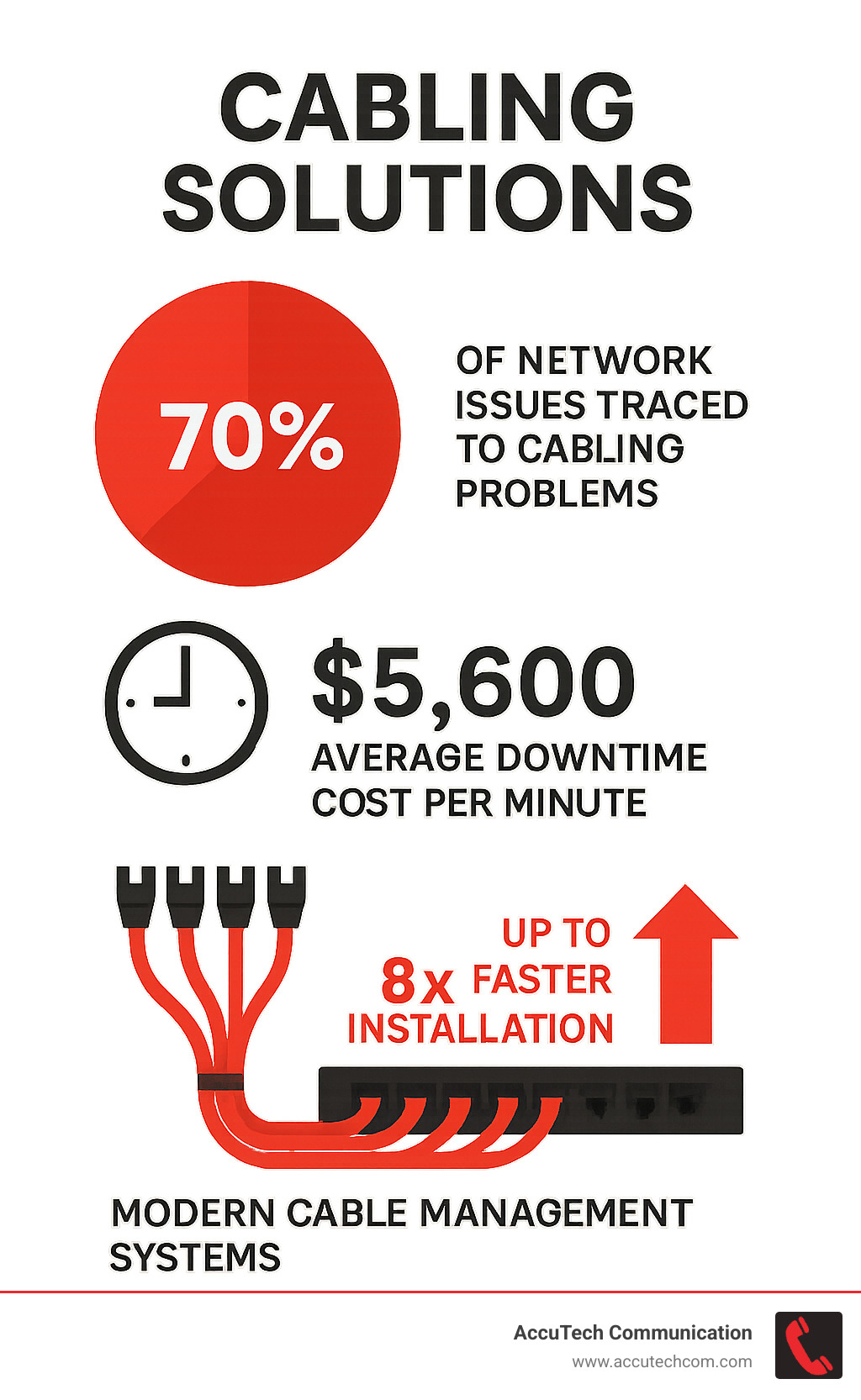
Did you know that 70% of network issues stem from poor cable management? The average cost of IT downtime is $5,600 per minute, with medium-sized businesses experiencing 10-50 hours of downtime annually. This makes choosing the right cabling solution not just a technical decision, but a critical business investment.
A structured cabling system serves as the foundation of your communications network, supporting current requirements while planning for future growth and technological expansion. Unlike traditional point-to-point cabling that creates a tangled mess of wires, structured cabling offers a standardized, organized approach that simplifies troubleshooting, reduces downtime, and adapts to your evolving needs.
I’m Corin Dolan, owner of AccuTech Communications with over 25 years of hands-on experience designing and implementing cabling solutions for businesses across healthcare, manufacturing, education, and retail sectors. My team of certified technicians specializes in creating robust, scalable cabling solutions that grow with your business while minimizing costly downtime.
Cabling solutions glossary:
– backbone cabling
– types of cables
– fiber optic cable
The Backbone: Structured Cabling Solutions
Think of your network like a house – without a solid foundation, even the most beautiful design will eventually crumble. Structured cabling solutions provide that essential foundation for your entire IT infrastructure. Unlike the tangled web of wires that traditional point-to-point cabling creates, structured cabling follows a clear, organized approach that makes sense both today and tomorrow.
As industry expert Bill Brooks points out, “Many hotels and commercial entities have invested in the leading technologies available but have failed to upgrade their structured cabling plant.” This common oversight creates a frustrating situation where expensive equipment simply can’t perform as promised because the underlying cabling infrastructure is holding everything back.
The Six Subsystems of Structured Cabling
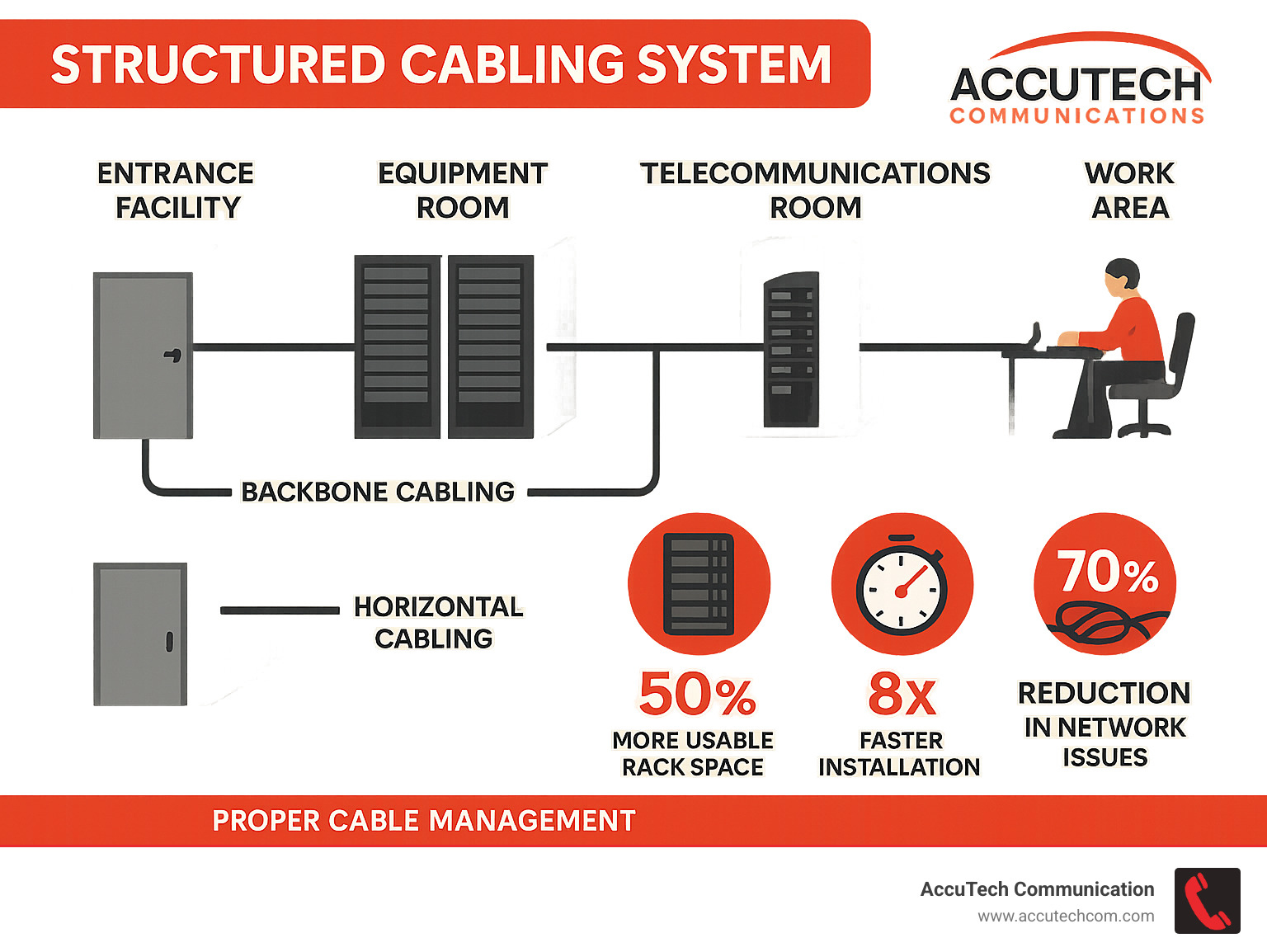
Your structured cabling system consists of six key components working together seamlessly. The entrance facility is where your external telecommunications services enter the building – think of it as your network’s front door. The equipment room houses your servers and core network equipment, while backbone cabling connects this room to telecommunications rooms throughout your building. Horizontal cabling extends from these telecom rooms to individual workspaces, and finally, work area components include the outlets and patch cords that connect your devices to the network.
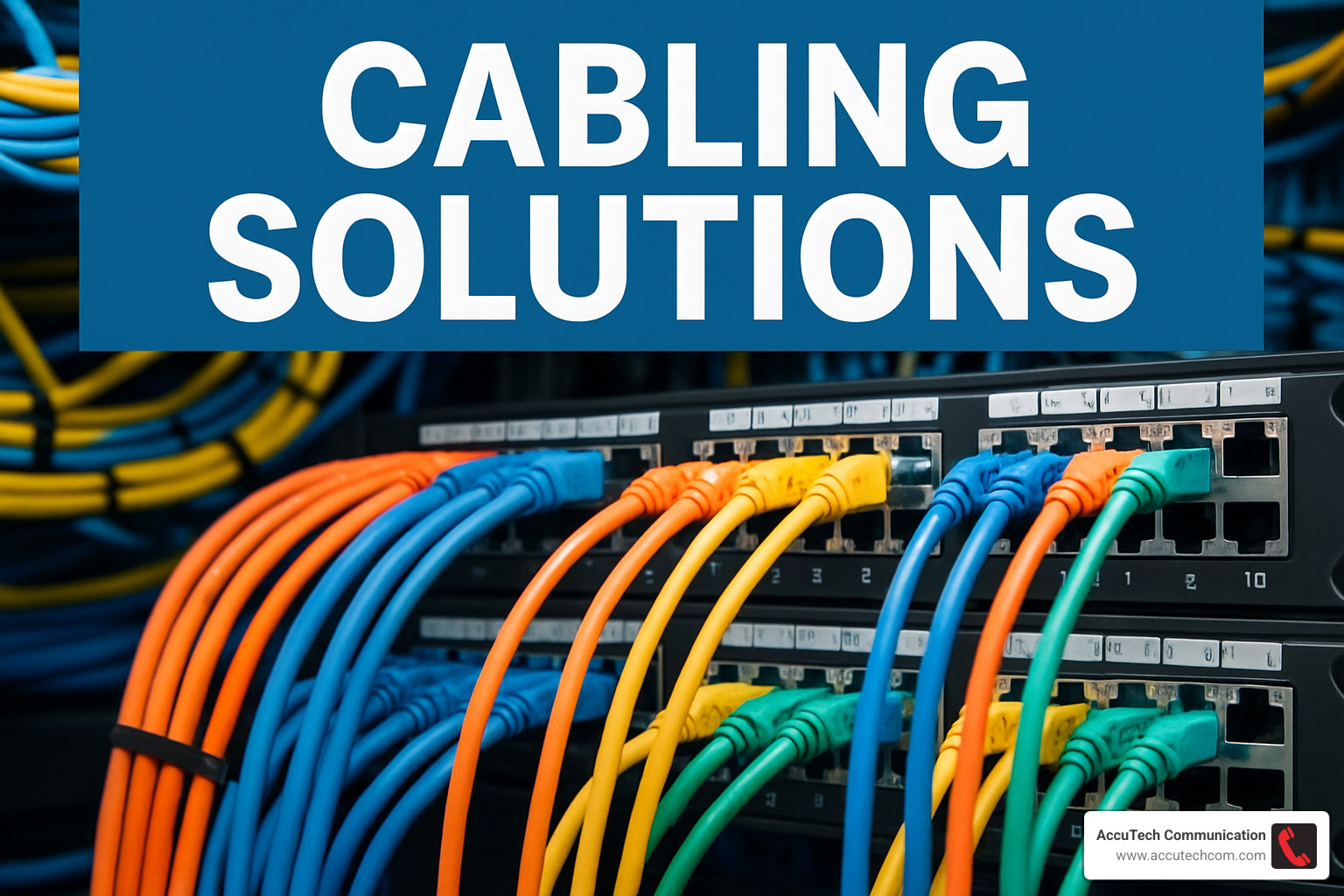
When you compare traditional cabling to a structured approach, the differences become clear:
| Traditional Point-to-Point Cabling | Structured Cabling |
|---|---|
| Individual direct connections | Standardized infrastructure |
| Difficult to trace and troubleshoot | Clearly labeled and documented |
| Limited scalability | Designed for growth |
| Prone to tangling and damage | Organized pathways and protection |
| High maintenance costs | Lower long-term TCO |
| Lengthy downtime for changes | Quick moves, adds, and changes |
Cabling Solutions for Enterprise LANs
For larger businesses, proper cabling solutions make the difference between a smoothly running operation and constant IT headaches. Your entrance facility requires special attention as it’s the critical junction where service provider networks connect to your internal systems. This area needs proper protection and management to avoid potential bottlenecks.
The horizontal cabling running throughout your building typically uses Category 6A or higher cable these days. We always recommend planning for more bandwidth than you currently need, because replacing this cabling later can be both disruptive and expensive. As Bill Novak, P.E. wisely advises, “It is in the best interest of your investment to consider upgrading your existing cabling to improve performance.”
We recently helped a Maine hospital implement a comprehensive horizontal cabling system that not only handled their data needs but also supported their nurse call systems, security cameras, and wireless access points – all on a single, unified infrastructure. This approach made their system much easier to manage while reducing long-term maintenance costs.
Modular Cabling Solutions & Industry Standards
For your cabling solution to work properly and safely, it needs to follow established industry standards. These standards aren’t just bureaucratic red tape – they ensure that everything works together properly and meets safety requirements:
ANSI/TIA-568 defines commercial building telecommunications cabling standards, while ISO/IEC 11801 provides international standards for customer premises cabling. UL Listing ensures your cables meet important safety requirements, and BICSI Guidelines offer best practices for proper design and installation.
Good documentation is absolutely essential when implementing structured cabling. Every cable should be clearly labeled at both ends with identifiers that reference its purpose, location, and connection points. As one data center manager told us, “The time spent on proper labeling saves hours of troubleshooting later.”
For a Virginia city hall project, our certified technicians implemented a network upgrade with comprehensive labeling and documentation that made future maintenance and expansion much simpler. Their standardized approach allowed them to integrate new technologies seamlessly without disrupting existing operations.
More info about Structured Cabling
Blazing Speed: Fiber Optic Cabling Solutions
When it comes to network performance, nothing outpaces the lightning-fast capabilities of fiber optic cabling solutions. Unlike traditional copper cables that rely on electrical signals, fiber optic cables transmit data using pulses of light through hair-thin strands of glass or plastic. This fundamental difference creates a world of difference in performance and reliability.
“The first time I installed fiber in a manufacturing facility, the IT manager couldn’t believe the difference in network stability,” shares one of our senior technicians. “Machines that previously caused network interference suddenly became non-issues.”
Fiber optic technology comes in several varieties, each designed for specific applications. OM3 multimode fiber (50/125 μm) delivers impressive 10 Gbps speeds over distances up to 300 meters, making it perfect for most building installations. For more demanding environments, OM4 multimode fiber extends these capabilities to support 10/40/100 Gbps connections up to 550 meters. When distance is paramount, OS2 single-mode fiber can span several kilometers while maintaining blazing speeds.
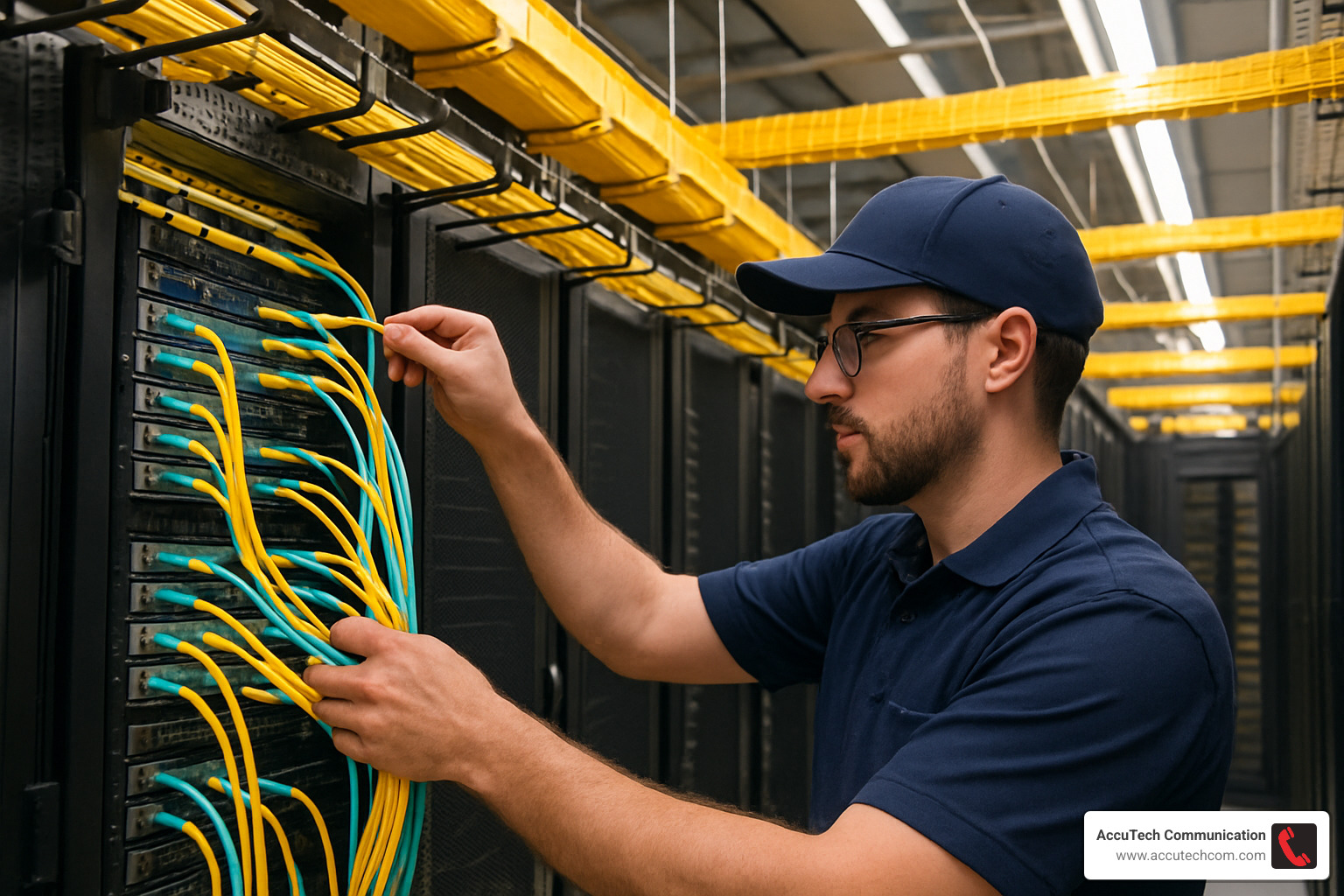
One of fiber’s most valuable features is its complete immunity to electromagnetic interference (EMI). This makes fiber ideal for industrial settings, healthcare facilities, and anywhere else with equipment that might generate electrical noise. The Scientific research on electromagnetic interference confirms this advantage, showing that fiber connections maintain perfect signal integrity even in the most challenging environments. As a bonus, this immunity also improves security since fiber cables can’t be “tapped” without detection.
Cabling Solutions for Data Centers
Modern data centers face increasing demands for bandwidth and density, making fiber optic cabling solutions essential infrastructure components. The pre-terminated fiber trunk has revolutionized data center deployments by offering several game-changing benefits.
“Pre-terminated fiber assemblies cut our installation time by 65% and virtually eliminated post-installation troubleshooting,” notes a data center manager at a regional hospital we recently worked with.
These factory-terminated assemblies arrive ready to install, eliminating time-consuming field terminations while ensuring consistent performance through 100% optical testing. The high-density design maximizes space efficiency, allowing more connections in less rack space – critical in facilities where every square foot counts.
For a custom metal manufacturer in Portland whose CAD/CAM systems demanded absolute reliability, we implemented a comprehensive fiber solution using CABLExpress EXP Series® fiber patch cables. These cables undergo rigorous testing to ensure consistent performance, giving the manufacturer confidence their design data would transfer flawlessly across their network.
Future-Proof Cabling Solutions for Campus Backbones
Campus environments present unique connectivity challenges, often requiring connections between multiple buildings spread across considerable distances. Single-mode fiber has become the gold standard for campus backbone installations, thanks to its virtually unlimited bandwidth potential and impressive reach of several kilometers.
When designing campus cabling solutions, we focus on three critical factors: pathway diversity (creating multiple routes for redundancy), future capacity (installing additional dark fiber for expansion), and low attenuation (minimizing signal loss over distance).
A recent project connecting 12 buildings for a community college showcases these principles in action. By implementing a single-mode fiber backbone with diverse pathways, we created a network that not only supported current needs but allowed for seamless growth. When they later added a new student center, connecting to the existing infrastructure took just hours instead of weeks.
“The fiber backbone has been rock-solid for five years now,” their IT director told us recently. “As we’ve added IP cameras, digital signage, and expanded our wireless, the fiber just keeps delivering without missing a beat.”
From healthcare to education to manufacturing, fiber optic cabling solutions provide the foundation for today’s high-speed networks while ensuring they’ll remain viable for tomorrow’s innovations. When performance, reliability, and future-readiness matter, fiber optic cabling delivers the competitive edge modern organizations need.
Versatility Meets Budget: Copper & Coaxial Cabling Solutions
While fiber optic cables might steal the spotlight with their blazing speeds, copper-based cabling solutions remain the reliable workhorses in most network setups. They strike that perfect balance between performance and affordability that many businesses appreciate.
Think of copper cabling as the dependable family sedan – not as flashy as a sports car, but gets you where you need to go reliably and economically. From the widely-used Cat5e to the high-performance Cat8, copper cables offer options for virtually every business need.
“We needed a solution that wouldn’t break the bank but could still handle our growing network demands,” shares a retail manager from Worcester. “Our Cat6A installation has been rock-solid for years now.”
The beauty of copper cabling lies in its versatility. With Power over Ethernet (PoE) capabilities, a single cable can deliver both data and electricity to devices like security cameras, VoIP phones, and wireless access points. This two-for-one approach simplifies your infrastructure and keeps installation costs in check.
I remember working with a boutique hotel in Portsmouth where we installed Cat6A cabling throughout the property. Not only did it power their guest internet, but the same cables supported their digital door locks, smart thermostats, and security cameras – all without needing separate power outlets. The maintenance staff practically hugged me!
Cabling Solutions for Office Moves
Office relocations can be chaotic, but well-designed copper cabling solutions can make the technology transition surprisingly smooth. The secret lies in thoughtful organization and planning.
Picture this: your company is moving to a new location next month. With properly labeled cables and organized patch panels, your IT team can disconnect everything on Friday afternoon and have you back up and running by Monday morning. Without this organization? You might be looking at days of downtime and frustrated employees.
Proper cable management isn’t just about aesthetics – it’s about business continuity. Color-coded cables grouped by department or function, clear labeling at both ends, and detailed documentation can reduce your downtime during moves by up to 75%. That’s the difference between a weekend move and a week-long nightmare.
For a law firm relocating in Providence, we created a comprehensive labeling system and color-coded patch panel arrangement. When moving day came, their IT manager told me, “This is the smoothest transition we’ve ever had – we were fully operational within hours, not days.”
High-Power PoE Cabling Solutions
As devices get smarter, they often need more power. The latest Power over Ethernet standards can deliver up to 90 watts per port – enough to power digital displays, PTZ cameras, and even some desktop computers without separate power supplies.
But with great power comes great responsibility (and heat). When designing high-power PoE cabling solutions, we pay special attention to three critical factors:
First, power budget planning ensures your network switches can actually deliver the juice your devices need. Second, thermal management prevents cable bundles from overheating (tightly packed cables carrying power can generate significant heat). And third, cable quality – using full-gauge copper conductors rather than cheaper copper-clad aluminum that can cause performance issues.
I recently worked with a manufacturing plant in Nashua where we installed a high-power PoE system for their production monitoring. The operations manager was amazed that we could power their high-definition cameras, digital information displays, and wireless access points throughout the facility without calling in electricians for new outlets. The project finished ahead of schedule and under budget – music to any business owner’s ears.
Whether you’re setting up a small office or planning an enterprise-wide deployment, copper cabling solutions offer the perfect blend of performance, versatility, and value that makes them the backbone of modern business networks.
More info about Types of Network Wiring
Rapid Deployment & Cable Management Innovations
In today’s business environment, network downtime translates directly to lost revenue. Modern cabling solutions aren’t just about performance specs—they’re about minimizing disruption and simplifying maintenance for your team.
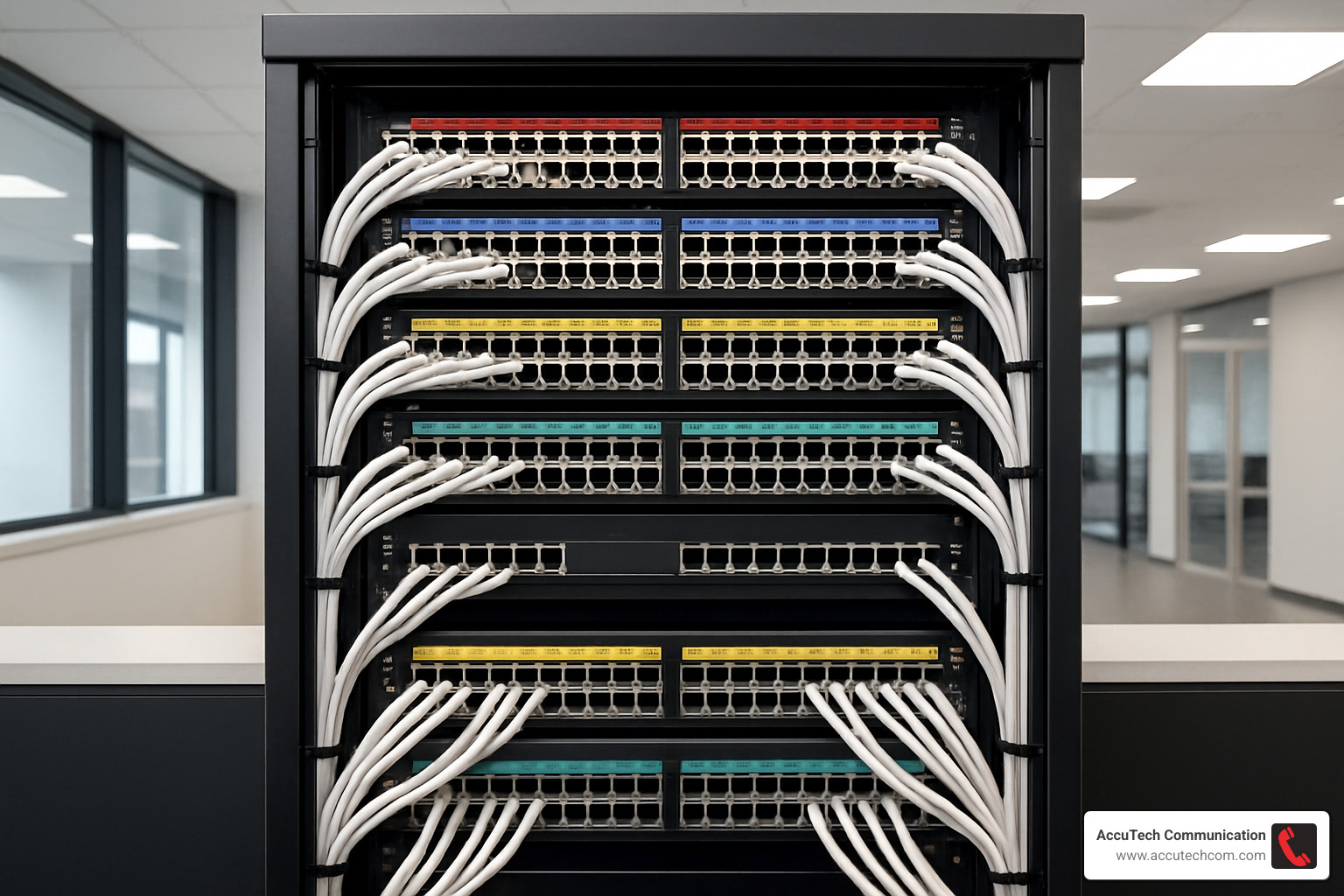
The Cost of Cable Chaos
We’ve all seen it—the server room that looks like a plate of digital spaghetti. But poor cable management isn’t just an eyesore. It creates real business problems that hit your bottom line.
When cables are tangled, your IT team spends precious hours just trying to identify which cable connects to what. This extended troubleshooting time turns minor issues into major headaches. Those cable nests also block crucial airflow, leading to equipment overheating and premature failure of expensive hardware.
The physical stress on improperly managed cables causes performance degradation over time—often in ways that are difficult to diagnose. And when it’s time to add new equipment? What should be a simple upgrade becomes a complicated ordeal that nobody wants to tackle.
Smart Rack Cabling Solutions
Imagine installing network cabling in a fraction of the time while actually creating more usable space in your rack. That’s not a fantasy—it’s what innovative rack-based cabling solutions like the PATCHBOX system deliver. These modern systems enable up to 8× faster installation compared to conventional cabling while freeing up to 50% more rack space.
The secret? Retractable patch cables that automatically adjust to the perfect length. No more loops of excess cable creating chaos—just clean, direct connections that make sense.
“Work smarter, not harder,” isn’t just a catchy phrase—it’s the philosophy behind these smart systems. Color-coding provides instant visual identification of different network segments, while QR-code labeling gives your team immediate access to documentation via smartphone. The modular design means your infrastructure can evolve as your needs change.
I remember implementing a smart rack solution for an assisted living center in Portland. Their small IT team was constantly overwhelmed with maintenance issues. After installing a properly organized system, their troubleshooting time dropped by over 60%. What used to take hours now took minutes—a game-changer for their limited resources.
Cabling Solutions that Minimize Downtime
In network operations, Mean Time To Repair (MTTR) is the metric that keeps IT managers up at night. Well-designed cabling solutions dramatically reduce this metric through thoughtful organization and accessibility.
Organized pathways keep different cable types clearly separated, eliminating confusion during troubleshooting. Proper labeling means your team can quickly identify each connection without guesswork. Tool-less hardware provides rapid access to connections without hunting for specialized equipment. And modular components mean you can replace failed elements without disrupting the entire system.
As one manufacturer notes, “Every power whip from Southwire is 100% factory tested through a proprietary automated testing process.” This industry trend toward pre-tested assemblies eliminates installation errors and reduces downtime—something we see making a real difference for our clients.
A few years ago, we implemented a comprehensive cabling infrastructure for a busy emergency operations center spanning over 43,000 square feet. The redundant pathways, clear labeling, and organized management ensured the facility could maintain operations during critical emergency response scenarios. When seconds count, reliable infrastructure becomes priceless.
Sustainable & Future-Ready Cabling Solutions
In today’s environmentally conscious world, businesses are looking beyond performance to the ecological footprint of their infrastructure. Modern cabling solutions are evolving to meet these demands, reducing environmental impact while preparing networks for tomorrow’s technologies.
Integrated Grounding Innovations
Remember when every network installation required separate grounding conductors? Those days are fading fast. Today’s innovative cabling solutions like CAB® Solar’s integrated grounding system brilliantly combine support and grounding functions into one neat design.
This smart approach eliminates the need for separate grounding conductors, significantly reducing material usage. You’ll enjoy faster installation times since there are fewer components to work with, and when maintenance is needed, troubleshooting becomes much simpler with less complexity to steer. All this adds up to meaningful cost savings in both materials and labor.
As Bill Brooks of Brooks Engineering puts it: “CAB® Solar is far more cost effective than trenching or cable tray. In summary, the use of purpose-built products like the CAB® Solar Hangers for the exposed cable management in a PV array is well substantiated by the NEC and industry installation standards.”

Green Cabling Solutions for Intelligent Buildings
Smart buildings need equally smart cabling solutions that do more than just connect systems – they actively contribute to sustainability goals. Modern cabling infrastructure supports sophisticated energy monitoring capabilities, allowing building management systems to optimize resource usage in real-time.
We’re seeing growing demand for low-smoke zero-halogen (LSZH) cable jackets that dramatically reduce toxic emissions in case of fire – a win for both safety and environmental responsibility. For organizations pursuing LEED certification, thoughtfully designed cabling infrastructure can contribute valuable points toward certification while reducing overall material usage through efficient design practices.
I recently worked with a manufacturing company that transformed their headquarters with integrated cabling supporting their building automation systems. Their new infrastructure gave them precise control over lighting, HVAC, and security systems – resulting in a remarkable 23% reduction in energy usage while actually improving comfort for everyone in the building. That’s the kind of win-win solution we love to deliver.
Resilient Outdoor Cabling Solutions
Mother Nature isn’t always kind to network infrastructure. Outdoor environments throw everything from scorching UV radiation to freezing temperatures at your cabling. Purpose-built outdoor cabling solutions are designed to withstand these challenges with specialized features that ensure reliability in harsh conditions.
UV-resistant jacketing prevents degradation from constant sun exposure, while improved temperature tolerance maintains performance across extreme heat and cold cycles. For above-ground installations, messenger-wire supports provide secure pathways without the disruption and expense of trenching. And robust moisture barriers offer critical protection against water damage that can destroy conventional cabling.
The proven reliability of these systems is impressive – CAB® Solar Hangers have been installed worldwide in over 100 GW of solar power plants, performing flawlessly in environments ranging from desert heat to arctic cold. As one solar engineer noted, “Standardizing cable management with CAB® helps to lower engineering costs and provides more predictable installation costs.”
At AccuTech Communications, we’ve helped numerous New England businesses implement sustainable cabling infrastructure that stands up to our region’s unique weather challenges while reducing environmental impact. From healthcare facilities to manufacturing plants, organizations are finding that environmentally responsible cabling solutions deliver both ecological and economic benefits for the long term.
Frequently Asked Questions about Cabling Solutions
What are the main components of a structured cabling system?
When clients ask me about structured cabling, I explain that it’s like the nervous system of your building—a well-designed network of pathways that keep information flowing smoothly.
A complete structured cabling solution consists of six essential components working together. The entrance facility serves as your building’s connection point to the outside world, where telecommunication services enter your premises. Your equipment room houses the brains of the operation—servers, switches, and other critical network equipment.
Backbone cabling connects these central areas to telecommunications rooms throughout your building, which serve as distribution points. From there, horizontal cabling extends to individual workspaces, connecting to work area components like outlets and patch cords that link your devices to the network.
Beyond these six subsystems, you’ll find hardware elements like racks, cabinets, cable management systems, and patch panels. Together, they create an organized infrastructure supporting everything from voice calls to video conferencing and even building automation systems.
I’ve seen how a properly designed structured cabling system provides the flexibility to adapt as your technology needs evolve—something that’s invaluable in today’s rapidly changing business environment.
How does proper cable management improve network performance?
“I can’t tell you how many times I’ve walked into a server room that looked like a plate of spaghetti,” a client once told me. That visual always makes me smile, but the performance impacts of cable chaos are no laughing matter.
Good cable management solutions deliver tangible benefits to your network. First, they improve airflow around your equipment. When cables are neatly organized, air can circulate properly, preventing the overheating that degrades performance and shortens equipment life.
Proper management also reduces signal interference by maintaining appropriate separation between different cable types. Those neat bundles aren’t just for show—they prevent the crosstalk and electromagnetic interference that can corrupt data transmission.
Your cables also receive physical protection from excessive bending, stretching, or crushing when properly managed. I’ve seen too many networks plagued by intermittent issues caused by damaged cables hidden in tangled messes.
Perhaps most importantly, when trouble does arise, organized cables make troubleshooting dramatically faster. Your IT team can quickly identify and resolve issues instead of wasting hours tracing cables through a jumbled mess.
Industry research confirms what we’ve seen in practice: about 70% of network problems stem from physical layer issues, many related to poor cable management. Implementing proper management systems significantly reduces downtime and improves overall network reliability.
Which certification standards should my cabling project follow?
Navigating certification standards can feel overwhelming, but these guidelines ensure your cabling solution performs reliably for years to come.
For most commercial buildings, ANSI/TIA-568 serves as the fundamental standard, providing specifications for telecommunications cabling. Internationally, ISO/IEC 11801 offers similar guidance. The BICSI TDMM (Telecommunications Distribution Methods Manual) provides comprehensive design guidelines that complement these standards.
Safety should never be overlooked. UL Certification ensures your cables meet important safety requirements, while the National Electrical Code (NEC/NFPA 70) provides installation safety guidelines.
Depending on your specific needs, you might also need to consider application-specific standards. For instance, if you’re implementing Power over Ethernet, IEEE 802.3 standards become relevant. Data centers should follow TIA-942, while healthcare facilities need to meet ANSI/TIA-1179 requirements.
I always recommend working with certified installers who understand these standards inside and out. Our technicians maintain current BICSI certifications and stay updated on evolving standards to ensure your installation is fully compliant, delivering maximum performance, compatibility, and safety.
One hospital IT director put it perfectly: “Standards compliance isn’t just about checking boxes—it’s about sleeping well at night knowing your infrastructure won’t let you down when you need it most.”
More info about Network Cabling Installation
Conclusion
Think of your cabling solutions as the circulatory system of your business technology—when designed well, everything flows smoothly, but when neglected, the entire body suffers. Throughout our journey together, we’ve seen that modern cabling isn’t just about connecting point A to point B; it’s about creating a foundation that supports your business today while preparing for tomorrow’s innovations.
What have we learned? Structured cabling brings order to chaos, giving your network a clear, organized framework that makes everything from troubleshooting to expansion dramatically simpler. When you need lightning-fast connections across significant distances, fiber optic solutions deliver best performance for your data centers and campus environments.
For most day-to-day applications, trusty copper cabling continues to offer the best balance of cost and capability, especially with Power over Ethernet bringing both data and electricity to your devices through a single cable. And don’t underestimate the value of thoughtful cable management—it’s like the difference between trying to find your keys in a cluttered drawer versus a well-organized key rack.
I’m particularly excited about the advances in sustainable approaches that not only reduce environmental impact but often save money and improve performance. It’s rare to find solutions where everyone wins, but green cabling truly delivers benefits across the board.
The numbers tell a compelling story: with 70% of network issues stemming from physical layer problems, your cabling infrastructure might be the most underappreciated aspect of your technology strategy. When downtime costs average $5,600 per minute, investing in quality cabling isn’t an expense—it’s insurance against costly disruptions.
Good cabling delivers tangible benefits that impact your bottom line: reduced maintenance costs, fewer emergency repairs, simplified growth planning, and the confidence that comes from knowing your infrastructure can handle whatever new technologies emerge. Like a well-built foundation for a house, quality cabling provides stability for everything built on top of it.
Since 1993, AccuTech Communications has been designing and installing reliable cabling systems for businesses across Massachusetts, New Hampshire, and Rhode Island. Our team brings not just technical expertise but a genuine understanding of how different industries—from healthcare to education to manufacturing—have unique requirements that demand custom solutions.
When you’re ready to build or upgrade your network foundation, quality design, materials, and installation aren’t luxuries—they’re essential investments in your organization’s future flexibility and reliability. Your cabling infrastructure might not be the most visible part of your technology, but it’s certainly one of the most important.
More info about Network Cabling Installation
