
Cat 5e Cables: 2024’s Vital Guide
Why Cat 5e Cables Remain Essential for Modern Networks
Cat 5e cables are twisted pair Ethernet cables supporting speeds up to 1 Gigabit per second and operating at 100 MHz bandwidth over distances up to 100 meters (328 feet). Introduced in 2001, they remain one of the most widely used networking cables due to their reliability, cost-effectiveness, and ability to handle most business networking needs.
Key Cat 5e Cable Specifications:
- Speed: Up to 1 Gbps (Gigabit Ethernet)
- Bandwidth: 100 MHz (some improved versions up to 350 MHz)
- Maximum Distance: 100 meters (328 feet)
- Construction: 4 twisted pairs of copper wire
- Connector: RJ45 (8P8C)
- Standards: TIA/EIA-568 compliant
Cat 5e cables offer excellent value for businesses needing reliable gigabit networking without the premium cost of newer cables. They’re backward compatible with older Cat 5 and Cat 3 systems while providing improved crosstalk reduction and signal quality.
For healthcare facilities, manufacturing plants, and other mission-critical environments, Cat 5e cables provide the dependable performance needed for VoIP phone systems, standard data traffic, and most business applications. At AccuTech Communications, we’ve been installing and maintaining Cat 5e cables and network infrastructure across Massachusetts, New Hampshire, and Rhode Island since 1993. Our decades of hands-on experience have shown us that properly installed Cat 5e systems continue to deliver reliable performance for businesses of all sizes.
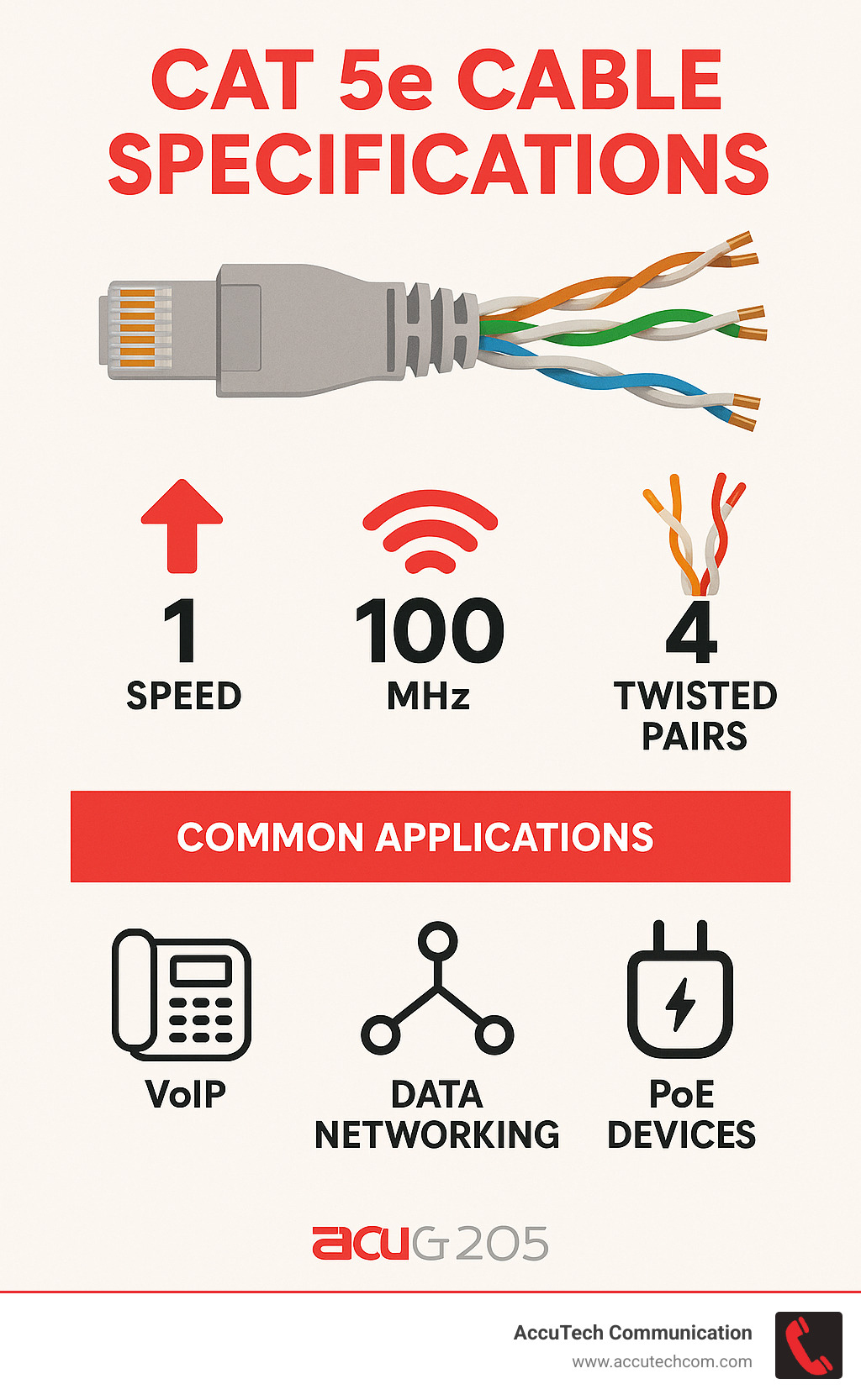
Cat 5e cables terms to know:
Cat5e Fundamentals: Speed, Bandwidth, and Distance
Understanding the technical capabilities of Cat 5e cables is key to making informed decisions for your network infrastructure. Knowing their specifications ensures you get the most out of your investment.
Key Specifications of Cat 5e Cables
Cat 5e cables deliver data at speeds up to 1 Gigabit per second (Gbps), making them perfect for Gigabit Ethernet. This speed handles everything from file transfers to video conferencing. The standard bandwidth is 100 MHz, though some high-quality versions operate up to 350 MHz, giving you extra headroom for demanding applications.
Cat 5e cables contain four twisted pairs of copper wire, engineered to minimize crosstalk—interference between wire pairs. This design keeps data signals clear and separate.
The “e” in Cat5e stands for “improved,” and it’s built to meet the strict TIA/EIA-568 standard. This means every Cat 5e cable we install has been tested to ensure it can handle the demands of modern networking. The improved specifications for crosstalk reduction make these cables significantly more reliable than their Cat5 predecessors.
Understanding Maximum Distance and Limitations
Cat 5e cables work reliably up to 100 meters (328 feet), a distance that includes the main cable run plus any patch cables. Exceeding this limit causes signal degradation (a phenomenon called attenuation), which can lead to slower speeds or dropped connections.
Power over Ethernet (PoE) applications add another layer of complexity. While Cat 5e cables handle PoE well, the electrical current creates heat that can affect performance over longer distances. For PoE devices like IP cameras and VoIP phones, we recommend keeping runs under 150 feet for optimal power delivery to avoid voltage drop.
Interestingly, Cat 5e cables can support faster speeds like 2.5GBASE-T and 5GBASE-T over shorter distances. While you won’t get these speeds at the full 100-meter length, it provides extra capability for short-distance performance in server rooms or between nearby devices.
The key is understanding these limitations upfront. When we design your network, we factor in all these distance considerations to ensure every connection performs exactly as expected.
Cat5e vs. Other Ethernet Cables: Making the Right Choice
Choosing the right Ethernet cable can be overwhelming. The good news is that Cat 5e cables often provide what most businesses need without breaking the bank. Here’s how they compare to newer categories.
| Feature | Cat 5e | Cat 6 | Cat 6a |
|---|---|---|---|
| Max Speed | 1 Gbps | 1 Gbps (up to 10 Gbps over shorter runs) | 10 Gbps |
| Bandwidth | 100 MHz (some up to 350 MHz) | 250 MHz | 500 MHz |
| Max Length | 100 meters (1 Gbps) | 100 meters (1 Gbps), 55 meters (10 Gbps) | 100 meters (10 Gbps) |
| Crosstalk | Improved | More stringent | Significantly improved |
| EMI/Noise | Good | Better | Excellent |
| Cost | Most cost-effective | Moderate | Higher |
| Future-Proofing | Limited for beyond 1 Gbps | Some for 10 Gbps (short runs) | High for 10 Gbps |
Cat 5e cables handle 1 Gigabit speeds perfectly, covering the needs of most businesses. While Cat6 and Cat6a have their place, they can be overkill for many standard applications.
When to Choose Cat5e Over Cat6/Cat6a
The best cable is one that meets your actual needs. Cat 5e cables shine in several key scenarios.
Home and small office networks are perfect candidates. Since most internet plans are below 1 Gbps, Cat 5e provides all the necessary performance for browsing and streaming without extra cost.
VoIP phone systems work exceptionally well with Cat 5e cables. They provide the stability your phone system needs without unnecessary expense.
For standard business data traffic like email and shared files, Cat 5e cables are more than adequate. You won’t notice a performance difference unless you’re transferring massive files.
Budget-conscious projects benefit from the cost-effectiveness of Cat 5e cables, which deliver reliable gigabit performance at a fraction of the cost of newer categories.
Legacy system compatibility is another strong point. If you’re upgrading from older Cat5 infrastructure, Cat 5e cables provide a seamless transition with improved performance.
Challenging installation environments sometimes favor Cat 5e cables. Their smaller diameter makes them easier to install in older buildings with tight conduits.
When an Upgrade to Cat6 or Higher is Necessary
However, some situations do require an upgrade to Cat6 or Cat6a.
High-bandwidth applications like large file transfers or uncompressed video editing can benefit from the increased bandwidth of Cat6 (250 MHz) or Cat6a (500 MHz).
10 Gbps networking over full 100-meter runs requires Cat6a as a minimum. Cat6 can handle 10 Gbps, but only up to 55 meters.
Data centers demand the highest performance, where Cat6a, Cat7, or even Cat8 become essential. This is where our expertise in data center technologies comes into play.
Environments with high electromagnetic interference from machinery or lighting benefit from the improved shielding of higher-category cables.
Future-proofing can justify the upgrade. If you plan to move to 10 Gbps workstations, installing Cat6a now can save future costs and disruption.
The key is to be honest about your actual needs. Often, Cat 5e cables provide the right performance at a sensible price.
A Guide to the Different Types of Cat 5e Cables
Understanding the different types of Cat 5e cables is crucial for a successful network installation. Cables come in various constructions and jacket ratings designed for specific environments.
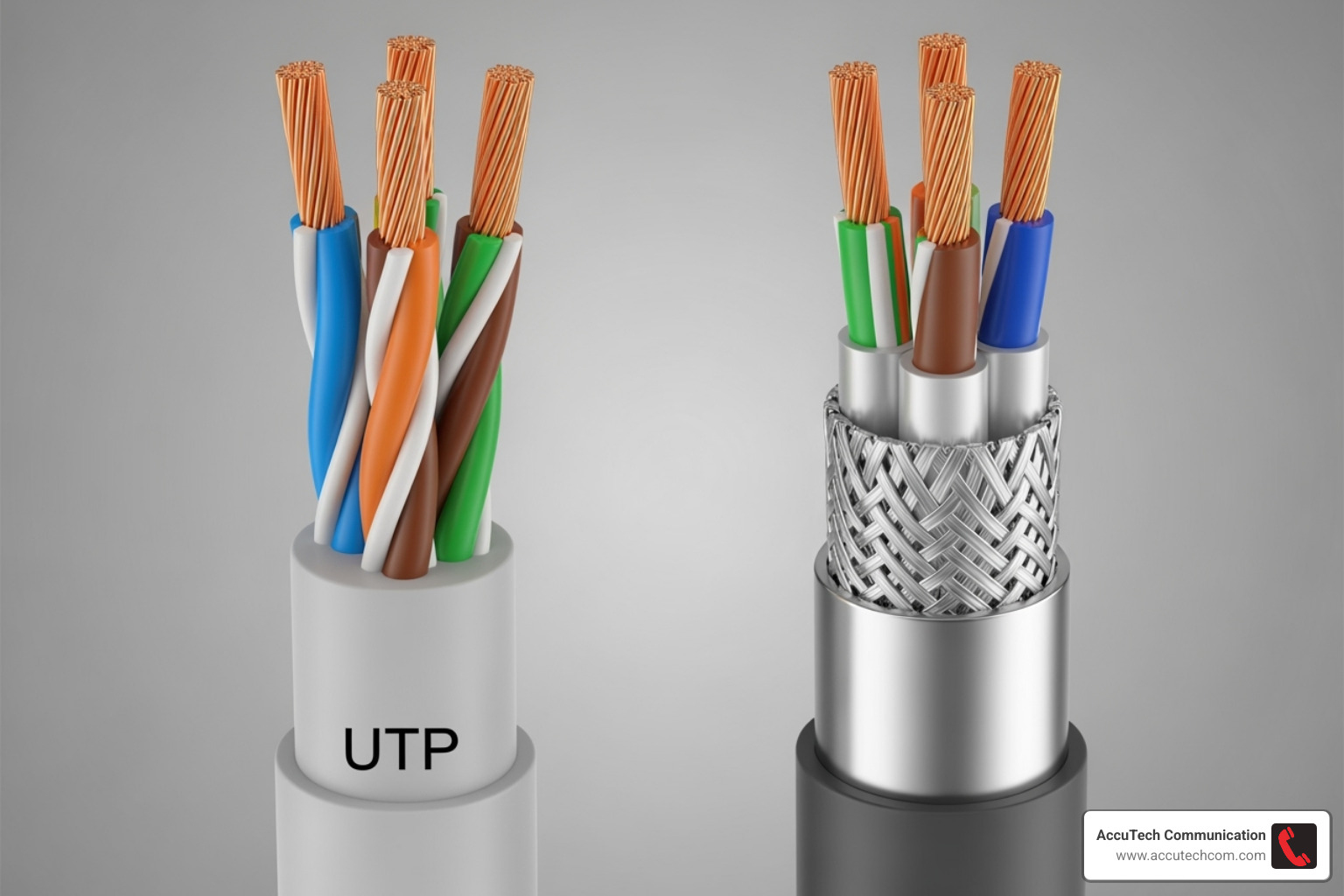
The construction and jacket rating must match the installation environment and its challenges.
Shielded (STP) vs. Unshielded (UTP)
The most fundamental distinction in Cat 5e cable construction is shielding, which impacts both performance and cost.
Unshielded Twisted Pair (UTP) cables are the industry standard. These Cat 5e cables rely on the twisting of their four wire pairs to prevent electromagnetic interference (EMI) and crosstalk. UTP is cost-effective, flexible, and easy to install, making it ideal for most offices, schools, and homes.
Shielded Twisted Pair (STP) cables add foil or braided shielding for superior protection against EMI from sources like motors or fluorescent lights. The trade-off is that STP cables are thicker, less flexible, and require proper grounding to be effective; otherwise, interference can worsen. For most offices, UTP provides excellent performance without this complexity.
In industrial environments, data centers, or areas with significant electrical noise, STP cables become essential. I’ve seen networks in manufacturing facilities where UTP cables couldn’t maintain reliable connections, but STP cables solved the problem.
Jacket Ratings: Plenum, Riser, and Standard
A Cat 5e cable’s outer jacket is a critical safety component governed by building codes. Using the wrong jacket rating can lead to failed inspections and costly rework.
CMP (Plenum Rated) cables are required for plenum spaces (areas with circulating air, like above dropped ceilings). Their low-smoke, flame-retardant jackets prevent the spread of toxic fumes through ventilation systems during a fire.
CMR (Riser Rated) cables are built for vertical runs between floors in non-plenum areas. Their jackets are designed to prevent fire from spreading from floor to floor.
CM/CMG (General Purpose) cables are standard indoor Cat 5e cables, perfect for horizontal runs within a single floor or for patch cords. They are the most economical option but are not suitable for plenum or riser applications.
LSZH (Low Smoke Zero Halogen) cables are increasingly popular in public buildings. They emit very low smoke and no toxic halogen gases when burned, making them safer for human health.
Outdoor/Direct Burial Cat 5e cables have UV-resistant and waterproof jackets to withstand harsh environmental conditions like moisture, extreme temperatures, and UV radiation.
Choosing the correct jacket rating is about safety and code compliance. We help businesses in Massachusetts, New Hampshire, and Rhode Island ensure their installations meet all local building codes.
Connectors, Compatibility, and Customization
Cat 5e cables offer impressive flexibility for connecting devices. Understanding connector and customization options is key for any network infrastructure.
Connectors and Compatible Devices
Nearly every Cat 5e cable uses the familiar RJ45 connector (technically an 8P8C connector). It’s the standard for Ethernet because it’s reliable, easy to use, and universally compatible.
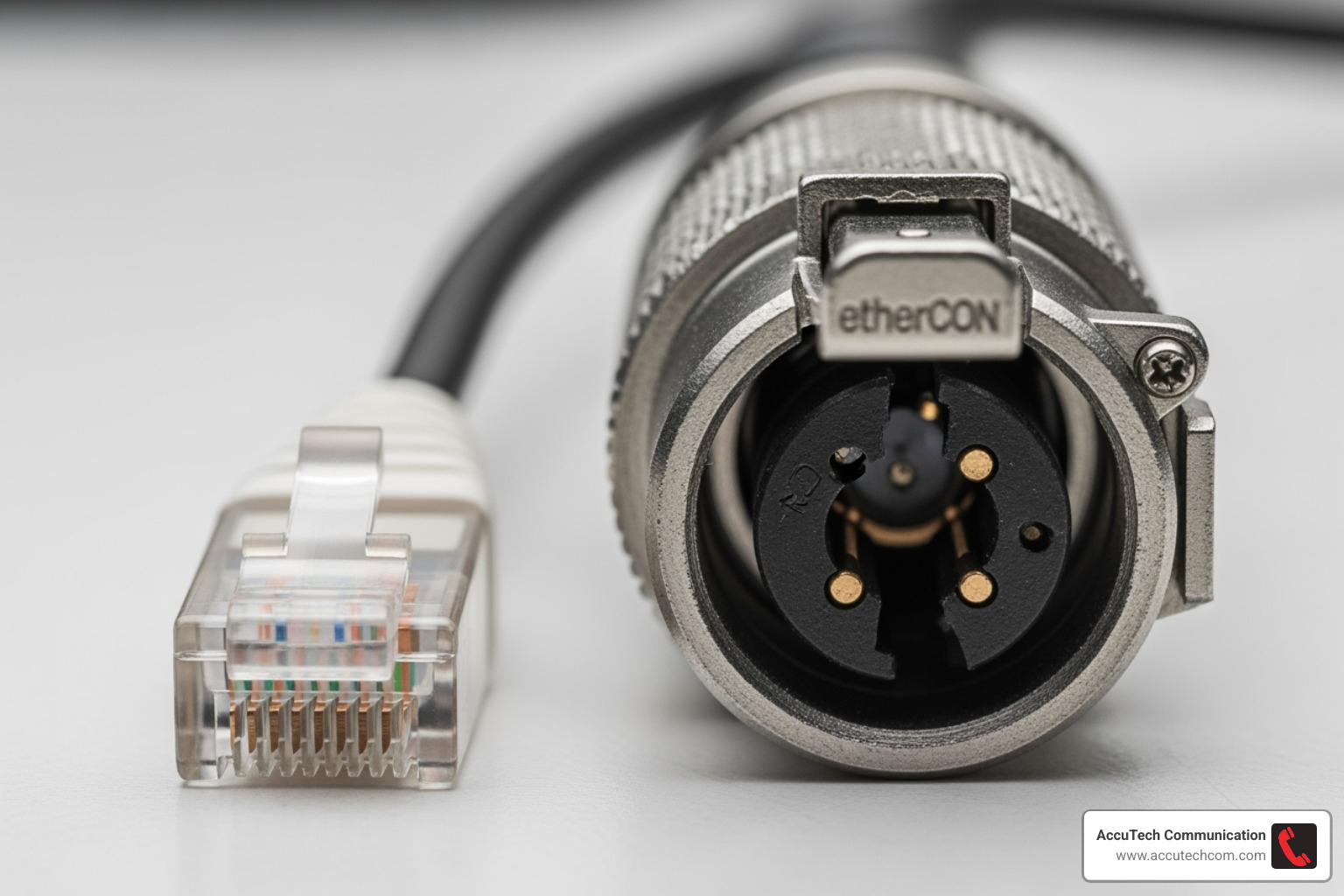
For more demanding environments, you might encounter etherCON connectors. These ruggedized, locking connectors are built for professional audio/video or industrial settings where a secure connection is critical.
The beauty of Cat 5e cables is their universal compatibility with nearly every networked device: computers, laptops, routers, switches, IP cameras, VoIP phones, smart TVs, and streaming devices. They are also ideal for gaming consoles (offering lower latency than Wi-Fi), network printers and scanners, and modems.
Customization Options for Your Network
When standard solutions aren’t enough, Cat 5e cables can be customized.
Custom lengths are a common request. Patch cables can be made to any length, eliminating messy, tangled, or short cables. Bulk Cat 5e cable comes in 500ft or 1000ft boxes.
Color coding transforms cable management. Different colors can represent different functions (e.g., blue for workstations, red for servers), making troubleshooting much easier.
Labeling takes organization to the next level. Custom labels can identify cable origins and destinations, saving countless hours during maintenance.
For tight spaces, angled designs with 90-degree or 45-degree angled RJ45 connectors allow for cleaner cable runs and better airflow.
When planning a major installation, reviewing the technical specifications for bulk cable ensures you’re getting quality materials.
Since 1993, AccuTech Communications has provided custom Cat 5e cable solutions for businesses across Massachusetts, New Hampshire, and Rhode Island, turning good networks into great ones.
Installation and Purchasing Considerations
The performance of your Cat 5e cable network depends equally on the quality of the cable and the quality of the installation.
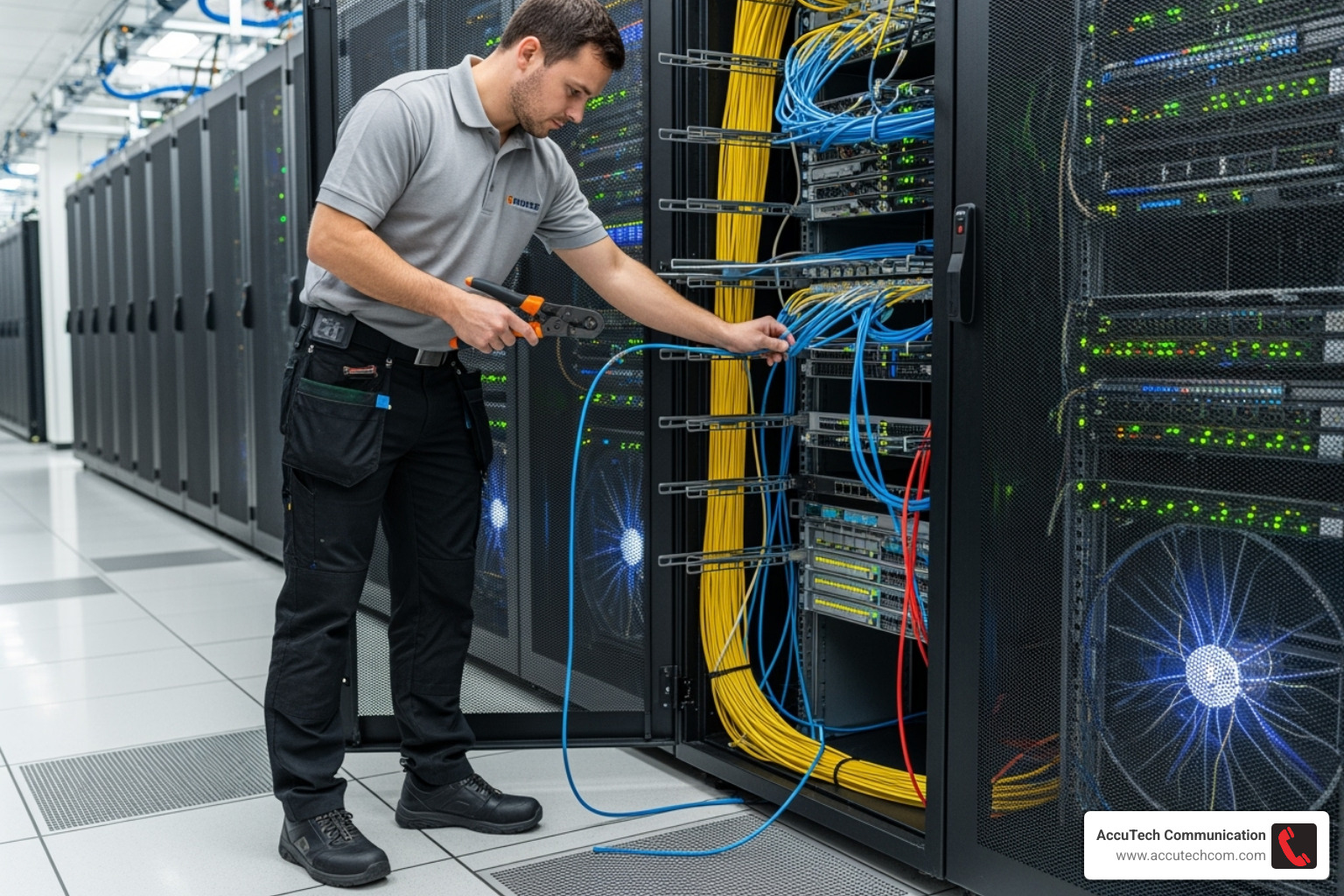
Best Practices for Installing Cat 5e Cables
Many networks fail due to avoidable installation mistakes. Even high-quality Cat 5e cables will underperform if not installed with care.
Avoiding sharp bends is critical. Ethernet cables have a minimum bend radius; bending them too sharply damages the internal pairs, leading to crosstalk and signal loss. We always respect these limits to avoid internal damage.
Separating from power cables is crucial. To avoid electromagnetic interference that degrades signal quality, Cat 5e cables should not be run parallel to electrical lines. We maintain proper separation or use shielded cables.
Proper termination is where many DIY installations fail. Attaching RJ45 connectors or keystone jacks is critical. Common mistakes like untwisting pairs too much or using the wrong wiring scheme cause issues. Our technicians follow strict T568A or T568B standards for rock-solid connections.
Using quality connectors is important. Cheap connectors can introduce resistance and crosstalk, undermining your network. We use high-quality connectors that match the cable’s performance.
Cable management tools like ties and trays prevent tangles, improve airflow, and make future maintenance easier.
Testing and certification is the final step that separates professional from amateur work. We test every Cat 5e cable run for continuity, length, attenuation, and crosstalk to certify it meets industry standards and will perform reliably.
Purchasing Tips: What to Look For
When purchasing Cat 5e cables, knowing what to look for can save you from performance issues.
Solid bare copper conductors are essential. The best Cat 5e cables feature 24 AWG solid bare copper for superior performance and standards compliance.
Avoid Copper Clad Aluminum (CCA) cables. These cheaper alternatives have an aluminum core and suffer from higher resistance, signal loss, and are prone to damage. They also generate more heat with PoE and are not compliant with TIA/EIA standards, which can lead to performance issues and code violations.
Jacket rating verification is crucial for safety. Always double-check that the cable’s jacket rating (CMP, CMR, etc.) matches your installation environment and local building codes.
Reputable suppliers make all the difference. We source only the highest quality Cat 5e cables from trusted suppliers who provide proper certifications.
Investing in quality cables and professional installation ensures network reliability and reduces long-term costs.
Frequently Asked Questions about Cat 5e Cables
Here are answers to the most common questions we receive about Cat 5e cables from our clients across Massachusetts, New Hampshire, and Rhode Island.
Is Cat5e still good in 2024?
Yes, Cat 5e cables are still excellent in 2024 for the vast majority of networking needs. They reliably deliver Gigabit Ethernet speeds (1 Gbps) up to 100 meters, which is sufficient for most businesses and homes.
Most internet plans are under 1 Gbps, and most devices (computers, smart TVs, etc.) have Gigabit Ethernet ports. This means Cat 5e cables are not a network bottleneck.
The only time to look beyond Cat 5e cables is for data centers, 10 Gigabit speeds to workstations, or specific high-bandwidth applications. For everyone else, Cat 5e offers the perfect blend of performance, reliability, and cost. Networks we installed over 15 years ago still run perfectly, demonstrating the longevity and value of Cat 5e cables.
Can I use a Cat5e cable for a 4K TV?
Yes. Cat 5e cables are more than capable of handling 4K streaming. 4K streaming requires about 15-25 Mbps, and since Cat 5e cables support up to 1000 Mbps, there is more than enough bandwidth.
When streaming issues occur, the problem is typically the internet service speed or Wi-Fi signal, not the cable. A properly installed Cat 5e cable provides rock-solid performance for streaming.
What is the main difference between Cat5 and Cat5e?
The main difference is performance standards, specifically regarding crosstalk (interference between wire pairs). While both operate at 100 MHz, Cat 5e cables have stricter requirements for minimizing this interference.
This improvement means Cat 5e cables are certified to reliably support Gigabit Ethernet, whereas Cat5 was only specified for 10/100 Mbps Ethernet. The “e” in Cat5e stands for “improved.”
The Cat5 standard was retired in 2001 and replaced by Cat5e, which is now the minimum standard for new installations. Upgrading from Cat5 to Cat5e provides a significant performance boost for a minimal cost.
Conclusion
After three decades in network infrastructure, we can confidently say Cat 5e cables are a dependable workhorse, striking the perfect balance between performance and practicality for most businesses.
What makes Cat 5e cables special is their versatility. Whether you’re running a small office network, connecting VoIP phones, or upgrading an old facility, Cat 5e cables adapt to your needs without breaking the budget.
Many businesses wonder if they need the latest cable technology, but the truth is that Cat 5e cables deliver what’s needed for most applications. They are not flashy, but they are absolutely dependable.
While Cat6 or Cat6a are necessary for data centers or high-bandwidth needs, most installations we handle across Massachusetts, New Hampshire, and Rhode Island find Cat 5e cables provide the perfect balance of performance, cost, and reliability.
At AccuTech Communications, we’ve helped businesses make these decisions since 1993. We understand that every network is unique. That’s why we take the time to understand your specific needs before recommending a solution.
Whether you’re dealing with tight spaces, working within budget constraints, or simply need a rock-solid network that just works, we’re here to help. Our certified technicians know how to get the most out of every Cat 5e cable installation, ensuring your network performs at its best for years to come.
Ready to discuss your network cabling needs? Contact us for a professional network cabling consultation and let’s build an infrastructure that works as hard as you do.
