
Why Structured Cabling is the Foundation of Commercial Network Efficiency
Finding a qualified data cable installer near me in Massachusetts, New Hampshire, or Rhode Island is critical for businesses that depend on reliable network infrastructure. Here’s what to look for when choosing a local professional:
Key Factors When Selecting a Data Cable Installer:
- Certifications – Look for RCDD credentials and ANSI/TIA/EIA standards compliance.
- Commercial Experience – Verify they specialize in business installations, not residential work.
- Service Area Coverage – Confirm they serve MA, NH, or RI.
- Testing & Documentation – Ensure they provide certification testing and as-built drawings.
- Warranty Protection – Ask about workmanship warranties (industry standard is 5+ years).
- Licensing & Insurance – Verify proper licensing and contractor insurance coverage.
The backbone of your business communications isn’t your phone system or your internet connection—it’s the structured cabling system. Industry research suggests structured cabling contributes up to 80% of your network efficiency, serving as the foundation for VoIP, cloud applications, and surveillance.
Many New England businesses operate on outdated Cat5e infrastructure or disorganized systems that create bottlenecks and increase downtime. Whether you run a healthcare facility or a manufacturing plant, the quality of your data cabling installation is a strategic business decision. A professional installation results in reduced latency, easier equipment integration, and improved reliability.
I’m Corin Dolan, owner of AccuTech Communications. Since 1993, we’ve helped businesses across Massachusetts, New Hampshire, and Rhode Island design and install commercial-grade structured cabling systems. Our team ensures that every data cable installer near me search leads to reliable, long-term network performance for educational institutions, manufacturing plants, and commercial offices.
Find more about data cable installer near me:
Core Services Offered by a Professional Data Cable Installer Near Me
When searching for a data cable installer near me, you need a partner who offers a comprehensive suite of services to optimize your commercial network infrastructure in Massachusetts, New Hampshire, and Rhode Island.
What services does a data cable installer typically offer?
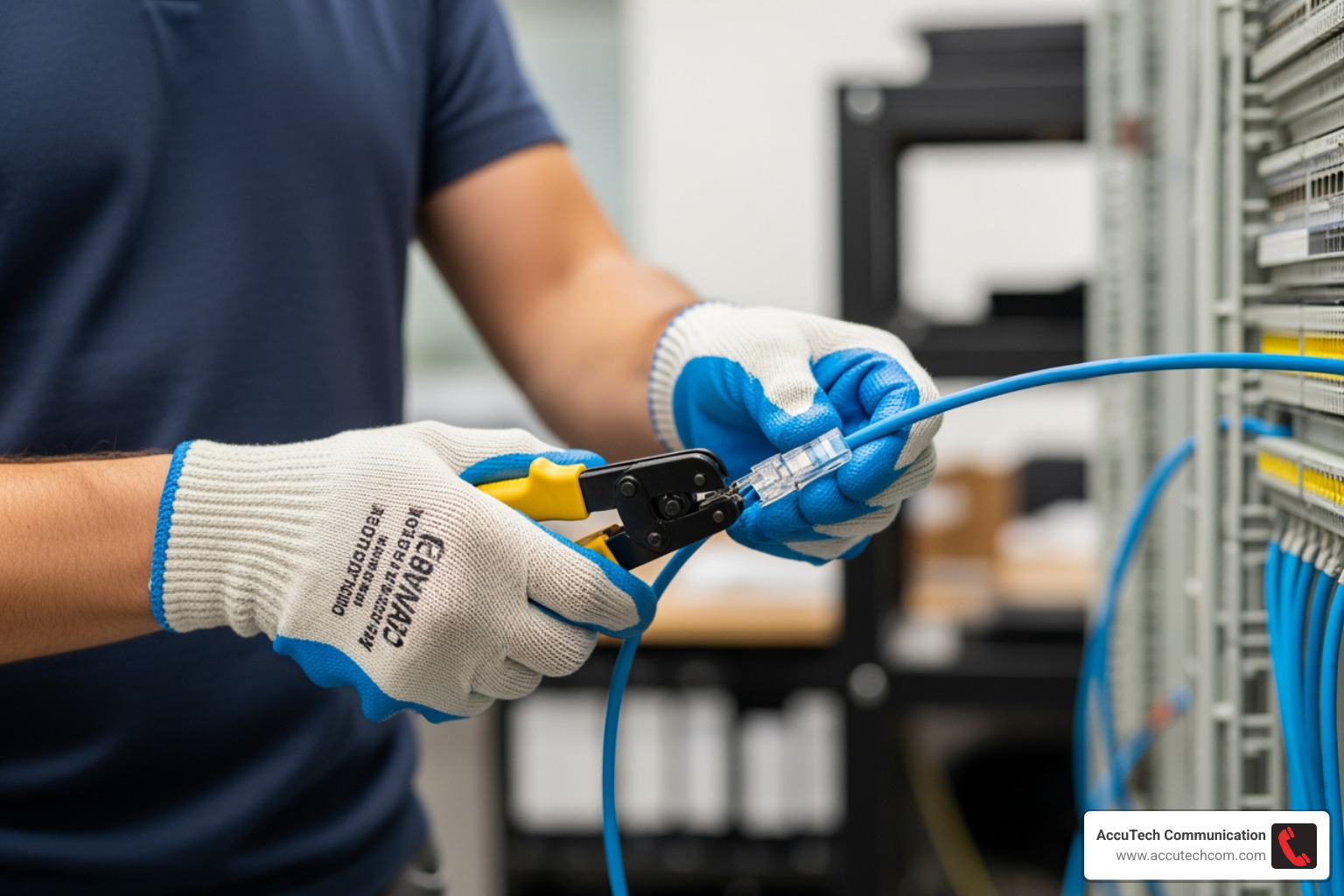
- Voice/Data Network Cabling: We install and terminate copper cabling (Cat5e, Cat6, Cat6a, Cat7, Cat8) to support workstations and VoIP systems.
- Fiber Optic Cabling: For high-speed, long-distance connectivity, we handle single-mode and multi-mode fiber installations, including fusion splicing and OTDR testing. More info about fiber optic cabling
- Patch Panel Installation: We organize network hubs to simplify troubleshooting and future upgrades.
- Audio/Video (A/V) Cabling: We install specialized cabling for conference rooms, digital signage, and intercoms.
- Wireless Infrastructure: We design the wired backbone for wireless access points (APs), including PoE support and site surveys.
- Structured Cabling Systems: A standardized framework supporting data, voice, and security. More info about structured cabling services
- Low Voltage Cabling: For security systems (CCTV, access control) and building automation.
- EMT Piping & Innerduct: Protection for cabling in industrial environments. More info about EMT piping and More info about innerduct installation
Why You Need a Certified Data Cable Installer Near Me
Choosing a professional over a DIY approach safeguards your business operations.
- Expertise and Compliance: Professionals adhere to ANSI/TIA/EIA standards, ensuring safety and performance.
- Quality and Reliability: We use commercial-grade materials and specialized tools.
- Efficiency: Certified technicians complete complex installations quickly, minimizing disruption.
- Troubleshooting: Documentation and testing make future issues easier to resolve.
- Future-Proofing: We design systems to scale with technologies like IoT and AI.
- Warranty: Our projects are backed by a five-year warranty on workmanship.
- Reduced Risk: Professionals mitigate signal interference and fire hazards.
Look for RCDD (Registered Communications Distribution Designer) credentials. Adherence to industry standards is non-negotiable for commercial installations. Our team is fully licensed and insured to operate across MA, NH, and RI, meeting all commercial compliance requirements.
The Strategic Advantage of Structured Cabling
Structured cabling is a standardized, hierarchical system that integrates data, voice, video, and security into a single infrastructure.
Why it is important for businesses:
- Network Efficiency: Organized systems minimize signal interference and bottlenecks.
- Scalability: Adding new users or technologies is easier and less disruptive.
- Future-Proofing: Structured systems accommodate higher bandwidth for IoT, 5G, and AI.
- Reduced Downtime: Labeled and documented cables make troubleshooting faster.
- Improved Aesthetics and Safety: Reduces clutter and improves airflow in server rooms.
For businesses in New England, structured cabling ensures your network performs at its peak. Read more about data purposes on how efficient data handling underpins business functions.
The Process of Hiring a Data Cable Installer Near Me
- Initial Consultation and Site Survey: We assess your building layout and operational demands in MA, NH, or RI.
- Detailed Proposal: We provide a comprehensive scope of work and a detailed quote.
- Project Planning and Design: RCDD-certified designers finalize the architecture according to ANSI/TIA/EIA standards.
- Installation: Certified technicians route cables and install hardware efficiently.
- Testing and Certification: Every cable run is tested to ensure it meets performance specifications.
- Documentation: We provide “as-built” drawings showing the exact layout of your system.
- Handover and Support: We ensure you understand your system and offer ongoing maintenance.
Understanding Cable Categories and Fiber Optic Solutions
Choosing the right cabling is essential for network performance.
Common Cabling Types:
- Cat5e: Supports up to 1 Gbps. Often considered the minimum standard today.
- Cat6: Supports 1 Gbps with less noise; can handle 10 Gbps over short distances.
- Cat6a: Fully supports 10 Gbps over 100 meters with improved shielding.
- Cat7/Cat8: Cat8 supports up to 40 Gbps over 30 meters, ideal for data centers.
- Fiber Optic: Transmits data using light pulses for higher bandwidth and longer distances.
- Single-mode: Ideal for long-haul and backbone connections.
- Multi-mode: Used for shorter distances within buildings.
| Feature | Cat6 (Copper) | Fiber Optic (Single-mode/Multi-mode) |
|---|---|---|
| Data Rate | Up to 10 Gbps (short distances) | 10 Gbps to 100+ Gbps |
| Distance | Up to 100 meters | Kilometers (SM) / Hundreds of meters (MM) |
| Immunity to EMI | Susceptible | Immune |
| Security | Easier to tap | Very difficult to tap |
| Cost | Generally lower | Higher initial cost |
Future-Proofing with High-Speed Fiber
- 100G Connectivity: Fiber is ready for the next decade of data demands.
- Mission-Critical Apps: Essential for healthcare and financial institutions.
- Data Center Backbone: Supports high-density cloud connectivity.
- New England Tech Growth: Scalability for growing tech sectors in MA, NH, and RI.
More info about fiber optic cabling and More info about innerduct installation
Signs Your Business Infrastructure Requires a Professional Upgrade
If you notice these signs in your Massachusetts, New Hampshire, or Rhode Island business, it’s time to call a data cable installer near me:
- Network Latency: Slow internet or lagging applications despite fast ISP speeds.
- Frequent Downtime: Intermittent connectivity often stems from faulty cabling.
- Cable Tangles: Disorganized server rooms obstruct airflow and complicate troubleshooting.
- New Technology Demands: IoT, cloud services, and VoIP strain older infrastructures.
- Hardware Overheating: Poor cable management restricts airflow, damaging equipment.
- Office Expansion: Growing teams require scalable cabling designs.
Find local professionals by searching On the Map. More info about network cabling installation.
Professional vs. DIY: The Commercial Risk
- Signal Interference: Improper termination leads to crosstalk and slow speeds.
- Safety Hazards: Professionals use fire-rated cables and follow strict building codes.
- Warranty: Professional jobs include workmanship warranties and performance certification.
- Longevity: DIY jobs often lack the quality materials needed for long-term reliability.
In commercial networking, reliability is paramount. A professional data cable installer near me ensures a compliant, future-ready infrastructure.
Frequently Asked Questions about Data Cabling
What is the average cost for data cabling installation?
The cost of data cabling installation varies based on cable type, complexity, and the number of drops. Based on publicly available industry averages, the cost can range from $100 to $900 per drop.
Please note: All prices mentioned are average costs sourced from publicly available internet data and are not the actual prices of AccuTech Communications.
Factors influencing cost include:
- Cable Type: Fiber is generally more expensive than copper.
- Complexity: Running cable through conduit or difficult areas increases labor.
- Testing: Professional certification adds cost but ensures reliability.
How does proper cable management improve performance?
- Airflow: Prevents equipment from overheating and failing.
- Reduced Interference: Proper routing minimizes EMI and crosstalk.
- Maintenance: Labeled cables make identifying issues significantly faster.
- Safety: Eliminates trip hazards and ensures a safer environment.
What is the role of cabling in wireless network setup?
A professional data cable installer near me is essential for high-performing Wi-Fi:
- Access Point Backbone: APs require high-speed Ethernet connections.
- PoE Support: Installers ensure cabling supports Power over Ethernet for APs.
- Strategic Placement: Running cables to optimal locations maximizes signal strength.
- Reliability: A robust wired foundation prevents wireless bottlenecks.
Conclusion
Your network cabling infrastructure is a critical asset that underpins your business operations in Massachusetts, New Hampshire, and Rhode Island. Choosing the right data cable installer near me impacts your efficiency, security, and growth.
At AccuTech Communications, we have been a trusted partner since 1993. We provide Massachusetts expertise, New Hampshire reliability, and Rhode Island quality to every project. Don’t let disorganized cabling hold your business back. Invest in a scalable, future-ready network today.
