
Cat6a Outdoor Ethernet Cable: 5 Top-Rated Reliable Picks 2025
Selecting the Right Outdoor Network Cable
Looking for a cat6a outdoor ethernet cable for your business network? Here’s what you need to know:
| Feature | Cat6a Outdoor Cable Specs |
|---|---|
| Speed | 10 Gigabit Ethernet (10 Gbps) up to 328 feet (100 meters) |
| Construction | 23 AWG solid copper conductors with polyethylene (PE) jacket |
| Temperature Range | -40°C to +70°C (-40°F to +158°F) |
| Protection | UV-resistant, waterproof, often with gel-filled core |
| Shielding | Available in shielded (F/UTP) and unshielded (UTP) versions |
| Installation Types | Direct burial, conduit, and aerial installations |
| PoE Support | Compatible with PoE/PoE+ up to 100W |
When your network needs to extend beyond your building, cat6a outdoor ethernet cable becomes essential. Unlike indoor cabling, outdoor-rated Cat6a is designed to withstand harsh weather, UV exposure, moisture, and temperature extremes while delivering reliable high-speed data transmission.
Outdoor Cat6a cables differ from standard indoor versions in several critical ways:
- Improved jacketing: Typically polyethylene (PE) for superior UV and moisture resistance
- Water protection: Either gel-filled cores or water-blocking tape to prevent moisture ingress
- Temperature tolerance: Engineered to function in extremes from -40°C to +70°C
- Shielding options: Many include foil shielding (F/UTP) to protect against outdoor EMI/RFI
I’m Corin Dolan, owner of AccuTech Communications with over 25 years of experience installing and maintaining cat6a outdoor ethernet cable solutions for businesses across Massachusetts, New Hampshire, and Rhode Island.

Top Features That Define the Best Cat6a Outdoor Ethernet Cable
Shopping for a cat6a outdoor ethernet cable can feel overwhelming. Here’s what really matters when looking for quality outdoor cable:
UV-Resistant Polyethylene (PE) Jacket
Think of the jacket as your cable’s raincoat and sunscreen. Quality outdoor cables use polyethylene (PE) jacketing that won’t break down under constant sunlight. Standard PVC jackets can literally crumble after just one summer of UV exposure, while a proper PE jacket stays flexible and intact for years.
Water-Blocking Technologies
Water is the arch-nemesis of network cables. The best cat6a outdoor ethernet cable options fight moisture in one of two ways:
- Gel-filled cores where waterproof gel surrounds the internal wires – fantastic for direct burial or extremely wet environments
- Water-blocking tape that swells if moisture penetrates the jacket – cleaner to work with while still providing excellent protection
Shielding (F/UTP) for EMI Protection
The outdoors is full of electrical noise. Quality cat6a outdoor ethernet cable includes foil shielding (F/UTP) that wraps around the internal wires like a protective cocoon. This shielding is crucial when your cable runs near power lines or industrial equipment.
Bandwidth and Performance Specifications
A true Cat6a outdoor cable delivers full 10 Gigabit speeds up to 328 feet (100 meters) with frequency support up to 500-550 MHz. This ensures your outdoor network won’t become a bottleneck as your bandwidth needs grow.
23 AWG Solid Copper Conductors
Premium cables use solid bare copper conductors, not cheaper copper-clad aluminum (CCA) alternatives. The solid copper provides better electrical performance, superior power delivery for PoE devices, and greater strength during installation.
Extended Temperature Range
Quality cat6a outdoor ethernet cable functions reliably from -40°C to +70°C (-40°F to +158°F). This wide range means your network keeps working through freezing blizzards and sweltering heat waves.
Power over Ethernet (PoE) Compatibility
Modern outdoor cables support the latest PoE++ standard (IEEE 802.3bt Type 4), delivering up to 100W of power alongside data. This lets you power security cameras and wireless access points without running separate electrical lines.
Direct-Burial Rating
True direct-burial cat6a outdoor ethernet cable can technically go straight into the ground, but installing it in PVC conduit is always the smarter choice for additional protection.
Why Cat6a Outshines Cat6 and Cat5e Outdoors
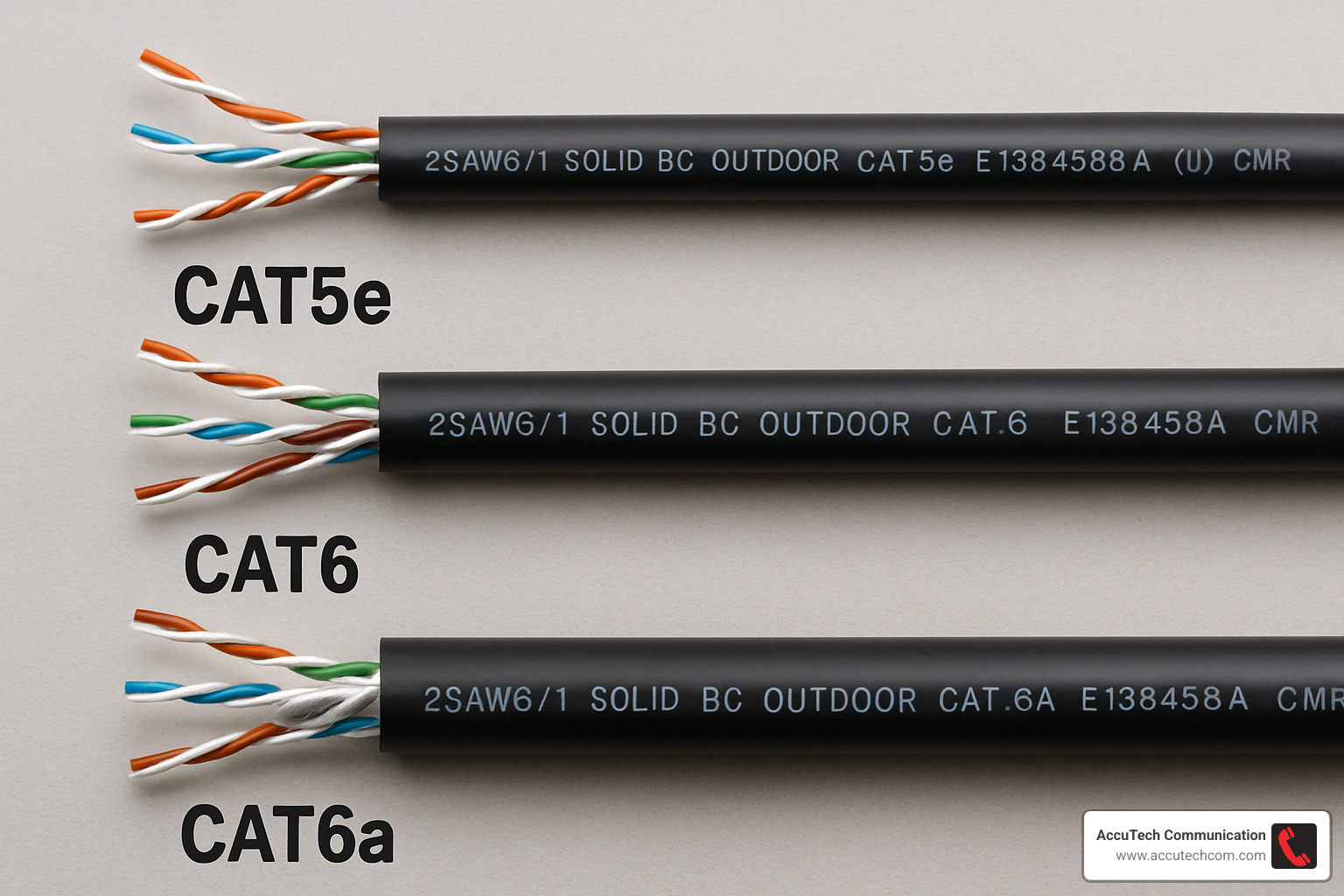
The primary advantage of cat6a outdoor ethernet cable is its ability to deliver full 10 Gigabit Ethernet across the entire standard 100-meter channel length, while Cat5e and Cat6 cables struggle with 10 Gigabit speeds over longer distances.
| Feature | Cat5e Outdoor | Cat6 Outdoor | Cat6a Outdoor |
|---|---|---|---|
| Max Speed | 1 Gbps at 100m 10 Gbps at 45m |
1 Gbps at 100m 10 Gbps at 55m |
10 Gbps at 100m |
| Frequency | 100 MHz | 250 MHz | 500-550 MHz |
| Alien Crosstalk | Limited protection | Moderate protection | Advanced protection |
| PoE Support | Good | Better | Best (up to 100W) |
| Noise Immunity | Basic | Improved | Superior (75% reduction) |
| Future-Proofing | Limited | Moderate | Excellent |
| Typical Cost | $ | $$ | $$$ |
Superior Alien Crosstalk Control
One significant advantage of cat6a outdoor ethernet cable is its ability to handle alien crosstalk—interference between adjacent cables. This becomes especially important in outdoor installations where cables often get bundled together.
Cat6a’s design features increased twist rates in conductor pairs, improved internal shielding, and separation splines that keep everything organized inside the cable jacket.
Future-Proofing Your Investment
Replacing outdoor cabling is disruptive and expensive. Investing in cat6a outdoor ethernet cable now makes sense, even if your current applications don’t yet demand 10 Gigabit speeds.
Network demands increase exponentially over time. When your business implements bandwidth-hungry applications like 4K video surveillance, wireless backhaul for Wi-Fi 6E, or IoT sensor networks, you’ll be thankful you chose Cat6a from the start.
The modest premium for cat6a outdoor ethernet cable today is significantly less than what you’d spend on a complete infrastructure replacement in a few years.
Jacket & Insulation Options for Any Climate
The jacket and insulation choices for your cat6a outdoor ethernet cable can mean the difference between reliable connections for years or premature failure. Here are the key options:
Polyethylene (PE) Jackets
PE jackets are the all-weather champion of outdoor cable protection. These jackets remain flexible even during freezing temperatures and won’t crack or degrade under harsh UV rays.
For most installations across Massachusetts, New Hampshire and Rhode Island, black PE jackets are recommended. The black color provides the best UV resistance for cables exposed to direct sunlight.
CMX-Rated Jackets
If your cat6a outdoor ethernet cable will run along exterior walls or through conduits rather than being directly buried, CMX-rated jackets might be suitable. These jackets carry a specific fire safety rating for outdoor communications cables while still providing decent environmental protection.
Water-Blocking Technologies Compared
Water is perhaps the greatest enemy of outdoor cable installations. There are two main approaches to keeping moisture at bay:
- Water-block tape acts like a self-healing barrier inside your cable. When moisture penetrates the outer jacket, this special tape swells to create a physical barrier.
- Gel filling provides fortress-level protection against moisture. These cables contain waterproof gel surrounding the twisted pairs that prevents any water migration. They’re messier to terminate but worth considering for coastal installations or areas with high water tables.
Low-Smoke Zero-Halogen (LSZH) Variants
LSZH variants of cat6a outdoor ethernet cable address an important safety concern. Standard PVC jackets can release toxic compounds when burned, while LSZH cables emit minimal smoke and no harmful halogens, making them valuable for installations that transition into healthcare facilities, schools, or public buildings.
Sunlight Resistance Ratings
When selecting your cat6a outdoor ethernet cable, look specifically for ratings that mention “sunlight resistance” or “UV resistance” with clear specifications about expected lifespan. A quality cable should maintain its integrity for at least 10 years of direct sunlight exposure.
Rain-Ready Picks – Our 5 Highest-Rated Outdoor Cat6a Cable Types
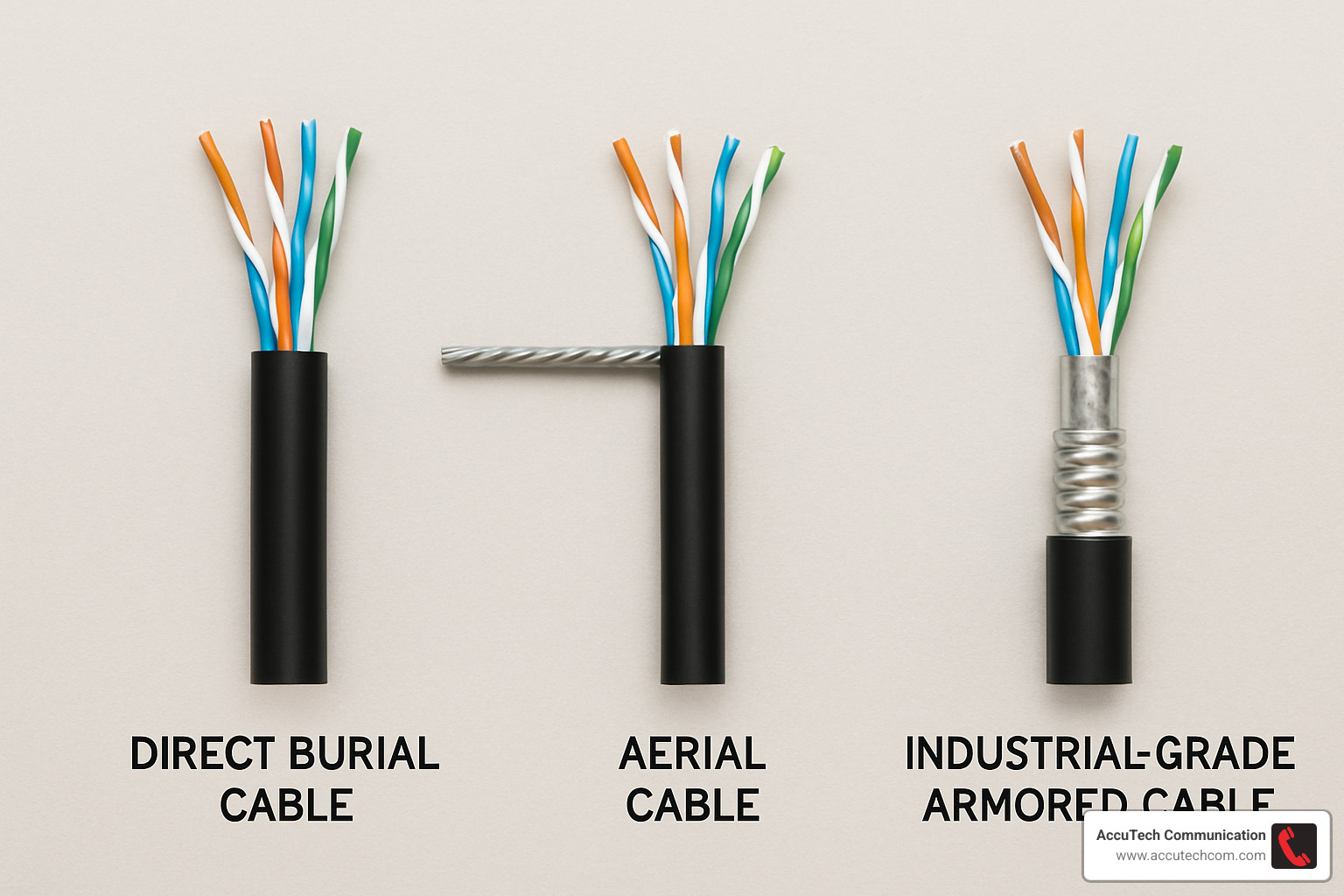
Based on our installation experience across New England, here are five distinct categories of cat6a outdoor ethernet cable that excel in different applications:
Shielded Direct-Burial Cat6a Outdoor Ethernet Cable
For underground installations, shielded direct-burial cat6a outdoor ethernet cable is the heavyweight champion. These cables feature:
- Full foil shield (F/UTP) protecting against electromagnetic interference
- Gel-filled core keeping water at bay even in soggiest conditions
- Robust PE jacket with rodent-resistant features
- Crush resistance up to 50 pounds per linear inch
- Operating temperature range from -40°C to +70°C
- 23 AWG solid bare copper conductors
Though rated for direct burial, using conduit is still recommended for additional protection and easier future maintenance.
IP68 Pre-Terminated Cat6a Patch Cable for Outdoor Devices
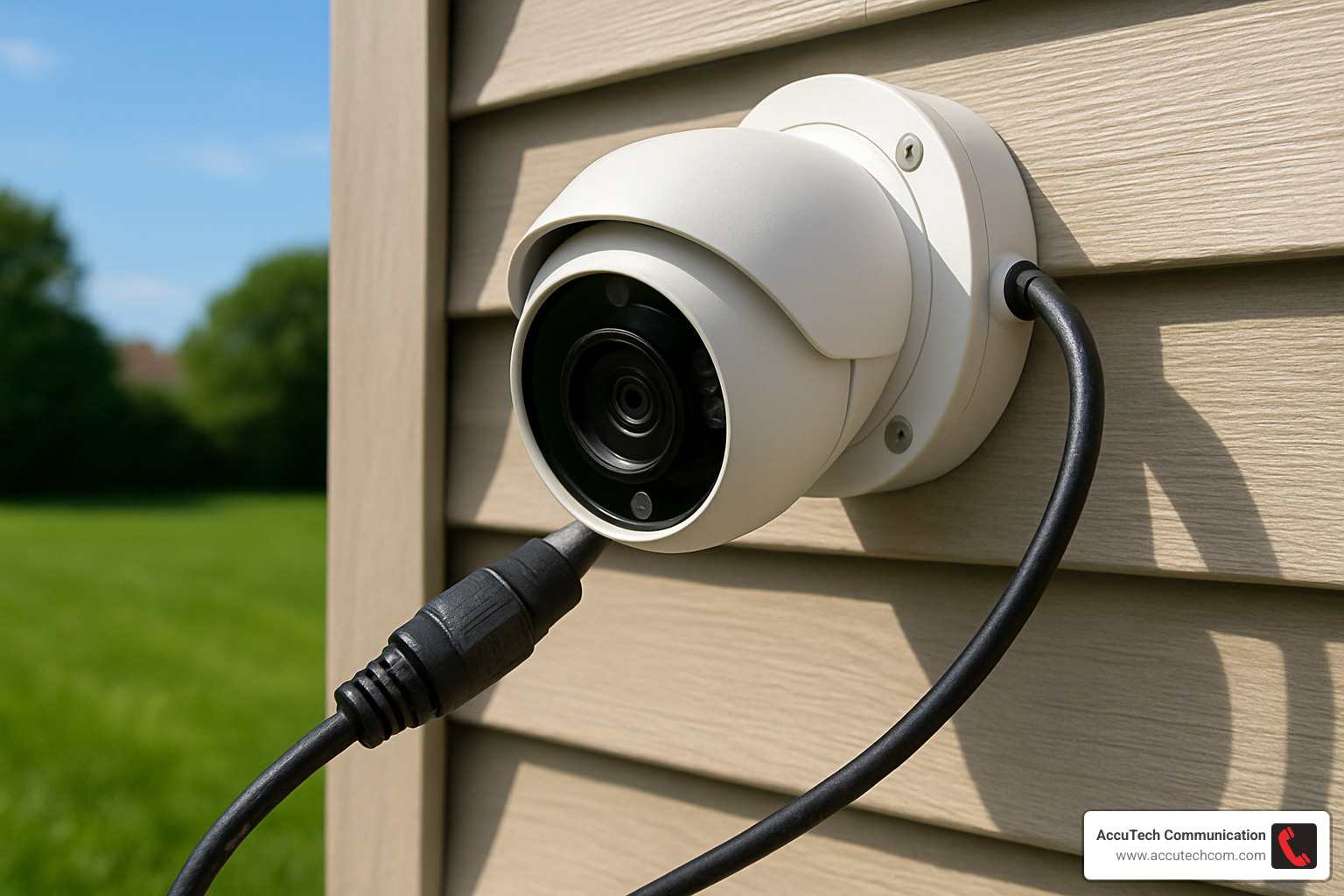
For connecting outdoor devices like security cameras or wireless access points, pre-terminated cat6a outdoor ethernet cable with IP68-rated connectors eliminates field termination in challenging weather conditions.
The factory-molded weatherproof RJ45 shrouds create a seal that’s both dust-tight and protected against long-term water immersion. Always use matching IP68 couplers when joining these cables to maintain the watertight seal.
Dry-Core Aerial Cat6a with Messenger Wire
When trenching isn’t practical, aerial cat6a outdoor ethernet cable with integrated messenger wire allows spanning distances between buildings or poles. This specialized cable includes a built-in steel support wire and typically uses water-block tape construction for cleaner termination.
Proper grounding is essential – both the messenger wire and cable shield should be grounded at both ends to protect against lightning strikes.
High-Flex Industrial Cat6a for Tight Bends
Industrial environments require cables that can handle tight spaces, moving equipment, and exposure to chemicals. High-flex cat6a outdoor ethernet cable features Bonded-Pair construction that maintains pair geometry even during repeated bending.
These cables can be up to 25% smaller in diameter than standard Cat6a, making them perfect for cramped installation pathways. They perform well in manufacturing environments with constant vibration and maintain flexibility in cold temperatures.
Entry-Level CMX Cat6a Outdoor Ethernet Cable
For more budget-conscious installations, entry-level CMX-rated cat6a outdoor ethernet cable provides a more affordable option that still delivers solid performance when properly protected.
These cables feature a basic UV-resistant jacket with CMX fire rating and water-block tape construction. They’re suitable for shorter outdoor runs that will be fully protected in conduit or temporary installations where extreme durability isn’t necessary.
Installation & Maintenance Best Practices
Route Planning and Preparation
Before digging that first trench, properly plan your cable route. Walk the entire site to identify potential hazards like unmarked power lines or irrigation pipes. Document your planned route with measurements and landmarks, and check local codes regarding outdoor cable installation.
Plan for generous service loops (3-5 extra feet) at each end of your cat6a outdoor ethernet cable run to provide flexibility for future changes.
Conduit vs. Direct Burial Considerations
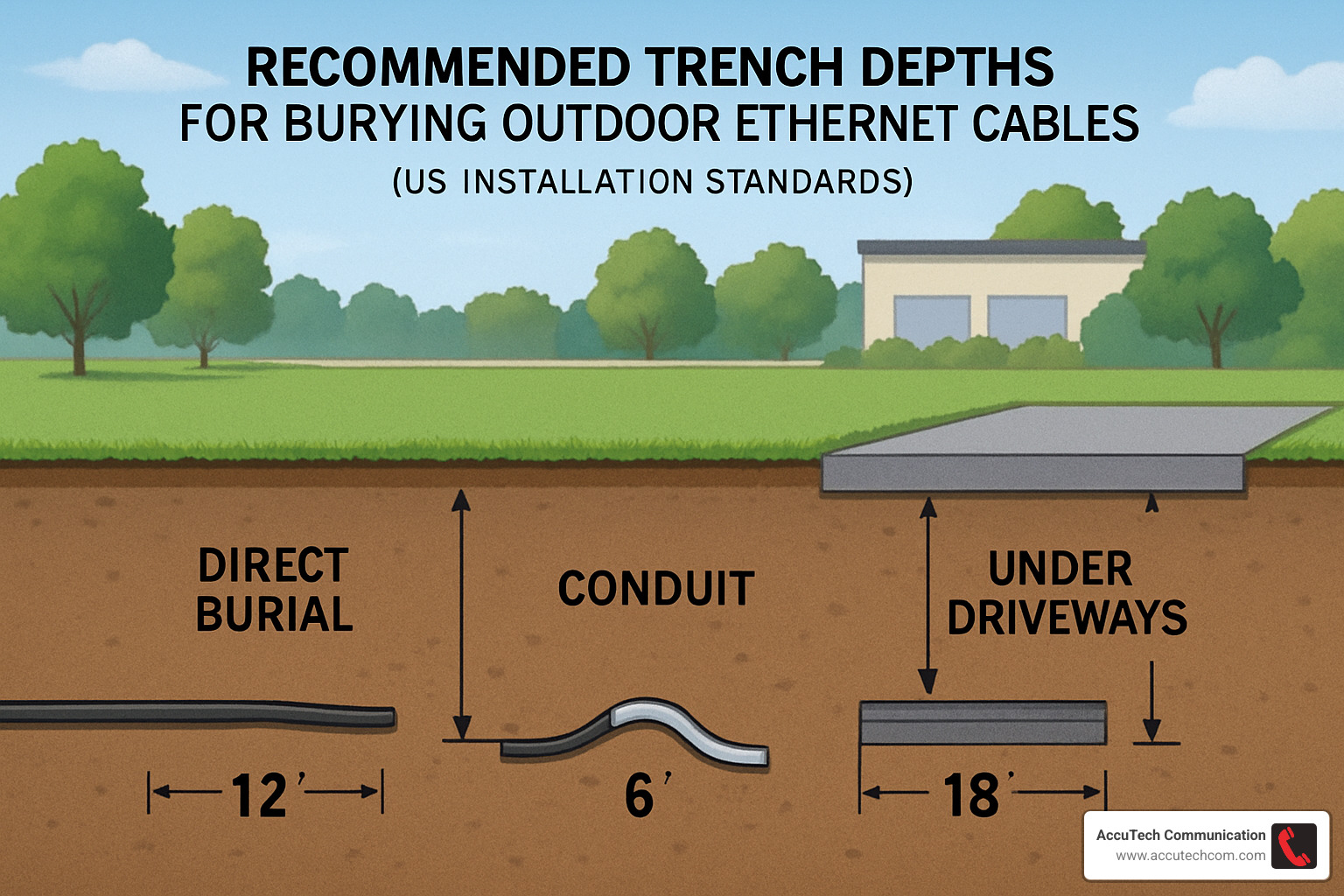
Even though your cat6a outdoor ethernet cable might be rated for direct burial, using conduit is almost always worth the extra investment. Conduit protects your cable from rocks, roots, and curious critters, and makes future cable replacement much easier.
For most installations, schedule 40 PVC conduit provides sufficient protection, though schedule 80 is recommended for areas with vehicle traffic. Always install pull strings in all conduits, use wide-sweep elbows rather than sharp 90° bends, and seal conduit ends with waterproof plugs.
Critical Installation Parameters
Respect these technical parameters when installing cat6a outdoor ethernet cable:
- Bend radius: Never bend tighter than a 1-inch radius for installed cable, and keep bends to at least 2.5 inches during installation
- Pull tension: Don’t exceed 25 pounds of force to avoid stretching conductors
- Grounding: For shielded cable, ground the shield at both ends of the run
- Drip loops: Create downward loops wherever cable enters a building or enclosure to prevent water ingress
Termination Tips for Outdoor Runs
The termination points of your cat6a outdoor ethernet cable are often the most vulnerable parts. Use weatherproof enclosures rated for outdoor use (NEMA 4X minimum) to protect connections.
For field terminations, consider gel-filled RJ45 connectors designed for outdoor use. Maintain pair twisting to within ½ inch of the termination point, and stick with the T568B color code standard for consistency.
Building entry points deserve special attention. Use proper service entrance fittings and install lightning protectors where cable enters the building. Outdoor-rated cable should transition to indoor-rated cable within 50 feet of entry.
Longevity & Inspection Checklist
Implement a consistent inspection routine to prevent small issues from becoming major problems:
- Schedule annual visual inspections for jacket damage, cracking, or UV degradation
- Check for animal damage and verify that enclosures remain watertight
- Every two years, conduct performance testing to verify that your network still meets Cat6a specifications
- For PoE applications, consider infrared scanning to identify hot spots
With proper installation and maintenance, your cat6a outdoor ethernet cable installation should provide 10-15 years of reliable service.
Performance, Length & PoE Considerations
Maximum Length Considerations
The standard maximum length for any Ethernet cable, including Cat6a, is 328 feet (100 meters) for a full channel. This includes the main cable run, patch cables at both ends, and any connections in between.
Several factors can reduce this maximum length: high ambient temperatures above 50 °C, high PoE power loads, multiple connection points, and excessive electromagnetic interference.
If your project requires going beyond the 100-meter limit, options include:
– Ethernet extenders (increase range up to 1,000+ feet)
– Fiber optic links with media converters for very long distances
– Intermediate switches to create multiple 100-meter segments
– Active boosters designed for outdoor use
Power over Ethernet (PoE) Considerations
One major advantage of modern cat6a outdoor ethernet cable is its robust support for Power over Ethernet. Today’s Cat6a cables support all current PoE standards, from basic 802.3af (Type 1) delivering about 13 W to devices, up to 802.3bt (Type 4/PoE++) providing up to 71 W of usable power. For readers new to the technology, the Power over Ethernet entry offers a helpful technical primer.
High-power PoE generates significant heat, especially when cables are bundled together. Quality cat6a outdoor ethernet cable with 23 AWG conductors can handle full PoE++ power delivery at distances up to 100 meters without derating, even in hot environments up to 60 °C.
For best results with PoE:
– Use shielded cable for high-power applications
– Avoid tight bundling of multiple PoE-carrying cables
– Choose cables with uniform heat-dissipation technologies
– Consider derating the maximum length for high-power applications in extremely hot environments
– Ensure proper grounding for shielded installations
EMI Hotspots and Mitigation
Outdoor environments contain many electromagnetic interference sources that can impact your cat6a outdoor ethernet cable performance: power lines, transformers, radio transmitters, cell towers, and industrial equipment.
In areas with high interference, use shielded F/UTP cable and maintain proper separation from power lines (at least 12 inches from 110 V lines and 24 inches from 220 V+ lines). When crossing power lines, do so at a 90-degree angle to minimize interference coupling.
Perform a site survey with an EMI detector before finalizing your cable route to avoid interference hotspots.
Do You Need Shielding?
Deciding whether your cat6a outdoor ethernet cable needs shielding depends on your specific environment.
When Shielding Is Essential
Shielded cable (F/UTP or S/FTP) becomes particularly valuable in several scenarios:
- Near power distribution equipment
- Close to radio transmitters, cellular towers, or industrial machinery
- For high-power PoE++ implementations powering outdoor devices
- In lightning-prone areas, especially for aerial installations or connections between buildings
F/UTP vs. U/UTP Comparison
Shielded F/UTP cable can reduce noise coupling by up to 75% compared to unshielded alternatives. While unshielded cable is generally lighter, more flexible, and less expensive, those advantages quickly fade when faced with significant EMI challenges.
Proper Grounding Techniques
If you opt for shielded cat6a outdoor ethernet cable, proper grounding is essential. Always ground both ends of shielded cable to eliminate potential differences. Use quality grounding blocks specifically designed for communications cabling, and ensure continuous shield connectivity through all connectors and patch panels.
Follow NEC Article 800 and local electrical codes for communications grounding for both performance and safety compliance.
In most residential applications, unshielded cable in conduit provides adequate protection. For business environments with mission-critical connections, properly shielded and grounded cat6a outdoor ethernet cable pays dividends in reliability.
Temperature & Environmental Ratings Explained
Understanding temperature and environmental ratings is essential for ensuring your cat6a outdoor ethernet cable investment lasts through challenging weather conditions.
Operating vs. Installation Temperature
The operating temperature range tells you the conditions your cat6a outdoor ethernet cable can withstand once installed. Premium outdoor cables typically handle a range from -40°C to +70°C (-40°F to +158°F).
Installation temperature is more restrictive, usually between -20°C to +50°C (-4°F to +122°F). Cable jackets become less flexible in extreme cold, making them prone to cracking if bent during installation.
If planning a winter installation, consider storing your cable in a heated space overnight before working with it.
Freeze-Thaw Cycle Considerations
In New England, the constant freeze-thaw cycles can damage outdoor infrastructure. Quality cat6a outdoor ethernet cable needs to maintain jacket elasticity at low temperatures and incorporate effective water-blocking features to prevent moisture accumulation.
When installing in areas prone to freeze-thaw cycles, include generous service loops (2-3 feet extra) at termination points and avoid mounting cables too tightly against surfaces to allow for natural expansion and contraction.
Coastal and High-Humidity Environments
Coastal areas present unique challenges with salt spray, high humidity, and intense UV exposure. For these installations, select cables with improved UV protection and gel-filled construction for superior moisture protection.
Use connectors with corrosion-resistant plating (nickel or stainless steel) and schedule more frequent visual inspections, ideally twice yearly rather than annually.
With proper cable selection and installation techniques, coastal installations can achieve the same longevity as inland deployments despite the challenging conditions.
Frequently Asked Questions about Cat6a Outdoor Ethernet Cable
How long can I run cat6a outdoor ethernet cable without a repeater?
The standard maximum run for any cat6a outdoor ethernet cable is 328 feet (100 meters) for the entire channel from end to end, including patch cables at both ends.
If your project requires going beyond this limit, options include:
– Ethernet extenders (up to 1,000+ feet)
– Intermediate network switches to create multiple segments
– Fiber optic with media converters for very long distances
PoE power delivery may be reduced as you approach the 100-meter mark due to voltage drop across the cable.
Is outdoor Cat6a compatible with PoE and PoE+ devices?
Yes! Quality cat6a outdoor ethernet cable works with all current Power over Ethernet standards, from basic PoE (15.4W) up to PoE++ (100W).
Properly constructed outdoor Cat6a cables with 23 AWG solid copper conductors handle these power loads even in high temperatures. For best performance with high-power PoE applications, use shielded cable and avoid bundling multiple PoE cables tightly together.
Can I transition outdoor Cat6a directly into my building?
No, you shouldn’t bring outdoor-rated cat6a outdoor ethernet cable directly into your building beyond a limited distance. The National Electrical Code (NEC) requires that outdoor cables transition to indoor-rated cables within 50 feet of entering a building because outdoor cable jackets typically don’t meet fire safety ratings required for indoor installation.
For proper transition:
– Install a junction box at your building entry point with good weatherproofing
– Implement correct grounding and bonding at this entry point
– Transition to indoor-rated cable using a punch-down block, coupler, or small switch
– Properly seal and firestop all building penetrations
– Label the transition point for future reference
Conclusion
Choosing the right cat6a outdoor ethernet cable is an investment in your business network’s reliability. In New England, where we face coastal salt spray, freezing winters, and humid summers, your outdoor network infrastructure needs to be tough enough to handle whatever Mother Nature throws its way.
The critical features that separate good cables from great ones include robust PE jacketing that resists UV rays and moisture, effective water-blocking technologies, and proper shielding that protects signals from environmental noise. Quality cable should handle temperatures from -40°C to +70°C and support the latest PoE standards up to 100W.
Proper installation makes all the difference. A well-installed cable can last 10-15 years, while cutting corners might leave you troubleshooting in the rain just a year later. Details like drip loops, proper grounding, and conduit protection keep your network reliable through all weather conditions.
At AccuTech Communications, we’ve been installing and maintaining outdoor network infrastructure throughout Massachusetts, New Hampshire, and Rhode Island since 1993. Our team knows what works in New England conditions.
Whether you’re connecting buildings across your campus, setting up a security camera system, or extending network access to a new addition, properly selected and installed cat6a outdoor ethernet cable provides the backbone your business network needs.
For professional installation or advice on your next outdoor networking project, contact our team at AccuTech Communications to discuss your requirements. We serve businesses throughout New England, including Boston, Worcester, Marlborough, Waltham, and surrounding communities.
