
Cat6a Patch Cable: Top 5 Best Picks for 2025 Success
Why Cat6a Patch Cables Are Essential for Modern Networks
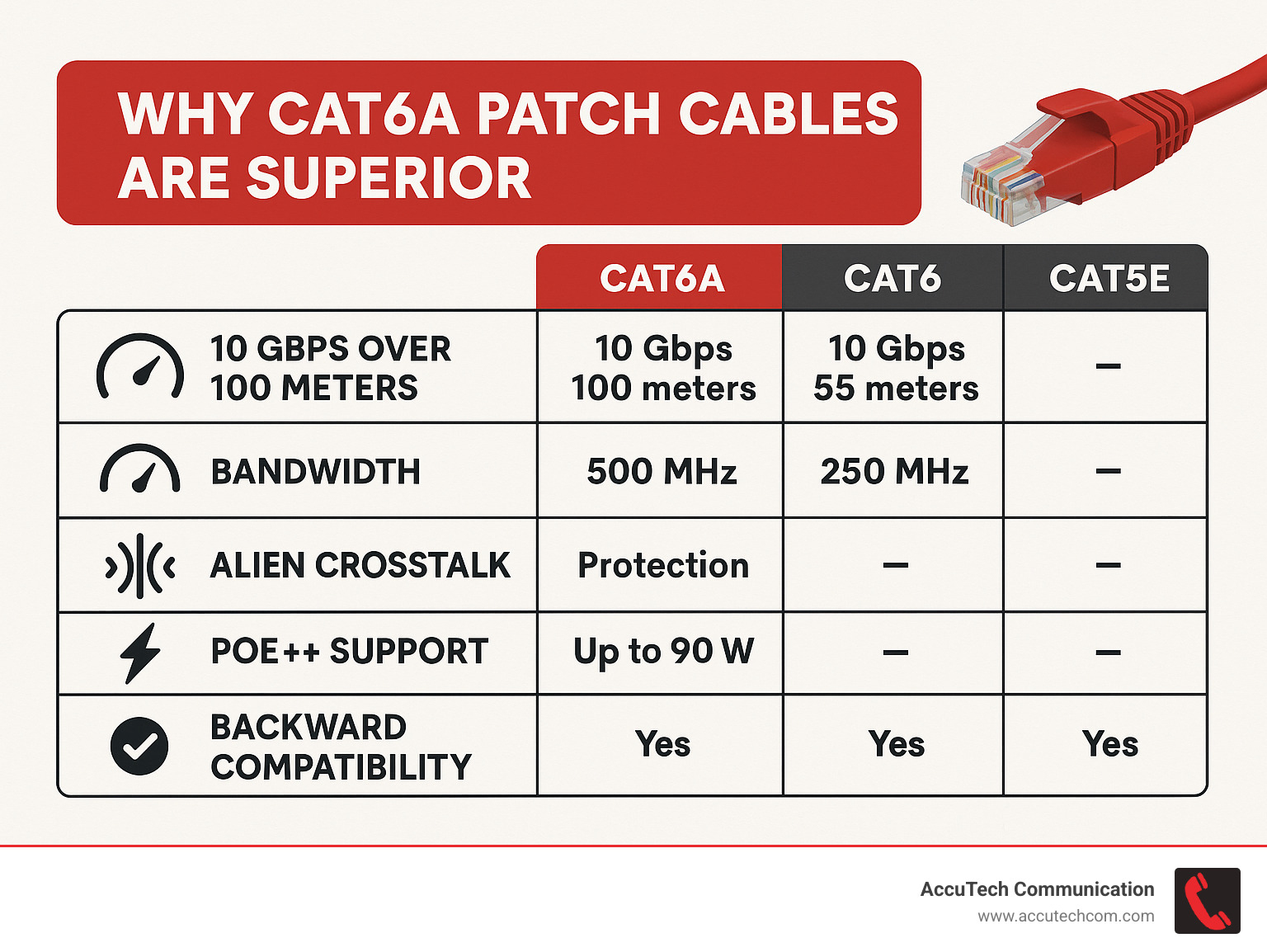
Cat6a patch cables deliver 10 Gigabit Ethernet speeds up to 100 meters with 500 MHz bandwidth, making them the gold standard for future-proof networking. Here’s what makes them superior:
Key Cat6a Patch Cable Benefits:
– 10 Gbps Performance: Full 10GBASE-T support over 100 meters (vs. Cat6’s 55-meter limit)
– 500 MHz Bandwidth: Double Cat6’s 250 MHz frequency range
– Alien Crosstalk Control: Advanced shielding reduces interference from adjacent cables
– PoE++ Ready: Supports up to 90W Power over Ethernet applications
– Backward Compatible: Works seamlessly with Cat6 and Cat5e equipment
The difference is significant. While Cat6 cables support 10 Gigabit speeds only up to 55 meters in ideal conditions, Cat6a maintains full performance across the standard 100-meter channel length. This matters for data centers, healthcare facilities, and any environment where reliable high-speed connectivity is critical.
“Nearly all Cat6a cables are shielded, whereas Cat6 shielding is optional,” according to industry analysis. This built-in protection makes Cat6a ideal for electrically noisy environments common in medical facilities and manufacturing plants.
I’m Corin Dolan, owner of AccuTech Communications, and I’ve been installing and troubleshooting cat6a patch cable systems across Massachusetts, New Hampshire, and Rhode Island since 1993. Through decades of hands-on experience with everything from small office upgrades to large healthcare network overhauls, I’ve seen how the right cabling choices can make or break a network’s performance.
Cat6a patch cable terms to learn:
– cat6a ethernet cable 1000 ft
– cat6a outdoor ethernet cable
Why Upgrade to a Cat6a Patch Cable
After three decades of running cable through everything from cramped office spaces to sprawling hospital networks, I can tell you that Cat6a delivers performance you can actually feel.
The magic happens at 500 MHz bandwidth – exactly double what Cat6 offers. When you’re pushing 10 Gbps speeds through a busy network, that extra bandwidth keeps your data flowing smoothly even when dozens of cables are bundled together.
Cat6a patch cables maintain full 10 Gigabit performance over the complete 100-meter channel length. Cat6 starts to struggle after 55 meters, and Cat5e? You’re lucky to get reliable 10 Gbps beyond 45 meters. When you’re planning a network that needs to work reliably for the next decade, that extra distance capability is pure gold.
The alien crosstalk control is where Cat6a really shines. With 48 cables running through a cable tray, older cables start interfering with each other like people trying to talk over each other at a crowded party. Cat6a’s improved shielding and that clever plastic spline keep each cable’s signals clean and separate.
Power over Ethernet capabilities have become crucial. Today’s Cat6a patch cables handle PoE++ applications up to 90 watts without breaking a sweat. That means you can power high-performance wireless access points, security cameras, and even some LED lighting systems through the same cable carrying your data.
The backward compatibility is seamless. Your existing Cat6 and Cat5e equipment works perfectly with Cat6a cables. Think of it as insurance – you’re not breaking anything today, but you’re ready for tomorrow’s upgrades.
The cost difference has shrunk significantly. The premium for Cat6a over Cat6 is much smaller than it used to be, especially when you consider you’re avoiding future re-cabling costs.
The EMI shielding in most Cat6a cables isn’t just nice to have – it’s essential in today’s electrically noisy environments. Medical facilities, manufacturing plants, even modern offices create electromagnetic interference that can cripple lesser cables.
More info about Ethernet Cable Types
Cat6a Patch Cable vs. Cat6 & Cat5e
The performance gap between cable categories becomes crystal clear when you need reliable 10 Gigabit speeds. Cat5e was great for its time, but asking it to handle 10 Gbps is like asking a bicycle to keep up on the highway.
Cat6a patch cables eliminate distance worries completely. Whether you’re running 10 meters or the full 100-meter channel, you get consistent performance.
| Cable Category | Max 10 Gbps Distance | Bandwidth | Typical Use Case |
|---|---|---|---|
| Cat5e | 45 meters | 100 MHz | Legacy installations |
| Cat6 | 55 meters | 250 MHz | Current standard |
| Cat6a | 100 meters | 500 MHz | Future-proof choice |
The alien crosstalk issue is where things get really interesting. When cables run parallel to each other – and they almost always do – they start interfering with each other’s signals.
We installed a network upgrade for a medical practice where existing Cat6 cables were bundled together in the ceiling. The practice was experiencing intermittent slowdowns that nobody could explain. Once we replaced them with Cat6a patch cables, those mystery performance issues disappeared completely.
Scientific Proof of the Upgrade
The engineering behind Cat6a isn’t just marketing fluff – it’s backed by solid science and rigorous testing standards. The TIA/EIA specifications for Cat6a include alien crosstalk parameters that don’t even exist for lower categories.
Scientific research on bend radius shows that cable flexibility directly impacts performance. Modern Cat6a cables typically need a bend radius of about four times their diameter – usually around an inch for standard cables.
The UL and ETL certifications verify that cables meet safety standards for different installation environments. RoHS compliance ensures you’re not installing cables with hazardous materials.
Even the connector details matter. That 50-micron gold plating on quality RJ45 connectors provides superior corrosion resistance and maintains low contact resistance over time. These details let properly installed Cat6a patch cables maintain their performance for 10-15 years or more.
Best Cat6a Patch Cable Picks for 2025
After three decades of installing network cabling across New England, I’ve learned that not all Cat6a patch cables are created equal. The difference between a mediocre cable and an exceptional one becomes crystal clear during installation – and even more obvious years later when your network is still performing flawlessly while others are struggling with mysterious slowdowns.
We’ve tested countless cables in everything from cramped server closets to sprawling hospital networks. The best cables share common traits: they exceed specifications rather than barely meeting them, they’re built to last decades not just years, and they make your job easier during installation. Here are the cables that have earned our trust through real-world performance.
Best Overall Cat6a Patch Cable
For most installations, high-flex Cat6a patch cables with slim profiles are game-changers. These cables pack the same performance as bulkier alternatives while taking up significantly less space in your patch panels and cable management systems.
The magic is in the engineering. Quality high-flex cables achieve bend radii as tight as 0.74 inches without compromising electrical performance. That might not sound impressive until you’re trying to route dozens of cables behind a rack in a cramped telecom room – then every fraction of an inch matters.
Look for cables with stranded 24 AWG conductors that maintain their flexibility over time. The best ones feature precision-molded connectors that won’t crack under stress and maintain solid connections even after hundreds of plug/unplug cycles. These cables reduce patch panel density issues by up to 25%, making cable management cleaner and more professional.
Best Shielded Cat6a Patch Cable
When electromagnetic interference is your enemy, S/FTP shielded Cat6a patch cables are your best defense. These cables feature individual foil shields around each twisted pair plus an overall braided shield – it’s like wearing both a raincoat and carrying an umbrella.
We install these in manufacturing plants where welding equipment creates electrical chaos, in hospitals near MRI machines, and in data centers packed with high-power equipment. The difference is dramatic. Unshielded cables in these environments often struggle to maintain even gigabit speeds, while properly grounded shielded cables deliver consistent 10 Gbps performance.
The key word is “properly grounded.” Shielded Cat6a patch cables only work their magic when both ends connect to grounded equipment through shielded connectors. Skip this step, and you’re paying extra for cables that perform no better than unshielded ones.
Best Budget Cat6a Patch Cable
Great performance doesn’t always require a premium price tag. Quality unshielded Cat6a patch cables with 24 AWG stranded conductors and CM-rated jackets deliver full Category 6A performance at budget-friendly prices.
These cables work beautifully in typical office environments where EMI isn’t a major concern. The stranded construction keeps them flexible for patch applications, while CM jacket ratings meet safety requirements for most commercial installations.
Even budget-conscious choices shouldn’t compromise on connector quality. Look for 50-micron gold plating on RJ45 connectors and full compliance with TIA-568.2-D standards. Poor connectors cause more network headaches than any other single factor we encounter during service calls.
Best PoE+ & PoE++ Cat6a Patch Cable
High-power PoE applications demand special attention to heat management and current capacity. The best PoE-optimized Cat6a patch cables handle up to 90 watts of power delivery while maintaining perfect signal integrity for data transmission.
These cables typically feature oversized 23 AWG conductors that reduce resistance and heat buildup. Special jacket materials help dissipate heat effectively, preventing the thermal issues that can degrade performance or damage equipment.
When installing multiple high-power PoE cables, maintain separation between bundles to prevent overheating. These cables are essential for powering modern wireless access points, PTZ security cameras, and intelligent LED lighting systems that demand both high power and reliable data connections.
Best Plenum-Rated Cat6a Patch Cable
Air-handling spaces require CMP-rated Cat6a patch cables that meet strict fire safety standards. These cables feature special low-smoke, flame-retardant jackets made from materials like fluorinated ethylene propylene that won’t contribute to toxic gas production during fires.
The plenum rating isn’t optional – it’s required by code in many commercial installations. We always verify local requirements before specifying cable types, because using CM-rated cables in plenum spaces is a code violation that can fail inspections and create safety hazards.
Yes, plenum cables cost more than standard alternatives, but they maintain the same electrical performance while meeting critical safety requirements. The special jacket materials keep cables flexible and easy to install while providing the fire resistance that building codes demand.
Buying Guide: Choosing the Right Cat6a Patch Cable
Choosing the perfect Cat6a patch cable is like picking the right tool for a job – it needs to match your specific needs and environment. After three decades of installations, I’ve learned that the cheapest cable often becomes the most expensive when you factor in troubleshooting time and performance issues.
Length planning deserves your first attention. While Cat6a patch cables support 10 Gbps over 100 meters total channel length, this includes everything – your patch cables, the horizontal cable run, and equipment cords. Keep patch cables as short as practical to maximize the distance available for your permanent cabling.
Wire gauge directly impacts both performance and how easy the cable is to work with. Most Cat6a patch cables use 24 AWG stranded conductors, which strike the right balance between flexibility and current-carrying capacity. If you’re running high-power PoE applications, consider 23 AWG conductors for better power handling.
RJ45 connector quality separates professional-grade cables from consumer versions. Look for 50-micron gold plating – this prevents corrosion and maintains low contact resistance over years of use. The connector housing should be precision-molded with proper strain relief, and clearly marked as Category 6A rated.
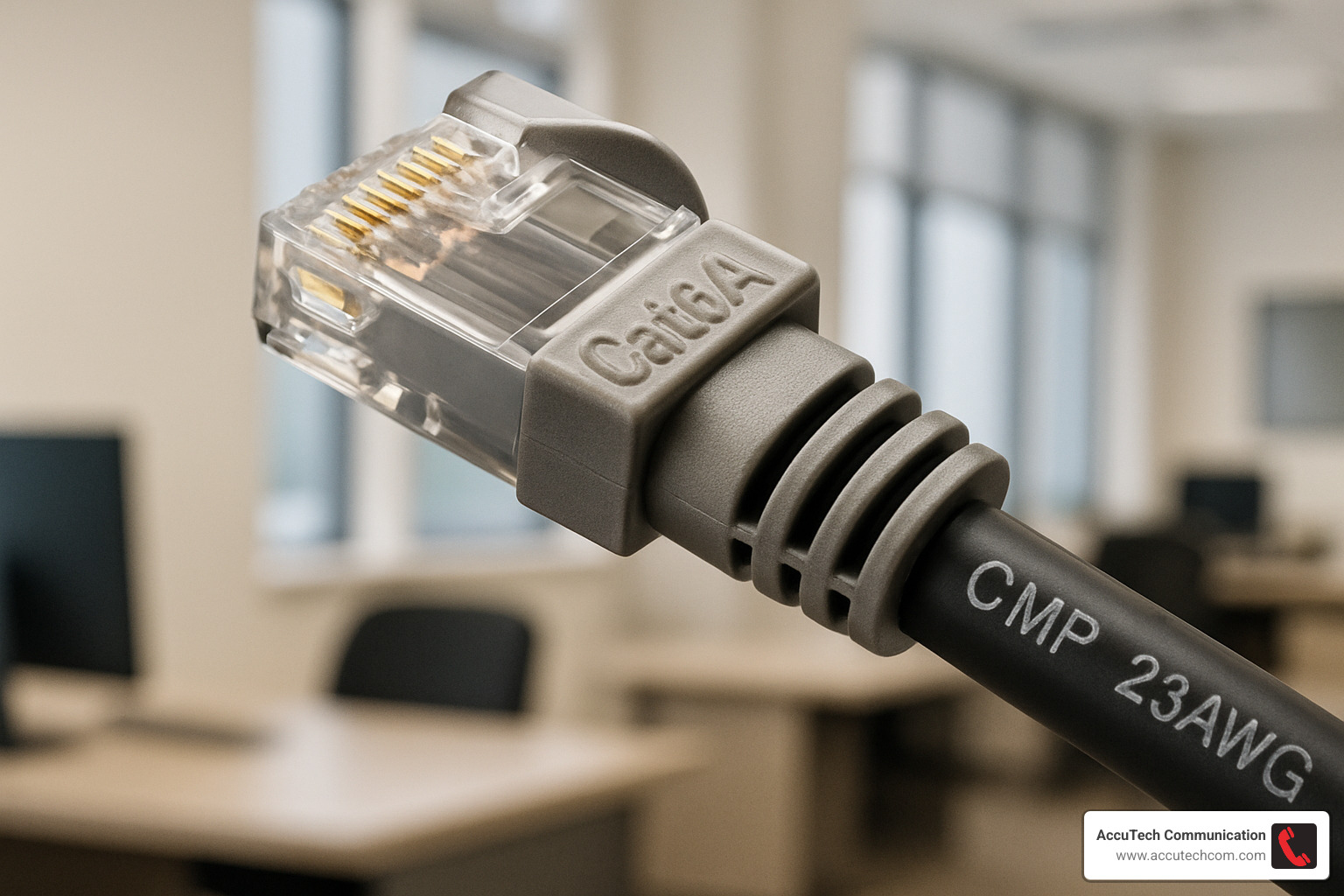
Jacket ratings must match your installation environment. CM (Communications) rating works for most commercial spaces. CMP (Communications Plenum) rating is mandatory in air-handling areas. CMR (Communications Riser) rating is needed for vertical runs between floors. Using the wrong jacket type can fail inspection and create safety hazards.
Always request test reports from your cable supplier. Quality Cat6a patch cables should include swept frequency testing data showing performance across the entire 1-500 MHz range, plus crosstalk measurements that verify alien crosstalk compliance.
More info about Network Cable Categories
Cat6a Patch Cable Certifications to Look For
TIA-568.2-D compliance is your baseline requirement – the minimum entrance exam for any Cat6a patch cable. This standard defines the electrical performance requirements including return loss, insertion loss, near-end crosstalk (NEXT), and those crucial alien crosstalk parameters.
ISO/IEC 11801 provides international standards that complement TIA requirements. Cables meeting both standards ensure compatibility with equipment from manufacturers worldwide.
UL listing verifies safety compliance with National Electrical Code requirements. Look for the UL mark printed on the cable jacket – this indicates the cable has been rigorously tested for fire resistance, electrical safety, and environmental compliance.
ETL verification provides independent third-party testing that confirms the cable actually meets its published specifications. This is particularly important for alien crosstalk performance, which requires specialized test equipment.
Cat6a Patch Cable vs. Cat6 – Quick Specs
The bandwidth difference between Cat6a (500 MHz) and Cat6 (250 MHz) is what enables Cat6a’s superior 10 Gigabit performance. The additional bandwidth provides headroom that maintains performance even when installation conditions aren’t perfect.
The central spline support structure in Cat6a patch cables physically separates the twisted pairs, reducing both internal crosstalk between pairs within the cable and alien crosstalk from adjacent cables. This mechanical design difference is why Cat6a cables are noticeably thicker but perform so much better.
Testing requirements for Cat6a include alien crosstalk measurements that don’t even exist for Cat6. This means every Cat6a patch cable undergoes more rigorous testing to verify performance in multi-cable environments.
In-depth comparison of Cat6 vs. Cat6a
Installation & Performance Tips
Getting the most from your Cat6a patch cable investment starts with understanding the fundamentals. The 100-meter channel length includes every inch from your network switch to the end device. Those patch cables at both ends, the horizontal cabling, and equipment jumpers all count toward this total distance.
Keep your Cat6a patch cables as short as practical – this gives you maximum flexibility for your permanent cabling runs. The bend radius rule is non-negotiable: four times the cable outer diameter. For most Cat6a cables, that’s about 0.944 inches minimum.
Cable management becomes more challenging with Cat6a because these cables are thicker and less flexible. Don’t try to force them into undersized cable trays or overstuff conduits. We size our cable management hardware specifically for Cat6a’s larger diameter.
Testing is where many installations fall short. Basic cable testers that just check continuity won’t catch the subtle performance issues that prevent reliable 10 Gbps operation. We use Fluke cable certifiers for all our Cat6a patch cable installations because they actually verify the frequency response and crosstalk performance.
Heat management becomes critical with high-power PoE applications. When you’re pushing 90 watts through a cable, proper bundle separation and ventilation are essential for maintaining both performance and cable lifespan.
More info about 5 Common Mistakes to Avoid When Installing Network Cabling
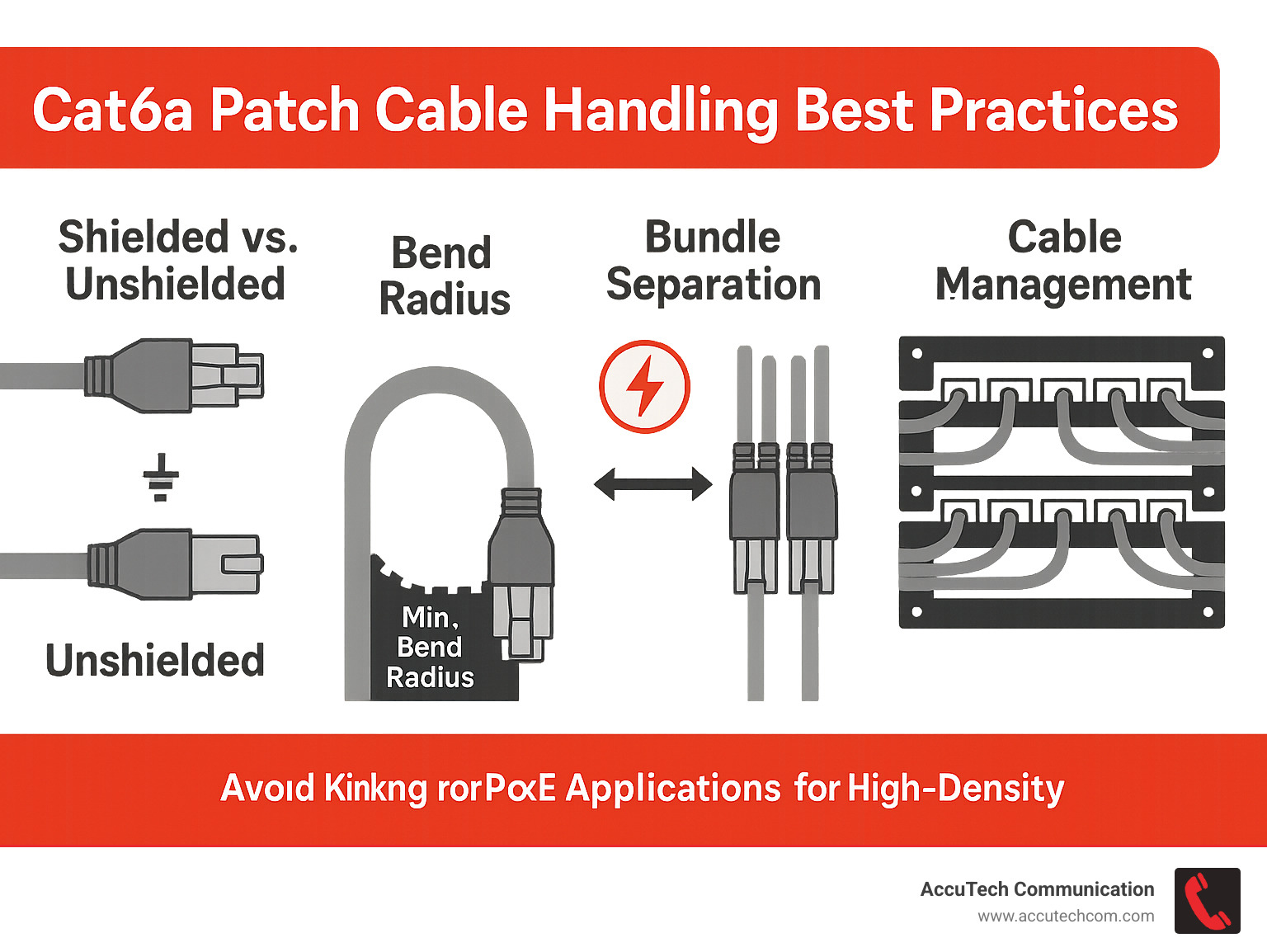
Cat6a Patch Cable Handling Best Practices
Sharp bends are the fastest way to ruin a perfectly good Cat6a patch cable. Always maintain that minimum bend radius during installation, and never kink or crush the cables.
Use cable management hardware that’s actually designed for Cat6a’s larger diameter. Trying to force these cables into pathways sized for Cat5e or Cat6 creates stress points that will cause problems down the road.
Physical separation between cables provides additional performance margin, especially in high-density installations. While Cat6a’s alien crosstalk resistance is excellent, a little extra space never hurts.
568B wiring standards should be your default choice for consistency. While 568A works electrically, 568B is what most commercial installations use.
Troubleshooting Cat6a Patch Cable Issues
When signal loss exceeds specification limits, start with the physical inspection. Look for kinked cables, damaged connector housings, or contaminated connector contacts. Often a simple cleaning or cable replacement solves what seemed like a complex network problem.
Connector damage causes more Cat6a patch cable failures than anything else we encounter. Bent pins, cracked housings, and loose strain relief boots are the usual suspects. Quality connectors with proper strain relief make a huge difference in long-term reliability.
Certification failures often point to installation practices rather than defective cables. Excessive bending, over-tightened cable ties, or improper grounding of shielded cables can cause performance issues that only show up during comprehensive testing.
The key is systematic troubleshooting. Start with the obvious physical issues, then move to more sophisticated testing. Most problems have simple solutions once you know what to look for.
Frequently Asked Questions about Cat6a Patch Cable
What is the maximum length for a Cat6a patch cable at 10 Gbps?
Here’s where Cat6a patch cables really shine – they maintain full 10 Gbps performance over the complete 100-meter channel length that Ethernet standards specify. But here’s the catch that trips up many people: those 100 meters include everything in your network path.
Think of it like a budget – you have 100 meters total to “spend” on patch cables at both ends, the horizontal cable run, and any equipment cords. That’s why we always recommend keeping patch cables as short as practical, typically between 1-7 meters. This leaves maximum distance available for your permanent horizontal cabling where you really need it.
The beauty of Cat6a becomes obvious when you compare it to Cat6 cables, which can only handle 10 Gbps reliably up to 55 meters. In our installations across New England, this difference often determines whether a network upgrade requires completely new horizontal cabling or just switching out the patch cables and equipment.
When should I choose shielded over unshielded Cat6a?
After three decades of network installations, I can tell you that environment makes all the difference. Shielded Cat6a patch cables are essential in places where electromagnetic interference runs wild – think manufacturing floors with heavy machinery, hospital MRI suites, or anywhere you’ve got high-power electrical equipment humming away.
We’ve seen dramatic performance differences in these challenging environments. Unshielded cables that work perfectly in a quiet office building can suffer constant packet loss and speed drops when deployed near industrial equipment. The shielding acts like armor against all that electrical noise.
Unshielded (UTP) cables work beautifully in typical office settings where EMI isn’t a major concern. They’re more budget-friendly and simpler to install since you don’t need to worry about proper grounding. But remember – shielded cables only deliver their benefits when they’re properly grounded at both ends. Half the shielded installations we troubleshoot have grounding issues that render the shielding useless.
Are Cat6a patch cables backward compatible with older gear?
Absolutely! Cat6a patch cables play nicely with everything from brand-new 10 Gbps switches down to that ancient Cat5e equipment you might still have lurking in a closet somewhere. They use the same RJ45 connectors and follow identical wiring standards, so compatibility is never an issue.
The performance will always be limited by the weakest link in your chain, though. Connect a Cat6a patch cable between a 10 Gbps switch and a gigabit device, and you’ll get gigabit speeds – the device sets the limit, not the cable. Similarly, if you mix one Cat5e patch cable into an otherwise all-Cat6a installation, that particular connection drops to Cat5e performance levels.
This backward compatibility makes upgrades much more manageable. You can install Cat6a patch cables today knowing they’ll work with your current equipment while providing a clear upgrade path when you’re ready to move to 10 Gbps networking. It’s future-proofing that actually makes financial sense.
Conclusion & Next Steps
Your network deserves better than yesterday’s technology. Cat6a patch cables aren’t just another upgrade – they’re your insurance policy against obsolescence and performance bottlenecks that can cripple productivity when you least expect it.
Think about it this way: the difference between Cat6 and Cat6a is like the difference between a two-lane road and a highway. Both get you there, but one handles traffic jams and future growth much better. With 10 Gbps performance over the full 100 meters, 500 MHz bandwidth, and alien crosstalk protection, Cat6a cables create a foundation that grows with your business instead of holding it back.
We’ve watched too many organizations try to squeeze extra years from marginal cabling, only to face emergency upgrades when critical applications start failing. The smart money invests in Cat6a patch cables now, while you can plan the transition properly rather than scrambling to fix problems under pressure.
After three decades in this business, I can tell you that quality cabling is like good insurance – you don’t think about it until you need it. But when your network is humming along at full speed while your competitors are dealing with connectivity issues, you’ll appreciate the investment. Cat6a patch cables from reliable suppliers eliminate the guesswork and provide the performance headroom that keeps everything running smoothly.
The installation matters as much as the cable itself. Proper termination, correct bend radius, and appropriate testing separate professional installations from amateur attempts. That’s where certified expertise makes the difference between a network that works and one that excels.
More info about Network Cabling Installation Services
Ready to build a network that supports your growth instead of limiting it? AccuTech Communications has been helping New England businesses make smart cabling decisions since 1993. We handle everything from initial assessment through final testing, ensuring your Cat6a patch cable investment delivers the performance and reliability your organization deserves.
