Beyond the Basics: How to Become a Certified Fiber Optics Technician
Why Becoming a Certified Fiber Optics Technician is Your Gateway to a High-Demand Career
A certified fiber optics technician is a professional with proven knowledge and skills in fiber optic systems, typically demonstrated through a formal certification like the FOA CFOT. They install, test, splice, and maintain the fiber optic networks that power our high-speed internet and data communications.
Quick Certification Path Overview:
- Training Duration: 3-5 days for basic certification (CFOT)
- Prerequisites: No formal degree required, just good eyesight and manual dexterity
- Average Salary: $40,000-$96,000 annually depending on experience
- Certification Validity: 3 years (renewable)
- Key Certifying Bodies: FOA (Fiber Optic Association) and ETA (Electronics Technicians Association)
The fiber optic industry is booming due to the demand for high-speed internet. Market forecasts predict substantial growth, making this an ideal time to enter the field. As one certified technician noted, “I got an extra $3/hour compared to the guy we just hired who doesn’t have them.”
Demand for skilled technicians is surging as businesses, healthcare facilities, and schools upgrade their infrastructure. They all require robust fiber optic networks to operate effectively.
I’m Corin Dolan, owner of AccuTech Communications. For over 30 years, I’ve worked with certified technicians to build reliable networks for businesses in Massachusetts, New Hampshire, and Rhode Island. I’ve seen how certification opens doors to stable, well-paying careers.
Certified fiber optics technician terms you need:
What is a Certified Fiber Optics Technician and Why Become One?
A certified fiber optics technician is an unsung hero of the modern world. Every time you stream a movie or make a video call, you rely on the fiber optic networks they build and maintain. These professionals are the backbone of our digital infrastructure, ensuring everything from high-speed internet to telemedicine runs smoothly. Their job mixes technical knowledge with hands-on skill, building the digital highways that connect us. It’s a critical role offering stability and importance.
The Role and Responsibilities
A certified fiber optics technician’s daily work is varied and vital for keeping networks running perfectly:
- Installation: This involves installing fiber optic cables underground as part of the Outside Plant (OSP), on utility poles, or inside buildings for data centers and telecommunications. At AccuTech Communications, we ensure these installations meet the highest standards.
- Splicing: This is the delicate process of joining two fiber cables to create a continuous path for light. Technicians use fusion splicing (melting fibers together with an electric arc) or mechanical splicing (using alignment devices). This work requires a steady hand and a keen eye.
- Termination: This means attaching connectors to the ends of fiber cables, allowing them to plug into equipment. Technicians must know various connector types and ensure perfect alignment for the best signal.
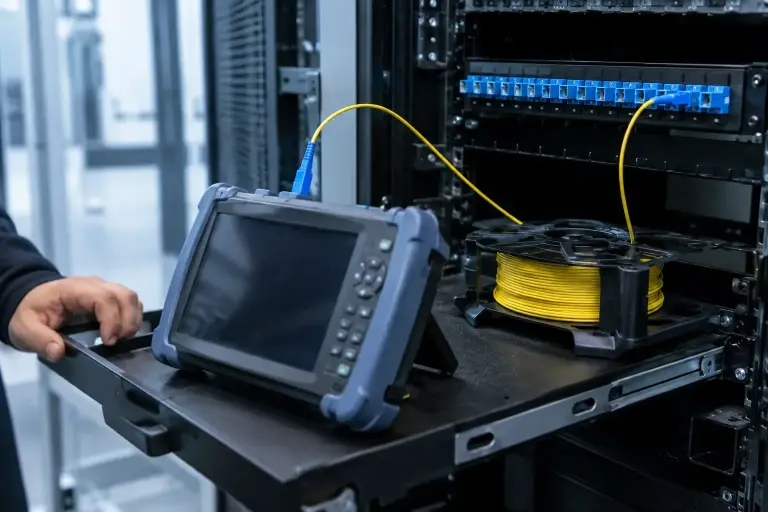
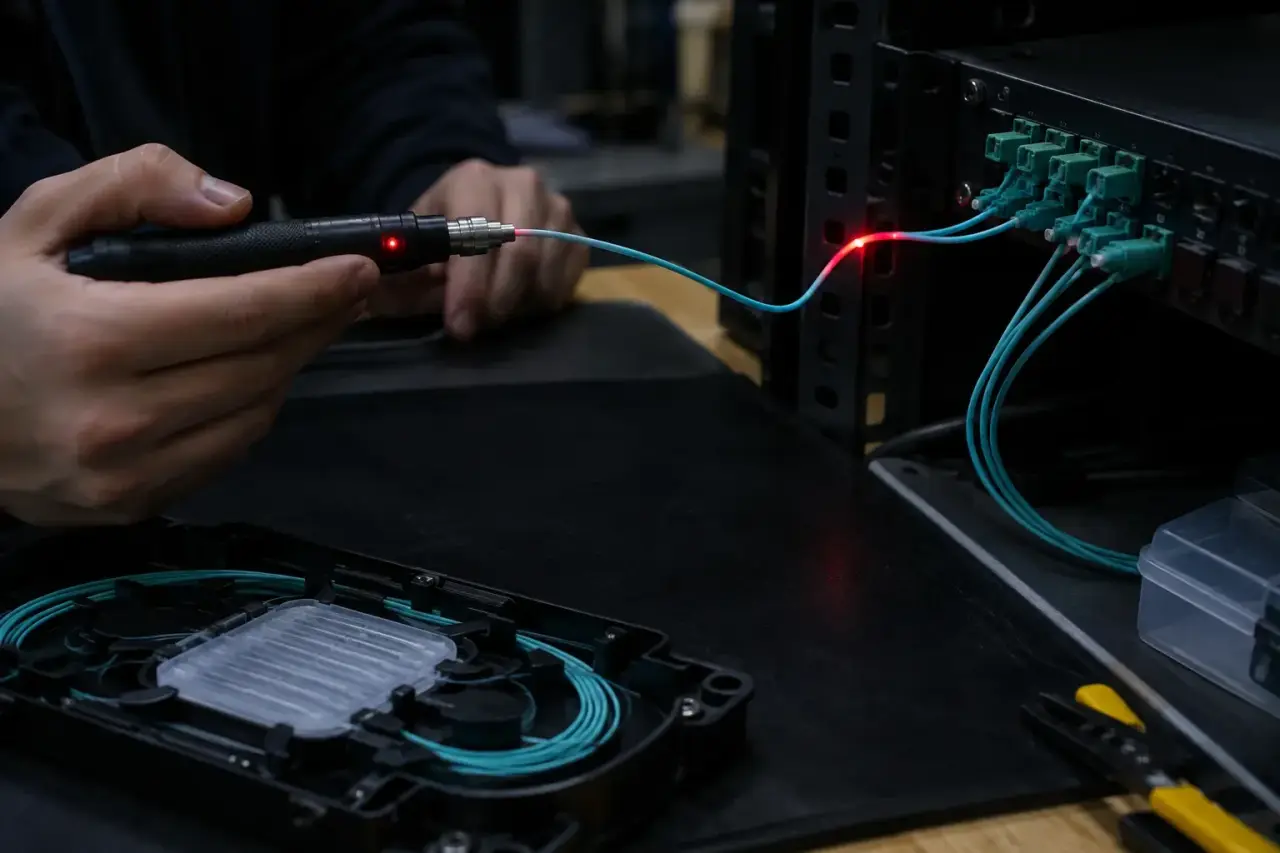
- Testing: This is crucial to verify network performance. Technicians use tools like an Optical Time Domain Reflectometer (OTDR) to find faults, a Visual Fault Locator (VFL) to spot breaks, and a power meter and light source to measure signal loss.
- Maintenance and Troubleshooting: Technicians perform ongoing maintenance and diagnose faults to make repairs and restore service, handling everything from routine checks to urgent fixes.
- Adherence to Standards: All work must follow strict industry rules like TIA-568 and the National Electrical Code (NEC). This ensures safety, compatibility, and optimal performance.
The Compelling Benefits of Certification
Becoming a certified fiber optics technician is a smart investment in your future with many benefits:
- Increased Salary Potential: Certified technicians can expect to earn between $40,000 and $96,000 annually, with experienced pros earning more. The quote about an extra $3/hour highlights the immediate financial benefit.
- Career Advancement: Basic certification opens doors to specializations in splicing, testing, or network design. These advanced skills lead to senior roles, better pay, and continuous career growth.
- Job Security: The fiber optic industry is booming thanks to 5G, Fiber to the Home (FTTH), and data center growth. This creates high demand and excellent job security for skilled technicians.
- High Demand: From hospitals to smart cities, nearly every sector relies on fiber optic networks. This creates a constant, growing demand for qualified professionals.
- Industry Recognition: Certifications from organizations like the FOA are recognized worldwide. This credential validates your skills and is a universal badge of competence, valuable in our service areas of Massachusetts, New Hampshire, and Rhode Island, and beyond.
- Professional Credibility: Certification formally proves your expertise to employers and clients, building trust. Many companies and government projects now require certification for network technicians.
FOA certifications are also recognized by the U.S. Department of Labor, highlighting their value in the national job market. You can explore the field’s outlook in the DoL Occupational Outlook Handbook.
Your Roadmap to Becoming a Certified Fiber Optics Technician
Becoming a certified fiber optics technician is more straightforward than you might think. The path is well-defined and achievable. Let’s review the prerequisites, training options, and what to expect from a certification program.
Essential Prerequisites and Foundational Knowledge
You don’t need a college degree to become a certified fiber optics technician, making it an accessible career path. The key requirements are specific personal traits and basic skills:
- Detail-oriented with good eyesight and manual dexterity, as you’ll be working with delicate optical fibers thinner than a human hair.
- Awareness of laser safety protocols, which are a core part of training.
- Must be of legal working age.
- Basic computer skills are helpful, as many testing tools are digital.
Choosing Your Training Path: Formal Courses vs. Field Experience
You have a couple of excellent paths to certification, depending on your background.
- FOA-Approved Schools: For newcomers, these intensive, 3- to 5-day programs are highly recommended. They offer structured training with a strong focus on hands-on training courses (often 85% of the course), preparing you for the certification exam.
- “Work to Cert” Program: Experienced professionals can use the FOA’s direct certification pathway. This requires at least two years of documented field experience in installation, splicing, termination, and testing.
- On-the-Job Training (OJT): This is another effective path, especially when combined with online study. The FOA’s “Fiber U OJT-To-Cert” program blends online learning with supervised field experience.
What to Expect in a Typical Training Program
Foundational CFOT courses are intensive 3- to 5-day programs where about 85% of your time is dedicated to hands-on activities. You’ll work with actual tools and components to build practical skills.
The curriculum covers:
- Theory and terminology: How fiber optics work, including single-mode and multimode fiber.
- Splicing: Both fusion and mechanical techniques for joining fibers.
- Connector termination: Attaching various connectors for optimal performance.
- Testing: Using equipment like an OTDR (Optical Time Domain Reflectometer), a VFL (Visual Fault Locator), and light meters to verify network integrity.
- Industry standards: Ensuring your work is compliant and reliable for applications like Fiber To The Desk (FTTD) or Fiber To The Home (FTTH).
For more details on the practical aspects of cabling, explore our resources on More info about network cabling installation.
Navigating the World of Fiber Optics Certifications
The world of fiber optics certifications can seem complex, but it’s a clear roadmap for your career. Think of them as building blocks: start with a solid foundation and add specializations as you grow. At AccuTech Communications, we know the right certifications can transform a certified fiber optics technician’s career.
The Key Certifying Bodies: FOA and ETA
Two main organizations set the standards for certification:
- The Fiber Optic Association (FOA): An international non-profit, the FOA has been the industry’s gold standard since 1995. It certifies technicians, approves training programs, and helps develop industry standards. They also provide extensive free resources. Learn more about FOA’s role in the industry.
- Electronics Technicians Association (ETA) International: ETA offers vendor-neutral certifications across many technical fields, including fiber optics. Accredited by the ICAC, their programs cover basic installation to advanced design, providing well-rounded expertise.
Both organizations offer respected certifications; the best choice depends on your career goals and local employer preferences.
Understanding the Certification Hierarchy: Core vs. Specialist
The certification structure allows you to start with a foundational credential and then add specializations that match your career path.
- Foundational Certifications: These provide the core knowledge every technician needs. The FOA’s CFOT (Certified Fiber Optic Technician) is the primary certification, covering all aspects of the job. The ETA’s FOI (Fiber Optics Installer) focuses specifically on installation fundamentals.
- Specialist Certifications: These require a foundational certification and allow you to focus on specific areas. The FOA offers specialist tracks like CFOS/S (Splicing), CFOS/T (Testing), CFOS/H (Fiber to the Home), and CFOS/D (Design). Splicing is often considered one of the most valuable specializations. ETA offers similar programs, including BFI (Broadband Fiber Installer) and FSS (Fiber Splicing Specialist).
A Breakdown of Key Certifications for a certified fiber optics technician
Here are the key certifications that can boost your career and earning potential:
- CFOT (Certified Fiber Optic Technician): This foundational FOA certification is your starting point. It’s a globally recognized credential that qualifies you for design, installation, and operational roles.
- CFOS/S (Specialist in Splicing): This specialization often provides the best return on investment. Splicing requires precision, and companies pay a premium for technicians skilled in fusion and mechanical splicing.
- CFOS/T (Specialist in Testing): As networks grow more complex, advanced testing skills with OTDRs and power meters are invaluable for troubleshooting and network verification.
- CFOS/H (Fiber to the Home Specialist): This certification targets one of the fastest-growing market segments. FTTx specialists are in high demand due to massive investment in residential fiber networks.
- BFI (Broadband Fiber Installer): This ETA certification is excellent for technicians focusing on the physical layer, covering critical skills in Passive Optical Networks (PON) and OTDR usage for FTTx deployments.
Preparing for Success: Acing Your Certification Exam
After learning about the role, the next step is preparing for the certification exam. The exam typically includes a written knowledge test and a hands-on skills assessment. With the right preparation, you can pass with confidence and become a certified fiber optics technician.
Top Study Resources for Aspiring Technicians
To prepare for the written exam, you need a solid grasp of fiber optic theory and terminology. Here are some excellent study resources:
- FOA Online Reference Guide: This comprehensive guide on the FOA website covers everything from basic theory to advanced troubleshooting.
- Textbooks: Books like “The FOA Reference Guide To Fiber Optics” provide detailed, step-by-step learning.
- Self-Study Programs: The FOA’s Fiber U platform offers free online courses aligned with certification requirements. Start your learning journey with Fiber U free online training.
- YouTube Videos: The FOA’s YouTube channel features over 100 videos covering various topics and hands-on demonstrations.
Mastering the Hands-On Skills of a certified fiber optics technician
Theory is important, but hands-on ability is what defines a great technician. The practical exam is crucial for proving your skills, and the key to success is practice.
- Practice Kits: Use these to rehearse cable preparation, splicing, and termination outside of class. Repetition builds muscle memory.
- Basic Skills Lab: Many programs use a lab environment for you to demonstrate proficiency with real equipment under exam-like conditions.
- Cable Preparation: Master stripping various cable types, cleaving fibers for a perfect end-face, and cleaning them for a clear signal.
- Splicing Techniques: Practice is vital for mastering both fusion splicing and mechanical splicing.
- Termination Methods: Learn to properly attach various connectors to ensure low-loss connections.
- Testing Procedures: Gain experience with essential tools like OTDRs, VFLs, power meters, and light sources. Learn to run tests, interpret results, and troubleshoot issues.
The CFOT exam typically consists of a 100-question written test (requiring a 70% passing score) and a hands-on skills evaluation. These hands-on skills are the foundation of reliable fiber optic installations, like those we perform at AccuTech Communications. Learn more about our structured cabling services.
Frequently Asked Questions about Fiber Optics Certification
Here are answers to common questions about becoming a certified fiber optics technician.
How hard is it to become a fiber optic technician?
Becoming a technician is manageable. It relies more on practical skills, attention to detail, and patience than a college degree. Training programs break down complex topics into understandable steps. While tasks like splicing require dexterity and troubleshooting requires problem-solving, these skills can be mastered with dedicated practice. The CFOT exam is very achievable for motivated individuals who study and practice.
How long does a fiber optics certification last?
Most foundational certifications, like the FOA CFOT, are valid for three years. This ensures technicians stay current with evolving technology and standards. To maintain your status, you must complete a renewal process before expiration, which typically involves showing continued work in the field and submitting an application. Renewing on time is the best way to keep your credentials active.
Is fiber optic certification worth the cost?
Yes, the investment in certification is absolutely worth it. It provides a strong return in several key areas:
- Higher Earning Potential: Certified technicians typically earn more, making the certification a smart financial investment from the start.
- Better Job Prospects: Certification makes you a more attractive candidate to employers, who seek professionals with proven knowledge and skills.
- Career Mobility: Certification opens doors to specialized roles and advancement opportunities, demonstrating your commitment to the profession.
- Credibility: A certification is a universally recognized stamp of approval that builds trust with employers and clients.
- Project Requirements: Many government and corporate projects require technicians to be certified, so not having it can limit your opportunities.
Given the career stability, higher earning potential, and industry growth, the cost of certification is a small investment for a significant return. It’s a fantastic step for your future!
Conclusion
Becoming a certified fiber optics technician is a path to a rewarding, stable, and future-proof career. As we’ve covered, certification is your ticket to better pay, job security, and industry respect.
This guide has provided a roadmap, from prerequisites and training options to the certification hierarchy from bodies like the FOA and ETA. You can now plan your professional growth, starting with a foundational credential like the CFOT and moving toward specializations.
The demand for skilled fiber optics professionals is growing, driven by our need for faster, more reliable data. From streaming services to critical infrastructure, these networks are essential. The future is bright, ensuring the expertise of a certified fiber optics technician will be highly valued for years to come.
At AccuTech Communications, we believe in the power of certified expertise. Our team consistently delivers top-notch results and builds client trust. If your business in Massachusetts, New Hampshire, or Rhode Island needs expert fiber optic installation, explore our fiber optic cabling installation services. We’re ready to help you connect to the future.